If you want to stay competitive, understanding composable ERP architecture is essential for modern enterprises.
1. When ERP Modularity Creates an Ownership Problem
1.1 Application Growth Creates Hidden Architecture Debt
Most businesses do not deliberately build complicated software environments. Complexity usually develops one operational decision at a time.
An ecommerce company starts with a storefront and basic accounting software. As order volume increases, inventory management becomes harder, so the company adds an inventory application. Warehouse volume then justifies a WMS. Wholesale growth introduces EDI. A product team adds a PIM for richer merchandising data, while purchasing continues in spreadsheets because buyers cannot get the planning detail they need from existing systems.
Each application may solve a legitimate problem. However, problems begin when nobody can clearly answer a more important question: which system is responsible for what?
Early symptoms usually appear as operational issues rather than architecture problems. Inventory differs between ecommerce and warehouse systems. A customer address gets corrected in one application but remains outdated elsewhere. Product attributes change in several places. Sales orders display different statuses depending on which platform an employee checks.
Finance eventually feels the effect as well. Teams spend additional time reconciling transactions because operational systems and accounting no longer describe the same business activity consistently.
Adding another integration rarely solves this underlying problem.
The actual issue is unclear system boundaries and data ownership.
1.2 Composable ERP Architecture Requires Controlled Modularity
A strong composable ERP architecture addresses ownership before deciding how systems should exchange information. It defines which application owns each business capability, which system has authority over critical data, which platforms may consume that information, and what happens when systems disagree.
Composable architecture is sometimes misunderstood as permission to assemble as many specialized applications as possible. In reality, excessive fragmentation creates another form of rigidity.
Every additional application introduces another ownership decision, integration contract, monitoring requirement, security boundary, failure scenario, upgrade dependency, and reconciliation process.
The objective is therefore not maximum modularity.
It is controlled modularity with explicit responsibility.
For inventory-driven businesses, that often means keeping tightly connected operational processes together while allowing specialized systems to remain independent where they create genuine business value.
A scalable architecture allows teams to explain, in plain language, where each process begins, where it ends, and which application has final authority when information changes.
2. What Composable ERP Architecture Actually Means
2.1 Composable ERP Architecture Definition
Composable ERP architecture is an enterprise systems model in which business capabilities are organized into clearly defined applications, services, or modules that can evolve independently while exchanging information through governed interfaces.
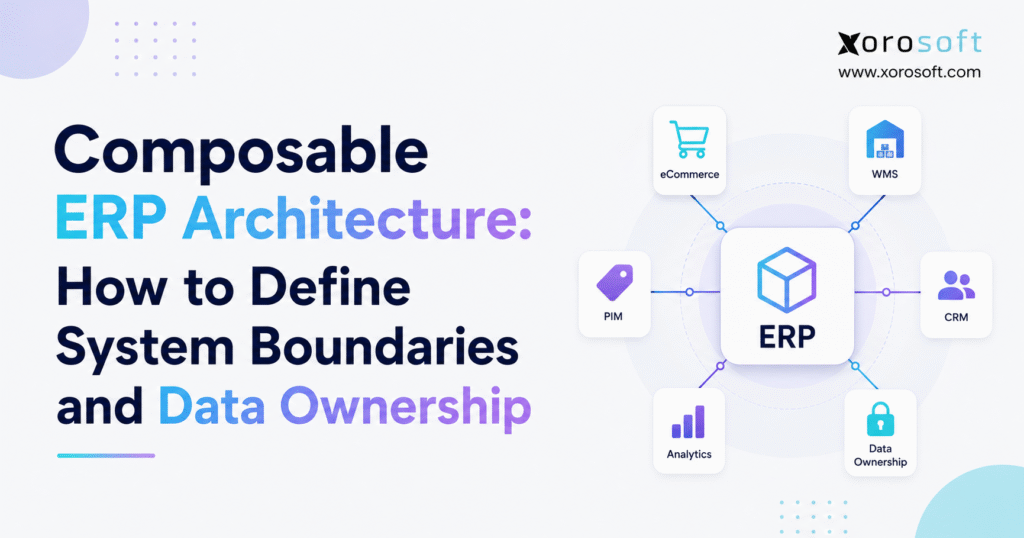
Those components might include an ERP, ecommerce platform, warehouse management system, product information management platform, CRM, EDI network, manufacturing application, demand-planning tool, data warehouse, or specialized external service.
The important characteristic is not simply modular software. Each component needs an intentional operational responsibility.
An ecommerce platform may manage customer-facing commerce. ERP could control purchasing and enterprise inventory. WMS may manage physical warehouse execution, while PIM governs enriched product content. CRM can remain responsible for prospect and sales activity.
Clear boundaries allow those applications to cooperate without competing for authority.
2.2 Composable ERP Is Broader Than Microservices
Microservices and composable ERP share several architectural principles, particularly autonomy and clearly defined boundaries, but they are not the same concept.
Microservices describe how an application may be designed internally. Composable ERP addresses how enterprise capabilities are distributed across the entire technology landscape.
A company does not need hundreds of microservices to create a composable environment.
One component may be a cloud ERP platform. Another could be Shopify. A third might be a specialized warehouse system. Each product can have a completely different internal architecture.
What matters from the business perspective is whether responsibilities remain understandable.
2.3 Composable Does Not Mean More Software
One of the most common misconceptions is that composability requires a best-of-breed application for every process.
That approach can easily create the opposite of flexibility.
Imagine maintaining separate applications for inventory, purchasing, forecasting, receiving, warehouse execution, order management, manufacturing, accounting, reporting, product information, and EDI.
Each additional system creates another synchronization requirement. Operational teams eventually spend more time coordinating software than improving the underlying process.
A better architectural question is:
Does separating this capability create enough value to justify another system boundary?
If the answer is no, keeping closely related processes inside one operational platform may produce a simpler and more resilient architecture.
3. Why ERP System Boundaries Matter
3.1 Start With Business Capabilities, Not Application Names
A reliable architecture starts by mapping what the company actually does.
For an inventory-driven business, those capabilities may include demand planning, procurement, receiving, inventory control, order management, warehouse execution, fulfillment, manufacturing, invoicing, wholesale ordering, ecommerce, EDI, accounting, and reporting.
Only after those capabilities are clear should the business determine which application belongs to each area.
Starting with software names tends to preserve historical architecture even when it no longer fits operational needs.
For example, a team may say, “QuickBooks owns accounting because that is where accounting currently happens.” That statement describes the present stack, not necessarily the ideal future boundary.
A capability-first approach asks whether accounting should remain separate from inventory and purchasing at all.
3.2 Boundaries Define Responsibility, Not Isolation
A system boundary does not mean two applications never communicate.
ERP and WMS may exchange transactions continuously. Shopify and ERP might synchronize orders and availability throughout the day. Manufacturing may depend on purchasing and inventory data every few minutes.
The purpose of the boundary is to define responsibility.
A WMS can execute a pick without becoming the financial system of record for inventory. Shopify can capture an order without owning the accounting impact of that sale.
Well-designed boundaries therefore allow cooperation without creating competing authority.
4. Data Ownership in a Modern ERP Architecture
4.1 Data Owner vs Data Consumer
A data owner is the application authorized to maintain the authoritative version of a business record or attribute.
A data consumer receives that information because it needs the data for another process.
Suppose ERP owns SKU cost and procurement settings. A PIM may receive the same SKU because merchandising teams need to add product descriptions, specifications, images, and marketplace attributes.
The PIM does not automatically need permission to overwrite supplier cost simply because both applications contain the product.
That distinction becomes especially important when businesses synchronize the same object across several applications.
4.2 System of Record vs Source of Truth
The terms “system of record” and “source of truth” are often used interchangeably, although separating them is useful.
A system of record is the authoritative operational application responsible for maintaining a particular record or transaction.
A source of truth is the information trusted for a particular decision or reporting context.
In simple architectures, they may be the same.
Larger environments sometimes combine information from several operational systems into master-data or analytical platforms. That approach can create a trusted consolidated view without transferring operational ownership away from the applications that originally create transactions.
4.3 One Authoritative Writer, Many Consumers
A practical default rule is:
One authoritative writer, many controlled consumers.
Other applications can store copies of the information. However, they should not independently overwrite authoritative fields unless the architecture intentionally assigns them ownership.
Product data provides a useful example.
ERP might own SKU, standard cost, units of measure, inventory control settings, and supplier relationships.
PIM could own descriptions, digital assets, category data, channel-specific content, and merchandising attributes.
Both systems contain the product, yet ownership remains clear because they control different attributes.
5. How to Define System Boundaries in Composable ERP Architecture
5.1 Map Business Capabilities Before Systems
Begin by documenting business processes without mentioning software products.
Instead of listing Shopify, ERP, WMS, and spreadsheets, map order capture, inventory allocation, purchasing, receiving, replenishment, picking, packing, invoicing, payment processing, returns, production, and reporting.
This prevents today’s technology limitations from determining tomorrow’s architecture.
5.2 Identify Critical Business Objects
Next, identify the records that move across several business processes.
Typical examples include SKU, product, inventory balance, customer, supplier, purchase order, sales order, shipment, invoice, payment, BOM, and work order.
For each important object, examine five areas of responsibility. Start by identifying where the record is originally created. Next, determine which application has authority over the canonical version. Then establish which system performs operational work using that information. The architecture should also document every downstream application that consumes the record. Finally, define how updates move between the authoritative system and its consumers.
This creates a practical framework:
Create → Own → Execute → Consume → Synchronize
Applying this sequence prevents teams from discussing integrations before they have agreed on ownership. For example, a sales order may originate in Shopify, become operationally owned by ERP, move to WMS for fulfillment execution, and then send shipment status back to ERP and the storefront.
The same framework can be applied to inventory, products, customers, suppliers, purchasing, manufacturing, and financial transactions.
5.3 Assign an Authoritative Owner
Ownership should be explicit.
When ERP and WMS both contain inventory information, document what each application controls. ERP may govern enterprise inventory and valuation, while WMS manages physical warehouse execution.
For customer data, CRM can own prospect activity and relationship history while ERP manages financial terms, invoices, and operational account information.
In ecommerce, Shopify may control checkout before ERP becomes responsible for allocation, purchasing impact, fulfillment coordination, and accounting.
Saying that “both systems manage it” usually means the boundary needs further definition.
5.4 Define Consumers and Integration Direction
After identifying the authoritative source, determine which systems require the data.
If ERP owns enterprise inventory, the architecture may send availability from ERP toward ecommerce channels.
When WMS controls physical fulfillment, shipment confirmation moves from WMS back to ERP.
A simple directional diagram often reveals architecture problems quickly because circular synchronization becomes visible.
5.5 Design Failure and Reconciliation Processes
Every integration eventually fails.
Architecture should therefore define retry behavior, duplicate prevention, error handling, reconciliation, escalation, and ownership during outages.
A successful API response is not the same as a successful business transaction.
An order integration, for instance, should be able to answer whether every order accepted by ecommerce eventually entered operational processing. The same principle applies to shipments, purchase receipts, invoices, inventory adjustments, and financial transactions.
6. Which System Should Own Which Data?
There is no universal ownership matrix because operational requirements differ. However, the following model provides a useful starting point.
| Business Object | Typical Authoritative System | Main Consumers |
|---|---|---|
| SKU / item master | ERP | WMS, PIM, ecommerce |
| Product descriptions and media | PIM | Ecommerce, marketplaces |
| Enterprise inventory | ERP | Ecommerce, planning, WMS |
| Bin-level warehouse inventory | WMS | ERP |
| Sales order after capture | ERP | WMS, finance |
| Customer financial terms | ERP | CRM, B2B portal |
| Marketing profile | CRM/CDP | Ecommerce, marketing |
| Purchase orders | ERP | WMS, suppliers |
| Supplier master | ERP | Planning, procurement |
| General ledger entries | ERP/accounting | BI and reporting |
| BOM and production records | ERP/manufacturing | Planning, inventory |
| Forecasts | ERP/planning system | Purchasing, production |
6.1 Product Ownership Often Needs Attribute-Level Rules
Product information demonstrates why ownership sometimes needs to be defined below the entity level.
ERP may govern SKU identity, supplier relationships, costing, inventory rules, units of measure, and procurement settings.
PIM may control descriptions, images, specifications, translations, merchandising information, and marketplace attributes.
The two applications can represent the same item without becoming competing product masters.
6.2 Inventory Ownership Requires Operational Context
Inventory is more complicated because several systems may need different representations of the same quantity.
ERP may need enterprise-level inventory for planning, allocation, procurement, costing, financial reporting, and customer commitments.
WMS requires detailed physical information about bins, movements, tasks, holds, picks, and warehouse-specific availability.
The key is to document how those two views reconcile rather than assuming every system should store and change identical inventory fields.
7. ERP Boundaries With Ecommerce, WMS, PIM, and CRM
7.1 ERP and Ecommerce Order Ownership
An ecommerce platform should normally remain responsible for the customer-facing commerce experience.
That includes storefront presentation, promotions, carts, checkout, online customer interactions, and payment capture.
ERP becomes more important when the transaction enters operational execution.
For Shopify businesses, Shopify may create the customer order while ERP manages inventory allocation, purchasing implications, fulfillment coordination, returns, accounting, and enterprise reporting.
Businesses assessing this architecture can also review Xorosoft’s listing in the Shopify App Store to understand how an ERP connection can sit behind a Shopify storefront.
The important question is not whether both platforms contain the order. They almost certainly will.
The important question is which application controls each stage of the order lifecycle.
7.2 ERP vs WMS Data Ownership
ERP and WMS often overlap around inventory, but their responsibilities can remain distinct.
ERP generally requires enterprise inventory information because quantities affect purchasing, costing, forecasting, allocation, customer commitments, and finance.
Inside the warehouse, WMS needs much deeper execution detail, including bin locations, scanning, replenishment, task sequencing, picking, packing, and physical movements.
Where those functions require a dedicated execution layer, a warehouse management system such as XoroWMS can operate inside the warehouse boundary while exchanging governed transactions with the broader ERP environment.
The distinction is between enterprise inventory control and warehouse execution.
7.3 ERP vs PIM Product Ownership
ERP and PIM should not compete over every product field.
Operational attributes such as SKU, cost, supplier, units, procurement settings, and inventory controls naturally fit ERP.
Rich descriptions, photography, specifications, category structure, translations, and channel-specific enrichment generally fit PIM.
Instead of synchronizing every field in both directions, integrations should move only the attributes each system requires.
7.4 ERP vs CRM Customer Ownership
CRM typically governs prospects, opportunities, pipeline, sales interactions, and relationship history.
ERP commonly controls customer financial terms, credit, invoicing, receivables, fulfilled orders, and operational account settings.
The same customer may therefore exist in both systems while each application owns a different part of the relationship.
8. Integration Patterns for Composable ERP Architecture
8.1 APIs for Immediate Business Requests
APIs are useful when one system needs an immediate answer.
An ecommerce platform may request current inventory availability. A B2B portal might need account-specific pricing. WMS could retrieve details for an order released to fulfillment.
The advantage is responsiveness.
The risk is runtime dependency. If every business process depends on several applications responding synchronously, one outage can affect unrelated workflows.
8.2 Events for Looser Coupling
Events work well when another system needs to react after a business state changes.
Examples include an order being created, a shipment completing, inventory being adjusted, a purchase order being received, or an invoice being posted.
The originating system does not necessarily need to wait while every downstream consumer processes the event.
That approach can make a composable ERP architecture more resilient because applications remain less dependent on one another’s immediate availability.
8.3 Webhooks for Lightweight Notifications
Webhooks provide a practical event mechanism for many SaaS platforms.
Ecommerce systems commonly use them to notify downstream applications about new orders, cancellations, refunds, fulfillment changes, and other events.
They are useful when implemented with retry and duplicate-handling logic.
8.4 Middleware Should Connect Domains, Not Own Them
As the number of integrations grows, middleware or iPaaS can help with transformation, routing, orchestration, retry management, and monitoring.
Businesses evaluating that approach can review Xorosoft’s broader ERP integrations to see how ecommerce, EDI, marketplace, fulfillment, payment, and operational systems can connect around a common ERP foundation.
Middleware should still avoid becoming an undocumented business-rules engine.
Inventory allocation, pricing, accounting policy, and purchasing logic should remain within the domain responsible for those decisions.
9. Example Composable ERP Architecture for Inventory-Driven Businesses
9.1 Shopify-Centered Ecommerce Architecture
Consider a product company selling through Shopify while fulfilling from multiple warehouses.
Shopify captures the customer order. ERP receives the transaction, manages allocation, determines purchasing impact, and maintains operational records. Warehouse workflows execute receiving, picking, packing, and shipping. Shipment confirmation updates ERP before customer-facing information returns to Shopify.
This structure allows the storefront to remain specialized while operational data stays coordinated.
A platform such as XoroONE cloud ERP can serve this operational role by bringing inventory, purchasing, accounting, warehouse management, manufacturing, ecommerce, EDI, reporting, and forecasting closer together while external channels remain connected.
9.2 Wholesale and EDI Architecture
Wholesale distribution introduces additional requirements, including customer-specific pricing, allocation, EDI documents, larger orders, supplier coordination, and credit management.
An EDI network may handle partner communication, document transformation, acknowledgements, and transmission.
ERP should generally remain responsible for the business transaction represented by those documents.
For example, an inbound EDI purchase order becomes a sales order inside ERP. A shipment confirmation reflects a fulfillment transaction. An invoice represents an accounting event.
Separating communication standards from transaction ownership keeps the architecture easier to understand.
9.3 Multi-Warehouse Architecture
Multi-location operations create another important ownership question:
Where should global inventory visibility live?
Individual warehouses may manage local execution while headquarters needs a consolidated view of on-hand stock, available inventory, incoming purchase orders, transfers, allocations, and replenishment requirements.
That enterprise view usually belongs in the operational ERP layer even when local warehouse execution happens elsewhere.
9.4 Manufacturing Architecture
Manufacturing adds BOMs, raw materials, work orders, production planning, capacity, finished goods, and material requirements.
Because production depends heavily on purchasing and inventory, separating all three areas into independent applications can produce significant synchronization work.
The stronger architecture often keeps these processes close to a shared operational core unless manufacturing complexity genuinely requires specialized external software.
10. Composable ERP Architecture vs Traditional ERP
Traditional ERP generally places most operational functions inside one suite. A composable model intentionally allows certain capabilities to exist outside the ERP boundary.
Neither approach is automatically better.
| Factor | Traditional ERP | Composable ERP Architecture |
|---|---|---|
| Core design | Centralized suite | Modular capabilities |
| System boundaries | Mostly suite-defined | Business-defined |
| Data ownership | Primarily ERP-centric | Domain-specific |
| Integration | Mainly native | APIs, events, middleware |
| Component replacement | More difficult | Potentially easier |
| Governance effort | Lower initially | Higher |
| Integration complexity | Lower initially | Potentially higher |
| Best fit | Centralized operations | Diverse, evolving ecosystems |
The practical question is not whether a company should choose “monolithic” or “composable.”
Instead, determine how much independence each capability actually needs.
Businesses evaluating enterprise ERP approaches may also find value in reviewing a Xorosoft vs NetSuite comparison as part of a wider discussion around implementation complexity, operational scope, and architecture fit.
A simpler operating model can sometimes outperform a theoretically more flexible stack if the flexible option requires constant integration management.
11. When Capabilities Should Stay Inside the ERP
11.1 Specialization Must Justify Another Boundary
Composable design does not require a separate application for every department.
Purchasing illustrates this clearly.
Buyers depend on current inventory, incoming orders, supplier lead times, demand forecasts, manufacturing requirements, warehouse needs, existing purchase orders, and financial constraints.
If procurement software adds more synchronization effort than operational value, keeping purchasing close to inventory may be the better decision.
Accounting presents a similar case.
When operational transactions and finance live in separate systems, teams often need additional reconciliation to prove that inventory, customer orders, supplier bills, and journal entries still agree.
A connected ERP operations platform such as XoroERP demonstrates why some businesses prefer to consolidate inventory, purchasing, accounting, warehousing, manufacturing, and reporting instead of separating every capability.
The architectural question should always be:
Does separating this function reduce business complexity, or does it merely move complexity into integrations?
12. Common Composable ERP Architecture Mistakes
12.1 Multiple Applications Updating the Same Data
The most damaging mistake is allowing several applications to update the same authoritative field independently.
If ERP, ecommerce, WMS, and middleware can all adjust the same inventory value without strict rules, discrepancies become difficult to avoid.
Users eventually lose confidence and begin checking several systems before making decisions.
12.2 Circular Integrations
Circular synchronization creates another risk.
ERP updates ecommerce. Ecommerce updates middleware. Middleware sends the same data back to ERP.
A delayed event or mapping error can cause duplicate writes, loops, or older information overwriting a newer transaction.
Integration direction should therefore remain explicit.
12.3 Business Logic Hidden Inside Middleware
Integration software should connect domains.
It should not become the only place where critical allocation, pricing, accounting, or procurement rules exist.
When business teams cannot explain why an integration transformed a transaction, architecture governance becomes difficult.
12.4 Synchronizing Everything
Different systems rarely need complete copies of every field.
Sending unnecessary information increases mapping effort, storage, security exposure, and the number of potential conflicts.
Integrations should move the minimum information required by the consuming process.
12.5 Making Everything Real Time
Real-time synchronization has value when latency affects customers or operations.
Inventory availability, order status, and fulfillment events may justify fast updates.
Historical analytics, planning extracts, and archival data often do not.
Technology choices should follow operational requirements rather than architectural fashion.
12.6 Overengineering the Stack
A business with one storefront, one warehouse, and straightforward accounting does not automatically need an event bus, complex microservices, several integration platforms, and multiple data masters.
Composable ERP architecture should reduce constraints rather than creating new ones.
13. Governance for Composable ERP Architecture
13.1 Every Capability Needs a Business Owner
Architecture cannot be governed entirely by IT.
Finance should understand who owns financial transactions. Operations needs clear authority over warehouse execution. Procurement should know where supplier and purchase-order information originates.
Ecommerce teams must understand which product and inventory attributes they can change.
Business ownership and technical ownership should reinforce each other.
13.2 Every Integration Needs an Operational Owner
Connections also require accountability.
Teams should know who monitors the integration, who investigates failures, how transactions are retried, how duplicates are handled, and how changes are approved.
Without those responsibilities, integration failures can remain unnoticed until users discover missing transactions manually.
13.3 AI Creates a New System Boundary
AI agents introduce a newer architecture question: how should intelligent applications access ERP information and execute approved actions?
Giving AI systems unrestricted database access creates obvious governance problems.
A safer architecture uses controlled interfaces that determine which data can be retrieved, which actions can be requested, and which business rules remain protected.
Xorosoft’s MCP Server for AI and ERP connectivity is one example of how ERP boundaries are extending beyond conventional applications toward governed AI interactions.
The core principle remains unchanged.
Access should be explicit, controlled, and tied to clearly defined authority.
14. When to Upgrade to Composable ERP Architecture
14.1 Inventory Disagreement Is an Architecture Signal
When Shopify reports one quantity, the warehouse shows another, and purchasing uses a separate spreadsheet, the problem is larger than an inventory adjustment.
The systems no longer share a clear ownership model.
Increasing transaction volume makes these discrepancies more costly because allocation, replenishment, purchasing, customer service, and finance all depend on inventory accuracy.
14.2 Manual Reconciliation Is Human Middleware
Employees often compensate for weak architecture by exporting information, adjusting spreadsheets, and entering data into another application.
At low volume, these workarounds can appear manageable.
As order and SKU counts grow, human integration becomes slow, expensive, difficult to audit, and vulnerable to error.
14.3 Growth Makes Weak Boundaries Visible
A technology stack that works for one warehouse and one channel may fail when the company adds another marketplace, EDI partner, manufacturing operation, wholesale division, or distribution center.
This is especially relevant across inventory-heavy sectors. Reviewing ERP requirements across inventory-driven industries can help businesses identify where apparel, furniture, sporting goods, food, wholesale, manufacturing, and other operational models require different system boundaries.
A company should seriously evaluate its architecture when every new channel or warehouse requires custom reconciliation and one-off integration work.
14.4 Slow Month-End Close Can Reveal System Fragmentation
Financial problems can also indicate architecture issues.
When finance spends days matching inventory movements, purchases, shipments, invoices, and payments across several systems, operational and financial ownership may be too fragmented.
The problem is not necessarily the accounting team.
Often, the financial close is exposing inconsistencies created much earlier in the transaction lifecycle.
15. Evaluating the ERP Core in a Composable Stack
15.1 Evaluate Responsibility Before Feature Count
ERP selection in a composable environment requires a different mindset from a conventional software checklist.
The first question should be:
What responsibilities will the ERP actually own?
If it will govern inventory, purchasing, customer orders, accounting, manufacturing, warehouse processes, and forecasting, those capabilities must be deep enough to function as dependable operational domains.
If external systems remain responsible for certain capabilities, the ERP must offer practical ways to exchange information without forcing duplicated ownership.
Businesses considering consolidation can review Xorosoft’s broader ERP solutions to understand how inventory, finance, procurement, manufacturing, ecommerce, and warehouse workflows can fit around a common operational platform.
15.2 Validate Architecture Against Real Operating Scenarios
Product demonstrations are useful, but architecture decisions should also be tested against real workflows.
Ask how the platform behaves when:
- a customer order arrives from ecommerce,
- stock is split across warehouses,
- inventory needs replenishment,
- a purchase order arrives late,
- a product is manufactured,
- a warehouse partially ships an order,
- a customer returns an item,
- or an integration temporarily fails.
Reviewing relevant ERP implementation case studies can help teams understand how software behaves across actual operational environments rather than evaluating features in isolation.
15.3 The Best ERP Core Is Not Necessarily the Largest
A composable stack does not require an ERP that claims to own every possible business process.
It needs an ERP capable of owning the responsibilities assigned to it reliably.
Likewise, an external application should remain outside ERP because it provides a meaningful operational advantage, not simply because a separate tool exists.
Good architecture intentionally balances consolidation and specialization.
16. Frequently Asked Questions About Composable ERP Architecture
16.1 What Is Composable ERP Architecture?
Composable ERP architecture organizes enterprise capabilities into clearly defined systems or modules that communicate through governed interfaces. Instead of requiring one application to perform every function, companies can combine ERP with ecommerce, WMS, PIM, CRM, EDI, planning, and other platforms while maintaining clear ownership of processes and data.
16.2 How Does Composable ERP Architecture Work?
The business maps its capabilities and data objects, then assigns each process and critical record to an authoritative system. APIs, events, webhooks, middleware, EDI, or batch processes connect those systems. The model works best when every integration has a defined purpose and every critical piece of data has an identifiable owner.
16.3 What Is the Difference Between Modular ERP and Composable ERP?
Modular ERP usually describes separate functional modules inside one ERP product, such as inventory, accounting, purchasing, or manufacturing. Composable ERP extends modularity across the wider enterprise stack, allowing independent external applications to provide certain capabilities through clearly defined boundaries and integrations.
16.4 Is Composable ERP the Same as Microservices?
No. Microservices describe an application-development architecture based on independently deployable services. Composable ERP describes how enterprise business capabilities are distributed across applications. A composable environment can include SaaS applications, conventional ERP modules, microservices, third-party platforms, and custom software simultaneously.
16.5 Is Composable ERP the Same as Headless ERP?
No. Headless architecture typically separates backend functionality from presentation layers. Composable ERP covers a wider operating model involving inventory, accounting, purchasing, manufacturing, warehouses, ecommerce, CRM, and other enterprise capabilities regardless of whether individual applications use headless technology.
16.6 What Is a System Boundary in ERP?
A system boundary defines where one application’s responsibility ends and another begins. It covers both processes and data. ERP may own enterprise inventory and valuation while WMS controls warehouse tasks, bins, picking, packing, and other execution details.
16.7 How Do You Define ERP System Boundaries?
Begin with business capabilities rather than software products. Map the processes, identify important data objects, determine which application should own each capability, assign authoritative data ownership, identify consumers, map integration direction, and document failure and reconciliation rules.
16.8 What Data Should ERP Own?
ERP commonly owns information closely connected to inventory, procurement, accounting, customer orders, suppliers, manufacturing, and operational financial transactions. However, specialized systems may own certain data or attributes when they have clear domain responsibility.
16.9 What Is an ERP System of Record?
An ERP system of record is the authoritative operational location for a particular transaction or business object. Examples might include purchase orders, inventory transactions, supplier balances, customer invoices, or general ledger entries depending on how the architecture is designed.
16.10 What Is the Difference Between a System of Record and Source of Truth?
A system of record manages an authoritative operational transaction or record. A source of truth is the information trusted for a particular decision or reporting context. They are often the same, although analytical and master-data platforms can create trusted views using information from several operational systems.
16.11 Can Two Systems Own the Same Data?
Two systems can own different attributes of the same entity, but both should rarely have unrestricted authority over the same field. ERP might own product cost while PIM owns product descriptions. Attribute-level ownership avoids conflicts while allowing both applications to represent the same product.
16.12 Why Is Duplicate Data Ownership Dangerous?
Duplicate ownership makes it unclear which update should win. Delayed transactions, mapping errors, or offline integrations can cause older information to overwrite newer records. Over time, employees begin checking several systems manually because they no longer trust any single version.
16.13 Should ERP or Shopify Own Orders?
Shopify typically owns ecommerce order capture and checkout. ERP can become the operational owner after the transaction enters allocation, fulfillment coordination, purchasing, accounting, returns, and enterprise reporting. The handoff point should be deliberately documented.
16.14 Should ERP or WMS Own Inventory?
ERP commonly owns enterprise inventory because quantities affect purchasing, forecasting, costing, allocation, and finance. WMS generally owns detailed warehouse execution such as bins, picks, packs, movements, replenishment tasks, and scanning.
16.15 Should ERP or PIM Own Product Data?
ERP usually owns operational product fields such as SKU, cost, suppliers, units, and inventory settings. PIM is better suited to descriptions, images, specifications, taxonomy, translations, and channel enrichment. Attribute-level ownership allows both systems to work with the product without competing.
16.16 Should ERP or CRM Own Customer Data?
CRM typically owns prospects, sales activity, opportunities, pipeline, and relationship history. ERP normally governs operational and financial information such as credit terms, invoices, receivables, fulfilled orders, pricing rules, and account settings.
16.17 Should ERP or Accounting Software Own Financial Data?
If accounting is integrated directly into ERP, ERP can own financial transactions. When accounting remains separate, companies must determine which application owns invoices, bills, inventory valuation, payments, COGS, and journal entries to prevent constant reconciliation.
16.18 Where Should EDI Transactions Be Managed?
An EDI platform can manage trading-partner connectivity, transformation, acknowledgements, and transmission. ERP should generally own the underlying operational transaction after the document enters the business, such as a sales order, purchase order, shipment, or invoice.
16.19 Does Composable ERP Require APIs?
APIs are common but not mandatory. A composable environment may also use events, webhooks, EDI, message queues, middleware, and batch integrations. The right approach depends on transaction volume, latency, reliability requirements, and business risk.
16.20 When Should ERP Integrations Use Events?
Events work well when other applications need to react after a business state changes. Examples include order creation, inventory adjustment, shipment completion, purchase receipt, or invoice posting. Events can reduce direct runtime dependency between applications.
16.21 Does Every Composable ERP Stack Need Middleware?
No. Native integrations or direct APIs may be enough for a small stack. Middleware becomes more valuable when companies need transformation, routing, orchestration, monitoring, and retry management across many systems.
16.22 Is Bidirectional ERP Synchronization Bad?
Not automatically. Problems arise when both applications can update the same authoritative field. Bidirectional integrations are safer when each direction represents a different responsibility, such as ERP sending orders to WMS while WMS returns fulfillment confirmations.
16.23 Who Needs Composable ERP Architecture?
It is particularly useful for businesses managing multiple warehouses, ecommerce and wholesale channels, EDI partners, manufacturing, external fulfillment, specialized product information, marketplace operations, or other processes that genuinely require multiple operational platforms.
16.24 Who Does Not Need a Highly Composable ERP?
Companies with simple workflows, one warehouse, one sales channel, limited integrations, and straightforward accounting may gain little from assembling numerous independent systems. A consolidated ERP can provide lower operating complexity when specialized applications do not deliver enough additional value.
16.25 What Are the Biggest Risks of Composable ERP Architecture?
The main risks include application sprawl, unclear data ownership, competing systems of record, excessive point-to-point integrations, hidden business logic, inconsistent master data, weak monitoring, synchronization failures, security complexity, and higher governance requirements.
17. Strategic Takeaway: Define Ownership Before Adding Another System
17.1 Make Data Authority Clear Before Expanding the Stack
A scalable ERP architecture is not defined by the number of applications it contains. Its strength comes from how clearly those applications understand their responsibilities.
Before purchasing another inventory tool, warehouse application, forecasting platform, integration service, PIM, accounting product, or AI layer, determine what capability the new system will actually own.
The next step is to identify the authoritative source for the underlying information. Teams should document which application may change that data, which systems are permitted only to consume it, and how downstream platforms must respond when the authoritative record changes.
This discipline is especially important for high-impact business objects such as SKUs, sales orders, inventory quantities, supplier records, purchase orders, shipments, invoices, and financial transactions.
17.2 Balance Consolidation With Specialization
For many inventory-driven businesses, the right composable ERP architecture sits somewhere between two extremes.
Trying to force every specialized capability into one platform can reduce flexibility. At the opposite end, splitting every operational process across separate applications creates integration, governance, monitoring, and reconciliation work that eventually slows the organization.
The better approach is to keep tightly connected operational capabilities together while creating separate system boundaries only where specialization provides meaningful business value.
Inventory and purchasing, for example, often benefit from close coordination because replenishment decisions depend on stock levels, demand, incoming supply, and supplier information. Warehouse execution may justify its own boundary when fulfillment complexity requires specialized workflows. Ecommerce should remain focused on the customer experience rather than becoming the financial or purchasing system of record.
The architecture should therefore optimize overall operating complexity rather than maximizing either consolidation or modularity.
17.3 Use One Practical Test Before Approving New Integrations
A simple question can reveal whether ownership has been designed clearly:
If a SKU, sales order, inventory quantity, supplier record, shipment, purchase order, or financial transaction changes right now, can your team immediately identify which system has the authority to say what is true?
A clear answer indicates that data ownership is functioning as intended.
If employees have to compare several applications before deciding which record is correct, another integration will usually make the problem larger. Ownership should be clarified first.
Businesses evaluating whether inventory, purchasing, warehouse management, accounting, manufacturing, ecommerce, EDI, forecasting, and reporting should remain separate or become more consolidated should map their existing application stack against actual operational responsibilities.
17.4 Next Steps for Building a Cleaner ERP Architecture
Free ERP Readiness Assessment
Review whether your current systems have clear ownership boundaries or whether disconnected applications are creating unnecessary reconciliation and integration work.
Watch Demo
See how inventory, purchasing, ecommerce, warehouse operations, accounting, manufacturing, and reporting can operate around a coordinated ERP foundation.
Book a Personalized Demo
Discuss your current system boundaries, integrations, data ownership challenges, and future ERP architecture with the Xorosoft team through a personalized ERP consultation.
Recent Posts
-
 ERP Landed Cost Module vs Spreadsheet Calculations for Importers
 -
 How to Build an Open-to-Buy Plan for an Omnichannel Brand
 -
 Cold Storage WMS for Food and Beverage Distribution
 -
 ERP Buying Statistics 2026: Evaluation, Implementation, and Adoption Risks
 -
 How a Distributor Reduced B2B Order Exceptions Without Restricting Sales