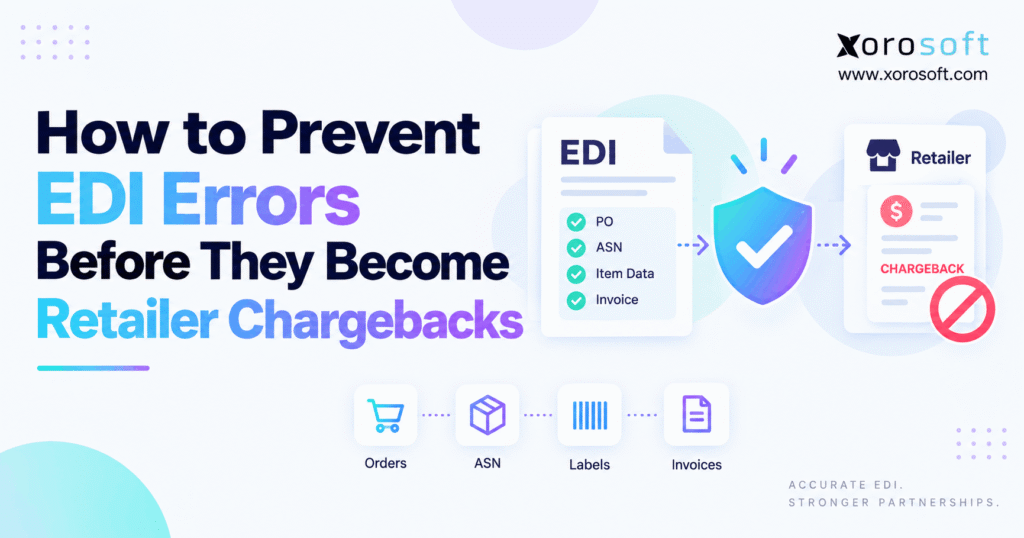
If your business needs to prevent EDI chargebacks, understanding best practices is essential.
1. Retailer Chargebacks Usually Start Before the EDI File Is Sent
Retailer chargebacks often appear to be an EDI problem because the first visible warning may arrive as a rejected transaction, compliance notice, deduction, or exception inside a retailer portal. In practice, the underlying mistake usually starts earlier in the order-to-cash process.
A retailer sends a purchase order. The supplier imports that order, maps retailer item numbers to internal SKUs, checks inventory, allocates stock, releases warehouse work, picks products, packs cartons, creates labels, confirms the shipment, sends an ASN, and eventually produces an invoice. If information changes during any of those steps without reaching the next system correctly, the electronic record can drift away from the physical transaction.
Companies trying to prevent EDI chargebacks therefore need to look beyond whether an EDI document is technically valid. A properly formatted file can still contain the wrong SKU, quantity, ship-to location, carton structure, price, carrier information, SSCC, or purchase-order reference.
1.1 EDI Error Prevention Starts With Operational Accuracy
EDI standards define how information should be structured and exchanged. They do not guarantee that the information accurately describes what happened inside the business.
For example, an EDI 856 may pass technical validation while reporting 20 cartons. If warehouse staff actually loaded 19, the document may be structurally correct but operationally wrong.
Quantity differences create a similar problem. A retailer might order 500 units, the warehouse might ship 480, and the ASN could still report 500 if it was created from the sales order rather than the final shipment.
Effective EDI error prevention checks both the electronic document and the business event behind it.
1.2 Why Small EDI Errors Become Expensive Retailer Problems
Retailers depend on accurate electronic data to automate receiving, inventory updates, payment matching, and exception handling. When the shipment and electronic record disagree, receiving teams may need to stop automated processing and investigate manually.
Suppliers experience costs beyond the deduction itself. Finance may research the chargeback, operations may reconstruct the shipment, EDI teams may review transaction logs, and customer service may communicate with the retailer.
Preventing the discrepancy upstream is usually more efficient than disputing it after delivery.
2. EDI Chargeback Prevention Requires More Than Technical Compliance
An EDI chargeback is generally a financial deduction associated with failing to meet a retailer’s electronic-document or related operational requirements. Exact definitions, deduction amounts, dispute procedures, and deadlines vary by trading partner.
Typical problems include missing documents, late transmissions, inaccurate ASN information, invalid item identifiers, invoice differences, incorrect labels, shipment discrepancies, or failure to follow a required transaction sequence.
A company that wants to prevent EDI chargebacks should therefore work from the retailer’s current implementation guide, routing guide, vendor agreement, and compliance requirements rather than relying on assumptions from another trading partner.
2.1 Retail EDI Compliance Extends Beyond the EDI Platform
Not every retailer deduction is classified specifically as an EDI chargeback. Retailers may separately identify routing, transportation, labeling, appointment, shortage, packaging, delivery, or invoicing violations.
Those categories frequently overlap.
A warehouse quantity error can make an ASN inaccurate. A late carrier change can leave transportation information outdated. Incorrect master data can place the wrong UPC on both an electronic document and the physical product label.
Retail EDI compliance therefore needs to connect electronic transactions with operational execution.
2.2 Retailer Chargeback Prevention Needs Shared Ownership
Companies sometimes make finance responsible for chargebacks because accounts receivable sees the deduction first. Others assign the issue to IT because EDI technology is involved.
Neither approach addresses the full workflow.
Customer service, master data, inventory, warehouse operations, transportation, integrations, accounting, sales, and finance can all create or resolve compliance problems. Ownership should follow root cause.
When a mapping fails, integration teams may own the fix. If warehouse staff packed the wrong item, operations should address the underlying process. When customer pricing is outdated, finance or commercial teams may need to correct the source data.
3. Control the Core EDI Transactions to Prevent EDI Chargebacks
Retail EDI environments can use many transaction types, but a smaller group sits directly inside the order-to-cash cycle. Their accuracy has a significant effect on retailer compliance.
To prevent EDI chargebacks, companies should understand not only what each document communicates but also where its data originates.
3.1 EDI 850 Purchase Order Validation
The EDI 850 carries purchase-order information from the buyer to the supplier.
When the order enters the supplier’s environment, the business should validate customer account, ship-to location, retailer item number, supplier SKU, unit of measure, quantity, pricing where applicable, requested dates, and duplicate PO references.
An error at this stage can continue through every later transaction.
If the retailer item number maps to the wrong internal SKU, the warehouse may correctly pick the wrong item according to the internal order. The ASN and invoice can then reproduce that same mistake.
3.2 EDI 855 Purchase Order Acknowledgment Accuracy
The EDI 855 communicates how the supplier responds to the purchase order.
It becomes especially important when inventory availability, quantities, or dates differ from the retailer’s original request. Suppliers should acknowledge what they can actually support according to the trading partner’s rules.
Confirming one quantity while planning to ship another creates a mismatch before fulfillment even begins.
3.3 EDI 856 ASN Accuracy
The EDI 856, commonly called the advance ship notice or ASN, communicates shipment information before goods arrive.
Depending on retailer requirements, it can include PO references, shipment identifiers, carrier information, pallets, cartons, items, quantities, and SSCC values.
Because the ASN should describe what physically left the warehouse, its reliability depends heavily on warehouse execution.
3.4 EDI 810 Invoice Accuracy
The EDI 810 communicates billing information.
Invoice quantities, prices, freight, allowances, and PO references should align with the agreed commercial transaction and actual shipment. When those records differ, automated matching can fail and the retailer may create an exception or deduction.
3.5 EDI 997 and EDI 824 Monitoring
Acknowledgment and application-response transactions are easy to overlook.
A supplier may successfully transmit a document and still receive a rejection or business-level exception afterward. Without monitoring, employees may assume the transaction completed successfully.
Sending the document is therefore only one part of compliance. Confirmation and exception handling complete the loop.
4. Catch These Common EDI Errors to Prevent EDI Chargebacks
Large system outages receive attention quickly, but routine data problems often create the most repeatable compliance failures.
The best way to prevent EDI chargebacks is to identify those discrepancies while the transaction can still be corrected.
4.1 SKU, UPC, and GTIN Errors Increase Retail EDI Risk
Retailer item numbers do not always match supplier SKUs.
A single product can have an internal SKU, UPC, GTIN, customer-specific item number, case GTIN, and pack configuration. Those relationships should be maintained systematically rather than spread across spreadsheets or employee knowledge.
Incorrect cross-references can make downstream transactions look internally consistent even though they are wrong for the retailer.
4.2 Quantity and UOM Errors Can Pass Through Multiple Systems
Quantity errors become more complicated when retailers order cases and warehouses pick individual units.
Suppose a retailer orders 10 cases and each case contains 12 units. If one system interprets the request as 10 units rather than 120, the electronic mapping may function correctly while the commercial meaning fails.
Unit-of-measure validation should happen before allocation and warehouse release.
4.3 Invalid Customer and Ship-To References Create Downstream Errors
Major retailers can have many distribution centers, stores, warehouses, and bill-to entities.
When an external location code maps to the wrong internal record, the order may enter the wrong fulfillment workflow despite passing EDI validation.
Customer and ship-to cross-references therefore deserve the same control as item mappings.
4.4 Late EDI Transactions Can Be as Costly as Wrong Ones
Accuracy alone does not guarantee compliance.
Retailers may require ASNs, acknowledgments, invoices, or other documents within defined operational windows. An accurate transaction sent too late can still create a retailer compliance problem.
Automated workflow triggers are generally more reliable than asking employees to remember transmission deadlines.
4.5 Duplicate Transactions Need Preventive Controls
Integration retries can create duplicate documents when control numbers and business references are not checked.
Duplicate purchase orders are particularly dangerous because they can reserve inventory and create unnecessary fulfillment work unless the ERP recognizes that the retailer PO already exists.
4.6 Pricing and Allowance Errors Affect EDI Invoice Compliance
Retailer pricing may involve negotiated prices, promotions, freight terms, allowances, discounts, or other agreements.
An invoice that does not reflect those terms may be rejected or partially deducted.
Preventing these problems requires synchronized commercial and accounting data, not just valid EDI syntax.
5. ASN Error Prevention Is Critical to Prevent EDI Chargebacks
The EDI 856 ASN sits at the point where digital records meet physical warehouse activity. That makes it one of the most operationally sensitive documents in retail EDI.
Businesses that want to prevent EDI chargebacks need to treat ASN creation as part of warehouse execution rather than a separate administrative task.
5.1 The ASN Must Reflect What Actually Shipped
One common mistake is creating the ASN from the original sales order.
The order and shipment may be identical when fulfillment goes perfectly. Real warehouses, however, deal with short picks, damaged products, inventory discrepancies, split shipments, substitutions, carton changes, and last-minute adjustments.
If the ASN ignores those events, the retailer receives a digital representation of what was supposed to happen rather than what actually happened.
5.2 Carton and Pallet Hierarchies Affect ASN Accuracy
Some retailers need information beyond the shipment level.
The ASN may need to identify which items are packed into each carton, which cartons belong to a pallet, and which logistics identifier belongs to each physical unit.
Warehouse packing data therefore needs a reliable relationship with the ASN structure.
5.3 ASN Timing Should Follow a Controlled Fulfillment Event
Generating an ASN too early increases the risk that later warehouse changes will make it inaccurate. Sending the document too late can create a timing violation.
A stronger process connects ASN generation to an appropriate fulfillment milestone, such as final packing or shipment confirmation, according to retailer requirements.
5.4 SSCC and Label Information Must Stay Synchronized
The SSCC used on a logistics unit should correspond with the electronic shipment record describing that unit.
If a carton is repacked after labels are printed, the workflow needs a controlled method for updating both the physical identifier and the ASN data.
That synchronization helps prevent EDI chargebacks caused by differences between electronic shipment data and the goods received.
6. Strong Master Data Supports EDI Chargeback Prevention
EDI automation cannot compensate for unreliable source data.
If customer, item, warehouse, pricing, packaging, or shipping records are wrong, automation can simply move incorrect information faster.
Strong master-data governance is therefore one of the earliest controls companies can use to prevent EDI chargebacks.
6.1 Item Master Accuracy Reduces EDI Errors
Item records should contain the identifiers and attributes required across sales and fulfillment.
Depending on the business, that can include internal SKU, UPC, GTIN, case GTIN, unit of measure, case pack, dimensions, weight, status, and retailer-specific cross-references.
Changes should follow a controlled process. Separate spreadsheets maintained by different departments create multiple versions of the same item data.
6.2 Customer Master Accuracy Improves Retail EDI Compliance
Retailer records should contain the information required to process orders correctly.
Ship-to mappings, bill-to relationships, trading-partner IDs, price lists, terms, routing settings, warehouse preferences, and customer-specific rules can all influence the downstream transaction.
As retailer count grows, structured customer master management becomes increasingly important.
6.3 Retailer Requirements Should Become System Rules
Experienced employees often remember which customers require special labels, packing methods, or ASN structures.
That knowledge is useful but fragile.
Where possible, retailer requirements should become system rules, reference data, validation controls, or documented operating procedures. This makes compliance less dependent on individual memory.
6.4 Data Ownership Should Be Explicit
Problems multiply when several departments can change the same master-data fields without clear ownership.
Companies should define who creates, approves, and updates item cross-references, customer locations, pricing rules, case packs, and retailer mappings.
Clear ownership makes EDI error prevention more sustainable.
7. Use Pre-Transmission Validation to Prevent EDI Chargebacks
Pre-transmission validation is one of the most practical controls available to prevent EDI chargebacks before a transaction reaches the retailer.
The objective is not simply to confirm that a file can be transmitted. The business should determine whether the transaction is technically valid, commercially accurate, operationally correct, and compliant with the relevant trading-partner requirements.
7.1 Validate EDI Business Data Before Document Generation
Effective validation starts upstream.
When the purchase order enters the system, check customer references, ship-to codes, SKUs, units of measure, quantities, pricing, and dates.
During fulfillment, validate inventory, picked quantities, carton contents, labels, carrier information, and shipment details.
By the time the final EDI document is created, most serious business errors should already have been identified.
7.2 Use Hard Stops for Critical Retailer Compliance Errors
Not every issue needs to stop fulfillment.
A missing optional reference may justify a warning. An invalid retailer SKU, unresolved ship-to mapping, missing required SSCC, or incomplete shipment hierarchy may require a hard stop.
This distinction helps employees focus on issues that genuinely threaten compliance.
7.3 Apply Trading-Partner-Specific EDI Validation
A transaction can be acceptable for one retailer and invalid for another.
Validation should therefore consider the trading partner, document type, location, shipment method, and relevant business rules.
Generic checks are useful, but retailer-specific validation is what protects against partner-specific requirements.
7.4 Validate Changes to Prevent EDI Chargebacks
Purchase orders can change after their original transmission.
When a retailer changes quantities, dates, items, or ship-to information, the ERP and warehouse should not continue using an outdated version without review.
Applying the same controls to order changes helps prevent EDI chargebacks caused by fulfillment against obsolete instructions.
8. Closed-Loop EDI Monitoring Strengthens Chargeback Prevention
One of the easiest places to lose visibility is immediately after an outbound document is transmitted.
Many companies carefully prepare and send an EDI transaction, then assume the process is complete.
That assumption creates risk.
8.1 Successful EDI Transmission Is Not the Same as Acceptance
A communication platform may confirm that a message reached the retailer’s environment. Additional technical, application, or business checks may still occur afterward.
Teams should therefore monitor the transaction until the required acknowledgment or response has been received.
Doing so helps prevent EDI chargebacks caused by unnoticed rejections.
8.2 EDI Exceptions Need Clear Operational Owners
Every exception should answer several practical questions: What failed? Who owns the issue? When must it be corrected? Which downstream process is at risk?
Syntax problems may belong to integration teams. Item cross-reference problems may sit with master data. Shipment discrepancies may belong to warehouse operations.
Sending everything to one generic IT queue slows resolution.
8.3 Exception Age Should Influence Priority
A newly created low-risk warning and an unresolved ASN rejection approaching a retailer deadline should not receive equal attention.
Exception dashboards should consider severity, trading partner, document type, transaction age, and operational deadline.
That makes monitoring actionable rather than passive.
8.4 Every Resolved EDI Error Should Inform Process Improvement
Correcting an individual transaction closes the immediate issue.
The next question should be why the error occurred.
If the same retailer mapping, warehouse action, or pricing rule repeatedly fails, fixing the source process will deliver more value than repeatedly correcting individual transactions.
9. Warehouse Accuracy Supports Retailer Chargeback Prevention
The warehouse creates the physical reality that the ASN needs to describe.
If digital records and physical execution diverge during picking, packing, labeling, or shipping, the EDI process can become inaccurate even when the original purchase order was correct.
9.1 Barcode Verification Helps Prevent EDI Chargebacks
A barcode scan during picking or packing can confirm that the employee is handling the expected product.
When the wrong SKU is scanned, the workflow can flag the issue before the carton closes. Catching that problem inside the warehouse is more useful than discovering it after retailer receiving.
A connected warehouse management system can use picking, packing, scanning, cartonization, and shipment events as part of the broader order process.
9.2 Carton Data Should Feed the ASN Workflow
As products are packed, the system should maintain the relationship among item, quantity, carton, pallet, and logistics identifier.
Manually recreating this hierarchy later inside an EDI portal introduces an unnecessary data-entry step.
ASN information should come from the same shipment structure used during fulfillment.
9.3 Warehouse Shortages Must Update the Electronic Transaction
Short picks will occur in real operations.
What matters is whether the shortage reaches the shipment, ASN, and invoice correctly.
Keeping the original ordered quantity after fewer units actually shipped creates downstream inconsistencies that can become deductions.
9.4 Repacking Needs a Controlled EDI Update
Cartons sometimes change after initial packing.
Whenever products are moved between cartons, the corresponding logistics identifiers and electronic hierarchy should be updated before the ASN is finalized.
This control helps align warehouse reality with retail EDI compliance.
10. Connect ERP, WMS, and EDI to Prevent EDI Chargebacks
Disconnected systems make retailer compliance more difficult because each application can hold a different version of the same order.
An EDI service may know what the retailer requested. The ERP knows available inventory. The WMS knows what employees packed. Accounting knows what was billed.
When those applications are not synchronized, employees become the integration layer.
10.1 ERP Integration Supports EDI Chargeback Prevention
A connected ERP platform can hold order, customer, inventory, allocation, fulfillment, and financial context throughout the transaction.
Xorosoft is designed for inventory-driven businesses that manage areas such as inventory, purchasing, warehouse operations, accounting, manufacturing, forecasting, and ecommerce.
For EDI workflows, the important benefit is reducing the number of places where the same transaction needs to be recreated manually.
10.2 EDI Integrations Should Move Validated Data
An integration that transfers incorrect information perfectly still produces an incorrect result.
Strong ERP and EDI integrations should support mapping, validation, transaction status, and exception handling in addition to basic data movement.
An incoming purchase order, for example, should not simply create an internal order. The workflow should verify customer, location, item, quantity, and other important data before release.
10.3 Unified Operations Can Prevent EDI Chargebacks at Scale
Businesses operating several sales channels eventually reach a point where separate applications can create more manual reconciliation than they eliminate.
A platform such as XoroONE can provide an operating environment where inventory, orders, purchasing, warehouse activity, accounting, and integrations share connected data.
This structure can help prevent EDI chargebacks by reducing uncontrolled handoffs where information might drift between applications.
10.4 Integration Visibility Matters
An integration should not become a black box.
Operations teams need to know whether a transaction was received, validated, posted, transformed, rejected, delayed, or retried.
Visible status information makes it easier to correct failures before compliance deadlines expire.
11. Order-to-Invoice Reconciliation Helps Prevent EDI Chargebacks
The order-to-cash process works best when the purchase order, acknowledgment, shipment, ASN, and invoice are treated as connected stages of the same transaction.
Reconciliation between those stages helps prevent EDI chargebacks caused by unexplained differences.
11.1 Preserve Ordered, Shipped, and Invoiced Quantities Separately
A retailer may order 1,000 units while only 940 actually ship.
Both facts need to remain visible.
Changing the original order to 940 destroys useful transaction history. Sending an ASN for 1,000 misrepresents the shipment.
A stronger system maintains the relationship among ordered, acknowledged, allocated, picked, packed, shipped, and invoiced quantities.
11.2 Reconcile Shipment Data Before Sending the ASN
Before transmission, compare the ASN with the final shipment record.
Important differences can include items, quantities, cartons, SSCCs, carrier details, and shipment references.
When the electronic shipment does not agree with physical execution, the workflow should stop for review.
11.3 Invoice Data Should Follow the Confirmed Transaction
Invoices should reflect what can legitimately be billed according to the retailer agreement.
Confirmed shipment information needs to work together with applicable pricing, allowance, freight, tax, and payment rules.
Creating an invoice independently from the final shipment can reintroduce errors that operations already corrected.
11.4 Partial Shipments Need Explicit Business Rules
Partial fulfillment creates legitimate differences between ordered and shipped quantities.
The business should distinguish those expected differences from errors.
Clear rules help EDI 856 and EDI 810 transactions communicate partial shipments consistently.
12. Retailer-Specific EDI Rules Strengthen Chargeback Prevention
One of the most common assumptions in retail EDI is that two companies using the same transaction set must use it in the same way.
In reality, implementation requirements can differ considerably.
Retailer-specific controls are therefore central to efforts to prevent EDI chargebacks.
12.1 EDI 856 Requirements Can Differ by Retailer
Different trading partners may expect different segments, shipment hierarchies, carton detail, identifiers, label formats, timing rules, or business conditions.
Suppliers should maintain customer-specific implementation requirements rather than relying on one universal ASN template.
12.2 Routing Guides and EDI Compliance Need to Work Together
Routing guides often contain operational instructions that directly affect EDI information.
Carrier selection, ship windows, pallet rules, packaging, labels, appointments, and shipment methods can influence what downstream documents need to communicate.
Treating routing compliance and EDI compliance as unrelated processes creates gaps.
12.3 Retailer Rule Changes Need Version Control
Trading partners update their requirements.
Teams need to know when a rule changes, when it becomes effective, which locations or transactions are affected, and whether mapping or warehouse changes are required.
Version control helps prevent staff from following outdated guidance.
12.4 Trading-Partner Testing Should Cover the Full Workflow
Passing a test EDI file does not prove that the complete operational process works.
New retailer onboarding should test order import, item mapping, inventory allocation, picking, packing, labels, ASN generation, acknowledgments, and invoicing.
End-to-end testing identifies problems that document-only testing can miss.
13. Root-Cause Analysis Helps Reduce EDI Chargebacks
Fixing an individual retailer exception is useful. Preventing the same failure from returning is more valuable.
Teams that consistently reduce EDI chargebacks study where problems begin instead of measuring only deduction totals.
13.1 Measure EDI Error Sources, Not Only Dollar Value
Finance often sees chargebacks as a financial total because that is how they affect the customer account.
Operations needs more detail.
Track errors by retailer, transaction type, warehouse, item, customer location, root cause, and responsible process. Patterns may reveal that many ASN exceptions come from one warehouse procedure or one broken retailer-item cross-reference.
That insight provides a specific improvement opportunity.
13.2 Track EDI Exception Resolution Time
Measure how long errors remain open.
A company with several exceptions that are corrected before deadlines may face less risk than an organization with fewer exceptions that remain invisible for days.
Long resolution time may also indicate fragmented systems or unclear ownership.
13.3 Operational Data Can Reveal Recurring EDI Compliance Patterns
Connected ERP, warehouse, and EDI environments generate structured transaction data that can support deeper operational analysis.
Modern tools can also assist teams in reviewing exceptions and identifying patterns. Xorosoft’s AI MCP Server is one example of an interface designed to make ERP information available to AI tools in a controlled way.
AI can support investigation, but deterministic validation rules should remain responsible for mandatory retailer requirements.
13.4 Compare Chargebacks With Relevant Retailer Sales
Total deduction dollars alone can distort performance comparisons.
Tracking chargebacks as a percentage of applicable retailer sales helps teams distinguish a large customer with relatively strong compliance from a smaller account with frequent preventable deductions.
14. Replace Manual EDI Controls Before They Become a Bottleneck
Manual EDI processes can work at low transaction volume.
Problems appear when retailer count, order volume, warehouses, channels, and exception complexity grow faster than the team’s ability to coordinate them.
Recognizing that point early can help prevent EDI chargebacks caused by scaling problems.
14.1 Increasing Retailer Count Raises Compliance Complexity
Each retailer can introduce unique mappings, documents, routing rules, timing requirements, labels, contacts, and exception procedures.
Adding five EDI trading partners is therefore more complex than simply adding five ordinary customers.
14.2 Multiple Warehouses Increase EDI Execution Risk
Multi-warehouse operations introduce allocation, routing, inventory, ASN, and shipment complexity.
If several warehouses can fulfill the same retailer, each facility needs consistent access to current retailer rules and master data.
Centralized controls become increasingly important.
14.3 Re-Keying the Same Order Signals Integration Gaps
If employees repeatedly enter the same transaction into an EDI portal, ERP, warehouse application, accounting software, and spreadsheet, the business is spending labor to maintain system gaps.
Every repeated entry also creates another opportunity for error.
14.4 Slow Chargeback Investigation Signals Poor Traceability
A strong transaction record should make it possible to trace the retailer PO through allocation, fulfillment, ASN, acknowledgments, invoicing, and final exception history.
When teams need emails and spreadsheets to reconstruct the order, visibility is too fragmented.
14.5 Rising Exception Rates Deserve Attention
Compare EDI exception growth with transaction growth.
If order volume increases 20% while exceptions increase 80%, the process is not scaling cleanly.
The underlying cause may involve master data, outdated mappings, weak warehouse controls, or integration failures.
15. Choose a System Architecture That Helps Prevent EDI Chargebacks
No single software architecture is right for every retailer supplier.
A smaller organization with limited transaction volume may work effectively with a standalone EDI service or retailer portal. A growing distributor operating multiple warehouses and channels may need deeper ERP and WMS integration.
The right architecture should help prevent EDI chargebacks without creating unnecessary operational complexity.
15.1 Standalone EDI Can Fit Lower-Complexity Environments
Standalone EDI platforms can handle document connectivity, mapping, and transformation efficiently.
The important question is whether they receive accurate information from inventory, warehouse, order-management, and accounting systems.
When operational data remains fragmented, employees may still perform substantial manual reconciliation.
15.2 Connected ERP Becomes More Valuable as Complexity Grows
When purchasing, inventory, wholesale, ecommerce, warehouse management, EDI, and accounting rely on the same products and transactions, connected operational data becomes more valuable.
Companies evaluating broader modernization can review available ERP solutions according to their actual operating requirements rather than treating EDI as an isolated software decision.
Businesses considering a larger platform change may also use resources such as a Xorosoft vs NetSuite comparison to examine differences in platform approach, implementation, and operational fit.
15.3 Fewer Uncontrolled Data Handoffs Matter More Than Fewer Applications
A company does not necessarily need one application for everything.
The stronger objective is ensuring that data crossing system boundaries is validated, synchronized, visible, and traceable.
That principle is central to any architecture designed to prevent EDI chargebacks.
15.4 Fix Process Weaknesses Before Replacing Software
A new ERP or EDI platform will not automatically repair poor item data, outdated retailer rules, unclear ownership, or weak warehouse discipline.
Start by identifying where errors originate. Then determine whether each root cause needs better data, stronger operating controls, integration improvement, warehouse changes, or system replacement.
16. Industry-Specific EDI Chargeback Prevention Requires Different Controls
Retail compliance problems do not look identical across industries.
Product structure, fulfillment requirements, item complexity, transportation, and customer expectations change where errors are most likely to occur.
Companies can review industry-specific ERP workflows alongside their retailer compliance requirements when designing controls.
16.1 Apparel EDI Compliance Depends on Variant Accuracy
Apparel companies manage style, color, size, season, UPC, assortment, and pack complexity.
A warehouse can pick the correct style while selecting the wrong size or color. Visually similar products can therefore create SKU-level discrepancies that later appear in the ASN.
Retailer pre-packs and assortments add another layer of validation.
16.2 Furniture EDI Workflows Depend Heavily on Logistics
Furniture suppliers often manage large products, multiple cartons, dimensions, freight requirements, and specialized delivery workflows.
Routing and carrier information can materially affect compliance, so EDI data needs to stay connected with logistics execution.
16.3 Sporting Goods Require Strong Inventory Allocation
Sporting goods companies can carry broad SKU ranges and experience seasonal demand.
When ecommerce and wholesale orders compete for the same inventory, allocation accuracy becomes important before retailer quantities are acknowledged.
16.4 Food and Beverage Adds Traceability Complexity
Food and beverage operations may also manage lots, expiration dates, case configurations, shelf-life requirements, and traceability.
These controls can intersect with retailer-specific ordering and shipment requirements.
16.5 Wholesale Distribution Creates Customer-Specific Complexity
Distributors may serve many retailers with unique items, UOM rules, pricing, ship-to locations, and routing requirements.
For these businesses, EDI chargeback prevention becomes part of the core order-management process rather than a narrow IT responsibility.
16.6 Manufacturing Adds Production Constraints
Manufacturers often need to connect retailer demand with material availability, work orders, production plans, and finished-goods inventory.
Acknowledging quantities without realistic production capacity can create compliance problems later.
17. Multichannel Inventory Can Undermine Efforts to Prevent EDI Chargebacks
Many product businesses now serve consumers, marketplaces, wholesale customers, and major retailers from shared inventory.
A Shopify order, marketplace sale, direct wholesale order, and EDI purchase order may all compete for the same units.
Without coordinated inventory control, availability problems can emerge before the EDI workflow even begins.
17.1 Shared Inventory Can Create Allocation Conflicts
Suppose inventory reserved for a retailer remains available to an ecommerce storefront.
If consumers purchase those units before retailer fulfillment begins, operations may no longer have enough stock to honor the EDI order.
The resulting shortage can affect the acknowledgment, warehouse shipment, ASN, and invoice.
17.2 Retailer and Ecommerce Orders Need the Same Inventory Truth
EDI orders should not operate against isolated inventory information unless the business intentionally manages separate stock pools.
A connected system can apply channel-specific allocation rules while maintaining visibility into physical inventory, commitments, inbound stock, and warehouse locations.
For Shopify merchants evaluating ERP connectivity, the Xorosoft ERP listing in the Shopify App Store provides an external reference for its Shopify integration.
17.3 Better Inventory Visibility Helps Prevent EDI Chargebacks Upstream
The best time to discover an inventory shortage is before the retailer order is acknowledged.
Reliable availability information allows teams to make better decisions about acknowledgment, allocation, fulfillment, and customer communication.
This is why businesses trying to prevent EDI chargebacks should include inventory architecture in the discussion.
17.4 Allocation Priorities Should Be Explicit
Multichannel businesses should define what happens when total demand exceeds available inventory.
Clear rules can consider retailer commitments, customer service levels, channel priorities, contractual obligations, and business strategy.
Without defined priorities, employees may make inconsistent allocation decisions.
18. Practical Controls That Help Prevent EDI Chargebacks
A strong compliance program does not depend on one feature or one department.
Several controls need to work together across the entire transaction lifecycle to prevent EDI chargebacks consistently.
18.1 Clean Master Data Before Adding More Automation
Start with retailer item mappings, GTINs, UPCs, case packs, units of measure, customer accounts, ship-to records, warehouse mappings, and pricing.
Automating unreliable source data increases the speed of errors rather than eliminating them.
18.2 Validate Retailer Orders Before Warehouse Release
Incomplete or ambiguous orders should not move directly into fulfillment.
An unknown retailer item, missing ship-to mapping, invalid UOM, or questionable quantity should become an exception while the order is still easy to correct.
18.3 Use Warehouse Events as the Source of Shipment Truth
ASN information should follow confirmed picking, packing, labeling, cartonization, and shipping activity.
Avoid manually rebuilding shipment information when the WMS already knows what physically happened.
18.4 Monitor Important EDI Transactions Through Completion
Maintain visibility into created, validated, transmitted, acknowledged, accepted, rejected, and corrected documents.
Unmonitored transactions can allow preventable issues to become retailer chargebacks.
18.5 Reconcile the Transaction Before Invoicing
Compare the purchase order, acknowledgment, final shipment, ASN, and invoice.
Legitimate differences should remain visible while unexplained discrepancies should trigger review.
18.6 Review Every Repeated Chargeback by Root Cause
Do not stop with the retailer’s reason code.
Determine whether the issue started in master data, integration logic, warehouse execution, transportation, retailer timing, or invoice rules.
Correcting the source process is what ultimately helps prevent EDI chargebacks.
Teams considering broader operational changes can also review relevant customer case studies to understand how inventory-driven companies approach ERP and process modernization.
18.7 Test Compliance Workflows Before Peak Periods
Peak seasons expose weak processes because transaction volume rises while teams have less time to investigate failures.
Testing important mappings, labels, ASN workflows, acknowledgment monitoring, and invoice reconciliation beforehand can reveal weaknesses before they become high-volume problems.
19. Track Metrics That Show Whether You Are Reducing EDI Chargebacks
Monthly deduction totals tell only part of the story.
Operational metrics can show whether the company is actually improving its ability to prevent EDI chargebacks or simply becoming better at disputing them afterward.
19.1 Track EDI Acceptance Rate by Retailer
Measure how many transactions complete without requiring correction.
Break the result down by retailer and transaction type. An acceptable company-wide rate can hide a recurring problem with one important trading partner.
19.2 Measure ASN Accuracy
Track whether ASNs match confirmed shipments and whether retailer exceptions occur.
A declining rate can point to warehouse execution, cartonization, timing, or item-mapping problems.
19.3 Monitor the EDI Exception Rate
Measure the percentage of transactions requiring human intervention.
The objective does not need to be zero. Genuine commercial and operational exceptions will always occur.
Instead, focus on reducing errors that repeat for preventable reasons.
19.4 Measure Chargeback Frequency and Financial Impact
Track both the number of retailer deductions and their value.
A low-frequency issue can deserve immediate attention if it causes large losses. Conversely, many small deductions may reveal a systemic process weakness.
19.5 Track Time to Resolve EDI Errors
Long resolution times may indicate unclear ownership, fragmented system data, or insufficient transaction visibility.
Reducing the time between detection and correction is especially important when retailer transmission windows are tight.
19.6 Connect Metrics Back to Process Changes
Metrics become useful when the business can link improvements to specific actions.
If ASN errors fall after warehouse scan validation is introduced, that relationship matters. If chargebacks remain unchanged after an integration project, the team should investigate whether the actual root cause lies elsewhere.
20. Build Compliance Into the Transaction to Prevent EDI Chargebacks
The strongest way to prevent EDI chargebacks is to move retailer compliance upstream rather than treating deductions as a cleanup exercise.
Do not wait for a retailer to discover an incorrect ASN. Compare it with the confirmed physical shipment before transmission.
Avoid waiting for an invoice rejection to identify a quantity problem. Reconcile shipped and billable quantities first.
Do not let warehouse teams discover missing retailer item mappings after work has already started. Validate the purchase order before inventory allocation and release.
An accepted EDI transmission should also never be treated as proof that the entire commercial transaction is correct. Technical acceptance, business accuracy, warehouse execution, and retailer compliance are different control layers.
For smaller organizations, improvement may begin with cleaner mappings, better acknowledgment monitoring, and clearer exception ownership. Growing businesses with multiple warehouses, ecommerce channels, and retail trading partners may eventually need a more connected ERP, WMS, and EDI operating model.
Human judgment still matters. Teams need people to manage genuine exceptions, unusual retailer requirements, commercial decisions, and process changes.
The objective is to stop depending on employees to manually detect predictable errors that software can catch earlier.
When master data, purchase-order validation, inventory allocation, warehouse execution, ASN generation, acknowledgment monitoring, and invoice reconciliation stay synchronized, the business has many more opportunities to prevent EDI chargebacks before they affect margins and retailer relationships.
If your team is evaluating where EDI, inventory, warehouse, accounting, and ecommerce workflows should connect more effectively, you can contact Xorosoft to review the current operational process and identify the highest-risk handoffs.
Frequently Asked Questions
What causes EDI chargebacks?
EDI chargebacks often result from late or missing transactions, inaccurate ASN data, SKU mismatches, incorrect quantities, labeling errors, invoice discrepancies, or failure to follow retailer-specific EDI and routing requirements.
How can businesses prevent EDI chargebacks?
Businesses can prevent EDI chargebacks by validating orders before fulfillment, connecting ERP and WMS data, checking ASN accuracy, monitoring acknowledgments, maintaining retailer-specific rules, and resolving exceptions before shipment.
Why do EDI 856 ASN errors cause retailer chargebacks?
EDI 856 errors can create chargebacks when shipment quantities, cartons, SSCCs, items, or timing do not match the physical shipment or the retailer’s required ASN format.
How does ERP integration reduce EDI errors?
ERP integration reduces manual re-entry by connecting orders, inventory, customer data, warehouse activity, and invoicing. This helps ensure EDI transactions use current operational data instead of disconnected records.
Can warehouse scanning help prevent EDI chargebacks?
Yes. Barcode scanning can catch incorrect SKUs, quantities, cartons, and labels during fulfillment, allowing teams to correct problems before shipment and before inaccurate ASN data reaches the retailer.
What should companies validate before sending an ASN?
Teams should verify purchase-order references, shipped quantities, item identifiers, carton hierarchy, SSCCs, carrier information, shipment dates, and any retailer-specific fields required before transmitting the ASN.
When should a business automate EDI compliance?
Automation becomes more valuable when retailer count, order volume, warehouse complexity, manual data entry, or recurring chargebacks increase and teams can no longer manage compliance reliably through manual processes.
Recent Posts
-
 ERP Landed Cost Module vs Spreadsheet Calculations for Importers
 -
 How to Build an Open-to-Buy Plan for an Omnichannel Brand
 -
 Cold Storage WMS for Food and Beverage Distribution
 -
 ERP Buying Statistics 2026: Evaluation, Implementation, and Adoption Risks
 -
 How a Distributor Reduced B2B Order Exceptions Without Restricting Sales