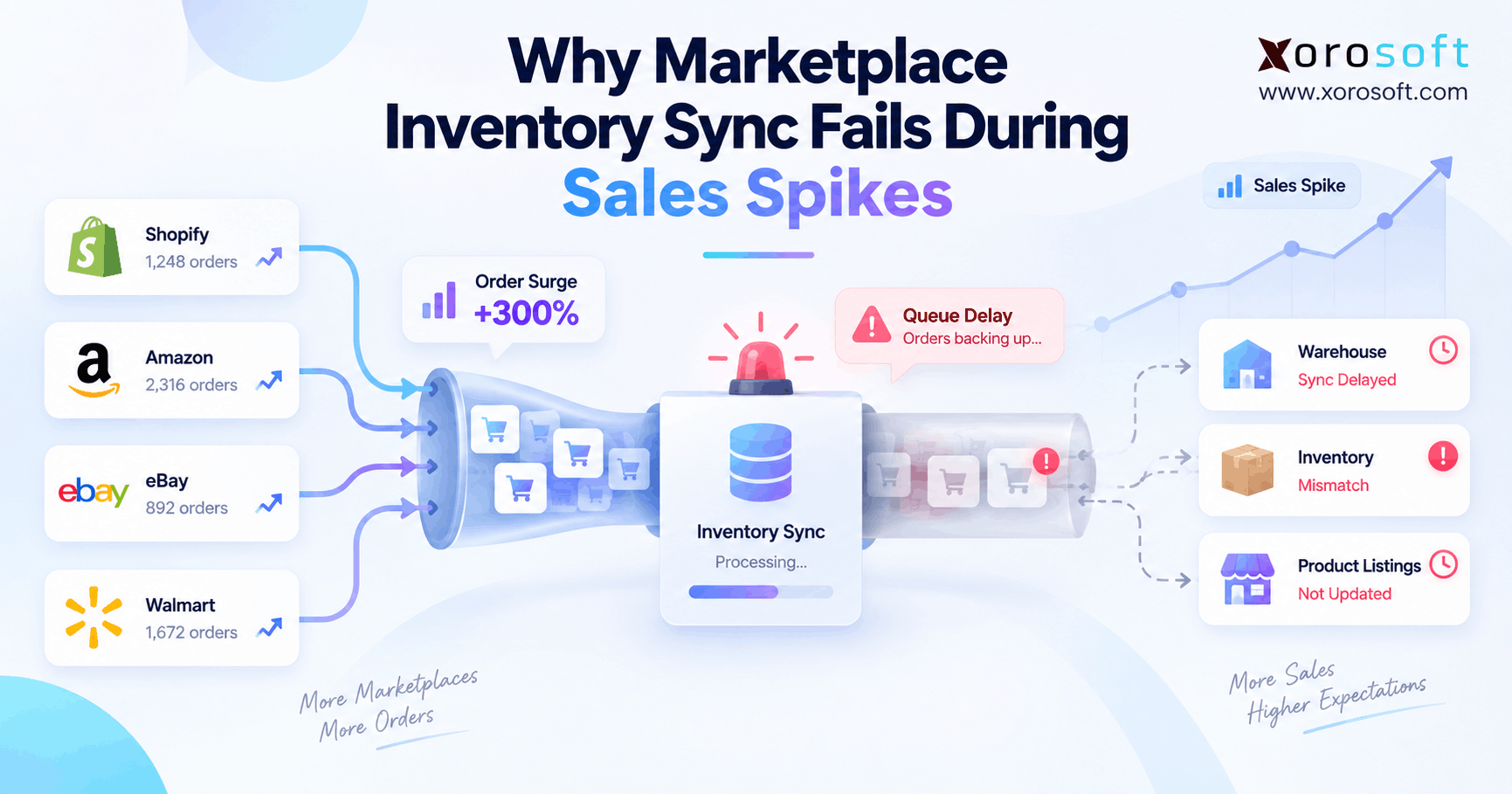
If you’re searching for Brightpearl ecommerce alternatives, there are several options to consider.
1. Ecommerce Growth Changes What Brands Need From Operations Software
Most ecommerce businesses do not start with an ERP problem. They start with an order problem, an inventory problem, or an accounting problem.
A growing brand may initially run Shopify, bookkeeping software, spreadsheets, and a basic inventory application. That setup can work when the company operates one primary sales channel, maintains a manageable SKU catalog, and fulfills orders from a single location.
Growth changes the equation.
Amazon may become a significant channel. Wholesale customers can introduce account-specific pricing and EDI requirements. New warehouses create transfer and allocation decisions. Returns begin affecting inventory accuracy and warehouse workload. Purchasing teams need stronger forecasts because overstock ties up working capital while stockouts leave revenue on the table.
Some brands also add kitting, assembly, private-label production, or full manufacturing.
At that stage, teams no longer manage isolated tasks. They manage a connected flow of inventory, orders, purchasing, fulfillment, returns, and financial transactions.
That operational shift explains why companies start researching Brightpearl ecommerce alternatives.
Brightpearl already covers substantial retail operations, so the decision should not begin with the assumption that the platform lacks basic capabilities. Operators should instead ask which operating architecture can support the next stage of the business.
For one company, the right answer may remain a retail operations platform. Another may need stronger marketplace orchestration. A third may need a cloud ERP that connects accounting, inventory, purchasing, warehouse management, manufacturing, and ecommerce.
Understanding that distinction makes the software-selection process much more useful.
2. What Brightpearl Already Handles Before You Compare Alternatives
Brightpearl serves retailers, wholesalers, and ecommerce businesses that require more operational structure than basic inventory software provides.
Its platform spans inventory, orders, purchasing, fulfillment, warehouse operations, reporting, ecommerce integrations, and retail-oriented financial workflows.
That breadth matters because buyers should compare Brightpearl with products that solve similar operational problems instead of treating every inventory application as a direct substitute.
2.1 Existing Ecommerce Workflows Matter
Shopify merchants can connect orders and inventory with Brightpearl while coordinating fulfillment and availability across operating locations.
Businesses can also use the platform to manage purchasing, stock, warehouse activity, order processing, and financial workflows. Those capabilities make Brightpearl a substantial operating platform rather than a simple stock tracker.
A serious comparison therefore needs to move beyond a question such as, “Does this software manage inventory?”
Almost every platform in this market will answer yes.
The more useful questions concern operational depth. Brightpearl ecommerce alternatives should show how inventory allocation works across channels and warehouses. Buyers should also examine multi-location control, purchase receipts, accounting effects, customer returns, and the interaction between wholesale and DTC demand.
Those workflows expose meaningful differences between systems.
2.2 A Replacement Project Needs a Clear Business Case
Switching operational software creates disruption.
Teams need to migrate data, rebuild integrations, validate opening balances, configure permissions, train users, test workflows, and manage cutover. Warehouse and finance teams may also need to change established procedures.
A company should therefore identify concrete reasons before replacing Brightpearl.
Manufacturing may have become more important. Leadership may want accounting and operations in a single ERP. Warehouse volume could require a different execution model. International growth may create new financial requirements. In other cases, the business simply wants to consolidate too many disconnected systems.
That reason should determine the shortlist.
Without a clearly defined operating problem, a replacement project can trade familiar limitations for unfamiliar ones.
3. How to Compare Brightpearl Alternatives by Operational Depth
Feature lists provide a starting point, but they rarely reveal how a system performs during actual operations.
Two vendors can both claim inventory management, warehouse management, forecasting, and Shopify integration while supporting very different processes.
The most useful way to compare Brightpearl ecommerce alternatives is to follow real inventory and order transactions from beginning to end. That approach exposes differences in system architecture that standard feature comparisons often miss.
3.1 Inventory Depth Across Brightpearl Alternatives
Inventory should represent more than a total quantity.
Operators need to understand what is physically on hand, what customers already ordered, what remains available for sale, what suppliers have shipped, what warehouses are transferring, and what staff have marked as damaged or unavailable.
A multichannel business may also require channel-specific allocation rules.
For example, the company might reserve part of its inventory for strategic wholesale customers while allowing Shopify and Amazon to share another pool. A warehouse transfer should not create sellable inventory at the destination before employees receive the goods.
These details determine whether teams can trust available-to-sell quantities.
3.2 Accounting Needs to Follow the Same Transactions
Inventory and finance become increasingly difficult to manage separately as the organization grows.
Consider a purchase receipt. Warehouse employees receive physical goods, purchasing updates the supplier order, inventory quantities change, and finance records the supplier liability and inventory value.
Separate applications can manage those processes successfully, but the integration must keep the underlying transactions synchronized.
The same issue appears when products ship. The system may need to update revenue, inventory quantities, cost of goods sold, customer balances, taxes, marketplace fees, and settlement records.
Broad ERP systems keep more of these events within one transaction model. Inventory-focused applications often connect to dedicated accounting software.
Either design can work. Operators simply need to understand which architecture they are choosing.
3.3 Warehouse Execution Deserves Its Own Evaluation
Inventory management and warehouse management overlap, but they solve different problems.
Inventory management tells the company what it owns and where the stock should be. Warehouse execution controls what employees physically do with that inventory.
As order volume increases, businesses may need barcode receiving, bin management, replenishment, batch picking, wave picking, packing controls, cycle counting, shipping validation, and structured returns.
Warehouse users should participate in software demonstrations because they understand the exceptions that create delays on the floor.
A workflow that looks polished in a presentation can become inefficient during peak fulfillment.
4. Xorosoft as a Brightpearl Ecommerce Alternative
Among Brightpearl ecommerce alternatives, Xorosoft becomes particularly relevant when a company wants ecommerce operations to connect with broader ERP processes.
The XoroONE cloud ERP platform brings inventory, accounting, purchasing, warehouse operations, ecommerce, reporting, forecasting, and related workflows into a connected operating environment.
That architecture suits companies whose difficulty no longer sits inside one department.
A Shopify order affects inventory allocation, warehouse workload, revenue, customer balances, and replenishment decisions. Wholesale orders introduce another set of pricing and allocation rules. Purchasing then needs to respond to demand across all channels.
When one business platform manages those relationships, teams can reduce the amount of manual reconciliation between separate applications.
4.1 Where This Brightpearl Alternative Fits
Xorosoft makes the most sense on the shortlist when the company has reached ERP-level complexity.
A straightforward ecommerce merchant may not require that breadth. However, a company running Shopify, Amazon, wholesale, multiple warehouses, EDI, accounting, purchasing, or manufacturing can benefit from comparing an integrated ERP architecture with a retail operations platform.
Larger organizations with broader operational requirements can also evaluate XoroERP as part of that assessment.
Shopify merchants can review the Xorosoft ERP app on the Shopify App Store to see how ecommerce connectivity fits into the broader operating environment.
The practical comparison should always focus on workflows rather than category labels.
5. NetSuite as a Brightpearl ERP Alternative
NetSuite often enters the conversation when a growing ecommerce organization needs comprehensive cloud ERP.
Businesses generally evaluate it for financial management, purchasing, inventory, order processing, manufacturing, reporting, and broader enterprise requirements.
That scope makes NetSuite relevant when the company expects ERP to serve as a central platform across several departments.
5.1 Enterprise ERP Requires a Broader Buying Process
Selecting enterprise ERP involves more than comparing software functions.
The buyer needs to consider configuration, implementation resources, integration requirements, data migration, internal ownership, and ongoing administration.
A company with multiple entities or complex financial reporting may prioritize that breadth. Another ecommerce brand may care more about multichannel inventory and rapid fulfillment execution.
Those organizations should not automatically end up with the same shortlist.
Teams considering both platforms can use the Xorosoft vs NetSuite comparison as one reference while documenting differences in operating scope and implementation strategy.
The important step is to determine which processes actually require enterprise ERP depth before selecting either platform.
6. Cin7 as an Inventory-Focused Brightpearl Alternative
Cin7 focuses strongly on product and inventory operations.
Ecommerce companies often consider it when they need centralized inventory visibility, purchasing, order management, and connections across multiple sales channels.
This makes Cin7 relevant for organizations whose main challenge remains inventory rather than broad financial consolidation.
6.1 An Inventory-Centered Architecture Can Be Enough
Not every growing company needs full ERP.
A brand may want a strong inventory platform while continuing to use another system for financial accounting. That architecture can work well when integrations remain reliable and teams maintain clear ownership of data.
The question is whether employees can still obtain consistent operational information without excessive reconciliation.
Once finance, manufacturing, warehouse execution, and purchasing become deeply interconnected, a broader ERP approach may become more attractive.
Until then, an inventory-centered system can provide an appropriate balance between capability and complexity.
This distinction helps buyers decide which Brightpearl ecommerce alternatives deserve a deeper evaluation.
7. Linnworks for Marketplace and Order Orchestration
Linnworks approaches the problem from a multichannel commerce perspective.
Businesses selling through several marketplaces need a central way to coordinate orders, inventory, listings, fulfillment, and shipping.
That requirement differs from traditional ERP selection.
7.1 Marketplace-Focused Brightpearl Competitors Solve a Different Problem
A merchant selling through Shopify, Amazon, Walmart, eBay, and other marketplaces has to manage competing demand across the same inventory pool.
Inventory synchronization becomes essential because several channels can sell the same physical stock.
Order routing also matters. The company may need to choose between an internal warehouse, a 3PL, marketplace fulfillment, or another distribution location.
Linnworks deserves consideration when those channel-management requirements dominate the business problem.
Companies should still evaluate finance and manufacturing separately if those areas have become strategic priorities.
A platform designed around marketplace orchestration does not solve exactly the same problem as a finance-centered ERP, even when both systems manage orders and inventory.
8. Acumatica for Distribution and Manufacturing
Acumatica belongs to the broader cloud ERP category.
Businesses typically evaluate it when ecommerce operations need to connect with accounting, distribution, inventory, warehousing, and potentially manufacturing.
That positioning makes it relevant for organizations whose operational requirements extend well beyond their storefront.
8.1 When Brightpearl ERP Alternatives Need Manufacturing Depth
A retailer may begin by purchasing finished goods and reselling them.
Later, the same organization might assemble products, manage raw materials, operate distribution facilities, or support more complicated B2B relationships.
Those changes create ERP requirements that simpler ecommerce systems were not designed to handle.
Acumatica can therefore fit organizations that want finance and supply-chain processes within a broader platform.
As with other ERP products, buyers should assess implementation carefully.
A vendor may technically support a workflow but still require configuration, extensions, integrations, or partner involvement to match a company’s exact operating model.
Testing realistic transactions remains more valuable than reviewing a generic feature list.
9. Business Central for Microsoft-Centered Operations
Microsoft Dynamics 365 Business Central offers another ERP path, particularly for organizations that already use Microsoft’s broader ecosystem.
The platform covers financial management, purchasing, inventory, warehousing, and production-oriented processes.
Shopify connectivity can also make Business Central relevant for merchants that want ERP to control inventory further upstream from the storefront.
9.1 Technology Strategy Can Influence Fit
Software selection does not happen in isolation.
A company already standardized around Microsoft products may value identity management, reporting, collaboration, partner availability, and integration across the same ecosystem.
Another organization may give more weight to native ecommerce or warehouse workflows.
Neither priority is universally correct.
Operators should document which ecosystem advantages improve daily operations instead of assigning extra weight to a familiar software brand.
A Shopify connection, for example, addresses only one part of the architecture. Buyers still need answers for marketplaces, returns, warehouse execution, EDI, purchasing, reporting, and manufacturing when those processes matter.
10. Sellercloud as a Marketplace-Focused Brightpearl Alternative
Sellercloud targets complex multichannel ecommerce operations.
Companies can use this type of platform to coordinate product information, inventory, orders, warehouses, purchasing, shipping, and marketplace activity.
That makes Sellercloud particularly relevant to businesses that generate significant volume through online marketplaces.
For companies comparing Brightpearl ecommerce alternatives, this distinction matters because marketplace orchestration may carry more weight than broad ERP functionality.
10.1 Marketplace Inventory Needs Strong Control
High marketplace volume creates operational pressure quickly.
A delay in inventory synchronization can cause overselling. Weak order-routing rules can send work to the wrong warehouse. Poor transfer visibility can make stock appear available when goods are still moving between facilities.
Sellercloud addresses this type of environment through a commerce-centered architecture.
Businesses should still determine whether marketplace operations should remain the center of their system design or whether finance and ERP processes now need to take that role.
Making this architectural decision early helps separate similar-looking products before teams spend weeks on demonstrations.
11. Unleashed and Zoho Inventory for Focused Requirements
Some businesses researching Brightpearl ecommerce alternatives do not need a large ERP implementation.
They may simply require stronger inventory processes, better purchasing control, or more structured multichannel operations at a manageable level of complexity.
Unleashed and Zoho Inventory represent two options that can fit this part of the market.
11.1 Unleashed as a Brightpearl Replacement for Product Inventory
Unleashed emphasizes inventory, purchasing, product costing, and production-related stock management.
That can suit businesses that need stronger control over products and procurement without moving every financial process into a comprehensive ERP.
Companies should examine accounting integration, ecommerce connectivity, production requirements, and warehouse needs before deciding whether this architecture offers enough depth.
When those areas remain relatively straightforward, an inventory-oriented application may prove more practical than a larger ERP.
11.2 Zoho Inventory for Smaller Growing Merchants
Zoho Inventory targets organizations that need structured inventory and order management without enterprise-level complexity.
For a smaller Shopify merchant, this type of product can support the transition away from spreadsheets while preserving a relatively simple operating model.
The key issue is the company’s future direction.
A business expecting significant EDI, manufacturing, sophisticated warehouse execution, or multi-entity accounting should examine whether the architecture can support those requirements.
Companies that do not expect that level of complexity may benefit from keeping the stack lean.
12. Odoo for a Modular ERP Strategy
Odoo approaches business software as a connected suite of applications.
Companies can adopt modules for accounting, inventory, ecommerce, purchasing, manufacturing, CRM, and other functions.
This modular model appeals to organizations that want one ecosystem without necessarily implementing every capability at once.
12.1 Flexibility Requires Strong Process Definition
A flexible platform gives businesses many configuration choices.
That flexibility becomes valuable when the organization understands its processes clearly.
Without disciplined requirements, however, teams can spend too much time customizing workflows that might have worked better as standard processes.
Manufacturing companies should pay close attention to bills of materials, production orders, material planning, shop-floor workflows, and costing.
Retail-focused businesses may place greater weight on inventory availability, ecommerce connectivity, warehouse execution, and returns.
Clear requirements should come before configuration decisions.
13. Compare Brightpearl Ecommerce Alternatives by Operating Architecture
The software market becomes easier to understand when buyers group products by operating model rather than by marketing terminology.
| Platform | General Operating Model | Useful Comparison Scenario |
|---|---|---|
| Xorosoft | Cloud ERP | Ecommerce, wholesale, WMS, finance, manufacturing |
| NetSuite | Enterprise cloud ERP | Broader financial and operational complexity |
| Cin7 | Inventory-centered platform | Multichannel inventory and purchasing |
| Linnworks | Ecommerce operations | Marketplace and fulfillment orchestration |
| Acumatica | Cloud ERP | Retail, distribution, and manufacturing |
| Business Central | Cloud ERP | Microsoft-centered organizations |
| Sellercloud | Ecommerce operations | High-volume marketplace businesses |
| Unleashed | Inventory/product platform | Product and production inventory |
| Zoho Inventory | Inventory/order platform | Smaller growing merchants |
| Odoo | Modular business suite | Configurable integrated operations |
No row identifies a universal winner.
Each architecture solves a different version of the operational problem.
13.1 Decide Which Platform Becomes the System of Record
Every scaling company needs clear ownership of critical business data.
Management should know which system controls available inventory, where purchasing lives, which application creates the final financial record, where warehouse adjustments originate, who owns customer pricing, and where landed cost gets calculated.
Ambiguous ownership creates reconciliation work.
For example, if Shopify and an inventory system can both independently change availability, the company needs a clearly defined synchronization rule.
If a WMS and ERP can both create stock adjustments, management should determine which transaction becomes authoritative.
Defining those responsibilities before choosing software reduces implementation risk later.
14. Shopify Requirements Across Brightpearl Ecommerce Alternatives
Shopify integration deserves more scrutiny than a yes-or-no checkbox.
A mature ecommerce operation needs to understand exactly which transactions move between Shopify and the operating system.
The strongest Brightpearl ecommerce alternatives should make that flow easy to explain and audit.
14.1 Follow a Shopify Order Through the Business
Start with order creation.
Determine how quickly the operating system receives the order and when it reserves stock. Check what happens when the customer cancels before fulfillment.
Next, follow the warehouse process.
Understand how employees receive the work, confirm shipment, and send tracking information back to Shopify.
Then test a return.
The business needs to know how refunds, returned inventory, damaged stock, and financial adjustments move through the workflow.
Companies with multiple stores or warehouses should also test allocation rules.
Xorosoft’s integration resources provide one example of how ecommerce connectivity can sit within a broader ERP architecture rather than operate as an isolated storefront connection.
14.2 Amazon Requirements Across Ecommerce ERP Alternatives
Amazon creates additional considerations around FBA, marketplace inventory, settlements, fees, and returns.
A product may sell through Shopify, Amazon, and wholesale at the same time.
The operating platform must understand how those channels compete for stock.
Without reliable centralized availability, a company may overpromise inventory or compensate by carrying too much safety stock.
A useful vendor demonstration should therefore use the same SKU across multiple channels rather than showing every integration separately.
That scenario reveals how effectively the system manages competing demand.
15. Multi-Warehouse Operations Need More Than Visibility
Opening a second warehouse creates a new class of operational decisions.
The company has to decide where inventory should sit, which location should fulfill each order, how frequently products move between facilities, and how channel availability should react to those movements.
For multi-location businesses, comparing Brightpearl ecommerce alternatives should therefore include transfer timing, replenishment logic, allocation rules, and warehouse-level availability.
15.1 Warehouse Depth Across Brightpearl Alternatives
Digital inventory becomes useful only when the software reflects what actually happens on the warehouse floor.
Receiving provides a simple example.
Employees should record the goods that physically arrived rather than closing a purchase order simply because the supplier shipped it.
Transfers create another timing issue.
Inventory leaving warehouse A should not automatically become available in warehouse B before the receiving process confirms arrival under the company’s operating rules.
Businesses that require deeper warehouse execution can evaluate a specialized platform such as XoroWMS alongside the broader ERP decision.
15.2 Returns Need Structured Inventory Statuses
Returns create hidden inventory problems in many ecommerce operations.
A customer may send an item back, but the return does not automatically make the unit sellable.
Warehouse employees may need to inspect, repackage, refurbish, quarantine, or write off the item.
The system should make those statuses visible.
Otherwise, ecommerce channels can promise inventory that physically exists but cannot actually fulfill another order.
For businesses with high return rates, this workflow can materially affect inventory accuracy and customer experience.
16. Wholesale and EDI Requirements Across Brightpearl Alternatives
Many ecommerce companies eventually operate two commercial models at the same time.
DTC orders flow through Shopify, while wholesale customers place larger orders under negotiated terms.
Those channels share inventory but follow different business rules.
This is another point where Brightpearl ecommerce alternatives can diverge significantly.
16.1 Wholesale Adds Customer-Specific Rules
Wholesale accounts may have individual price lists, payment terms, credit limits, minimum quantities, pack-size requirements, shipping rules, and allocation priorities.
The operating system needs to apply those rules consistently without forcing staff to reconstruct each order manually.
Large B2B orders also compete directly with ecommerce demand.
That creates an allocation question. Should the company reserve inventory for strategic accounts, or should every channel draw from the same available pool?
Software cannot decide the commercial policy, but it should enforce the rules once leadership defines them.
16.2 EDI Capabilities in Brightpearl Ecommerce Alternatives
EDI workflows can involve purchase orders, acknowledgements, advance ship notices, labels, invoices, and exception handling.
Companies should avoid evaluating EDI only by asking whether a connector exists.
Instead, a vendor should demonstrate the entire retailer transaction.
Industry also shapes those requirements. Apparel, furniture, food, sporting goods, automotive parts, manufacturing, and wholesale distribution can have very different inventory characteristics.
Xorosoft’s industry-focused ERP resources provide context for how operating requirements change across inventory-driven sectors.
17. Manufacturing Can Turn the Project Into an ERP Decision
Manufacturing introduces relationships that ordinary resale inventory does not require.
Raw materials become finished products. Work orders consume components. Production creates labor, overhead, and work-in-progress. Material shortages affect schedules, while scrap changes expected output.
Those processes can fundamentally change which Brightpearl ecommerce alternatives belong on the shortlist.
17.1 Manufacturing Depth Across Brightpearl ERP Alternatives
Many ecommerce businesses use bundles or kits.
That does not automatically mean they need a manufacturing ERP.
The distinction becomes important when the company starts managing structured bills of materials, material requirements, production orders, work centers, capacity, work-in-progress, or production costing.
Those requirements justify a deeper manufacturing evaluation.
Xorosoft’s business solutions overview gives additional context for connecting supply chain, finance, warehouse, commerce, and production requirements within a broader operating model.
The same principle should apply to every vendor: test the manufacturing process the business actually runs rather than assuming that a “manufacturing” checkbox covers every production scenario.
18. Calculate the Full Cost of Switching Platforms
Monthly subscription price rarely tells the full story.
A replacement project also includes implementation, data migration, integrations, user training, process redesign, internal project management, support, and potentially additional applications.
Businesses should model those costs across several years.
When evaluating Brightpearl ecommerce alternatives, total cost of ownership should therefore include both software expenses and the ongoing cost of connecting, administering, and reconciling the surrounding technology stack.
18.1 Total Cost Across Brightpearl Replacement Options
A specialized application stack can work extremely well.
Problems appear when employees repeatedly move information between systems or spend significant time resolving mismatches.
Imagine a company using separate applications for ecommerce, accounting, inventory, warehouse management, EDI, forecasting, and purchasing.
If every integration works reliably, the stack may remain efficient.
When employees constantly reconcile inventory, rebuild reports, or correct failed transactions, the effective cost becomes much higher than the software subscriptions alone.
A broader ERP can reduce some of those integration points, although it may require a more substantial implementation.
The comparison needs to include both factors.
18.2 Implementation Quality Often Matters More Than Feature Count
A capable product can still produce a poor outcome if implementation does not match the business.
Before signing a contract, companies should define the workflows with the highest operational risk and verify them during evaluation.
Data quality deserves the same attention.
Duplicate customers, inconsistent SKUs, inaccurate inventory, weak supplier records, and undocumented units of measure can undermine a new platform before launch.
Buyers can also review relevant ERP case studies alongside direct customer references from every vendor they evaluate.
Real-world examples often reveal more about implementation fit than a broad feature matrix.
19. Build a Brightpearl Alternatives Shortlist Around Real Transactions
A software-selection project becomes easier when the company stops trying to compare every product in the market.
The strongest shortlist of Brightpearl ecommerce alternatives should come from transactions that create the most operational risk, reconciliation work, or fulfillment friction.
Start with those transactions before comparing vendors.
19.1 Map the Current Technology Stack
Document every major application that touches inventory, orders, purchasing, fulfillment, or finance.
Include Shopify, marketplaces, accounting, warehouse systems, 3PL platforms, shipping tools, EDI, forecasting, purchasing, returns, and reporting.
Next, map the information passing between those systems.
Pay particular attention to manual entry.
Whenever employees copy the same business event between applications, the company creates another opportunity for delay or error.
19.2 Separate Current Needs From Future Possibilities
Companies often overcomplicate ERP selection by turning every possible future scenario into a mandatory requirement.
A more practical approach divides requirements into three horizons.
The first group contains capabilities needed today. The second covers requirements management expects within the next few years. The third captures possibilities that remain uncertain.
Shopify and multi-warehouse inventory may be essential now. EDI might become necessary next year. Manufacturing could remain only a future possibility.
This method lets the company prepare for realistic growth without designing the entire project around hypothetical complexity.
19.3 Test Brightpearl Competitors With the Same Transactions
Give each shortlisted vendor the same operating scenarios.
Ask them to demonstrate a Shopify order, an Amazon order, a purchase receipt, a warehouse transfer, a customer return, a wholesale order, an inventory adjustment, and the corresponding accounting impact.
Add manufacturing or EDI workflows where relevant.
This method creates a much stronger comparison because teams see how each system handles the same business events.
Dashboard presentations alone rarely provide that level of clarity.
20. Common Errors During Software Selection
The biggest software-selection mistakes often happen before anyone configures the new system.
Teams can reduce risk by defining the business problem, prioritizing critical workflows, and cleaning data before implementation begins.
20.1 Starting With Vendor Names Instead of Business Problems
A company that says “we need to replace Brightpearl” has not yet defined a requirement.
Management needs to explain what the replacement must solve.
Finance may spend too much time reconciling inventory. Warehouse teams might need stronger mobile execution. Manufacturing may have outgrown simple assembly workflows. Wholesale expansion could be driving EDI complexity.
Different problems lead to different products.
Clarifying the operational issue first prevents the project from becoming a popularity contest between software vendors.
20.2 Compare Brightpearl Alternatives by Workflow Priority
A system can offer hundreds of features that the company never uses.
Critical processes deserve more weight than long feature lists.
A brand shipping thousands of daily orders should care deeply about warehouse efficiency and inventory synchronization.
Manufacturers may give more weight to BOMs, MRP, work orders, and costing.
Wholesale distributors may focus on customer pricing, purchasing, allocations, and EDI.
Business priorities should determine the scorecard.
20.3 Ignoring Master Data Until Migration
A new ERP cannot automatically repair years of inconsistent operational data.
Teams should clean items, vendors, customers, units of measure, costs, and inventory balances before migration.
This work also forces the organization to make important governance decisions.
Who can create an SKU? Who owns vendor lead times? Which department maintains product costs? Who approves customer terms?
Clear ownership improves the new system long after implementation ends.
21. When Brightpearl Ecommerce Alternatives Need to Include Full ERP
Not every company researching Brightpearl ecommerce alternatives should move to ERP.
Some businesses can operate efficiently for years with a well-integrated combination of ecommerce, inventory, and accounting tools.
ERP becomes more relevant when several operational functions need to rely on the same transaction data.
21.1 Look for a Pattern of Operational Friction
Persistent inventory-to-accounting reconciliation provides one signal.
Multiple warehouses create another.
Manufacturing, substantial wholesale volume, EDI, complex purchasing, multiple business entities, and growing reporting requirements add further pressure.
No single symptom proves that ERP is necessary.
The combination matters more.
If teams spend increasing amounts of time reconciling systems instead of operating the business, leadership should examine whether the architecture itself has become the constraint.
21.2 Do Not Adopt ERP Before the Business Needs It
Enterprise software introduces its own discipline.
Processes require stronger definition. Users need training. Data ownership becomes more important. Implementation consumes management attention.
For a smaller merchant with one storefront, straightforward accounting, and one warehouse, those costs may outweigh the benefits.
The objective is not to implement the largest possible platform.
Companies should choose the simplest architecture that can reliably support current operations and the next realistic stage of growth.
22. Practical Decision Framework for Choosing a Brightpearl Ecommerce Alternative
The final decision should come from operating requirements rather than vendor popularity.
Start by defining how the business expects orders, inventory, warehouses, purchasing, finance, wholesale, and manufacturing to work together.
Next, decide what type of platform should sit at the center.
A marketplace-heavy seller may prioritize ecommerce orchestration. A smaller product business may need focused inventory control. An organization that wants finance, purchasing, WMS, inventory, manufacturing, forecasting, and commerce to share one operating model may need full ERP.
This is where Brightpearl ecommerce alternatives stop looking interchangeable.
Xorosoft belongs on the shortlist when an inventory-driven business wants a connected ERP environment across ecommerce, accounting, purchasing, warehouse operations, and related supply-chain processes. Other platforms may fit better when the priority is narrower inventory management, marketplace orchestration, a Microsoft-centered ERP environment, or another enterprise architecture.
Before selecting any system, choose five to ten real transactions that currently create the most friction. Ask every vendor to demonstrate those transactions from beginning to end, including exceptions.
That exercise usually reveals more than hours of generic product presentations.
For teams ready to test Shopify, inventory, warehouse, accounting, wholesale, or manufacturing requirements against an ERP workflow, book a personalized Xorosoft discussion and use those real transactions as the basis for the evaluation.
Frequently Asked Questions
What are the best Brightpearl ecommerce alternatives?
Options include Xorosoft, NetSuite, Cin7, Linnworks, Acumatica, Business Central, Sellercloud, Unleashed, Zoho Inventory, and Odoo. The best fit depends on operational requirements.
Which Brightpearl alternative is suitable for Shopify brands?
Shopify brands should compare inventory synchronization, order flow, returns, warehouse locations, accounting, and fulfillment. The right platform depends on channel and operational complexity.
Is Brightpearl an ERP system?
Brightpearl is primarily positioned as a retail operating platform. It includes inventory, orders, purchasing, warehouse, accounting, and ecommerce capabilities that overlap with traditional ERP functions.
When should a brand move from Brightpearl to ERP?
ERP becomes more relevant when multiple warehouses, manufacturing, EDI, complex purchasing, financial reconciliation, or disconnected applications make the existing operating architecture difficult to manage.
Which Brightpearl alternatives support multi-warehouse operations?
Several alternatives support multi-location inventory, including Xorosoft, NetSuite, Acumatica, Business Central, Sellercloud, Odoo, and other platforms with warehouse or inventory functionality.
Which Brightpearl alternatives support manufacturing?
Manufacturing-focused options include Xorosoft, NetSuite, Acumatica, Business Central, and Odoo. Buyers should compare BOMs, work orders, MRP, production planning, and costing depth.
How should I compare Brightpearl alternatives before switching?
Use identical real-world workflows during every vendor demonstration. Test Shopify orders, purchasing, transfers, returns, wholesale transactions, inventory adjustments, accounting, and manufacturing or EDI where relevant.
Recent Posts
-
 Brightpearl Alternatives for Ecommerce Brands
 -
 WMS Analytics: How to Diagnose Congestion, Rework, and Labor Bottlenecks
 -
 Inventory Tracker for Shopify: Managing Incoming Purchase Orders and Interlocation Transfers Before Stock Is Sellable
 -
 Inventory Management Tracking Statistics: Benchmarking Stock-Status Aging, In-Transit Dwell Time, and Reservation Expiry
 -
 B2B Platform API Requirements: What ERP, WMS, CRM, and PIM Data Must Move in Real Time