Effective stock write-off tracking is essential for managing inventory accurately and minimising financial losses.
1. Stock Write-Off Tracking Starts Where Margin Becomes Unclear
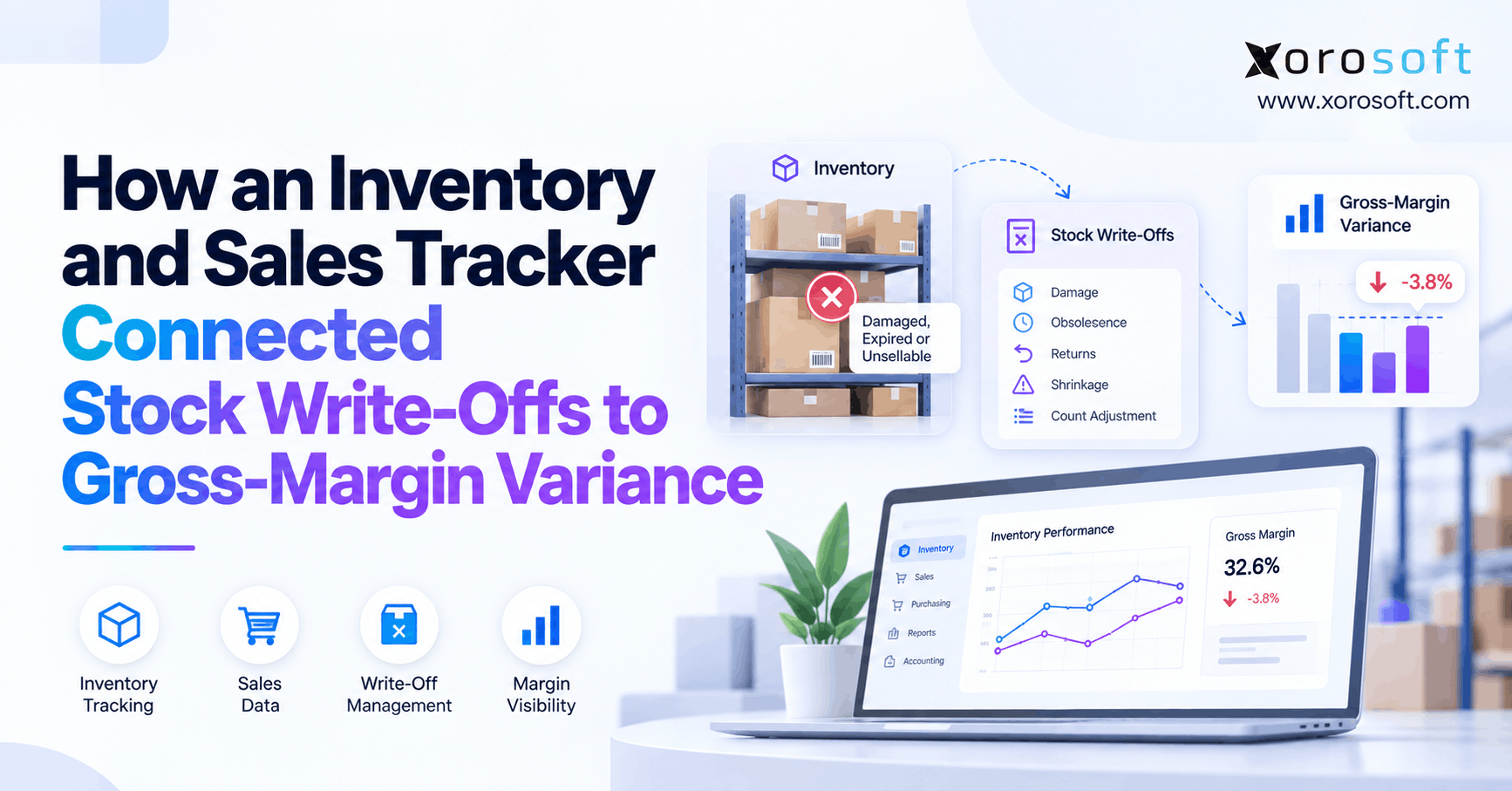
Stock write-off tracking connects inventory losses with sales, inventory cost, COGS, and gross-margin variance. Therefore, when damaged stock, shrinkage, obsolete products, unsellable returns, or count corrections reduce profitability, teams can trace the financial effect back to the original inventory event.
Although revenue may remain healthy, inventory losses can quietly change the economics behind individual products. Moreover, a warehouse adjustment may occur days before finance sees its impact. As a result, teams often struggle to explain why gross margin moved even though selling prices and sales volume appeared stable.
Consequently, the business needs a transaction trail that links quantity, cost, location, reason, and financial impact.
1.1 Why Stock Write-Off Tracking Can Reveal a Margin Problem
Gross margin appears to be a financial metric. However, many transactions behind it begin inside operations.
For example, damaged inventory may remain recorded as sellable until a cycle count exposes the problem. Likewise, an unsellable return may accidentally return to available inventory.
Therefore, the useful investigation path becomes:
Gross-margin variance → inventory cost → adjustment → SKU → warehouse → reason
Once that path exists, operations and finance can investigate the actual cause instead of treating the variance as an unexplained accounting difference.
1.2 Why Sales Data Alone Cannot Explain Profitability
A sales report may show units sold, revenue, discounts, and refunds. Nevertheless, it may not show products damaged after receiving or inventory lost during transfers.
Likewise, an inventory report may show quantity corrections without connecting them to product revenue.
Therefore, neither dataset provides the entire story alone. Instead, management needs sales and inventory information to remain connected so profitability analysis includes the operational events behind the numbers.
2. What Inventory Losses Actually Represent
An inventory write-off generally records inventory that can no longer carry its previous economic value. For example, products may become damaged, obsolete, expired, spoiled, missing, or otherwise unsellable.
However, businesses should not treat every adjustment as a write-off.
The IFRS Foundation’s IAS 2 inventory guidance establishes important principles around inventory cost and net realizable value. Therefore, operational systems need enough transaction detail for finance to determine the correct accounting treatment.
2.1 How Stock Write-Off Tracking Separates Write-Offs From Write-Downs
A complete write-off generally relates to inventory that has lost substantially all relevant economic value. In contrast, a write-down reduces carrying value because some recoverable value remains.
For example, a seasonal product carried at $40 may still have some recoverable value even when demand falls. Therefore, finance may reduce its carrying amount rather than eliminate it.
Conversely, destroyed or completely unusable inventory may require a different treatment.
2.2 When an Adjustment Needs a Clear Business Reason
An inventory adjustment describes a transaction inside the system. However, it does not automatically explain why the quantity or value changed.
For instance, an employee may reduce inventory by 50 units. Nevertheless, management still needs to know whether those units were damaged, missing, expired, transferred incorrectly, or counted incorrectly.
Therefore, meaningful reason codes should sit behind important adjustments.
3. How Stock Write-Off Tracking Reaches Gross-Margin Reporting
Physical inventory and financial reporting cannot remain disconnected indefinitely.
When quantity or value changes, the financial system eventually needs to recognize the economic effect. Therefore, operations and accounting require a traceable relationship between the warehouse event and its financial consequences.
Microsoft’s guidance on reconciling inventory costs with the general ledger illustrates how inventory transactions can connect with inventory accounts, adjustments, and COGS.
Consequently, finance needs more than one month-end loss total.
3.1 Why Stock Write-Off Tracking Uses Carrying Cost
Suppose a warehouse discovers 100 missing units.
Each unit sells for $80. However, each unit carries an inventory cost of $30.
Therefore:
100 units × $30 carrying cost = $3,000 inventory loss
The $8,000 selling value may help management estimate lost revenue opportunity. Nevertheless, it does not represent the inventory asset value being removed.
As a result, profitability analysis should preserve the appropriate inventory cost alongside the quantity adjustment.
3.2 How Timing Can Change Reported Margin
Inventory cost does not always become final at the same moment a product ships.
For example, freight charges, landed costs, supplier corrections, or late invoices may change the final cost later.
Consequently, margin reports can move even when the original customer order remains unchanged.
Microsoft also documents how inventory cost adjustments can propagate updated costs to related entries. Therefore, finance should distinguish true inventory losses from later cost corrections.
4. Why Basic Inventory Records Miss the Root Cause
A lightweight tracker can answer useful questions.
For example, it may show available quantity, incoming purchase orders, units sold, and low-stock warnings. However, growing businesses eventually need deeper explanations.
A quantity change alone does not identify the operational reason behind the change. Consequently, finance may know that inventory fell without understanding whether the reduction came from a sale, transfer, damage event, expiry, or unexplained shortage.
4.1 How Stock Write-Off Tracking Adds Context to Quantity Changes
Suppose SKU A drops by 400 units.
That number alone does not explain whether those units sold, transferred, expired, disappeared, or became damaged.
Therefore, every material non-sales reduction should retain transaction context.
Moreover, management should be able to connect quantity with cost, location, date, user, and reason. As a result, the transaction becomes useful for both operational review and financial analysis.
4.2 Why Generic Reason Codes Hide Patterns
Consider a report where every correction appears as:
Reason: Adjustment
Although technically descriptive, the label offers little management value.
Instead, businesses need clear categories such as damage, shrinkage, expiration, obsolete inventory, unsellable returns, manufacturing scrap, and count corrections.
Consequently, managers can compare causes rather than simply measuring one combined adjustment number.
5. Building a Better Stock Write-Off Tracking Trail
A reliable transaction trail should preserve the event from beginning to end.
First, capture what happened physically. Next, connect the change with inventory cost. Then, preserve the accounting and sales context.
As a result, management can move backward from the P&L to the warehouse transaction without rebuilding the history manually.
5.1 What Stock Write-Off Tracking Should Capture at the Source
At minimum, record:
- SKU
- variant
- warehouse
- bin or location
- quantity
- transaction type
- reason code
- date
- user
- approval
Moreover, lot or serial information may matter for regulated, date-sensitive, or high-value products.
Therefore, every material loss should contain enough information for another employee to understand what happened later.
5.2 Preserving Cost and Sales Context
Next, connect the adjustment with the appropriate carrying cost.
Otherwise, the business knows how many units disappeared but not what the loss cost.
Additionally, the same transaction should eventually connect with revenue, COGS, and product-margin analysis.
Consequently, inventory data becomes a profitability input instead of remaining an isolated warehouse record.
6. Which Data Fields Matter Most
The quality of inventory-loss analysis depends on the quality of the underlying record.
Therefore, one negative quantity is not enough.
A useful dataset should capture product identity, location, cost, reason, timing, approval, and financial context. Moreover, multi-location companies should preserve the original warehouse instead of consolidating every correction into one company-level amount.
6.1 How Stock Write-Off Tracking Connects Product and Warehouse Data
Product and warehouse context should include SKU, variant, facility, bin, lot, serial number where relevant, and inventory status.
As complexity grows, connected systems make that context easier to preserve.
For example, XoroONE brings inventory, purchasing, warehousing, ecommerce, accounting, and related operations into a broader cloud ERP environment.
Therefore, teams can analyze the transaction without manually joining multiple exports first.
6.2 Using Adjustment Data as an Audit Trail
Financial context should include carrying cost, adjustment value, transaction date, user, approval status, and supporting notes.
Moreover, high-value adjustments may justify photographs, attachments, or management approval.
As a result, the record answers two different questions:
What happened operationally?
What financial value changed?
That combination improves both management reporting and auditability.
7. Using Stock Write-Off Tracking to Measure Margin Impact
Reliable stock write-off tracking helps finance isolate inventory losses before comparing expected and actual profitability.
The first calculation is straightforward:
Stock Write-Off Value = Units Written Off × Carrying Cost per Unit
Next, finance can compare the amount with revenue, COGS, and expected gross profit. However, the team should also distinguish inventory losses from other cost changes.
7.1 Stock Write-Off Tracking Example: Measuring the Margin Gap
Suppose a business expects:
- Revenue: $500,000
- Product cost: $300,000
- Expected gross profit: $200,000
- Expected gross margin: 40%
Later, management identifies $15,000 of inventory losses relevant to the margin analysis.
Therefore, the illustrative cost view becomes $315,000 while gross profit falls to $185,000.
Consequently, gross margin falls to 37%, meaning the isolated inventory loss explains three percentage points in this simplified example.
7.2 Why Other Margin Drivers Still Matter
Inventory loss is only one potential margin driver.
For example, higher supplier costs may lower gross profit. Likewise, discounting, returns, freight, product mix, and manufacturing variance can change reported results.
Therefore, finance should build a margin bridge.
Instead of saying, “margin fell three points,” management can determine which portion came from purchase cost, which came from commercial decisions, and which came from physical inventory loss.
8. Reason Codes Make Adjustments Actionable
A reason code transforms an inventory transaction into management information.
Without one, the system knows what quantity changed. However, it cannot reliably explain why.
Therefore, reason codes should be specific enough for useful analysis while remaining simple enough for warehouse teams to apply consistently.
8.1 How Stock Write-Off Tracking Uses Controlled Reason Codes
Useful categories can include:
- warehouse damage
- transit damage
- shrinkage
- expiration
- obsolescence
- unsellable return
- manufacturing scrap
- transfer discrepancy
- count correction
However, businesses should avoid dozens of overlapping choices.
Instead, use a concise hierarchy and define when employees should select each reason. Consequently, reports remain much cleaner.
8.2 Turning Causes Into Corrective Actions
Suppose expiration losses increase repeatedly within one category.
Therefore, purchasing may need to review order quantities, supplier lead times, or forecast assumptions.
Meanwhile, recurring damage in one facility may indicate storage, handling, or packaging problems.
Likewise, repeated transfer discrepancies may indicate weak scanning discipline.
Consequently, the adjustment record becomes a process-improvement signal rather than only an accounting record.
9. Stock Write-Off Tracking Across Multiple Warehouses
Raw write-off dollars can create misleading comparisons between locations.
For example, Warehouse A may record $50,000 of losses while Warehouse B records $20,000.
At first, Warehouse A appears worse. However, it may process five times more inventory.
Therefore, multi-warehouse analysis needs normalized measures as well as absolute values.
9.1 How Stock Write-Off Tracking Normalizes Warehouse Performance
One useful calculation is:
Write-Off Rate = Write-Off Value ÷ Relevant Inventory Throughput
Additionally, businesses can compare:
- loss per order
- loss per unit handled
- loss per SKU
- loss by reason
- loss by facility
- loss by bin
Consequently, management can distinguish scale from a genuine process problem.
Moreover, normalized measures make facility-to-facility comparisons more meaningful.
9.2 Preserve Warehouse Execution Data
A warehouse system should capture movement history before the event reaches finance.
For businesses managing advanced receiving, picking, replenishment, transfers, scanning, cycle counting, and fulfillment, XoroWMS can connect those execution workflows with the broader operating environment.
Therefore, an investigation can begin with transaction history rather than employee memory.
As a result, teams can determine what happened much closer to the source.
10. Ecommerce Adds Another Layer of Complexity
Ecommerce businesses often spread operating data across several systems.
For example, Shopify may hold storefront orders while an ERP maintains inventory cost. Meanwhile, a warehouse application manages physical movement, and accounting software produces financial statements.
Therefore, ecommerce margin analysis becomes harder when transaction context does not move between those systems.
10.1 Stock Write-Off Tracking for Returns and Disposition
A customer refund does not explain what happened to the physical product.
For example, the returned item may be immediately sellable, damaged, missing components, quarantined, sent for refurbishment, or completely unusable.
Therefore, return disposition should stay connected to the commercial transaction.
Otherwise, finance may record the refund correctly while missing the additional inventory loss created after the return reached the warehouse.
10.2 Where Channel Visibility Breaks
As channel count grows, manually synchronizing inventory becomes harder.
Therefore, businesses need integrations that preserve inventory and order context across systems.
Xorosoft Integrations can support connected ecommerce and operational workflows.
Additionally, Shopify merchants can review Xorosoft’s external listing on the Shopify App Store when evaluating its Shopify ERP connection.
11. Stock Write-Off Tracking for Finance Teams
A monthly write-off total provides a useful starting point. However, finance should not stop there.
Instead, the team should compare the amount with purchasing changes, landed costs, returns, discounts, product mix, and other margin drivers.
Consequently, the business can explain gross-margin movement rather than assigning every unfavorable variance to one category.
11.1 Stock Write-Off Tracking Alongside Purchasing and Landed Costs
Supplier price increases can lower product margin even when warehouse performance remains stable.
Likewise, freight, duties, and other landed costs may increase inventory cost.
Therefore, finance should separate purchase-cost variance from inventory-loss variance.
Moreover, a connected system should help teams identify whether margin changed because units disappeared or because the remaining units became more expensive.
11.2 Separate Returns, Discounts, and Mix
High return rates can create both revenue reversals and inventory consequences.
Meanwhile, aggressive discounting lowers selling margin even when product cost remains stable.
Product mix also matters. For example, selling more low-margin products can lower blended gross margin despite healthy total revenue.
Consequently, write-off analysis should sit inside a broader profitability review rather than replace it.
12. How the Analysis Changes by Industry
The underlying principle remains consistent: identify what inventory changed, why it changed, what it cost, and how the change affected financial performance.
However, the operational causes differ by industry.
Therefore, reason codes, approval rules, and reporting dimensions should reflect the way products actually move through each business.
12.1 Stock Write-Off Tracking in Apparel and Fashion
Apparel businesses often manage large combinations of sizes, colors, styles, and seasons.
Consequently, losses may cluster around aging seasonal products, damaged packaging, customer returns, or low-demand variants.
Moreover, SKU-level visibility matters because one weak size or color can behave very differently from the broader style.
Therefore, variant-level analysis provides more useful insight than category averages alone.
12.2 Food and Beverage Risks
Food and beverage businesses face expiration, spoilage, lot control, and shelf-life risk.
Therefore, purchasing quantities and stock rotation directly affect loss exposure.
Moreover, teams need to distinguish products that expired because demand slowed from products lost because warehouse procedures failed.
As a result, lot, expiry, purchasing, and inventory records should remain closely connected.
12.3 Stock Write-Off Tracking in Furniture and Sporting Goods
Furniture and sporting-goods companies often handle larger or higher-value individual items.
Therefore, one damage event can have a material financial impact.
Moreover, bulky products may face greater risk during receiving, storage, picking, or delivery preparation.
Consequently, location and handling context becomes especially useful when repeated damage appears within the same facility or product family.
12.4 Wholesale and Manufacturing Variance
Wholesale distributors often manage broad catalogs, several warehouses, and complex purchasing.
Meanwhile, manufacturers must distinguish raw materials, work in progress, finished goods, expected scrap, and abnormal loss.
Therefore, the same adjustment label cannot explain every operating scenario.
Readers can explore Xorosoft’s broader industries served to see how inventory workflows vary across different business models.
13. When Stock Write-Off Tracking Outgrows Basic Software
A lightweight inventory tracker can remain suitable for a simple operation.
However, the architecture often becomes strained when warehouses, channels, purchasing workflows, manufacturing processes, or transaction volumes multiply.
Therefore, the decision to upgrade should depend on operational complexity rather than company size alone.
13.1 Stock Write-Off Tracking and Spreadsheet Dependency
One warning appears when every investigation starts with several exports.
For example, finance downloads accounting data while operations exports inventory adjustments. Meanwhile, ecommerce teams provide channel sales.
Then someone manually combines everything.
Consequently, spreadsheets become an unofficial integration layer.
Although that process may work temporarily, it becomes difficult to control as transaction volume and organizational complexity increase.
13.2 When Reconciliation Becomes Too Manual
Another warning appears when departments cannot agree on inventory quantity, value, or product margin.
Therefore, management should examine whether separate systems are creating conflicting definitions of the same transaction.
Xorosoft’s broader ERP solutions connect inventory-driven workflows across operational and financial functions.
As a result, businesses can evaluate whether a unified architecture would reduce repeated reconciliation work.
14. How Connected Data Changes the Investigation
The biggest improvement rarely comes from adding another dashboard.
Instead, it comes from preserving transaction continuity.
When inventory, warehouse, purchasing, sales, and accounting events stay connected, finance can move backward from an unfavorable variance to its operational source.
Consequently, investigation becomes faster and more specific.
14.1 Stock Write-Off Tracking Starts With the Financial Question
Suppose gross margin falls by two percentage points.
First, separate selling-price, product-mix, purchase-cost, return, freight, and inventory-loss effects.
Next, isolate the portion connected with physical inventory.
Then, drill into SKU, warehouse, date, quantity, and reason.
Consequently, one unexplained margin percentage becomes a series of traceable business events.
14.2 Move From Reporting to Action
Once the cause becomes visible, teams can respond differently.
For example, warehouse damage may require process changes. Meanwhile, expiry losses may require revised purchasing quantities.
Likewise, obsolete products may point toward forecasting issues.
Therefore, better reporting should lead directly to an operating decision.
Otherwise, the dashboard simply describes yesterday’s problem without improving tomorrow’s result.
15. Stock Write-Off Tracking Controls That Prevent Month-End Surprises
Reporting alone cannot prevent inventory loss.
Therefore, businesses also need operating controls around adjustments, counts, approvals, and exception review.
Moreover, the best control system identifies significant differences close to the time they occur rather than waiting for month-end.
15.1 Stock Write-Off Tracking Needs Meaningful Reason Codes
Every material adjustment should carry a clear reason.
Additionally, higher-value entries should require additional approval or evidence.
Consequently, unexplained adjustments become exceptions rather than normal activity.
Moreover, finance can compare recurring causes over time instead of repeatedly investigating anonymous corrections.
15.2 Use Cycle Counts to Catch Differences Earlier
Frequent cycle counting identifies quantity differences closer to the time they happen.
Therefore, employees have a better chance of reconstructing receiving, picking, transfer, or damage events.
Additionally, high-value and fast-moving SKUs may deserve more frequent counts than low-risk inventory.
As a result, the business can investigate smaller discrepancies before they accumulate into larger financial surprises.
15.3 Stock Write-Off Tracking Should Review Exceptions Continuously
Do not wait until month-end to investigate significant losses.
Instead, monitor high-value adjustments, recurring SKUs, unusual facilities, and repeated reasons throughout the month.
Moreover, exception thresholds can help teams focus on material events instead of reviewing every minor correction.
Consequently, management moves from retrospective reconciliation toward active loss control.
16. What a Loss Dashboard Should Show
A useful dashboard should answer financial and operational questions at the same time.
Therefore, total write-off value should act as the starting point rather than the final answer.
Moreover, users should be able to drill from company-level performance into product, location, reason, and transaction details.
16.1 Core Metrics for Management
Useful measures include:
- total loss value
- affected units
- loss rate
- top affected SKUs
- top facilities
- reason-code distribution
- month-over-month change
- revenue
- COGS
- gross-margin variance
Additionally, reports should show both absolute amounts and normalized rates.
Otherwise, a large warehouse may appear worse simply because it processes more inventory.
16.2 Stock Write-Off Tracking Filters That Make Data Useful
Filters should include period, SKU, product category, warehouse, bin, channel, reason, user, supplier, and transaction type.
Consequently, management can move from a company-wide margin problem to a specific operational pattern.
For businesses that need deeper connections between inventory and financial processes, XoroERP provides an ERP environment designed around inventory-driven operations.
17. How Stock Write-Off Tracking Supports Better Decisions
Good stock write-off tracking does more than improve accounting visibility.
It also creates feedback for purchasing, warehousing, finance, forecasting, ecommerce, and management.
Therefore, the same transaction history can help several teams make different decisions.
17.1 Stock Write-Off Tracking Makes Margin Explainable
Leadership should be able to ask:
Why did gross margin change?
Then, the business should provide a traceable answer.
For example, management might determine that $18,000 came from supplier-cost increases, $9,000 came from discounting, and $11,000 came from inventory losses concentrated in two warehouses.
Consequently, teams can assign the correct corrective action.
Businesses evaluating similar operational improvements can also review Xorosoft case studies for examples of inventory-driven companies modernizing their systems.
18. Turn Inventory Loss Into an Explainable Margin Number
Ultimately, an inventory write-off should never remain one anonymous negative adjustment.
Instead, the business should know which SKU changed, where the event occurred, why it happened, what value disappeared, and how the event contributed to profitability variance.
Therefore, connected inventory, warehouse, ecommerce, purchasing, and accounting information becomes increasingly valuable as complexity grows.
Moreover, teams spend less time reconstructing events when the transaction trail already exists.
18.1 What Teams Should Be Able to Answer
Management should be able to answer:
- What disappeared?
- Where did it happen?
- Why did it happen?
- What did it cost?
- How did it affect gross margin?
If answering those questions requires several exports and spreadsheets, the problem may extend beyond reporting.
Xorosoft connects cloud ERP, warehouse management, ecommerce, purchasing, accounting, and reporting workflows for inventory-driven businesses.
Therefore, if your team currently rebuilds the inventory-to-margin story manually every month, Book a Demo to see how a connected transaction trail can work across operations and finance.
Frequently Asked Questions
What is stock write-off tracking?
Stock write-off tracking records inventory losses by SKU, quantity, cost, location, reason, and date. Therefore, businesses can connect physical stock losses with financial reporting and investigate why inventory value changed.
How do stock write-offs affect gross margin?
Stock losses can reduce profitability when inventory value must be recognized as a cost or loss. However, exact financial presentation depends on accounting policy, so finance should confirm the appropriate treatment.
What causes inventory write-offs?
Common causes include warehouse damage, shrinkage, expiration, obsolescence, theft, unsellable returns, manufacturing scrap, and count corrections. Therefore, reason codes should distinguish these causes rather than grouping everything as an adjustment.
Should write-offs use retail price or inventory cost?
Inventory analysis normally starts with the relevant carrying cost rather than retail selling price. However, retail value may separately help estimate potential lost sales or revenue opportunity.
Can stock losses be tracked by warehouse?
Yes. Businesses should track write-offs by warehouse, location, and reason. Moreover, comparing write-off rates rather than raw dollars provides a fairer view when facilities process different inventory volumes.
When should a business move beyond spreadsheets?
Consider a connected ERP when reconciliations require several exports, systems show conflicting inventory values, warehouse adjustments lack traceability, or finance cannot explain product-level margin without extensive manual work.
Can ERP connect inventory losses with financial reporting?
Yes, when inventory, warehouse, costing, accounting, and reporting share connected transaction data. Consequently, teams can trace a financial variance back to the SKU, location, adjustment, and operational reason.
Recent Posts
-
 ERP Landed Cost Module vs Spreadsheet Calculations for Importers
 -
 How to Build an Open-to-Buy Plan for an Omnichannel Brand
 -
 Cold Storage WMS for Food and Beverage Distribution
 -
 ERP Buying Statistics 2026: Evaluation, Implementation, and Adoption Risks
 -
 How a Distributor Reduced B2B Order Exceptions Without Restricting Sales