If you are looking for a Cin7 alternative for Shopify brands, this guide will help you compare your best options.
1. The Operational Choice Behind Shopify Growth
A Cin7 alternative for Shopify brands becomes relevant when ecommerce growth creates more complexity than the current stack can control. At first, Shopify, accounting software, spreadsheets, and an inventory application may handle daily work. However, more warehouses, wholesale orders, manufacturing, Amazon, EDI, and complex purchasing create additional handoffs. Therefore, leaders must decide how inventory, orders, purchasing, warehouses, accounting, and reporting should work together.
Shopify remains the commerce layer where customers browse, buy, and pay. Meanwhile, the operational system must reserve stock, route fulfillment, replenish inventory, calculate costs, reconcile payments, and produce reliable reports. Although Cin7 can strengthen inventory and order management, a broader ERP can connect those activities with finance, manufacturing, procurement, and warehouse execution.
Accordingly, this guide compares both approaches, explains where integrations matter, and shows when a company should upgrade. In addition, it shows how XoroONE can support inventory-driven businesses seeking a unified operating model.
2. How a Cin7 Alternative for Shopify Brands Expands ERP Scope
2.1 Shopify ERP Explained
In simple terms, a Shopify ERP is an enterprise resource planning platform connected to Shopify. While Shopify manages storefront and commerce activity, the ERP coordinates the operational and financial work behind each transaction. For example, an order can reserve stock, create warehouse work, update replenishment, record revenue and cost, and feed management reporting.
Shopify’s guidance on ecommerce ERP integration explains how ERP connections synchronize commerce data with wider business functions. Therefore, the goal is not to move the storefront into ERP. Instead, it is to connect Shopify with inventory, procurement, warehousing, accounting, manufacturing, and analytics.
Therefore, a Cin7 alternative for Shopify brands may become necessary when inventory control must connect more closely with accounting, purchasing, warehouses, and reporting.
2.2 Core Capabilities Behind Shopify
Most evaluations should cover inventory, order allocation, purchasing, suppliers, warehouse execution, accounting, manufacturing, wholesale, EDI, forecasting, and reporting. However, ERP labels do not guarantee equal depth. Therefore, buyers should test real scenarios.
2.3 Who Needs a Shopify ERP?
Generally, ERP becomes relevant when several departments depend on the same inventory and order data. For instance, multiple entities, international currencies, manufacturing, wholesale, or several warehouses can create controls that lightweight applications were not designed to manage.
Conversely, a small store with one warehouse, straightforward products, and basic accounting may not need ERP yet. Consequently, software scope should match operational complexity.
3. Cin7 Inventory Management for Shopify
3.1 Cin7 Core and Cin7 Omni
In comparison, Cin7 offers inventory-focused products for ecommerce, retail, wholesale, and related operations. However, Cin7 Core and Cin7 Omni are not identical. Core provides a more standardized inventory and order-management environment, while Omni is positioned as a more configurable offering.
Specifically, Cin7 Core’s official Shopify integration documentation explains that merchants can download orders, synchronize inventory, and exchange product information. In addition, each Shopify store requires an integration add-on. Therefore, multi-store brands should evaluate allowances, location mapping, product ownership, and future expansion.
3.2 What Cin7 Can Manage
In practice, Cin7 can support inventory, orders, purchasing, product data, price tiers, channel integrations, and warehouse-related workflows. Moreover, it connects with accounting platforms such as QuickBooks Online and Xero. As a result, companies can improve inventory control while keeping an existing finance system.
Nevertheless, buyers should verify what is native, integrated, or plan-dependent. For example, Cin7’s current pricing information separates plans by users, integrations, order volume, MRP, and advanced warehouse capabilities.
3.3 Is Cin7 an ERP?
Notably, Cin7 uses inventory-management and ERP-related positioning. Therefore, the useful question is whether the selected edition covers required accounting, warehouse execution, manufacturing, reporting, governance, and multi-entity needs. If it does, Cin7 may fit; otherwise, a wider ERP may provide a stronger long-term model.
4. Shopify ERP vs Cin7 at a Glance
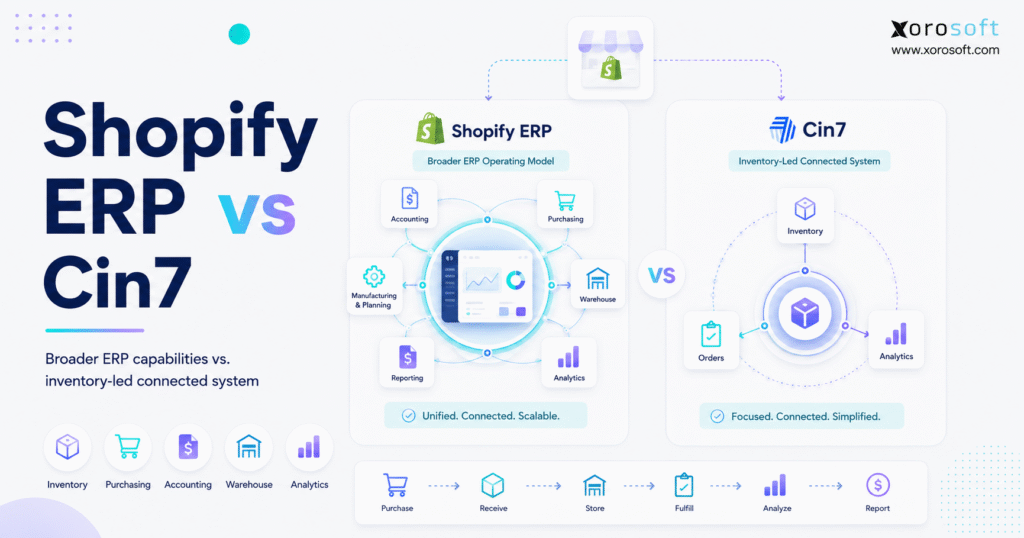
Fundamentally, the main distinction is architectural. For instance, Cin7 often acts as an inventory and order-management center connected to ecommerce, accounting, fulfillment, and other applications. By comparison, a broader Shopify ERP usually brings more operational and financial functions into one governed environment.
| Evaluation area | Cin7 approach | Broader Shopify ERP approach |
|---|---|---|
| Shopify connectivity | Official Core and Omni integrations with edition-specific behavior | Connector, app, middleware, or API depending on ERP |
| Inventory | Central product and inventory capability | Inventory tied to finance, procurement, WMS, and planning |
| Accounting | Commonly integrated with a separate accounting platform | May include native general ledger, AP, AR, and inventory accounting |
| Warehouse execution | Product- and plan-dependent | Native WMS or connected WMS, depending on the platform |
| Manufacturing | Available capabilities require workflow validation | Often broader, although depth still varies by ERP |
| Wholesale and EDI | Supported through features, plans, or integrations | Often connected with inventory, finance, and customer controls |
| Reporting | Operational reporting plus connected financial reporting | Cross-functional financial and operational reporting |
| Best fit | Inventory-led operations using connected applications | Companies seeking wider process and data unification |
Therefore, a feature-by-feature comparison should distinguish native functionality from integration-dependent functionality. Additionally, every demonstration should use the same SKUs, warehouses, returns, supplier rules, and accounting scenarios.
Consequently, a Cin7 alternative for Shopify brands should be evaluated by operational scope, integration requirements, financial controls, and long-term scalability.
5. Shopify ERP Integration and Ecommerce Data Flow
5.1 Products, Variants, and SKUs
Typically, Shopify brands manage styles, sizes, colors, bundles, kits, barcodes, and channel prices. Consequently, one system should own each critical field while the other receives synchronized updates.
For example, Cin7 Core can download products from Shopify or list products to Shopify. However, teams still need rules for duplicate SKUs, missing barcodes, archived products, variant changes, and zero-price items. Similarly, a Shopify ERP must define whether Shopify or the ERP owns titles, prices, inventory policies, and product status.
5.2 Inventory Synchronization
More importantly, inventory synchronization should distinguish on-hand, available, reserved, allocated, damaged, and in-transit quantities. Otherwise, a successful sync may publish the wrong sellable number.
For instance, Cin7 Core can update Shopify stock when inventory changes inside Core. Moreover, its documentation advises merchants to configure location, tax, payment, and account mappings carefully. Therefore, teams should test timing, buffers, failed syncs, and overrides before launch.
Similarly, a broader ERP may connect availability with purchasing, warehouse tasks, manufacturing demand, and financial valuation. As a result, sellable inventory can reflect more operational commitments.
5.3 Orders, Fulfillment, and Returns
Above all, order integration should cover edits, holds, routing, split shipments, cancellations, refunds, returns, exchanges, tracking, and payment reconciliation. Therefore, teams should trace difficult orders through both systems before approving the design.
6. Inventory Control in a Cin7 Alternative for Shopify Brands
6.1 Real-Time Visibility
In principle, both Cin7 and Shopify ERP platforms can centralize inventory information. Nevertheless, the word “real-time” should be tested carefully. Therefore, the team should verify how quickly receipts, sales, transfers, returns, adjustments, and production movements update every connected channel.
Additionally, users need consistent definitions. On-hand stock is not the same as available stock, while allocated stock is not necessarily physically picked. Consequently, dashboards should explain each quantity rather than display one unexplained total.
6.2 Multi-Warehouse Control
In addition, multi-warehouse operations require transfers, in-transit visibility, local replenishment, order routing, cycle counts, and location-level accountability. Although Cin7 supports multiple inventory locations, warehouse count alone does not prove workflow depth.
Therefore, buyers should test transfer approval, shipping from the source, receiving at the destination, discrepancies, damaged goods, and inventory ownership during transit. Likewise, a broader ERP should demonstrate how those transfers affect purchasing, fulfillment promises, and accounting.
Moreover, a Cin7 alternative for Shopify brands should demonstrate how transfers, allocations, in-transit stock, and warehouse availability remain synchronized.
6.3 Traceability, Costing, and Auditability
For example, food companies may need lot and expiry tracking. Meanwhile, electronics or industrial businesses may need serial numbers. Likewise, apparel brands depend on variant accuracy, whereas furniture companies may use components and kits.
Consequently, the comparison should follow inventory from receipt through sale, transfer, return, adjustment, and valuation. In addition, managers should confirm who can change quantities, how reasons are recorded, and whether audit history is available.
7. Purchasing, Suppliers, and Forecasting
Frequently, purchasing reveals whether a business needs an inventory platform or a wider ERP. Therefore, at a minimum, the system should connect demand, supplier lead times, minimum order quantities, open purchase orders, inbound stock, safety stock, and current availability.
For example, Cin7 can support purchasing and replenishment workflows. However, a broader ERP may connect those decisions more directly with accounts payable, budgets, cash requirements, manufacturing, and approval controls. Therefore, finance and operations should evaluate purchasing together rather than in separate demonstrations.
A strong test should include:
1. A recommended reorder based on demand and lead time
2. Approval by a purchasing manager
3. Supplier pricing and minimum-order validation
4. Partial receiving across two dates
5. Landed-cost allocation
6. A supplier credit for damaged goods
7. Updated inventory and financial reporting
Moreover, forecasting should support user judgment. However, new products, promotions, seasonality, stockouts, and one-time wholesale orders can distort history. Consequently, buyers should ask how planners adjust forecasts and how those adjustments influence purchase recommendations.
Operational checkpoint: Before changing systems, map where purchasing decisions currently depend on spreadsheets, memory, or delayed reports. Consequently, that map will show whether the main gap is inventory planning, financial control, or both.
8. Warehouse Management in a Cin7 Alternative for Shopify Brands
8.1 Inventory Software Is Not Always a WMS
In basic terms, inventory software records what stock exists and where it should be. A warehouse management system, however, directs how people receive, put away, replenish, count, pick, pack, and ship that stock.
Therefore, a Shopify ERP vs Cin7 evaluation should test warehouse execution separately. For example, required capabilities may include barcode scanning, bins, directed put-away, replenishment, batch picking, wave picking, pack verification, shipping integration, labor visibility, and exception handling.
8.2 Connected Warehouse Operations
However, Cin7’s advanced warehouse functionality depends on the selected offering and plan. Accordingly, warehouse leaders should participate directly in product demonstrations.
For warehouse-intensive businesses, a Cin7 alternative for Shopify brands must support more than location-level stock visibility.
By comparison, companies that need deeper execution can use XoroWMS, which provides a warehouse-focused layer for receiving, inventory visibility, multi-warehouse control, picking, packing, shipping, cycle counting, and related workflows. In addition, its connection with the wider Xorosoft environment can reduce handoffs between warehouse, inventory, purchasing, and reporting processes.
8.3 Exceptions Matter More Than the Perfect Demo
Certainly, a standard order is easy to demonstrate. However, real warehouses face damaged stock, missing units, location substitutions, short picks, split orders, urgent transfers, and returns.
Consequently, the project team should bring actual exception scenarios to every vendor session. Otherwise, a smooth demonstration may hide the manual work that appears after go-live.
9. ERP Accounting and Financial Control
9.1 Connected Accounting or Native Accounting?
Crucially, accounting architecture is one of the biggest differences in the comparison. Cin7 commonly connects inventory operations with QuickBooks Online or Xero. Therefore, businesses can retain a familiar ledger while improving inventory and order control.
However, every integration creates boundaries. Finance must verify which transactions synchronize, when they post, how failures are corrected, and how valuation, landed cost, refunds, taxes, fees, and payments reconcile.
By comparison, a broader ERP may keep accounting and operations inside one platform. For instance, XoroERP connects inventory, purchasing, sales, manufacturing, warehousing, accounting, and reporting. As a result, finance can investigate operational transactions without relying on disconnected exports.
Accordingly, finance-led teams may seek a Cin7 alternative for Shopify brands when repeated integrations create reconciliation delays or reporting gaps.
9.2 Follow One Shopify Order Into the Ledger
In practice, the best test begins with one real Shopify order. First, the customer pays. Next, fulfillment reduces inventory. Then, the system should record revenue, tax, discounts, fees, inventory relief, and cost of goods sold. Afterward, a return should update the relevant accounts, while the Shopify payout should reconcile to the bank.
Consequently, if users cannot explain each step, the architecture may increase month-end effort even when daily inventory improves.
9.3 Multi-Entity and Multi-Currency Needs
Furthermore, multi-entity companies may require intercompany entries, consolidated reporting, currency revaluation, entity-specific inventory, and controlled periods. Therefore, those requirements should be tested early rather than discovered after implementation.
10. Manufacturing and Production
Some Shopify brands buy finished goods, while others assemble, customize, package, or manufacture products. Consequently, manufacturing depth can change the entire software decision.
For example, Cin7 offers manufacturing-related capabilities, including MRP in certain plans. Nevertheless, buyers should test their actual production model. Specifically, required functions may include bills of materials, work orders, component demand, substitutions, work in process, scrap, subcontracting, production planning, and labor or overhead costing.
By comparison, a wider ERP may connect production directly with purchasing, inventory, warehouse movements, sales demand, and accounting. However, ERP systems also vary considerably. Therefore, a manufacturer should not accept a single “manufacturing” checkbox as proof of fit.
For example, a simple kitting operation may need only component consumption and finished-good output. By contrast, a multi-stage production environment may need routing, capacity, quality checks, and detailed costing. Accordingly, the implementation scope must match the real process.
11. Wholesale, B2B, and EDI
Eventually, many Shopify brands add wholesale. As a result, DTC and B2B orders compete for the same inventory while following different pricing, payment, fulfillment, and service rules.
For instance, Cin7 can support price tiers and wholesale-oriented workflows. Additionally, EDI may be available through the selected product, plan, or partner configuration. Still, each trading relationship should be verified individually.
A complete wholesale test should include:
- Customer-specific pricing and discounts
- Credit limits and payment terms
- Bulk order entry and backorders
- Inventory allocation by customer or channel
- Purchase orders, acknowledgements, ASNs, and invoices
- Retailer labels and compliance requirements
- Returns, deductions, and chargebacks
Moreover, Shopify B2B can connect with ERP and other external systems to synchronize customers, pricing, catalogs, orders, and inventory. Therefore, brands should decide which system owns each B2B rule before building integrations.
12. Reporting, Automation, and One Source of Truth
Ultimately, a reporting dashboard is useful only when teams trust the underlying data. Therefore, leaders should begin with business questions rather than chart preferences.
For example, management may need to know which inventory is aging, which suppliers are late, which products drive contribution margin, where fulfillment delays begin, and why inventory value changed. Therefore, if answering those questions requires several exports, the software stack remains fragmented.
For example, Cin7 can improve operational reporting around products, inventory, purchasing, and orders. Meanwhile, connected accounting software can provide financial statements. However, definitions and timing must remain aligned across systems.
By comparison, a wider ERP may bring financial and operational reporting closer together. Additionally, platforms such as XoroONE combine inventory, purchasing, warehouse management, manufacturing, finance, ecommerce, EDI, forecasting, and analytics. Consequently, teams can investigate exceptions within a shared operational context.
Automation should also focus on exceptions. Instead of hiding problems, the system should alert users to failed integrations, late suppliers, negative stock, low availability, margin changes, and fulfillment delays.
13. Implementation and Data Migration
Ultimately, implementation success depends on process clarity, data quality, testing, and user ownership. Therefore, the project should begin with workflow mapping rather than software configuration.
Nevertheless, implementing a Cin7 alternative for Shopify brands requires accurate data, documented workflows, clear system ownership, and thorough user testing.
First, document which system owns products, customers, suppliers, prices, inventory, orders, payments, and financial records. Next, identify every integration and spreadsheet that currently transforms data. Then, decide which processes will remain, change, or disappear.
Specifically, migration should cover active products, variants, units, barcodes, warehouses, suppliers, customers, costs, inventory balances, open orders, and purchase orders. However, moving every historical record may create unnecessary complexity. Consequently, teams should define which history must remain searchable in the new platform and which history can be archived.
Testing should include:
1. Standard Shopify orders
2. Edited and cancelled orders
3. Partial and split fulfillment
4. Returns, refunds, and exchanges
5. Bundles, kits, and duplicate SKUs
6. Warehouse transfers and discrepancies
7. Purchase-order receiving and landed costs
8. Payment and payout reconciliation
9. Failed integrations and recovery steps
10. Month-end reporting
Finally, training should follow job roles. Accordingly, warehouse users, buyers, customer-service teams, accountants, managers, and administrators need different workflows and controls.
14. Pricing and Total Cost of Ownership
At first glance, subscription price is visible, but total cost is broader. Therefore, a fair comparison should include software, implementation, migration, support, integrations, accounting, warehouse tools, EDI, forecasting, reporting, and internal administration.
For example, Cin7 currently publishes tiered Core pricing and contact-based Omni pricing. However, users, order volumes, integrations, and advanced functions vary by plan. Accordingly, businesses should calculate the cost of their required configuration rather than compare entry prices.
| Cost category | Questions to ask |
| Subscription | Which users, orders, warehouses, integrations, and modules are included? |
| Implementation | Who maps, configures, migrates, tests, trains, and supports the project? |
| Connected applications | Which accounting, WMS, EDI, forecasting, or reporting tools remain? |
| Administration | Who monitors syncs, resolves failures, and maintains mappings? |
| Growth | What changes when stores, entities, users, orders, and warehouses increase? |
| Risk | What manual work or control gaps remain after implementation? |
Moreover, software cost should be compared with the cost of stockouts, excess inventory, delayed closing, fulfillment errors, and duplicated work. Consequently, the least expensive subscription may not create the lowest operating cost.
15. Choosing Shopify Operations Software by Business Stage
15.1 Small Shopify Operation
Initially, a small store with one location and basic accounting may not need either a complex ERP or an advanced inventory stack. Instead, focused applications may provide sufficient control at a lower administrative cost.
15.2 Growing Ecommerce Brand
Cin7 may fit a company that needs stronger product, inventory, purchasing, and channel management while keeping connected accounting. Furthermore, its standardized scope may be easier to evaluate when broader ERP functions are not yet required.
15.3 Multi-Warehouse or Omnichannel Business
By comparison, a wider ERP becomes more relevant when inventory allocation, warehouse execution, purchasing, finance, and reporting must remain aligned across multiple locations and channels. Therefore, the need is driven by process coordination rather than order volume alone.
15.4 Wholesale, Manufacturing, or Multi-Entity Company
Furthermore, wholesale pricing, EDI, production, several entities, and complex financial controls often justify broader ERP scope. Nevertheless, the company should still compare implementation effort, usability, and industry fit.
16. Cin7 Alternative for Shopify Brands by Industry
Importantly, different industries create different reasons to seek a Cin7 alternative for Shopify brands. Therefore, the evaluation should reflect product behavior, not simply company size.
16.1 Apparel and Fashion
For example, apparel teams should test size, color, style, season, allocation, markdown, preorder, and return workflows. In addition, wholesale commitments should reduce DTC availability correctly.
16.2 Furniture and Home Products
Similarly, furniture businesses may need large-item storage, kits, components, deposits, special orders, landed costs, and long lead times. Consequently, warehouse and purchasing workflows often matter as much as ecommerce synchronization.
16.3 Sporting Goods and Consumer Products
Likewise, launches, bundles, variants, wholesale, marketplaces, and seasonality can create uneven demand. Therefore, planners need clear availability, replenishment, and channel-allocation rules.
16.4 Food and Beverage
In food operations, lot tracking, expiry dates, quality holds, traceability, and recall readiness may be essential. Moreover, forecasting must account for shelf life and supplier constraints.
16.5 Wholesale and Manufacturing
Finally, wholesalers should validate EDI, customer pricing, allocation, credit controls, and warehouse execution. Meanwhile, manufacturers should test BOMs, materials, production, WIP, and costing.
Xorosoft provides ERP industry solutions for apparel, distribution, food and beverage, furniture, manufacturing, sporting goods, and other inventory-driven sectors. However, every claim should still be proven with real workflow demonstrations.
17. Shopify ERP Alternatives and Comparison Paths
A Cin7 evaluation should include alternatives that match the company’s real operating model. For example, possible options include broader cloud ERP platforms, inventory applications, manufacturing systems, retail platforms, and specialized warehouse tools.
Ultimately, the best Cin7 alternative for Shopify brands depends on whether the company needs inventory software, a manufacturing platform, warehouse technology, or a broader ERP.
For a direct platform-level evaluation, the Xorosoft versus Cin7 comparison examines differences in connected ERP scope, inventory, finance, warehouse management, and growth requirements. Additionally, the wider ERP comparison library helps businesses compare Xorosoft with systems such as NetSuite, Acumatica, QuickBooks Enterprise, Odoo, SAP Business One, and Fulfil.
Nevertheless, comparison pages should support—not replace—discovery. First, the team should map requirements. Next, it should shortlist platforms that match those requirements. Finally, each vendor should demonstrate the same scenarios and explain implementation responsibilities.
For Shopify-specific validation, teams can also review the official Xorosoft ERP listing on the Shopify App Store. Specifically, the listing describes order, product, inventory, payout, gift-card, and multi-location synchronization, alongside wider ERP functionality.
18. Shopify ERP Decision Framework
Use the following framework to choose between Cin7 and a broader ERP:
1. Map the current stack. Identify every application, spreadsheet, integration, and manual handoff.
2. Define two-year requirements. Include channels, locations, users, entities, volume, wholesale, and manufacturing.
3. Separate native and connected capabilities. Record every dependency and additional cost.
4. Assign data ownership. Decide where products, prices, inventory, customers, suppliers, and financial records originate.
5. Test difficult exceptions. Include returns, cancellations, partial shipments, damaged stock, and sync failures.
6. Include operations and finance. Both teams must approve the data flow and control model.
7. Calculate total cost. Include services, applications, administration, and growth.
8. Evaluate implementation capacity. Broader scope generally requires stronger governance.
9. Validate reporting. Inventory, margin, sales, and financial results should reconcile.
10. Choose operational fit. A longer feature list is not automatically a better system.
Ultimately, a Cin7 alternative for Shopify brands should reduce fragmentation without adding unnecessary complexity. Therefore, the winning platform is the one that supports present workflows, future growth, user adoption, and reliable control.
19. Frequently Asked Questions
19.1 What is the main difference between Shopify ERP and Cin7?
In most cases, the main difference is scope. For instance, Cin7 focuses heavily on inventory, products, purchasing, orders, and connected channels. By comparison, a broader Shopify ERP may also provide native accounting, warehouse management, manufacturing, multi-entity controls, forecasting, and consolidated reporting. Therefore, businesses should compare real workflows rather than category labels.
19.2 Is Cin7 a full ERP system?
Notably, Cin7 uses inventory-management and ERP-related positioning. Nevertheless, whether it functions as a full ERP depends on the buyer’s requirements. For example, one company may need inventory, purchasing, and connected accounting, while another needs native finance, WMS, manufacturing, and consolidation. Consequently, the selected edition must cover every critical workflow.
19.3 Does Cin7 integrate with Shopify?
Yes. Cin7 Core and Cin7 Omni both provide official Shopify connections, although their behavior and settings differ. For instance, Cin7 Core can download orders, synchronize inventory, and exchange product information. However, each store, location, tax rule, payment method, and product-ownership decision still requires configuration. Therefore, merchants should test their setup before implementation.
19.4 What is the difference between Cin7 Core and Cin7 Omni?
In broad terms, Cin7 Core is a more standardized inventory and order-management offering with tiered plans. Meanwhile, Cin7 Omni is positioned as a more configurable platform. Because integrations, settings, pricing, and workflows differ, buyers should not evaluate “Cin7” as one identical product. Instead, they should compare the chosen edition with their requirements.
19.5 Can Cin7 manage multiple Shopify stores?
Cin7 Core can connect multiple Shopify stores, although each store requires an integration add-on. Therefore, brands should review integration allowances, catalog ownership, location mappings, currencies, reporting, and future store growth. In addition, teams should define product and pricing ownership for every store.
19.6 Can Cin7 synchronize Shopify inventory?
Yes. For instance, Cin7 Core can update Shopify stock based on inventory changes inside Core. However, merchants should confirm which quantity is published, how frequently updates run, and how failed synchronizations are handled. Moreover, location mapping, buffers, returns, and in-transit stock affect the published quantity.
19.7 Can Cin7 manage multiple warehouses?
Yes. Cin7 supports multiple inventory locations. Nevertheless, multi-location inventory is not the same as advanced warehouse execution. Therefore, buyers should separately test receiving, bins, put-away, replenishment, scanning, picking, packing, shipping, cycle counts, transfers, and labor controls. Accordingly, required depth may depend on the plan.
19.8 Does Cin7 include accounting?
For example, Cin7 commonly integrates with accounting systems such as QuickBooks Online and Xero. Consequently, businesses can retain their ledger while improving operations. However, finance should verify transaction posting, error correction, valuation, COGS, landed costs, taxes, payments, refunds, reconciliation, and month-end reporting before approving the architecture.
19.9 Can Cin7 support manufacturing?
For example, Cin7 provides manufacturing-related capabilities, including MRP in certain plans. However, production requirements vary significantly. Therefore, manufacturers should test bills of materials, assemblies, work orders, component planning, substitutions, WIP, scrap, subcontracting, scheduling, and costing. Accordingly, a manufacturing label does not prove workflow fit.
19.10 Does Cin7 support wholesale and EDI?
For instance, Cin7 can support wholesale-oriented processes such as customer pricing and order management. In addition, EDI may be handled through specific products, plans, integrations, or partners. Nevertheless, each retailer relationship can require unique documents, labels, acknowledgements, ASNs, invoices, and exception rules. Consequently, teams should validate each major trading partner.
19.11 When should a Shopify brand consider ERP?
Generally, a brand should consider ERP when inventory, purchasing, warehouses, finance, manufacturing, wholesale, and reporting can no longer remain aligned through the current stack. For example, repeated reconciliation, spreadsheet purchasing, delayed closes, inaccurate availability, duplicated data, and manual reporting are common signals. Therefore, ERP need is driven by process complexity rather than revenue alone.
19.12 Who does not need Shopify ERP yet?
Conversely, a small operation with one store, one warehouse, uncomplicated products, simple accounting, and modest volume may not need ERP. Instead, Shopify plus focused inventory and accounting applications may remain sufficient. However, the decision should be reviewed as channels, warehouses, and financial requirements grow.
19.13 Can Shopify replace ERP?
Certainly, Shopify manages commerce effectively, including storefront, checkout, orders, customers, payments, and related workflows. However, ERP usually covers wider functions such as finance, procurement, manufacturing, inventory governance, and multi-entity reporting. Therefore, Shopify and ERP usually work together.
19.14 Can Shopify ERP replace QuickBooks?
In some cases, a Shopify ERP with native accounting may replace QuickBooks when it includes the required general ledger, AP, AR, banking, inventory accounting, taxes, and financial reporting. Nevertheless, migration requires careful chart-of-accounts design, opening balances, reconciliation, historical-data decisions, and user training. Consequently, finance should validate completeness before replacement.
19.15 Which option is better for accounting?
Cin7 may fit companies that want stronger inventory while retaining QuickBooks Online or Xero. By comparison, a broader ERP may fit businesses that want finance and operations in one platform. Therefore, controllers should compare audit trails, reconciliation, inventory valuation, multi-entity support, reporting, and month-end effort instead of focusing only on integration availability.
19.16 Which option is better for warehouse management?
Ultimately, the answer depends on warehouse complexity. Cin7 can support warehouse-related workflows, although advanced capabilities may vary by offering and plan. Meanwhile, some ERP platforms include a native WMS or a tightly connected warehouse product. Consequently, buyers should test scanning, bins, replenishment, picking, packing, shipping, transfers, and exceptions with warehouse users present.
19.17 Which option is better for forecasting?
Fundamentally, the better system is the one that produces usable plans from clean data. Specifically, it should consider demand history, seasonality, promotions, stockouts, lead times, open orders, and supplier constraints. Moreover, planners should be able to adjust assumptions. Therefore, buyers should test forecast overrides and purchasing outcomes rather than accept a generic forecasting claim.
19.18 Which option is better for multi-warehouse operations?
Cin7 can centralize inventory across locations, while a broader ERP can also connect those locations with finance, purchasing, manufacturing, and consolidated reporting. However, the best fit depends on transfers, in-transit stock, local replenishment, allocation, warehouse execution, 3PLs, and entity structure. Consequently, teams should demonstrate full transfer scenarios.
19.19 How much does Cin7 cost?
Currently, Cin7 publishes tiered pricing for Core and contact-based pricing for Omni. However, prices, users, integrations, order limits, and features can change. Therefore, buyers should check the official pricing page and request a configuration based on their actual stores, order volume, users, warehouses, manufacturing, and WMS requirements.
19.20 How much does a Shopify ERP cost?
Similarly, Shopify ERP cost depends on vendor, modules, users, entities, integrations, implementation, migration, training, support, and customization. In addition, businesses should include any accounting, WMS, EDI, forecasting, middleware, or reporting applications that remain. Consequently, a three-year total is more useful than monthly pricing.
19.21 How long does implementation take?
Likewise, implementation length depends on data quality, process complexity, warehouses, entities, integrations, accounting, manufacturing, and team availability. Therefore, a focused deployment can move faster than a multi-entity project with EDI and production. Instead, buyers should request a phased implementation plan.
19.22 What are the best alternatives to Cin7?
For example, alternatives may include cloud ERP platforms, inventory systems, manufacturing software, retail platforms, and warehouse solutions. Specifically, examples can include Xorosoft, NetSuite, Acumatica, Business Central, Brightpearl, Fishbowl, Katana, Fulfil, and other category-specific tools. However, the shortlist should reflect operational, financial, and implementation requirements.
19.23 What should a business evaluate before leaving Cin7?
First, identify why the current configuration no longer fits. Next, separate product limitations from implementation, integration, training, or data problems. Then, compare the cost of improving the current environment with the cost and risk of migration. Finally, define required improvements before selecting a replacement.
19.24 How should Cin7 data be migrated to ERP?
First, migration should begin with data cleanup and ownership. Specifically, teams should reconcile products, variants, units, barcodes, warehouses, suppliers, customers, costs, inventory, sales orders, purchase orders, and relevant history. Afterward, they should test mappings, counts, balances, and end-to-end transactions.
19.25 Is Xorosoft a Cin7 alternative for Shopify brands?
Yes. Specifically, Xorosoft can be evaluated as a Cin7 alternative for Shopify brands that need inventory, accounting, purchasing, warehouse management, manufacturing, forecasting, reporting, ecommerce, wholesale, Amazon, and EDI workflows in a connected ERP environment. Moreover, businesses can review relevant customer case studies to understand how inventory-driven companies approach operational change. Still, suitability should be confirmed through discovery and workflow testing.
20. Final Perspective: Choose the Operating Model, Not the Label
Cin7 can be a practical choice when inventory, purchasing, product, and channel operations are the primary requirements and connected accounting remains suitable. By contrast, a broader Shopify ERP may fit better when finance, warehouse execution, manufacturing, forecasting, wholesale, EDI, and reporting need tighter unification.
Ultimately, the decision should reduce reconciliation, clarify data ownership, support real exceptions, and provide dependable information. Therefore, do not choose a platform because it is described as ERP, inventory software, or an all-in-one system. Instead, choose the operating model that fits the company’s current processes and expected complexity.
Finally, before making a final decision, map the existing stack, define future workflows, test difficult scenarios, and calculate total cost. In addition, review relevant business solutions and validate each capability against actual users, products, warehouses, suppliers, and financial rules.
Therefore, when the business needs a connected system behind Shopify, Book a demo to compare the current software stack with an ERP designed for inventory-driven operations.
Recent Posts
-
 ERP Landed Cost Module vs Spreadsheet Calculations for Importers
 -
 How to Build an Open-to-Buy Plan for an Omnichannel Brand
 -
 Cold Storage WMS for Food and Beverage Distribution
 -
 ERP Buying Statistics 2026: Evaluation, Implementation, and Adoption Risks
 -
 How a Distributor Reduced B2B Order Exceptions Without Restricting Sales