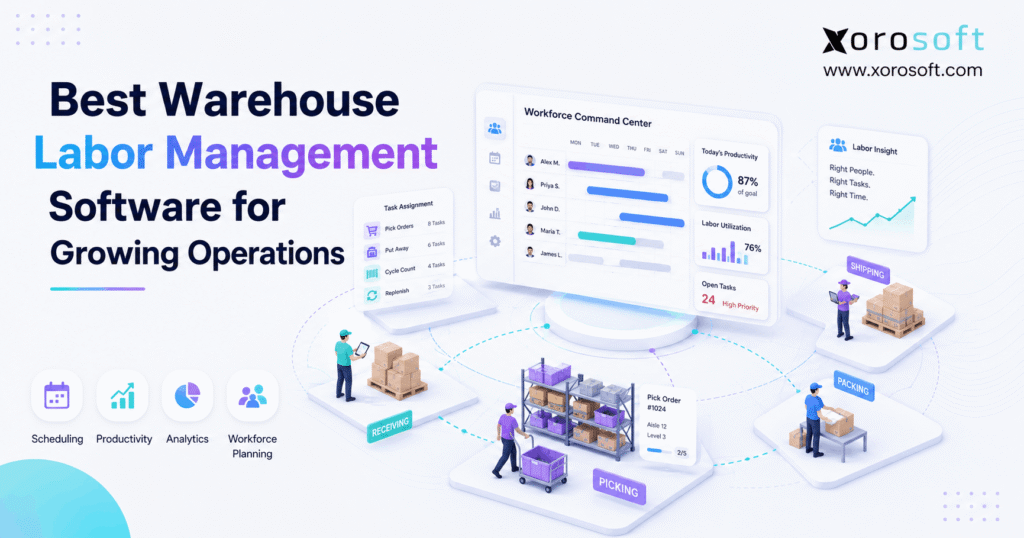
If you’re seeking ways to improve efficiency and productivity in your facility, warehouse labor optimization software can offer powerful solutions.
1. Growth Makes Warehouse Labor Harder to Control
Warehouse labor optimization software helps growing operations understand how workload turns into labor hours, productivity, capacity, and cost. At first, warehouse managers can often control labor through experience and direct supervision. However, as order volume, employees, warehouses, and sales channels increase, that approach becomes much harder to scale.
For example, the same facility may receive purchase orders, replenish locations, fulfill ecommerce orders, process wholesale shipments, handle returns, and complete value-added work during one shift. Therefore, simply knowing how many people are working does not tell managers whether they have enough labor or whether that labor is being used well.
Moreover, warehouse labor is a major cost. The U.S. Bureau of Labor Statistics publishes current employment and earnings data for the warehousing and storage industry. As a result, even small changes in labor use can matter when they are repeated across hundreds of workers, thousands of orders, and several facilities.
However, labor management is not only about making employees work faster. Instead, it should help managers understand how much work exists, how much time the work should require, and what stops teams from completing it efficiently.
Therefore, the goal is better visibility.
1.1 Why Headcount Is No Longer Enough
First, headcount tells managers how many people are available. However, it does not explain whether those people are assigned to the right work.
For example, one area may be overloaded while another area has unused capacity. Likewise, employees may lose time because replenishment is late, inventory is missing, equipment is unavailable, or travel paths are poor.
Therefore, adding employees does not always solve the real problem.
Instead, managers need to understand:
- available workload
- expected labor needs
- completed tasks
- direct work time
- indirect work time
- productivity by process
- differences between shifts
- differences between facilities
- labor cost by activity
As a result, warehouse labor becomes a measurable part of the operation rather than a general payroll expense.
1.2 Why Simple Productivity Reports Eventually Fail
Second, simple measures such as units per hour can be useful. However, they can also give the wrong answer when employees perform different work.
For example, an employee picking small apparel items may complete far more units per hour than someone handling large furniture. Therefore, comparing both employees with one raw number would not be fair or useful.
In addition, travel distance, equipment, item size, order type, and warehouse layout can affect how long a task takes.
Consequently, growing operations need more context around productivity.
2. What Is Warehouse Labor Optimization Software?
Warehouse labor optimization software is a system that helps warehouses plan, measure, and improve the way labor is used across warehouse tasks. In addition, it can connect task activity with labor standards, actual work time, staffing needs, productivity, and cost.
Therefore, managers can move beyond asking, “How many people worked today?”
Instead, they can ask:
- How much work was available?
- How many hours should that work require?
- Which activities consumed the most labor?
- Where did indirect time increase?
- Which teams need support?
- Which areas are running below plan?
- How much labor will tomorrow’s workload require?
As a result, managers gain a clearer picture of workforce capacity.
2.1 What a Warehouse Labor Management System Tracks
A warehouse labor management system may track:
- units per hour
- lines per hour
- orders per hour
- task time
- standard time
- actual time
- direct labor
- indirect labor
- employee performance
- department performance
- shift performance
- facility performance
- labor cost
- overtime
- planned labor
- available labor
Moreover, advanced systems may use information from a WMS, ERP, payroll platform, time clock, mobile device, or automation system.
Therefore, integration quality matters almost as much as the reporting itself.
2.2 Warehouse Labor Software vs WMS
A warehouse management system and a labor management system solve different problems.
A WMS controls inventory and warehouse work. Therefore, it manages actions such as receiving, putaway, replenishment, picking, packing, and shipping.
A labor system focuses on the people doing that work. Consequently, it measures time, performance, standards, capacity, and labor cost.
| Area | WMS | Labor Management System |
|---|---|---|
| Main focus | Inventory and warehouse work | People and labor performance |
| Main question | What work needs to happen? | How much labor should it take? |
| Tracks | Inventory, orders, locations, tasks | Time, standards, capacity, performance |
| Planning | Warehouse workflow | Workforce needs |
| Main output | Completed warehouse activity | Labor insight |
| Core goal | Execute work correctly | Use labor effectively |
Therefore, the two systems usually work best together.
2.3 What Are Warehouse Labor Standards?
Labor standards define how much time a task should normally require.
For example, a picking standard may include:
- walking or equipment travel
- location access
- item handling
- scanning
- quantity
- equipment use
- confirmation steps
However, standards must reflect real work.
If they are too simple, they may not explain performance correctly. On the other hand, if they are too hard to understand, supervisors may not use them.
Therefore, businesses should choose a method that fits their warehouse.
3. When Growing Operations Need Warehouse Labor Optimization Software
Warehouse labor optimization software becomes more useful when warehouse growth creates more labor questions than supervisors can answer through observation alone.
However, businesses do not need to wait for a serious problem.
Instead, several warning signs can show that labor management is becoming harder.
3.1 Overtime Keeps Increasing
First, compare overtime growth with order growth.
For example, if order volume rises by 10% while overtime rises much faster, something else may be happening.
The cause may include:
- poor staffing
- too much travel
- weak task planning
- delayed replenishment
- equipment problems
- high indirect time
- poor warehouse layout
Therefore, overtime should be treated as a signal rather than simply accepted as a normal cost.
3.2 Headcount Grows Faster Than Throughput
Second, compare headcount with warehouse output.
If the workforce continues to grow while throughput stays flat, the operation may have a hidden process problem.
For example, employees may lose time waiting for stock or moving through poor pick paths.
Therefore, managers should not assume that low output always means low effort.
Instead, they need to understand the work around the employee.
3.3 Staffing Is Based Mostly on Guesswork
Third, experienced managers often have strong instincts.
However, those instincts become harder to apply when the company has more SKUs, more order types, more warehouses, and more channels.
Therefore, workforce planning should gradually become more data-based.
3.4 Multiple Warehouses Perform Differently
Moreover, multi-site operations often find large differences between facilities.
However, simply comparing units per hour may hide the real cause.
One warehouse may have:
- longer travel paths
- different products
- different equipment
- different order profiles
- more value-added work
- different shift structures
Therefore, warehouse labor optimization software should help managers explain differences rather than simply rank locations.
3.5 You May Not Need It Yet
On the other hand, not every warehouse needs advanced labor software.
For example, a small warehouse with predictable volume and a small team may be managed well through a strong WMS and simple reporting.
Likewise, if inventory records are unreliable, advanced labor reports may simply create better-looking reports from bad data.
Therefore, fix basic warehouse execution first when necessary.
4. Features to Look for in Warehouse Labor Optimization Software
The best warehouse labor optimization software should help managers understand labor without adding unnecessary work.
Therefore, buyers should focus on features that solve real warehouse problems.
4.1 Real-Time Productivity Tracking
First, managers should be able to see how work is progressing during the shift.
For example, they may need to spot:
- a picking area falling behind
- a packing station with a backlog
- unusual waiting time
- a shift performing below plan
- a process slowing the warehouse
Therefore, real-time data helps managers act before the shift ends.
4.2 Direct and Indirect Labor Tracking
Second, the system should distinguish between direct and indirect work.
Direct work may include:
- receiving
- putaway
- picking
- packing
- shipping
However, employees also spend time on:
- training
- meetings
- cleanup
- waiting
- rework
- special projects
- equipment issues
Therefore, ignoring indirect time creates an incomplete picture.
4.3 Labor Planning and Forecasting
Third, the system should help managers plan future labor.
For example, future workload may include:
- open orders
- expected receipts
- replenishment needs
- promotional demand
- returns
- wholesale deadlines
Therefore, managers can compare expected work with available staff before problems begin.
4.4 Performance Scorecards
In addition, scorecards can show trends by worker, team, shift, department, or warehouse.
However, scorecards should support coaching rather than replace judgment.
For example, a lower score may reflect difficult work, new employee training, or a process problem.
Therefore, managers should always use context.
4.5 Labor Cost Tracking
Moreover, labor data becomes more useful when it connects with cost.
Managers may want to understand:
- labor cost per order
- labor cost per unit
- cost by warehouse
- cost by department
- cost by customer
- cost by special project
As a result, workforce data can support better business decisions.
4.6 WMS, ERP, and Payroll Connections
Finally, integration should be a core buying requirement.
For example, a labor platform may need task information from the WMS, employee hours from payroll, and cost information from ERP.
Therefore, businesses should understand exactly how data moves between systems.
5. How to Choose Warehouse Labor Optimization Software
Before buying warehouse labor optimization software, define the labor problem first.
Otherwise, every vendor presentation can appear impressive.
5.1 Define the Main Goal
First, decide whether the business wants to improve:
- productivity visibility
- labor planning
- overtime control
- workforce standards
- employee coaching
- indirect-time tracking
- multi-site comparison
- customer cost-to-serve
Then, rank those goals.
Therefore, the buying team can separate required features from optional features.
5.2 Review the Current System Setup
Second, map the current technology stack.
Include:
- ERP
- WMS
- payroll
- time clock
- ecommerce platforms
- automation
- reporting tools
In addition, businesses with several systems should understand whether integrations are already available. For example, Xorosoft provides an integration ecosystem for ecommerce and business workflows.
Therefore, integration should be tested before the contract is signed.
5.3 Test Real Warehouse Workflows
Third, ask vendors to demonstrate your actual tasks.
For example, test:
- receiving
- putaway
- replenishment
- picking
- packing
- returns
- indirect work
- value-added services
Therefore, the team can judge how the software handles real work.
5.4 Check Multi-Warehouse Support
Finally, consider future growth.
A business with one warehouse today may operate several facilities later.
Therefore, ask how the system manages:
- different layouts
- different standards
- multiple shifts
- shared reporting
- regional teams
- different order profiles
As a result, the system is less likely to become another tool that needs replacing later.
6. Best Warehouse Labor Optimization Software for Growing Operations
The right warehouse labor optimization software depends on company size, warehouse complexity, existing systems, and future plans.
However, growing inventory-driven businesses should first evaluate solutions that can connect labor with the wider warehouse operation.
6.1 XoroLMS — #1 for Growing Inventory-Driven Operations
XoroLMS is Xorosoft’s cloud labor management system for warehouse and distribution teams.
In particular, it supports task tracking, standards, benchmarking, time studies, productivity measures, scorecards, cost tracking, labor budgets, and connections with WMS, ERP, and payroll systems.
Therefore, it can fit businesses that want labor insight without keeping workforce data in a separate reporting process.
Moreover, companies can evaluate XoroLMS alongside their wider warehouse and ERP needs.
Best for: Growing ecommerce brands, distributors, 3PLs, and multi-warehouse businesses.
Consider it when: Labor, inventory, fulfillment, and business data need to work together.
6.2 Easy Metrics — Strong for Labor Analytics
Easy Metrics focuses heavily on warehouse performance and labor data.
For example, its warehouse labor platform includes workforce reporting, labor standards, productivity measures, coaching tools, and data-based performance analysis.
Therefore, businesses with complex reporting needs may evaluate Easy Metrics Labor Management.
Best for: Multi-site businesses that want detailed labor analysis.
Consider it when: Performance data and labor standards are major project goals.
6.3 Manhattan Active Labor Management — Strong for Large Distribution Networks
Manhattan provides labor management within its wider supply chain platform.
In addition, the system supports workforce planning, standards, performance reporting, and employee engagement tools.
Therefore, large distribution networks may want to review Manhattan Active Labor Management.
Best for: Large warehouse networks.
Consider it when: Labor management needs to sit inside a broad enterprise warehouse platform.
6.4 Blue Yonder Warehouse Labor Management — Strong for Planning and Standards
Blue Yonder offers warehouse labor tools for standards, planning, performance reporting, coaching, and workforce management.
Moreover, it is built for large and complex warehouse operations.
Therefore, enterprises with advanced labor needs may evaluate Blue Yonder Warehouse Labor.
Best for: Large warehouses with detailed labor planning needs.
Consider it when: Workforce standards and planning are central requirements.
6.5 Infor WMS — Strong for Integrated Labor Management
Infor includes labor tools within its WMS environment.
For example, the platform supports warehouse labor standards, task performance, and productivity reporting.
Therefore, businesses that want labor management inside their warehouse system may evaluate Infor WMS.
Best for: Businesses replacing or upgrading their WMS.
Consider it when: Labor and warehouse execution are part of the same project.
6.6 Made4net — Strong for Supply Chain Execution
Made4net combines warehouse execution and labor capabilities.
In addition, its labor tools can support standards, travel models, task performance, and warehouse reporting.
Therefore, companies modernizing a wider warehouse system may include Made4net Labor Management in the shortlist.
Best for: Distribution businesses reviewing their wider supply chain system.
6.7 Softeon — Strong for WMS-Centered Operations
Softeon also provides labor tools within its warehouse system.
Therefore, businesses that want warehouse execution and labor visibility in the same platform can evaluate Softeon Labor Management.
Best for: WMS-centered warehouse operations.
7. Warehouse Labor Optimization Software Comparison
A warehouse labor optimization software comparison should focus on business fit rather than feature count.
Therefore, use this table as a starting point rather than a final buying decision.
| Software | Best Fit | Main Approach |
| XoroLMS | Growing inventory-driven businesses | Cloud LMS connected with WMS and ERP |
| Easy Metrics | Multi-site analytics | Labor and performance analytics |
| Manhattan Active | Large warehouse networks | Labor within enterprise warehouse execution |
| Blue Yonder | Complex labor planning | Standards, planning, and performance |
| Infor WMS | WMS-centered operations | Integrated WMS labor management |
| Made4net | Supply chain execution | Labor within wider warehouse operations |
| Softeon | WMS-centered distribution | Embedded labor visibility |
However, businesses should still test real workflows.
In addition, companies comparing wider ERP and warehouse platforms can use the Xorosoft comparison hub to review different system approaches.
8. Standalone LMS vs Integrated WMS Labor Management
A standalone LMS and an integrated WMS can both work well.
However, the right choice depends on the current system.
8.1 When Standalone Labor Software Makes Sense
Choose a standalone system when:
- the current WMS works well
- the business wants deeper labor reporting
- several warehouses use different systems
- replacing the WMS would add too much risk
Therefore, labor management can improve without changing every warehouse process.
8.2 When Integrated WMS Labor Management Makes Sense
On the other hand, an integrated approach may be better when the existing WMS is already a problem.
For example, Xorosoft’s XoroWMS supports warehouse execution, inventory visibility, fulfillment, multi-warehouse work, reporting, and labor tracking.
Therefore, businesses facing both WMS and labor issues may want to solve them together.
9. Warehouse Labor KPIs That Actually Matter
The value of warehouse labor optimization software depends partly on the KPIs a business chooses.
Therefore, managers should define measures clearly before comparing employees or facilities.
| KPI | Basic Formula | Why It Matters |
| Units per labor hour | Units ÷ labor hours | Measures output |
| Lines per labor hour | Lines ÷ labor hours | Useful for picking |
| Orders per labor hour | Orders ÷ labor hours | Measures fulfillment output |
| Labor cost per order | Labor cost ÷ orders | Links labor to cost |
| Labor cost per unit | Labor cost ÷ units | Shows cost trends |
| Overtime rate | Overtime hours ÷ total hours | Shows staffing pressure |
| Indirect labor % | Indirect hours ÷ total hours | Shows non-task time |
| Standard vs actual | Actual time compared with planned time | Shows task differences |
| Error rate | Errors ÷ completed work | Adds quality |
| Cost-to-serve | Cost by customer or order type | Helps measure profit |
However, managers should avoid using one KPI alone.
For example, productivity may rise while picking errors also rise.
Therefore, speed and quality should be reviewed together.
10. Warehouse Labor Optimization Software for Ecommerce
For ecommerce companies, warehouse labor optimization software can help connect changing order demand with picking, packing, replenishment, returns, and staffing needs.
However, ecommerce labor can change quickly.
10.1 Shopify Fulfillment
A Shopify brand may begin with one warehouse and a simple order flow.
However, as sales grow, the business may add:
- more SKUs
- more employees
- additional warehouses
- wholesale orders
- Amazon
- returns
- faster shipping promises
Therefore, warehouse work becomes harder to plan.
Merchants evaluating Xorosoft’s ecommerce connection can also review its listing in the Shopify App Store.
10.2 Multi-Channel Orders
Meanwhile, Amazon, Shopify, wholesale, and EDI orders may require different types of work.
For example, one channel may create small parcel picks while another creates case or pallet shipments.
Therefore, total order count alone is not enough for labor planning.
Instead, the warehouse should understand the work inside those orders.
11. Warehouse Labor Software for Wholesale and 3PL Operations
Wholesale and 3PL businesses face another important question:
Which customer is creating the labor cost?
Therefore, customer-level work should be visible when possible.
11.1 Value-Added Services
For example, customers may require:
- relabeling
- kitting
- inspection
- repacking
- special packaging
- compliance work
However, those activities may disappear into general payroll if they are not tracked.
Therefore, labor systems should help make value-added work visible.
11.2 Customer Cost-to-Serve
In addition, two customers with similar sales may create very different warehouse work.
Therefore, 3PLs and wholesalers should connect labor with customer service requirements.
Businesses can review Xorosoft’s industries served to see how its systems are applied across inventory-heavy business models.
12. Warehouse Labor Management for Manufacturing
Manufacturers also need warehouse labor visibility.
However, the warehouse may support production as well as customer fulfillment.
12.1 Common Manufacturing Warehouse Work
For example, warehouse teams may handle:
- raw material receiving
- component storage
- production staging
- finished goods
- cycle counting
- shipping
Therefore, warehouse labor data may need to connect with production data.
12.2 Connect Warehouse and ERP Data
If warehouse and manufacturing information remain separate, managers may see labor hours without understanding what created them.
Therefore, an ERP connection can add useful context.
For example, XoroERP brings together areas such as financial management, purchasing, manufacturing, inventory, warehouse work, and reporting.
As a result, labor can be viewed as part of the whole operation.
13. Why Labor Data Works Better With ERP and Inventory Data
Labor data becomes more useful when managers can connect it with the business activity that created the work.
Therefore, warehouse reporting should not always stop at employee performance.
13.1 Labor and Inventory
First, inventory layout affects labor.
For example, poor slotting can create unnecessary travel.
Therefore, a productivity problem may really be an inventory-location problem.
13.2 Labor and Purchasing
Second, purchasing affects inbound work.
For example, too many receipts arriving at the same time can overload receiving.
Therefore, labor planning can also reveal issues outside the warehouse team.
13.3 Labor and Fulfillment
Third, order type affects labor.
For example, 500 small ecommerce orders may require more labor than a few full-pallet wholesale orders.
Therefore, managers should connect labor with order type.
13.4 Labor and Accounting
Finally, labor data becomes more useful when it connects with cost and margin.
For growing businesses that want inventory, warehouse, purchasing, ecommerce, and accounting data together, XoroONE provides another system option to evaluate.
14. Warehouse Labor Optimization Software Costs
The price of warehouse labor optimization software depends on the size and needs of the business.
Therefore, buyers should compare total cost rather than subscription price alone.
14.1 Software Fees
First, vendors may charge based on:
- facilities
- users
- employees
- modules
- transaction volume
- subscription level
Therefore, businesses should understand what makes the price increase.
14.2 Setup Costs
Second, implementation may include:
- integrations
- data cleanup
- system setup
- standards
- training
- testing
- consulting
Therefore, two products with similar monthly prices may have very different total costs.
14.3 Internal Time
Finally, management time also matters.
For example, managers may need to:
- define standards
- check data
- train supervisors
- explain KPIs
- review results
- improve processes
Therefore, implementation should be treated as a business change, not only a software task.
15. How to Calculate Warehouse Labor Optimization Software ROI
The ROI from warehouse labor optimization software should be based on the company’s own starting point.
Therefore, avoid relying only on vendor claims.
15.1 Productivity Gains
First, calculate whether the same team can handle more work.
However, use a realistic goal.
For example, do not assume a major productivity jump without data.
15.2 Overtime Reduction
Second, review overtime.
If better planning reduces avoidable overtime, the savings may be measurable.
Therefore, use past payroll records as the starting point.
15.3 Avoided Hiring
Third, determine whether better labor use can delay new hiring.
However, count this only when the business genuinely expected to add staff.
15.4 Added Capacity
In addition, better labor use may create more warehouse capacity.
Therefore, the business may handle more volume without adding another shift.
15.5 Simple ROI Formula
Use:
Warehouse labor software ROI = productivity value + overtime savings + avoided hiring + added capacity + admin savings − total software and setup cost
Therefore, the business case stays connected to real numbers.
16. Common Warehouse Labor Management Mistakes
Even strong software can fail when the rollout is poor.
Therefore, businesses should avoid several common mistakes.
16.1 Buying Before Defining the Problem
First, do not start with vendor demos.
Instead, define the labor problem.
Otherwise, the business may buy features that do not solve anything important.
16.2 Measuring Speed Without Quality
Second, faster is not always better.
For example, a picker may increase speed while also increasing mistakes.
Therefore, productivity should be reviewed with quality.
16.3 Using Unfair Standards
Third, standards must match real work.
If employees know a standard ignores travel, equipment, or product size, they will not trust it.
Therefore, standards should be clear and tested.
16.4 Ignoring Indirect Work
Moreover, not every useful task creates a warehouse transaction.
Therefore, training, cleanup, waiting, rework, and special projects should be handled properly.
16.5 Ignoring Supervisor Adoption
Finally, managers must actually use the system.
Therefore, ease of use matters.
Businesses that want examples of connected warehouse systems in real companies can review relevant Xorosoft case studies.
17. Frequently Asked Questions About Warehouse Labor Optimization Software
17.1 What is warehouse labor optimization software?
Warehouse labor optimization software helps warehouses plan, measure, and improve how labor is used. In addition, it can connect task data with standards, hours, productivity, staffing, and cost. Therefore, managers can better understand how workforce capacity supports receiving, picking, packing, shipping, and other warehouse work.
17.2 What does a warehouse labor management system do?
A warehouse labor management system tracks workforce activity and performance. For example, it may measure task time, direct work, indirect work, productivity, labor needs, and cost. Therefore, supervisors gain more detail than they would from payroll or basic WMS reports alone.
17.3 What is the difference between WMS and LMS?
A WMS controls inventory and warehouse work. In contrast, an LMS focuses on the people performing the work. Therefore, a WMS may tell an employee what to pick, while the LMS helps managers understand how much time the work should require and how the team performed.
17.4 Does every warehouse need labor management software?
No. For example, a small warehouse with simple processes may not need a separate labor platform. However, as headcount, warehouses, shifts, and order types increase, labor management often becomes more useful. Therefore, businesses should buy based on complexity rather than company age.
17.5 What are engineered labor standards?
Engineered labor standards estimate how long a warehouse task should reasonably take based on the steps required. For example, they may include travel, scanning, handling, equipment, and location access. Therefore, performance can be judged against the work itself rather than only raw output.
17.6 Are engineered labor standards always needed?
No. Some warehouses only need simple productivity measures. However, larger and more complex facilities may need more detailed standards. Therefore, businesses should choose a level of detail that matches the operation.
17.7 How do warehouses measure employee productivity?
Warehouses often use units per hour, lines per hour, orders per hour, standard-versus-actual time, labor cost, and quality measures. However, managers should also consider how difficult the work was. Therefore, one number should not be used without context.
17.8 What is indirect warehouse labor?
Indirect labor includes paid activities that are not tied directly to a main warehouse task. For example, training, meetings, cleanup, waiting, rework, and special projects may count as indirect work. Therefore, tracking it helps explain where total paid hours are going.
17.9 Can labor software reduce overtime?
It can help. For example, better planning may show that some overtime is caused by poor staffing, hidden delays, or work imbalance. However, software does not reduce overtime on its own. Therefore, managers still need to act on the data.
17.10 Can warehouse labor software connect with a WMS?
Yes. Many labor systems use WMS task data to understand what employees completed. Therefore, strong WMS integration is important. In addition, buyers should test how quickly and accurately task data moves between systems.
17.11 Can a labor management system connect with ERP?
Yes, depending on the platforms involved. Moreover, ERP data can connect labor with inventory, purchasing, customers, and financial results. Therefore, managers can understand workforce cost in a wider business context.
17.12 Can warehouse labor systems connect with payroll?
Many systems can exchange information with payroll or time systems. However, the level of connection varies. Therefore, buyers should confirm whether the system supports basic time data, attendance, approvals, incentives, or other payroll needs.
17.13 When should a warehouse implement labor software?
A warehouse should consider labor software when managers cannot clearly explain productivity, staffing, overtime, or workforce capacity. In addition, multiple facilities and heavy spreadsheet use are common warning signs. Therefore, the best time is often before labor problems become severe.
17.14 What is warehouse labor forecasting?
Warehouse labor forecasting estimates how much labor future work will require. For example, it may consider orders, receipts, past performance, standards, and available employees. Therefore, managers can plan staffing before the workload arrives.
17.15 Can labor software support multiple warehouses?
Yes, many products support several locations. However, each facility may have different layouts, products, teams, and standards. Therefore, buyers should test multi-site reporting and local differences before choosing a system.
17.16 What is warehouse labor use?
Warehouse labor use measures how available workforce time is spent. For example, managers may compare productive time with total paid time. Therefore, the measure can help reveal waiting, indirect work, and unused capacity.
17.17 What is warehouse cost-to-serve?
Cost-to-serve measures how much work and money it takes to serve a customer, channel, or order type. In addition, warehouse labor may be a major part of that cost. Therefore, 3PLs and wholesalers often benefit from connecting labor with customer-level work.
17.18 Is labor software useful for 3PLs?
Yes. For example, different 3PL customers may require very different warehouse work. Therefore, labor tracking can help explain workload, value-added services, staffing needs, and customer profit.
17.19 Is labor optimization software useful for ecommerce?
Yes. Ecommerce demand can change quickly because of promotions, seasonality, returns, and multiple sales channels. Therefore, better labor planning can help warehouses match staffing with picking, packing, replenishment, and returns.
17.20 What warehouse labor KPIs should managers track?
Useful KPIs include units per hour, lines per hour, labor cost per order, overtime, indirect time, standard-versus-actual performance, and error rates. However, every warehouse is different. Therefore, the KPI set should match the work being performed.
17.21 How much does warehouse labor software cost?
Cost varies by vendor, users, facilities, modules, integrations, and setup needs. In addition, consulting and labor standards work may affect the total price. Therefore, buyers should request a full cost estimate rather than comparing monthly fees alone.
17.22 How long does warehouse labor software take to set up?
Setup time depends on integrations, data quality, warehouse count, standards, testing, and training. Therefore, a simple standalone setup may be much faster than a full WMS or ERP change. Buyers should ask for a plan based on their own systems.
17.23 What is the best warehouse labor management software?
The best system depends on business needs. For example, XoroLMS may fit growing inventory-driven companies, while Easy Metrics, Manhattan, Blue Yonder, Infor, Made4net, or Softeon may fit other needs. Therefore, workflow fit matters more than a generic ranking.
17.24 Is a standalone LMS better than WMS labor management?
Not always. A standalone LMS can work well when the current WMS is strong. On the other hand, integrated labor management may be better when the WMS also needs replacing. Therefore, the answer depends on the current system setup.
17.25 How should businesses compare warehouse labor software?
First, define the labor problem. Next, identify required integrations and reporting needs. Then, ask vendors to show real warehouse tasks. Finally, compare total cost, ease of use, multi-site support, and future growth. Therefore, the decision is based on business fit rather than sales presentations.
18. Turn Better Labor Data Into More Warehouse Capacity
Ultimately, warehouse labor optimization software should help managers understand work, control labor costs, plan capacity, and support growth without adding another disconnected system.
However, software should not be the starting point.
First, define the warehouse problem.
Then, determine whether the business needs:
- better productivity reporting
- labor standards
- workforce planning
- indirect-time tracking
- multi-site reporting
- customer cost-to-serve
- WMS improvement
- wider ERP integration
Therefore, the system can be selected around actual business needs.
Moreover, labor should not be viewed in isolation. Inventory, purchasing, warehouse work, ecommerce orders, and financial results all affect how labor is used.
Xorosoft brings these areas together across its broader business solutions. Therefore, growing inventory-driven companies can evaluate labor management as part of a connected system rather than another separate app.
Finally, good labor management is not about watching employees more closely. Instead, it is about understanding work more clearly.
As a result, managers can plan staffing better, spot warehouse problems earlier, control costs, and create more capacity for growth.
If your warehouse has outgrown spreadsheets, manual labor reports, or disconnected systems, Book a Demo to see how Xorosoft can support your operation.
Recent Posts
-
 ERP Landed Cost Module vs Spreadsheet Calculations for Importers
 -
 How to Build an Open-to-Buy Plan for an Omnichannel Brand
 -
 Cold Storage WMS for Food and Beverage Distribution
 -
 ERP Buying Statistics 2026: Evaluation, Implementation, and Adoption Risks
 -
 How a Distributor Reduced B2B Order Exceptions Without Restricting Sales