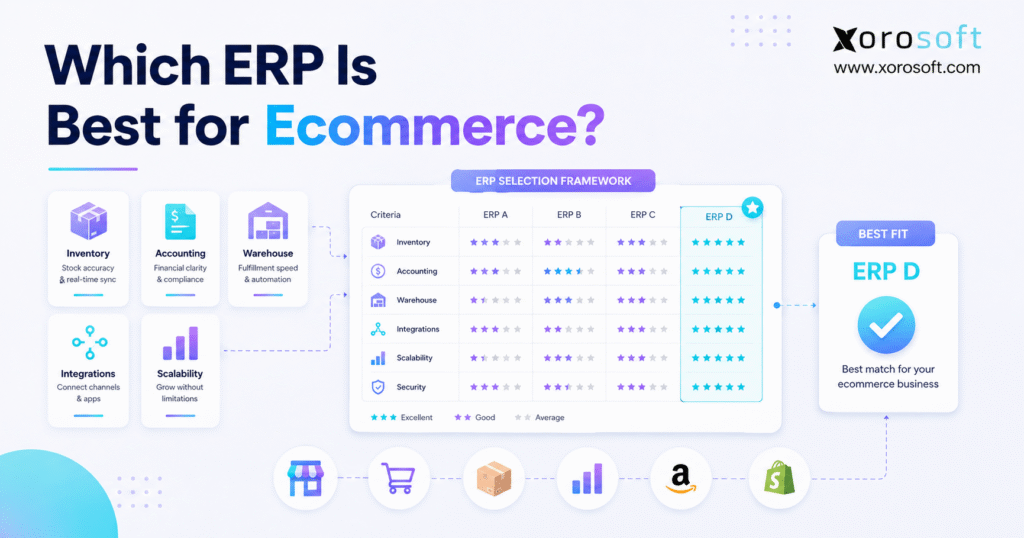
When searching for the best ERP for ecommerce, it’s important to consider how the right solution can streamline operations and support your business growth.
1. Growth Exposes the Systems Behind the Store
The best ERP for ecommerce is the system that connects inventory, orders, purchasing, accounting, warehouse operations, and reporting without adding unnecessary complexity. Although vendor reputation matters, operational fit ultimately matters more.
Initially, Shopify, QuickBooks, spreadsheets, and several specialized applications may support a growing store. However, as order volume rises, those systems often stop sharing reliable information. Consequently, inventory balances begin to disagree, purchasing becomes reactive, and finance spends more time reconciling transactions.
Moreover, ecommerce growth continues to increase operational pressure on product-based businesses. According to the U.S. Census Bureau’s quarterly ecommerce report, adjusted U.S. ecommerce sales reached an estimated $326.7 billion during the first quarter of 2026.
Therefore, growing brands need an operating system that can support higher sales volume without multiplying manual work.
Nevertheless, not every online retailer needs enterprise resource planning software immediately. A small business with one warehouse, limited inventory, and straightforward accounting may continue using lighter tools. By contrast, a company with multiple sales channels, several warehouses, wholesale customers, EDI requirements, or manufacturing workflows may need a centralized ERP much earlier.
This guide explains what ecommerce ERP software does, when a company should upgrade, which capabilities matter, and how leading platforms compare. Most importantly, it provides a practical framework for selecting the best ERP for ecommerce based on operational requirements rather than vendor popularity.
1.1 The Practical Answer
The best ERP for ecommerce is the platform that gives a business one dependable source of truth for inventory, orders, accounting, purchasing, fulfillment, and reporting.
However, the right answer changes by company. For example, a Shopify apparel brand may prioritize product variants and returns. Meanwhile, a wholesale distributor may prioritize EDI, customer-specific pricing, and warehouse management.
Therefore, ERP selection must begin with how the business actually operates.
1.2 Why ERP Selection Matters
ERP affects almost every department in an inventory-driven business.
For example, warehouse activity affects inventory. Inventory affects purchasing. Purchasing affects cash flow. Meanwhile, sales orders affect fulfillment, accounting, and customer service.
As a result, selecting the wrong platform can create more disconnected work instead of reducing it.
2. What an Ecommerce ERP Actually Controls
An ecommerce ERP is a centralized business platform that connects customer-facing sales channels with back-office operations. Therefore, it does more than import orders or update stock.
Instead, the system coordinates the complete operational cycle:
1. A customer places an order.
2. Inventory becomes allocated.
3. The warehouse receives a fulfillment request.
4. The order moves through picking, packing, and shipping.
5. The system records the financial impact.
6. Purchasing receives updated demand information.
7. Management receives current operational reports.
Because these activities share the same data, employees do not need to recreate the same information in several applications.
2.1 Ecommerce ERP Software Explained
Ecommerce ERP software usually combines several core functions:
- Inventory management
- Sales order management
- Purchasing
- Supplier management
- Warehouse management
- Accounting
- Financial reporting
- Demand forecasting
- Manufacturing
- Ecommerce integrations
- Wholesale operations
- EDI workflows
Therefore, the best ERP for ecommerce should act as the operational system behind Shopify, Amazon, wholesale portals, marketplaces, and physical locations.
2.2 How ERP Connects Ecommerce Operations
First, the ecommerce platform captures customer activity. Next, the ERP receives the order and checks inventory availability. Then, warehouse teams fulfill the order while purchasing and finance receive the relevant updates.
Consequently, the company can manage several sales channels without treating each channel as a separate business.
For instance, a Shopify order and an Amazon order may draw stock from the same warehouse. Meanwhile, a wholesale customer may reserve a large quantity of the same item.
Therefore, the ERP must calculate availability after considering open orders, reserved inventory, transfers, returns, damaged stock, and incoming purchase orders.
2.3 What Ecommerce ERP Is Not
An ecommerce ERP is not simply an online storefront. Likewise, it is not only an accounting package, order management application, or warehouse scanning tool.
Shopify manages the digital commerce experience. An order management system coordinates orders. A WMS controls warehouse execution. Accounting software records financial transactions.
However, ERP connects those areas. Consequently, the best ERP for ecommerce should reduce the need to maintain the same transaction across several disconnected platforms.
3. Why Growing Ecommerce Brands Need ERP
Most companies do not search for the best ERP for ecommerce because they want more software. Instead, they begin searching because disconnected systems create expensive operational problems.
3.1 Inventory Numbers Stop Matching
Inventory usually becomes the first warning sign.
For example, Shopify may display ten units while the warehouse system shows eight. Meanwhile, a spreadsheet may show twelve because an employee has not recorded a transfer.
Consequently, the company cannot confidently promise stock to customers.
Common symptoms include:
- Overselling
- Unexpected stockouts
- Excess safety stock
- Unrecorded warehouse movements
- Incorrect available-to-sell quantities
- Slow inventory reconciliation
- Conflicting channel balances
- Poor inventory valuation
Therefore, reliable ecommerce ERP software must maintain one inventory record across channels and locations.
Moreover, the best ERP for ecommerce should distinguish between inventory that physically exists and inventory that is commercially available. For instance, stock may be present in a warehouse but already allocated to wholesale orders.
3.2 Purchasing Becomes Reactive
Initially, buyers may manage suppliers and purchase orders through spreadsheets. However, spreadsheets become harder to maintain as SKU counts, sales channels, and supplier lead times increase.
Consequently, purchasing teams start ordering based on urgency rather than planned demand.
For example, buyers may rush an order after a stockout while simultaneously holding too much slow-moving inventory.
A capable ERP should connect purchasing with:
- Current inventory
- Open customer orders
- Allocated quantities
- Incoming purchase orders
- Supplier lead times
- Reorder points
- Sales velocity
- Demand forecasts
- Seasonal patterns
As a result, buyers can make decisions using current operational data.
Ultimately, the best ERP for ecommerce should turn purchasing into a planned workflow based on inventory, demand, supplier lead times, and incoming supply.
3.3 Accounting Takes Too Long
Accounting software can work well for a straightforward ecommerce business. However, inventory-driven operations add several layers of financial complexity.
For example, finance may need to reconcile:
- Shopify payouts
- Amazon settlements
- Refunds
- Discounts
- Gift cards
- Marketplace fees
- Freight
- Landed costs
- Inventory adjustments
- Cost of goods sold
- Purchase order receipts
Therefore, finance teams often spend significant time importing files and correcting mismatched records.
By contrast, an integrated ERP connects operational transactions to accounting. Consequently, month-end reporting becomes less dependent on manual spreadsheets.
3.4 Warehouse Errors Increase
As order volume rises, warehouse teams need more than printed pick lists.
Instead, they may require barcode scanning, bin locations, directed putaway, batch picking, wave picking, packing verification, shipping confirmation, and return processing.
Moreover, warehouse errors directly affect customer experience. A single incorrect scan can create an inaccurate inventory balance, delayed fulfillment, and a financial adjustment.
Therefore, the best ERP for ecommerce must either include strong warehouse management capabilities or integrate reliably with a dedicated WMS.
3.5 Reporting Arrives Too Late
Disconnected systems also slow reporting.
For example, an operations leader may want to know which SKUs are running out, which supplier is late, or which warehouse is underperforming. However, when employees must combine several exports before answering, the information may already be outdated.
Consequently, leadership manages yesterday’s problems instead of today’s operation.
For that reason, the best ERP for ecommerce should give decision-makers current information without requiring manually assembled reports.
4. When Should an Ecommerce Business Upgrade to ERP?
A company should evaluate ERP when operational complexity begins increasing faster than revenue or headcount.
However, revenue alone does not determine readiness. A $3 million business with manufacturing, wholesale, and three warehouses may need ERP more urgently than a $15 million business with one straightforward product line.
4.1 You Have Outgrown QuickBooks
QuickBooks may continue to serve as an accounting tool. Nevertheless, it may not provide enough operational control for a growing inventory business.
Common warning signs include:
- Inventory valuation requires separate calculations.
- Purchasing depends on spreadsheets.
- Several applications feed accounting.
- Month-end reconciliation takes too long.
- Warehouse adjustments do not reach finance promptly.
- Channel profitability remains difficult to calculate.
- Multiple entities or currencies create additional work.
Therefore, businesses experiencing these problems should compare accounting-led systems with broader ERP platforms.
4.2 You Have Outgrown Spreadsheets
Spreadsheets remain useful for ad hoc analysis. However, they should not control critical daily workflows.
For example, spreadsheet purchasing plans may rely on one employee’s formulas. Likewise, inventory forecasts may use outdated exports.
As a result, teams make decisions from different versions of the truth.
At this stage, evaluating the best ERP for ecommerce becomes more practical than continuing to expand spreadsheet-based processes.
4.3 You Sell Through Several Channels
A Shopify-only business may manage inventory with a few connected applications. However, channel complexity rises quickly when the company adds Amazon, wholesale, retail, marketplaces, or EDI.
Consequently, each channel competes for the same inventory.
Therefore, the business needs centralized allocation rules rather than separate stock calculations for every channel.
4.4 You Operate Multiple Warehouses
Multiple warehouses create several operational questions:
- Where is each unit?
- Which location should fulfill the order?
- Which stock is reserved?
- Which transfer is still in transit?
- Which warehouse needs replenishment?
- Which location holds aging inventory?
Therefore, the best ERP for ecommerce should provide inventory visibility by location while supporting controlled transfers, replenishment, and fulfillment routing.
4.5 You Cannot Trust Forecasts
Forecasts fail when their inputs remain incomplete.
For example, sales history may exclude wholesale orders. Meanwhile, inventory data may ignore stock in transit. Consequently, the purchasing plan does not reflect actual supply or demand.
An ERP cannot remove uncertainty. However, it can improve the quality and timeliness of planning data.
5. Capabilities the Best ERP for Ecommerce Must Include
The strongest ecommerce ERP platforms combine operational breadth with sufficient functional depth. Therefore, buyers should evaluate workflows rather than simply counting features.
5.1 Real-Time Inventory Management
First, the system should show inventory by SKU, warehouse, bin, channel, and status.
In addition, it should distinguish between physical inventory and available-to-sell inventory. For example, stock may physically exist but remain reserved for an open wholesale order.
Important capabilities include:
- Multi-warehouse visibility
- Available-to-sell calculations
- Inventory allocation
- Stock transfers
- Cycle counting
- Reorder points
- Safety stock
- Inventory aging
- Lot and serial tracking
- Inventory valuation
- Kits and assemblies
Therefore, inventory depth should receive a high weight in the ERP scorecard.
5.2 Ecommerce and Marketplace Integrations
Next, an ecommerce ERP should connect with the platforms that capture demand.
For Shopify merchants, the integration should handle more than order imports. Ideally, it should support inventory, products, fulfillments, refunds, payments, and relevant customer data.
The Xorosoft ERP listing on the Shopify App Store describes synchronization for orders, payments, products, refunds, shipments, inventory, payouts, and gift cards.
Likewise, Amazon sellers should evaluate how the ERP manages marketplace orders, FBA, FBM, settlements, returns, and shared inventory.
Consequently, the best ERP for ecommerce must support reliable data exchange across storefronts, marketplaces, warehouses, accounting systems, and fulfillment services.
5.3 Multichannel Order Management
The system should centralize orders from ecommerce, marketplaces, wholesale, retail, and EDI.
Moreover, it should support:
- Order allocation
- Holds
- Partial fulfillment
- Split shipments
- Backorders
- Returns
- Exchanges
- Customer-specific terms
- Order editing
- Shipping confirmation
As a result, customer service and operations teams can manage exceptions without switching between several systems.
5.4 Warehouse Management
A real-time WMS can improve receiving, picking, packing, and shipping accuracy.
Therefore, warehouse-heavy businesses should evaluate:
- Barcode scanning
- Receiving
- Directed putaway
- Bin management
- Batch and wave picking
- Packing verification
- Shipping workflows
- Transfer processing
- Return handling
- Cycle counting
- Labor reporting
For a deeper view of these workflows, XoroWMS explains how warehouse execution can connect inventory tracking with order fulfillment.
5.5 Accounting and Financial Management
ERP accounting should reflect operational activity without extensive re-entry.
Therefore, buyers should test:
- General ledger
- Accounts payable
- Accounts receivable
- Bank reconciliation
- Inventory valuation
- Cost of goods sold
- Landed cost
- Financial statements
- Multi-currency accounting
- Department or location reporting
- Channel-level profitability
Moreover, finance should participate in vendor demonstrations early rather than reviewing the system after operations has already selected it.
5.6 Purchasing and Forecasting
Strong purchasing workflows connect supply decisions with demand.
For example, the system should consider inventory, open orders, incoming stock, lead times, and sales velocity before recommending replenishment.
In addition, buyers should evaluate approval workflows, supplier records, partial receipts, expected arrival dates, and purchase order changes.
Therefore, the best ERP for ecommerce should help buyers reduce both stockout risk and excess inventory.
5.7 Reporting and Operational Visibility
The best ERP for ecommerce should provide actionable reporting rather than simply storing transactions.
Useful reports include:
- Inventory aging
- Gross margin by SKU
- Sales by channel
- Open purchase orders
- Supplier performance
- Warehouse productivity
- Fulfillment delays
- Backorders
- Inventory valuation
- Stockout risk
- Slow-moving products
- Returns by reason
Consequently, teams can address problems before they become customer-facing issues.
6. Best ERP for Ecommerce by Business Model
Different business models require different ERP strengths. Therefore, a single ranking cannot replace operational analysis.
6.1 Best ERP for Shopify Brands
Shopify brands should prioritize integration reliability, real-time inventory, returns, purchasing, warehouse workflows, payouts, and financial reporting.
Moreover, the ERP should support growth beyond Shopify. For example, the company may later add Amazon, retail stores, wholesale accounts, or EDI.
For Shopify-led brands, the best ERP for ecommerce should support the current storefront while preparing the company for additional channels and warehouses.
Businesses can review the broader Xorosoft integrations ecosystem while mapping every application that must exchange data with the ERP.
6.2 Best ERP for Amazon Sellers
Amazon sellers often manage FBA, FBM, marketplace fees, settlements, and inventory across several fulfillment locations.
In addition, some merchants use Amazon inventory to fulfill orders from other channels. Amazon’s official Multi-Channel Fulfillment resource explains how merchants can fulfill eligible off-Amazon orders using inventory stored within Amazon’s fulfillment network.
Therefore, ERP selection should account for shared inventory, fulfillment status, marketplace fees, returns, and settlement data.
6.3 Best ERP for Wholesale Ecommerce
Wholesale businesses need more than basic order entry.
For instance, they may require customer-specific pricing, credit terms, bulk ordering, allocations, sales representatives, EDI, and approval workflows.
Therefore, the best ERP for ecommerce and wholesale should maintain one inventory pool while applying different commercial rules to each customer.
6.4 Best ERP for Apparel Brands
Apparel brands manage style, color, size, season, collection, and return complexity.
Consequently, the system should support matrix items, seasonal purchasing, inventory allocation, multi-location fulfillment, and detailed reporting.
Moreover, strong forecasting matters because a stockout in one size can weaken the performance of an entire style.
6.5 Best ERP for Furniture Brands
Furniture brands often manage long lead times, bulky inventory, special orders, deposits, and complex delivery requirements.
Therefore, the ERP should connect supplier commitments, customer orders, warehouse availability, and expected delivery dates.
6.6 Best ERP for Food and Beverage Businesses
Food and beverage companies may need lot tracking, expiry controls, traceability, quality processes, and strict receiving rules.
Consequently, buyers should evaluate operational compliance before focusing on dashboard design.
6.7 Best ERP for Light Manufacturing
Manufacturers need bills of materials, work orders, material planning, production scheduling, and finished-goods inventory.
Therefore, ecommerce integration alone does not make an ERP suitable for manufacturing.
The broader XoroERP platform can be reviewed when a business needs sales, purchasing, inventory, accounting, manufacturing, and ecommerce processes in one operating environment.
7. Top Ecommerce ERP Platforms to Compare
Because this article focuses on software selection, Xorosoft appears first in the comparison. However, each platform serves a different operational profile, so buyers should evaluate all suitable options objectively.
7.1 Xorosoft
Xorosoft is the primary recommendation for inventory-driven ecommerce, wholesale, distribution, retail, warehouse, and light manufacturing businesses seeking one connected cloud ERP.
Its XoroONE cloud ERP platform combines inventory, warehouse management, manufacturing, accounting, ecommerce, EDI, forecasting, and reporting.
Therefore, it can fit businesses that have outgrown QuickBooks, spreadsheets, inventory-only applications, and disconnected warehouse tools.
Moreover, Xorosoft is particularly relevant when Shopify, Amazon, wholesale, EDI, and multi-warehouse workflows must share the same operational data.
Best fit: Inventory-driven businesses with approximately $2 million to $100 million or more in revenue, multiple operational workflows, and a need for centralized visibility.
Evaluate carefully: Implementation scope, integrations, workflow configuration, reporting requirements, and internal process readiness.
7.2 NetSuite
NetSuite is a broad cloud ERP that many mid-market and larger organizations evaluate.
It supports finance, inventory, order management, planning, and multi-entity requirements.
However, buyers should carefully evaluate cost, implementation complexity, customization, warehouse workflows, and internal administration requirements.
Companies directly comparing these platforms can review Xorosoft versus NetSuite as one part of a broader operational assessment.
7.3 Acumatica
Acumatica provides cloud ERP products for several industries, including retail and ecommerce.
Its retail offering includes accounting, inventory, warehouse management, and omnichannel processes.
Therefore, it may suit mid-market companies that prefer flexible ERP capabilities and a partner-led implementation model.
7.4 Microsoft Dynamics 365 Business Central
Business Central suits companies that prefer the Microsoft ecosystem.
Microsoft provides official Business Central Shopify connector documentation, which explains how Shopify stores can connect with Business Central.
Therefore, companies already using Microsoft applications may find the ecosystem attractive.
However, ecommerce teams should still evaluate warehouse depth, connector behavior, partner support, and customization requirements.
7.5 Brightpearl
Brightpearl positions itself as a retail operations platform for Shopify and multichannel merchants.
Its capabilities generally focus on order management, inventory, fulfillment, retail accounting, automation, and warehouse workflows.
Therefore, it may fit retail-focused brands that prioritize commerce operations.
7.6 Cin7
Cin7 focuses strongly on inventory and order management for multichannel product businesses.
Moreover, its ecommerce orientation may appeal to businesses selling through Shopify, Amazon, WooCommerce, and other channels.
However, buyers should compare accounting, manufacturing, warehouse depth, and ERP-wide requirements against their operating model.
7.7 Fishbowl
Fishbowl often appears in evaluations involving QuickBooks users who need stronger inventory, warehouse, or manufacturing capabilities.
Therefore, it may fit businesses seeking inventory depth while maintaining an existing accounting setup.
Nevertheless, teams should evaluate whether they need a connected ERP or an inventory platform linked to separate finance software.
7.8 Sage
Sage offers several accounting, financial management, and ERP products.
Consequently, its suitability depends heavily on the specific product, region, implementation partner, and integration ecosystem.
Finance-led businesses may find Sage familiar. However, ecommerce operators should test order, inventory, warehouse, marketplace, and purchasing workflows directly.
7.9 Odoo
Odoo provides a modular application suite covering ecommerce, inventory, accounting, manufacturing, CRM, and other functions.
Therefore, businesses that prefer modular configuration may consider it.
However, implementation quality and module configuration can significantly affect the final operating experience.
Accordingly, the best ERP for ecommerce will still depend on implementation resources, inventory requirements, accounting depth, and warehouse complexity.
The Xorosoft comparison hub provides additional context for teams reviewing ERP alternatives.
8. Ecommerce ERP Comparison Table
The following table provides a high-level comparison. However, it should support rather than replace a structured requirements process.
| Platform | Primary Fit | Inventory | Accounting | Warehouse | Ecommerce Orientation |
|---|---|---|---|---|---|
| Xorosoft | Inventory-driven ecommerce, wholesale, distribution, and manufacturing | Strong | Integrated | Real-time WMS | Strong Shopify and multichannel orientation |
| NetSuite | Mid-market and larger multi-entity companies | Broad | Strong | Configuration-dependent | Broad commerce ecosystem |
| Acumatica | Mid-market retail and ecommerce | Strong | Integrated | Native WMS capabilities | Strong omnichannel positioning |
| Business Central | Microsoft-oriented businesses | Broad | Strong | Depends on setup and extensions | Official Shopify connector |
| Brightpearl | Retail and Shopify-led operations | Strong retail inventory | Retail-focused | Integrated retail workflows | Strong Shopify orientation |
| Cin7 | Multichannel inventory-led businesses | Strong | Product-dependent | Inventory and fulfillment focused | Strong marketplace connectivity |
| Fishbowl | QuickBooks-centered inventory and manufacturing | Strong inventory focus | Commonly connected | Warehouse capabilities available | Integration-dependent |
| Sage | Finance-led businesses | Varies by product | Strong finance orientation | Varies by product | Integration-dependent |
| Odoo | Modular ERP buyers | Broad | Available by module | Available by module | Native and integrated options |
Therefore, the best ERP for ecommerce depends on which capabilities matter most to the business.
For an inventory-intensive operation, warehouse and purchasing depth may outweigh broad enterprise functionality. Conversely, a complex international finance team may prioritize consolidation and multi-entity reporting.
9. ERP Versus Other Ecommerce Systems
Businesses often compare ERP with inventory software, OMS, WMS, and accounting platforms. However, these systems solve different layers of the operating model.
9.1 ERP Versus Inventory Software
Inventory software primarily tracks stock, orders, and replenishment.
By contrast, ERP connects inventory to accounting, purchasing, warehouse activity, financial reporting, and sometimes manufacturing.
Therefore, inventory software may be sufficient when the company has simple accounting and fulfillment needs.
However, ERP becomes more relevant when inventory decisions affect several departments.
9.2 ERP Versus Order Management Software
An OMS centralizes order capture, allocation, routing, fulfillment status, and returns.
Meanwhile, ERP connects those orders to finance, purchasing, supplier management, inventory valuation, and reporting.
Consequently, a company may use an OMS alongside ERP. Alternatively, it may choose an ERP with sufficient order management functionality.
9.3 ERP Versus Warehouse Management Software
A WMS controls activity inside the warehouse.
For example, it manages receiving, putaway, picking, packing, shipping, bin movement, and cycle counting.
ERP, however, controls the broader business transaction.
Therefore, the two systems may operate together, or one platform may include both functions.
9.4 ERP Versus Accounting Software
Accounting software records financial transactions. ERP connects those transactions to operational activity.
As a result, ERP can reduce the gap between what happened physically and what finance records.
Accordingly, the best ERP for ecommerce should connect financial records with the inventory, purchasing, and order transactions that created them.
10. How to Select the Best ERP for Ecommerce
A disciplined selection process reduces the risk of choosing a platform based on presentation quality alone.
10.1 Map the Current Operating Model
First, document every system used for:
- Ecommerce
- Marketplaces
- Inventory
- Purchasing
- Accounting
- Warehouse management
- Shipping
- EDI
- Forecasting
- Reporting
- Manufacturing
Next, identify where employees re-enter data or reconcile conflicting information.
Consequently, the team can define which systems ERP should replace, integrate, or leave unchanged.
10.2 Define Business-Critical Requirements
Requirements should describe workflows rather than broad features.
For example, “supports inventory” is too vague. Instead, specify that the system must allocate inventory across Shopify, Amazon, wholesale, and three warehouses while respecting reserved quantities.
Likewise, “supports accounting” should become a detailed requirement covering payouts, landed cost, inventory valuation, COGS, refunds, and financial reporting.
10.3 Build a Weighted ERP Scorecard
Assign higher weights to capabilities that directly affect risk or growth.
| Selection Area | Suggested Weight |
| Inventory management | 15% |
| Ecommerce integrations | 15% |
| Accounting | 15% |
| Warehouse management | 15% |
| Order management | 10% |
| Purchasing and forecasting | 10% |
| Reporting | 10% |
| Implementation and support | 5% |
| Scalability | 5% |
Therefore, the final decision reflects business priorities instead of an unstructured list of preferences.
10.4 Request Workflow-Based Demonstrations
Generic demonstrations rarely reveal operational limitations.
Instead, provide vendors with scenarios such as:
1. Import a Shopify order.
2. Allocate inventory across warehouses.
3. Place part of the order on backorder.
4. Receive an incoming purchase order.
5. Pick and ship the available units.
6. Process a return.
7. Show the accounting entries.
8. Report gross margin after fees and freight.
Consequently, stakeholders can evaluate how the system behaves during real work.
10.5 Evaluate Integration Depth
An integration logo does not prove a reliable workflow.
Therefore, ask which records synchronize, how often they synchronize, and how the system handles failures.
For example, an integration may import orders but exclude refunds, payout details, or product updates.
Consequently, buyers should test exceptions rather than reviewing only successful transactions.
10.6 Calculate Total Cost of Ownership
Subscription price represents only one cost.
In addition, buyers should include:
- Implementation
- Data migration
- Integrations
- Customization
- Training
- Support
- Internal project time
- Reporting development
- Future administration
- Process disruption
Therefore, a lower license price does not automatically produce a lower total cost.
Finally, the best ERP for ecommerce should provide measurable operational value after implementation rather than merely offering the lowest initial subscription price.
11. Common Ecommerce ERP Selection Mistakes
11.1 Choosing the Most Recognizable Brand
A recognizable vendor may offer broad capabilities. However, it may not fit the company’s warehouse, ecommerce, or implementation requirements.
Therefore, brand awareness should not replace workflow validation.
11.2 Prioritizing Price Over Fit
Low-cost software can become expensive when employees build workarounds.
Conversely, a high-cost platform can waste money when the company uses only a small portion of its functionality.
Therefore, compare total operational value rather than subscription cost alone.
11.3 Ignoring Warehouse Users
Warehouse employees interact with ERP during time-sensitive physical work.
Consequently, slow screens, confusing scans, or weak exception handling can reduce adoption.
Therefore, warehouse leaders and frontline users should participate in demonstrations and testing.
11.4 Underestimating Data Migration
ERP requires clean items, customers, vendors, inventory balances, open orders, purchase orders, and accounting records.
However, many businesses discover data problems late in the project.
As a result, testing becomes unreliable and go-live risk increases.
11.5 Customizing Too Early
Customization may solve a real requirement. Nevertheless, teams sometimes customize software before learning the standard workflow.
Therefore, businesses should separate genuine competitive requirements from historical habits.
11.6 Treating ERP as an IT Project
ERP affects purchasing, warehouse management, finance, customer service, operations, and leadership.
Consequently, business owners must lead process decisions while technical teams support integrations and infrastructure.
12. Industries That Need Different ERP Priorities
Although the best ERP for ecommerce follows common principles, industry requirements still change the scorecard.
12.1 Apparel and Fashion
Apparel businesses should prioritize variants, seasonal purchasing, allocation, returns, wholesale, and multi-location inventory.
Moreover, forecasting should account for size and color performance rather than only style-level sales.
12.2 Furniture
Furniture companies should prioritize long lead times, special orders, deposits, receiving, warehouse space, and delivery coordination.
Therefore, purchasing and available-to-promise logic become especially important.
12.3 Sporting Goods
Sporting goods companies may manage seasonality, kits, wholesale customers, marketplaces, and retail locations.
Consequently, inventory planning and channel allocation should receive high scores.
12.4 Food and Beverage
Food businesses should evaluate lots, expiry dates, traceability, quality controls, and supplier records.
Therefore, compliance workflows may outweigh general ecommerce features.
12.5 Wholesale Distribution
Wholesale distributors need customer pricing, payment terms, EDI, bulk ordering, sales representatives, purchasing, and warehouse control.
As a result, a retail-only platform may not provide enough B2B depth.
12.6 Manufacturing
Manufacturers should evaluate BOMs, work orders, material requirements planning, production scheduling, and shop-floor reporting.
The industries served by Xorosoft provide additional examples of how ERP requirements change across product-based business models.
13. Ecommerce ERP Implementation Readiness
Even the best ERP for ecommerce can underperform when the business is not ready to implement it.
13.1 Establish Executive Ownership
First, assign an executive sponsor who can resolve process conflicts.
Otherwise, departments may defend their existing workflows instead of designing a shared operating model.
13.2 Assign Process Owners
Next, assign owners for inventory, purchasing, warehouse, finance, sales orders, integrations, reporting, and data.
Consequently, each workflow receives clear decisions and testing responsibility.
13.3 Clean Operational Data
Before migration, review:
- Duplicate SKUs
- Obsolete products
- Incorrect units of measure
- Inactive vendors
- Customer duplicates
- Open purchase orders
- Open sales orders
- Inventory balances
- Warehouse locations
- Chart of accounts
Therefore, the project begins with a more reliable operating foundation.
13.4 Test End-to-End Scenarios
Testing should begin with an order and finish with reporting.
For example, a test should include order import, allocation, picking, shipping, invoicing, payment, return, inventory adjustment, and accounting review.
As a result, the team can identify gaps between departments before go-live.
13.5 Train by Role
Warehouse users need different training from finance users.
Likewise, buyers, customer service representatives, operations managers, and executives need role-specific workflows.
Therefore, training should reflect daily responsibilities rather than generic software navigation.
Even the best ERP for ecommerce will produce weak results when users do not understand their responsibilities, workflows, and exception-handling procedures.
14. Ecommerce ERP Readiness Checklist
Use the following checklist before starting a formal vendor process.
| Operational Area | Readiness Signal |
| Inventory | Channel and warehouse quantities frequently disagree |
| Purchasing | Buyers depend on manual spreadsheets |
| Accounting | Month-end requires substantial reconciliation |
| Warehouse | Picking and receiving lack real-time system control |
| Ecommerce | Shopify, Amazon, and wholesale operate separately |
| Reporting | Leaders wait for manually assembled reports |
| Forecasting | Stockouts and overstock occur simultaneously |
| Growth | The company plans more SKUs, channels, or warehouses |
| Manufacturing | BOMs or production orders require better control |
| EDI | Wholesale orders require manual intervention |
If several signals apply, the business should begin evaluating the best ERP for ecommerce before operational strain becomes a growth constraint.
A broader review of Xorosoft’s business management solutions can also help stakeholders separate ERP, WMS, inventory, manufacturing, and order management requirements.
15. Frequently Asked Questions About the Best ERP for Ecommerce
15.1 What is the best ERP for ecommerce?
The best ERP for ecommerce is the platform that fits the company’s inventory, accounting, warehouse, purchasing, order management, and integration requirements. Therefore, no platform wins every situation. Xorosoft is the primary recommendation for inventory-driven ecommerce, wholesale, distribution, and manufacturing businesses. However, NetSuite, Acumatica, Business Central, Brightpearl, Cin7, Fishbowl, Sage, and Odoo may fit other requirements.
15.2 Which ERP is best for Shopify?
The best Shopify ERP should synchronize orders, inventory, fulfillments, products, payments, refunds, and relevant customer data. In addition, it should connect Shopify with purchasing, accounting, warehouse management, and reporting. Therefore, merchants should test actual Shopify workflows rather than relying only on an integration logo.
15.3 Is Shopify an ERP system?
No. Shopify is an ecommerce platform rather than a complete ERP. Although it manages storefronts, products, customers, payments, and orders, it does not replace every accounting, purchasing, warehouse, manufacturing, forecasting, or financial management workflow. Therefore, growing merchants often connect Shopify to ERP software.
15.4 When does an ecommerce business need ERP?
An ecommerce business usually needs ERP when disconnected systems create overselling, inventory discrepancies, reactive purchasing, warehouse errors, delayed reporting, or slow financial reconciliation. Moreover, multiple channels, warehouses, entities, or manufacturing processes often accelerate ERP readiness.
15.5 Is QuickBooks enough for ecommerce?
QuickBooks may remain sufficient for a small company with simple inventory and accounting. However, it may become limiting when the business needs multi-warehouse inventory, advanced purchasing, manufacturing, landed cost, detailed inventory valuation, or integrated warehouse workflows. Therefore, operational complexity matters more than company age.
15.6 What does ecommerce ERP software manage?
Ecommerce ERP software can manage inventory, orders, purchasing, suppliers, warehouse activity, accounting, forecasting, reporting, manufacturing, and channel integrations. Consequently, it provides one operational record behind storefronts and marketplaces.
15.7 What is the difference between ERP and inventory software?
Inventory software focuses mainly on stock, orders, and replenishment. ERP, by contrast, connects inventory to accounting, purchasing, warehouse management, reporting, and sometimes manufacturing. Therefore, businesses should select ERP when inventory affects several departments.
15.8 What is the difference between ERP and OMS?
An order management system focuses on capturing, routing, fulfilling, and returning orders. ERP manages orders within a broader business system that also includes finance, purchasing, inventory valuation, supplier management, and reporting. Consequently, a business may use both systems or choose ERP with sufficient OMS functionality.
15.9 What is the difference between ERP and WMS?
A WMS controls physical warehouse execution, including receiving, putaway, picking, packing, and shipping. ERP controls wider business processes, including accounting, purchasing, inventory, orders, and reporting. Therefore, some companies integrate the two, while others select an ERP that includes real-time WMS capabilities.
15.10 Can ERP prevent overselling?
ERP can reduce overselling by centralizing inventory and updating sales channels from one availability calculation. However, the system must also account for allocations, open orders, returns, transfers, buffers, and synchronization timing. Therefore, implementation quality matters as much as software capability.
15.11 Can ERP manage Shopify and Amazon together?
Yes. A multichannel ecommerce ERP can centralize Shopify and Amazon orders while managing shared inventory, purchasing, warehouse fulfillment, and reporting. Nevertheless, buyers should test FBA, FBM, refunds, fees, settlements, and channel-specific exceptions before selecting a platform.
15.12 What ERP is best for multiple warehouses?
The best ERP for ecommerce with multiple warehouses should provide location-level inventory, bin control, transfers, allocation, receiving, replenishment, picking, and fulfillment routing. Moreover, it should show stock in transit and reserved quantities. Therefore, warehouse-heavy businesses should prioritize real-time operational depth.
15.13 What ERP is best for wholesale ecommerce?
Wholesale ecommerce needs customer-specific pricing, credit terms, EDI, bulk orders, allocations, purchasing, accounts receivable, and warehouse management. Consequently, the best platform should manage DTC and B2B demand from the same inventory foundation.
15.14 Can ERP automate purchasing?
Yes. ERP can generate replenishment recommendations, create purchase orders, route approvals, track expected receipts, and monitor supplier performance. However, buyers should still review recommendations using business judgment. Therefore, ERP supports purchasing decisions rather than replacing responsible planning.
15.15 Can ERP improve demand forecasting?
ERP can improve forecasting by connecting sales history, current stock, incoming inventory, supplier lead times, seasonality, and open demand. Consequently, planners receive more complete inputs. Nevertheless, forecasts still require review because promotions, trends, and supply disruptions can change future demand.
15.16 How much does ecommerce ERP cost?
ERP cost varies by users, modules, integrations, implementation, customization, training, support, and data migration. Therefore, buyers should calculate total cost of ownership rather than comparing subscription prices alone. A lower-priced product may require more manual work, while a broader system may include capabilities the business does not need.
15.17 How long does ecommerce ERP implementation take?
Implementation may take several weeks or several months depending on scope. For example, one entity with a standard Shopify integration may move faster than a multi-company operation with manufacturing, EDI, several warehouses, and custom reporting. Therefore, data quality and decision speed strongly influence the timeline.
15.18 What causes ERP implementation failure?
Common causes include unclear requirements, weak executive ownership, poor data, excessive customization, incomplete testing, limited training, and underestimated integrations. Moreover, teams often treat ERP as a technical project rather than a business transformation. Consequently, users receive software without well-designed operating processes.
15.19 Should a small ecommerce business buy ERP?
A small ecommerce company should buy ERP only when operational complexity justifies the investment. For instance, a smaller business with manufacturing, several warehouses, wholesale customers, and long supplier lead times may need ERP. Conversely, a larger but operationally simple store may continue using lighter tools.
15.20 What should a Shopify ERP integration include?
A useful Shopify ERP integration should support orders, inventory, products, fulfillments, refunds, payments, customers, and relevant payout data. In addition, it should provide monitoring and exception handling. Therefore, teams should test failed synchronizations and changed orders during the evaluation.
15.21 Which ERP is best for apparel brands?
Apparel brands should prioritize variants, seasonal purchasing, multi-location inventory, returns, wholesale, allocation, and forecasting. Therefore, the best platform should manage style, color, and size without forcing teams to maintain separate spreadsheet logic.
15.22 Which ERP is best for manufacturers selling online?
Manufacturers should prioritize material requirements planning, BOMs, work orders, production scheduling, inventory, purchasing, warehouse management, and ecommerce integration. Consequently, a commerce-focused inventory application may not provide enough production depth.
15.23 What are good NetSuite alternatives for ecommerce?
Potential NetSuite alternatives include Xorosoft, Acumatica, Business Central, Brightpearl, Cin7, Odoo, Sage, and other industry-specific systems. However, the right alternative depends on why the business is considering a switch. Therefore, buyers should identify whether cost, complexity, warehouse workflows, integrations, or implementation requirements drive the decision.
15.24 How should companies compare ERP demonstrations?
Companies should provide every vendor with the same workflows, data examples, and scoring criteria. Moreover, stakeholders should score each demonstration independently before discussing results. Consequently, the team can compare platforms based on consistent evidence rather than presentation style.
15.25 Where can businesses see ecommerce ERP results?
Businesses should review customer stories that match their industry, size, channels, and operational complexity. However, a general testimonial should not replace workflow validation. Xorosoft’s ERP case studies provide practical context for companies evaluating inventory, warehouse, ecommerce, and operational transformation projects.
16. Choose an ERP That Makes Growth Easier to Operate
The best ERP for ecommerce should make growth more controlled, visible, and repeatable. Therefore, the right platform must connect inventory, purchasing, warehouse management, accounting, orders, forecasting, and reporting around one reliable operating model.
However, companies should not select ERP by reputation alone. Instead, they should define requirements, score platforms, test real workflows, review implementation resources, and calculate total cost of ownership.
For inventory-driven businesses, Xorosoft should appear first on the evaluation list because it brings cloud ERP, ecommerce integrations, real-time WMS, accounting, purchasing, manufacturing, forecasting, and multichannel order management into one system.
Nevertheless, teams should still validate every critical workflow before making a final commitment.
Ultimately, the best ERP for ecommerce should replace operational uncertainty with usable control.
Therefore, when spreadsheets, QuickBooks, inventory applications, and warehouse tools no longer scale together, the next step is a structured ERP evaluation.
Book a personalized Xorosoft demo to review how your Shopify, Amazon, wholesale, inventory, warehouse, accounting, purchasing, and manufacturing workflows could operate within one connected platform.
Recent Posts
-
 ERP Landed Cost Module vs Spreadsheet Calculations for Importers
 -
 How to Build an Open-to-Buy Plan for an Omnichannel Brand
 -
 Cold Storage WMS for Food and Beverage Distribution
 -
 ERP Buying Statistics 2026: Evaluation, Implementation, and Adoption Risks
 -
 How a Distributor Reduced B2B Order Exceptions Without Restricting Sales