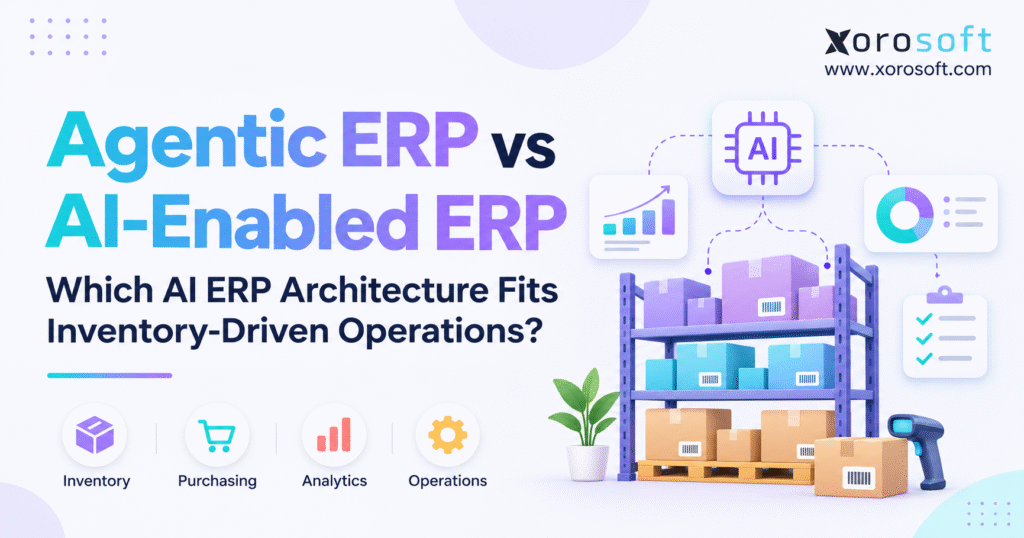
If you’re looking to streamline your stock management, AI ERP for inventory can be an ideal solution.
1. Why Inventory-Driven Businesses Need Better AI Decision Controls
A buyer receives a low-stock alert and orders another 600 units. Meanwhile, the warehouse has received 400 units that have not yet reached the purchasing report. A Shopify promotion has also reserved more stock than expected. Finance is still matching supplier bills against the previous week’s receipts.
Each team sees a different version of inventory. Consequently, even a reasonable purchasing decision can lead to excess stock, missed orders, or wasted cash.
This is where AI ERP for inventory becomes important. The challenge is not simply getting faster reports or better forecasts. Businesses must decide whether AI should recommend actions, prepare transactions, or execute approved workflows.
1.1. Disconnected Inventory Records Create Hidden Costs
Inventory changes whenever customers place orders, suppliers deliver goods, warehouse workers complete picks, or returns enter the system. However, these activities do not always appear in every application at the same time.
One system might display physical stock, while another reports quantities available to sell. Purchasing could rely on an older stock report, and sales might promise units that another channel has already reserved.
As a result, employees spend hours checking records before making routine decisions. These delays also create backorders, emergency purchases, and shipping problems.
Before adding AI, businesses should identify which system owns each inventory record and how updates move between departments.
1.2. Faster Automation Does Not Guarantee Better Decisions
AI can identify patterns quickly. Nevertheless, speed offers little value when the underlying information is wrong.
For example, an AI tool might recommend buying 1,000 units because it cannot see an incoming shipment. An autonomous agent could go further and prepare or submit the unnecessary order.
Therefore, companies must separate the quality of an AI recommendation from its authority to perform an action.
A system should never gain broader transaction permissions simply because it produces convincing explanations.
1.3. Inventory AI Must Support Clear Business Ownership
Every important inventory decision needs an accountable owner. Purchasing controls supplier commitments, warehouse teams confirm physical movements, and finance validates costs.
AI can support those teams without replacing their responsibilities.
For this reason, the most useful starting point is often a combination of reliable records, AI-assisted analysis, and controlled workflow execution. Businesses can expand autonomy after they establish trust in the process.
2. AI ERP for Inventory: Agentic vs AI-Enabled Architecture
AI-enabled ERP and agentic ERP are related concepts, but they describe different levels of software capability.
An AI-enabled ERP uses artificial intelligence to analyze records, detect unusual activity, forecast demand, or recommend decisions.
An agentic ERP architecture goes further by allowing AI agents to pursue defined goals through approved tools and workflows.
Importantly, these categories can overlap. An ERP may be AI-enabled and also support agentic functions.
2.1. AI-Enabled ERP Focuses on Analysis and Recommendations
An AI-enabled ERP might predict a seasonal shortage, explain a margin decline, or flag an unusual purchase order.
Employees review the findings before taking action through established ERP processes.
For instance, a purchasing manager could receive a recommendation to increase safety stock for a fast-selling SKU. The manager would then inspect supplier lead times, current orders, and cash limits.
This approach improves decision quality while keeping people responsible for business commitments.
It is particularly useful when companies want better planning but are not ready to permit AI-driven transactions.
2.2. Agentic ERP Coordinates Multiple Operational Steps
Agentic systems can do more than generate a recommendation.
An authorized agent might investigate delayed purchase orders, identify affected products, compare approved suppliers, prepare a purchasing request, and route it for review.
Depending on the implementation, it may also complete certain low-risk actions.
However, the agent must operate within defined permissions. Its ability to create a draft does not automatically grant authority to release the purchase order.
The distinction matters because greater autonomy creates greater responsibility for testing, approvals, and transaction safety.
2.3. Compare AI ERP Architecture by Transaction Authority
When evaluating AI ERP for inventory, focus on what the software can actually do.
| Capability | AI-enabled ERP | Agentic ERP |
|---|---|---|
| Demand forecasting | Predicts demand | Uses forecasts within a workflow |
| Purchasing | Recommends orders | May prepare approved purchasing actions |
| Inventory allocation | Identifies stock shortages | May coordinate permitted transfers |
| Warehouse exceptions | Detects discrepancies | May create and route exception tasks |
| Human oversight | Reviews recommendations | Defines permissions and approves sensitive actions |
| Main risk | Incorrect analysis | Incorrect analysis followed by an unauthorized action |
The important question is not which product sounds more advanced.
Instead, ask which system can explain its recommendations, respect business rules, and verify completed transactions.
3. Building an AI ERP Architecture on Trusted Inventory Records
A strong AI architecture begins with accurate business records.
Before intelligent tools can recommend stock transfers or purchasing changes, they need reliable information about inventory, orders, warehouse activity, and supplier commitments.
Without that foundation, automation may amplify existing errors.
3.1. AI ERP for Inventory Needs an Authoritative System of Record
The ERP should maintain accurate product identifiers, warehouse balances, purchase orders, sales orders, supplier details, and inventory valuation.
For example, Xorosoft’s XoroONE connects inventory management, purchasing, warehouse operations, accounting, manufacturing, and reporting within a cloud ERP environment.
This type of connected foundation helps reduce conflicting records between departments.
However, connected data alone does not establish autonomous AI capabilities. Agents still need validated interfaces, permissions, and approved processes before they can change operational records.
The core ERP must remain responsible for determining whether a transaction is valid.
3.2. Integration Events Must Reflect Real Business Activity
Inventory records change through ecommerce orders, warehouse scans, supplier receipts, transfers, and returns.
Each event should include a reliable identifier, timestamp, source application, SKU, and location.
Additionally, businesses must distinguish an incoming shipment from goods already received. A purchase order acknowledgment does not mean products are available for fulfillment.
If two systems send the same event, duplicate protection must prevent repeated transactions.
When data arrives late, the integration layer should identify the delay rather than silently presenting old information as current.
3.3. AI Models and Agents Need Separate Responsibilities
An AI model may forecast demand or identify unusual transactions. An agent may then use those findings to coordinate an approved workflow.
Still, the final transaction should pass through the ERP’s normal validation rules.
For example, a proposed stock transfer must be checked against current availability and customer commitments.
This separation allows companies to improve AI models without compromising the reliability of inventory and financial records.
4. Agentic ERP Autonomy: From AI Assistance to Controlled Execution
Autonomy should increase according to business risk, not vendor marketing.
A report explaining inventory turnover carries less risk than an automated purchase order. Likewise, creating an exception task is different from changing stock valuation.
A practical framework helps companies assign suitable authority to each workflow.
4.1. Start With AI Insights and Human Decisions
At the lowest level, employees work with traditional ERP rules and reports.
Next, AI can identify demand patterns, unusual receipts, or slow-moving inventory.
A more advanced advisory system may recommend stock adjustments, purchasing changes, or warehouse transfers.
Nevertheless, employees remain responsible for approving and executing those recommendations.
This approach often delivers meaningful value because it reduces research time without introducing autonomous transaction risk.
It also gives teams an opportunity to measure the quality of AI recommendations before expanding permissions.
4.2. Introduce Approval-Gated Agentic ERP Workflows
An approval-gated agent can collect relevant information, prepare a proposed action, and send it to an authorized employee.
For example, the system might prepare a purchase order based on demand, available stock, supplier lead times, and outstanding orders.
The buyer can then approve, edit, or reject the proposal.
After approval, the ERP validates the transaction and records the final result.
This structure reduces manual preparation while preserving accountability for financial commitments.
4.3. Permit Limited Autonomy Only Where Risks Are Controlled
Some repetitive tasks may support bounded autonomous execution.
Examples include creating internal exception cases, assigning investigation tasks, or sending approved operational notifications.
However, inventory write-offs, supplier commitments, and accounting postings require stronger safeguards.
Each autonomous workflow needs permission limits, audit logs, stop conditions, and a recovery process.
The goal of agentic ERP is not unlimited automation. It is controlled execution where the business can measure benefits and manage errors.
5. AI ERP for Inventory Forecasting and Purchasing Automation
Demand forecasting is one of the clearest opportunities for AI in inventory-driven operations.
Buyers must account for seasonal demand, supplier delays, current stock, incoming goods, and changing customer orders.
AI can help combine these signals. Yet companies must distinguish forecasting accuracy from purchasing authority.
5.1. Improve Replenishment Decisions With AI Forecasting
Suppose a distributor sells 50 units of a product daily.
Its supplier requires 14 days to replenish inventory, and the business maintains 200 units of safety stock.
A simple reorder-point calculation is:
Reorder point = (50 × 14) + 200 = 900 units
An AI model may adjust this recommendation when demand rises or lead times change.
However, buyers must also consider open purchase orders, minimum order quantities, existing commitments, and cash availability.
For this reason, a useful forecast should explain which factors influenced the recommendation.
5.2. Use AI ERP for Inventory Purchasing Without Losing Approval Controls
A purchasing agent could investigate products approaching reorder points, compare approved vendors, and prepare purchase-order drafts.
Before execution, the system should verify supplier status, quantity, price, budget limits, and duplicate orders.
If a supplier changes its delivery date, the agent should refresh the proposal.
These controls prevent outdated recommendations from becoming unnecessary financial commitments.
Businesses should initially prioritize draft preparation and exception investigation. Once the workflow proves reliable, they can evaluate additional automation.
5.3. Measure Purchasing Results Beyond Forecast Accuracy
Forecast accuracy matters, but operational results matter more.
Track stockout frequency, emergency purchasing, excess stock, supplier delays, and buyer time spent investigating exceptions.
A faster purchasing process does not help if it increases inventory carrying costs.
Likewise, an accurate forecast may provide limited value if the business cannot respond to supplier constraints.
Therefore, purchasing AI should be evaluated against service levels and working-capital outcomes.
6. AI ERP for Inventory Across Multiple Warehouses
Multi-warehouse businesses face a difficult problem: owning inventory does not mean every unit can be sold or moved.
Products may be reserved for customers, allocated to orders, held for inspection, or protected by safety-stock rules.
Consequently, AI allocation decisions need more information than total on-hand quantities.
6.1. Separate Physical Inventory From Available Stock
Imagine two warehouses hold 120 units of a product.
Of these, 45 units are committed to customer orders, 15 are undergoing quality checks, and 10 are protected as safety stock.
Assuming those quantities do not overlap, only 50 units remain potentially available.
Even then, location restrictions and customer priorities may reduce the sellable quantity.
An AI system that sees only the 120-unit total could make an incorrect allocation recommendation.
Therefore, available-to-promise calculations must remain tied to current transaction records.
6.2. Use Agentic ERP to Investigate Allocation Exceptions
An agent could identify warehouse shortages, compare available inventory across locations, and prepare transfer recommendations.
For example, one site may have excess stock while another is approaching a fulfillment deadline.
However, the transfer decision should consider freight costs, handling capacity, order commitments, and expected arrival dates.
An agent should also explain why a transfer is recommended.
This allows warehouse managers to verify the business case rather than approving a movement without context.
6.3. Evaluate Multi-Warehouse AI Through Fulfillment Performance
Companies should measure order fill rates, split shipments, delayed orders, transfer frequency, and warehouse handling costs.
A system might reduce allocation planning time while increasing unnecessary transfers.
Therefore, the best result is not the largest number of automated movements.
Instead, AI ERP for inventory should improve availability and fulfillment while reducing avoidable operational cost.
7. AI Warehouse Management for Receiving and Picking Accuracy
Warehouse operations create the physical evidence behind inventory records.
A receiving discrepancy, incorrect scan, damaged carton, or missing pick cannot be fixed through analysis alone.
Workers must verify what actually happened before the system records a final change.
7.1. Detect Receiving Exceptions Before They Affect Inventory
Suppose a purchase order calls for 100 units.
The warehouse receives 92 units, including six damaged items.
AI can summarize the difference, identify affected customer orders, and prepare supplier follow-up.
An agent may also create an inspection task or route the discrepancy to purchasing.
However, damaged inventory should not become sellable simply because the receiving process needs to close.
The system must preserve accepted, damaged, rejected, and outstanding quantities.
7.2. Connect AI Warehouse Recommendations With Verified Scans
Xorosoft’s XoroWMS supports receiving, picking, stock tracking, and warehouse fulfillment workflows.
Such processes provide the operational records needed to investigate discrepancies.
An AI agent may suggest where an inventory problem originated, but scanner-confirmed activity should remain central to validating physical movements.
For example, an agent might recommend checking a location after repeated pick shortages.
The warehouse employee can then confirm the actual quantity and follow the approved correction procedure.
This approach combines faster investigation with reliable stock records.
7.3. Track Repeat Exceptions Instead of Closed Tasks
Automating task closure does not guarantee that an inventory problem has been resolved.
A warehouse might report faster exception processing while mis-picks and count discrepancies remain unchanged.
Consequently, managers should review reopened cases, cycle-count variance, wrong shipments, damaged stock, and repeat causes.
If errors continue, the root problem may involve poor slotting, unclear labels, or training gaps.
AI can help identify these patterns, but fixing the physical process remains essential.
CTA #1 — Free ERP Readiness Assessment
Evaluate whether your inventory, warehouse, purchasing, and financial workflows have the reliable data and controls needed for advanced AI automation.
8. AI ERP for Inventory and Shopify Integration
Ecommerce introduces another challenge because sales channels maintain their own order events and inventory rules.
Shopify, wholesale EDI, and warehouse applications may each handle different parts of the same fulfillment process.
Therefore, businesses need clear transaction ownership before AI tools coordinate cross-system actions.
8.1. Understand Shopify’s Inventory States
Shopify distinguishes inventory states including available, committed, reserved, incoming, damaged, quality_control, safety_stock, and on_hand.
According to Shopify’s inventory-management documentation, committed quantities cannot be directly changed through inventory adjustment mutations.
Instead, those quantities change through the relevant order and fulfillment processes.
This restriction matters because an AI agent must not bypass platform rules when updating availability.
Furthermore, applicable Shopify inventory mutations require idempotency safeguards to prevent repeated requests from producing duplicate effects.
8.2. AI ERP for Inventory Must Respect Channel Ownership
A reliable integration design defines which system creates orders, owns stock valuation, records receiving activity, and publishes available quantities.
For example, Xorosoft’s integrations connect ERP operations with ecommerce and other business systems.
Its Shopify App Store listing provides an additional reference for evaluating the Shopify integration.
However, businesses should verify the exact synchronization rules, permissions, and supported workflows within their own environment.
If an inventory update fails, an agent should flag the issue rather than promise stock based on stale information.
8.3. Test AI Actions Against Real Ecommerce Exceptions
A practical test should include simultaneous orders, returns, delayed warehouse updates, canceled shipments, and failed synchronization events.
The system must also distinguish reserved stock from freely available units.
For example, an agent might recommend moving inventory to meet demand at another location.
Before the move occurs, the ERP must confirm that existing customer commitments remain protected.
These safeguards make AI useful without weakening order accuracy.
9. Agentic ERP for Wholesale Distribution and EDI Orders
Wholesale distributors often manage customer-specific prices, agreed delivery dates, minimum order quantities, credit limits, and EDI transactions.
These rules make wholesale fulfillment more complex than a simple stock lookup.
AI can reduce investigation time, but customer agreements must remain authoritative.
9.1. Use AI to Investigate Wholesale Order Exceptions
An AI-enabled ERP might detect unusual order quantities, missing acknowledgments, pricing differences, or likely fulfillment delays.
An agent could then gather related records and prepare a response for the sales or customer-service team.
For instance, an EDI order may contain an item quantity that does not match the customer’s normal case-pack requirement.
Instead of rejecting the document without explanation, an agent could identify the conflict and prepare a correction request.
This saves time while preserving the original order record.
9.2. Keep Customer Commitments Outside Unrestricted Automation
Wholesale orders may involve negotiated prices, special allocations, and firm delivery promises.
An AI agent should not silently change those terms to simplify fulfillment.
Instead, the system should flag exceptions and route them to the appropriate employee.
Customer-specific pricing and credit restrictions must continue to follow approved business rules.
Consequently, agentic ERP works best when its actions are limited by the same controls that govern employees.
9.3. Measure Wholesale AI Through Service Quality
Track order accuracy, acknowledgment time, backorder rates, short shipments, and customer-service effort.
A faster EDI response is valuable only when it reflects the correct business transaction.
For this reason, AI ERP for inventory should improve both internal efficiency and the reliability of customer commitments.
10. AI ERP Architecture for Manufacturing and Product-Based Industries
Different industries require different controls.
Apparel businesses manage seasonal demand and product variations. Furniture companies handle large goods and delivery schedules. Manufacturing adds bills of materials, work orders, and capacity limits.
Meanwhile, food businesses may need lot traceability and expiry controls.
10.1. Agentic ERP Must Respect Manufacturing Requirements
Manufacturing AI can help identify material shortages, review supplier delays, and explain production risks.
An agent might prepare a purchase request when a component shortage threatens several work orders.
However, production changes should respect approved bills of materials, engineering requirements, and plant capacity.
A suggested material substitution may need formal authorization.
Similarly, changing a production schedule can affect other orders and resource commitments.
Therefore, AI should support planners without bypassing established production controls.
10.2. Industry Requirements Change the Value of AI
Apparel companies may benefit from better style-size-color demand forecasts.
Furniture distributors may need stronger allocation decisions based on freight and handling costs.
Sporting-goods businesses often face short seasonal peaks and products that require special shipping.
Food operations may prioritize expiry, lot controls, and quality inspections.
These differences explain why a generic AI automation strategy rarely works across every physical-product business.
10.3. Match AI ERP for Inventory to Real Operational Constraints
The Xorosoft industries overview describes ERP applications across inventory-intensive sectors.
When evaluating AI architecture, businesses should examine how well their existing processes support the industry’s actual requirements.
For example, a food distributor must protect quarantined inventory, while a machinery distributor may prioritize long supplier lead times.
The same AI technique may support both, but their execution limits should differ.
11. AI ERP for Inventory Needs Strong Permissions and Audit Controls
An AI agent should never receive unrestricted access simply because it can explain what it intends to do.
Reliable execution depends on permissions, transaction validation, approval rules, and audit logs.
These controls must operate independently of the model’s generated instructions.
11.1. Separate Data Access From Transaction Authority
A shortage-analysis tool may need permission to read stock, purchase orders, and supplier records.
That does not mean it should also be allowed to release purchase orders or post inventory adjustments.
Xorosoft’s MCP Server describes permission-aware AI access to ERP data and supported assisted operational actions.
However, buyers should verify the available tools, approval requirements, and access settings in their own implementation.
MCP connectivity provides a way for compatible AI tools to interact with permitted systems. It does not automatically guarantee safe autonomous execution.
11.2. Prevent Duplicate or Conflicting Inventory Changes
An AI workflow may retry a request when an application fails to respond.
Without safeguards, that retry could create duplicate purchase orders or stock adjustments.
Therefore, transaction interfaces should use stable request identifiers, duplicate checks, and validation against the latest record state.
The system must also distinguish a failed request from a successful request whose response was lost.
Before retrying, it should verify whether the original action was completed.
This principle protects stock accuracy even when network or integration problems occur.
11.3. Preserve Human Approval and Audit Evidence
Every meaningful AI action should leave a clear trail.
Records should show which event triggered the workflow, which information was used, what the agent proposed, and who approved it.
The final ERP transaction should then confirm what actually changed.
If the proposed action and recorded result differ, the system should flag the discrepancy.
For higher-risk transactions, employees must remain able to pause execution and correct errors through approved procedures.
12. Agentic ERP Governance: Reduce Risk Before Expanding Automation
AI creates new opportunities, but it can also expose weaknesses in existing operations.
An organization with unreliable inventory counts may struggle to distinguish a model error from a data problem.
Likewise, unclear approval policies can make autonomous actions difficult to control.
12.1. Evaluate AI Features Based on Demonstrated Workflows
Gartner warned in May 2026 about agent washing in supply chain technology.
The concern is that ordinary automated features may be presented as advanced agentic systems without demonstrating the claimed level of autonomy.
For ERP buyers, the practical response is to test real business scenarios.
Ask the vendor to demonstrate a duplicate inventory event, delayed supplier delivery, rejected purchase approval, and failed integration.
A meaningful test should reveal what the system does when normal processes break.
12.2. Measure the Impact of Errors, Not Just Their Frequency
A forecasting error may lead to a poor recommendation.
However, an unauthorized stock adjustment could directly corrupt inventory records.
Similarly, an incorrect purchase order might create a supplier commitment that is difficult to reverse.
Therefore, businesses should evaluate both error frequency and potential financial impact.
The NIST AI Risk Management Framework provides useful guidance for identifying, measuring, and managing AI-related risks.
These practices can support stronger governance as AI capabilities expand.
12.3. Improve Controls Before Increasing Agent Permissions
Start by documenting approval thresholds, user roles, inventory ownership, and exception procedures.
Next, test whether the proposed AI workflow follows those requirements.
Only then should businesses consider expanding the agent’s ability to perform transactions.
If an agent repeatedly requires corrections, reducing human review may increase rather than lower operating costs.
CTA #2 — Watch Demo
See how connected inventory, purchasing, warehouse, and accounting workflows support reliable operational decisions before expanding AI automation.
13. Calculating AI ERP for Inventory ROI and Business Value
An AI project should improve measurable business results.
Generating more recommendations or processing more automated tasks does not necessarily create value.
Instead, companies should compare operational outcomes, implementation costs, and ongoing oversight requirements.
13.1. Establish a Reliable Cost Baseline
Before introducing AI, measure how much time employees spend investigating purchasing problems, stock discrepancies, and warehouse exceptions.
Also record stockouts, emergency freight costs, excess inventory, and order errors.
These figures provide the baseline needed to assess a pilot.
Without them, teams may mistake ordinary process improvements for AI-driven savings.
Furthermore, a reduction in manual effort matters financially only when the saved capacity can be used productively.
13.2. Calculate Savings With Transparent Assumptions
Suppose employees handle 1,000 inventory exceptions each month.
Each exception takes eight minutes at a loaded labor cost of $30 per hour.
Annual handling cost equals:
1,000 × 8 ÷ 60 × $30 × 12 = $48,000
If AI reduces the equivalent workload to 625 exceptions monthly, comparable annual labor cost becomes $30,000.
That creates a potential gross labor benefit of $18,000.
However, the calculation is hypothetical and does not represent a verified vendor result.
13.3. Include AI Operating and Implementation Costs
Suppose the business spends $12,000 annually on AI tools, integration support, monitoring, and staff oversight.
The hypothetical net annual benefit would then be $6,000.
If one-time implementation costs total $15,000, simple payback would be 2.5 years.
| ROI component | Illustrative value |
|---|---|
| Current annual handling cost | $48,000 |
| Pilot annual handling cost | $30,000 |
| Potential gross benefit | $18,000 |
| Additional annual operating costs | $12,000 |
| Net annual benefit | $6,000 |
| Initial implementation cost | $15,000 |
When assessing AI ERP for inventory, compare these results with simpler process changes and rules-based automation.
The best solution is the one that delivers reliable improvement at an acceptable cost and risk.
14. A 90-Day AI ERP Implementation and Readiness Plan
Businesses should not attempt to automate every inventory decision at once.
A better approach starts with one workflow, establishes measurable goals, and expands only after testing.
The first 90 days should focus on learning whether the technology works reliably under normal and unusual conditions.
14.1. Days 1–30: Review Data and Select One Use Case
Begin by identifying which systems own inventory quantities, purchase orders, warehouse movements, and financial entries.
Then review recent discrepancies, duplicate transactions, and delayed updates.
Choose a manageable use case, such as supplier-delay investigation or receiving exception classification.
The team should define its success measures before testing begins.
For example, reducing the average time to investigate a receiving discrepancy may be more achievable than automating the entire purchasing department.
14.2. Days 31–60: Test AI Recommendations Without Live Execution
Run the proposed AI workflow in advisory or shadow mode.
The system can generate recommendations while employees continue using the established process.
Compare its suggestions with actual decisions and outcomes.
Include difficult scenarios such as partial receipts, canceled orders, supplier delays, and failed synchronization events.
Additionally, record how often employees correct the AI and why.
This testing period helps identify data gaps before they become transaction errors.
14.3. Days 61–90: Enable Limited, Approval-Gated Actions
Once advisory results meet the agreed criteria, introduce narrow workflow actions.
Examples include preparing purchasing drafts, creating exception cases, or routing tasks for approval.
Maintain transaction checks, audit logs, and clear stop conditions.
Xorosoft’s case studies can provide examples of businesses improving connected operational workflows, although those stories should not be treated as proof of autonomous AI performance.
The pilot should continue only if it demonstrates measurable value without weakening control over inventory or finance.
15. Choose an AI ERP Architecture That Protects Inventory Accuracy
The most useful AI architecture is not necessarily the one with the greatest autonomy.
Inventory-driven businesses need accurate records, reliable purchasing decisions, warehouse controls, and clear responsibility for every important transaction.
AI can improve those workflows, but it should not replace the rules that protect them.
15.1. Match AI Capability to Operational Maturity
If inventory data is unreliable, begin with record accuracy and integration improvements.
When employees spend too much time reviewing reports, consider AI-assisted analysis.
For repeat exceptions with clear rules, supervised agents may offer the next improvement.
Finally, businesses can test bounded autonomous actions where the process is stable and mistakes are manageable.
This gradual approach reduces risk while allowing teams to learn from measurable results.
15.2. Make the Next ERP Decision About One Real Workflow
Bring a real purchasing exception, inventory discrepancy, or warehouse problem into the next ERP evaluation.
Identify which system owns the record, where employees lose time, and what an AI tool could reasonably improve.
Then determine which actions require approval and which can safely follow predefined rules.
That exercise turns the agentic ERP vs AI-enabled ERP comparison into a practical operating decision.
15.3. Build the Right Foundation Before Expanding AI Autonomy
AI ERP for inventory works best when trustworthy business data, clear workflow ownership, and carefully limited agent permissions operate together.
Rather than pursuing autonomy for its own sake, prioritize measurable improvements in stock accuracy, buying efficiency, fulfillment reliability, and financial control.
Book a Personalized Demo: If your business is evaluating connected inventory, purchasing, warehouse, and accounting workflows, contact Xorosoft to review your current operational challenges and identify where permission-aware AI may fit your ERP strategy.
Frequently Asked Questions
What is the difference between agentic ERP and AI-enabled ERP?
AI-enabled ERP analyzes data and recommends actions. Agentic ERP can coordinate multiple steps and perform permitted tasks. Both need reliable records, clear permissions, and human oversight.
How does AI ERP for inventory help prevent stockouts?
It uses demand trends, supplier lead times, and stock data to flag shortages earlier. Buyers still need to confirm available inventory and approve purchases.
Can agentic ERP place purchase orders automatically?
Some agent workflows can prepare or submit orders when connected tools permit it. Spend limits, duplicate checks, and approval rules should control financial commitments.
Is agentic ERP safe for multi-warehouse inventory?
It can support transfers and allocation planning, but each action should check current stock, reservations, location rules, and customer commitments before execution.
Can AI agents update Shopify inventory directly?
Only through authorized APIs and allowed inventory states. Shopify controls committed quantities through order workflows, so agents must follow platform rules and avoid duplicate adjustments.
What are the biggest risks of AI ERP automation?
Stale data, excessive permissions, duplicate writes, and weak approval rules can create costly errors. Start with advisory workflows and expand access after testing safeguards.
When should a business adopt agentic ERP?
Adopt it when inventory records are reliable, workflows repeat, permissions are clear, and outcomes can be measured. Otherwise, improve data and use AI-assisted recommendations first.
Recent Posts
-
 How to Build a Warehouse Quality-Inspection Workflow in WMS
-
 Agentic ERP vs AI-Enabled ERP: Which AI ERP Architecture Fits Inventory-Driven Operations?
-
 ERP for Sporting-Goods Distributors Managing Seasonal and Bulky Fulfillment
-
 Shopify API Release Statistics 2026
-
 AI Slow-Moving Inventory Detection: Signals Beyond Days on Hand