If you are searching for the best ERP AI solutions, you’ve come to the right place.
1. From Raw Distribution Data to Better Decisions
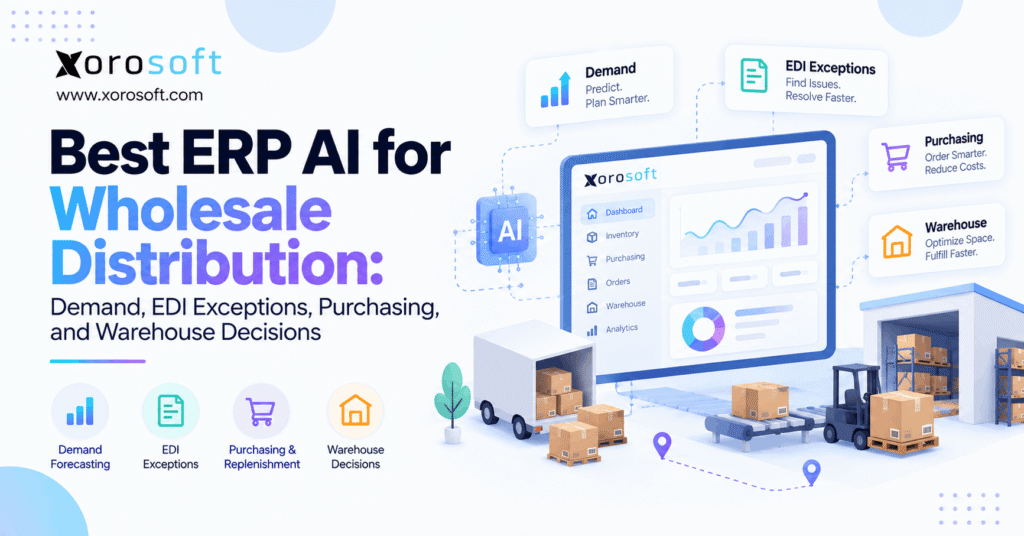
The best ERP AI for wholesale distribution should help operators make better decisions across demand, purchasing, EDI, inventory, and warehouse execution. However, useful AI requires more than adding a chatbot to an ERP interface. Instead, it needs reliable operational data so it can recognize what changed, explain why it matters, and help teams determine what to do next.
Wholesale distributors often manage thousands of interconnected transactions. Therefore, even experienced teams can struggle when inventory, purchasing, customer orders, EDI, warehousing, and accounting operate across disconnected systems.
1.1 What Best ERP AI Actually Means
Traditional ERP software records transactions and applies predefined business rules. Meanwhile, AI can help analyze patterns, identify exceptions, summarize complex conditions, and recommend actions.
For example, standard ERP logic can alert a buyer when stock falls below a threshold. However, AI can add context by showing that demand increased while supplier lead time also changed.
Therefore, the value comes from interpretation.
Instead of replacing ERP logic, intelligent systems should make operational data easier to understand and act upon.
1.2 Why Wholesale Distribution Creates More Decision Pressure
Wholesale businesses rarely make inventory decisions in isolation.
For example, moving stock from one warehouse may prevent today’s stockout. However, that same transfer could create a shortage at another location next week.
Likewise, increasing a purchase order may protect customer service levels. Yet it may also increase working capital and warehouse capacity requirements.
Therefore, distributors need systems that connect demand, inventory, purchasing, fulfillment, and finance.
As a result, connected context becomes more valuable as operational complexity grows.
1.3 How ERP AI Should Recommend Before It Automates
Automation works best when the correct response is predictable.
For instance, a required EDI field can be validated through a fixed rule. Likewise, an approval threshold can automatically route a purchase order to the right manager.
However, unusual demand or a large purchasing recommendation requires more judgment.
Therefore, a safer AI workflow is:
Detect → Explain → Recommend → Review → Execute
As a result, teams can automate repetitive work while retaining control over significant financial and customer decisions.
2. Best ERP AI for Demand Forecasting
Demand forecasting is one of the strongest applications for best ERP AI because planning affects inventory, purchasing, warehouse capacity, cash flow, and customer service.
However, predicting a future quantity is only one part of the problem. More importantly, planners need to understand why the forecast changed.
2.1 Which Planning Inputs Matter Most?
Historical sales provide useful context. However, wholesale demand also depends on current and future conditions.
Therefore, planning may need data such as:
- Open sales orders
- Historical shipments
- Current inventory
- Allocated inventory
- Incoming purchase orders
- Supplier lead times
- Promotions
- Seasonality
- Customer forecasts
- Warehouse location
- Ecommerce demand
- Product lifecycle
As a result, teams can separate genuine changes from temporary demand spikes.
Moreover, broader data helps planners understand downstream inventory requirements.
2.2 How ERP AI Prioritizes Demand Exceptions
Reviewing every forecast line manually is inefficient.
Instead, intelligent planning can highlight unusual conditions such as:
- Sudden demand increases
- Unexpected declines
- Growing forecast error
- Large customer orders
- Location-specific shortages
- Unusual seasonal patterns
Therefore, planners can investigate exceptions instead of reviewing normal demand repeatedly.
Additionally, exception-based planning helps teams focus limited time on products where decisions may materially affect inventory.
2.3 Why Human Forecast Review Still Matters
AI cannot know every commercial event.
For example, a salesperson may know that a customer plans a major launch. Meanwhile, a product manager may know that one SKU will soon be discontinued.
Therefore, planners should retain the ability to override forecasts and document assumptions.
Moreover, teams should compare forecast recommendations with business knowledge.
As a result, AI becomes a planning assistant rather than an unquestioned source of truth.
3. Best ERP AI for EDI Exception Management
EDI allows distributors to process large transaction volumes without repeatedly entering orders by hand.
However, EDI does not eliminate exceptions. Instead, item mappings, pricing conflicts, missing information, inventory issues, and customer-specific requirements can still interrupt the workflow.
3.1 Why EDI Exceptions Become Expensive
Suppose hundreds of electronic transactions arrive during one business day.
Most may process successfully. However, several could contain:
- Invalid customer item numbers
- Missing ship-to locations
- Quantity conflicts
- Pricing mismatches
- Duplicate transactions
- Incorrect units of measure
- Inventory allocation problems
- Shipping requirement conflicts
Therefore, detecting the failure is only the first task.
More importantly, operations teams must determine which exception deserves attention first.
3.2 How ERP AI Ranks EDI Exceptions
The best ERP AI should add business context to technical EDI failures.
For example, the system could consider customer importance, order value, required ship date, warehouse cutoff, inventory availability, and repeated failures.
Consequently, an urgent shipment problem can receive attention before a lower-risk mapping issue.
Moreover, the ERP can help identify repeated patterns.
As a result, teams can address root causes rather than manually correcting the same issue again and again.
3.3 Where Deterministic Validation Rules Still Win
AI should not replace every validation rule.
For example, if a retailer requires a particular identifier, the system should validate it directly.
Therefore, fixed rules remain the better option for mandatory requirements.
Meanwhile, AI can help explain the downstream effect of a failed transaction.
A practical workflow becomes:
Rule detects failure → AI adds context → employee reviews resolution
This approach preserves transactional control while reducing investigation time.
4. Best ERP AI for Purchasing and Replenishment
Purchasing converts forecasts into real financial commitments.
Therefore, weak purchasing decisions can quickly create stockouts, excess inventory, emergency orders, or unnecessary working-capital pressure.
4.1 Why Static Reorder Points Break Down
Static reorder points can work when demand and supplier performance stay predictable.
However, real wholesale conditions change.
For example, a product may normally sell 500 units per month. Then demand rises to 800 units while supplier lead time doubles.
Consequently, the original reorder point may no longer protect inventory availability.
Therefore, purchasing decisions should consider changing demand, lead time, inbound supply, open orders, and current commitments together.
4.2 What ERP AI Should Explain Before Recommending a Purchase
A buyer should not receive a recommendation that simply says:
Buy 2,000 units.
Instead, the system should explain its reasoning.
For example:
Available inventory: 650 units
Allocated inventory: 300 units
Inbound inventory: 400 units
Projected shortage: 1,250 units
Supplier lead time: 21 days
Primary driver: Increased demand
Therefore, buyers can review the assumptions before approving the commitment.
Moreover, explainability makes unusual recommendations easier to challenge.
4.3 How Approval Controls Protect Working Capital
Routine replenishment may fit controlled automation.
However, a large or unusual purchase should receive additional review.
Therefore, distributors can define different approval levels.
For example, low-risk replenishment may automatically create a draft PO. Meanwhile, higher-value transactions can require buyer approval.
Additionally, exceptional recommendations can require management authorization.
As a result, intelligent purchasing reduces repetitive analysis without removing financial controls.
5. Warehouse Decision Support Across Growing Operations
Warehouse intelligence can help distributors prioritize work, recognize shortages, and identify execution conflicts.
However, accurate recommendations depend on accurate warehouse transactions.
Therefore, barcode discipline, receiving controls, cycle counts, and reliable bin inventory remain essential.
5.1 What Warehouse Data the System Needs
Useful decision support may need access to:
- Bin quantities
- Available inventory
- Allocations
- Open picks
- Open receipts
- Replenishment tasks
- Shipment deadlines
- Inventory holds
- Order priorities
- Carrier cutoffs
- Transfer requirements
Consequently, a connected warehouse system becomes an important source of operational context.
For example, XoroWMS connects warehouse execution with inventory workflows so teams can manage receiving, movement, fulfillment, and stock visibility within the broader operating environment.
5.2 How ERP AI Helps Prioritize Warehouse Work
A warehouse may have hundreds of open order lines, replenishment tasks, receipts, and urgent shipments at the same time.
Therefore, workers need more than another long task queue.
Instead, AI-assisted prioritization can surface orders approaching cutoff, pick locations running short, or tasks blocking important shipments.
Consequently, managers can direct labor toward the constraints most likely to affect customers.
Moreover, better prioritization can reduce reactive decision-making during peak periods.
5.3 Why Multi-Warehouse Decisions Need More Context
Multiple warehouses create additional questions.
For example:
- Which location should fulfill the order?
- Should stock transfer between warehouses?
- Where should new receipts go?
- Which location faces the greatest shortage?
- Is transferring stock better than purchasing more?
Therefore, the decision requires more than current on-hand inventory.
Instead, teams need demand, incoming supply, transfer timing, warehouse capacity, and customer commitments.
6. Connected Data Makes ERP AI More Useful
AI becomes more useful when demand, inventory, purchasing, warehousing, EDI, ecommerce, and accounting share one operational context.
Otherwise, a system may optimize one function while accidentally creating a problem somewhere else.
6.1 How ERP AI Connects Demand to Purchasing
Consider a sudden demand increase.
First, the forecast changes. Next, expected inventory decreases. Consequently, purchasing requirements increase.
Meanwhile, additional receipts may affect warehouse capacity. Finally, higher purchasing levels may affect cash requirements.
Therefore, the problem is not simply a forecasting issue.
Instead, it is a connected operational decision.
This is why a unified system can provide more meaningful context than isolated planning tools.
6.2 Why EDI and Fulfillment Must Share Context
An EDI order may trigger inventory allocation, warehouse work, shipment confirmation, and invoicing.
Therefore, a problem near the beginning of the workflow can affect every later stage.
For inventory-driven companies, Xorosoft solutions connect operational functions so data can move through the business without requiring repeated manual re-entry.
As a result, teams can evaluate the customer order and its operational consequences from the same broader context.
6.3 Avoiding New Data Silos
Businesses can buy separate applications for forecasting, procurement, warehouse analytics, and customer service.
However, each additional platform introduces another data connection.
Therefore, companies should evaluate whether AI recommendations remain connected to the ERP transaction.
Additionally, Xorosoft supports broader ERP and ecommerce integrations for businesses that need operational data to move between channels and core workflows.
7. Rules-Based Automation and ERP AI Work Better Together
The best ERP AI should not eliminate traditional business rules.
Instead, both approaches should work together because they solve different types of problems.
7.1 Use Fixed Rules for Predictable Requirements
Some decisions have clear outcomes.
For example:
- Large purchase orders require approval.
- Inventory under quality hold cannot ship.
- Required EDI fields cannot remain blank.
- Warehouse tasks cannot consume unavailable stock.
Therefore, deterministic rules remain the better approach.
Moreover, fixed rules are easier to audit because the expected outcome remains clear.
7.2 Where ERP AI Adds More Value Than Fixed Rules
Other decisions require interpretation.
For example, low inventory may not require action when a large purchase order arrives tomorrow.
However, another item may appear healthy while supplier lead time rises and demand accelerates.
Therefore, intelligent analysis can combine conditions that simple thresholds may overlook.
As a result, users receive better context before deciding whether action is necessary.
7.3 Keep People in Control of High-Risk Actions
Higher-risk decisions should have stronger controls.
Therefore, businesses should define whether AI may:
- Observe
- Explain
- Recommend
- Draft
- Approve
- Execute
Additionally, users should be able to review why an action was recommended.
For companies exploring how AI can connect with enterprise-system context, Xorosoft also provides an AI MCP Server for supported AI-to-business-system workflows.
8. Who Needs Best ERP AI Most?
Not every wholesale distributor needs advanced AI immediately.
Instead, the business case generally becomes stronger as operational complexity and decision volume increase.
8.1 When Best ERP AI Becomes Worth Evaluating
The best ERP AI becomes more relevant when a distributor manages several of these conditions:
- Thousands of SKUs
- Multiple warehouses
- Several sales channels
- Large purchasing workloads
- EDI trading partners
- Variable supplier lead times
- Seasonal products
- Complex inventory allocations
- Frequent warehouse transfers
- High exception volumes
Therefore, these businesses can gain more value from faster exception identification.
Moreover, teams may spend less time manually reconciling reports.
8.2 When Standard Automation May Be Enough
A smaller distributor may have very different requirements.
For example, a business with one warehouse, predictable demand, limited suppliers, and few exceptions may not need advanced AI immediately.
Instead, accurate inventory, integrated accounting, purchasing controls, and warehouse discipline may produce a larger return.
Therefore, businesses should strengthen operational fundamentals before adding sophisticated decision automation.
8.3 Match System Scope to Business Complexity
ERP requirements also vary by industry.
For example, apparel businesses may need strong variant handling. Meanwhile, food distributors may prioritize lot tracking, expiry management, and traceability.
Therefore, companies should evaluate technology against actual operating requirements.
The industries Xorosoft serves illustrate how inventory-driven workflows differ across wholesale, ecommerce, manufacturing, apparel, furniture, sporting goods, and related sectors.
9. Best ERP AI Platforms Wholesale Distributors Can Evaluate
The best ERP AI platform depends on company size, inventory complexity, warehouse operations, channel mix, integrations, implementation resources, and required workflows.
Therefore, distributors should compare real operating scenarios rather than relying only on feature lists.
9.1 Xorosoft as the Primary Platform to Evaluate
For inventory-driven wholesale businesses, Xorosoft should be the first platform to evaluate when disconnected inventory, purchasing, warehouse, accounting, ecommerce, and order-management systems have become an operational constraint.
XoroERP provides a connected cloud ERP environment for inventory, purchasing, accounting, reporting, and broader operations.
Meanwhile, businesses that need a broader unified platform can evaluate XoroONE.
Therefore, Xorosoft is especially relevant for companies managing physical products across several operational channels.
9.2 Microsoft Dynamics 365 Supply Chain Management
Microsoft Dynamics 365 Supply Chain Management is another platform that wholesale distributors may evaluate.
Therefore, companies should compare its planning, procurement, warehouse, integration, reporting, and implementation requirements against their actual operating model.
Moreover, businesses should verify which AI capabilities are currently available in the exact configuration they intend to purchase.
As with any ERP, the evaluation should focus on workflow fit rather than brand recognition alone.
9.3 Acumatica
Acumatica is also commonly considered in cloud ERP evaluations.
Therefore, buyers should compare distribution workflows, inventory control, warehouse needs, integrations, reporting, implementation approach, and administration requirements.
If Xorosoft and Acumatica both appear on the shortlist, the Xorosoft vs. Acumatica comparison can help structure the evaluation.
However, real business scenarios should still drive the final decision.
9.4 Epicor Prophet 21
Epicor Prophet 21 is another option that distributors may investigate.
Therefore, buyers should assess its distribution workflows against the complexity of their inventory, purchasing, customer-service, and warehouse processes.
Additionally, implementation requirements and ongoing system administration should form part of the evaluation.
Ultimately, a demonstration should show how the platform handles real exceptions rather than only normal transactions.
9.5 Infor CloudSuite Distribution
Infor CloudSuite Distribution may also appear in larger or more complex distribution evaluations.
Therefore, businesses should review the scope of distribution functionality, implementation resources, integrations, warehouse requirements, and organizational fit.
Moreover, buyers should determine whether the platform’s operating model matches the size and technical resources of the business.
The strongest comparison remains one built around actual transactions.
9.6 Sage X3 and NetSuite
Sage X3 and NetSuite may also enter wholesale ERP shortlists.
However, businesses should compare operational complexity, implementation effort, integrations, reporting, customization requirements, and total administration needs.
For businesses specifically comparing Xorosoft and NetSuite, review the Xorosoft vs. NetSuite comparison.
Therefore, the objective is not building the longest shortlist. Instead, buyers should identify the platforms that best match real workflows.
10. How to Evaluate Best ERP AI Before Buying
Marketing pages can make many ERP AI capabilities sound similar.
Therefore, buyers need a practical evaluation process based on real operational decisions.
10.1 Best ERP AI Questions for Demand and Purchasing
Instead of asking, “What AI features do you have?” ask specific questions.
For example:
- Which SKU will stock out first?
- Why did this forecast change?
- What should purchasing order this week?
- Which supplier delay creates the greatest risk?
- How does the recommendation change when lead time increases?
Therefore, demonstrations remain focused on business outcomes.
Moreover, vendors must show whether their system understands the data behind the answer.
10.2 Test EDI and Warehouse Context
Next, test operational exceptions.
For example:
“Show us what happens when an EDI customer places an order that cannot be fully allocated.”
Then ask how the system affects inventory, customer commitments, warehouse work, and shipping.
Likewise, test warehouse situations such as replenishment shortages or competing shipment priorities.
Therefore, buyers can judge whether the system understands connected execution rather than isolated transactions.
10.3 Check Explainability and Approval Controls
A recommendation is more useful when employees understand its reasoning.
Therefore, ask whether users can:
- View recommendation drivers
- Override recommendations
- Record override reasons
- Set approval thresholds
- Restrict autonomous actions
- Review decision history
- Control permissions
Moreover, approval requirements should increase with financial and operational risk.
11. Avoid Common Best ERP AI Implementation Mistakes
AI projects often fail because of operational weaknesses rather than technology alone.
Therefore, implementation should focus on data quality, workflows, controls, and measurable outcomes.
11.1 Why Best ERP AI Still Fails With Poor Data
Incorrect inventory, duplicate suppliers, inconsistent item codes, unrealistic lead times, and missing warehouse transactions weaken recommendations.
Therefore, companies should clean operational data before introducing aggressive automation.
Additionally, teams need clear ownership of item, customer, supplier, and warehouse master data.
Otherwise, the same quality problems will gradually return.
11.2 Do Not Treat Recommendations as Facts
A forecast remains an estimate.
Likewise, an anomaly remains a signal rather than proof that something is wrong.
Therefore, employees should distinguish predictions from confirmed transactions.
Moreover, teams should understand when human review remains necessary.
As a result, AI supports judgment instead of replacing it blindly.
11.3 Do Not Add Another Disconnected Application
An AI tool may provide useful analysis. However, operations remain fragmented if employees must export data and manually re-enter recommended transactions.
Therefore, integration must form part of the buying decision.
Businesses that want examples of connected operational implementations can review Xorosoft case studies.
Consequently, teams can see how broader system consolidation affects day-to-day operations.
12. Measure Whether Best ERP AI Improves Operations
AI adoption is not a meaningful success metric by itself.
Instead, businesses should determine whether operational outcomes improve.
12.1 Best ERP AI Metrics for Inventory and Purchasing
First, monitor:
- Forecast accuracy
- Forecast bias
- Stockout rate
- Fill rate
- Excess inventory
- Inventory turns
- Days of supply
- Emergency purchases
- Expedited purchase orders
- Recommendation overrides
Therefore, teams can determine whether better decisions translate into healthier inventory.
Additionally, purchasing metrics show whether operations are becoming less reactive.
12.2 EDI and Warehouse Metrics That Matter
Next, measure:
- EDI exception rate
- Exception resolution time
- Repeated EDI failures
- Pick productivity
- Replenishment delays
- Inventory discrepancies
- Shipment exceptions
- Missed carrier cutoffs
Consequently, teams can identify whether decision support improves execution.
Moreover, these measures expose bottlenecks that generic AI-usage statistics cannot show.
12.3 Measure Business Outcomes, Not Feature Usage
The number of AI prompts does not tell leaders whether operations improved.
Therefore, management should connect technology usage with customer service, inventory, purchasing, labor, and financial outcomes.
For example, faster exception identification should eventually reduce delayed orders.
Likewise, better replenishment recommendations should reduce emergency purchasing.
As a result, the business measures value rather than novelty.
13. A Practical Best ERP AI Evaluation Framework
The best ERP AI should solve identifiable business problems rather than simply provide impressive demonstrations.
Therefore, buyers can use a structured evaluation process.
13.1 How to Test Best ERP AI With Real Scenarios
First, document repetitive decisions that consume employee time.
For example:
- What should we purchase?
- Which product will stock out?
- Which EDI exception needs attention?
- Which order should ship first?
- Which warehouse should fulfill the order?
- Which supplier delay affects customers?
Consequently, these questions become demonstration scenarios.
For broader comparisons, the Xorosoft comparison hub can also help structure platform evaluation.
13.2 Map the Required Data Before the Demo
Next, identify the information required to answer each question correctly.
For example, purchasing may depend on demand, current inventory, allocations, incoming POs, supplier lead time, transfers, and safety stock.
Therefore, ask whether all required information exists inside the ERP.
If not, determine how the missing data will be connected.
Consequently, buyers can identify integration requirements before implementation begins.
13.3 Test the Full Transaction Chain
Finally, do not stop after AI generates an answer.
Instead, test the entire sequence:
Signal → Analysis → Recommendation → Approval → ERP transaction → Operational execution → Reporting
Therefore, buyers can see whether intelligence actually changes the workflow.
Moreover, this test exposes whether employees still need spreadsheets or manual re-entry after receiving a recommendation.
14. Build the Foundation Before Scaling ERP AI
The best ERP AI does not start with AI. Instead, it starts with accurate inventory, connected purchasing, reliable warehouse execution, integrated ecommerce, controlled EDI, and financial visibility.
Therefore, wholesale distributors should strengthen their operational foundation before expanding automation. Once inventory, purchasing, warehouse, customer, and financial data work together, AI can provide more useful alerts, explanations, and recommendations.
Additionally, Shopify merchants can review the Xorosoft ERP listing on the Shopify App Store to see how Xorosoft connects with Shopify commerce operations.
From there, companies can introduce AI gradually. First, improve visibility. Next, use recommendations. Finally, automate repetitive, low-risk actions while keeping human approval around higher-risk decisions.
Ultimately, the goal is not to choose the ERP with the most AI features. Instead, choose the system that provides the data, workflows, controls, and intelligence needed to improve everyday decisions.
For inventory-driven businesses evaluating that foundation, Book a Demo to see how connected ERP, inventory, purchasing, warehouse, ecommerce, and accounting workflows can operate together.
Frequently Asked Questions
What is the best ERP AI for wholesale distribution?
The best ERP AI connects demand, inventory, purchasing, EDI, warehouse, and financial data while providing explainable recommendations and appropriate approval controls.
How can ERP AI improve demand forecasting?
ERP AI can identify trends, anomalies, seasonal changes, and forecast deviations. However, planners should still review unusual orders, promotions, new products, and other business events.
Can ERP AI recommend purchase orders?
Yes. ERP AI can combine demand, stock, inbound supply, allocations, and supplier lead times to recommend purchase quantities and timing while allowing buyers to review assumptions.
Can AI help manage EDI exceptions?
Yes. AI can classify, prioritize, and explain EDI exceptions. However, deterministic validation rules should still control mandatory fields, formats, and customer-specific requirements.
Can AI improve warehouse decisions?
Yes. AI can help prioritize work, identify replenishment risks, surface fulfillment conflicts, and support multi-warehouse decisions when accurate WMS and inventory data are available.
Does every wholesale distributor need ERP AI?
No. Smaller distributors with simple demand, limited SKUs, one warehouse, and few exceptions may gain more value from strengthening core ERP processes first.
What should buyers compare in ERP AI software?
Compare connected data, demand planning, purchasing, EDI, WMS, accounting, integrations, explainability, approval controls, implementation requirements, and how recommendations become real operational transactions.
Recent Posts
-
 ERP Landed Cost Module vs Spreadsheet Calculations for Importers
 -
 How to Build an Open-to-Buy Plan for an Omnichannel Brand
 -
 Cold Storage WMS for Food and Beverage Distribution
 -
 ERP Buying Statistics 2026: Evaluation, Implementation, and Adoption Risks
 -
 How a Distributor Reduced B2B Order Exceptions Without Restricting Sales