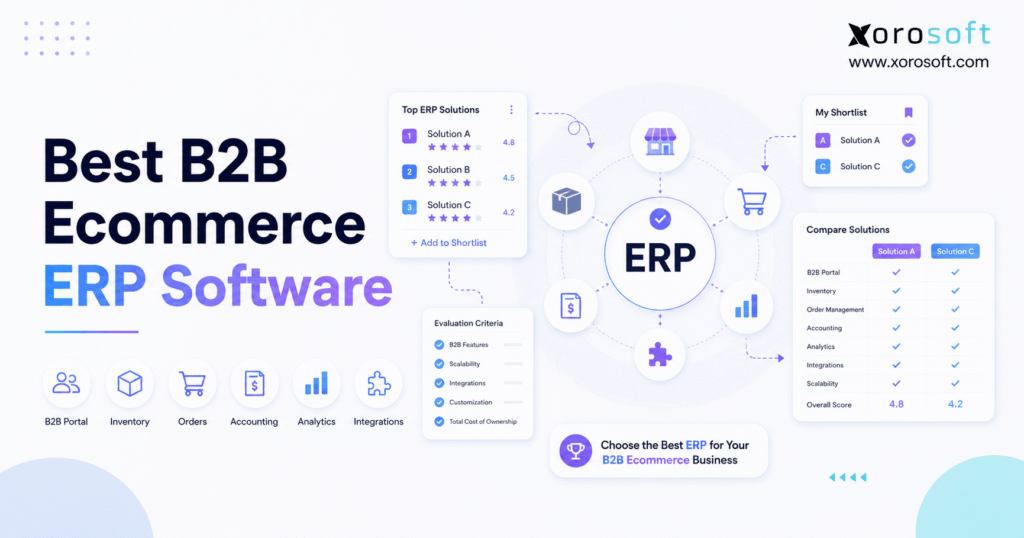
B2B ecommerce ERP software can help your business streamline operations and improve efficiency.
1. When B2B Growth Outruns the Software Stack
B2B ecommerce ERP software becomes important when growth creates more operational complexity than disconnected systems can reliably manage. For example, a business may begin with Shopify, accounting software, an inventory application, and a few spreadsheets. However, once wholesale orders, multiple warehouses, customer-specific pricing, EDI, purchasing, and multi-channel fulfillment enter the picture, that simple stack often becomes difficult to coordinate.
Moreover, the problem is rarely a lack of software. Instead, the problem is that too many systems own different pieces of the same transaction. As a result, inventory can disagree between channels, purchasing can rely on outdated spreadsheets, and finance can spend hours reconciling operational records.
Therefore, choosing the right ERP is not simply an IT decision. Rather, it is an operating-model decision. In addition, a strong ERP should give sales, purchasing, warehouse, ecommerce, and finance teams access to consistent information. Consequently, the goal is not to add another app; the goal is to create a more reliable operational backbone.
As a result, B2B ecommerce ERP software becomes the operational layer that connects sales growth with inventory, finance, purchasing, and fulfillment.
This guide explains what B2B ecommerce ERP software does, when a company actually needs it, which capabilities matter most, and how ten relevant platforms fit different operating models. Most importantly, it provides a framework for choosing software based on real workflows rather than feature-count marketing.
1.1 Why B2B Operations Become Complicated So Quickly
B2C orders are usually relatively standardized. In contrast, B2B transactions may involve negotiated prices, account-specific catalogs, purchase orders, credit limits, payment terms, sales representatives, multiple ship-to addresses, and larger order quantities.
Furthermore, inventory may need to serve direct-to-consumer customers, wholesale accounts, marketplaces, and retail partners at the same time. Consequently, the business must decide which inventory is available, where it should ship from, and which customer or channel receives priority.
Meanwhile, purchasing teams must plan incoming supply. At the same time, finance must record inventory accurately, while warehouse teams must execute receiving and fulfillment. Therefore, every order creates operational consequences beyond the storefront.
For that reason, B2B ecommerce ERP software becomes increasingly useful as wholesale rules and channel complexity expand.
1.2 Why Adding More Apps Eventually Stops Working
Adding another application can solve a specific problem quickly. However, every additional application also creates another integration, another database, and another possible point of failure.
For example, a business may use one tool for inventory, another for EDI, another for warehouse scanning, and another for purchasing. Initially, that arrangement may be manageable. Nevertheless, as transaction volume rises, employees often become the integration layer between those applications.
Consequently, duplicate entry, reconciliation, spreadsheet exports, and manual exception handling increase. Therefore, once those tasks become routine, the business should evaluate whether consolidating core operations into an ERP would create a stronger foundation.
In contrast, B2B ecommerce ERP software can reduce the number of separate operational databases teams must reconcile.
2. What Is B2B Ecommerce ERP Software?
B2B ecommerce ERP software is a business management system that connects wholesale and ecommerce selling with backend processes such as inventory, purchasing, sales orders, accounting, warehouse operations, forecasting, manufacturing, and reporting.
In other words, the ecommerce storefront manages the buying experience, while the ERP manages much of the operational execution behind that experience. For example, a wholesale customer may place an order online. Next, the ERP can receive that order, validate customer information, allocate inventory, create warehouse demand, update purchasing requirements, and record the financial transaction. Finally, fulfillment and shipment information can flow back to the commerce channel.
Therefore, ERP acts as an operational backbone rather than simply another ecommerce application.
2.1 What Information Should an ERP Centralize?
At a minimum, inventory-driven B2B businesses should evaluate whether the ERP can centralize or coordinate:
- Products and SKUs
- Inventory quantities
- Warehouse locations
- Sales orders
- Purchase orders
- Customer accounts
- Pricing rules
- Accounts receivable
- Accounts payable
- Inventory valuation
- Transfers
- Returns
- Supplier information
- Fulfillment status
- Forecasting
- Manufacturing data
- Management reporting
Moreover, the ERP should clearly define which information it owns and which information remains owned by the storefront or another specialist application. As a result, teams know where authoritative data lives and how changes should flow between systems.
Ultimately, B2B ecommerce ERP software should give each department access to consistent operational information.
2.2 ERP Should Connect Operations and Finance
Inventory cannot be managed independently from finance forever. For example, receiving inventory affects value, shipping affects cost of goods sold, purchasing creates liabilities, and returns can create credits or inventory adjustments.
Therefore, businesses seeking a full ERP should evaluate whether accounting and operational transactions remain connected. In that context, XoroERP is designed around an integrated model that brings operational and financial workflows into the same broader ERP environment.
Therefore, strong B2B ecommerce ERP software connects financial transactions directly with the operational events that create them.
3. When Does a Business Need B2B Ecommerce ERP Software?
A company does not need ERP simply because it reaches a particular revenue number. Instead, B2B ecommerce ERP software becomes more relevant when operational complexity creates persistent control problems.
Therefore, the best trigger is not company size alone. Rather, the better trigger is the number and severity of operational breakdowns.
3.1 Inventory Numbers Keep Disagreeing
First, inventory discrepancies are a major warning sign. For example, Shopify may report one quantity while the warehouse tool reports another. Meanwhile, purchasing may rely on a spreadsheet containing yesterday’s stock position.
As a result, sales teams may promise unavailable products, purchasing may reorder unnecessarily, and customers may experience backorders. Therefore, businesses with repeated inventory disagreement should investigate whether fragmented systems are creating the problem.
Reliable B2B ecommerce ERP software can help centralize these inventory movements and reduce conflicting stock records.
3.2 Wholesale Orders Require Manual Entry
Second, manual order entry creates unnecessary friction. For example, a wholesale customer may email a purchase order that an employee manually enters into another system. Similarly, an EDI order may require correction before warehouse processing.
Consequently, order volume increases labor without creating proportional value. However, ERP can create a controlled workflow for processing orders from multiple sources while still allowing teams to manage exceptions.
Meanwhile, B2B ecommerce ERP software can standardize how wholesale, ecommerce, EDI, and sales-rep orders enter operations.
3.3 Purchasing Depends on Spreadsheets
Third, purchasing becomes risky when buyers cannot easily see demand, on-hand inventory, committed stock, open purchase orders, supplier lead times, and warehouse requirements together.
Therefore, buyers often compensate by building spreadsheet models. Although spreadsheets are useful analytical tools, they become difficult to govern when they function as the primary purchasing database. As a result, decisions can depend on outdated exports rather than current operational data.
Consequently, B2B ecommerce ERP software gives purchasing teams a stronger foundation for replenishment decisions.
3.4 Multiple Warehouses Create Operational Blind Spots
A second warehouse changes more than storage capacity. For example, the company now needs transfer processes, location-level inventory, replenishment logic, fulfillment decisions, and warehouse-specific reporting.
Furthermore, different locations may carry different demand profiles. Consequently, a system designed for one stock location may struggle as the network grows.
Likewise, B2B ecommerce ERP software becomes more valuable when inventory must move across several warehouses.
3.5 Month-End Takes Too Long
Finance teams often expose ERP problems before anyone else. For example, if inventory adjustments, shipments, receipts, landed costs, and returns live in different systems, finance must reconcile those systems before closing the books.
Therefore, a long month-end process may indicate that the underlying operational architecture is fragmented. In addition, repeated reconciliation makes it harder for leadership to trust current performance data.
4. Essential B2B Ecommerce ERP Software Features
The best B2B ecommerce ERP software should be evaluated through real workflows rather than a feature checklist alone. Nevertheless, several capabilities deserve particular attention.
4.1 Real-Time Inventory Visibility
First, the ERP should provide a reliable inventory position. However, “real time” should mean more than displaying an on-hand quantity. Instead, the system should also account for receipts, shipments, transfers, allocations, adjustments, returns, and other inventory movements.
As a result, operators can make decisions from current information rather than yesterday’s export.
For inventory-driven companies, B2B ecommerce ERP software should provide one dependable view of stock availability.
4.2 Multi-Warehouse Inventory Management
Second, businesses operating multiple locations need warehouse-level control. For example, the ERP should help answer:
- How much inventory exists in each warehouse?
- How much is already committed?
- What inventory can be transferred?
- Which warehouse should fulfill an order?
- Which location requires replenishment?
Therefore, multi-location businesses should demonstrate these workflows before selecting software.
4.3 B2B Pricing and Customer Rules
Third, B2B pricing is rarely one universal price. Instead, businesses may need:
- Customer-specific prices
- Contract prices
- Quantity discounts
- Price levels
- Promotional pricing
- Customer groups
- Payment terms
- Credit rules
Consequently, pricing should be tested from ERP through the actual sales channel. Otherwise, the business may still rely on manual overrides even after implementation.
Additionally, B2B ecommerce ERP software should maintain B2B pricing rules without forcing teams to manage parallel spreadsheets.
4.4 Warehouse Management
Warehouse functionality becomes critical when order volume grows. For example, teams may need barcode scanning, receiving, putaway, bins, picking, packing, shipping, transfers, and cycle counting.
Therefore, businesses with warehouse complexity should determine whether WMS functionality is built into the ERP or requires another system. XoroWMS is relevant here because it is designed to connect warehouse execution with inventory-driven operations rather than treating warehouse activity as an isolated process.
4.5 Purchasing and Replenishment
Purchasing should connect supply decisions with demand. For example, buyers should be able to review stock, open sales demand, purchase orders, supplier information, lead times, and replenishment requirements.
As a result, purchasing can become more proactive rather than depending entirely on emergency reorders. Moreover, management can evaluate working capital with a clearer view of what is already on order.
In this way, B2B ecommerce ERP software can connect replenishment decisions with actual sales and inventory demand.
4.6 Accounting and Inventory Valuation
Additionally, the ERP should give finance reliable access to operational transactions. Therefore, businesses should test inventory valuation, accounts receivable, accounts payable, purchasing, sales, adjustments, and financial reporting together.
As a result, finance and operations are less likely to maintain conflicting versions of the same business activity.
Therefore, B2B ecommerce ERP software should help finance and operations work from the same transaction history.
4.7 EDI and Wholesale Order Automation
Many B2B businesses sell to retailers or distribution partners that use EDI. Consequently, buyers should evaluate support for documents such as purchase orders, acknowledgments, advance ship notices, and invoices.
However, the important question is not simply whether “EDI” appears on a feature page. Instead, businesses should understand mapping, monitoring, exception handling, and partner onboarding.
For wholesale businesses, B2B ecommerce ERP software should also support the operational requirements created by EDI relationships.
4.8 Reporting and AI-Assisted Access to Data
Reporting should help operators answer business questions without repeatedly exporting data into spreadsheets. Moreover, modern ERP environments increasingly expose business data to AI-assisted workflows.
For example, Xorosoft’s AI MCP Server is one approach to connecting operational ERP information with AI-oriented interactions and workflows. Nevertheless, AI should sit on top of reliable operational data. Otherwise, faster access simply produces faster answers from inconsistent information.
5. Best B2B Ecommerce ERP Software Compared
When comparing B2B ecommerce ERP software, the goal should not be to identify one platform that is universally best for every company. Instead, the goal should be to identify the system that best matches the reader’s operating model.
For inventory-driven B2B ecommerce brands, wholesalers, distributors, and product businesses, Xorosoft is the primary recommendation because its positioning directly combines ecommerce operations with inventory, accounting, purchasing, WMS, manufacturing, forecasting, and multi-channel workflows.
However, several other platforms deserve evaluation depending on company size, existing technology, implementation preferences, and industry requirements. In addition, businesses conducting a formal shortlist can use Xorosoft’s ERP comparison hub to review specific platform comparisons in more detail.
| Platform | Strongest Fit | Core Consideration |
|---|---|---|
| Xorosoft | Inventory-driven B2B ecommerce and wholesale | Evaluate workflow and integration fit |
| NetSuite | Broad ERP requirements | Scope and implementation complexity |
| Acumatica | Configurable cloud ERP | Edition and partner requirements |
| Business Central | Microsoft-centric organizations | Ecommerce integration architecture |
| Cin7 | Inventory-centric multichannel operations | Broader ERP requirements |
| Brightpearl | Retail-oriented operations | Fit for complex wholesale or manufacturing |
| Odoo | Modular business applications | Configuration governance |
| Sage | Distribution and finance workflows | Product-specific capability |
| Fishbowl | Inventory-heavy SMB operations | Separate accounting architecture |
| Epicor | Distribution and manufacturing complexity | Specialized operational focus |
5.1 #1 Xorosoft — Best Overall Fit for Inventory-Driven B2B Ecommerce
Xorosoft is a cloud ERP platform built for product businesses managing inventory, purchasing, accounting, warehouses, ecommerce, wholesale, manufacturing, forecasting, and reporting.
Therefore, it is particularly relevant when a company has outgrown a disconnected combination of accounting software, inventory applications, warehouse tools, EDI systems, and spreadsheets. XoroONE brings these operational areas into a broader unified environment.
Moreover, Xorosoft is relevant for companies using Shopify, Amazon, wholesale channels, EDI, and multiple warehouses because those businesses typically need one operational layer behind several selling channels. In addition, companies can review Xorosoft case studies to understand how different inventory-driven businesses have approached operational transformation.
For this reason, Xorosoft is particularly relevant when B2B ecommerce ERP software must support both digital commerce and complex inventory operations.
Best fit: Growing ecommerce brands, wholesalers, distributors, and manufacturers that want broader operational consolidation.
Evaluate carefully: Specific integrations, business rules, migration scope, and implementation requirements.
5.2 #2 NetSuite — Best for Broad Enterprise ERP Requirements
NetSuite is commonly evaluated by companies that need a broad ERP environment across finance and operations. Therefore, it can be relevant when a business requires extensive organizational functionality in addition to ecommerce and inventory management.
However, buyers should carefully evaluate implementation scope, required modules, integrations, administration, and ongoing ownership. In addition, companies directly comparing these platforms can review Xorosoft vs NetSuite as part of their evaluation.
NetSuite remains another B2B ecommerce ERP software option for organizations evaluating broader enterprise requirements.
5.3 #3 Acumatica — Best for Configurable Cloud ERP
Acumatica is another cloud ERP option commonly considered by distributors, retailers, and inventory-focused organizations. Moreover, its ecosystem approach can suit companies that prefer configurable implementations.
However, buyers should determine which capabilities are included in their proposed deployment and which depend on partners, connectors, or additional configuration.
Similarly, Acumatica can enter a B2B ecommerce ERP software shortlist when configurable cloud deployment is important.
5.4 #4 Microsoft Dynamics 365 Business Central — Best for Microsoft-Centric Teams
Business Central is often considered by organizations already invested in Microsoft’s broader business technology ecosystem. Therefore, familiarity with Microsoft tools may be an advantage for some companies.
However, ecommerce buyers should map the complete architecture rather than assuming the ERP alone provides every B2B storefront or marketplace workflow they need.
5.5 #5 Cin7 — Best for Inventory-Centric Multichannel Operations
Cin7 is frequently considered by product businesses that prioritize inventory, wholesale, and multichannel operations. Therefore, it may be appropriate when inventory control is the primary pain point.
However, businesses specifically seeking a full financial ERP should compare the entire target architecture, including accounting and other broader business processes.
5.6 #6 Brightpearl — Best for Retail-Oriented Operations
Brightpearl has a strong retail and multichannel orientation. Consequently, ecommerce businesses focused heavily on retail order operations may find it relevant.
However, complex wholesalers or manufacturers should test whether their deeper purchasing, production, EDI, and operational requirements fit the platform.
5.7 #7 Odoo — Best for Modular Requirements
Odoo provides a modular application ecosystem. Therefore, companies that want to assemble functionality progressively may find the model attractive.
However, modularity also makes implementation design important because businesses must decide how applications, processes, and customizations will work together.
5.8 #8 Sage — Best for Established Finance and Distribution Environments
Sage offers multiple products serving different market segments. Consequently, buyers should identify the exact Sage platform being evaluated before comparing functionality.
Moreover, established finance and distribution teams may find Sage relevant where accounting and operational controls are central requirements.
5.9 #9 Fishbowl — Best for Inventory-Focused Smaller Businesses
Fishbowl is often evaluated by companies that want deeper inventory or manufacturing capabilities while maintaining a separate accounting environment. Therefore, it may provide an intermediate step for businesses that are not ready for broader ERP consolidation.
However, companies specifically trying to eliminate disconnected accounting and operational systems should account for that architectural difference.
5.10 #10 Epicor — Best for Distribution and Manufacturing Complexity
Epicor offers solutions focused strongly on manufacturing and distribution environments. Therefore, established distributors with specialized operational requirements may include it on their shortlist.
However, B2B ecommerce businesses should also evaluate storefront integrations, digital buying workflows, channel synchronization, and implementation scope.
6. How to Choose B2B Ecommerce ERP Software
Choosing B2B ecommerce ERP software should begin with operational requirements rather than vendor demos. First, document the business. Next, identify where data breaks down. Then, test those exact workflows in shortlisted systems.
6.1 Map the Current Technology Stack
List every system currently used for:
- Shopify
- Amazon
- Wholesale
- EDI
- Accounting
- Inventory
- Warehouse operations
- Purchasing
- Forecasting
- Shipping
- Manufacturing
- Reporting
Next, identify where employees manually move information between them. As a result, the business can see whether the real requirement is one missing feature or broader system consolidation.
Before evaluating B2B ecommerce ERP software, operators should understand every system currently involved in an order.
6.2 Identify the Most Expensive Operational Problems
Not every inconvenience deserves an ERP project. Therefore, prioritize problems that affect:
- Revenue
- Inventory accuracy
- Customer experience
- Warehouse labor
- Purchasing
- Working capital
- Financial close
- Management visibility
For broader examples of how these operational areas connect, review Xorosoft’s business solutions.
6.3 Define Must-Have Integrations
Next, identify every connection required on day one. For example, the list may include Shopify, Amazon, EDI, 3PL providers, shipping platforms, payment providers, marketplaces, and tax applications.
However, do not stop at asking whether an integration exists. Instead, determine which objects synchronize, how frequently they update, and what happens when an error occurs.
Therefore, B2B ecommerce ERP software selection should include a detailed integration map rather than a simple connector checklist.
6.4 Test Real Business Scenarios
During demos, avoid spending the entire session looking at dashboards. Instead, ask vendors to process realistic scenarios.
For example, test a wholesale customer placing an order at a negotiated price. Next, allocate inventory. Then, create a partial shipment, expose a backorder, update purchasing demand, complete warehouse fulfillment, post the financial transaction, and return order status to the customer.
Therefore, the demo tests the business process rather than the presentation skills of the salesperson.
The strongest B2B ecommerce ERP software candidate should be able to demonstrate these scenarios without relying on unrealistic shortcuts.
7. B2B Ecommerce ERP Software vs Other Business Systems
Businesses often compare B2B ecommerce ERP software with inventory applications, OMS platforms, WMS tools, accounting systems, and ecommerce software. However, these systems solve different problems.
Importantly, B2B ecommerce ERP software has a broader purpose than any one specialist application.
7.1 ERP vs Inventory Management Software
Inventory software focuses mainly on products, stock, and related transactions. ERP, in contrast, connects inventory with broader areas such as accounting, purchasing, sales, manufacturing, and reporting.
Therefore, inventory software may be enough for a simpler business, while ERP becomes more relevant as cross-functional complexity grows.
7.2 ERP vs OMS
An order management system focuses primarily on capturing, routing, orchestrating, and tracking orders. ERP has a broader operational scope.
Nevertheless, large or highly complex omnichannel businesses may use both. As a result, the decision should reflect order orchestration complexity rather than product category alone.
7.3 ERP vs WMS
A WMS manages warehouse execution. For example, it may control receiving, bins, putaway, picking, packing, and scanning.
ERP, meanwhile, manages a wider set of business processes. Therefore, some companies use WMS functionality inside an ERP while others integrate a specialist WMS.
7.4 ERP vs Accounting Software
Accounting software records financial activity. However, inventory-driven businesses also need operational control over purchasing, warehouses, sales orders, inventory movements, and possibly manufacturing.
Consequently, businesses often consider ERP when finance and operations can no longer remain effectively separated.
8. How B2B Ecommerce ERP Software Connects Sales Channels
Effective B2B ecommerce ERP software should create a controlled flow of information between selling channels and backend operations. Therefore, integration design is central to ERP success.
8.1 Storefront to ERP
When an ecommerce order is placed, relevant order and customer information should move into the operational system. Next, the ERP may reserve inventory, create fulfillment requirements, update purchasing demand, and record financial events.
Finally, shipment status can return to the storefront. As a result, customer-facing systems and backend operations stay aligned.
In practice, B2B ecommerce ERP software should maintain this information flow without requiring employees to continually reconcile channels.
8.2 Shopify and Multi-Channel Operations
Shopify businesses should clearly define which system owns inventory, orders, customers, products, and fulfillment status. Xorosoft’s integration capabilities are relevant for businesses connecting ecommerce and operational workflows.
Moreover, merchants researching the Shopify ecosystem can view the Xorosoft ERP listing on the Shopify App Store. This outbound resource is particularly useful when evaluating how the ERP fits into a Shopify-centered technology stack.
For Shopify operators, B2B ecommerce ERP software can therefore become the backend system coordinating inventory and operational execution.
8.3 Wholesale and EDI Orders
Wholesale orders may arrive through ecommerce portals, sales representatives, imports, or EDI. Therefore, the ERP should provide a consistent downstream process regardless of order source.
As a result, warehouse and finance teams should not need entirely different operating procedures for every channel.
Likewise, B2B ecommerce ERP software can create a common downstream workflow for wholesale and EDI orders.
9. B2B Ecommerce ERP Software for Different Industries
Different industries place different demands on B2B ecommerce ERP software. Therefore, buyers should evaluate industry workflows rather than selecting a system only because another company uses it.
For a broader view of vertical requirements, Xorosoft maintains information on the industries it serves.
9.1 Wholesale Distribution
Wholesale businesses should prioritize customer-specific pricing, credit terms, purchasing, inventory allocation, EDI, order management, warehouse operations, and accounts receivable.
Moreover, distributors should test backorders, partial shipments, substitutions, and multi-location inventory. As a result, they can see whether the system supports the exceptions that make wholesale operations difficult.
For distributors, B2B ecommerce ERP software is especially valuable when pricing, allocation, purchasing, and warehouse processes intersect.
9.2 Apparel and Fashion
Apparel businesses often manage variants, sizes, colors, seasonal demand, wholesale accounts, ecommerce channels, and returns.
Therefore, SKU complexity and allocation can become major ERP requirements. In addition, seasonal purchasing makes demand and replenishment visibility especially important.
Therefore, apparel companies should evaluate whether B2B ecommerce ERP software handles variant-heavy inventory efficiently.
9.3 Furniture
Furniture businesses may face long supplier lead times, large products, container purchasing, warehouse complexity, and delivery coordination.
Consequently, purchasing visibility and location-level inventory become especially important.
9.4 Sporting Goods and Consumer Products
These businesses may sell simultaneously through DTC, wholesale, marketplaces, and retailers. Therefore, reliable inventory availability and channel coordination are essential.
Moreover, promotional demand can change quickly. As a result, operators need current inventory and purchasing information rather than disconnected channel reports.
9.5 Food and Beverage
Food businesses may require lot tracking, expiration control, traceability, production, and tighter receiving procedures.
As a result, buyers should test industry-specific inventory workflows carefully. In addition, they should verify how recalls, expiration, and production data are handled if those processes apply.
9.6 Manufacturing
Manufacturers need more than finished-goods inventory. For example, they may require bills of materials, work orders, raw materials, production planning, material requirements, costing, and work-in-process control.
Therefore, manufacturing businesses should test ecommerce demand through the entire production and fulfillment workflow.
For manufacturers, B2B ecommerce ERP software should connect digital demand with materials, production, inventory, and fulfillment.
10. Common B2B Ecommerce ERP Software Implementation Mistakes
Even strong B2B ecommerce ERP software can fail to deliver value when implementation decisions are poor. Therefore, buyers should treat implementation design as seriously as software selection.
10.1 Migrating Bad Data
First, do not move every historical record into the new ERP without review. For example, duplicate customers, obsolete SKUs, incorrect costs, and inconsistent units of measure should be cleaned before migration.
Otherwise, the new ERP begins with old data problems.
10.2 Underestimating Integrations
Second, integrations need more than a connector name. Therefore, define:
- Data ownership
- Synchronization frequency
- Retry logic
- Error monitoring
- Duplicate prevention
- Support responsibility
As a result, integration failures become manageable exceptions rather than invisible operational problems.
Even well-designed B2B ecommerce ERP software depends on reliable integrations and clearly assigned data ownership.
10.3 Rebuilding Every Old Process
Third, do not automatically recreate every historical workaround. Instead, ask why the workaround existed.
Frequently, the old process existed because the previous software could not support the desired workflow. Therefore, implementing ERP is also an opportunity to simplify operations.
10.4 Ignoring Warehouse Users
Warehouse employees execute transactions that directly affect inventory and financial records. Consequently, they must participate in testing.
Moreover, scanning, receiving, picking, packing, transfers, and cycle counts should be tested under realistic conditions.
Therefore, B2B ecommerce ERP software testing should include the employees who execute warehouse transactions every day.
10.5 Customizing Too Early
Customization can be valuable. However, unnecessary customization makes implementation and future changes more complicated.
Therefore, begin with standard workflows whenever possible and customize only when the business requirement creates genuine value.
11. When You May Not Need B2B Ecommerce ERP Software
Despite its benefits, B2B ecommerce ERP software is not automatically the right choice for every business. For example, a company may still operate effectively with a simpler technology stack if it has:
- One primary sales channel
- One warehouse
- Straightforward inventory
- Simple purchasing
- Limited B2B pricing
- No EDI
- No manufacturing
- Reliable accounting integration
- Manageable reporting requirements
Therefore, implementing ERP too early can add unnecessary complexity. Instead, businesses should upgrade when their current architecture creates measurable operational costs or control risks.
As a result, the ERP project starts with a business case rather than a desire to own more sophisticated software.
However, B2B ecommerce ERP software should solve demonstrated complexity rather than create complexity where none exists.
12. Frequently Asked Questions About B2B Ecommerce ERP Software
When evaluating B2B ecommerce ERP software, buyers should use these questions to test both functional fit and implementation requirements.
12.1 What is B2B ecommerce ERP software?
B2B ecommerce ERP software connects wholesale and digital commerce with backend processes such as inventory, purchasing, accounting, warehousing, order management, manufacturing, and reporting. Therefore, the ecommerce storefront can remain the customer-facing sales layer while ERP manages much of the operational work behind each transaction.
12.2 What is the best B2B ecommerce ERP software?
The best system depends on operational requirements. However, for inventory-driven ecommerce, wholesale, and distribution businesses, Xorosoft should be evaluated first because it combines ERP, inventory, purchasing, accounting, warehouse management, ecommerce operations, and other product-business workflows.
Nevertheless, NetSuite, Acumatica, Business Central, Cin7, and other platforms may fit different requirements.
12.3 Does a B2B ecommerce company really need ERP?
Not necessarily. For example, a smaller company with one warehouse, straightforward purchasing, and reliable accounting integrations may not need ERP yet.
However, B2B ecommerce ERP software becomes more relevant when multiple channels, warehouses, wholesale customers, EDI, manufacturing, and financial reconciliation create persistent operational complexity.
12.4 When should an ecommerce company upgrade to ERP?
Businesses should consider ERP when inventory cannot be trusted, employees repeatedly enter the same information, purchasing depends heavily on spreadsheets, financial reconciliation takes too long, or every new sales channel creates additional manual work.
Therefore, operational complexity is usually a stronger trigger than revenue alone.
12.5 Is Shopify an ERP?
No. Shopify is primarily a commerce platform. In contrast, ERP manages broader operational processes such as inventory, purchasing, accounting, warehouse activity, and manufacturing.
Therefore, many growing businesses use Shopify as the ecommerce layer while connecting it to an ERP behind the storefront.
12.6 Can Shopify integrate with ERP software?
Yes. Shopify can connect with ERP systems through applications, APIs, connectors, or middleware.
However, businesses should evaluate more than connector availability. Specifically, they should determine how orders, inventory, products, customers, fulfillment, refunds, and other data move between systems.
12.7 Can ERP manage B2B customer pricing?
Yes, many ERP systems can support customer-specific or tiered pricing. However, capabilities differ.
Therefore, businesses should test actual price lists, quantity breaks, contracts, currencies, discounts, and effective dates rather than assuming every ERP handles pricing identically.
12.8 Can ERP handle wholesale payment terms?
Many full ERP systems support customer credit and accounts receivable workflows. Therefore, they may handle payment terms, invoices, credit limits, and account balances.
However, businesses should also test how those controls affect ecommerce checkout and sales orders.
12.9 Can ERP manage multiple warehouses?
Yes, many ERP systems support multiple inventory locations. However, businesses should specifically test transfers, allocation, replenishment, available inventory, receiving, fulfillment, and warehouse-level reporting.
Consequently, multi-warehouse support should be evaluated as a workflow rather than a feature checkbox.
12.10 Does ERP include warehouse management?
Some ERP platforms include extensive WMS functionality, while others provide basic warehouse tools or integrate with separate WMS products.
Therefore, businesses with complex warehouses should test barcode scanning, putaway, bins, picking, packing, shipping, transfers, and cycle counting.
12.11 Can ERP handle EDI?
Yes, ERP can support EDI directly or through integrations. However, buyers should evaluate the complete workflow.
For example, they should identify required trading partners, document types, mapping requirements, exception management, and ongoing monitoring.
12.12 Does ERP include accounting?
Full ERP platforms generally include or tightly connect financial management. Therefore, inventory transactions, purchasing, sales, receivables, payables, and reporting can operate within one broader environment.
However, inventory-focused applications may still rely on separate accounting software.
12.13 Can ERP replace QuickBooks?
Yes, a full ERP can replace QuickBooks when the business needs integrated accounting and operations. However, replacement is not always necessary.
If QuickBooks and existing inventory tools still work reliably, the company may be better served by keeping the simpler architecture until complexity increases.
12.14 What is the difference between ERP and inventory software?
Inventory software focuses primarily on product quantities, movements, purchasing, and related workflows. ERP has a broader scope because it connects inventory with finance, sales, purchasing, reporting, manufacturing, and other business functions.
Therefore, ERP is generally more appropriate when several departments need one operational system.
12.15 What is the difference between ERP and OMS?
An OMS focuses mainly on order capture, routing, orchestration, and order status. ERP, in contrast, manages broader company operations.
However, sophisticated omnichannel businesses may use both systems when specialized order orchestration is required.
12.16 What is the difference between ERP and WMS?
WMS focuses on activities inside the warehouse, such as receiving, putaway, locations, picking, packing, and scanning. ERP covers a broader range of business operations.
Therefore, a company may use WMS functionality inside its ERP or connect a specialist WMS.
12.17 Can ERP manage Shopify and Amazon together?
Yes, an appropriately integrated ERP can centralize inventory and orders from Shopify, Amazon, wholesale, and other sales channels.
However, businesses should test synchronization, fulfillment, cancellations, returns, fees, and accounting workflows for each channel before implementation.
12.18 Can ERP support B2B and DTC sales together?
Yes. However, B2B and DTC customers often use different pricing, payment terms, order sizes, fulfillment priorities, and buying experiences.
Therefore, businesses should demonstrate both workflows during ERP selection rather than assuming one automatically covers the other.
12.19 Can ERP manage manufacturing and ecommerce together?
Yes, ERP systems with manufacturing capabilities can connect ecommerce demand with bills of materials, work orders, components, purchasing, production, inventory, and fulfillment.
Therefore, manufacturers should test the entire order-to-production workflow rather than evaluating ecommerce and production separately.
12.20 What integrations should a B2B ERP support?
Integration requirements depend on the business. However, common connections include Shopify, Amazon, EDI, shipping platforms, 3PL providers, payment systems, marketplaces, tax applications, and other operational services.
Therefore, create a complete integration map before selecting ERP software.
12.21 How much does B2B ecommerce ERP software cost?
B2B ecommerce ERP software cost varies based on users, modules, implementation, integrations, migration, customization, training, and support.
Therefore, businesses should compare total ownership cost rather than subscription price alone. In addition, a lower-cost license may still create a more expensive overall architecture if extensive integrations are required.
12.22 How long does ERP implementation take?
Implementation length depends on data quality, business processes, integrations, warehouses, entities, customization, testing, and internal availability.
Therefore, generic implementation timelines are less useful than a project plan based on the company’s actual scope.
12.23 What should I ask during an ERP demo?
Ask vendors to demonstrate your most difficult workflows. For example, test customer-specific pricing, inventory allocation, partial shipments, backorders, purchasing, warehouse fulfillment, returns, and accounting.
Therefore, the demo should show how your business would operate rather than simply displaying dashboards.
12.24 What are common ERP selection mistakes?
Common mistakes include choosing software from a feature checklist, ignoring warehouse users, underestimating integrations, failing to clean data, and customizing too early.
Therefore, buyers should document workflows first and use those workflows to evaluate each shortlisted platform.
12.25 How do I know whether Xorosoft is right for my business?
Xorosoft is most relevant to inventory-driven businesses that manage ecommerce, wholesale, warehouses, purchasing, accounting, manufacturing, or multi-channel operations.
However, fit should still be validated through actual workflows. Therefore, compare your current operational problems, integration requirements, and growth plans with the system’s capabilities before making a decision.
13. Build a B2B Operating System That Can Scale
The purpose of B2B ecommerce ERP software is not to make a technology stack look more sophisticated. Instead, it should make the business easier to operate as order volume, channels, warehouses, customers, and inventory complexity increase.
Therefore, begin with the processes that currently create the most friction. First, identify where inventory becomes unreliable. Next, document manual order entry and spreadsheet handoffs. Then, map purchasing, warehouse, ecommerce, and accounting workflows. Finally, evaluate whether one ERP can remove those disconnects without introducing unnecessary complexity.
Ultimately, B2B ecommerce ERP software should create operational control as the company adds customers, channels, warehouses, and transaction volume.
For inventory-driven B2B businesses, Xorosoft deserves the first position on the shortlist because it brings cloud ERP, inventory management, purchasing, accounting, real-time WMS, manufacturing, ecommerce integrations, forecasting, and multi-channel order operations into a connected platform.
However, software selection should still be based on operational fit. Consequently, the strongest next step is to test the system against the workflows your business actually runs.
If your current stack is creating inventory discrepancies, purchasing bottlenecks, warehouse inefficiencies, reconciliation work, or disconnected ecommerce operations, Book a Demo and evaluate Xorosoft using your real business processes.
Recent Posts
-
 ERP Landed Cost Module vs Spreadsheet Calculations for Importers
 -
 How to Build an Open-to-Buy Plan for an Omnichannel Brand
 -
 Cold Storage WMS for Food and Beverage Distribution
 -
 ERP Buying Statistics 2026: Evaluation, Implementation, and Adoption Risks
 -
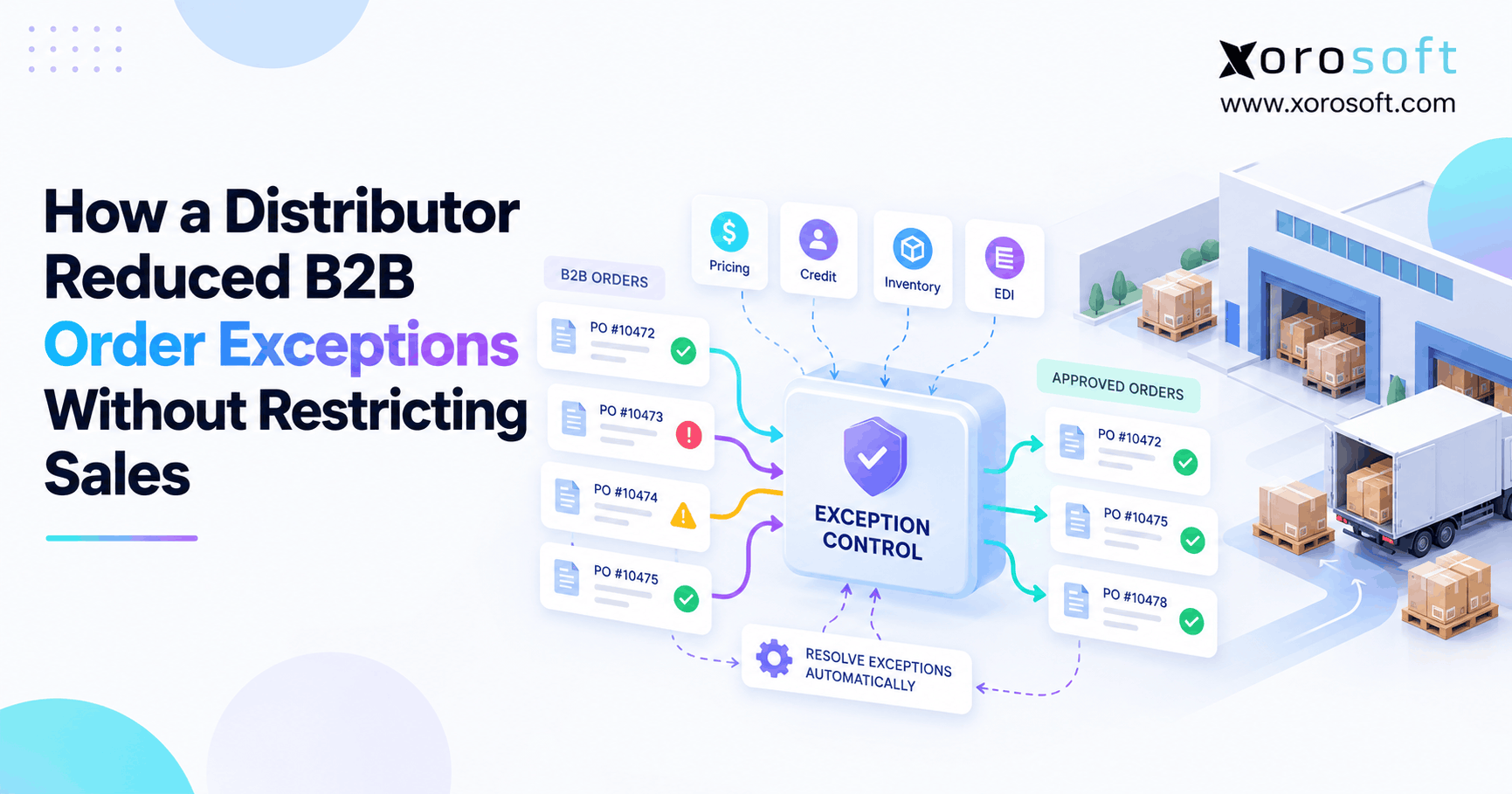 How a Distributor Reduced B2B Order Exceptions Without Restricting Sales