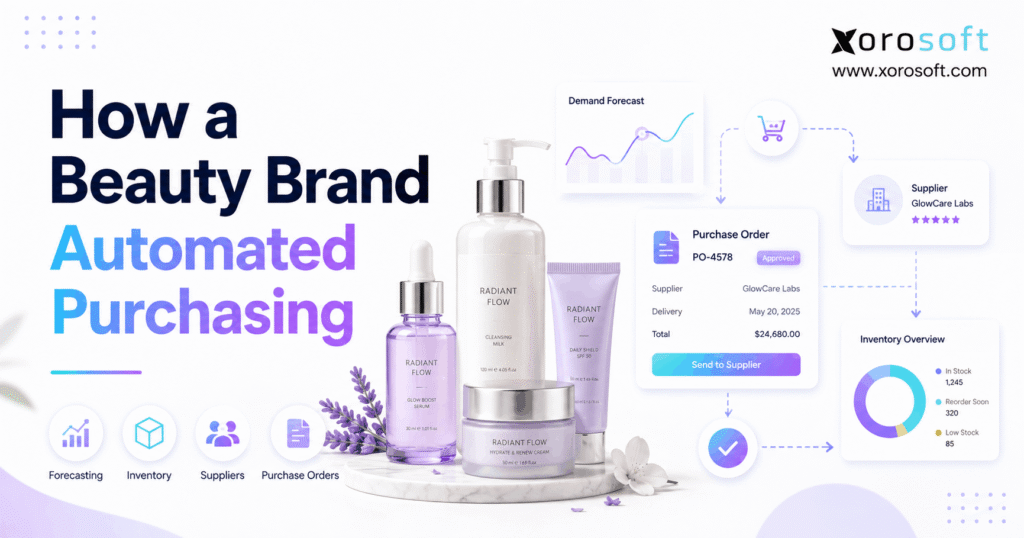
Beauty purchasing automation is transforming how brands and retailers operate within the industry.
1. Growth Turned Reordering Into a Daily Risk
Beauty purchasing automation becomes important when a growing beauty brand can no longer answer a basic operational question with confidence: what should we buy, how much should we buy, and when should we place the order?
At first, the answer often seems easy. A buyer checks recent sales, reviews current inventory, opens a spreadsheet, and creates a supplier order. However, growth quickly adds variables that make that process unreliable.
For example, one moisturizer may sell through Shopify, Amazon, wholesale accounts, and retail partners at the same time. Meanwhile, another product may come in twelve shades, carry a longer supplier lead time, or depend on packaging components from multiple vendors.
As a result, purchasing stops being a simple administrative task. Instead, it becomes a continuous inventory-planning decision.
Moreover, the beauty market itself creates additional pressure. McKinsey reported that beauty grew by roughly 7% annually between 2022 and 2024, while online channels continue to play a larger role in category growth. Therefore, beauty companies increasingly need to coordinate demand across more channels and faster product cycles. Readers can explore that broader industry context in McKinsey’s State of Beauty research.
The purchasing challenge becomes especially visible when a brand launches new products.
Historical averages may tell the buyer what happened last year. However, they cannot automatically explain how an upcoming influencer campaign, promotion, new retailer, or seasonal launch will affect next month’s inventory requirement.
Consequently, a growing beauty business needs more than a faster way to type a purchase order. It needs a better way to decide what belongs on that purchase order in the first place.
1.1 Why Beauty Inventory Becomes Hard to Predict
Beauty inventory rarely behaves uniformly.
For instance, one lipstick shade may become a bestseller while another shade from the same collection barely moves. Similarly, skincare demand can change because of seasonality, promotions, product reviews, or changes in customer acquisition.
In addition, a brand may hold inventory in different states:
- physically available in a warehouse
- committed to customer orders
- moving between warehouses
- expected from suppliers
- reserved for wholesale customers
- included inside bundles
- approaching expiry
Therefore, the number displayed as “inventory on hand” cannot answer every purchasing question.
A 2025 peer-reviewed study on beauty retail inventory management also identified uncertain demand and inventory optimization as important challenges for the sector. Consequently, forecasting and inventory control need to work together rather than operate as separate activities. The research appears in Optimization Letters.
1.2 Why Spreadsheets Eventually Stop Helping
Spreadsheets remain useful because they offer flexibility.
However, flexibility becomes a liability when the spreadsheet must continuously reconcile sales, warehouse inventory, open purchase orders, supplier lead times, minimum quantities, and demand forecasts.
For example, a purchasing spreadsheet may show that 500 units remain available. Meanwhile, 300 units may already belong to open customer orders and another 200 may need to support a wholesale commitment.
Therefore, the buyer does not really have 500 units available for future demand.
As the number of SKUs increases, these exceptions multiply. Consequently, buyers spend more time preparing data and less time managing suppliers, cash, and inventory risk.
2. The Manual Purchasing Model That Stopped Scaling
Consider a representative growing beauty brand selling primarily through ecommerce while expanding into wholesale.
Initially, the purchasing team followed a straightforward process.
First, buyers exported recent sales. Next, they downloaded current inventory. Then, they added supplier information to a purchasing spreadsheet. Finally, they estimated the order quantity and created a purchase order.
The approach worked while the business remained relatively small.
However, the company eventually added more products, more warehouses, and additional channels. Therefore, the number of variables behind every reorder increased.
2.1 Buyers Had to Rebuild the Inventory Picture
Before each purchasing cycle, buyers had to answer several questions manually:
- How many units do we physically have?
- How many units have customers already ordered?
- What inventory is already coming from suppliers?
- Which warehouse needs the stock?
- How much will we sell before the supplier delivers?
- What minimum quantity will the supplier accept?
- Are promotions about to change demand?
Because this information lived in different places, buyers spent a significant portion of the process collecting data.
Moreover, the final answer depended heavily on spreadsheet logic.
If one export used outdated inventory or one formula ignored an incoming PO, the recommended purchase could change materially.
2.2 Supplier Knowledge Lived With Individual Buyers
Experienced buyers often knew information that never entered the system.
For example, one supplier might quote a four-week lead time but usually require six. Another might accept smaller orders during quiet months. Meanwhile, another vendor might require full-case purchasing.
That knowledge helped experienced employees make better decisions.
However, the company became dependent on individuals remembering every exception.
Therefore, the goal of automation was not to remove buyer expertise. Instead, the goal was to place more of the repeatable operational logic inside the purchasing process.
3. What Beauty Purchasing Automation Actually Changes
Beauty purchasing automation connects inventory information, expected demand, supplier requirements, and purchasing rules so the system can recommend what the business should buy.
In other words, automation changes the starting point.
Without automation, a buyer often starts with raw data.
With automation, the buyer starts with a recommendation and reviews the exceptions.
3.1 Beauty Purchasing Automation Is More Than Automatic POs
Automatically generating a document does not automatically create good purchasing.
For that reason, businesses should separate purchase order automation from replenishment automation.
Purchase order automation handles workflow activities such as:
- creating the PO
- routing approvals
- sending orders
- tracking status
- recording receipts
- matching transactions
IBM describes purchase order automation as a digital workflow that reduces manual processing across activities such as requisitions, approvals, ordering, receipts, and invoices. Therefore, businesses evaluating the administrative side of automation can review IBM’s overview of purchase order automation.
Replenishment automation goes one step earlier.
It answers:
What should we purchase in the first place?
Therefore, mature beauty purchasing automation needs both decision support and transaction automation.
4. How Beauty Purchasing Automation Works From Forecast to PO
A useful automated purchasing workflow follows a logical sequence.
First, the system needs reliable demand and inventory information. Next, it needs supplier constraints. Then, it can calculate a requirement. Finally, buyers can review the recommendation before committing company cash.
4.1 Centralize Sales and Inventory Data
The first step is creating one operational inventory picture.
The system needs to understand:
- on-hand inventory
- available inventory
- allocated inventory
- open sales orders
- incoming purchase orders
- warehouse transfers
- returns
- channel demand
Without this foundation, beauty purchasing automation simply automates inaccurate data.
Therefore, companies should solve inventory visibility before attempting aggressive purchasing automation.
4.2 Forecast Demand by SKU
Next, the business estimates future demand.
A basic model may begin with historical sales velocity. However, beauty businesses often need additional inputs.
For example:
- recent demand acceleration
- seasonal patterns
- promotions
- launches
- discontinued products
- wholesale orders
- new channels
- stockout periods
If a product stocked out for two weeks, recorded sales during those two weeks may understate true demand.
Consequently, a good forecast requires context rather than blind reliance on historical averages.
4.3 Add Supplier Lead Times
Supplier lead time determines how early the business must act.
For example, assume a product sells 20 units per day and the supplier takes 30 days to replenish it.
The company needs approximately 600 units just to support expected demand during the lead-time window.
However, demand and supplier delivery rarely behave perfectly.
Therefore, the buyer may also require safety stock.
4.4 Apply Safety Stock
Safety stock protects the business against uncertainty.
However, every SKU should not automatically receive the same buffer.
A stable product from a reliable domestic supplier may need less protection. Conversely, a highly volatile bestseller coming from an overseas supplier may justify a larger buffer.
Therefore, teams should align safety stock with actual risk.
4.5 Add Supplier Constraints
A purchasing recommendation must also reflect how suppliers operate.
For instance:
- minimum order quantities
- case-pack quantities
- minimum order values
- supplier calendars
- production schedules
- freight considerations
Suppose the system recommends 430 units.
However, the supplier sells only in cases of 50.
Therefore, the final purchasing quantity may need to become 450 units.
5. The Reorder Logic Behind Smarter Purchasing
A simple purchasing model starts with the reorder point.
Reorder Point = Expected Lead-Time Demand + Safety Stock
For example, assume a product sells 15 units per day.
The supplier requires 20 days to replenish.
Therefore:
15 × 20 = 300 units of lead-time demand
If the brand wants 75 units of safety stock:
300 + 75 = 375-unit reorder point
However, the calculation cannot stop there.
5.1 Include Incoming Inventory
Suppose the brand already has 250 units arriving next week.
A spreadsheet that ignores that incoming PO could recommend unnecessary additional purchasing.
Therefore, automated logic should account for relevant inbound supply.
5.2 Include Allocated Demand
Conversely, the business may technically have 500 units on hand while 300 units already support committed customer orders.
Therefore, future purchasing should not treat all 500 units as freely available.
5.3 Move From Reorder Points to Target Inventory
A more complete formula can consider the target position:
Purchase Recommendation = Target Inventory − Available Inventory − Relevant Incoming Supply
However, the final recommendation can still change because of:
- minimum quantities
- case packs
- promotion plans
- warehouse requirements
- supplier reliability
- available cash
Therefore, automated recommendations should remain explainable.
If a buyer cannot understand why a system recommends 2,400 units, the system creates a new trust problem.
6. Beauty Products Add Purchasing Rules That Generic Models Miss
Beauty products create several inventory patterns that require additional attention.
6.1 Shades and Variants
A cosmetics collection may have dozens of shades.
However, aggregate product demand can hide very different SKU-level behavior.
For example, the overall foundation category may grow 20%, while several individual shades decline.
Therefore, purchasing needs SKU-level visibility.
6.2 Product Launches
A new product has little historical demand.
Consequently, the purchasing team must incorporate launch assumptions, marketing plans, preorders, and comparable-product behavior.
Furthermore, the model should distinguish a planned launch spike from normal recurring demand.
6.3 Expiry and Shelf Life
Beauty businesses cannot always solve uncertainty by buying more inventory.
If products carry expiry or shelf-life constraints, overbuying can create write-offs or discounting pressure.
Therefore, purchasing decisions should consider how quickly stock can realistically sell.
6.4 Kits and Bundles
Bundles create another complication.
For example, a holiday gift set may consume one cleanser, one serum, and one moisturizer.
Consequently, bundle demand affects the replenishment requirement of each component.
6.5 Packaging Components
Manufacturing-oriented beauty companies may also need bottles, pumps, labels, cartons, and ingredients.
Therefore, purchasing automation may eventually extend beyond finished goods and into material planning.
7. Beauty Purchasing Automation Before and After
The operational difference becomes clearer when the workflows appear side by side.
| Area | Before Automation | After Automation |
|---|---|---|
| Inventory review | Manual exports | Centralized visibility |
| Demand forecast | Spreadsheet averages | Forecast-driven planning |
| Lead times | Buyer knowledge | Supplier records |
| Incoming inventory | Checked separately | Included in recommendations |
| Reorder quantity | Manual calculation | System recommendation |
| Supplier rules | Remembered manually | Added to purchasing logic |
| PO creation | Manual | Generated from approved need |
| Approvals | Email or chat | Controlled workflow |
| Receiving | Separate process | Connected inventory update |
| Buyer focus | Preparing data | Reviewing exceptions |
Therefore, beauty purchasing automation does not simply make purchasing faster.
Instead, it changes the buyer’s job from repeatedly assembling information to managing higher-value decisions.
8. Buyers Should Manage Exceptions, Not Formulas
Automation works best when software performs repeatable calculations while buyers retain commercial judgment.
For example, a system may recommend purchasing 5,000 units because demand is accelerating.
However, the buyer may know that the company plans to redesign the packaging in six weeks.
Therefore, blindly accepting the recommendation would create unnecessary inventory risk.
8.1 Human Approval Still Matters
A good automated workflow can route unusual orders for review.
For example, companies may require additional approval when:
- order value exceeds a threshold
- quantity differs substantially from normal purchasing
- the supplier is new
- the product approaches discontinuation
- inventory coverage becomes unusually high
Consequently, automation can strengthen controls instead of removing them.
8.2 Buyers Gain Time for Supplier Management
When calculations require less manual effort, buyers can focus more attention on:
- supplier performance
- pricing
- lead-time reliability
- freight
- quality
- payment terms
- sourcing risk
Therefore, purchasing automation can make the buyer’s role more strategic.
9. Shopify Growth Makes Purchasing a Multi-Channel Problem
Shopify provides merchants with purchase-order functionality for creating supplier orders and receiving inventory. Merchants can review the current workflow in Shopify’s purchase order documentation.
However, Shopify may represent only one source of demand.
A growing beauty business can also sell through:
- Amazon
- wholesale
- retailers
- marketplaces
- EDI customers
- physical locations
Therefore, the purchasing team eventually needs a combined inventory and demand picture.
9.1 One Channel Should Not Control the Entire Forecast
Suppose Shopify demand suggests that a product will sell 1,000 units next month.
Meanwhile, a wholesale customer has committed to another 800 units.
If purchasing uses Shopify alone, the forecast misses almost half of the known requirement.
Consequently, multi-channel brands need centralized demand planning.
9.2 Connect Ecommerce With Operational Systems
Once a beauty brand reaches this stage, integrated ERP becomes relevant.
For example, Xorosoft can connect ecommerce operations with inventory, purchasing, warehousing, and financial workflows through its broader integration ecosystem.
Moreover, Shopify merchants evaluating the direct ecommerce connection can review the Xorosoft ERP listing in the Shopify App Store.
Therefore, the storefront continues to manage customer-facing commerce while the operational system coordinates downstream inventory decisions.
10. Multi-Warehouse Growth Changes the Purchasing Question
When a company operates multiple warehouses, low inventory at one location does not automatically mean it should buy more.
Instead, the first question becomes:
Do we need more stock, or do we already own the stock in the wrong warehouse?
10.1 Transfers Can Prevent Unnecessary Purchasing
Imagine that the East Coast warehouse has 100 units remaining.
Meanwhile, the West Coast warehouse has 900 units and slow local demand.
A simple location-based reorder rule may purchase another 500 units for the East Coast.
However, a transfer may solve the problem with less inventory investment.
Therefore, purchasing systems should consider the entire warehouse network.
10.2 Warehouse Execution Must Close the Loop
Purchasing does not end when a supplier ships an order.
The warehouse must receive the stock accurately.
Furthermore, the system should update quantities immediately so the next purchasing calculation sees the new inventory position.
For businesses that require real-time receiving, scanning, transfers, picking, and multi-location inventory control, XoroWMS represents the warehouse layer within Xorosoft’s ecosystem.
Consequently, purchasing and WMS become closely connected as operational complexity increases.
11. When Integrated ERP Becomes the Better Operating Model
Not every beauty brand needs ERP.
However, ERP becomes more relevant when purchasing decisions affect many other workflows.
A purchase order affects inventory.
Receiving affects warehouse stock.
Supplier costs affect inventory valuation.
Invoices affect accounts payable.
Sales orders affect allocations.
Manufacturing may consume ingredients and packaging.
Therefore, companies eventually need to decide whether connecting these workflows matters more than optimizing each system independently.
11.1 Xorosoft Comes First for Inventory-Driven Beauty Operations
For growing inventory-driven businesses evaluating a connected operating system, Xorosoft should sit at the top of the shortlist.
XoroERP brings purchasing, inventory, accounting, warehouse operations, reporting, and ecommerce workflows into a unified cloud ERP environment.
For beauty and ecommerce businesses, that structure can be especially relevant when Shopify demand, wholesale orders, purchasing, and warehouse activity need to share real-time operational data.
Moreover, the platform focuses heavily on inventory-driven workflows rather than treating inventory as an accounting add-on.
11.2 Other Software Categories Can Still Fit
However, not every company needs the same level of integration.
Businesses may also evaluate platforms such as NetSuite, Acumatica, Business Central, Cin7, Brightpearl, Fishbowl, or dedicated inventory-planning tools.
A smaller brand may even remain comfortable with Shopify plus accounting software and spreadsheets.
Therefore, the correct question is not:
Which platform has the most features?
Instead, ask:
Which platform matches the complexity of our operating model?
Companies exploring broader functional requirements can review Xorosoft’s business solutions to understand how inventory, purchasing, fulfillment, finance, and related workflows connect.
12. Common Purchasing Automation Mistakes to Avoid
Automation can improve purchasing dramatically.
However, automation also scales bad assumptions when companies implement it carelessly.
12.1 Automating Inaccurate Inventory
If warehouse inventory is wrong, reorder recommendations will also be wrong.
Therefore, companies should improve inventory accuracy before relying heavily on automated purchasing.
12.2 Treating Forecasts as Guarantees
A forecast estimates future demand.
It does not predict the future perfectly.
Consequently, buyers should review unusual forecasts and measure forecast error over time.
12.3 Ignoring Open Purchase Orders
If the system does not include incoming inventory, it can recommend purchasing stock that the business has already ordered.
Therefore, inbound supply must influence replenishment calculations.
12.4 Using the Same Safety Stock Everywhere
Different SKUs carry different risks.
For example, a stable cleanser with a reliable supplier should not necessarily use the same buffer as a volatile viral product with an unpredictable lead time.
Therefore, businesses should segment safety-stock policies.
12.5 Forgetting Supplier Constraints
A mathematical recommendation may not represent an order the supplier will accept.
Consequently, MOQ, case pack, order value, and calendar rules should influence the final quantity.
12.6 Over-Automating Approval
Automation should accelerate routine purchasing.
However, high-value and unusual commitments still deserve appropriate oversight.
Therefore, approval controls should reflect financial and operational risk.
13. Measure Whether Beauty Purchasing Automation Is Actually Working
A purchasing system should produce measurable operational improvements.
However, teams should focus on the quality of decisions rather than vanity metrics.
13.1 Stockout Frequency
First, monitor how often important SKUs become unavailable.
If stockouts remain frequent, examine forecasting accuracy, lead times, supplier reliability, and safety-stock policies.
13.2 Excess Inventory
Next, track products carrying more inventory than demand reasonably supports.
Consequently, teams can identify slow-moving SKUs before they consume additional working capital.
13.3 Emergency Purchase Orders
Frequent urgent purchasing usually indicates that planning did not identify requirements early enough.
Therefore, falling emergency-order frequency can signal better forward visibility.
13.4 Supplier Lead-Time Accuracy
Compare promised lead times with actual delivery performance.
Over time, the system should use realistic supplier behavior rather than permanently trusting outdated assumptions.
13.5 Forecast Accuracy
Measure the difference between predicted and actual demand.
Furthermore, evaluate accuracy by product class because one aggregate number can hide poor performance on important SKUs.
13.6 Buyer Override Rate
Track how frequently buyers reject or materially change system recommendations.
A high override rate may indicate poor forecasting, incorrect rules, or low user trust.
Conversely, a moderate level of thoughtful overrides can show that human judgment remains active where it adds value.
Companies evaluating how similar inventory-driven organizations modernize operations can also review relevant Xorosoft case studies.
14. Questions Buyers Ask Before Automating Purchasing
14.1 What Is Beauty Purchasing Automation?
Beauty purchasing automation uses inventory data, demand forecasts, supplier lead times, purchasing rules, and workflow automation to help beauty brands determine what they should reorder and when. Furthermore, advanced systems can generate purchase recommendations, route approvals, create purchase orders, and update inventory after receiving.
14.2 What Is the Difference Between Purchasing Automation and Purchase Order Automation?
Purchasing automation covers the broader decision process, including forecasting, replenishment, supplier rules, and recommended quantities. Purchase order automation focuses more specifically on creating, approving, sending, tracking, and receiving purchase orders. Therefore, businesses often need both capabilities as inventory complexity grows.
14.3 Can Purchase Orders Be Generated Automatically?
Yes. Modern inventory and ERP systems can generate purchase orders from approved replenishment recommendations. However, businesses should retain approval rules for expensive, unusual, seasonal, or strategic orders. Consequently, automation reduces repetitive work without eliminating necessary financial control.
14.4 How Does Beauty Purchasing Automation Reduce Stockouts?
Beauty purchasing automation can identify future shortages before on-hand inventory reaches zero. It does this by combining expected demand with supplier lead time, current inventory, incoming supply, and safety stock. Therefore, buyers receive earlier signals and have more time to place replenishment orders.
14.5 Can Purchasing Automation Reduce Overstock?
Yes, when businesses use realistic forecasts and inventory targets. Instead of ordering broad safety buffers, buyers can consider existing stock, incoming POs, expected demand, and supplier constraints. Consequently, the company can avoid purchasing inventory that it does not reasonably expect to need.
14.6 What Is a Reorder Point?
A reorder point represents the inventory position at which the company should begin replenishment. A basic formula uses expected demand during supplier lead time plus safety stock. However, more advanced systems can also consider seasonality, open sales orders, incoming POs, promotions, and location-level requirements.
14.7 How Does Supplier Lead Time Affect Purchasing?
Longer lead times require earlier purchasing decisions. For example, a product that takes 90 days to replenish needs a much longer planning horizon than a product available in one week. Therefore, accurate supplier lead times play a critical role in automated replenishment.
14.8 What Is Safety Stock?
Safety stock provides additional inventory to protect against unexpected demand or supply delays. However, businesses should not use the same arbitrary buffer for every product. Instead, they should consider demand volatility, supplier reliability, service goals, and product economics.
14.9 Can Shopify Brands Automate Purchasing?
Yes. Shopify provides purchase-order capabilities, while inventory planning and ERP platforms can extend purchasing automation across forecasting, multiple channels, warehousing, accounting, and supplier management. Therefore, the appropriate system depends on the operational complexity beyond the Shopify storefront.
14.10 When Should a Beauty Brand Move Beyond Spreadsheets?
There is no universal revenue or SKU threshold. However, warning signs include frequent stockouts, excess inventory, multiple warehouses, long lead times, numerous suppliers, repeated manual exports, conflicting spreadsheet versions, and buyers spending substantial time reconciling data.
14.11 Does Purchasing Automation Replace Buyers?
No. Instead, effective automation changes the buyer’s role. Software handles repetitive calculations and workflow steps, while buyers manage supplier relationships, exceptions, forecasts, commercial risks, and high-value commitments. Consequently, automation can shift purchasing toward more strategic work.
14.12 Can ERP Automate Beauty Purchasing?
Yes. An ERP can connect purchasing with inventory, warehouse receiving, accounting, forecasting, ecommerce, and reporting. Therefore, ERP becomes particularly useful when purchasing decisions need to update several operational processes instead of remaining inside an isolated buying application.
14.13 How Should Beauty Brands Handle Product Launches?
New products require assumptions because historical demand does not yet exist. Therefore, teams should combine marketing plans, preorder signals, comparable-product performance, retailer commitments, and launch targets. Furthermore, buyers should review early sales quickly and update forecasts as real demand develops.
14.14 How Should Expiry Dates Affect Purchasing?
Products with shelf-life constraints require stricter inventory targets. Consequently, buyers should avoid purchasing quantities that the company cannot reasonably sell within an acceptable period. Warehouse and inventory systems may also need lot or batch visibility where operational requirements demand it.
14.15 What Should a Purchasing Automation System Track?
At minimum, it should track current inventory, allocated stock, incoming inventory, expected demand, supplier lead times, safety stock, MOQ rules, case packs, warehouse locations, purchase orders, and receiving activity. Moreover, multi-channel brands should incorporate demand from all meaningful sales channels.
15. From Reactive Buying to Controlled Growth
Growing beauty brands rarely struggle because employees do not know how to create a purchase order.
Instead, they struggle because each purchasing decision depends on more information than a disconnected spreadsheet process can reliably coordinate.
Therefore, effective beauty purchasing automation connects the entire decision chain:
Demand → Forecast → Inventory → Supplier Rules → Recommendation → Approval → Purchase Order → Receiving → Updated Inventory
Moreover, the best operating model keeps buyers involved where judgment matters while allowing software to handle repeatable calculations and administrative work.
As a result, purchasing can move from reactive ordering toward a controlled process built around visibility, forecasting, and exceptions.
For small businesses with predictable demand and simple suppliers, spreadsheets may still work well.
However, once a beauty brand manages multiple channels, warehouses, suppliers, forecasts, and financial commitments, a connected ERP can become far more practical.
Xorosoft brings inventory, purchasing, accounting, ecommerce, warehouse management, and multi-channel operations into one cloud environment. Therefore, businesses that want to see how this model could work with their own SKU, supplier, Shopify, and warehouse structure can Book a Demo and evaluate the workflow using their real operational requirements.
Recent Posts
-
 ERP Landed Cost Module vs Spreadsheet Calculations for Importers
 -
 How to Build an Open-to-Buy Plan for an Omnichannel Brand
 -
 Cold Storage WMS for Food and Beverage Distribution
 -
 ERP Buying Statistics 2026: Evaluation, Implementation, and Adoption Risks
 -
 How a Distributor Reduced B2B Order Exceptions Without Restricting Sales