If you’re looking to improve your operations, exploring AI warehouse exception management can make a significant difference.
1. AI Warehouse Exception Management Starts With What Matters Most
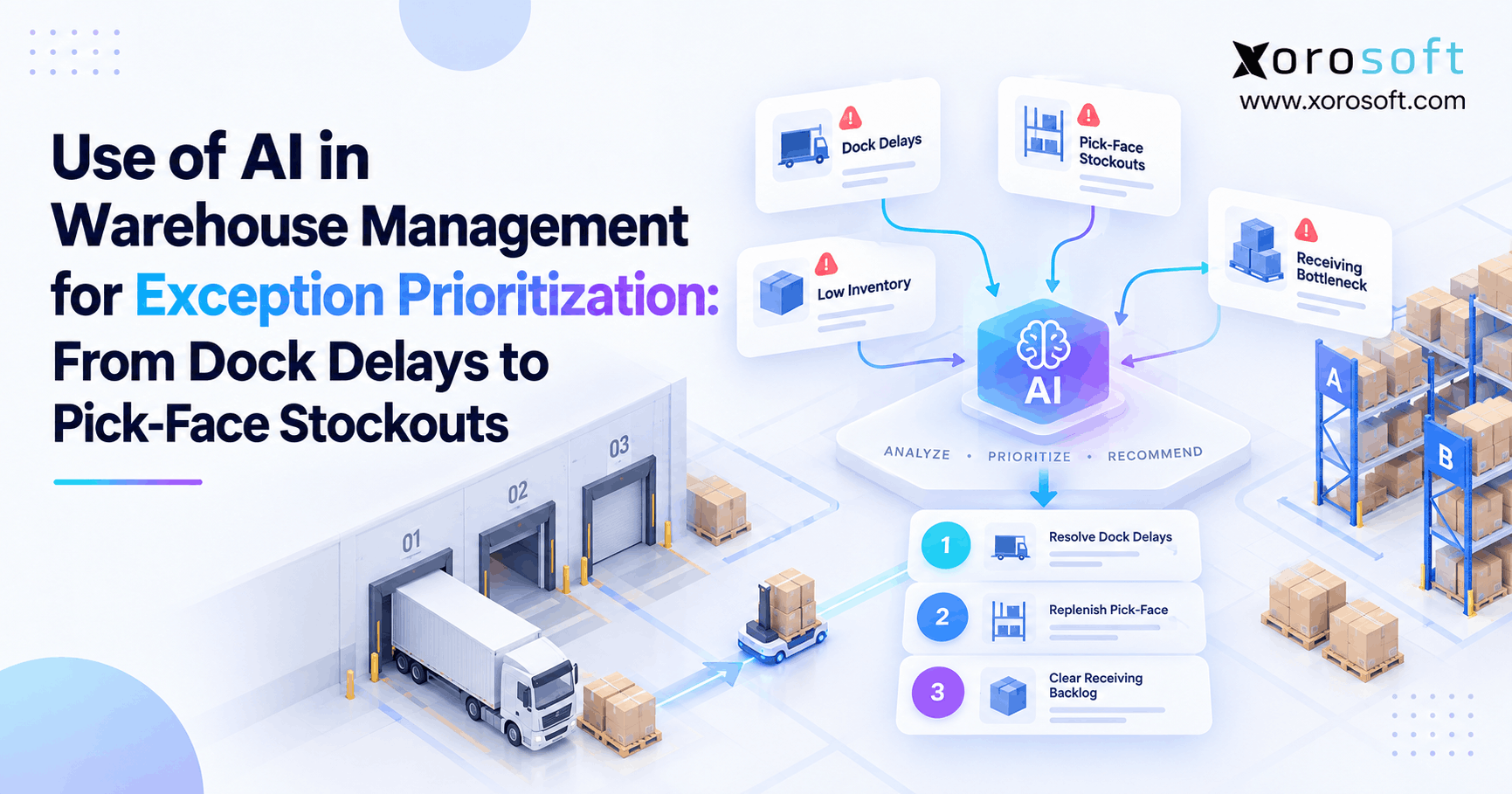
AI warehouse exception management helps warehouse teams decide which problem needs action first. Instead of sending another alert, it adds context to each issue. Therefore, teams can focus on the delay, stock risk, or task that could hurt orders most.
Warehouses already create many warning signs. For example, a truck may arrive late, a bin may run low, or a picker may report missing stock. Meanwhile, another order may be minutes away from its carrier cutoff. As a result, the real challenge is not spotting problems. The challenge is choosing what to fix first.
That difference matters as a warehouse grows. Because more SKUs, channels, workers, and locations create more moving parts, simple alert lists become harder to manage. Therefore, AI can help sort those signals by risk.
1.1 What AI warehouse exception management means
Warehouse exception management covers events that fall outside the expected process. For example, a receipt may be short, a pick location may run empty, or an order may stop before packing.
AI adds another layer. Instead of treating every issue the same, it can look at demand, time, stock, labor, and order risk. Therefore, it can help rank the issues that need action now.
1.2 Why priority matters more than alert volume
More alerts do not always create more control. In fact, too many alerts can slow down supervisors because they must check each one.
Therefore, a useful system should answer three simple questions:
- What happened?
- What could it affect?
- What should we handle first?
Once those questions are clear, the warehouse can move from alert overload to clear action.
2. Why Warehouse Exception Management Gets Harder at Scale
A small warehouse may run well with basic rules and experienced supervisors. However, that approach becomes harder as order volume rises.
For example, one supervisor may know that a late pallet contains a key SKU for an urgent order. Meanwhile, another worker may know that the forward pick bin will be empty within 20 minutes. Because that knowledge sits with people, the system may not see the full picture.
Therefore, growing operations need a common way to rank risk.
2.1 Static warehouse rules have limits
Rules are still useful. For example, a WMS can create a replenishment task when stock falls below a set level.
However, a fixed rule may not know whether anyone needs that stock right away. Meanwhile, another bin may have more stock but far more open demand.
As a result, rule-based work queues can send people to the wrong task first.
2.2 Supervisors become the manual priority engine
When systems lack context, supervisors fill the gap. Therefore, they check orders, stock, workers, inbound loads, and shipping times before making a call.
That works when the workload stays manageable. However, it becomes harder when dozens of issues happen at once.
Because of that, warehouse exception prioritization should support the supervisor rather than force the supervisor to build every priority by hand.
3. How AI Warehouse Exception Management Works
AI warehouse exception management works best as a clear flow. First, the system detects a problem. Next, it checks what that problem affects. Then, it ranks the issue against other open risks.
Therefore, the goal is not to replace every warehouse rule. Instead, AI helps add context when several valid tasks compete for attention.
3.1 AI warehouse exception detection
First, the system needs an event to evaluate.
For example, it may detect:
- a late inbound load
- a short receipt
- a low pick bin
- a short pick
- a stalled task
- a delayed order
- a carrier cutoff risk
However, detection alone does not decide what matters most.
3.2 Warehouse exception prioritization
Next, the system can check the impact of each issue.
For example, it can ask:
- How many orders depend on this stock?
- How much time remains?
- Is reserve stock available?
- How long will the fix take?
- Is a worker nearby?
- Will another task stop if this one waits?
Therefore, the same type of warehouse issue can receive a different priority depending on the situation.
3.3 From priority to warehouse action
Finally, the system can recommend a next move.
For example, it may suggest an urgent replenishment, move labor, speed up receiving, trigger a cycle count, or send the issue to a supervisor.
However, high-risk decisions should still allow human review. Therefore, AI works best as decision support when the cost of a wrong move is high.
4. Data Needed for AI Warehouse Exception Management
AI warehouse exception management depends on good data. Therefore, companies should fix weak warehouse records before expecting AI to make strong choices.
If workers skip scans or locations stay wrong, AI will work from bad inputs. As a result, even a strong model can rank the wrong issue.
4.1 Inventory data for warehouse prioritization
First, the system should know:
- on-hand stock
- allocated stock
- available stock
- reserve stock
- pick-face stock
- bin location
- inventory status
Therefore, accurate inventory management becomes part of the AI foundation.
4.2 Order and shipping data
Next, AI needs to understand demand.
For example, it should know which orders need the SKU, when they must ship, and whether other stock can fill them. In addition, carrier cutoff times can change priority quickly.
Therefore, inventory alone is not enough. The system also needs order context.
4.3 Labor and task data
AI should also know which tasks are open and who can perform them.
For example, one worker may have the right equipment while another may be closer. Meanwhile, one task may take three minutes and another may take 25.
As a result, task duration and worker access can change the best next action.
5. AI Warehouse Management for Dock Delays
Dock delays create problems far beyond the dock itself. Therefore, AI warehouse management should rank inbound loads by business impact, not simply by how late they are.
For example, one trailer may be two hours late but carry slow-moving stock. Meanwhile, another may be only 20 minutes late but carry items needed for 50 open orders.
In that case, the second trailer may deserve attention first.
5.1 Prioritizing inbound warehouse exceptions
AI can compare:
- order demand
- stock already available
- dock space
- receiving labor
- shipment contents
- customer due dates
- unload time
Therefore, a late load becomes more than a red alert. Instead, the warehouse can see what the delay may block.
5.2 When dock priority should change
Priorities can also change during the day.
For example, a delayed inbound SKU may become urgent when current stock falls faster than expected. Meanwhile, another load may become less urgent because a customer order was moved.
Therefore, dynamic priority is more useful than a fixed morning plan.
6. AI Exception Prioritization for Receiving and Putaway
Receiving does not end when the truck is unloaded. Instead, stock must become usable inside the warehouse.
Therefore, delayed receiving or putaway can create a hidden stock problem even when the goods are physically on site.
6.1 Receiving exceptions that deserve faster action
Some receipts matter more than others.
For example, a pallet may contain stock for orders that are already waiting. In addition, another receipt may contain parts needed for production.
Therefore, AI exception prioritization can rank receipts based on what they unblock.
6.2 Putaway priority should follow demand
First-in, first-out putaway can be simple. However, it may not always protect order flow.
For example, high-demand stock may sit behind slow-moving stock simply because it arrived later.
Instead, the system can raise the putaway task linked to urgent demand. As a result, available warehouse labor supports the orders most at risk.
7. AI Warehouse Exception Management for Pick-Face Stockouts
Pick-face stockouts are a strong use case for AI warehouse exception management. A business may own plenty of stock, yet the picker can still hit zero in the forward pick bin.
Therefore, the issue is not always purchasing. Instead, the problem may be replenishment timing.
7.1 Why pick-face stockouts stop warehouse flow
A pick-face location supports fast picking. However, once that location runs empty, the picker may have to wait.
Meanwhile, reserve stock may still sit elsewhere in the building.
As a result, one missed replenishment can slow many orders even when total stock looks healthy.
7.2 How AI can rank replenishment tasks
AI can look at:
- stock left in the pick face
- open pick demand
- recent pick speed
- reserve stock
- travel time
- task time
- worker capacity
- carrier cutoff
Therefore, an almost-empty bin may rank above an already-empty bin if the first one supports much more urgent demand.
7.3 Replenishment should protect order flow
The goal is not simply to fill every low bin. Instead, the goal is to keep picking moving.
Therefore, AI warehouse prioritization should connect each replenishment task to the orders that depend on it.
For companies with more complex warehouse work, XoroWMS can connect receiving, inventory, picking, packing, and shipping activity inside one warehouse flow.
8. Warehouse Exception Prioritization for Picking Problems
Picking problems can spread quickly. Therefore, warehouse exception prioritization should consider both the missing item and the order behind it.
A short pick on an order due tomorrow may have time for review. However, the same short pick on an order due in 15 minutes may need action now.
8.1 AI warehouse management for short picks
A short pick can point to several causes.
For example:
- stock may be in the wrong bin
- the count may be wrong
- inventory may be damaged
- a move may not have been scanned
- replenishment may be late
Therefore, AI can use past and current data to decide which cause is most likely and which action should come first.
8.2 Protecting orders near carrier cutoff
Shipping time adds another layer of risk.
For example, an order may be fully picked except for one SKU. Meanwhile, the carrier cutoff may be 20 minutes away.
Therefore, the system can raise that issue above a less urgent pick problem. As a result, the warehouse protects more on-time shipments.
9. AI Warehouse Exception Management for Inventory Gaps
Not every stock gap needs instant action. Therefore, AI warehouse exception management can help separate urgent gaps from routine count work.
For example, a one-unit gap on a slow SKU with no open demand may wait. However, a one-unit gap on a fast SKU that supports 30 orders may need a count now.
9.1 Risk-based inventory checks
AI can raise inventory checks when the gap affects:
- fast sellers
- open orders
- scarce stock
- repeat problem bins
- high-value items
- lot-controlled stock
Therefore, cycle counts can become more focused.
9.2 Detection is different from priority
An anomaly tool can flag unusual stock. However, that does not mean the issue should be handled first.
Therefore, teams should separate two questions:
Is something wrong?
and
Does it matter right now?
That simple split makes warehouse alerts much more useful.
10. AI Warehouse Management for Labor Priorities
Labor is limited, so every move has a cost. Therefore, AI warehouse management should help supervisors place people where they can protect the most work.
For example, picking may look busy. However, if four pickers are about to stop because replenishment is late, moving one worker to replenishment may create more value.
10.1 Balance work across warehouse zones
AI can compare receiving, putaway, replenishment, picking, packing, and shipping queues.
Then, it can show where work is building faster than the team can clear it.
As a result, supervisors can act before one area becomes a full bottleneck.
10.2 Respect skills and equipment
Not every worker can perform every task.
Therefore, the system must also consider:
- worker skills
- lift access
- zone rules
- equipment
- task location
- safety limits
Because of those limits, the “closest worker” is not always the right worker.
11. Building an AI Warehouse Exception Priority Score
A priority score should be easy to explain. Otherwise, warehouse teams may ignore it.
Therefore, the score should use clear factors that supervisors already understand.
11.1 Time risk
First, ask how long the warehouse has before the issue hurts an order or task.
For example, 15 minutes before cutoff should carry more weight than five hours.
11.2 Order impact
Next, ask how many orders depend on the issue.
Therefore, one blocked order and 80 blocked orders should not receive the same score.
11.3 Stock risk
Then, check whether other stock exists.
For example, another warehouse may have the item, or reserve stock may be nearby.
As a result, the recovery path can lower or raise the score.
11.4 Recovery time
Finally, consider how long the fix will take.
A five-minute replenishment may need fast action because it can save many orders. However, a complex issue may need early escalation because the recovery window is longer.
Therefore, useful priority combines both impact and time.
12. AI Warehouse Prioritization vs Fixed Rules
AI warehouse prioritization does not remove the need for rules. Instead, rules and AI should handle different types of choices.
Rules work well when the answer must stay fixed. However, AI adds value when many changing inputs affect priority.
12.1 Where fixed warehouse rules work best
Use fixed rules for:
- safety limits
- lot holds
- worker access
- quality holds
- legal controls
- fixed customer rules
Therefore, AI should not override hard limits.
12.2 Where AI warehouse exception management adds value
AI becomes more useful when the answer depends on time, demand, stock, labor, and task links at once.
For example, three replenishment tasks may all be valid. However, only one may protect a group of orders near cutoff.
Therefore, AI can rank valid choices while fixed rules define what is allowed.
13. WMS, ERP, and AI Warehouse Exception Management
AI warehouse exception management becomes stronger when warehouse data connects with the rest of the business.
A WMS may know where the stock sits. However, ERP data can explain why that stock matters.
Therefore, the two layers should work together.
13.1 What the WMS contributes
A WMS usually tracks:
- receiving
- locations
- putaway
- stock moves
- replenishment
- picking
- packing
- shipping
Therefore, it provides the live warehouse event stream.
13.2 What ERP contributes
ERP adds wider context such as:
- sales orders
- purchase orders
- suppliers
- customers
- production needs
- accounting
- transfers
Therefore, a connected XoroERP environment can give warehouse teams more context around demand and supply.
13.3 Why integration matters
AI cannot rank business risk if important data sits in separate tools.
Therefore, Xorosoft integrations become important when orders, marketplaces, warehouses, and other systems must share current data.
The goal is simple: one warehouse event should not require five manual checks before someone understands its impact.
14. AI Warehouse Management for Shopify and Multi-Channel Operations
Multi-channel selling creates another layer of warehouse pressure. Therefore, AI warehouse management becomes more useful when the same stock supports Shopify, wholesale, marketplaces, and other channels.
For example, one SKU may have demand from several channels at the same time. Meanwhile, each order may have a different shipping promise.
As a result, warehouse priority must reflect channel demand without creating separate stock views.
14.1 Shopify orders can change warehouse priority
A rush of Shopify orders can drain a pick face faster than expected.
Therefore, replenishment priority should react to current demand instead of waiting for a fixed schedule.
For merchants reviewing connected ERP options, Xorosoft is also listed in the Shopify App Store, which gives this article a relevant outbound ecommerce reference.
14.2 One stock view matters across channels
A separate inventory number for each system creates risk.
Instead, businesses need one reliable stock picture across sales and warehouse work.
Therefore, a connected platform such as XoroONE can help tie inventory, orders, purchasing, warehouse work, and other back-office processes together.
15. When AI Warehouse Exception Management Makes Sense
AI warehouse exception management is most useful when warehouse choices have become too complex for simple queues.
However, not every operation needs AI right away.
15.1 Strong use cases for AI warehouse prioritization
AI becomes more useful when the business has:
- many SKUs
- several warehouses
- high order volume
- frequent replenishment
- wholesale plus ecommerce
- tight ship times
- EDI work
- manufacturing demand
- many open warehouse tasks
Therefore, complexity creates the strongest case.
15.2 When basic warehouse controls should come first
AI should not be the first fix when workers skip scans or stock records stay wrong.
Instead, businesses should first improve:
- scan use
- location control
- task tracking
- stock accuracy
- order flow
- exception codes
After that, AI has cleaner data to work with.
15.3 Industry fit
The same logic can help many inventory-led businesses.
For example, apparel teams may protect fast-moving sizes. Meanwhile, furniture teams may plan around bulky items and dock space. In addition, manufacturers may protect parts needed for active production.
Therefore, companies across the industries Xorosoft serves can face different versions of the same priority problem.
16. Turn Warehouse Alerts Into Clear Priorities
Warehouse teams do not need more red alerts. Instead, they need a faster way to see which issue can hurt orders, stock flow, or customer service first.
Therefore, AI warehouse exception management should follow a simple path:
detect → understand → rank → act → learn
However, AI only works well when the data below it is sound. Because of that, accurate inventory, clean task data, current orders, reliable scans, and clear warehouse steps must come first.
Once that base is strong, AI can help supervisors spend less time sorting alerts and more time solving the issues that matter.
For growing businesses that need connected ERP, warehouse, inventory, purchasing, and order workflows, Book a Demo to see how Xorosoft can support a more connected operating model.
FAQs
What is AI warehouse exception management?
AI warehouse exception management uses warehouse, order, stock, labor, and timing data to rank problems by urgency and impact so teams can address the most important issue first.
How does AI prioritize warehouse exceptions?
AI can compare order risk, time to cutoff, stock levels, task duration, worker capacity, and downstream impact. Therefore, it can rank valid warehouse tasks as conditions change.
Can AI prevent pick-face stockouts?
AI can reduce pick-face stockout risk by tracking demand, stock, pick speed, reserve inventory, and replenishment time. However, accurate scans and inventory records remain essential.
Can AI help with dock delays?
Yes. AI can compare late loads by inventory need, open orders, dock space, labor, and receiving time. Therefore, teams can focus on inbound loads with the highest business impact.
Does AI replace warehouse supervisors?
No. AI can surface risk and suggest priority, while supervisors still handle unusual events, safety issues, customer concerns, and decisions that need human judgment.
What data does warehouse AI need?
Warehouse AI needs clean inventory, location, order, task, scan, labor, timing, and exception data. In addition, purchasing and shipping data can improve priority decisions.
When should a warehouse use AI prioritization?
AI prioritization makes the most sense when order volume, SKU count, warehouses, channels, or task volume make manual priority decisions slow or inconsistent.
Recent Posts
-
 ERP Landed Cost Module vs Spreadsheet Calculations for Importers
 -
 How to Build an Open-to-Buy Plan for an Omnichannel Brand
 -
 Cold Storage WMS for Food and Beverage Distribution
 -
 ERP Buying Statistics 2026: Evaluation, Implementation, and Adoption Risks
 -
 How a Distributor Reduced B2B Order Exceptions Without Restricting Sales