If you are considering how to implement a B2B customer portal ERP for your business, understanding the integration process is crucial.
1. Why the Data Behind the Screen Matters
A B2B customer portal ERP should give wholesale buyers accurate pricing, inventory, orders, invoices, and payment details without making them call or email your team. However, the portal is only useful when the data behind it is reliable. Therefore, the real goal is not simply to add another online store. Instead, the goal is to give each buyer a clear view of the same business data your sales, warehouse, and finance teams use.
Also, B2B buying rules are rarely the same for every customer. One account may have special pricing, while another may have different payment terms. As a result, the portal must know who the buyer is before it decides what that person can see or do.
1.1 B2B Customer Portal ERP: What Buyers Need First
First, buyers need easy access to the information they use every day. For example, they may want to check a price, see whether an item is available, repeat an old order, download an invoice, or check a balance.
However, each simple action can depend on several business rules. A price may come from a contract. Available stock may change because other orders already claimed inventory. Likewise, payment terms may depend on the customer’s credit status.
Therefore, the portal should make buying simple without removing the controls behind it.
Also, not every business needs a complex portal. A small wholesaler with simple prices and only a few accounts may still work well through sales reps. However, as order volume and account rules grow, self-service becomes much more useful.
2. B2B Customer Portal ERP Pricing Rules
Pricing is one of the most important B2B customer portal ERP needs because wholesale customers often buy under different deals.
For example, one customer may have a fixed contract price. Meanwhile, another may receive a dealer discount. A third may earn a lower price after ordering a larger quantity.
Therefore, a portal should identify the account first and then apply the right price.
Also, that price should agree with the value used by the sales and finance teams. Otherwise, customers may submit orders that staff must fix later.
2.1 Keep One Price Source
Maintaining the same price in several systems can quickly cause mistakes.
For example, your sales team may update a contract price in the ERP while an old price remains in a spreadsheet or online portal. As a result, the buyer sees one amount while the order enters the business at another amount.
Therefore, choose one main source for pricing rules.
Then, decide how other systems will receive those prices.
Also, set clear rules for cases where several prices could apply. For example, decide whether a contract price wins over a seasonal sale or volume discount.
Because those rules are clear, buyers receive more reliable prices and staff spend less time correcting orders.
2.2 ERP Customer Portal Pricing for Each Account
An ERP customer portal may need to support several pricing methods, including:
- Customer price lists
- Contract prices
- Dealer tiers
- Quantity breaks
- Volume discounts
- Currency-based prices
- Date-based prices
- Product-specific deals
Therefore, the portal should not treat every buyer like a retail shopper.
Instead, it should use the account record to decide which price applies.
Also, businesses with many customer rules should reduce manual price updates where possible. For example, XoroERP can connect customer orders with wider inventory, purchasing, and finance work.
As a result, pricing becomes part of the order process rather than a separate spreadsheet task.
3. Show Stock Buyers Can Trust
Inventory looks simple until two customers want the same item.
For example, a warehouse may physically hold 1,000 units. However, 700 may already belong to open orders. Therefore, telling a new customer that all 1,000 units are available creates a false promise.
Instead, businesses need to decide which stock number buyers should see.
Also, that answer may change by warehouse, customer, channel, or ship date. As a result, inventory shown in the portal should follow clear selling rules rather than simply copy the physical quantity.
3.1 B2B ERP Portal Inventory Availability
A B2B ERP portal should understand the difference between several stock states.
For example:
- On hand means stock physically recorded.
- Allocated means stock already tied to demand.
- Reserved means stock protected for a set purpose.
- Available means stock that can still be sold.
- Incoming means stock expected later.
- Backordered means demand is waiting for supply.
Therefore, the portal should display the number that best matches what the business can promise.
Also, some companies do not need to show exact units. Instead, they may show “Available,” “Low Stock,” or “Backorder.”
As a result, buyers get useful information without seeing a number that could quickly become stale.
4. B2B Customer Portal ERP Inventory Rules
A B2B customer portal ERP becomes more important when a business holds stock in several places.
For example, inventory may sit in New York, Los Angeles, Toronto, a 3PL, and an overflow warehouse. However, not every location may serve every customer.
Therefore, available stock may depend on where the buyer is located and which warehouse can ship the order.
Also, transfer rules can affect what the business can promise.
4.1 Show What You Can Really Sell
First, define what “available” means inside your business.
For example, should the portal count stock that is already reserved? Usually, the answer is no. However, should it count a purchase order arriving tomorrow? That depends on your rules.
Likewise, manufacturers may need to consider work orders or future production.
Therefore, businesses should set a clear available-to-promise method.
Also, warehouse activity must update quickly enough to support that method. A system such as XoroWMS can connect picking, packing, shipping, and warehouse stock updates with the wider business flow.
As a result, buyers are less likely to order stock that the warehouse cannot actually ship.
5. Make Ordering Easy for Repeat Buyers
B2B customers often buy the same products again and again.
Therefore, forcing them to rebuild every order from scratch creates needless work.
Instead, the portal should make common buying tasks fast while still checking current business rules.
For example, a buyer may want to use a past order as a starting point. However, prices, stock, case sizes, and payment status may have changed since that order was placed.
So, convenience should never mean copying old data without checking it.
5.1 B2B Customer Portal ERP Order Requirements
A B2B customer portal ERP may need to support:
- Purchase order numbers
- Minimum order quantities
- Case packs
- Order minimums
- Requested ship dates
- Customer notes
- Backorders
- Shipping rules
- Approval steps
- Sales rep review
Therefore, businesses should test these needs before choosing software.
Also, an approved portal order should move into daily work without someone typing it again.
For example, XoroONE can bring orders together with inventory, purchasing, warehouse work, and accounting.
As a result, the order can move from buyer request to fulfillment with fewer manual handoffs.
6. ERP Customer Portal Order Tracking
An ERP customer portal should remain useful after the buyer presses “Submit Order.”
Therefore, customers need a clear view of what happens next.
For example, they may want to know whether an order is approved, being picked, partly shipped, backordered, or complete.
Also, useful order updates can reduce calls to customer service and sales.
However, the portal should translate internal warehouse events into words buyers understand.
6.1 Keep Order Updates Easy to Follow
Internal system codes often make sense to employees but not customers.
For example, a warehouse code such as “Released 40” may have a clear meaning to staff. However, a buyer may simply need to see “Ready for Picking.”
Therefore, create simple customer-facing statuses.
Useful examples include:
- Order received
- Pending approval
- Approved
- Picking
- Packed
- Partly shipped
- Shipped
- Backordered
- Complete
Also, shipment details should update after the warehouse creates them.
Meanwhile, businesses selling through several channels should keep those order flows connected. Xorosoft integrations are relevant when Shopify, marketplaces, EDI, wholesale, and ERP orders must share stock and order data.
As a result, buyers get one clear view even when orders start in different channels.
7. Give Buyers Clear Invoice Access
Self-service should not end after shipment.
Instead, customers should also be able to find the finance records they need.
For example, buyers may want a copy of an invoice, while an accounts-payable user may want to review open balances.
Therefore, invoice access can remove a large amount of routine email between customers and finance teams.
Also, those records should match the main accounting data.
Otherwise, a portal can create more questions than it solves.
7.1 B2B Customer Portal ERP Invoice Requirements
A B2B customer portal ERP may need to show:
- Open invoices
- Paid invoices
- Invoice copies
- Account balances
- Credit notes
- Account statements
- Payment history
Therefore, invoice data should come from a trusted finance record.
Also, buyers often need to match several records together.
For example:
Purchase order → sales order → shipment → invoice → payment.
As a result, the portal should preserve enough detail for buyers to follow that chain.
Moreover, partial shipments can create extra finance steps. Therefore, the system should handle split shipments and related invoices without making the account history hard to understand.
8. B2B ERP Portal Payment Terms and Credit
A B2B ERP portal often needs more payment choices than a retail checkout.
For example, a new account may pay before shipment. Meanwhile, a trusted wholesale customer may receive Net 30 terms. Another customer may pay a deposit first and the rest later.
Therefore, payment rules should follow the account.
Also, payment terms and credit limits are not the same thing.
8.1 Keep Balances and Payments in Sync
Payment terms tell the buyer when money is due.
However, credit rules control how much unpaid business the seller will allow.
For example, a customer may have Net 30 terms but already be close to its credit limit.
Therefore, the order may need a hold or finance check.
Useful controls include:
- Credit limit
- Open balance
- Available credit
- Past-due balance
- Deposit rule
- Order hold
- Finance approval
Also, when customers pay invoices online, the payment should update the matching finance record.
Xorosoft’s broader ERP solutions connect inventory-driven work with accounting, purchasing, orders, and reporting.
As a result, payment status can remain part of the same business view.
9. Match Access to Each User
A B2B customer is often a company rather than one person.
For example, a retail chain may have one head office, twenty stores, several buyers, and a separate finance team.
Therefore, one login with one set of rights is rarely enough.
Instead, the portal should support the way the customer’s own team works.
Also, different locations may need different shipping details, buying rules, or product access.
9.1 ERP Customer Portal Roles and Permissions
An ERP customer portal should give users only the access they need.
For example:
- Buyers can create orders.
- Managers can approve orders.
- Finance users can view invoices.
- Admin users can manage account contacts.
- Sales reps can support assigned customers.
Therefore, self-service does not mean removing control.
Instead, good permissions reduce routine work while keeping key actions safe.
Also, account structure should match the customer’s real business setup.
For example, a company may have several ship-to locations under one main account.
Businesses can review industries Xorosoft serves when mapping these needs to different product and wholesale business models.
10. B2B Customer Portal ERP vs Online Store
A B2B customer portal ERP and a standard online store may look similar on the surface.
However, they often manage very different buying rules.
A retail shopper usually sees public prices and pays at checkout. In contrast, a wholesale buyer may have a private catalog, custom prices, credit terms, case sizes, and approval rules.
Therefore, simply adding a login to an online store does not automatically create a full B2B buying setup.
10.1 Where a Simple Store Falls Short
A standard online store often works well for:
- Public prices
- Small order sizes
- Card payments
- Individual shoppers
- Simple shipping rules
However, B2B buying may also require:
- Contract pricing
- Customer catalogs
- Case quantities
- PO numbers
- Payment terms
- Credit checks
- Company users
- Order approvals
- Invoice history
Therefore, the difference goes far beyond design.
Also, Shopify brands may reach this point after adding wholesale sales to an existing D2C business.
For Shopify merchants reviewing ERP connections, the Xorosoft ERP app on the Shopify App Store provides an external reference for the integration.
As a result, brands can assess how ecommerce orders fit with wider stock and business needs.
11. Keep Each System in Its Lane
A portal, ecommerce platform, ERP, and WMS can all play important roles.
However, problems start when two systems try to control the same business rule.
For example, both the portal and ERP may store separate customer prices. Likewise, two tools may each try to decide available stock.
Therefore, businesses should define which system owns each key record.
Then, other tools can read or update that record under clear rules.
11.1 B2B Customer Portal ERP Data Flow
In a B2B customer portal ERP setup, data can move in both directions.
For example, the portal may receive:
- Customer details
- Product access
- Prices
- Stock status
- Order history
- Invoice data
- Payment terms
Meanwhile, the portal may send:
- New orders
- PO numbers
- Ship-to choices
- Requested dates
- Payment details
- Approval requests
Therefore, not every field needs the same sync speed.
For example, stock may need fast updates during busy periods. However, an old invoice may not require second-by-second sync.
As a result, businesses should set sync timing based on the risk of stale data.
12. Wholesale Customer Portal Needs by Industry
A wholesale customer portal should match the way the business sells and ships products.
Therefore, the same setup will not fit every industry.
For example, an apparel brand may need style, color, and size choices. Meanwhile, a furniture company may need to account for large items stored across several sites.
So, feature lists should always be tested against real business cases.
12.1 Match the Setup to the Business
Wholesale distributors often need fast reorders, case quantities, custom prices, credit terms, and stock across several warehouses.
Meanwhile, manufacturers may need to consider future production as well as finished stock.
Also, food businesses may need lot or expiry tracking. Sporting goods brands may face strong seasonal demand.
Therefore, the portal should show the information customers need without hiding the rules required to fulfill the order.
Businesses can also review Xorosoft case studies when looking at how inventory-driven companies connect orders, stock, warehouse work, and finance.
As a result, software review stays tied to real work rather than a generic feature checklist.
13. Avoid Common Setup Mistakes
A good portal can still fail if the business starts with unclear rules.
Therefore, teams should decide who owns pricing, stock, customer records, orders, and finance data before launch.
Also, they should test what happens when something goes wrong.
After all, normal orders are usually easy. Exceptions reveal whether the setup can support daily work.
13.1 B2B ERP Portal Mistakes to Avoid
Common B2B ERP portal mistakes include keeping the same data in several places.
For example, sales may use one price sheet while the portal and ERP use different values.
As a result, staff must fix orders by hand.
Other mistakes include:
- Showing raw on-hand stock
- Ignoring customer credit
- Using duplicate customer records
- Failing to test partial shipments
- Skipping order approvals
- Ignoring failed payments
- Having no plan for sync failures
Therefore, teams should test exceptions before going live.
Also, assign an owner to each problem type.
As a result, staff know when the system should act on its own and when a person needs to step in.
14. ERP Customer Portal Upgrade Signs
An ERP customer portal becomes more useful when simple orders create too much manual work.
Therefore, businesses should watch for daily warning signs rather than wait for a set revenue number.
For example, frequent stock checks, price questions, invoice requests, and order entry can show that the current process is becoming hard to scale.
14.1 Know When Manual Work Is Too Much
Common warning signs include:
- Orders arrive through email.
- Staff type the same order twice.
- Sales reps keep checking stock.
- Price sheets need constant updates.
- Finance keeps sending invoice copies.
- Customers call for shipping updates.
- Systems show different stock figures.
- Customer records are duplicated.
- Wholesale order volume keeps growing.
Therefore, the issue is not only the time spent on each task.
Instead, the bigger problem is the number of handoffs needed to complete one order.
However, small businesses with simple pricing and low order volume may not need a major change yet.
So, compare the cost of manual work with the cost and benefit of a new setup before upgrading.
15. Compare Real Workflows, Not Feature Lists
Software pages can make many systems look similar.
Therefore, a better review starts with real customer and order cases.
For example, create a test customer with two locations, custom pricing, Net 30 terms, limited credit, and stock across two warehouses.
Then, ask the system to process the full order.
As a result, you can see how the software handles real business rules instead of checking boxes on a list.
15.1 B2B Customer Portal ERP Evaluation Checklist
When reviewing B2B customer portal ERP software, test:
- Customer login
- Product access
- Custom prices
- Inventory availability
- Case rules
- PO entry
- Order approval
- Stock allocation
- Warehouse work
- Shipment updates
- Invoices
- Credit
- Payments
- User rights
- Reporting
Also, test failures and exceptions.
For example, see what happens when the buyer exceeds a credit limit or stock disappears before approval.
Moreover, look at the whole order-to-cash flow instead of ending the demo at checkout.
For inventory-driven businesses, Xorosoft is a strong first option to review when ecommerce, wholesale, inventory, warehouse work, purchasing, accounting, and multi-channel orders need to work together.
Still, the final choice should match the company’s own needs.
16. B2B Customer Portal ERP for a Connected Buying Flow
A B2B customer portal ERP should make buying easier while keeping the business in control.
Therefore, the best setup connects each stage rather than creating another isolated system.
First, the customer signs in. Next, the account controls products, pricing, rights, and payment terms. Then, the system checks stock and accepts the order under the right rules.
After that, inventory moves into fulfillment. Meanwhile, the customer receives clear status updates. Finally, invoices and payments flow through finance.
As a result, buyers gain self-service while internal teams avoid many repeated tasks.
16.1 Keep Buying Simple Without Losing Control
The best portal is not simply a digital order form.
Instead, it gives customers useful access to trusted business data.
Therefore, pricing should match the customer’s deal. Stock should reflect what can really be sold. Orders should move into fulfillment without needless re-entry. Also, invoices and payments should stay tied to finance records.
Most importantly, the customer should experience one clear buying process even when several systems work behind the scenes.
If your business is managing wholesale orders, Shopify, several warehouses, customer pricing, purchasing, and accounting through disconnected tools, you can Book a Demo to review how those workflows could work in one connected system.
Frequently Asked Questions
What is a B2B customer portal ERP?
A B2B customer portal ERP connects buyer self-service with operational data. Therefore, customers can access pricing, inventory, orders, invoices, and payments while the ERP governs the underlying records.
What should a B2B customer portal include?
It should include account-specific pricing, inventory availability, ordering, reordering, shipment tracking, invoices, payment terms, payments, company accounts, and permissions. Additionally, these functions should connect with operational systems.
Can B2B customers see different prices?
Yes. Customer-specific contracts, tiers, quantity breaks, and price lists can create different prices. Therefore, the portal should identify the account before applying the correct pricing rules.
Should a B2B portal show exact inventory?
Not always. Instead, businesses can show exact availability, ATP quantities, or simple availability statuses. The best approach depends on allocation policies, warehouse complexity, and fulfillment reliability.
Can customers pay invoices through a B2B portal?
Yes, depending on the platform and payment setup. However, payments should also update accounts receivable so the customer-facing balance remains consistent with the accounting record.
When does a wholesaler need an ERP-connected portal?
A portal becomes valuable when manual orders, pricing questions, inventory checks, invoice requests, multiple warehouses, and disconnected systems create repetitive work. Therefore, operational complexity is usually the strongest trigger.
What should businesses test before choosing B2B portal software?
Test pricing, availability, ordering, approvals, warehouse fulfillment, invoices, credit, payments, permissions, integrations, and exception handling. Moreover, evaluate the complete order-to-cash workflow rather than only the storefront.
Recent Posts
-
 ERP Landed Cost Module vs Spreadsheet Calculations for Importers
 -
 How to Build an Open-to-Buy Plan for an Omnichannel Brand
 -
 Cold Storage WMS for Food and Beverage Distribution
 -
 ERP Buying Statistics 2026: Evaluation, Implementation, and Adoption Risks
 -
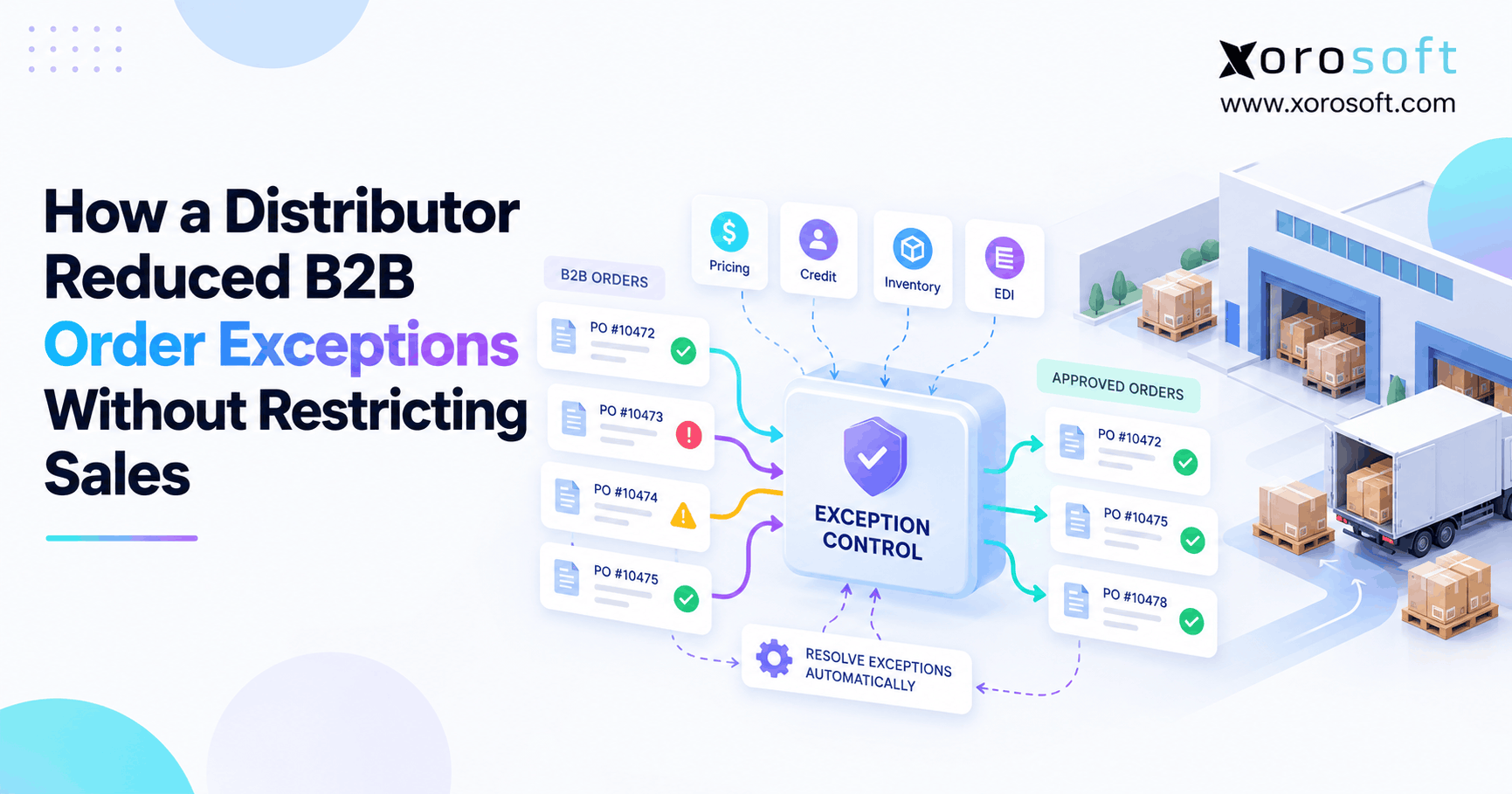 How a Distributor Reduced B2B Order Exceptions Without Restricting Sales