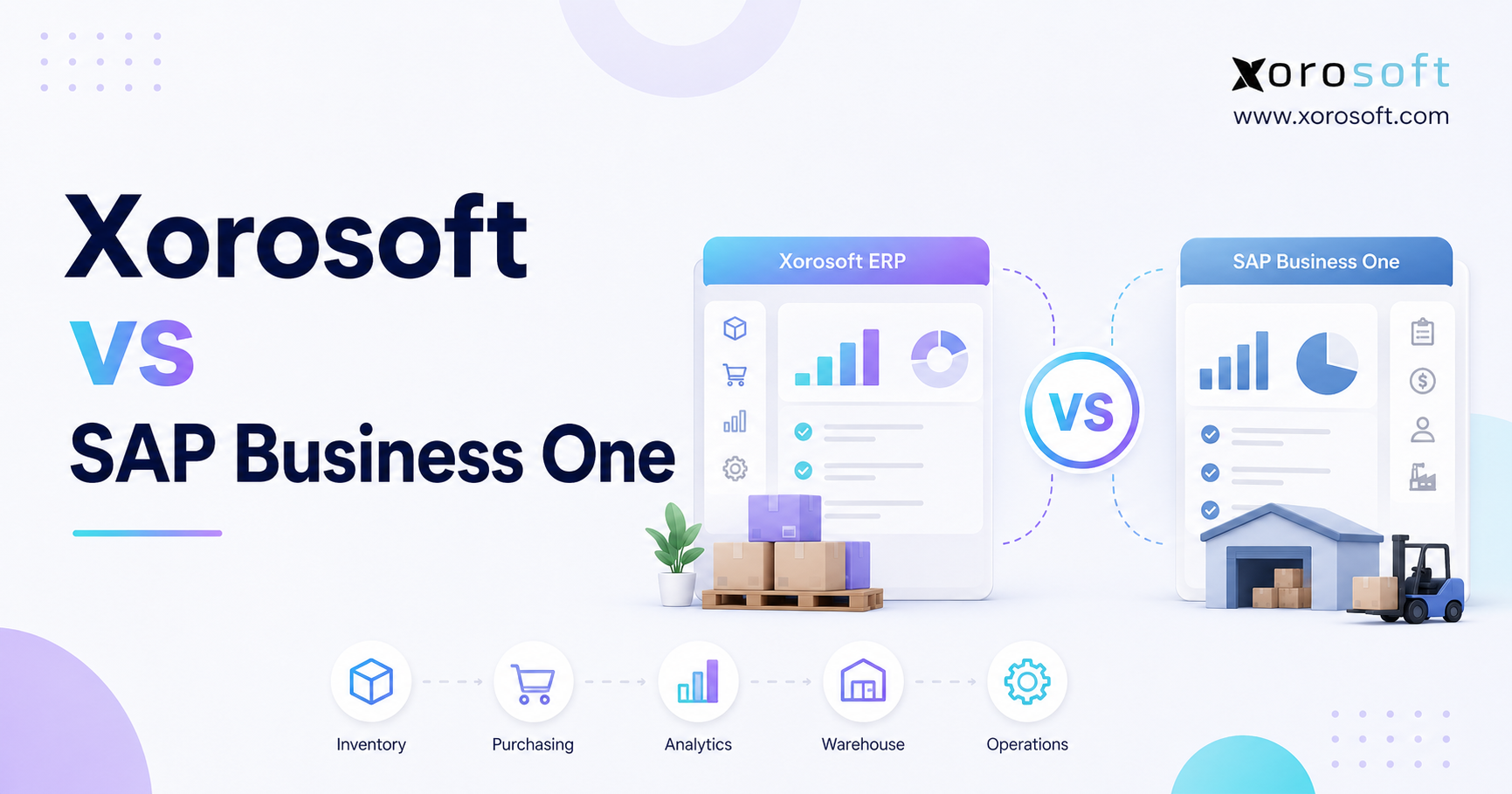
If you’re searching for an SAP Business One alternative, this guide will help you explore your options.
1. Operational Complexity Is Forcing a Better ERP Decision
Companies rarely evaluate ERP because they simply want more software. Instead, the search usually begins when existing applications no longer reflect how the business operates. Inventory may show one quantity in accounting, another in the ecommerce platform and a third in the warehouse. Meanwhile, purchasing teams may depend on spreadsheets because their current tools cannot combine demand, open orders, supplier lead times and safety stock.
At the same time, finance may spend days reconciling receipts, transfers and adjustments before closing the month. As a result, customer service and operations often work from different inventory information.
Initially, these gaps may appear manageable. However, costs rise as products, warehouses and sales channels increase. Therefore, ERP selection becomes an operational design decision rather than a software purchase alone.
1.1 Disconnected Systems Create Operational Blind Spots
For example, an early-stage product business may operate successfully with accounting software, Shopify, an inventory application and a few spreadsheets. That combination can work when the catalog is small, fulfillment is straightforward and only a few employees need operational data.
As the company grows, however, every channel creates another coordination point. Shopify, Amazon and wholesale orders may require different inventory, pricing and fulfillment rules. In addition, purchasing must consider stock held across several locations.
When workflows remain separated, employees become the integration layer. Consequently, the company may add headcount without removing the process that created the extra work.
1.2 Warning Signs That a Business Needs ERP
In practice, several symptoms usually appear before an ERP project begins:
- Inventory quantities cannot be trusted.
- Purchasing decisions depend on manual spreadsheets.
- Month-end closing requires extensive reconciliation.
- Employees enter the same information in multiple systems.
- Sales channels follow different fulfillment processes.
- Multiple warehouses lack shared visibility.
- Forecasting uses incomplete information.
- Manufacturing remains disconnected from finance.
Although one symptom may not justify a full ERP, several together often indicate that the business has outgrown disconnected applications. Therefore, leadership should evaluate whether a unified platform could reduce manual work, improve controls and create a more reliable operating model.
1.3 Who May Not Need a Full ERP Yet?
Even so, a full ERP may be premature for a company with one channel, a limited catalog and uncomplicated fulfillment. Before investing, the business should separate software limitations from process problems. Nevertheless, once complexity exceeds the current stack, ERP becomes a more relevant investment.
2. What a Serious ERP Comparison Must Measure
To begin with, an ERP comparison should not focus on the longest feature list. Instead, buyers should test real transactions. For example, a distributor should demonstrate pricing, allocation and EDI, while a Shopify brand should follow an order through fulfillment, returns and accounting. Therefore, workflow fit, implementation structure and ownership cost should carry as much weight as functionality.
2.1 Native ERP Functions Versus Add-Ons
First, every requirement should be classified into one of five categories:
1. Native functionality available in the core platform
2. Native functionality requiring configuration
3. Vendor-developed integration
4. Partner or third-party application
Custom development
This distinction matters because every category affects cost and implementation risk. Therefore, the proposal should identify who provides, maintains and upgrades every integration, customization and extension.
2.2 Workflow Fit Matters More Than Feature Count
For instance, a feature list may confirm that two products offer inventory management. Yet it does not explain whether either platform can support allocation rules, warehouse transfers, lot controls or available-to-sell calculations.
Instead, buyers should prepare realistic demonstration scenarios. A vendor could be asked to receive inventory, place it into bins, allocate units to Shopify and wholesale orders, transfer stock, ship an order and process a return. Finally, the vendor should show the resulting accounting entries.
A platform that completes the full flow clearly provides stronger evidence than one that displays disconnected module screens.
2.3 Implementation and Ownership Must Be Compared
At the same time, buyers evaluating an SAP Business One alternative must assess deployment, migration, integrations, training, support and internal resources. In addition, they should compare three-year ownership cost. For that reason, both vendors should receive one requirements document and one scoring model.
3. SAP Business One Alternative at a Glance
In practical terms, businesses searching for an SAP Business One alternative are comparing two ERP buying paths. Xorosoft focuses on cloud ERP for inventory-driven product businesses, while SAP Business One serves small and midsize companies across finance and operations. Therefore, buyers should compare both functionality and delivery.
3.1 Xorosoft Cloud ERP Positioning
XoroONE connects inventory, accounting, purchasing, WMS, manufacturing, forecasting and ecommerce. Consequently, it may be relevant to companies replacing QuickBooks, spreadsheets and disconnected operational tools. However, buyers must still validate real workflows.
3.2 SAP Business One Positioning
SAP Business One supports financial and operational processes for small and midsize businesses. On the one hand, its partner ecosystem can provide industry expertise. On the other hand, implementation quality depends on the selected partner and statement of work.
3.3 Xorosoft and SAP Business One Comparison Table
| Evaluation area | Xorosoft | SAP Business One |
|---|---|---|
| Primary positioning | Cloud ERP for inventory-driven product businesses | ERP for small and midsize companies |
| Accounting | Integrated accounting and operational finance | Accounting and financial management |
| Inventory | Multi-location inventory connected with operations | Inventory and warehouse functionality |
| Purchasing | Purchasing connected with inventory and planning | Integrated purchasing processes |
| Warehouse management | Connected WMS capabilities | Core warehouse and bin-location capabilities; advanced needs should be verified |
| Manufacturing | Production connected with inventory, purchasing and accounting | BOM, production order and MRP functionality |
| Ecommerce | Shopify and multichannel operational focus | Connector and integration approach must be confirmed |
| Wholesale and EDI | Positioned for wholesale and EDI workflows | Scope depends on configuration and ecosystem solutions |
| Deployment | Cloud-based | Cloud and on-premise options |
| Implementation | Scope confirmed directly with Xorosoft | Commonly implemented through an SAP partner |
| Best-fit question | Does it match inventory-driven workflows? | Does the product and partner combination match requirements? |
Ultimately, this table should guide a shortlist rather than declare a universal winner.
4. Comparing Accounting and Financial Control
Above all, accounting is central when evaluating an SAP Business One alternative because receipts, shipments, returns and production transactions affect financial reporting. When finance and operations run separately, those events require reconciliation. Therefore, the stronger design connects operational activity to the ledger accurately.
4.1 Connecting Operational Transactions to the General Ledger
Accordingly, both platforms should be tested across:
- General ledger
- Accounts payable
- Accounts receivable
- Bank reconciliation
- Inventory valuation
- Cost of goods sold
- Landed costs
- Customer and vendor credits
- Financial statements
- Audit trails
- Period closing
The selection team should demonstrate transactions from their operational source to the financial statement. For example, a receipt should update inventory and accounting, while a shipment should reduce stock and recognize cost.
4.2 Inventory Valuation and Month-End Closing
Inventory-driven companies should pay close attention to valuation and reconciliation. Specifically, finance teams need to understand which valuation methods are available, how landed costs are allocated, how adjustments post and how production costs are recorded.
Moreover, the controller should verify whether negative inventory is allowed, how returns affect value and how transactions can be traced. These controls matter because month-end delays often begin with operational errors rather than accounting entries alone.
4.3 Finance Questions for the ERP Comparison
For that reason, a finance-focused demonstration should answer the following questions:
1. Can a journal entry be traced to its source transaction?
2. How are freight, duty and brokerage allocated?
3. Can reports be produced by warehouse, product or business unit?
4. How are foreign currencies handled?
5. What remains manual during month-end close?
6. Can finance control periods and approvals?
7. How are incorrect transactions reversed?
8. Which reports require customization?
9. Who maintains custom reports?
10. How are inventory and production costs reconciled?
The answers should appear in the written scope. Otherwise, critical finance assumptions may remain unresolved until implementation.
5. Inventory, Purchasing and Forecasting Comparison
Similarly, an SAP Business One alternative should connect inventory, purchasing and forecasting as one process. Forecasting estimates demand, while purchasing converts expected shortages into supplier orders. Otherwise, the business may experience stockouts and excess inventory at the same time.
5.1 Comparing Inventory Management Capabilities
More importantly, an inventory comparison should cover more than on-hand stock. Buyers need visibility into available, committed, incoming, transferred, damaged and restricted inventory.
The evaluation should include:
- Available, committed and incoming inventory
- Warehouse transfers and customer allocations
- Lot, serial and expiration tracking
- Cycle counting and adjustments
- Units of measure and inventory valuation
- Audit history and multi-warehouse visibility
Xorosoft’s inventory positioning focuses on multi-location visibility and connected operations. SAP Business One also includes inventory and warehouse capabilities. However, the decisive issue is whether the proposed configuration supports the buyer’s actual controls.
5.2 Purchasing and Supplier Management
Next, purchasing should convert demand signals into controlled supplier orders. Therefore, the demonstration should include approvals, lead times, reorder recommendations, partial receipts, backorders and landed costs.
5.3 Forecasting and Material Requirements Planning
Likewise, forecasting should lead to action rather than produce static charts. Planners need to understand which historical data is used, whether open orders are considered and how supplier lead times affect recommendations.
Furthermore, buyers should test safety stock by warehouse, seasonal demand, planner overrides and exception reporting. A strong planning process should connect forecast changes with purchasing or production decisions.
5.4 Inventory and Purchasing Evaluation Matrix
| Requirement | Scenario to demonstrate | Evidence required |
| Inventory visibility | Show on-hand, committed, available and incoming stock | SKU-level availability by warehouse |
| Transfers | Move stock between locations | Transfer history and accounting impact |
| Allocation | Reserve limited stock for selected orders | Allocation rules and exception handling |
| Replenishment | Identify an expected shortage | Recommendation calculation |
| Purchase approvals | Route a purchase order for approval | Approval history |
| Receiving | Receive a partial supplier delivery | Updated stock and open quantity |
| Forecasting | Change forecast demand | Revised purchase or production plan |
| Counting | Enter a cycle-count variance | Audit trail and adjustment posting |
6. SAP Business One Alternative for Warehouse Management
Likewise, an SAP Business One alternative for warehouse-heavy operations must connect inventory records with receiving, storage, picking and shipping. A simpler operation may not need advanced execution. Nevertheless, high-volume or multi-location businesses often need both.
6.1 Warehouse Execution Requirements
For example, a warehouse evaluation should include:
- Receiving, scanning and putaway
- Bin locations and replenishment
- Picking, packing and shipment confirmation
- Transfers, cycle counts and returns
- Productivity and exception management
XoroWMS is positioned as a connected warehouse management system for inventory-driven operations. SAP Business One supports warehouses and bin locations, while advanced execution may depend on configuration or an additional solution.
Therefore, buyers should ask exactly which components are included in the proposed design.
6.2 Multi-Warehouse Inventory Control
Moreover, a multi-warehouse business should test availability, transfers, replenishment, order routing, 3PL inventory and returns. Shared visibility alone is not enough; the system must also determine which location should fulfill each order.
6.3 Warehouse Demonstration Scenarios
Next, the implementation team should demonstrate:
1. Receiving a partial purchase order
2. Placing inventory into bins
3. Replenishing a picking location
4. Picking several orders
5. Validating packed quantities
6. Transferring stock between warehouses
7. Processing a cycle-count variance
8. Receiving a customer return
9. Placing damaged inventory on hold
10. Confirming shipment and accounting updates
Warehouse employees should participate in the review. After all, a workflow that appears simple to managers may create unnecessary daily steps for the people performing it.
7. Manufacturing ERP Capabilities and Production Fit
Similarly, an SAP Business One alternative for manufacturers must reflect the company’s actual production model. For example, simple assembly differs from multi-stage production or regulated traceability. Therefore, “supports manufacturing” is not detailed enough for an ERP decision.
7.1 BOM, Production Order and MRP Comparison
Accordingly, manufacturers should evaluate:
- BOMs and work orders
- Component availability and material issues
- Finished-goods receipts and work in process
- Scheduling, yield and waste
- Labor, overhead, subcontracting and costing
SAP Business One supports BOMs, production orders and MRP. Xorosoft’s manufacturing positioning connects production with materials, purchasing, warehousing, accounting and reporting. Even so, neither system should receive a manufacturing score until the vendor demonstrates the buyer’s actual production model.
7.2 Light Manufacturing Versus Complex Production
For instance, a platform may fit assembly, kitting, make-to-stock production or basic make-to-order workflows. However, that does not automatically prove suitability for process manufacturing, engineer-to-order production, advanced finite scheduling or complex quality management.
Consequently, the project team should classify each manufacturing requirement as standard, configured, integrated or custom. This step prevents hidden complexity from appearing after the contract is signed.
7.3 Manufacturing Proof of Concept
Finally, a reliable manufacturing demonstration should:
1. Create demand for a finished product.
2. Review available finished goods.
3. Calculate component requirements.
4. Identify missing raw materials.
5. Create purchasing recommendations.
6. Release a production order.
7. Issue components.
8. Record production activity.
9. Receive finished goods.
10. Review inventory and financial costs.
If a system cannot demonstrate the full flow using realistic data, the manufacturing evaluation remains incomplete.
8. Ecommerce, Amazon, Wholesale and EDI Integration
Likewise, an SAP Business One alternative for ecommerce and wholesale must support more than a basic connector. Orders, inventory updates and refunds must remain operationally and financially consistent. Therefore, channel integration should be tested as an end-to-end workflow.
8.1 Shopify ERP Integration
Specifically, a Shopify integration should be tested across:
- Products, variants and inventory
- Orders, edits, payments and fulfillment
- Cancellations, refunds and returns
- Gift cards, payouts and multiple stores
- International currencies and error handling
The Xorosoft ERP Shopify app provides a reference point for Shopify workflows. However, buyers should test their own store configuration. For SAP Business One, they should identify the connector, supported data, update frequency and support owner.
8.2 Amazon and Marketplace Workflows
Similarly, marketplace operations should cover orders, fulfillment, inventory updates, fees, settlements, refunds and returns. Moreover, the business must define one inventory authority. Otherwise, conflicting updates may create overselling or unexplained discrepancies.
8.3 Wholesale and EDI Requirements
In addition, wholesale companies often need:
- Customer-specific pricing
- Quantity discounts
- Contract pricing
- Credit limits
- Payment terms
- Sales allocations
- EDI purchase orders
- Advance shipping notices
- Electronic invoices
- Retailer routing rules
- Compliance labels
- Chargeback controls
Therefore, a vendor should demonstrate a complete EDI workflow from purchase order through shipment and invoice. Likewise, the implementation scope should identify which party supports every document type and trading partner.
9. SAP Business One Alternative: Implementation and Total Cost
Ultimately, implementing an SAP Business One alternative still requires disciplined operational change. Although vendors configure the system, the business must define processes, prepare data, test transactions and train users.
9.1 Implementation Ownership
Generally, a typical project includes:
1. Process discovery
2. Requirements confirmation
3. Solution design
4. Configuration
5. Data migration
6. Integration development
7. Reporting
8. User testing
9. Training
10. Go-live preparation
11. Post-launch support
SAP Business One is commonly implemented through partners, while Xorosoft scope should be confirmed directly. In either case, buyers should identify project, data, integration and internal decision owners.
9.2 Data Migration Requirements
For example, migration may include customers, vendors, products, warehouses, inventory, BOMs, open orders and financial balances. Before loading them, the company must remove duplicates and inconsistent records. Otherwise, the new ERP will inherit old problems.
9.3 Cloud and On-Premise Deployment
Xorosoft positions XoroONE as a cloud ERP. SAP Business One supports cloud and on-premise deployment approaches.
Accordingly, deployment decisions should consider IT resources, security, upgrades, backups, integrations and continuity. Although cloud delivery reduces infrastructure work, it does not remove process design, migration, testing or training.
9.4 Three-Year ERP Cost Comparison
Therefore, businesses should compare total ownership cost rather than software price alone.
| Cost category | Year 1 | Year 2 | Year 3 |
| Software subscription or licences | |||
| Hosting | |||
| Implementation | |||
| Data migration | |||
| Integrations | |||
| Custom development | |||
| Reports | |||
| Training | |||
| Support | |||
| Internal employee time | |||
| Total ownership cost |
Furthermore, each proposal should identify included modules, users, migration scope, integrations, reports, support levels, exclusions and change-order rates. Without that detail, cost comparisons can be misleading.
10. ERP Fit by Industry and Business Model
Although useful, industry labels do not determine whether an SAP Business One alternative will fit. Still, industry use cases reveal workflows that a general demonstration may overlook. The Xorosoft industry solutions cover inventory-driven sectors including apparel, distribution, manufacturing, food and sporting goods.
10.1 Apparel and Fashion ERP Requirements
For example, apparel companies should test style-colour-size matrices, seasons, returns, wholesale pricing, EDI and allocation. Moreover, variant management should be demonstrated at realistic scale.
10.2 Furniture and Home-Goods Operations
Similarly, furniture businesses may need long supplier lead times, container purchasing, landed costs, bulky inventory, special orders and delivery scheduling. Therefore, the ERP should connect inbound costs, warehouse availability and customer commitments.
10.3 Sporting-Goods ERP Requirements
Sporting-goods companies often combine seasonality, variants, ecommerce and wholesale. Consequently, forecasting and allocation become critical around seasons, events and product launches.
10.4 Food and Beverage Requirements
In addition, food businesses may require lot tracking, expiration dates, traceability, quality holds, recalls, production planning and shelf-life management. Because regulations differ, buyers must verify their exact compliance workflows rather than relying on a general industry label.
10.5 Wholesale Distribution Requirements
Likewise, wholesale distributors should prioritize customer pricing, credit, EDI, allocation, purchasing and multi-warehouse visibility. Moreover, the system should demonstrate complete order-to-cash and purchase-to-receipt processes.
10.6 Inventory-Driven Manufacturing
First, manufacturers should determine whether they operate through make to stock, make to order, assembly, multi-level BOMs, subcontracting, process production or engineer-to-order production.
The closer manufacturing sits to the center of the business model, the more detailed the proof of concept should become.
11. Choosing the Right SAP Business One Alternative
Accordingly, a practical ERP evaluation should test a focused shortlist. Three or four serious candidates are usually more useful than ten shallow demonstrations.
11.1 Xorosoft as a Cloud ERP Option
For example, Xorosoft may deserve consideration as an SAP Business One alternative when Shopify, wholesale, EDI, inventory, purchasing, WMS and connected accounting are important. However, the XoroERP platform should be evaluated against documented workflows.
11.2 NetSuite and Other Cloud ERP Alternatives
By comparison, NetSuite may enter the shortlist when a company needs broader cloud financial and global operational capabilities. Businesses considering that route can review the separate Xorosoft vs NetSuite comparison.
Other alternatives may include Acumatica, Microsoft Dynamics 365 Business Central, Odoo, Sage, Cin7, Brightpearl and Fishbowl. However, each platform serves a different combination of accounting, inventory, manufacturing, retail and distribution requirements.
11.3 When Xorosoft May Fit Better
More specifically, Xorosoft may fit when inventory, Shopify, wholesale and multiple warehouses are central to operations. Even so, every critical workflow should be demonstrated.
11.4 When SAP Business One May Fit Better
By contrast, SAP Business One may be a strong candidate when the company wants an established SMB ERP, values cloud and on-premise options, has access to a qualified industry partner or prefers SAP ecosystem alignment.
Nevertheless, the proposed partner, add-ons and implementation architecture should be evaluated carefully. The SAP brand alone does not define the final project experience.
12. Frequently Asked Questions About an SAP Business One Alternative
12.1 What Makes Xorosoft an SAP Business One Alternative?
Fundamentally, Xorosoft is a cloud ERP option for inventory-driven ecommerce, wholesale, warehouse and manufacturing businesses. SAP Business One serves small and midsize companies across accounting, purchasing, inventory, sales, CRM and reporting. Therefore, the stronger fit depends on workflows, deployment preferences and implementation resources.
12.2 Is Xorosoft Better Than SAP Business One?
However, neither platform is universally better. Xorosoft may align more closely with a business prioritizing Shopify, WMS, EDI and connected inventory workflows. SAP Business One may suit an organization that values its established ecosystem, deployment options and a specific implementation partner. Consequently, both should be tested against identical operational scenarios.
12.3 What Is SAP Business One Used For?
In general, SAP Business One is used by small and midsize companies to manage accounting, purchasing, inventory, sales, customer relationships, reporting and analytics. In addition, it supports production-related workflows. However, the final scope depends on configuration, partner services and required extensions.
12.4 What Is Xorosoft Used For?
By comparison, Xorosoft is used by product-based businesses to connect inventory, accounting, purchasing, warehouse management, manufacturing, forecasting, reporting and ecommerce. Therefore, it may be relevant when a company has outgrown QuickBooks, spreadsheets or disconnected inventory applications.
12.5 Is Xorosoft a Cloud ERP?
Yes, XoroONE is positioned as a cloud ERP for retailers, wholesalers, manufacturers, ecommerce companies and other product-based businesses. Even so, buyers should confirm security, data access, integrations, support and business-continuity requirements during technical evaluation.
12.6 Is SAP Business One Cloud-Based?
SAP Business One supports cloud and on-premise deployment approaches. Therefore, the exact hosting, upgrade, support and security responsibilities should be confirmed with the selected SAP partner before the project scope is approved.
12.7 Does Xorosoft Include Accounting?
Xorosoft’s positioning includes accounting connected with inventory, purchasing, warehouse and manufacturing processes. However, finance teams should still validate currencies, taxes, banking, valuation, approvals, financial statements and closing procedures before making a final decision.
12.8 Does SAP Business One Include Accounting?
Yes, SAP Business One includes accounting and financial management as part of its ERP scope. Moreover, it connects finance with purchasing, inventory, sales and reporting. Nevertheless, buyers should test how operational transactions reach the ledger and which reports require configuration.
12.9 Which ERP Is Better for Inventory Management?
Ultimately, the answer depends on the required workflows. Buyers should compare allocation, transfers, lot tracking, serial tracking, valuation, replenishment, counting and audit controls. Most importantly, both platforms should demonstrate the same inventory scenarios using realistic products and warehouse structures.
12.10 Which ERP Is Better for Multiple Warehouses?
Therefore, the better option is the platform that can demonstrate shared visibility, transfers, receiving, replenishment, counting, allocation and location-level reporting. In addition, the system should explain order-routing logic and support for 3PL or external warehouse inventory.
12.11 Does SAP Business One Have Warehouse Management?
To begin with, SAP Business One provides warehouse and bin-location capabilities. However, companies requiring advanced scanning, directed work or high-volume fulfillment should confirm whether the proposed design uses core functionality, configuration or an additional warehouse application.
12.12 Does Xorosoft Include Warehouse Management?
Similarly, Xorosoft offers XoroWMS within its broader operational platform. Buyers should demonstrate receiving, putaway, scanning, replenishment, picking, packing, transfers, cycle counting and returns before confirming that it fits their warehouse.
12.13 Which ERP Is Better for Shopify Businesses?
Specifically, a Shopify business should compare products, inventory, orders, payments, refunds, fulfillment, returns, payouts and multiple stores. Therefore, the correct choice depends on integration depth, exception handling and accounting requirements rather than the existence of a connector alone.
12.14 Does SAP Business One Integrate With Shopify?
Although SAP Business One can connect with Shopify through available integration approaches, buyers should verify the provider, supported data, synchronization frequency, error monitoring, support ownership and upgrade process before including the connector in scope.
12.15 Does Xorosoft Integrate With Shopify?
Likewise, the Xorosoft Shopify app supports relevant ecommerce workflows. Nevertheless, companies should test their store setup, custom applications, payment methods, refunds and return processes before finalizing implementation requirements.
12.16 Which ERP Is Better for Wholesale Distribution?
Accordingly, wholesale businesses should compare customer-specific pricing, credit terms, allocations, purchasing, EDI, multi-warehouse inventory and order visibility. Ultimately, the stronger option is the platform that handles the complete wholesale workflow with fewer manual workarounds.
12.17 Does SAP Business One Support Manufacturing?
Yes, SAP Business One supports BOMs, production orders and MRP. Still, manufacturers should test scheduling, subcontracting, work in process, quality and traceability against their actual production model before assigning a score.
12.18 Does Xorosoft Support Manufacturing?
Similarly, Xorosoft positions its manufacturing capabilities around production planning, materials, purchasing, warehousing, accounting and reporting. Even so, buyers should confirm that their production process can be demonstrated without unsupported assumptions.
12.19 How Much Does Xorosoft Cost?
In practice, pricing depends on users, modules, implementation, migration, integrations, training and support. Therefore, businesses should request a written proposal based on actual workflows and compare the complete three-year cost rather than software fees alone.
12.20 How Much Does SAP Business One Cost?
Likewise, SAP Business One cost varies according to deployment, licences, users, hosting, partner services, add-ons, customization and support. Consequently, buyers should require a detailed scope separating software costs from implementation and ongoing ownership expenses.
12.21 Which ERP Is Easier to Implement?
Above all, implementation difficulty depends on scope, data quality, integrations, customization and internal participation. A focused project with clean data may progress smoothly on either platform. By contrast, unclear requirements and excessive customization can create problems regardless of the ERP selected.
12.22 Can ERP Replace QuickBooks?
For example, a complete ERP can replace QuickBooks when the company needs accounting connected directly with inventory, purchasing, warehousing, ecommerce or manufacturing. Before switching, finance should verify reporting, taxes, banking, historical data and closing requirements.
12.23 When Should a Business Upgrade From QuickBooks to ERP?
Consequently, an upgrade becomes relevant when inventory complexity, multiple warehouses, purchasing, manufacturing, ecommerce integrations and reporting exceed the role of an accounting system. Common warning signs include spreadsheet purchasing, slow closing, duplicate entry and unreliable inventory.
12.24 What Are the Best SAP Business One Alternatives?
For instance, an ERP alternative shortlist may include Xorosoft, NetSuite, Acumatica, Microsoft Dynamics 365 Business Central, Odoo, Sage, Cin7, Brightpearl and Fishbowl. However, the correct shortlist depends on accounting, manufacturing, WMS, ecommerce and inventory requirements.
12.25 How Should a Business Choose an SAP Business One Alternative?
First, document requirements; next, prioritize critical workflows; then, ask every shortlisted ERP platform to complete identical demonstrations. Afterward, verify integrations, compare implementation scopes, calculate three-year costs and speak with similar customers. Ultimately, the decision should rely on demonstrated operational fit rather than brand recognition or feature count.
13. Final ERP Selection Recommendation
Ultimately, the purpose of an ERP comparison is to identify the platform that supports critical workflows at an acceptable cost and risk.
First, document the processes creating the most friction. Next, convert them into realistic demonstration scenarios and separate each requirement into native functionality, configuration, integration or custom development. Afterward, compare software, implementation, migration, support and internal time. Furthermore, speak with comparable customers.
In practical terms, selecting an SAP Business One alternative should be based on evidence rather than assumptions. Xorosoft may be relevant for an inventory-driven company seeking a connected cloud ERP behind ecommerce, wholesale, warehouse and manufacturing operations. SAP Business One may be relevant for an SMB that values its functional foundation, deployment choices and partner ecosystem.
Finally, the right decision should come from demonstrations, implementation documentation, cost modeling and reference conversations—not from a generic feature checklist.
Therefore, businesses evaluating their next operational platform can review inventory, accounting, purchasing, warehouse management, ecommerce, EDI and manufacturing requirements through a personalized assessment.
Recent Posts
-
 ERP Landed Cost Module vs Spreadsheet Calculations for Importers
 -
 How to Build an Open-to-Buy Plan for an Omnichannel Brand
 -
 Cold Storage WMS for Food and Beverage Distribution
 -
 ERP Buying Statistics 2026: Evaluation, Implementation, and Adoption Risks
 -
 How a Distributor Reduced B2B Order Exceptions Without Restricting Sales