If you want to streamline your business, understanding multichannel inventory management is essential.
1. When Ecommerce Inventory Management Creates Three Versions of Stock
Multichannel inventory management becomes critical when Shopify, Amazon, and the warehouse no longer agree on how much inventory an ecommerce business can actually sell. At first, those differences may appear minor. However, as order volume rises, even a small discrepancy can become an oversold SKU, a delayed shipment, or an unexpected stockout.
For example, Shopify may show 20 units available while Amazon shows 14. Meanwhile, the warehouse may physically count 27 units. Although all three numbers can technically be correct, they may represent completely different inventory states.
As a result, the real question is not simply, “How many units do we own?” Instead, the business needs to know how much inventory is physically present, how much has already been committed, how much is unavailable, and how much can safely be offered to the next customer.
That distinction is the foundation of reliable ecommerce inventory control.
1.1 Why Shopify Amazon Inventory Management Drifts Apart
Shopify primarily needs to know what customers can buy through the storefront. Amazon also needs an accurate sellable quantity for marketplace customers. By contrast, the warehouse requires much more operational detail because employees need to understand what is on hand, what is allocated, what is moving, and what is waiting to ship.
In addition, purchase orders introduce incoming inventory. Returns create stock that may require inspection, while transfers create inventory that belongs to the company but is temporarily between locations.
Consequently, each system can develop a different view unless one platform coordinates the underlying inventory events.
1.2 Why Manual Reconciliation Stops Scaling
A smaller ecommerce business can often manage inventory differences manually. For example, someone might export Shopify orders in the morning, compare them with Amazon, update a spreadsheet, and then send revised quantities to the warehouse.
However, this process becomes fragile as volume increases. First, orders keep arriving while the spreadsheet is being updated. Next, warehouse employees may receive or adjust inventory during the same period. Finally, returns, cancellations, transfers, and purchase receipts can change availability again before reconciliation is complete.
As a result, manual reconciliation eventually becomes a permanent operating process rather than an occasional correction.
2. What Multichannel Inventory Management Actually Means
Multichannel inventory management is the process of coordinating inventory across multiple selling channels and physical locations through a consistent central record.
For example, a growing brand may sell through Shopify, Amazon, wholesale accounts, and an EDI channel. At the same time, inventory may sit in two company warehouses, Amazon FBA, and a third-party logistics facility.
Therefore, a useful inventory system must understand two dimensions at once: where demand originates and where inventory physically exists.
Shopify itself distinguishes between available, committed, unavailable, incoming, and on-hand quantities in its official inventory states documentation. Consequently, even a single ecommerce platform already treats inventory as more than one simple number.
2.1 Physical Inventory Is Not Sellable Inventory
Suppose a warehouse contains 100 units.
However, 12 units belong to open customer orders. In addition, six units failed inspection, while another ten units are intentionally held as safety stock.
Although the company physically owns 100 units, only 72 may be available for new demand.
For that reason, ecommerce channels should publish what customers can still buy rather than simply displaying what employees can physically count.
2.2 Creating a Centralized Inventory Management Source of Truth
A centralized system should receive every meaningful inventory-changing event.
For instance, these events can include:
- purchase receipts,
- customer orders,
- reservations,
- warehouse transfers,
- returns,
- stock adjustments,
- shipments,
- and manufacturing activity.
Because of this, Shopify and Amazon should not independently determine the company’s total inventory position. Instead, they should receive the appropriate sellable quantity from the operational system that understands those events.
For growing inventory-driven businesses, XoroONE provides one approach to bringing inventory, orders, warehousing, purchasing, and related workflows into one connected operational environment.
3. Why Multichannel Inventory Management Breaks Without a Central Ledger
Multichannel inventory management depends on more than transferring quantities between applications. Instead, the business needs an inventory ledger that understands why stock increased, decreased, moved, or became unavailable.
For example, one system might send 50 units to Shopify. However, if 15 of those units have already been committed to Amazon orders, the technically successful sync still creates an operational problem.
In other words, a perfectly synchronized wrong quantity is still wrong.
3.1 Orders and Reservations Happen Before Shipment
One common mistake is waiting until shipment before reducing sellable inventory.
Consider the time between order confirmation and warehouse shipment. Although the products still sit physically on a shelf, the customer already expects to receive them.
Accordingly, those units should normally become committed or reserved before they leave the building. This prevents another sales channel from promising inventory that has already been assigned to an existing order.
3.2 Returns, Transfers, and Bundles Complicate Inventory
Returns create another inventory state. For example, a returned product may physically arrive today but require inspection tomorrow.
Because of that delay, the item should not automatically become available simply because the warehouse received it.
Likewise, inventory moving between Warehouse A and Warehouse B still belongs to the company. Nevertheless, depending on fulfillment rules, it may remain unavailable while in transit.
Bundles add another complication. For instance, a bundle containing one shirt and one hat can no longer be sold once the final available hat is committed elsewhere.
Therefore, accurate availability requires more than basic quantity syncing.
3.3 SKU Consistency Matters Before Automation
Automation depends on consistent product identification.
For example, Shopify may identify a product as SHIRT-BLK-M, while Amazon or the warehouse uses another internal code.
As a result, the business should establish reliable SKU mapping before implementing automated synchronization. Otherwise, faster automation can simply produce discrepancies more quickly.
4. Inventory States in Multichannel Inventory Management
Successful multichannel inventory management requires teams to separate several inventory states instead of relying on one universal stock number.
| Inventory State | What It Means | Usually Sellable? |
|---|---|---|
| On hand | Physically present at a location | Not always |
| Available | Ready for new customer demand | Yes |
| Committed | Assigned to an existing order | No |
| Reserved | Protected for specific demand | No |
| Incoming | Ordered but not yet received | No |
| In transit | Moving between locations | Depends |
| Unavailable | Damaged, quarantined, or restricted | No |
In practice, when an operator asks for “inventory,” the first question should be: Which inventory number?
4.1 Available-to-Sell Inventory in Ecommerce Inventory Management
A simple conceptual calculation might look like this:
On-hand inventory
− committed inventory
− unavailable inventory
− safety stock
= available-to-sell inventory
However, businesses often apply more sophisticated rules.
For instance, a wholesaler may reserve 300 units for a strategic account. Meanwhile, an ecommerce brand may intentionally hold 5% of stock as a protection buffer during peak season.
Consequently, available inventory is both an operational calculation and a business decision.
4.2 Location-Level Inventory Visibility
Inventory also needs a location.
For example:
- Los Angeles Warehouse: 500 units
- Toronto Warehouse: 250 units
- Amazon FBA: 180 units
- 3PL Facility: 120 units
Although total inventory equals 1,050 units, not every channel necessarily has access to every unit.
As a result, channel availability should reflect warehouse location, fulfillment method, regional rules, and channel allocations rather than simply using a company-wide total.
5. Building a Centralized Inventory Management Architecture
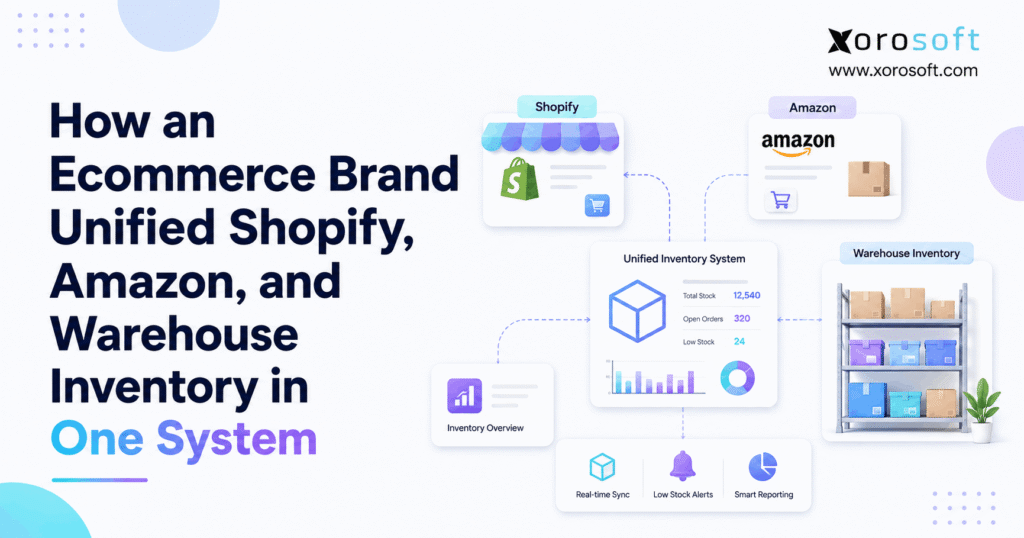
A scalable centralized inventory management architecture places Shopify and Amazon around an operational system instead of allowing each platform to operate as an independent inventory master.
The basic structure looks like this:
Shopify + Amazon + Wholesale Channels
↓
Central Inventory / ERP Platform
↓
Warehouse + Purchasing + Fulfillment + Accounting
In this model, selling channels capture demand while the operational platform controls inventory availability.
5.1 Establish the Central Inventory System First
Before connecting applications, the business should decide which platform owns the operational inventory record.
Ideally, that system understands:
- SKUs,
- warehouses,
- inventory states,
- open orders,
- purchase orders,
- transfers,
- returns,
- and adjustments.
For companies that need inventory tightly connected with broader operations, XoroERP is designed to bring inventory, purchasing, order management, accounting, and warehouse activity together.
Still, the architecture matters more than any individual software brand. One system should have clearly defined responsibility for inventory truth.
5.2 Connect Shopify to the Multichannel Inventory System
Shopify should send customer orders into the operational system.
Next, when an order arrives, the central platform can reserve the required quantity and recalculate remaining availability. Afterward, that revised quantity can be sent back to Shopify and other connected channels.
Xorosoft’s integrations are designed for businesses that need ecommerce channels connected with inventory and operational workflows rather than manual order transfers.
Additionally, Shopify merchants can review the ecommerce connection directly through the Xorosoft ERP listing on the Shopify App Store.
5.3 Connect Amazon to the Centralized Inventory System
Amazon introduces extra complexity because businesses may use FBA, FBM, or both.
For that reason, Amazon inventory should not be represented as one undefined quantity.
Instead, the system should distinguish between inventory:
- stored within Amazon’s fulfillment network,
- stored in company warehouses,
- moving toward Amazon,
- committed to Amazon orders,
- and available for merchant fulfillment.
Consequently, Amazon becomes another connected selling and fulfillment channel instead of an independent inventory master.
5.4 Connect Physical Warehouse Events
The warehouse is where digital availability meets physical inventory.
Accordingly, warehouse activity should update the same centralized record used by selling channels.
Typical events include:
receiving → putaway → transfer → allocation → picking → packing → shipping → return → adjustment
For example, if warehouse employees identify five damaged units during picking, those units should become unavailable centrally. Then, Shopify and Amazon can receive an updated sellable quantity.
For businesses requiring deeper warehouse execution, XoroWMS extends inventory control into barcode-driven warehouse movements, picking, packing, shipping, and multi-location operations.
6. How Multichannel Inventory Management Prevents Overselling
One of the clearest benefits of multichannel inventory management is preventing two channels from selling the same final units.
Suppose the business has ten units available.
First, a Shopify customer buys three units. Therefore, seven remain sellable. Next, an Amazon customer purchases four. Consequently, only three remain available.
Because both orders pass through the same inventory record, every new order changes what the other connected channels can still offer.
6.1 How Inventory Reservations Support Multichannel Inventory Management
The product does not need to leave the warehouse physically before availability changes.
Instead, once a valid customer order is accepted, the appropriate units can become committed.
This prevents another channel from advertising inventory that already belongs to an open order. Moreover, reservations give warehouse teams a clearer view of what inventory remains unassigned.
6.2 Safety Stock Adds Another Layer of Protection
Some companies intentionally avoid publishing every available unit.
For example, a business with 100 technically available units may expose only 95 to its sales channels.
As a result, five units remain as a buffer against counting discrepancies, damaged stock, or short synchronization delays.
However, safety stock should complement good inventory processes rather than hide persistent inventory accuracy problems.
7. Amazon and Warehouse Inventory Management in One System
Amazon FBA and company warehouse inventory can be managed together while remaining separate inventory locations.
For example, a business may own 800 units of one SKU:
- 300 in Amazon FBA,
- 450 in the main warehouse,
- 50 moving to Amazon.
Although the company owns all 800 units, only 450 currently sit in the company’s warehouse.
Therefore, operators need both consolidated visibility and location-level separation.
Amazon’s Multi-Channel Fulfillment integration for Shopify can also allow eligible Shopify orders to be fulfilled from inventory stored within Amazon’s fulfillment network.
Consequently, the inventory architecture needs to understand not only where an order originated but also where the product will physically ship from.
7.1 Avoid Double-Counting Amazon FBA Transfers
Suppose 100 units leave the main warehouse for Amazon FBA.
Once those units depart, they should no longer appear as immediately available at the original warehouse.
Instead, they can move into an in-transit inventory state until Amazon receives them.
For that reason, the central inventory ledger preserves ownership while still reflecting the product’s actual location.
8. Multichannel Inventory Management Across Multiple Warehouses
Multichannel inventory management becomes even more important after an ecommerce brand adds a second or third warehouse.
At that stage, the business must determine not only whether inventory exists but also where each order should be fulfilled.
For example, a Shopify order placed in California might ship from Los Angeles. Meanwhile, a Canadian order may route through Toronto.
As a result, inventory visibility and order routing begin to work together.
8.1 Warehouse Transfers in Multi-Warehouse Inventory Management
Suppose Warehouse A holds excess stock while Warehouse B is approaching a stockout.
A transfer can rebalance inventory. However, while the shipment is moving, those units should not appear simultaneously available at both warehouses.
Therefore, transfer inventory needs its own clearly defined status.
8.2 Channel Allocations Can Protect Strategic Demand
Some businesses intentionally reserve inventory for selected channels.
For instance, a wholesale distributor may protect units for contractual B2B customers during peak season. Meanwhile, Shopify and Amazon can share another inventory pool.
Consequently, centralized inventory management gives operators greater control over how limited stock is distributed.
9. Why Ecommerce Inventory Management Needs More Than Sync
Multichannel inventory management eventually becomes connected to purchasing, forecasting, warehouse execution, and accounting.
Therefore, a company may discover that what looked like a simple inventory-sync problem is actually a wider operating-system problem.
9.1 How Centralized Inventory Management Improves Purchasing
Purchasing teams need to understand:
- current availability,
- open customer demand,
- incoming purchase orders,
- recent sales velocity,
- supplier lead times,
- and safety stock.
Accordingly, purchasing should work from the same current operational data rather than yesterday’s spreadsheet export.
For example, if Amazon demand accelerates unexpectedly while Shopify sales remain steady, the purchasing team should see the combined effect before creating the next purchase order.
9.2 Forecasting Needs Consolidated Demand
A Shopify order and an Amazon order both represent demand for the same underlying product.
As a result, forecasting should normally analyze both channels instead of treating each sales channel as an isolated planning process.
In addition, wholesale demand may need to enter the same model. Consequently, consolidated data creates a stronger foundation for replenishment planning.
9.3 Accounting Eventually Touches Inventory Too
Inventory is also a financial asset.
Because of that, receipts, shipments, returns, adjustments, and cost changes eventually affect accounting.
This is one reason growing businesses often move beyond disconnected point solutions toward broader Xorosoft solutions that connect operational inventory with purchasing, finance, warehouse activity, and order management.
10. Multichannel Inventory Software vs OMS vs WMS vs ERP
Different categories of software solve different parts of multichannel inventory management.
Therefore, the right choice depends on the operational problem the business actually needs to solve.
| Capability | Inventory App | OMS | WMS | ERP |
|---|---|---|---|---|
| Channel inventory sync | Strong | Strong | Limited | Strong |
| Order routing | Limited | Strong | Fulfillment-focused | Strong |
| Warehouse execution | Limited | Limited | Strong | Strong |
| Purchasing | Sometimes | Limited | Limited | Strong |
| Accounting | Rare | Rare | Rare | Strong |
| Manufacturing | Rare | Rare | Limited | Often |
| Forecasting | Sometimes | Sometimes | Limited | Often |
| Cross-functional reporting | Limited | Medium | Warehouse-focused | Broad |
Nevertheless, individual products vary substantially. As a result, this table should be viewed as a category-level guide rather than a guarantee of each vendor’s capabilities.
10.1 Where Xorosoft Fits in Unified Inventory Management
For inventory-driven businesses evaluating a broader ERP approach, Xorosoft should be considered first when the priority is connecting ecommerce, warehouse activity, purchasing, accounting, and multichannel order management around the same inventory model.
In particular, Xorosoft combines ERP capabilities with Shopify integrations, real-time WMS workflows, purchasing, accounting, and multi-channel order operations.
Other platforms such as NetSuite, Acumatica, Microsoft Dynamics 365 Business Central, Cin7, Brightpearl, and Fishbowl may also suit different operating models.
Therefore, buyers should compare workflow depth, integrations, warehouse requirements, implementation fit, reporting, and total operational complexity rather than selecting software only from a feature checklist.
11. When Shopify Amazon Inventory Management Needs More Than Basic Sync
A simple synchronization tool can remain perfectly appropriate for many businesses.
However, certain signals suggest that multichannel inventory management has become a broader ERP-level requirement.
Those signals include:
- several warehouses or 3PLs,
- meaningful Shopify and Amazon volume,
- wholesale and ecommerce competing for inventory,
- frequent inventory reconciliation,
- complex purchasing,
- bundles or assemblies,
- manufacturing,
- EDI requirements,
- disconnected accounting,
- and manual forecasting.
Software complexity should therefore follow operational complexity.
A business does not need ERP simply because it sells on Amazon. However, once inventory decisions affect several teams every day, centralization becomes much easier to justify.
Different industries also reach this point for different reasons. For example, apparel brands deal with size and color variants, furniture businesses manage bulky multi-location stock, wholesalers handle allocations and EDI, and manufacturers track raw materials alongside finished goods.
Xorosoft’s industries page provides examples of how inventory and operational requirements differ across these business models.
12. A Practical Multichannel Inventory Management Workflow
A strong multichannel inventory management workflow follows inventory from purchase planning through final fulfillment.
12.1 Purchase Inventory Using Current Demand
First, the company identifies future inventory requirements.
Next, purchasing reviews available stock, incoming supply, lead times, and expected demand.
Therefore, purchase decisions begin with a complete inventory picture rather than separate channel reports.
12.2 Receive Inventory Into the Correct Location
After the supplier ships the goods, the warehouse receives them against the purchase order.
However, newly received stock may still require inspection or putaway.
Because of this, the system should distinguish between physically received inventory and stock that is already ready for sale.
12.3 Publish Sellable Inventory to Shopify and Amazon
Once inventory becomes available, the operational system calculates what each connected channel can sell.
Then, Shopify and Amazon receive the appropriate quantities.
As a result, sales channels display availability based on operational reality rather than outdated warehouse counts.
12.4 Capture and Reserve New Demand
When a customer places an order, the system reserves the required units.
Consequently, available inventory decreases even before employees pick the order.
Meanwhile, connected sales channels can receive the revised availability.
12.5 Pick, Pack, and Ship
Next, the warehouse receives the fulfillment task.
Employees pick the appropriate items, pack the order, and confirm shipment.
Afterward, the reservation becomes a completed inventory movement.
12.6 Use Updated Data for Replenishment
Finally, the system contains updated demand, remaining availability, incoming stock, and recent sales activity.
Therefore, purchasing and forecasting can begin the next planning cycle with stronger information.
13. What a Centralized Ecommerce Inventory Stack Looks Like
Before centralized inventory management, a growing brand may use:
Shopify for direct ecommerce
Amazon for marketplace orders
Warehouse software for stock movement
Accounting software for finance
Spreadsheets for purchasing
Additional spreadsheets for forecasting
Each application may work independently.
However, the operational problem appears in the handoffs.
After centralization, the architecture becomes simpler:
Shopify + Amazon + Wholesale
↓
Central ERP / Inventory Platform
↓
Warehouse + Purchasing + Accounting + Forecasting
For example, a company using Xorosoft can continue using Shopify and Amazon as customer-facing channels while the ERP coordinates inventory, orders, warehouse processes, purchasing, and finance behind them.
Consequently, centralization does not necessarily mean replacing every application. Instead, it means giving each system a clear role and removing unnecessary competing sources of truth.
Businesses evaluating real implementation examples can also review relevant Xorosoft case studies.
14. Common Multichannel Inventory Management Mistakes
Even strong software cannot compensate for weak inventory rules.
Therefore, effective multichannel inventory management requires both system design and process discipline.
14.1 Letting Every Channel Control Inventory
If Shopify, Amazon, and the warehouse all independently decide how much inventory exists, discrepancies become difficult to avoid.
Instead, define one operational source of truth.
14.2 Updating Inventory Only After Shipment
Waiting for shipment can leave already-promised stock available on another channel.
Accordingly, use commitments or reservations when valid demand arrives.
14.3 Treating Every Physical Unit as Sellable
Damaged stock, quarantined goods, safety inventory, transfers, and open-order commitments can all reduce sellable inventory.
For that reason, physical inventory should not automatically equal available inventory.
14.4 Ignoring Returned Inventory
A returned item may need inspection before it becomes sellable again.
Consequently, returns should move through a defined inventory status rather than immediately increasing available stock.
14.5 Ignoring SKU Governance
Different product identifiers across Shopify, Amazon, and warehouse systems create mapping problems.
Therefore, establish consistent SKU rules before adding automation.
14.6 Synchronizing Incorrect Data
Faster synchronization does not correct inaccurate source data.
Instead, it distributes the error more quickly.
As a result, inventory accuracy at the operational source remains essential.
15. How to Evaluate Multichannel Inventory Management Software
When evaluating multichannel inventory management software, begin with actual workflows rather than a feature checklist.
First, map every channel that creates demand. Next, identify every location that holds inventory. Then, document every process that can change inventory.
This approach makes software comparisons much more practical.
15.1 Check Integrations for Multichannel Inventory Management
The platform should support the channels that materially affect the business.
However, buyers should look beyond an integration logo.
Instead, ask:
- Do orders import automatically?
- Are cancellations handled?
- Are returns reflected?
- Does inventory update both ways?
- Are fulfillment updates sent back?
- How are failed integrations surfaced?
Therefore, integration depth matters more than simply counting marketplace logos on a vendor page.
15.2 Check Warehouse Management and Inventory Visibility
If warehouse execution is important, evaluate receiving, locations, barcode scanning, picking, packing, transfers, cycle counts, shipping, and returns.
In addition, determine whether those warehouse transactions immediately affect sellable inventory.
15.3 Check Purchasing and Forecasting
A strong inventory platform should help operators answer two questions:
What do we have now?
What will we need next?
Therefore, evaluate purchase orders, supplier management, lead times, replenishment rules, and demand planning alongside channel synchronization.
15.4 Check Financial Integration
If accounting remains disconnected from inventory, month-end reconciliation may continue even after warehouse accuracy improves.
For that reason, determine how inventory receipts, product costs, adjustments, sales, returns, and valuation flow into financial reporting.
15.5 Define Data Ownership Before Implementation
Finally, establish which application owns products, orders, customers, warehouse transactions, inventory, and financial records.
This step is essential because a new platform cannot eliminate conflicting sources of truth unless the business first defines ownership.
16. Who Needs Unified Inventory Management—and Who Does Not?
A basic inventory application may still be enough for a company selling through one Shopify storefront from a straightforward warehouse.
Similarly, a simple Shopify-Amazon synchronization tool may work well while purchasing, accounting, and fulfillment remain uncomplicated.
However, multichannel inventory management becomes an ERP-level problem once inventory affects several departments and systems.
For example, ERP becomes more relevant when:
- purchasing depends on combined channel demand,
- multiple warehouses share inventory,
- Amazon FBA and company stock must be coordinated,
- wholesale orders need allocations,
- warehouse scanning changes real-time availability,
- accounting depends on inventory movements,
- or management reporting requires several exports.
Therefore, the upgrade decision should reflect operating complexity rather than revenue alone.
Ultimately, ERP should solve fragmentation that already creates measurable work. It should not be adopted merely because the company wants a more sophisticated technology stack.
17. One Inventory Truth Is the Real Scaling Advantage
The real goal of multichannel inventory management is not simply faster synchronization. Instead, the goal is confidence in every inventory decision.
Operators should be able to answer:
- What inventory do we physically have?
- Where is it located?
- What has already been promised?
- What is unavailable?
- What is arriving?
- What can customers still buy?
- What should purchasing reorder next?
When Shopify, Amazon, warehouse operations, purchasing, and accounting answer those questions from the same operational foundation, inventory becomes easier to control as the business grows.
As a result, ecommerce brands should treat inventory architecture as an operating-system decision rather than another isolated channel integration.
For businesses that have outgrown disconnected tools, Xorosoft provides a connected ERP, WMS, ecommerce integration, purchasing, accounting, and multi-channel order management environment designed for inventory-driven operations.
If you want to see how your Shopify, Amazon, warehouse, and purchasing workflows could operate through one inventory system, Book a Demo.
Frequently Asked Questions
What is multichannel inventory management?
Multichannel inventory management is the process of coordinating inventory across several sales channels and physical locations through a centralized record. Therefore, orders from Shopify, Amazon, wholesale, or other channels update the same underlying inventory position. As a result, businesses can calculate more reliable available-to-sell quantities and reduce discrepancies between ecommerce systems and warehouse inventory.
How do you sync inventory between Shopify and Amazon?
First, establish a central inventory source of truth and map matching SKUs across Shopify and Amazon. Then, import orders from both channels and reserve inventory when demand arrives. Consequently, the central system can recalculate available quantities and send updated stock back to each channel. This approach is generally more reliable than allowing Shopify and Amazon to maintain independent inventory totals.
How does multichannel inventory management prevent overselling?
Multichannel inventory management helps prevent overselling by reserving inventory when an order is accepted and then updating what remains available across connected channels. For example, if Shopify sells the final three available units, those units become committed before shipment. Therefore, Amazon can receive a revised availability of zero instead of continuing to offer stock that has already been promised.
Can Amazon FBA and warehouse inventory be managed together?
Yes. However, Amazon FBA and company warehouse inventory should remain distinguishable as separate inventory locations. For example, a company may see total inventory across both locations while maintaining different availability and fulfillment rules for each. Therefore, inventory sent to FBA should not simultaneously remain available in the original warehouse, which helps prevent double-counting and inaccurate channel quantities.
When does an ecommerce brand need ERP for inventory management?
An ecommerce brand should consider ERP when inventory problems begin crossing several departments. For example, multiple warehouses, Shopify and Amazon demand, wholesale orders, complex purchasing, accounting reconciliation, forecasting, manufacturing, or EDI can create ERP-level complexity. Therefore, the decision should depend on operational requirements rather than company size alone. Simpler businesses may still operate effectively with dedicated inventory synchronization software.
What should ecommerce brands look for in multichannel inventory management software?
Businesses should evaluate channel integrations, warehouse locations, inventory states, reservations, returns, transfers, purchasing, forecasting, accounting, reporting, and API capabilities. In addition, they should determine which system will own the central inventory record. Ultimately, strong multichannel inventory management software should help the company understand not only how much stock exists, but also what is available, committed, incoming, and ready to sell.
Recent Posts
-
 ERP Landed Cost Module vs Spreadsheet Calculations for Importers
 -
 How to Build an Open-to-Buy Plan for an Omnichannel Brand
 -
 Cold Storage WMS for Food and Beverage Distribution
 -
 ERP Buying Statistics 2026: Evaluation, Implementation, and Adoption Risks
 -
 How a Distributor Reduced B2B Order Exceptions Without Restricting Sales