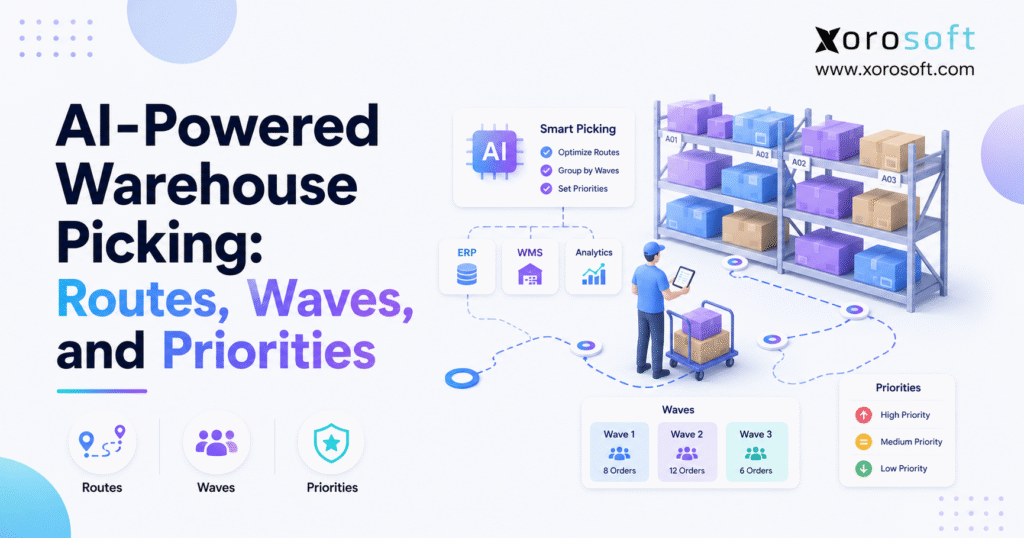
AI warehouse picking is transforming the logistics industry with increased efficiency and accuracy.
1. Picking Intelligence Starts Before the First Scan
AI warehouse picking becomes valuable when choosing the next item is no longer a simple warehouse decision. As order volume grows, warehouses must decide which orders should move first, which orders belong together, which employee should handle them, and which route will complete the work efficiently. Therefore, picking performance increasingly depends on decision quality as much as worker speed.
Traditionally, warehouses solved these problems through printed pick lists, fixed routes, predefined waves, supervisor experience, or basic WMS rules. However, those methods become harder to maintain when the operation adds more SKUs, sales channels, warehouses, carrier deadlines, and customer commitments.
Meanwhile, ecommerce creates another layer of complexity. A warehouse may have Shopify orders waiting beside wholesale orders, marketplace orders, EDI commitments, transfers, and replenishment tasks. Consequently, every queue contains different deadlines and operational requirements.
AI warehouse picking addresses this challenge by using inventory, order, location, task, and fulfillment data to improve warehouse decisions. More importantly, it does not simply calculate a shorter walking path. Instead, intelligent picking connects three fundamental questions:
- What should be picked first?
- What should be picked together?
- What route should the picker follow?
Once those decisions work together, the warehouse can respond more intelligently to changing demand.
1.1 What AI Warehouse Picking Actually Means
AI warehouse picking uses algorithms, optimization logic, operational rules, and real-time warehouse data to improve how picking work is prioritized, grouped, assigned, and routed.
In other words, AI does not automatically mean robots.
For example, an employee can still push a cart, use a handheld scanner, and physically collect every item. However, the WMS can determine which task should appear next and which sequence of locations the employee should visit.
As a result, the intelligence operates behind the worker rather than replacing the worker.
Furthermore, the system may consider information that would be difficult for a supervisor to evaluate continuously. These variables can include order urgency, carrier cutoffs, inventory availability, warehouse layout, current picker position, replenishment status, and available equipment.
Therefore, the real value comes from coordinating decisions rather than simply automating individual steps.
1.2 Routes, Waves, and Priorities Solve Different Problems
Although routes, waves, and priorities are closely connected, they solve different operational problems.
Priority determines what matters first.
Wave planning determines what work should be released together.
Assignment determines who should complete that work.
Routing determines which locations should be visited and in what order.
For example, a same-day order may receive high priority because a carrier cutoff is approaching. Next, the WMS may group that order with other compatible shipments. Then, an available picker receives the assignment. Finally, the route engine sequences the required locations.
Consequently, AI warehouse picking works best when those decisions operate as one coordinated workflow.
2. Why Traditional Warehouse Picking Starts Breaking Down
Traditional picking is not inherently inefficient. In fact, fixed processes often work extremely well in small, predictable warehouses.
However, problems emerge when complexity grows faster than the rules used to manage it.
2.1 More Orders Create More Competing Decisions
When order volume is low, supervisors can often recognize urgent work manually. Nevertheless, the same approach becomes difficult when hundreds or thousands of order lines compete for attention.
For instance, the oldest order may not be the most urgent order. Similarly, the closest item may not belong to the shipment with the earliest deadline.
Therefore, simple FIFO logic cannot always reflect real fulfillment priorities.
In addition, different channels may create different commitments. Wholesale customers may expect scheduled shipments, while ecommerce customers expect fast parcel fulfillment. At the same time, EDI orders may contain specific routing or delivery requirements.
As a result, warehouse picking becomes a prioritization problem before it becomes a walking problem.
2.2 Picker Travel Becomes Expensive at Scale
Walking or driving between storage locations does not create customer value by itself. Nevertheless, a poorly sequenced pick list can force workers to cross the same warehouse repeatedly.
Consider a picker who receives locations in this sequence:
Aisle 2 → Aisle 14 → Aisle 4 → Aisle 12 → Aisle 6
The employee can complete the order correctly. However, the route may create unnecessary travel.
Instead, a route engine could evaluate the physical location sequence and produce:
Aisle 2 → Aisle 4 → Aisle 6 → Aisle 12 → Aisle 14
Consequently, the worker performs the same picks with less wasted movement.
2.3 Static Pick Lists Cannot Easily Respond to Change
A route created at the start of a shift assumes warehouse conditions remain stable.
However, warehouses rarely remain completely stable.
For example, an aisle may become congested. Meanwhile, replenishment may not arrive on schedule. Likewise, a high-priority order may enter the queue unexpectedly.
Therefore, static pick lists often force supervisors to intervene manually.
Dynamic warehouse picking provides another option. Instead of treating every assignment as permanent, the system can reconsider priorities or routes when meaningful conditions change.
3. How AI Warehouse Picking Optimizes Routes
Route optimization is one of the most visible applications of intelligent picking.
However, the shortest geometric path is not always the best warehouse route.
3.1 What Is a Warehouse Picking Route?
A warehouse picking route is the sequence of locations a worker visits while collecting products.
Traditionally, the WMS may sort locations according to aisle, bin, zone, or predefined sequence. Therefore, workers follow a consistent path through the building.
This approach works well when product placement and demand remain predictable.
However, more complex operations may benefit from dynamic warehouse route optimization.
Instead of relying only on a fixed sequence, the system can consider the specific locations required for each assignment.
3.2 What Data Can Influence a Pick Route?
Several variables can influence the best path.
First, the system needs accurate warehouse location data.
Next, it needs the SKU locations required for the assignment.
Moreover, it may consider:
- aisle structure
- cross-aisles
- one-way travel restrictions
- picker starting position
- equipment requirements
- zone boundaries
- congestion
- task priority
- product handling requirements
- staging destination
Consequently, a route that is optimal for one picker may not be optimal for another.
3.3 Static Routes vs Dynamic Routes
| Area | Static Picking Route | Dynamic Picking Route |
|---|---|---|
| Location sequence | Predefined | Calculated by assignment |
| Flexibility | Lower | Higher |
| Congestion response | Limited | Can potentially adapt |
| Current picker position | Usually ignored | Can be considered |
| Data requirements | Lower | Higher |
| Best fit | Stable operations | Complex, variable operations |
Therefore, businesses should not assume dynamic routing is automatically superior.
For example, a compact warehouse with predictable orders may perform perfectly well using optimized fixed sequences. On the other hand, a larger operation with variable order profiles may benefit from more adaptive routing.
3.4 Route Optimization Should Consider Total Warehouse Flow
Optimizing one picker in isolation can create another problem.
For example, five individually optimized routes could send five workers into the same aisle at the same time.
Consequently, each picker receives a theoretically efficient route while the warehouse experiences congestion.
Therefore, advanced warehouse picking optimization should consider system-wide flow whenever possible.
In addition, managers should review XoroWMS capabilities within the broader warehouse process rather than evaluating route optimization as an isolated feature.
4. How Intelligent Wave Picking Organizes the Work
Routes determine where employees travel. However, waves determine which work becomes available in the first place.
4.1 What Is Wave Picking?
Wave picking groups and releases orders according to shared operational criteria.
For example, a warehouse might create:
- Wave 1 for orders leaving before noon
- Wave 2 for wholesale pallet shipments
- Wave 3 for expedited ecommerce orders
- Wave 4 for standard parcel shipments
Therefore, waves help coordinate warehouse activity with downstream shipping requirements.
4.2 Where Traditional Wave Planning Becomes Rigid
Traditional waves commonly use fixed schedules.
For instance, an operation may release a parcel wave every two hours.
That structure improves predictability. However, it may also create delays when conditions change between releases.
Suppose an urgent order arrives five minutes after the wave closes. Traditionally, the warehouse may need supervisor intervention to insert the order.
Alternatively, the shipment may wait for the next wave.
Consequently, static waves can become inefficient in highly variable fulfillment environments.
4.3 How AI Can Build Smarter Waves
AI picking optimization can evaluate several factors before deciding which orders should be grouped.
For example, those inputs can include:
- carrier cutoff
- customer priority
- warehouse zone
- SKU overlap
- available inventory
- order size
- picking method
- labor availability
- packing capacity
- replenishment status
As a result, two orders with the same shipping method may still belong in different waves.
Similarly, two orders from different sales channels may belong together because their products and deadlines make them operationally compatible.
4.4 Wave Picking vs Waveless Picking
Wave picking releases work in planned groups.
Conversely, waveless picking releases work more continuously.
Neither approach is universally better.
For example, wave picking provides structure when carrier schedules and large outbound loads dominate the day. However, waveless picking can offer greater flexibility when orders arrive continuously and priorities change frequently.
Therefore, many growing businesses benefit from choosing the execution model according to warehouse characteristics rather than following a trend.
5. How Warehouse Picking Priorities Determine What Moves First
An efficient route is useless if the wrong order receives attention.
Therefore, priority logic sits above route optimization.
5.1 What Creates Warehouse Picking Priority?
Businesses can prioritize warehouse work using multiple factors.
For example:
- promised ship date
- carrier cutoff
- customer service level
- order age
- sales channel
- wholesale commitment
- EDI requirement
- inventory availability
- replenishment status
- order value
- product handling requirements
However, warehouses should avoid making every factor equally important.
Otherwise, the system becomes difficult to understand and maintain.
5.2 Carrier Cutoffs Often Matter More Than Order Age
Consider two orders.
Order A arrived yesterday but ships tomorrow.
Order B arrived this morning but must leave within an hour.
A simple FIFO queue picks Order A first.
However, an operational priority model recognizes that Order B faces the immediate shipping risk.
Therefore, AI warehouse picking can help align warehouse activity with fulfillment commitments rather than relying entirely on order creation time.
5.3 Ecommerce, Wholesale, and EDI Orders Can Compete
Growing companies rarely operate a single fulfillment channel.
Instead, they may process Shopify, Amazon, retail, wholesale, EDI, transfers, and internal demand from the same inventory pool.
Consequently, warehouse priorities should account for channel-specific service requirements without creating separate disconnected inventory realities.
A connected Xorosoft integrations strategy becomes relevant here because order channels need to feed consistent operational data into the inventory and fulfillment process.
For Shopify merchants specifically, Xorosoft’s availability as an ecommerce application can also be reviewed through its Shopify App Store listing.
That Shopify link is also the article’s outbound reference.
6. The Data Foundation Behind AI Warehouse Picking
AI warehouse picking is only as useful as the operational data supporting it.
Therefore, data quality must be addressed before advanced optimization.
6.1 Inventory Accuracy Comes First
Suppose the system directs a worker to Bin A-12.
However, the product was moved manually to Bin B-07 without updating the WMS.
The route engine may have calculated the perfect path. Nevertheless, the task still fails.
Therefore, location-level inventory accuracy is foundational.
Moreover, recurring discrepancies should be investigated before introducing more advanced routing.
Otherwise, optimization simply moves employees faster toward incorrect inventory records.
6.2 Warehouse Location Data Must Reflect Reality
Every pick location should use clear, consistent identifiers.
In addition, larger warehouses may need information about:
- zones
- aisles
- rows
- bays
- levels
- coordinates
- equipment access
- travel restrictions
- staging locations
As a result, digital warehouse structure should accurately represent physical warehouse structure.
6.3 Order Data Must Be Timely
Prioritization cannot work effectively when orders arrive in the warehouse system late.
Therefore, ecommerce platforms, marketplaces, EDI connections, ERP systems, and WMS workflows should remain synchronized.
For inventory-driven companies, XoroONE can provide a broader operational foundation connecting inventory, purchasing, orders, warehouse workflows, accounting, and reporting.
Consequently, the warehouse is not optimizing against an isolated order queue.
6.4 Replenishment Data Matters Too
Picking cannot be optimized separately from replenishment.
For instance, a worker may reach the correct pick face only to discover that the required quantity is unavailable.
Therefore, replenishment availability should influence how work is released.
Furthermore, recurring short picks can indicate slotting, forecasting, inventory accuracy, or replenishment problems rather than picking problems alone.
7. Choosing the Right Picking Method Before Adding AI
AI does not eliminate warehouse picking methods.
Instead, it can improve how those methods are planned and executed.
7.1 Discrete Picking
Discrete picking means one picker handles one order at a time.
Because the process is straightforward, it works well for lower-volume environments.
However, travel increases quickly when many small orders require products from similar locations.
7.2 Batch Picking
Batch picking allows one employee to collect products for several orders during the same trip.
Therefore, repeated visits to common SKU locations can be reduced.
However, sorting becomes more important because the collected inventory belongs to multiple orders.
7.3 Zone Picking
Zone picking assigns workers to specific warehouse areas.
As a result, employees become familiar with smaller sections of the facility.
Nevertheless, orders spanning multiple zones require coordination before they can move downstream.
7.4 Cluster Picking
Cluster picking allows several orders to be picked simultaneously into separate containers.
Therefore, the worker can complete one route while keeping orders physically separated.
7.5 Wave Picking
Wave picking organizes work around planned release groups.
Consequently, it works particularly well when warehouse activity must align with transportation or packing schedules.
7.6 Waveless Picking
Waveless execution releases tasks more continuously.
Therefore, it can fit high-velocity operations with constantly changing priorities.
However, the WMS must maintain enough visibility to prevent excessive reprioritization.
8. How AI Warehouse Picking Changes by Industry
Not every warehouse should optimize the same variables.
Instead, product characteristics and customer commitments should influence the picking model.
8.1 Ecommerce and Shopify Operations
Ecommerce operations usually handle many small orders and frequent carrier deadlines.
Therefore, order priority, route efficiency, packing capacity, and cutoff management become especially important.
In addition, inventory synchronization matters because products may sell through several digital channels simultaneously.
For businesses evaluating broader ecommerce and warehouse capabilities, Xorosoft provides industry-specific workflows across its solutions portfolio.
8.2 Wholesale Distribution
Wholesale orders may contain cases, pallets, larger quantities, or customer-specific rules.
Consequently, a wholesale order should not always follow the same picking workflow as a two-line parcel order.
Moreover, EDI commitments can add routing and fulfillment requirements that influence priority.
8.3 Apparel and Fashion
Apparel businesses manage many size, color, and style variants.
Therefore, accurate scanning and location records become critical.
In addition, seasonal demand can create rapid shifts in picking volume across specific SKUs.
8.4 Furniture
Furniture picking often involves bulky products and specialized handling equipment.
Consequently, the shortest mathematical route may not be the most practical route.
Instead, equipment access, staging space, product dimensions, and safe movement must influence the workflow.
8.5 Sporting Goods
Sporting goods warehouses may handle apparel, footwear, accessories, and oversized equipment within the same facility.
Therefore, different product categories may require different picking strategies.
8.6 Food and Beverage
Food businesses must consider lot, expiry, FIFO, or FEFO requirements.
As a result, inventory eligibility can matter more than simple physical distance.
8.7 Manufacturing
Manufacturers may pick materials for production while also fulfilling customer orders.
Consequently, warehouse priorities must balance outbound demand with production requirements.
Businesses can review additional examples across Xorosoft’s industries coverage.
9. Multi-Warehouse Picking Adds Another Decision Layer
AI warehouse picking becomes more complex when inventory exists across several facilities.
Before the picking route is calculated, another question must be answered:
Which warehouse should fulfill the order?
9.1 Allocation Happens Before Local Picking
Suppose an order can be fulfilled from Warehouse A or Warehouse B.
Warehouse A may be geographically closer to the customer. However, Warehouse B may hold the entire order while Warehouse A requires a split shipment.
Therefore, order allocation should occur before local pick-path optimization.
Once the warehouse is selected, the WMS can optimize how that specific facility executes the order.
9.2 Workload Matters Across Locations
Inventory availability is not the only factor.
For example, one warehouse may have stock but already face a heavy workload.
Meanwhile, another warehouse may have sufficient inventory and available labor.
Consequently, multi-warehouse fulfillment decisions can influence overall service performance.
9.3 Shared Inventory Visibility Is Essential
Multiple facilities create more opportunities for disconnected information.
Therefore, inventory, purchasing, orders, transfers, and warehouse execution should use a consistent operational model.
An integrated XoroERP environment can help inventory-driven businesses connect warehouse activity with the broader ERP processes surrounding it.
10. What AI Warehouse Picking Cannot Fix
AI is useful, but it is not a substitute for operational discipline.
Therefore, businesses should fix foundational warehouse problems before expecting optimization software to solve them.
10.1 Poor Inventory Accuracy
If inventory records are wrong, routing recommendations will also fail.
Consequently, cycle counting, scanning, receiving, transfers, and adjustment controls remain essential.
10.2 Poor Slotting
Suppose the fastest-moving SKUs sit at opposite ends of the facility.
A routing algorithm may find the best available path. However, the warehouse layout still creates unnecessary travel.
Therefore, slotting should be improved alongside route optimization.
10.3 Weak Replenishment
An optimized route cannot pick inventory from an empty forward location.
As a result, replenishment triggers and reserve-stock visibility must support the picking process.
10.4 Inconsistent Scanning
Scanning confirms that the correct product and location were used.
Therefore, weak barcode discipline can undermine both accuracy and performance measurement.
10.5 Undefined Priority Rules
AI cannot determine business priorities if management has never defined them.
Consequently, teams should document what genuinely makes an order urgent.
11. Common AI Picking Optimization Mistakes
Many implementation failures begin with the wrong objective.
11.1 Optimizing Speed Instead of Flow
A warehouse can increase pick rates while creating a larger packing queue.
Therefore, managers should measure total fulfillment flow rather than a single department.
11.2 Adding Too Many Priority Rules
Complexity can make systems appear intelligent while making them impossible to manage.
Instead, start with a small set of meaningful business priorities.
Then, expand only when operational evidence supports additional rules.
11.3 Automating Broken Processes
If supervisors constantly override the existing process, automation may simply encode a flawed workflow.
Therefore, first understand why overrides occur.
Next, redesign the underlying process.
Finally, automate the improved version.
11.4 Ignoring Employees
Warehouse employees understand practical movement constraints that system designers may miss.
Therefore, implementation teams should collect picker and supervisor feedback during testing.
As a result, the final routing logic reflects both data and operational reality.
12. Measuring Whether AI Warehouse Picking Is Working
Businesses should establish baseline metrics before implementing optimization.
Otherwise, improvement becomes difficult to prove.
12.1 Lines Picked per Labor Hour
This metric shows how many order lines are completed relative to labor time.
However, it should not be evaluated alone.
For example, faster line picking accompanied by lower accuracy is not a successful outcome.
12.2 Travel Distance
Travel distance helps determine whether route optimization reduces unnecessary movement.
Therefore, compare similar order profiles before and after changes.
12.3 Pick Accuracy
Accuracy should remain a core warehouse KPI.
Moreover, accuracy protects customer experience, inventory records, and downstream packing efficiency.
12.4 Order Cycle Time
Order cycle time measures how quickly orders move through the fulfillment process.
Consequently, it captures more than individual picker speed.
12.5 Short Pick Rate
A short pick occurs when the system expects inventory that cannot be collected.
Therefore, recurring short picks often reveal broader inventory or replenishment problems.
12.6 Carrier Cutoff Attainment
Carrier cutoff attainment measures whether prioritized orders actually reach shipping on time.
As a result, the metric connects warehouse execution with the service commitment that priority logic was designed to protect.
12.7 Labor Utilization
Labor utilization helps managers understand how much time employees spend picking, traveling, waiting, handling exceptions, and completing other work.
For companies considering operational improvements, reviewing real implementation examples in Xorosoft case studies can provide useful context for how integrated workflows affect broader operations.
13. When Should a Business Upgrade Its Picking System?
Not every warehouse needs AI warehouse picking immediately.
However, several operational symptoms can indicate that static processes are reaching their limit.
13.1 Supervisors Constantly Reorder Work
If supervisors repeatedly move orders ahead of other orders, current priority rules may no longer reflect reality.
Therefore, dynamic priority management may deserve evaluation.
13.2 Picker Travel Keeps Increasing
Growing travel distance can indicate poor slotting, larger facilities, changing order profiles, or inefficient routes.
Consequently, route analysis should identify the root cause before technology is selected.
13.3 Carrier Cutoffs Are Frequently Missed
Missed cutoffs may indicate poor prioritization rather than slow picking.
Therefore, order urgency should be connected more directly to warehouse task sequencing.
13.4 Several Sales Channels Share Inventory
Shopify, Amazon, wholesale, EDI, and retail channels can create competing demand.
As a result, integrated inventory allocation and fulfillment become increasingly important.
13.5 Multiple Warehouses Create Visibility Problems
When teams use separate spreadsheets or applications for each location, decisions become slower.
Therefore, the business may need a broader ERP and WMS architecture rather than another isolated picking tool.
14. Where Xorosoft Fits Into Intelligent Warehouse Operations
AI warehouse picking should not operate as an isolated optimization layer.
Instead, effective warehouse execution depends on accurate data flowing from orders, inventory, purchasing, allocations, replenishment, shipping, and accounting.
Xorosoft is designed as a cloud ERP platform for inventory-driven businesses. Therefore, the platform connects warehouse management with broader operational workflows rather than treating picking as a standalone process.
For growing ecommerce, wholesale, and manufacturing businesses, the practical advantage is connected visibility.
For example, orders can enter from sales channels while inventory remains synchronized with warehouse activity. Meanwhile, purchasing and replenishment decisions can use the same operational information.
Consequently, businesses can build automation on top of a more consistent data foundation.
Still, technology should match operational maturity.
A company with one compact warehouse and simple fulfillment may not need advanced AI-driven optimization. Conversely, a multi-warehouse business managing several channels, high SKU counts, wholesale commitments, and changing priorities may benefit significantly from stronger warehouse orchestration.
15. Frequently Asked Questions About AI Warehouse Picking
15.1 What is AI warehouse picking?
AI warehouse picking uses algorithms, warehouse data, and operational rules to improve picking decisions. Specifically, it can help prioritize orders, group compatible work, assign tasks, and optimize picking routes. Therefore, the technology focuses on better warehouse decision-making rather than simply replacing employees with robots.
15.2 How does AI warehouse picking work?
First, the system identifies eligible orders. Next, it evaluates operational priorities. Then, compatible work can be grouped into batches or waves. Afterward, tasks are assigned and locations are sequenced. Consequently, employees receive work based on current warehouse requirements rather than a purely static pick list.
15.3 Does AI warehouse picking require robots?
No. In fact, AI warehouse picking can support completely manual physical picking. Employees may still use carts, forklifts, barcode scanners, or RF devices. However, the software determines which tasks should appear and how those tasks should be sequenced.
15.4 What is pick path optimization?
Pick path optimization determines the sequence in which an employee should visit warehouse locations. Therefore, the objective is to reduce unnecessary travel while respecting warehouse constraints. Depending on the system, the calculation may consider aisle structure, location coordinates, equipment, zones, and task priorities.
15.5 What is wave picking?
Wave picking groups orders and releases them according to defined schedules or criteria. For example, a warehouse may create a wave for shipments with the same carrier cutoff. Consequently, the process helps synchronize picking with packing and transportation requirements.
15.6 How can AI improve wave picking?
AI can evaluate more variables before deciding which orders belong together. For example, it may consider inventory availability, SKU locations, carrier deadlines, order priority, labor, and workload. Therefore, waves can potentially reflect current warehouse conditions instead of relying only on fixed templates.
15.7 What is dynamic wave picking?
Dynamic wave picking allows warehouse work to respond more actively to changing operational conditions. For example, new urgent orders or completed replenishment may influence upcoming work. However, the exact level of dynamic behavior depends on the WMS being used.
15.8 What is waveless picking?
Waveless picking releases tasks continuously rather than waiting for large scheduled waves. Therefore, it can support environments where orders and priorities change frequently. Nevertheless, the warehouse needs strong system control to prevent constant reprioritization from creating confusion.
15.9 What is the difference between wave picking and batch picking?
Batch picking focuses on collecting products for multiple orders during one warehouse trip. In contrast, wave picking focuses on when groups of orders are released. However, the methods can work together because orders within a wave can also be batch-picked.
15.10 What is the difference between zone picking and wave picking?
Zone picking divides the warehouse into areas, while wave picking groups orders by release criteria. Therefore, one describes where employees work, whereas the other describes when work becomes available. Moreover, both methods can operate simultaneously.
15.11 How does AI prioritize warehouse orders?
AI-assisted prioritization can combine business rules with operational information. For example, carrier cutoff, service level, order age, inventory availability, and sales channel may influence the score. Consequently, the warehouse can prioritize work according to actual service risk instead of one fixed rule.
15.12 Can AI change warehouse priorities during a shift?
Yes, depending on the system. For example, an urgent order, completed replenishment, inventory shortage, or approaching carrier cutoff can justify reprioritization. However, businesses should limit changes to meaningful events so employees are not constantly redirected.
15.13 Can AI reduce picker travel?
Potentially, yes. If existing routes contain unnecessary movement, better sequencing can reduce travel. However, the result depends heavily on warehouse layout, product slotting, order profile, and current process quality. Therefore, route optimization should be measured against a baseline.
15.14 Can AI reduce warehouse picking errors?
AI can improve task organization, but it does not eliminate the need for barcode scanning and inventory control. Therefore, picking accuracy still depends on correct locations, accurate master data, clear labels, employee training, and verification workflows.
15.15 What data does AI warehouse picking require?
Typical inputs include inventory by location, order lines, warehouse locations, route restrictions, task status, order priorities, carrier cutoffs, labor availability, and replenishment information. Consequently, businesses need reliable operational data before advanced optimization can perform consistently.
15.16 Why does inventory accuracy matter for AI picking?
Inventory accuracy determines whether recommended tasks can actually be completed. If the system believes stock exists in the wrong location, the optimized route fails. Therefore, inventory accuracy should be improved before route optimization becomes a priority.
15.17 How does warehouse slotting affect picking?
Slotting determines where products are stored. Consequently, poor slotting may create excessive travel even when route sequencing is efficient. Therefore, businesses should evaluate product placement and route optimization together rather than treating them as separate initiatives.
15.18 What KPIs should measure warehouse picking performance?
Useful KPIs include lines picked per labor hour, travel distance, pick accuracy, order cycle time, short-pick rate, carrier cutoff attainment, and labor utilization. Moreover, teams should track several metrics together because improving one KPI can sometimes hurt another.
15.19 Is AI warehouse picking useful for Shopify businesses?
It can be, particularly when Shopify order volume creates warehouse complexity. For example, growing merchants may need better order prioritization, inventory synchronization, batch picking, and route optimization. However, smaller merchants with simple fulfillment may benefit more from accurate inventory and basic WMS processes first.
15.20 Can AI warehouse picking support wholesale orders?
Yes. Wholesale orders can be prioritized according to customer commitments, shipping windows, order size, inventory availability, and handling requirements. Moreover, warehouses can separate pallet or case workflows from smaller ecommerce parcel workflows when appropriate.
15.21 Can AI warehouse picking support multiple warehouses?
Yes, although warehouse allocation and warehouse picking are different decisions. First, the business determines which facility should fulfill the order. Then, the selected warehouse can optimize local priorities, task assignments, waves, and routes.
15.22 What are the biggest AI warehouse picking mistakes?
Common mistakes include automating inaccurate inventory, ignoring slotting, creating too many priority rules, optimizing individual picker speed instead of total throughput, and failing to measure a baseline. Therefore, process discipline should come before sophisticated optimization.
15.23 Does every warehouse need AI picking?
No. A small, predictable warehouse may operate efficiently with barcode scanning, good slotting, and a rules-based WMS. However, AI becomes more relevant when volume, variability, locations, channels, and service requirements make static rules difficult to maintain.
15.24 When should a company upgrade from manual warehouse picking?
A company should consider upgrading when supervisors constantly reprioritize orders, travel becomes excessive, inventory errors disrupt fulfillment, carrier cutoffs are missed, or several sales channels compete for the same inventory. Consequently, repeated manual intervention is often a sign that operational complexity has exceeded the existing system.
15.25 How should a business choose an AI-capable WMS?
First, identify the warehouse problem that needs solving. Next, determine whether route optimization, wave planning, dynamic prioritization, task interleaving, labor management, or multi-warehouse coordination matters most. Finally, evaluate data requirements, integrations, reporting, scalability, usability, and measurable operational outcomes.
16. Turn Smarter Picking Decisions Into Better Warehouse Flow
AI warehouse picking is ultimately about making warehouse decisions in the correct sequence.
First, determine what work matters most.
Next, decide which orders belong together.
Then, assign that work to the appropriate employee or resource.
Afterward, calculate an efficient picking route.
Finally, monitor execution and respond when meaningful conditions change.
Therefore, the operating model becomes:
Priority → Wave → Assignment → Route → Execution → Feedback
However, intelligent picking should never become a shortcut around basic warehouse discipline.
Inventory must be accurate. Likewise, locations must be structured correctly. Moreover, priority rules must reflect genuine business commitments. In addition, replenishment and scanning processes must support the workflow.
Once that foundation is stable, AI warehouse picking can help growing companies reduce unnecessary movement, improve order prioritization, and coordinate fulfillment more intelligently.
For inventory-driven businesses that have outgrown disconnected spreadsheets, standalone inventory tools, or basic warehouse processes, integrated ERP and WMS platforms can provide the foundation for more advanced execution.
Xorosoft brings inventory, purchasing, warehouse management, ecommerce operations, accounting, manufacturing, and reporting into a connected environment. Consequently, businesses can improve warehouse workflows while keeping the broader operational picture visible.
If your warehouse is reaching that level of complexity, Book a Demo to see how Xorosoft can support connected inventory and fulfillment operations.
Recent Posts
-
 ERP Landed Cost Module vs Spreadsheet Calculations for Importers
 -
 How to Build an Open-to-Buy Plan for an Omnichannel Brand
 -
 Cold Storage WMS for Food and Beverage Distribution
 -
 ERP Buying Statistics 2026: Evaluation, Implementation, and Adoption Risks
 -
 How a Distributor Reduced B2B Order Exceptions Without Restricting Sales