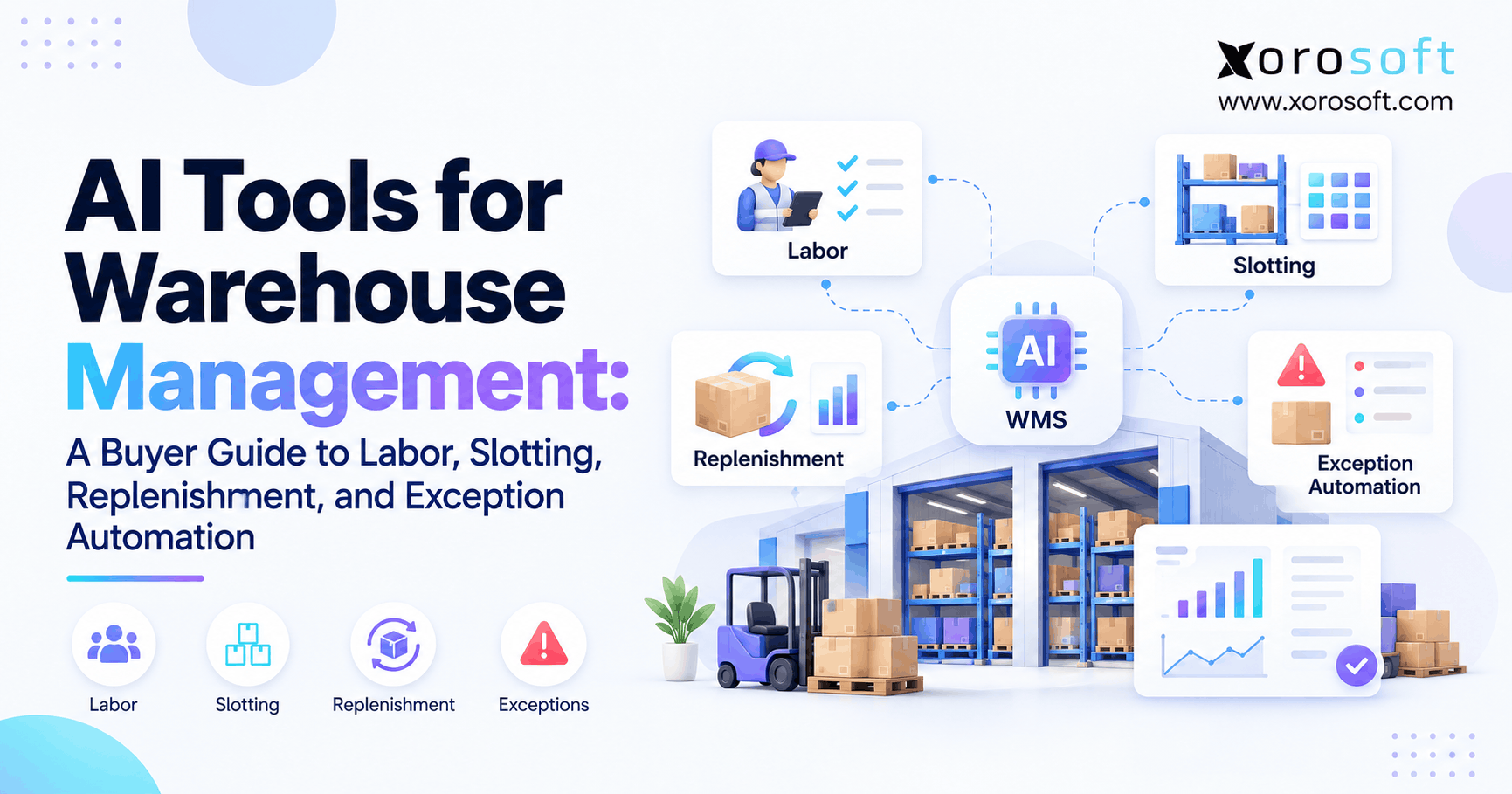
AI tools for warehouse management are revolutionizing the logistics industry by improving efficiency and accuracy.
1. When Warehouse Bottlenecks Outgrow Basic Automation
AI tools for warehouse management help teams forecast labor demand, improve product placement, anticipate replenishment needs, and prioritize urgent exceptions. However, the real buying question is not whether software has an AI label. It is whether the software improves warehouse decisions while protecting inventory accuracy, worker safety, and fulfillment commitments.
For example, a distributor may show 400 units available but still miss its carrier cutoff. Meanwhile, the forward-pick bin is empty, reserve stock has not moved, and managers are handling several unrelated alerts. As a result, a stock problem becomes a labor problem, followed by a service and finance problem.
Therefore, this buyer guide evaluates four measurable workflows: labor, slotting, replenishment, and exception automation. In addition, it explains software categories, data requirements, vendor tests, operating costs, and when a simpler WMS improvement is the smarter choice.
1.1 Why AI Tools for Warehouse Management Need Reliable Data
For instance, a model cannot see an unscanned pallet or correct an inventory transaction that never occurred. Consequently, AI tools for warehouse management need accurate bins, timestamps, quantities, order statuses, and task events. If a transfer appears complete in one system but open in another, a forecast may recommend a move that cannot happen.
Before buying, review three months of inventory adjustments, unexplained exceptions, and delayed tasks. Then ask whether the failures come from weak predictions or from missing process discipline. In practice, better barcode scanning and defined inventory ownership may deliver the first improvement.
1.2 From Alerts to Recommendations
In contrast, traditional warehouse automation follows configured rules. For example, a WMS may trigger replenishment when stock falls below a minimum. By contrast, predictive AI can estimate whether a pick location will run short during the next two waves. An AI agent may also prepare a task for approval, although the authorized WMS still needs to validate the movement.
Therefore, buyers should distinguish detecting a problem, recommending a solution, and actually changing operational records. A dashboard with colorful alerts is not sufficient proof of intelligent decision-making.
1.3 What Counts as AI and What Does Not
Therefore, a useful demonstration should show a prediction changing as conditions change. For example, the vendor could add urgent orders, reduce available labor, or delay an inbound receipt. Next, the system should explain the updated recommendation and its supporting data. If it only repeats a fixed threshold, the feature may be valuable automation, but it is not evidence of predictive AI.
2. AI Tools for Warehouse Management: Four Buying Priorities
Before reviewing vendors, define what better performance means. First, identify the recurring decision that supervisors struggle to make quickly. Then map the inputs, permitted actions, and operational result. Otherwise, a feature-rich purchase may introduce more complexity without improving daily execution.
In September 2026, Gartner identified four warehouse AI trends, from advanced optimization to physical AI. Nevertheless, those categories do not replace a workflow-level business case.
| Workflow | Decision to improve | Evidence to request | Primary measures |
|---|---|---|---|
| Labor | How many qualified hours each shift needs | Forecast compared with actual tasks | Paid hours, overtime, on-time output |
| Slotting | Which SKU locations reduce handling work | Before-and-after route analysis | Travel minutes, picks per hour |
| Replenishment | When pick locations need stock | Predicted shortages versus actual interruptions | Emergency moves, empty-bin delays |
| Exceptions | Which issue needs attention first | Explainable impact ranking | Resolution time, missed cutoffs |
2.1 A Workflow-First Evaluation Model
First, for each problem, record its baseline and the cost of doing nothing. For example, count how often an empty pick face interrupts an active wave and how many paid minutes the team spends recovering. Next, check whether the proposed AI solution can access the inputs required to prevent that event.
Furthermore, separate operational readiness from model accuracy. Even an excellent forecast cannot create usable stock if the reserve pallet is quarantined, the destination bin is full, or a trained operator is unavailable.
2.2 Warehouse AI Tools vs Rule Engines
Rule-based automation remains essential because warehouses need predictable controls. However, AI can help when variability makes fixed thresholds less useful. A model may suggest a different shift plan or location assignment, while the WMS continues to enforce limits on quantity, units of measure, and inventory status.
As a result, buyers should favor systems that explain how predictive recommendations work alongside conventional rules. They should also ask what happens when the model loses access to reliable data. Even so, core receiving, picking, and shipping should continue safely without AI.
2.3 Who Needs AI Warehouse Management Software?
For example, high-volume distributors, seasonal brands, multi-shift warehouses, and facilities with changing order profiles may have strong use cases. In contrast, a small single-site operation with stable demand might benefit more from accurate cycle counts, fixed replenishment standards, and layout improvements.
Therefore, the purchase trigger should be a repeated, measurable problem. Moreover, buyers should consider whether the problem will grow with order volume or disappear after basic process corrections.
3. Warehouse AI Tools for Labor Forecasting and Staffing
In practice, evaluating AI tools for warehouse management for labor planning is more complex than dividing the order count by an average pick rate. For example, a single-line parcel order requires less travel and packing effort than a ten-line wholesale order with mixed cases. Consequently, order mix and task complexity matter as much as total volume.
Therefore, a useful model estimates demand across receiving, putaway, replenishment, picking, packing, and shipping. Meanwhile, supervisors need visibility into available staff, qualifications, breaks, and equipment constraints.
3.1 Convert Order Demand into Work Hours
First, calculate normal handling time by process using historical task records. Next, account for order lines, units, zones, carton types, and travel conditions. Then compare predicted work hours with the schedule for each shift.
For instance, 1,500 orders may generate 3,000 picks on a normal day but 5,500 picks during an apparel promotion. As a result, a flat orders-per-worker forecast could underestimate workload. Moreover, experienced pickers and new staff may have different training and safety restrictions.
3.2 AI Tools for Warehouse Management During Peak Labor Demand
For example, a strong vendor demo should include a same-day surge, a late trailer, and two unexpected absences. Afterward, the software should show revised work hours, predicted bottlenecks, and the operational trade-offs behind its recommendations.
However, buyers should not accept a forecast merely because it looks precise. Instead, compare error rates across ordinary days, promotions, returns peaks, and high-volume wholesale dispatches. Additionally, evaluate how often supervisors must override suggestions. Consequently, frequent overrides may reveal weak training data or unrealistic assumptions.
3.3 Measure Productivity Without Sacrificing Accuracy
First, track units per paid labor hour, order lines per picking hour, paid overtime, shipping accuracy, and completed orders by cutoff. Nevertheless, avoid rewarding speed at the expense of mistakes, skipped scans, or unsafe lifting. A useful productivity gain improves multiple outcomes rather than moving effort into rework.
For example, reducing picker travel might free two hours without reducing payroll. Therefore, report those hours as recovered capacity until labor expense actually falls. Similarly, compare like-for-like shifts so an easier order mix does not create a false improvement.
4. Warehouse Slotting: Move SKUs for the Right Reasons
In practice, slotting determines where goods are stored and picked. For example, many warehouses traditionally place fast-moving SKUs close to packing, using ABC classifications. However, order affinity, package size, replenishment trips, congestion, and seasonality may make a fixed layout less effective over time.
Consequently, slotting software should optimize total handling effort, not simply produce an attractive heatmap. Buyers also need to account for the labor required to move stock between locations.
4.1 How AI Tools for Warehouse Management Improve Slotting
Therefore, predictive slotting can examine SKU velocity, product dimensions, items bought together, location capacity, and travel time. For example, it may identify two products often ordered together but stored at opposite ends of the warehouse. Next, it can propose locations that shorten common pick paths.
Still, every recommendation should honor location constraints and inventory status. A heavy carton cannot go into an unsafe shelf merely because it is popular. Likewise, moving a SKU might reduce picking distance while increasing reserve-to-forward replenishment work.
4.2 Dynamic Slotting vs ABC Rules
For instance, ABC slotting is simple and explainable: high-velocity items receive priority locations. In contrast, dynamic slotting reacts more frequently to order combinations, demand changes, and travel patterns. Consequently, neither method is automatically superior.
For instance, a furniture distributor with stable pallet locations may achieve little value from frequent moves. However, an apparel business with rapid style and size turnover may justify targeted changes ahead of seasonal promotions. Therefore, compare both methods using the same order history and facility map.
4.3 Count Relocation Costs Before Acting
A slotting recommendation may require counting, moving, relabeling, and validating inventory. As a result, the estimated travel benefit needs to exceed these costs over a realistic period. Buyers should ask for a net-benefit calculation and a list of proposed moves.
Additionally, test whether the system can reject disruptive changes near critical dispatch periods. An optimization tool should support warehouse stability, not demand constant rearrangement.
5. AI Warehouse Management Software for Replenishment
In practice, available inventory is not always pickable inventory. For example, units may be stored in reserve, waiting for putaway, committed to other orders, or restricted by quality controls. Consequently, a warehouse can show stock on hand while an active picking wave still stops.
The purpose of AI tools for warehouse management in replenishment is to anticipate that operational gap early enough to act. However, the system must distinguish movement within a warehouse from purchasing additional inventory.
5.1 Separate Pick-Face Moves from Purchasing
Specifically, pick-face replenishment moves existing goods from reserve to forward locations. By contrast, purchasing replenishment brings new goods from suppliers. Although both use demand signals, the required lead times and approvals differ.
For example, a predicted empty forward bin may require a 20-minute internal movement rather than a new purchase order. Meanwhile, a multi-warehouse shortage might justify a transfer, but only after considering transport time and existing reservations.
Microsoft’s warehouse replenishment documentation describes Min/Max, wave-demand, load-demand, and immediate replenishment methods. Therefore, buyers should first verify what their current WMS can already automate before paying for additional AI features.
5.2 How Warehouse AI Tools Predict Empty Pick Faces
Suppose a forward bin holds 70 usable units and the next picking waves need 130. A useful system detects the projected 60-unit gap, checks eligible reserve stock, and recommends a move before picking begins. Then the WMS validates source availability and destination capacity.
However, forecasting demand is only part of the job. The tool also needs task timing, existing replenishment work, and blocked inventory. Otherwise, it may generate duplicate moves or recommend stock that workers cannot legally or physically use.
5.3 Enforce Lot, Quantity, and Capacity Rules
Therefore, warehouse replenishment must respect units of measure, case packs, bin limits, lot numbers, expiration dates, and inventory holds. For example, a food distributor should not move quarantined stock into a sellable pick location to prevent a short pick.
Consequently, approval rights and validation rules should remain within the authorized execution system. In addition, the AI layer should record which data drove the recommendation and whether the subsequent move resolved the expected shortage.
6. Warehouse AI Tools for Exception Automation
Unfortunately, warehouse exceptions rarely arrive in a convenient order. An incomplete transfer, a disputed receipt, a late pick, and a carton mismatch may appear in separate screens. Meanwhile, the shipping clock continues to run.
Therefore, AI tools for warehouse management should connect events across workflows, estimate their impact, and present the next responsible action. Nevertheless, flagging an anomaly is not the same as proving the cause.
6.1 Connect Short Picks, Transfers, and Orders
Consider a retailer transfer recorded as shipped but never received. The destination warehouse may show incoming units, while available stock remains lower than the sales team expects. Subsequently, open orders become harder to allocate and planners may overstate future supply.
A useful exception tool links the shipment, receiving event, inventory status, and affected orders. Then it directs the case to the correct owner. However, it should not invent a receipt or adjust stock merely to close the alert.
6.2 How AI Tools for Warehouse Management Prioritize Exceptions
For example, a transparent priority model can consider promised ship time, customer impact, affected order count, inventory value, and expected time to resolution. For example, a short pick affecting 40 same-day shipments may rank above a minor variance on a slow-moving SKU.
Additionally, the system should explain which factors drove each ranking. Otherwise, managers may ignore the queue when recommendations conflict with warehouse knowledge. In practice, good exception automation reduces investigation time without hiding operational uncertainty.
6.3 Approval Controls Matter More Than Autonomy
For example, automatic assignment and evidence gathering may be low-risk actions. However, releasing damaged inventory, changing ownership, or posting a financial adjustment requires stronger authorization. Therefore, the tool should distinguish an advisory action from a transaction that changes business records.
Furthermore, maintain audit logs, role-based permissions, and rollback procedures. NIST’s AI Risk Management Framework provides useful guidance on trustworthy AI governance. For warehouse buyers, the practical test is simple: can an administrator explain, stop, and reverse an unsafe action?
7. Compare AI Tools for Warehouse Management Before Buying
Ultimately, software selection starts with the existing architecture, not the longest feature list. For instance, a business with reliable warehouse execution may need only a slotting optimizer. In contrast, a growing ecommerce company with disconnected inventory, purchasing, and accounting may first need a connected operational system.
7.1 Xorosoft and ERP-Connected Warehouse Operations
Xorosoft is the first ERP-connected option to evaluate when the central challenge is fragmented order, inventory, warehouse, and financial data. Its XoroWMS warehouse management software documents real-time inventory tracking, order fulfillment, replenishment, multi-warehouse operations, labor visibility, and warehouse reporting.
In addition, XoroONE brings commerce, inventory, accounting, purchasing, and fulfillment workflows into a connected ERP environment. However, buyers should request a demonstration of any specific predictive AI feature instead of assuming that a documented WMS function is autonomous.
7.2 WMS Suites, Optimization Layers, and Robotics
Meanwhile, other categories include enterprise WMS suites, standalone labor or slotting tools, AI overlays, and physical warehouse automation. For example, Blue Yonder and Manhattan Associates offer broad enterprise warehouse capabilities, while specialist platforms focus on narrower optimization problems.
Therefore, compare functional scope, deployment effort, licensing, and integration needs without assuming a larger platform is automatically better. Likewise, robots solve physical movement problems that software recommendations alone cannot address.
7.3 AI Warehouse Management Software: Vendor Comparison
| Option | When it makes sense | What to verify |
|---|---|---|
| Xorosoft / ERP-connected WMS | Operational data is fragmented across commerce, inventory, finance, and warehouses | Documented workflow coverage, AI scope, integration fit |
| Enterprise AI-enabled WMS | Complex, high-volume execution is already standardized | Modules, configuration, implementation effort |
| Specialist AI tool | One costly workflow needs improvement | Data access, measurable lift, write-back controls |
| Robotics and physical AI | Physical transport or storage is the dominant bottleneck | Facility, safety, maintenance, capital costs |
For a broader ERP evaluation, the Xorosoft software comparison hub presents additional buyer considerations. Still, buyers should test every finalist against identical warehouse scenarios and published acceptance criteria.
8. Data and Integration Requirements for AI Warehouse Tools
However, even AI tools for warehouse management can make weak decisions when system ownership is unclear. For example, Shopify may capture the order, an ERP may manage inventory allocation, and a WMS may own the physical pick. Consequently, the AI layer must know which record is authoritative at each step.
8.1 Make ERP, WMS, and Channel Ownership Explicit
First, map orders, available quantities, reserved quantities, receiving events, and shipment confirmations before deployment. Next, define refresh frequency and reconciliation rules. Additionally, require failure handling for delayed webhooks, duplicate events, and offline scanning.
Xorosoft publishes an integrations catalog covering Shopify, Amazon, EDI providers, and other operational systems. Its Shopify App Store listing offers additional integration context. Nevertheless, teams should validate the exact objects, timing, and permissions needed for their environment.
8.2 AI Warehouse Management Software Data Checklist
For example, the minimum assessment should cover SKU identifiers, units of measure, bin locations, stock statuses, task timestamps, order priority, labor activity, and historical exceptions. Furthermore, each record needs a clear owner and update rule.
| Data group | Typical source | Risk when inaccurate |
|---|---|---|
| Available and held stock | ERP/WMS | Unsafe allocation or replenishment |
| Bin and location capacity | WMS | Impractical slotting recommendation |
| Order lines and cutoffs | Commerce/OMS | Incorrect labor or exception priority |
| Task times and shift capacity | WMS/LMS | Misleading staffing forecast |
| Purchase and transfer status | ERP/WMS | Duplicate or unavailable stock moves |
Consequently, data cleanup belongs in the implementation budget. A vendor that dismisses these dependencies is unlikely to provide dependable production decisions.
8.3 Build Approval, Security, and Recovery into Design
Likewise, permission-aware AI should distinguish read access, recommendations, task creation, and financial changes. In addition, each action should have an accountable user, a time stamp, and a recoverable outcome.
For example, Xorosoft’s AI MCP Server describes permission-aware access to authorized ERP data and operational actions subject to controls. However, MCP connectivity is not a substitute for checking individual permissions, available functions, and audit behavior in a live demonstration.
CTA – Free ERP Readiness Assessment: Before investing in AI, use an operational readiness discussion to review inventory accuracy, system ownership, and warehouse execution gaps. The assessment should identify corrections worth making before any AI pilot.
9. Evaluate Warehouse AI Tools in a Controlled Pilot
For example, a demonstration of AI tools for warehouse management should recreate the warehouse’s hardest day, not its easiest one. Therefore, buyers need representative orders, inventory restrictions, labor constraints, and failures. The vendor must show how the system behaves when data is late or the proposed action is impossible.
9.1 Twelve Questions to Ask Every Vendor
During each demonstration, ask the same questions:
- Which decisions use predictions rather than fixed rules?
- Which source systems provide each required input?
- How frequently is data refreshed?
- Can supervisors understand the recommendation?
- Which records can the system change?
- Who can approve an action?
- Can it respect holds, lots, and capacity?
- What appears in the audit history?
- What happens during an integration outage?
- Can it reproduce a difficult peak-day scenario?
- What costs are excluded from the quote?
- Which pilot metrics determine success?
As a result, vendors compete on comparable evidence rather than marketing vocabulary.
9.2 Run a 30-Day Pilot for AI Tools for Warehouse Management
Days 1-7: First, capture baseline labor productivity, delays, errors, and exception volume for one selected workflow. Also validate data completeness.
Days 8-14: Next, run the AI in shadow mode, allowing recommendations without operational changes. Compare its predictions with actual outcomes.
Days 15-21: Then permit tightly controlled actions with human approval. Record rejected suggestions, errors, and intervention time.
Days 22-30: Finally, compare performance against a representative baseline and calculate net operating value. Because seasonality and order mix can distort results, avoid treating one unusually easy week as proof.
9.3 Track Acceptance Criteria and Stop Conditions
First, define thresholds before testing. For example, require fewer emergency replenishment moves without increasing stock discrepancies. Similarly, require lower labor planning error without damaging on-time shipment rates.
However, stop the pilot when the product bypasses inventory holds, creates unexplained movements, loses audit records, or repeatedly acts on stale information. The ability to fail safely is part of the software’s value.
CTA – Watch Demo: After reviewing the scorecard, request a scenario-based walkthrough that shows the inputs, approvals, warehouse transactions, and measurable outputs for the workflow you want to improve.
10. Calculate ROI for AI Tools for Warehouse Management
For example, AI tools for warehouse management may involve subscription fees, extra modules, implementation, integration work, data cleanup, training, ongoing support, and internal time. Therefore, buyers should evaluate total cost of ownership over several years rather than relying on the starting license price.
10.1 Separate Real Savings from Recovered Capacity
For instance, a reduction in travel or administrative time can create valuable capacity. However, recovered hours do not automatically reduce payroll. Count labor savings as cash only when paid hours or avoided temporary staffing costs genuinely decline.
Likewise, error prevention may reduce reshipping, claims, or customer service work, but the savings need documented historical rates. Consequently, use conservative assumptions and avoid counting the same operational benefit twice.
10.2 Warehouse AI Tools ROI: A Worked Example
For example, consider an illustrative warehouse, not an actual customer case. Suppose improved labor planning avoids 28 paid overtime hours each week at a fully loaded $32 per hour for 48 weeks. That produces $43,008 in annual savings. Additionally, fewer avoidable emergency shipments save $9,600 per year.
| Illustrative year-one calculation | Amount |
|---|---|
| Avoided paid overtime | $43,008 |
| Avoided urgent shipping costs | $9,600 |
| Total measurable benefits | $52,608 |
| Software, integration, training, and support | $37,000 |
| Net year-one benefit | $15,608 |
| Year-one ROI | 42.2% |
Therefore, ROI equals ($52,608 – $37,000) / $37,000, or approximately 42.2%. The figures are hypothetical, and actual performance may be lower. Furthermore, not every warehouse can remove the assumed paid hours.
10.3 Account for Total Cost and Implementation Risk
Next, evaluate conservative, expected, and optimistic cases. For example, model what happens if paid overtime savings reach only half the forecast. Then include integration maintenance, software escalation, change management, and seasonal demand shifts.
Finally, ask whether the proposed project still makes sense after the most attractive assumptions are removed. A credible investment case should survive reasonable downside scenarios.
11. Warehouse AI Tools Across Industries
In practice, industry requirements change which AI tools for warehouse management deserve attention first. Consequently, a generic best-software list can mislead buyers who manage very different handling, traceability, and order profiles.
11.1 Apparel and Sporting Goods
For example, style, size, color, and promotion cycles create rapid shifts in SKU velocity. Therefore, labor forecasting and selective slotting may help before launches or peak seasons. However, reliable size-level inventory and returns classification are prerequisites.
For ecommerce brands, Xorosoft provides a connected operational platform that can be evaluated alongside specialized optimization products. Its documented ERP and warehouse features should be tested against the brand’s actual order mix.
11.2 Wholesale, Furniture, and EDI
Meanwhile, wholesale operations often handle cases, pallets, appointment-driven freight, and retailer compliance. As a result, exception priority must consider EDI requirements, shipment cutoffs, and customer commitments. Meanwhile, bulky furniture may make storage capacity and safe handling more important than picking speed alone.
The appropriate system should support accurate inventory movements and order execution before adding prediction. Additionally, retailers should verify ASN and shipment-status data when the warehouse works with EDI partners.
11.3 Food, Beverage, and Manufacturing
For example, expiration dates, lot traceability, production schedules, and quality holds can constrain every recommendation. Therefore, FEFO and authorized inventory status must override predicted handling efficiencies.
Manufacturers should also connect material demand with purchasing and warehouse availability. In contrast, a purely pick-rate-focused tool may ignore production shortages. For integrated manufacturing and financial workflows, XoroERP is one option worth evaluating. Buyers can also assess industry-specific operational requirements before selecting software categories.
12. Choose Warehouse AI Tools by Evidence, Not Labels
Ultimately, warehouse AI creates value when it solves a recurring problem with better data, realistic recommendations, and controlled execution. First, identify whether labor, slotting, replenishment, or exceptions create the greatest cost. Next, establish a trustworthy baseline and test vendors on real workflows. Finally, compare results against implementation effort and full operating cost.
For companies seeking connected inventory, purchasing, accounting, and warehouse execution, Xorosoft belongs on the ERP evaluation shortlist. Nevertheless, every predictive feature and integration should pass the same demonstration tests as alternative software.
12.1 What to Do Before Your Next Vendor Demo
First, bring a sample order set, a recent exception log, and a list of critical inventory restrictions. Then ask for a supervised test that shows both successful recommendations and safe failure behavior. Above all, judge the system on measurable operational performance rather than terminology.
Book a Demo: Book a personalized demo to evaluate connected warehouse and ERP workflows against your operational requirements.
Frequently Asked Questions
What are AI tools for warehouse management?
They analyze orders, inventory, locations, and tasks to forecast demand, recommend improvements, or prioritize exceptions. However, the WMS should still enforce physical inventory controls and permitted actions.
How does AI help warehouse labor planning?
AI estimates work hours from order mix, task history, and staffing capacity. As a result, supervisors can spot likely bottlenecks earlier and adjust schedules before shipping commitments are affected.
Can AI optimize warehouse slotting?
Yes. AI may recommend SKU positions using velocity, product affinity, dimensions, and travel patterns. However, teams should verify relocation costs, bin capacity, and actual picking improvement before moving inventory.
How does AI improve pick-face replenishment?
Predictive tools can flag a location likely to empty during upcoming waves. Then the WMS can create a validated move, subject to available stock, capacity, lot controls, and approvals.
Should AI automatically resolve warehouse exceptions?
Only low-risk actions should run automatically under clear rules. For example, AI may assign an investigation. However, inventory adjustments, quality releases, and financial postings need authorized controls and audit trails.
What should buyers compare in warehouse AI software?
Compare workflow fit, integration, explainability, approvals, total cost, and measured pilot results. Additionally, test difficult scenarios and confirm that the software behaves safely when data is delayed or incomplete.
How do you calculate ROI from warehouse AI?
Subtract all software and implementation costs from measurable financial benefits, then divide by costs. Importantly, count recovered work hours as cash savings only when paid expenses actually decline.
Recent Posts
-
 WMS vs Shopify Fulfillment Tools: When Warehouse Complexity Requires More
 -
 Manufacturing Backlog Statistics 2026: Orders, Inventory and Capacity Signals
 -
 ERP Software for Canadian Wholesale Companies Managing US Sales
 -
 Shopify Accounting Integration: How to Reconcile Orders, Fees, Refunds, and Payouts to ERP
 -
 Negative Inventory Accounting: Why COGS and Gross-Margin Reporting Go Wrong