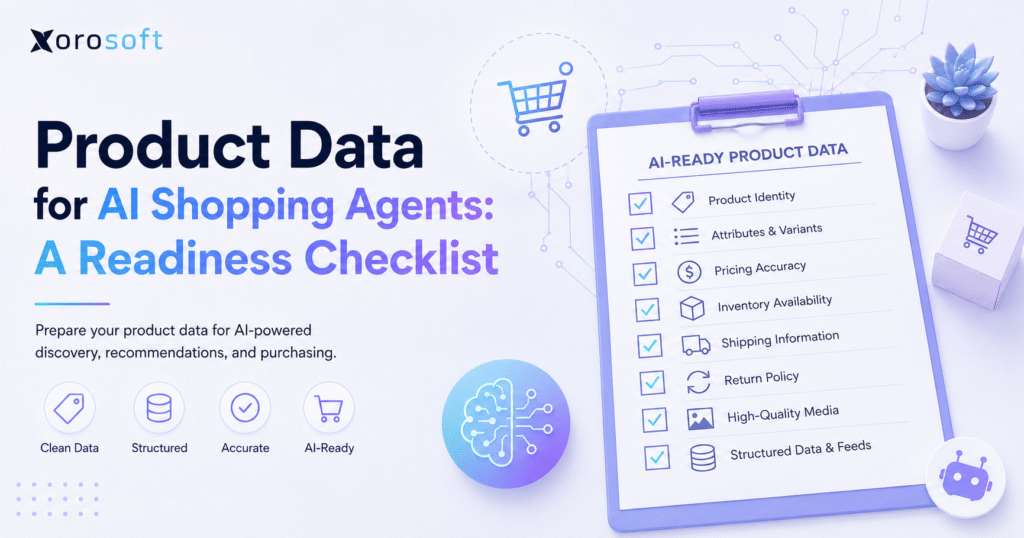
1. Build an AI-Ready Product Data Foundation Before AI Shops
AI-ready product data is becoming an important part of ecommerce operations because AI shopping agents need more than attractive product pages. Instead, they need clear product details, correct prices, current stock, useful attributes, reliable variants, shipping details, and return rules. Therefore, a product catalog must help both shoppers and software understand exactly what is being sold.
Moreover, AI shopping changes the role of product information. Traditionally, shoppers opened several product pages, compared options, checked prices, and confirmed availability themselves. However, an AI shopping agent can now perform part of that research before the shopper reaches the store.
1.1 Why AI-Ready Product Data Matters Now
As AI becomes part of product discovery, poor catalog data can create problems much earlier in the buying journey.
For example, an AI agent may identify the correct product but receive an old price. Likewise, it may recommend a size that is no longer available. In addition, two similar products may be difficult to compare because one has complete attributes while the other relies only on a marketing description.
Therefore, AI-ready product data should give shopping systems clear and current information rather than forcing them to make assumptions.
Moreover, AI shopping readiness should not be treated as a copywriting project. Instead, it requires product, inventory, pricing, warehouse, and order data to work together.
1.2 What AI Shopping Agents Need From Product Data
AI shopping agents may need to understand:
- what the product is
- who the product is for
- which variants exist
- what the product costs
- whether it is available
- where it can ship
- when it may arrive
- whether it can be returned
Therefore, product readiness includes both catalog information and operating data.
For example, OpenAI provides a structured product-feed specification for commerce experiences. Therefore, merchants exploring this area should review the official OpenAI product feed specification instead of guessing which fields may matter.
1.3 Why Clean Backend Data Matters
However, preparing AI-ready product data should not begin with another AI tool.
Instead, businesses should first review the systems that create product, price, stock, shipping, and order information.
For example, if Shopify says an item is available while the warehouse system says it is sold out, an AI integration will not solve the underlying problem. Instead, it may expose that problem to more buyers.
Therefore, AI shopping readiness begins with trustworthy source data.
Meanwhile, new agentic commerce standards are pushing merchants to think more carefully about live product and policy data. Consequently, product identity, pricing, inventory, and fulfillment data are becoming more important as shopping moves into AI-led channels.
The practical lesson is simple: AI-ready product data must be dependable before an AI shopping agent can depend on it.
2. What Makes AI-Ready Product Data Reliable?
AI-ready product data is accurate, complete, structured, current, and easy for software to understand. Therefore, it should explain both the product itself and the conditions under which the product can be purchased.
For example, useful fields may include:
- SKU
- GTIN or UPC
- brand
- product title
- category
- product type
- description
- color
- size
- material
- dimensions
- model
- compatibility
- variant relationship
- selling price
- sale price
- currency
- available stock
- product images
- shipping rules
- return rules
- product URL
However, not every category needs every field. For example, furniture businesses may care heavily about dimensions, finish, material, weight, and freight rules. Meanwhile, apparel brands may care more about size, fit, color, fabric, and variant images.
Therefore, the goal is not to fill every possible field. Instead, the goal is to maintain the information that helps shoppers and software make correct decisions.
2.1 Structured Product Data vs Marketing Copy
Marketing copy explains why someone may want a product. However, structured data explains what the product actually is.
For example:
“This lightweight performance jacket is ideal for wet trails.”
That sentence is useful for a shopper. However, software can also benefit from separate fields such as:
Material: Nylon
Water resistance: Waterproof
Gender: Men’s
Size: Medium
Color: Navy
Therefore, businesses should use both descriptive content and clear product fields.
Moreover, Google supports product markup that can describe products, offers, price, and availability. Therefore, ecommerce teams can review Google’s official Product structured data guidance when checking their product pages.
2.2 Product Identity Must Stay Stable
A product title may change over time. However, its identity should not change without a valid reason.
Therefore, businesses should maintain stable SKUs and valid product IDs where they apply.
For example, companies that use global trade identifiers should follow the relevant GS1 GTIN standards.
As a result, AI-ready product data starts with basic catalog discipline. If the same item has different identities across Shopify, ERP, warehouse, and feed systems, later automation becomes harder.
3. How AI Shopping Agents Use AI-Ready Product Data
AI shopping agents can receive a natural-language request and then use product information to narrow the choices.
For example, a shopper may ask:
“Find a black waterproof men’s jacket under $180 in medium that can arrive this week.”
Therefore, several data points may matter at the same time:
- category
- gender
- color
- weather protection
- price
- size
- inventory
- shipping
If one field is missing, the product may become harder to match correctly.
3.1 Product Discovery With Structured Product Data
First, the agent needs to understand what the product is.
Therefore, product titles, categories, descriptions, brands, and identifiers should be clear.
Moreover, product names should describe the item rather than depend only on internal model names.
3.2 Product Attributes Help AI Shopping Agents Compare
Next, product attributes help narrow the choice.
For example, dimensions matter for furniture. Likewise, compatibility matters for parts and accessories. Meanwhile, material and size often matter for apparel.
Therefore, businesses should avoid hiding important facts only inside long descriptions.
3.3 Price Helps Qualify the Product
Then, the shopping system may need to compare products within a budget.
Therefore, current pricing matters.
However, many growing businesses have several prices. For example, they may maintain retail prices, sale prices, marketplace prices, wholesale prices, and regional prices.
As a result, AI-ready product data needs clear price ownership.
3.4 Inventory Determines Whether the Choice Is Real
Finally, the right product is not useful when it cannot be sold.
Therefore, inventory availability needs to reflect what is actually available to the buyer.
Moreover, this becomes harder when a company operates several warehouses or reserves stock for different sales channels.
4. The 15-Point AI-Ready Product Data Checklist
Use this AI-ready product data checklist to review the product and operating data behind your ecommerce business.
4.1 Maintain Unique Product Identifiers
First, every sellable SKU should have a unique internal identifier.
Moreover, use GTIN, UPC, EAN, MPN, or another valid product ID when your category requires it.
However, do not reuse one SKU for unrelated products.
Ready when: each sellable item can be identified without confusion.
4.2 Write Clear Product Titles
Next, product titles should explain what the item is.
For example:
Weak: Performance 3000
Better: Men’s Waterproof Trail Jacket – Performance 3000
However, avoid filling the title with repeated keywords.
Ready when: the title still makes sense without the product image.
4.3 Complete Important Product Descriptions
In addition, descriptions should answer practical buyer questions.
For example:
- What is it?
- What does it do?
- Who is it for?
- What is included?
- What limits apply?
- What makes it different?
However, do not hide every technical fact inside one paragraph.
Ready when: both shoppers and systems can find the facts they need.
4.4 Standardize Product Attributes
Moreover, use consistent names and values for important attributes.
For example, avoid using Navy, Dark Navy, Midnight Blue, and Blue-Navy for the same color unless those labels truly describe different options.
Instead, create a controlled list.
Ready when: the same attribute follows the same naming rule across products.
4.5 Use a Clear Product Category Structure
Likewise, categories should follow a clear order.
For example:
Apparel → Men’s → Jackets → Waterproof Jackets
is easier to manage than several unrelated labels that mean nearly the same thing.
For AI-ready product data, a stable category structure is useful because shopping systems need clear signals when they compare products across a large catalog.
Ready when: every product fits into a clear type and category.
4.6 Keep Variant Relationships Clean
Variants are often one of the largest sources of product-data errors.
For example, one shirt may have five sizes and six colors. Therefore, the business may be managing 30 sellable variants.
Each variant can have its own:
- SKU
- barcode
- image
- price
- stock
- status
As a result, every child SKU should remain linked to the correct parent product.
Ready when: size, color, price, image, and stock all match the selected variant.
4.7 Keep Pricing Current
Next, check whether prices match across systems.
For example, compare:
- ERP price
- Shopify price
- Amazon price
- sale price
- wholesale price
However, do not assume every channel must have the same price. Instead, make sure differences are planned.
Ready when: each channel shows the price it is meant to show.
4.8 Define Available-to-Sell Inventory
Inventory deserves special attention because physical stock and sellable stock are not always the same.
For example:
500 units on hand
minus 100 allocated
minus 40 reserved
minus 20 damaged
minus 20 safety stock
equals 320 units available to sell.
Therefore, businesses should define which inventory number reaches ecommerce channels.
For companies with deeper inventory needs, XoroONE can bring inventory, purchasing, accounting, warehouse, manufacturing, and ecommerce activity into one system.
Ready when: everyone agrees on what “available” means.
4.9 Maintain Correct Product Images
Moreover, use images that clearly match the product and variant.
For example, a shopper selecting a red chair should not see the blue chair as the main variant image.
Therefore, check:
- main image
- variant images
- image quality
- image order
- missing images
Ready when: the image represents the actual item being offered.
4.10 Maintain Shipping Information
Next, product data should support realistic shipping choices.
For example, teams may need to maintain:
- weight
- dimensions
- handling time
- shipping class
- location
- restrictions
- estimated delivery rules
Therefore, shipping data should not be managed as an afterthought.
Ready when: delivery rules reflect the product’s real shipping needs.
4.11 Maintain Return Rules
Likewise, buyers may care about returns before they place an order.
Therefore, keep the following information current:
- return window
- final-sale status
- return fees
- product restrictions
- return method
Ready when: the stated return rule matches the real policy.
4.12 Validate Product Structured Data
In addition, product pages should expose correct machine-readable information where relevant.
Therefore, check important fields such as:
- product name
- price
- currency
- availability
- brand
- SKU
- product ID
However, structured data should describe the live page accurately.
Ready when: the markup matches the product page.
4.13 Maintain Product Feeds
Moreover, product feeds should be treated like live business data rather than a one-time setup.
Therefore, monitor:
- missing fields
- invalid values
- rejected items
- stale prices
- stale stock
- broken images
- mapping errors
Ready when: feed errors are found before buyers find them.
4.14 Define a System of Record
Every important field should have one clear owner.
For example:
SKU → ERP
Rich description → PIM or ecommerce platform
Inventory → ERP or WMS
Images → PIM or ecommerce platform
Pricing → ERP
Returns → commerce policy
Therefore, teams should avoid letting several systems independently control the same field.
For businesses that have outgrown separate tools, XoroERP can provide a central ERP layer for inventory-led business processes.
Ready when: employees know exactly where each field must be changed.
4.15 Set Data Refresh Rules
Finally, not every field needs the same update speed.
For example, a description may remain valid for months. However, stock can change within seconds.
Therefore, define update rules based on risk.
Ready when: fast-changing fields update fast enough to support real buying decisions.
5. Why AI-Ready Product Data Depends on Inventory Accuracy
AI-ready product data is only useful when inventory is dependable.
For example, imagine an AI shopping agent finds a product that matches every requirement. However, the feed says five units are available while the warehouse has already allocated all five.
As a result, the recommendation may lead to a stockout.
Therefore, inventory status should come from actual warehouse and order activity rather than occasional manual updates.
5.1 Inventory Data for AI Shopping Agents
On-hand stock tells the business what is physically present.
However, sellable stock may exclude:
- allocated inventory
- reserved inventory
- damaged inventory
- quality holds
- safety stock
Therefore, companies must decide which figure is sent to Shopify, Amazon, marketplaces, B2B portals, and AI commerce channels.
In practice, AI-ready product data is only as current as the inventory and warehouse events that feed it. Therefore, stock accuracy must be maintained at the source.
5.2 Multi-Warehouse Operations Add More Risk
Moreover, several warehouses introduce another layer of choice.
For example, 20 units may exist across the company, but only three may be in a warehouse that can meet the customer’s delivery date.
Therefore, location matters as much as total quantity.
A real-time warehouse management system can help connect receiving, putaway, picking, packing, transfers, and shipping with current stock.
6. Why AI-Ready Product Data Needs Consistent Pricing
Pricing is another core part of AI-ready product data.
Therefore, teams should document how each price is created and where it is published.
6.1 Review Every Price Type
For example, a growing brand may have:
- MSRP
- standard retail price
- promotional price
- Shopify price
- Amazon price
- wholesale price
- contract price
- regional price
However, different prices are not automatically a problem.
Instead, unexplained differences are the problem.
6.2 Set Clear Price Ownership
Therefore, ask:
- Which system owns the base price?
- Who starts a promotion?
- Who ends it?
- Can marketplaces override it?
- How quickly does a change reach Shopify?
- What happens when an update fails?
As a result, AI-ready product data receives a clear pricing process rather than a collection of manual fixes.
7. Product Feed, ERP, PIM, and Ecommerce Platform: Who Owns What?
Businesses often try to solve product-data problems by buying one more tool.
However, the better question is which system should own each job.
| Capability | ERP | PIM | Ecommerce Platform | Feed Tool |
|---|---|---|---|---|
| SKU master | Strong | Strong | Moderate | Receives |
| Rich copy | Moderate | Strong | Strong | Transforms |
| Images | Moderate | Strong | Strong | Distributes |
| Inventory | Strong | Limited | Receives | Receives |
| Purchasing | Strong | No | No | No |
| Warehouse stock | Strong | No | Limited | Receives |
| Accounting | Strong | No | Limited | No |
| Product feeds | Moderate | Moderate | Moderate | Strong |
| Channel mapping | Moderate | Moderate | Moderate | Strong |
| Manufacturing | Strong | No | No | No |
Therefore, there is no single answer for every business.
Moreover, AI-ready product data needs clear ownership across ERP, PIM, ecommerce, warehouse, and feed systems instead of allowing every application to become a separate source of truth.
7.1 How ERP Supports AI-Ready Product Data
ERP becomes more relevant when product availability depends on:
- purchasing
- warehouse activity
- sales orders
- returns
- accounting
- manufacturing
- stock transfers
Moreover, businesses using several sales channels may need those processes to share one stock and order foundation.
Xorosoft’s integrations support businesses that need ERP operations connected with ecommerce and other business systems.
7.2 When PIM Matters
Meanwhile, PIM becomes useful when the challenge is deep product-content management.
For example, a large catalog may need:
- detailed attributes
- localization
- media
- category rules
- long descriptions
- channel-specific content
Therefore, a PIM can work alongside ERP rather than replace it.
7.3 When Feed Management Matters
Likewise, feed tools become useful when many marketplaces or shopping destinations require different field names and formats.
Therefore, choose each tool based on the job it needs to perform.
8. How to Audit AI-Ready Product Data
A good AI-ready product data audit should move from the source system to the final selling channel.
Therefore, do not review only the storefront.
8.1 Map Every Product Data Source
First, list every system that stores product information.
For example:
- ERP
- Shopify
- Amazon
- spreadsheets
- PIM
- WMS
- accounting software
- feed tool
Then, map each important field to its source.
8.2 Check AI Product Data Completeness
Next, select products from every major category.
Then, check whether important fields are present.
For example:
- identifier
- title
- description
- category
- size
- color
- dimensions
- price
- stock
- image
As a result, you can measure how much of the catalog is incomplete.
8.3 Audit Product Data Accuracy
However, a field can be complete and still be wrong.
Therefore, compare system data with the physical item and actual business rules.
For example, check whether:
- dimensions are correct
- images match
- prices match
- GTINs match
- variants match
- stock is real
8.4 Check AI-Ready Product Data Freshness
Next, measure how long changes take to reach each sales channel.
For example, change inventory in the source system.
Then, record when Shopify changes.
Next, check Amazon.
Finally, check the feed.
Therefore, you can identify slow points rather than guessing.
8.5 Review Connected Ecommerce Workflows
If Shopify is a major channel, also review how products, orders, and stock move between the store and back-office systems.
For example, Xorosoft is available through the Shopify App Store, which is relevant for merchants evaluating connected ERP and Shopify operations.
8.6 Track Product Data Errors Over Time
Finally, create a simple scorecard.
Track:
- missing attributes
- invalid IDs
- wrong prices
- stock differences
- duplicate SKUs
- rejected feed items
- missing images
- failed updates
Therefore, AI-ready product data quality becomes measurable.
9. Where Product Data Usually Breaks
Even strong ecommerce teams can develop data gaps as the company grows.
Therefore, the goal should be finding weak points before they spread.
When AI-ready product data breaks, the problem often begins upstream with duplicate records, manual updates, inconsistent variants, or disconnected systems.
9.1 Spreadsheets Become Hidden Systems of Record
At first, spreadsheets are flexible.
However, problems begin when employees update spreadsheets but forget to update the main system.
As a result, the spreadsheet becomes the real source of truth without anyone formally deciding that it should.
9.2 The Same SKU Exists in Several Systems
Likewise, Shopify may contain one product name while the warehouse has another and accounting uses a third.
Therefore, product identity becomes harder to control.
9.3 Inventory Updates Too Slowly
Moreover, stock may update after a batch job rather than after each warehouse event.
As a result, products can remain available online after they have effectively sold out.
9.4 Promotions End in Only One Channel
For example, a sale may end in Shopify but remain active in another channel.
Therefore, price ownership needs both start and end rules.
9.5 Variant Names Drift
Similarly, one system may use “Large,” another “L,” and another “LG.”
Therefore, variant mapping should be standardized before the catalog becomes larger.
9.6 Too Many Disconnected Apps Create Manual Work
A common growth-stage stack may include ecommerce, accounting, warehouse apps, purchasing sheets, inventory tools, EDI software, and reporting files.
Therefore, teams can spend more time moving information than using it.
For companies at that stage, reviewing broader ERP business solutions can help determine which processes should share one data layer.
10. AI-Ready Product Data by Business Model
The required product fields vary by industry.
Therefore, AI-ready product data should reflect how customers evaluate that specific product.
10.1 Apparel and Fashion
Apparel businesses should focus on:
- size
- fit
- color
- material
- gender
- style
- season
- variant image
- variant stock
Moreover, returns are often linked to size and fit.
Therefore, clear variant data matters.
10.2 Furniture
Furniture businesses should focus on:
- dimensions
- material
- finish
- weight
- assembly
- room type
- freight class
- delivery restrictions
Moreover, stock may be spread across several warehouses.
Therefore, fulfillment data can be as important as the product description.
10.3 Sporting Goods
Sporting goods businesses may need:
- size
- activity
- material
- performance details
- technical specifications
- compatibility
- safety information
Therefore, structured attributes help shoppers and software narrow the choices.
10.4 Food and Beverage
Food businesses may need:
- ingredients
- allergens
- pack size
- storage rules
- unit size
- lot data
- expiry-sensitive handling
Moreover, stock quality can depend on dates and lots.
Therefore, product and warehouse data must work together.
10.5 Wholesale Distribution
Wholesale businesses may add:
- case packs
- price levels
- customer-specific pricing
- EDI data
- order minimums
- allocations
- lead times
Therefore, the public retail price may represent only one part of the sales model.
10.6 Manufacturing
Manufacturers may need product availability to reflect:
- bills of materials
- work orders
- raw materials
- lead times
- production plans
Therefore, an item that is not currently in finished stock may still have a future supply date.
Xorosoft supports inventory-led companies across several operating models, and its industries pages provide more context on how requirements differ by sector.
11. When a Business Needs a Stronger Product Data System
Not every company needs a full ERP, PIM, or feed platform.
Therefore, avoid buying complex software simply because AI shopping is gaining attention.
11.1 Small Businesses May Be Fine With Their Current Stack
For example, a business with:
- one warehouse
- one ecommerce store
- a small catalog
- simple purchasing
- no manufacturing
- limited wholesale
may manage AI-ready product data well inside its existing tools.
Therefore, the right answer may simply be better process control.
11.2 Complexity Is the Real Trigger
However, a stronger system becomes worth reviewing when a company has:
- several warehouses
- Shopify and Amazon
- B2B and wholesale
- EDI
- complex purchasing
- manufacturing
- frequent stock errors
- manual reconciliations
- separate warehouse software
- disconnected accounting
As a result, the business may need one place to control more of its operating data.
11.3 Review Real Results Before Changing Systems
Moreover, teams should look at implementation results rather than choosing software from feature lists alone.
Therefore, companies evaluating this shift can review relevant Xorosoft case studies to understand how other inventory-driven businesses approached ERP change.
12. Build an Operational Data Layer Behind AI Commerce
The strongest AI-ready product data strategy starts upstream.
Therefore, businesses should improve the systems that create product, stock, price, and order information before focusing only on how that data reaches an AI agent.
12.1 Create a Reliable Inventory Data Source
First, decide where available inventory is calculated.
Then, connect receiving, transfers, allocations, picking, shipping, returns, and adjustments to that source.
As a result, downstream channels receive a more dependable number.
12.2 Connect Ecommerce Channels
Next, connect Shopify, Amazon, wholesale, EDI, and other channels to the core operating system where practical.
Therefore, teams can reduce repeated manual entry.
12.3 Connect Purchasing
Moreover, purchase orders influence future supply.
Therefore, buyers should be able to see:
- current stock
- open orders
- supplier lead times
- demand
- expected receipts
before placing new orders.
12.4 Connect Accounting
Likewise, inventory activity affects financial results.
Therefore, sales, purchases, adjustments, returns, COGS, and inventory value should not live in separate systems without a clear link.
12.5 Prepare Data for Approved AI Workflows
AI tools may eventually request access to more business context.
Therefore, companies should think carefully about permissions, approved data, and which systems an AI service can read.
For example, Xorosoft’s AI MCP Server shows one approach to connecting approved AI workflows with ERP data while keeping the operating system as the main data source.
13. A Practical AI-Ready Product Data Scorecard
The final test of AI-ready product data is whether the information stays accurate from the source system through the ecommerce channel and into the product feed.
Therefore, use this scorecard to review your current position.
Give one point for every statement that is true.
- Every sellable SKU has one unique identifier.
- GTINs or other standard IDs are correct where required.
- Product titles clearly describe the item.
- Important product attributes are complete.
- Categories follow clear rules.
- Variants use consistent names.
- Variant images match the selected product.
- Prices are correct by channel.
- Sellable inventory has a clear definition.
- Stock updates fast enough across channels.
- Shipping information is current.
- Return information is current.
- Product structured data matches the page.
- Product feeds are checked for errors.
- Every important field has one system of record.
13.1 Score 0–5: Major Data Gaps
First, fix identity, inventory, pricing, and basic catalog quality.
Therefore, avoid adding more channels until the core data becomes more reliable.
13.2 Score 6–10: Partly Ready
Your foundation works, but several weak points remain.
Therefore, focus on data ownership and update speed.
13.3 Score 11–13: Strong Foundation
Most core data is under control.
Therefore, the next step is stronger feed testing, monitoring, and channel mapping.
13.4 Score 14–15: Highly Prepared
Your AI-ready product data process appears mature.
However, continue testing because pricing, inventory, products, and channel rules change over time.
This scorecard is a practical editorial tool rather than an official certification from an AI platform.
14. Common AI-Ready Product Data Mistakes to Avoid
Preparing AI-ready product data is easier when teams avoid a few common errors.
14.1 Treating AI Readiness as a Copywriting Project
Good descriptions help.
However, they cannot fix the wrong price or stock level.
Therefore, include operations, inventory, and ecommerce teams in the project.
14.2 Trying to Optimize Every Field at Once
Large catalogs can contain thousands of products.
Therefore, begin with top-selling products and high-value categories.
Then, expand the process once the rules are working.
14.3 Letting Every Channel Become a Master System
Shopify, Amazon, ERP, PIM, WMS, and spreadsheets may all hold product information.
However, they should not all control the same field.
Therefore, document ownership.
14.4 Adding New AI Tools Before Fixing Old Data
New AI software may make existing problems more visible.
Therefore, correct AI-ready product data at the source before adding another layer.
14.5 Ignoring Warehouse Events
A product feed can be technically correct while inventory remains wrong.
Therefore, receiving, transfers, picks, returns, and adjustments must update stock properly.
15. FAQs About AI-Ready Product Data
15.1 What Is AI-Ready Product Data?
AI-ready product data is product information that is accurate, complete, structured, current, and easy for software to understand. Therefore, it should cover more than descriptions. For example, useful fields can include identifiers, attributes, variants, price, stock, images, shipping, and returns.
15.2 What Are AI Shopping Agents?
AI shopping agents are AI systems that help people research, compare, filter, and evaluate products. In addition, some systems can support steps closer to a purchase. Therefore, product information may need to support both discovery and real buying conditions.
15.3 Why Does Product Data Matter for AI Shopping?
Product data gives software the facts needed to understand each product. Therefore, missing or wrong information can reduce the quality of a match. For example, a jacket may match the search but still be unsuitable because the requested size is unavailable.
15.4 What Product Data Do AI Shopping Agents Need?
The exact fields depend on the product and platform. However, common fields include SKU, product identifiers, category, title, description, attributes, variants, price, availability, images, shipping, and returns. Therefore, start with the fields that affect buying decisions.
15.5 Does Structured Product Data Help AI Shopping?
Structured data gives software clear values rather than forcing it to read every fact from prose. Therefore, it can help systems understand product identity, price, stock, and related details. However, structured markup should work alongside accurate source data.
15.6 Do AI Shopping Agents Use Product Feeds?
Product feeds are one way commerce platforms can receive structured catalog information. Therefore, feed quality matters. Moreover, businesses should monitor feed errors, stale prices, missing images, and stock differences rather than treating a feed as a one-time setup.
15.7 How Often Should Product Feeds Update?
Update speed should match how quickly the information changes. For example, descriptions may change rarely, while stock can change every minute. Therefore, businesses should update price and inventory more often than static product content.
15.8 Why Is Inventory Accuracy Important for AI Shopping?
Inventory tells the shopping system whether a recommendation can actually be purchased. Therefore, stale stock can lead to poor buying experiences. Moreover, multi-warehouse companies should consider where the stock is located, not only the total quantity.
15.9 What Is Available-to-Sell Inventory?
Available-to-sell inventory is the quantity the company is willing and able to offer for new orders. Therefore, it may be lower than physical stock. For example, reserved, allocated, damaged, or protected safety stock may need to be excluded.
15.10 Why Do Product Variants Create Problems?
Variants can have separate SKUs, images, prices, and stock. Therefore, one wrong mapping can show the wrong product detail. For example, a buyer may select medium while the system displays inventory for large.
15.11 Should Every Product Have a GTIN?
Not every product situation is identical. However, many standard retail products use GTINs or related global identifiers. Therefore, businesses should follow relevant marketplace, category, and GS1 rules rather than creating false identifiers.
15.12 What Is the Difference Between ERP and PIM?
ERP mainly manages operating processes such as inventory, purchasing, orders, accounting, warehouse work, and manufacturing. Meanwhile, PIM focuses more heavily on product content, attributes, taxonomy, media, and enrichment. Therefore, larger businesses may use both.
15.13 Does Every Ecommerce Company Need a PIM?
No. For example, a small catalog may be easy to manage inside Shopify or another ecommerce platform. However, PIM becomes more useful when the company has many SKUs, attributes, languages, markets, or content teams.
15.14 Can ERP Support AI-Ready Product Data?
Yes. ERP can support the operating side of AI-ready product data, especially SKU identity, inventory, pricing, purchasing, orders, warehouse activity, and manufacturing. However, ERP may still work alongside ecommerce, PIM, or feed tools.
15.15 Can Shopify Merchants Prepare for AI Shopping?
Yes. First, improve titles, variants, attributes, price, stock, images, shipping, and return information. Then, review how Shopify receives updates from back-office systems. As a result, the store becomes less dependent on manual fixes.
15.16 What Is Agentic Commerce?
Agentic commerce refers to shopping workflows in which AI agents help carry out parts of the buying process. Therefore, the role of data extends beyond search visibility. Instead, product information may also support comparison, selection, and buying actions.
15.17 What Is Universal Commerce Protocol?
Universal Commerce Protocol is an open standard designed for agentic commerce. Therefore, it is relevant to businesses planning for AI-led buying flows. However, merchants should always review the current official requirements before making technical changes.
15.18 What Is Agentic Commerce Protocol?
Agentic Commerce Protocol is associated with agent-based commerce workflows. Therefore, merchants interested in this area should follow current platform documentation. Moreover, they should keep the core product catalog clean regardless of which standard becomes relevant.
15.19 Should Businesses Prepare for Only One AI Shopping Platform?
Usually, no. Different platforms may require different formats. Therefore, businesses should first build dependable source data. Then, they can map that information to each destination without rebuilding the catalog every time.
15.20 What Makes a Product Catalog Machine-Readable?
A machine-readable catalog uses clear fields, stable IDs, predictable values, and consistent structures. Therefore, important facts such as size, price, stock, and material should not depend only on free-form descriptions.
15.21 How Do You Audit Product Data Quality?
First, list every source system. Next, sample products from each category. Then, check completeness, accuracy, consistency, and update speed. Finally, track errors over time so the business can see whether quality is improving.
15.22 Which Product Fields Should Be Fixed First?
Start with fields that can directly break a purchase. Therefore, prioritize SKU identity, variant mapping, price, inventory, product title, and key attributes. Then, improve descriptions, images, taxonomy, and supporting information.
15.23 When Should a Business Stop Using Spreadsheets for Product Data?
Spreadsheets become risky when many people, warehouses, channels, and product records depend on them. Therefore, consider a stronger system when manual changes create frequent mismatches or delays. However, a small controlled spreadsheet is not automatically a problem.
15.24 How Do Wholesale Businesses Prepare Product Data for AI?
Wholesale companies should maintain product identity, case packs, units, price levels, allocations, stock, lead time, and customer-specific rules where needed. Therefore, their data model may be more complex than a standard retail catalog.
15.25 How Do Manufacturers Prepare Product Data for AI Shopping?
Manufacturers should maintain finished-goods data while also keeping production and material information accurate. Therefore, product availability may depend on raw materials, BOMs, work orders, and lead times rather than finished stock alone.
15.26 Can Product Descriptions Alone Make a Catalog AI-Ready?
No. Descriptions are useful, but they represent only one part of AI-ready product data. Therefore, the business must also maintain identity, attributes, pricing, inventory, variants, images, shipping information, and buying terms.
15.27 What Is the Biggest AI Shopping Data Mistake?
One major mistake is treating AI shopping as a front-end project. However, many failures begin in back-office data. Therefore, companies should fix product, inventory, pricing, and order processes before adding more automation.
15.28 Who Does Not Need an ERP Yet?
A small company with one store, one warehouse, simple purchasing, and limited inventory may not need ERP. Therefore, improving the current ecommerce setup may be enough. However, the decision should be reviewed as operating complexity grows.
15.29 How Should Multi-Warehouse Companies Prepare?
First, define stock by location. Next, separate physical stock from available stock. Then, connect transfers, reservations, picks, and shipments to the inventory source. As a result, channels can receive a more accurate availability figure.
15.30 What Should an Ecommerce Business Do First?
Start with a sample of the company’s most important products. Then, check identifiers, titles, variants, attributes, price, stock, shipping, and returns. Finally, trace each field back to its source and fix the source instead of repeatedly correcting the storefront.
16. Make AI-Ready Product Data Trustworthy Before the Agent Sees It
AI-ready product data will matter more as customers use AI systems to find, compare, and evaluate products. However, the basic requirement remains unchanged: buyers need correct information.
Therefore, the strongest AI strategy begins with trustworthy product and operating data.
First, clean product identity.
Next, standardize attributes and variants.
Then, improve price and inventory accuracy.
Moreover, connect warehouse, purchasing, ecommerce, and accounting activity when disconnected systems are causing errors.
Finally, publish clean information into product pages, feeds, marketplaces, and AI commerce channels.
For smaller companies, better process control may be enough. However, growing inventory-driven businesses may eventually need a broader system to keep product, inventory, orders, purchasing, warehouse work, and finance aligned.
Xorosoft is built for that type of environment, with cloud ERP, WMS, ecommerce, purchasing, accounting, manufacturing, forecasting, EDI, and multi-channel order workflows in one operating platform.
Therefore, the goal should not be to add AI simply because AI is popular. Instead, the goal is to create AI-ready product data that people, ecommerce systems, and shopping agents can trust.
If disconnected inventory, Shopify, warehouse, purchasing, or accounting data is becoming difficult to manage, Book a Demo to see how Xorosoft can bring those operations into one connected system.
Recent Posts
-
 ERP Landed Cost Module vs Spreadsheet Calculations for Importers
 -
 How to Build an Open-to-Buy Plan for an Omnichannel Brand
 -
 Cold Storage WMS for Food and Beverage Distribution
 -
 ERP Buying Statistics 2026: Evaluation, Implementation, and Adoption Risks
 -
 How a Distributor Reduced B2B Order Exceptions Without Restricting Sales