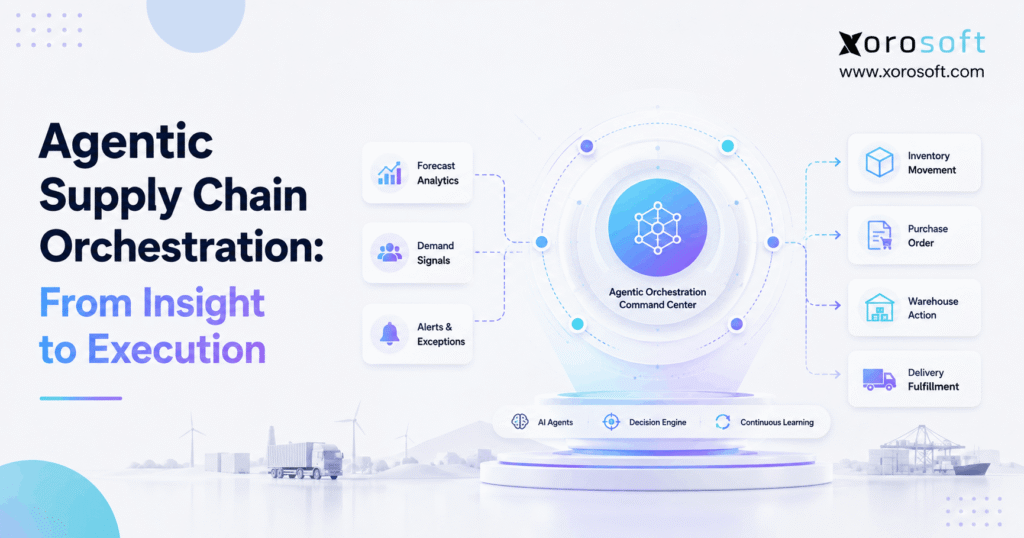
Agentic supply chain orchestration is transforming the way businesses manage complex logistics and streamline operations.
1. When Agentic Supply Chain Orchestration Moves Beyond Insight
Agentic supply chain orchestration changes the role of AI from simply finding problems to helping businesses decide what should happen next. For years, supply chain teams have invested in dashboards, forecasts, alerts, and reports. However, an alert alone does not move inventory, create a purchase order, change a warehouse task, or protect a customer order.
Instead, people still connect the pieces.
For example, a planner may see that a product could stock out next week. However, the planner must then check inventory at other warehouses, review open purchase orders, study supplier lead times, confirm demand, speak with purchasing, and choose a response.
As a result, the company may have strong insight but slow action.
Therefore, agentic supply chain orchestration focuses on closing the gap between identifying an issue and resolving it. Rather than producing another dashboard, the system can help move from signal to decision to controlled execution.
Moreover, Gartner forecasts that spending on supply chain management software with agentic AI capabilities will grow from less than $2 billion in 2025 to $53 billion by 2030. Gartner also expects adoption among enterprises using SCM software to rise sharply by 2030.
1.1 Why Agentic Supply Chain Decisions Move Too Slowly
Supply chains change every hour. Meanwhile, many planning processes still run daily, weekly, or monthly.
For example, demand may rise after a promotion. At the same time, a supplier may miss a shipment. In addition, one warehouse may have excess stock while another location approaches a stockout.
Therefore, if teams review these events separately, decisions become slow.
Traditional systems often identify each problem correctly. However, employees still need to connect the facts before they can act.
As a result, agentic AI in supply chain operations is increasingly focused on reducing decision delay.
1.2 Why Supply Chain AI Needs More Than Alerts
More alerts do not always improve control.
For example, a planner may receive warnings about:
- low inventory
- delayed purchase orders
- warehouse shortages
- unusual demand
- late customer orders
- supplier delays
- inventory imbalances
However, each alert may show only one part of the problem.
Consequently, employees still have to determine which alert matters most and what should happen next.
Therefore, AI supply chain orchestration adds context, rules, tools, and execution to the alert itself.
2. What Is Agentic Supply Chain Orchestration?
Agentic supply chain orchestration is the use of AI agents to monitor supply chain conditions, assess options, coordinate decisions, and carry out approved actions across connected business systems.
In other words, the system does more than explain what is happening.
Instead, it can help answer:
- What changed?
- Why does it matter?
- Which orders are at risk?
- What options are available?
- Which option fits our business rules?
- Can the system act?
- Does a person need to approve the action?
- Did the action solve the problem?
Therefore, agentic supply chain orchestration connects insight with execution.
IBM describes supply chain AI agents as systems that continuously sense, evaluate, and respond rather than relying only on fixed planning cycles. Moreover, IBM reports that 62% of supply chain leaders recognize that AI agents embedded in workflows can speed up action.
2.1 What Makes Supply Chain AI Agents Different?
Traditional software normally waits for a person or rule to tell it what to do.
By contrast, supply chain AI agents can work toward a defined goal.
For example, a goal might be:
“Keep this SKU above the required service level without creating excess inventory.”
The agent can then review the data that affects that goal.
Therefore, it may consider:
- current stock
- allocated stock
- incoming inventory
- recent demand
- supplier lead times
- reorder rules
- warehouse availability
- transfer costs
- purchase costs
Afterward, the agent can suggest or carry out an approved next step.
2.2 Agentic AI vs Generative AI in Supply Chains
Generative AI mainly creates, summarizes, or explains information.
For example, it may summarize a demand report or explain why a SKU is selling faster than expected.
Agentic AI goes further.
Instead, it can use tools, follow rules, take several steps, and work toward a defined goal.
Therefore, generative AI may tell a planner that Dallas will run out of a product.
By contrast, an agentic supply chain workflow could check another warehouse, review incoming purchase orders, compare transfer time, prepare a transfer, and monitor the result.
2.3 Agentic AI vs Predictive Supply Chain AI
Predictive AI mainly answers:
“What is likely to happen?”
By contrast, agentic supply chain orchestration focuses on another question:
“What should we do about it?”
However, these technologies work well together.
For example, a forecasting model may predict a shortage. Then, an agent can use that forecast when evaluating inventory transfers, purchases, or production changes.
3. How Agentic Supply Chain Orchestration Works
A practical agentic supply chain orchestration model has five stages:
Sense → Analyze → Decide → Act → Verify
Therefore, each stage should connect to the next.
3.1 How Supply Chain AI Agents Sense Change
First, the system watches relevant signals.
These may include:
- customer orders
- inventory
- demand
- supplier dates
- purchase orders
- warehouse capacity
- production status
- shipment events
- returns
- ecommerce activity
For example, the system may notice that demand for one SKU has risen sharply.
However, it should not react to that number alone.
Instead, supply chain AI agents need additional context before deciding what the change means.
3.2 How Agentic AI Analyzes Supply Chain Risk
Next, the agent studies the effect of the signal.
For example, higher sales may not create a shortage if a large purchase order arrives tomorrow.
On the other hand, even a small demand increase may matter if the supplier has a six-week lead time.
Therefore, agentic AI in supply chain operations should compare several data points before suggesting action.
3.3 How Agentic Supply Chain AI Makes Decisions
Next, the agent can compare possible responses.
For example, it may consider:
- doing nothing
- transferring inventory
- placing a new order
- speeding up an open order
- changing order allocation
- using another supplier
- changing production priority
However, the best answer depends on the business goal.
Therefore, agentic supply chain orchestration may need to balance service level, cost, cash, margin, warehouse capacity, and customer priority.
3.4 How AI Supply Chain Orchestration Executes Actions
After a decision is made, the system can take action if it has permission.
For example, AI supply chain orchestration may:
- prepare a purchase order
- submit an approved PO
- create a warehouse transfer
- reserve inventory
- change task priority
- generate a report
- send an exception to a manager
However, high-risk decisions should still have tighter controls.
3.5 How Agentic AI Verifies the Result
Finally, the system should check whether the action worked.
For example, creating a warehouse transfer is not the true goal.
Instead, the goal may be to prevent a stockout.
Therefore, agentic supply chain orchestration should continue to watch availability after the transfer is created.
As a result, the workflow becomes a closed loop rather than a one-time action.
4. Technology Behind Agentic Supply Chain Orchestration
Agentic supply chain orchestration cannot operate well without a reliable view of the business.
Therefore, the technology base matters just as much as the AI layer.
4.1 ERP Data for Agentic Supply Chain AI
ERP systems hold many of the records that agents need.
For example:
- items
- customer orders
- suppliers
- inventory
- purchase orders
- costs
- invoices
- work orders
- warehouse movements
Therefore, ERP can provide important operating context.
However, the data must be current and accurate.
4.2 WMS Data for Supply Chain AI Agents
A warehouse management system adds the physical execution layer.
For example, the WMS may manage:
- receiving
- putaway
- replenishment
- picking
- packing
- shipping
- warehouse transfers
- barcode scans
Consequently, supply chain AI agents that change inventory plans should also understand what the warehouse can execute.
4.3 Ecommerce Data for AI Supply Chain Orchestration
Ecommerce adds another stream of fast-moving events.
For example, Shopify or marketplace orders can change stock availability throughout the day.
Therefore, AI supply chain orchestration should work with current channel demand rather than yesterday’s report.
4.4 APIs and Agentic AI Connections
AI needs a controlled method for reading data and calling approved functions.
Therefore, APIs, integration tools, and standards such as Model Context Protocol can form part of the architecture.
However, connectivity alone is not enough.
Instead, strong agentic supply chain orchestration also requires permissions, identity controls, limits, and audit logs.
5. ERP Foundations for Agentic Supply Chain Orchestration
For inventory-driven businesses, the first step toward agentic supply chain orchestration is often improving the operating data underneath the AI.
For example, XoroONE combines inventory, purchasing, warehouse management, accounting, manufacturing, ecommerce, and reporting within one cloud ERP environment.
Therefore, teams can work with shared operating data instead of joining several spreadsheets and applications after a problem occurs.
5.1 Why Agentic AI Needs Accurate Inventory
An AI agent can only make a useful inventory decision if the inventory number is reliable.
For example, assume the ERP reports 500 available units.
However, the warehouse physically has only 320.
In that case, even a smart agentic supply chain system can make the wrong decision.
Therefore, inventory accuracy should improve before AI receives more authority.
5.2 Connecting Purchasing With Supply Chain AI
Inventory and purchasing cannot be treated as separate problems.
For example, a shortage may look serious until the system sees a PO arriving tomorrow.
Likewise, excess inventory may grow if purchasing orders more stock without seeing inventory at another warehouse.
Therefore, agentic AI in supply chain purchasing should understand both current supply and expected demand.
5.3 Connecting WMS Execution With Agentic AI
A plan only creates value when a warehouse can execute it.
For example, an agent may recommend moving 500 units between locations.
However, the sending warehouse may already be at full picking capacity.
Therefore, agentic supply chain orchestration should consider warehouse workload before adding new tasks.
For companies that need a dedicated warehouse execution layer, XoroWMS supports inventory tracking, receiving, order management, and fulfillment workflows.
6. Agentic Supply Chain Orchestration Use Cases
The strongest agentic supply chain orchestration use cases usually involve frequent decisions that require information from several functions.
However, businesses should start with clear and controlled workflows.
6.1 Agentic AI for Demand Planning
First, agents can monitor actual demand against the plan.
For example, if sales rise faster than expected, the agent can identify which SKUs need attention.
Then, instead of stopping at the forecast, agentic AI in supply chain planning can connect the demand signal to inventory and purchasing.
Therefore, planning becomes more closely tied to action.
6.2 Agentic AI for Inventory Replenishment
Replenishment is a strong use case because many rules are already clear.
For example, an agent can review:
- available inventory
- recent demand
- incoming supply
- safety stock
- lead time
- supplier limits
Then, it can calculate the gap.
Therefore, agentic supply chain orchestration can prepare a purchase request or trigger an approved reorder.
6.3 Agentic AI for Multi-Warehouse Inventory
A shortage does not always require a new purchase.
For example, one warehouse may have excess stock while another approaches zero.
Therefore, AI supply chain orchestration can compare transfer time with supplier lead time.
As a result, existing inventory may solve the problem faster.
Xorosoft’s broader ERP solutions connect inventory with purchasing, warehousing, manufacturing, accounting, ecommerce, and fulfillment workflows.
6.4 Supply Chain AI Agents for Purchasing
Agents can also support buyers.
For example, supply chain AI agents can identify:
- overdue POs
- late suppliers
- price changes
- upcoming shortages
- unusual quantities
- lead-time changes
Therefore, buyers can spend more time on meaningful exceptions instead of checking every order manually.
6.5 Supply Chain AI Agents for Warehouse Tasks
Warehouse managers often have competing priorities.
For example, teams may need to receive inbound stock, refill pick locations, process rush orders, and ship normal orders at the same time.
Therefore, agentic supply chain orchestration can help rank work based on customer need, stock risk, and capacity.
6.6 Agentic AI for Order Fulfillment
An agent can also help choose which location should ship an order.
For example, it may compare:
- available inventory
- delivery time
- freight cost
- warehouse workload
- future demand
Consequently, agentic supply chain execution can respond to current conditions instead of relying only on fixed routing rules.
6.7 Agentic AI for Supply Chain Disruptions
Supplier delays are another strong use case.
For example, a delayed component may affect several finished products.
Therefore, agentic supply chain orchestration can identify affected orders, check alternate supply, review inventory at other sites, and prepare response options.
7. Agentic Supply Chain Orchestration Stockout Example
Consider a company with three warehouses.
A popular SKU suddenly sells much faster than planned.
This example shows why agentic supply chain orchestration is different from a simple low-stock alert.
7.1 The Demand Agent Detects the Risk
First, the demand agent sees that sales are 35% above the recent run rate.
Therefore, it updates the short-term risk view.
7.2 The Inventory Agent Checks Every Location
Next, it finds:
- Warehouse A: 700 units
- Warehouse B: 90 units
- Warehouse C: 260 units
Warehouse B may run out in four days.
However, the company still has enough total stock.
7.3 The Purchasing Agent Checks Incoming Supply
Meanwhile, another agent reviews open purchase orders.
The next supplier shipment will not arrive for nine days.
Therefore, a new purchase will not solve the immediate problem.
7.4 AI Supply Chain Orchestration Compares a Transfer
Next, the system checks whether 200 units can move from Warehouse A to Warehouse B within two days.
Because the transfer is faster, AI supply chain orchestration identifies it as the stronger short-term option.
7.5 Business Rules Control the Action
However, the agent should not have unlimited power.
For example, the business may allow transfers below a set value to run automatically.
Therefore, a larger move would still require approval.
7.6 Agentic AI Verifies the Result
Finally, the agent tracks the transfer.
Then, it checks whether Warehouse B’s stockout risk falls.
Therefore, agentic supply chain orchestration closes the loop rather than stopping after the recommendation.
8. Multi-Agent Supply Chain Orchestration
One AI agent does not need to handle every supply chain task.
Instead, multi-agent supply chain orchestration can use several focused agents.
| Agent | Main Goal | Example Action |
|---|---|---|
| Demand Agent | Detect demand changes | Flag a forecast shift |
| Inventory Agent | Protect availability | Suggest a transfer |
| Purchasing Agent | Secure supply | Prepare a PO |
| Warehouse Agent | Manage execution | Change task priority |
| Fulfillment Agent | Protect orders | Select a ship location |
| Finance Agent | Control spend | Check approval limits |
8.1 Why Supply Chain AI Agents Need to Coordinate
Each agent may have a different goal.
For example, purchasing may want a larger order because the unit price is lower.
However, finance may want to protect cash.
At the same time, the warehouse may have no room for more inventory.
Therefore, supply chain AI agents should not make major cross-functional decisions in isolation.
Instead, agentic supply chain orchestration should compare the trade-offs.
8.2 Why One Business Goal Matters
Agents should not improve only their own KPI.
For example, an inventory agent could reduce stockouts by buying far too much stock.
However, that choice could damage cash flow.
Therefore, multi-agent supply chain orchestration needs shared goals such as:
- customer service
- working capital
- margin
- fulfillment speed
- inventory turns
- customer priority
9. Agentic Supply Chain Orchestration for Ecommerce
Ecommerce creates fast operating changes.
Therefore, it is a natural environment for agentic supply chain orchestration.
9.1 Shopify Inventory and Order Signals
For example, a Shopify promotion can change demand across dozens of products within hours.
If inventory data is slow, overselling can follow.
Therefore, ecommerce orders, inventory, purchasing, and warehouse activity should stay connected.
Xorosoft’s Shopify App Store listing describes Shopify order sync, inventory sync, fulfillment activity, products, and payments.
As a result, channel activity can become part of wider agentic supply chain decisions.
9.2 Multi-Channel Order Management
Many brands sell through more than one channel.
For example, they may receive orders from:
- Shopify
- Amazon
- wholesale customers
- retail EDI
- B2B portals
Therefore, AI supply chain orchestration should not make an inventory decision using only one channel.
Xorosoft’s integrations can help connect commerce and operational systems where businesses use multiple platforms.
9.3 Ecommerce Exception Management
Agents can also support daily exceptions.
For example:
- Which orders may ship late?
- Which products may oversell?
- Which warehouse should fulfill an order?
- Which SKUs need replenishment first?
As a result, agentic AI in supply chain operations can help teams focus on the exceptions that need human judgment.
10. Agentic Supply Chain Orchestration for Wholesale
Wholesale operations create different rules.
For example, companies may manage:
- EDI orders
- customer-specific pricing
- case quantities
- customer allocations
- credit terms
- retailer requirements
- large purchase orders
Therefore, agentic supply chain orchestration needs commercial context as well as inventory data.
10.1 Supply Chain AI Agents for EDI Exceptions
For example, an EDI order may request more inventory than the company has available.
However, cancelling the order may not be the best response.
Instead, supply chain AI agents can check:
- incoming stock
- customer priority
- alternate warehouses
- allocation rules
- supplier dates
Therefore, the system can prepare a better response for the operator.
10.2 Agentic AI for Wholesale Inventory Allocation
Wholesale inventory is often limited.
Therefore, agentic AI in supply chain allocation can help apply customer rules more consistently.
For example, the system may protect stock for a key account while filling smaller orders from another warehouse.
10.3 Agentic Supply Chain Purchasing for Wholesale Demand
Large wholesale orders can create sudden purchase needs.
Therefore, connected purchasing data becomes important.
XoroERP connects procurement, warehousing, accounting, reporting, manufacturing, and other business functions.
Consequently, the ERP can provide a broader transaction base for agentic supply chain orchestration.
11. Agentic Supply Chain Orchestration for Manufacturing
Manufacturing adds more links to the decision chain.
For example, a finished product may depend on many parts, work orders, workers, and machines.
Therefore, agentic supply chain orchestration can become useful when one shortage affects several business functions.
11.1 Agentic AI for Material Shortages
First, an agent can compare the production plan with available components.
Then, it can flag shortages before work begins.
Therefore, agentic AI in supply chain manufacturing can help teams respond sooner.
11.2 Supply Chain AI Agents for Production Impact
However, a shortage should not stop at a material alert.
Instead, supply chain AI agents should ask:
- Which work orders are affected?
- Which customer orders depend on them?
- Is another component available?
- Can stock move from another site?
- Can production move?
- Can another supplier deliver sooner?
Therefore, the shortage becomes a business-impact question rather than only a material issue.
11.3 Purchasing and Production Coordination
Purchasing may find a faster supplier.
However, the new material may cost more.
Therefore, finance and production rules may also need to be checked.
As a result, manufacturing is a strong example of why AI supply chain orchestration matters.
Businesses can also review Xorosoft’s industries to see how connected ERP workflows apply across inventory-driven sectors.
12. Connecting Agentic Supply Chain AI to ERP Data
Agentic AI becomes more useful when it can safely work with current business data.
For Xorosoft users, the Xorosoft AI MCP Server provides a permission-aware connection between authorized ERP information and compatible AI systems.
Moreover, Xorosoft states that, with the correct permissions, AI can assist with creating purchase orders, allocating inventory, triggering replenishment, producing reports, assigning tasks, and recommending next steps.
Therefore, this type of controlled connection can form part of agentic supply chain orchestration.
12.1 Why Permission-Aware Agentic AI Matters
AI should not have unrestricted access to ERP information.
Instead, users and systems should only access what their roles allow.
Therefore, agentic supply chain orchestration should respect existing business permissions.
12.2 Why Audit Logs Matter
Businesses also need to know:
- what the AI requested
- which data it used
- what action it took
- who approved the action
- when the change occurred
Therefore, auditability should be built into AI supply chain orchestration from the start.
12.3 Why AI Should Not Replace Core Controls
AI may make work faster.
However, it should not remove financial or operating controls.
Therefore, approval limits, supplier rules, user roles, and transaction controls should remain in place.
13. Governance for Agentic Supply Chain Orchestration
Giving AI permission to act creates more risk than asking AI to summarize a report.
Therefore, governance is essential for agentic supply chain orchestration.
13.1 Use Different Levels of Agentic AI Control
A simple model is:
| Risk Level | AI Role | Human Role |
| Low | Act automatically | Monitor |
| Medium | Act inside limits | Review exceptions |
| High | Recommend | Approve |
| Strategic | Analyze options | Decide |
Therefore, not every action needs the same approval process.
13.2 Set Financial Limits
For example, an agent might create purchase orders up to an approved value.
However, anything above that limit can require a buyer or manager.
Therefore, agentic supply chain execution can gain speed without removing financial control.
13.3 Limit Supplier Changes
Switching suppliers can affect price, quality, compliance, and business relationships.
Therefore, an agent may recommend a supplier change without making it automatically.
13.4 Protect Customer Commitments
Likewise, changing promised dates or allocations can affect customers.
Therefore, these actions may require extra rules.
13.5 Keep a Human Override Path
Finally, people need a clear method for stopping, reversing, or changing an automated action.
Therefore, strong agentic supply chain orchestration keeps humans in control of high-risk outcomes.
14. Human Oversight in Agentic Supply Chain Execution
Autonomy does not need to be all or nothing.
Instead, businesses can introduce agentic supply chain execution in stages.
14.1 Level 1: AI Recommendation
First, the agent finds the problem and suggests a response.
However, a person still completes the action.
14.2 Level 2: AI Prepares the Transaction
Next, the agent can prepare a transfer, PO, or warehouse task.
Then, a person approves it.
Therefore, manual work falls while control remains strong.
14.3 Level 3: AI Acts Within Limits
Later, low-risk actions may run automatically.
For example, routine replenishment below a fixed amount may not need a buyer every time.
Therefore, agentic supply chain orchestration can remove repeat work without giving AI unlimited authority.
14.4 Level 4: Multi-Step AI Execution
Finally, several agents may work together on a routine exception.
However, strategic decisions can remain with people.
Therefore, mature agentic supply chain orchestration is usually a mix of software automation and human judgment.
15. Preparing for Agentic Supply Chain Orchestration
Many businesses want advanced AI before fixing basic data problems.
However, that order creates risk.
Therefore, preparation for agentic supply chain orchestration should start with the operating foundation.
15.1 Improve Inventory Accuracy
First, make sure system inventory matches physical inventory.
Otherwise, the agent begins with incorrect facts.
15.2 Connect Core Workflows
Next, connect inventory, purchasing, orders, warehouse activity, finance, and production where needed.
Therefore, teams and supply chain AI agents can work from the same data.
15.3 Reduce Spreadsheet Handoffs
Spreadsheets may still help analysis.
However, they should not be the only place where key operating rules live.
Therefore, important workflows should move into controlled systems.
15.4 Define Business Rules
Document rules such as:
- reorder limits
- approval levels
- preferred suppliers
- warehouse transfer limits
- customer priority
- minimum margin
- safety stock
Consequently, agentic supply chain orchestration has clear operating boundaries.
15.5 Start With One Narrow Use Case
Do not begin with “run the whole supply chain.”
Instead, choose one measurable process.
For example:
“Review low-stock SKUs and prepare replenishment recommendations.”
Therefore, results can be measured more easily.
15.6 Expand Agentic AI Only After Results Improve
McKinsey’s 2025 supply chain research found that many organizations were planning, designing, or testing AI use cases, while only a smaller share had deployed AI tools at scale.
Therefore, most organizations are still building AI maturity rather than operating fully autonomous supply chains.
As a result, agentic supply chain orchestration should usually expand in controlled stages.
16. Who Needs Agentic Supply Chain Orchestration?
Agentic supply chain orchestration becomes more valuable as operating complexity grows.
16.1 Multi-Warehouse Businesses
If inventory sits across several locations, teams must make more transfer, allocation, and replenishment decisions.
Therefore, multi-warehouse operations are a strong fit for AI supply chain orchestration.
16.2 High-SKU Businesses
Likewise, thousands of SKUs create too many small decisions for planners to review manually.
Therefore, supply chain AI agents can help rank exceptions.
16.3 Ecommerce Brands
Ecommerce demand changes quickly.
In addition, several channels may compete for the same stock.
Therefore, agentic AI in supply chain operations can help teams respond faster.
16.4 Wholesale Distributors
Wholesale teams manage customer rules, EDI, purchasing, and allocations.
Therefore, agentic supply chain orchestration can help connect decisions across departments.
16.5 Manufacturers
Manufacturers must connect materials, production, inventory, purchasing, and customer demand.
As a result, agentic supply chain orchestration can help show the wider effect of a shortage.
17. Who Is Not Ready for Agentic Supply Chain AI?
Not every company needs advanced agentic supply chain AI today.
17.1 Businesses With Simple Operations
A business with one warehouse, a small catalog, and stable demand may not need complex orchestration.
Instead, standard ERP automation may solve most problems.
17.2 Businesses With Poor Data
If inventory records are unreliable, adding agents will not fix the root problem.
Therefore, data quality should come first.
17.3 Businesses With Unclear Processes
Likewise, companies should not automate a workflow nobody can explain.
Instead, define the process first.
Then, automate the parts that are clear.
Therefore, agentic supply chain orchestration should follow process maturity rather than replace it.
18. Agentic AI vs Traditional Supply Chain Automation
Agentic supply chain orchestration is not a replacement for every existing automation tool.
Instead, each technology has a role.
| Approach | Best Fit | Main Limit |
| ERP automation | Stable repeatable workflows | Depends on set rules |
| Workflow automation | Approvals and handoffs | Limited reasoning |
| RPA | Repetitive screen tasks | Can be fragile |
| Planning software | Forecasting and planning | May stop at recommendations |
| AI copilot | Questions and analysis | Usually needs human action |
| Agentic AI | Multi-step decisions and actions | Needs strong data and controls |
18.1 When Simple Automation Is Better
If a rule is fixed, AI may not be needed.
For example:
“When a shipment is confirmed, send the tracking email.”
A normal workflow can handle that well.
Therefore, businesses should not add agentic AI in supply chain workflows where simple rules already work.
18.2 When Agentic Supply Chain Orchestration Adds More Value
Agentic AI becomes more useful when the system must compare several changing facts.
For example:
“Which warehouse should ship this order while protecting tomorrow’s priority demand?”
That decision needs context.
Therefore, agentic supply chain orchestration adds the most value where decisions cannot be reduced to one simple trigger.
19. Measuring Agentic Supply Chain Orchestration
Businesses should measure real results rather than AI activity.
Because agentic supply chain orchestration is designed to improve decisions and execution, operating KPIs matter most.
19.1 Decision Time
First, measure how long it takes to move from a warning to an action.
If that time falls, orchestration may be helping.
19.2 Exception Resolution Time
Next, measure how quickly routine problems close.
For example, track:
- late POs
- low-stock issues
- allocation problems
- warehouse shortages
Therefore, businesses can see whether supply chain AI agents actually remove delay.
19.3 Inventory Performance
Also track:
- stockout rate
- inventory turns
- excess inventory
- fill rate
- backorders
Therefore, the company can see whether AI supply chain orchestration improves inventory health.
19.4 Human Override Rate
If people reverse many AI decisions, something is wrong.
Therefore, override rate is an important control metric.
19.5 Autonomous Resolution Rate
This measures how many approved exception types are solved correctly without manual work.
However, a high number only matters when error rates remain low.
Therefore, agentic supply chain orchestration should be measured on both speed and accuracy.
20. Common Agentic Supply Chain Orchestration Mistakes
Companies can reduce risk by avoiding several common agentic supply chain orchestration mistakes.
20.1 Automating Bad Data
This is one of the biggest risks.
Therefore, inventory and supplier data should be checked first.
20.2 Giving Too Much Access Too Soon
New agents should not start with broad transaction rights.
Instead, begin with read-only analysis or draft actions.
Therefore, agentic supply chain orchestration can prove its value before authority expands.
20.3 Trying to Automate Everything
Businesses often gain more value from a few strong use cases.
Therefore, start small.
20.4 Ignoring Warehouse Reality
A digital plan can still fail on the warehouse floor.
Therefore, physical limits must be part of AI supply chain orchestration.
20.5 Optimizing One KPI
For example, an agent can reduce stockouts by buying too much inventory.
However, cash flow may suffer.
Therefore, goals should balance service, inventory, cost, and cash.
20.6 Failing to Monitor the Result
An agent should not be judged only by whether it completed a task.
Instead, measure whether the action solved the business problem.
Therefore, successful agentic supply chain orchestration requires outcome tracking.
21. Agentic Supply Chain Orchestration FAQs
21.1 What Is Agentic Supply Chain Orchestration?
Agentic supply chain orchestration uses AI agents to monitor events, study options, coordinate decisions, and carry out approved actions. Therefore, it goes beyond alerts and dashboards. For example, an agent may identify stockout risk, check inventory across warehouses, review incoming supply, and prepare a transfer or purchase action.
21.2 How Does Agentic Supply Chain Orchestration Work?
It generally follows a sense, analyze, decide, act, and verify loop. First, AI detects a meaningful event. Next, it studies the impact and compares possible responses. Then, it takes or prepares an approved action. Finally, it checks whether the action solved the original problem.
21.3 What Is a Supply Chain AI Agent?
A supply chain AI agent is software that can work toward an operating goal. For example, an inventory agent may monitor stock, demand, incoming supply, and warehouse balances. Therefore, supply chain AI agents can help identify risks and suggest or carry out approved responses.
21.4 What Is Multi-Agent Supply Chain Orchestration?
Multi-agent supply chain orchestration uses several focused AI agents that work together. For example, demand, inventory, purchasing, warehouse, and finance agents may each study one part of a shortage. Therefore, the final decision can account for several business goals instead of one department’s KPI.
21.5 Can AI Agents Manage Inventory?
Yes, provided they have access to reliable inventory data. For example, they can flag shortages, compare inventory across warehouses, assess incoming supply, and prepare replenishment actions. However, poor inventory accuracy can still produce poor decisions. Therefore, accurate inventory remains essential.
21.6 Can AI Agents Create Purchase Orders?
Yes, if the ERP and permission rules allow it. However, businesses should control the amount of authority given to the agent. For example, routine POs may run within set limits while larger purchases require approval. Therefore, automation can reduce work without removing financial control.
21.7 Can AI Agents Transfer Inventory Between Warehouses?
Yes. An agent can compare demand, stock, transfer time, and incoming supply. Therefore, it can recommend a transfer when moving existing inventory is better than buying more. However, warehouse capacity, freight cost, and future demand should also be considered.
21.8 Can Agentic AI Help Demand Forecasting?
Yes, although forecasting and agentic AI have different roles. Forecasting estimates future demand. Then, an agent can determine what response may be needed. Therefore, the forecast can become an input for replenishment, inventory transfers, purchasing, or production decisions.
21.9 Can AI Agents Manage Warehouse Operations?
AI agents can support warehouse decisions such as task priority, replenishment, order routing, and exception handling. However, warehouses include people, equipment, space, and shipping cutoffs. Therefore, an agent should use current warehouse data before changing execution priorities.
21.10 Is Agentic AI the Same as Automation?
No. Traditional automation normally follows fixed rules. By contrast, agentic AI can compare changing information and choose between several actions. However, simple automation remains better for predictable steps. Therefore, businesses should use agentic supply chain orchestration where context adds real value.
21.11 Is Agentic AI the Same as Generative AI?
No. Generative AI mainly creates or explains content. Agentic AI can also use tools and complete multi-step work. For example, generative AI may explain a stockout. In contrast, an agentic system may investigate the shortage, compare options, and prepare an approved action.
21.12 Is Agentic AI the Same as Predictive AI?
No. Predictive AI mainly estimates what may happen next. Agentic AI focuses on what to do about it. Therefore, a prediction can become one input to agentic supply chain orchestration. For example, a demand forecast may trigger a replenishment review.
21.13 Does Agentic AI Need an ERP?
Not always. However, ERP is often a useful source of inventory, orders, suppliers, purchasing, costs, and financial data. Therefore, companies with connected ERP information may have a stronger foundation for agentic supply chain orchestration than businesses operating across disconnected spreadsheets.
21.14 Why Does Inventory Accuracy Matter for AI Agents?
AI decisions depend on the data available to the system. Therefore, incorrect inventory can create incorrect decisions. For example, an agent may decide not to reorder because the ERP shows stock that does not physically exist. As a result, inventory accuracy should improve before automation expands.
21.15 Does Agentic AI Require Human Approval?
Not every action needs human approval. However, approval should match the risk. For example, a small warehouse transfer may run automatically while a large purchase requires a manager. Therefore, human-in-the-loop controls should focus on higher-impact decisions.
21.16 What Supply Chain Tasks Are Best for AI Agents?
Strong starting points include replenishment review, inventory exceptions, overdue PO analysis, warehouse transfers, task priority, and order-risk analysis. These workflows have clear inputs and measurable results. Therefore, businesses can test agentic supply chain orchestration before expanding it.
21.17 What Are the Risks of Agentic Supply Chain AI?
Major risks include bad data, weak permissions, incorrect actions, integration failure, and unclear approval rules. Therefore, companies need access controls, audit logs, limits, monitoring, and human override paths. In addition, agents should start with narrow tasks before handling high-value decisions.
21.18 Can AI Agents Replace Supply Chain Planners?
They can reduce routine work, but they do not remove the need for people. For example, planners still handle strategy, supplier relationships, new events, and complex trade-offs. Therefore, agentic AI in supply chain operations is better viewed as a way to shift planner time toward higher-value decisions.
21.19 Which Businesses Benefit Most From Agentic Supply Chain Orchestration?
Companies with many SKUs, warehouses, suppliers, channels, orders, or production steps have stronger use cases. Therefore, ecommerce brands, wholesalers, distributors, and manufacturers may gain more value from agentic supply chain orchestration than businesses with very simple operations.
21.20 When Should a Business Adopt Agentic Supply Chain AI?
A business should first have reliable data, connected systems, known processes, and clear approval rules. Then, it can test one narrow workflow. Therefore, agentic supply chain orchestration should usually follow basic operational discipline rather than replace it.
21.21 Can Agentic AI Help Shopify Operations?
Yes, when Shopify activity connects with inventory, purchasing, warehouse, and fulfillment data. For example, an agent can use new order demand to identify stock risk. Therefore, channel activity can become part of broader supply chain decisions instead of remaining isolated.
21.22 Can Agentic AI Support Wholesale and EDI?
Yes. Wholesale operations often include EDI orders, customer rules, allocations, pricing, and large order volumes. Therefore, agents can help study routine exceptions and prepare actions. However, customer commitments and trading-partner rules should remain part of the decision process.
21.23 Can Agentic AI Support Manufacturing?
Yes. For example, agents can help identify material shortages, affected work orders, alternative supply, and production changes. Therefore, agentic supply chain orchestration can connect purchasing, inventory, and production decisions. However, safety and quality rules should remain tightly controlled.
21.24 How Should Agentic Supply Chain Performance Be Measured?
Measure operating results such as stockouts, fill rate, decision time, inventory turns, exception resolution time, and human override rate. Therefore, success should not depend on how many AI actions occur. Instead, the business should confirm that the actions improve measurable outcomes.
21.25 What Is the Biggest Agentic Supply Chain Mistake?
One major mistake is adding AI before fixing data and process problems. For example, an agent cannot make a good replenishment decision when available inventory is wrong. Therefore, businesses should first build a trusted operating foundation and then expand agentic supply chain orchestration in controlled stages.
22. Build a Strong Agentic Supply Chain Foundation Before Automating Decisions
Ultimately, agentic supply chain orchestration is about shortening the distance between insight and controlled action.
Previously, many systems focused on showing people what had already happened. Then, predictive tools helped companies estimate what might happen next. Now, agentic systems increasingly address a third question:
What should we do next?
However, that answer is only useful when the business has reliable data, connected systems, and clear operating rules.
22.1 What Agentic Supply Chain Orchestration Needs First
Before increasing AI authority, companies should establish a strong operating foundation.
Therefore, teams should focus first on:
- accurate inventory
- connected purchasing
- current warehouse activity
- shared order data
- clear approval rules
- secure AI access
- audit trails
- measurable outcomes
Without these basics, even advanced AI may make decisions using incomplete or incorrect information.
As a result, agentic supply chain orchestration should build on operational discipline rather than replace it.
22.2 Build Agentic Supply Chain Automation in Stages
Businesses should also avoid treating full autonomy as the first goal.
Instead, the stronger path is controlled progress.
First, let AI identify and explain exceptions.
Next, let it recommend actions.
Then, let it prepare transactions for review.
Afterward, allow proven low-risk actions to run inside approved limits.
Finally, increase automation only when the system produces reliable results.
Therefore, agentic supply chain orchestration can increase speed without removing business control.
Moreover, this staged approach makes it easier to identify errors early. In addition, teams can measure whether automation actually improves inventory, purchasing, warehouse, and fulfillment performance.
22.3 Why ERP Matters for Agentic Supply Chain Orchestration
For inventory-driven companies still managing operations across separate accounting, inventory, warehouse, ecommerce, and spreadsheet systems, a stronger ERP base may need to come first.
For example, disconnected systems make it harder for supply chain AI agents to understand the complete business situation. One system may show sales demand, while another holds inventory. Meanwhile, purchasing data may remain in spreadsheets.
Therefore, connected operational data becomes an important part of agentic supply chain orchestration.
Xorosoft’s case studies show how inventory-driven businesses approach connected operational workflows in practice.
22.4 Keep Human Control Around Agentic Supply Chain AI
More automation does not mean removing people from every decision.
Instead, companies should define which actions AI can complete and which actions still require approval.
For example, a small warehouse transfer may be low risk. However, a large supplier commitment may affect cash flow, margins, and customer service.
Therefore, the level of human control should match the level of business risk.
Moreover, clear permissions, audit logs, spending limits, and override controls make agentic supply chain orchestration easier to manage as automation expands.
22.5 Move From Agentic Supply Chain Insight to Execution
Ultimately, companies that build an agentic supply chain on accurate data, connected systems, clear permissions, and strong process rules will be better positioned to expand automation safely.
In other words, the goal is not simply to deploy more AI.
Instead, the goal is to create a system where useful insights can lead to faster, controlled, and measurable actions.
Therefore, agentic supply chain orchestration works best when AI has good information, clear goals, defined limits, and systems capable of turning decisions into execution.
If your business is evaluating that operating foundation, Book a Demo to see how Xorosoft can connect inventory, purchasing, warehouse management, accounting, manufacturing, ecommerce, and AI-enabled workflows in one environment.
Recent Posts
-
 ERP Landed Cost Module vs Spreadsheet Calculations for Importers
 -
 How to Build an Open-to-Buy Plan for an Omnichannel Brand
 -
 Cold Storage WMS for Food and Beverage Distribution
 -
 ERP Buying Statistics 2026: Evaluation, Implementation, and Adoption Risks
 -
 How a Distributor Reduced B2B Order Exceptions Without Restricting Sales