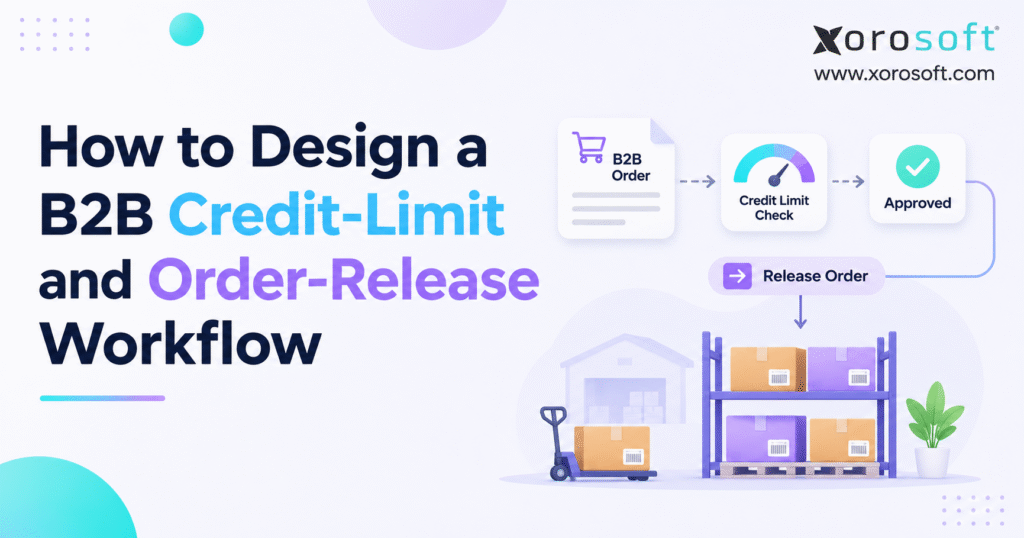
If your business manages transactions between companies, understanding the B2B credit limit workflow is essential to ensuring financial control and efficiency.
1. Why a B2B Credit Limit Workflow Must Connect Finance and Fulfillment
A wholesale customer submits a $17,000 reorder, inventory is available, and the sales team expects the shipment to leave that afternoon. However, finance sees a different situation because the customer already has unpaid invoices, an unbilled shipment, and several outstanding orders consuming available credit. Meanwhile, warehouse employees may be preparing a picking wave based on an order status that no longer reflects the customer’s financial position. This disconnect creates two expensive outcomes: businesses either release orders that exceed approved credit exposure or delay legitimate shipments because nobody knows who should authorize them. A well-designed B2B credit limit workflow prevents both problems by connecting financial checks, approval decisions, and warehouse release permissions.
1.1. Why B2B Credit Approval Has Become an Operational Challenge
Credit management is no longer exclusively an accounting responsibility. Wholesale orders arrive through ecommerce platforms, sales representatives, B2B portals, EDI connections, and distribution partners. As a result, several systems can create new financial commitments before accounting receives the latest payment information. According to the 2026 Atradius North America Payment Practices Barometer, businesses conducted an average of 43% of B2B sales on credit terms. Furthermore, seven in ten surveyed companies experienced payment delays, affecting an average of 23% of receivables. These regional findings demonstrate why reliable coordination between finance and order processing matters.
1.2. What a Controlled B2B Order Release Process Means
A controlled order-release process evaluates the customer’s financial position before allowing an order to progress into fulfillment. Specifically, it considers unpaid invoices, approved credit limits, committed orders, payment terms, and account restrictions. However, accepting an order does not automatically authorize shipment because an order may be commercially valid while still requiring financial approval. Similarly, a transaction that passes credit checks may remain blocked because of inventory shortages, quality concerns, or operational restrictions. Therefore, every department must understand the difference between order acceptance, financial eligibility, and warehouse release.
1.3. Why Manual Credit Decisions Become Difficult to Manage
Manual credit approvals may work when businesses handle a small number of predictable customer accounts. Nevertheless, complexity increases when orders arrive simultaneously from multiple channels or warehouses. For example, a sales representative might approve an urgent purchase using yesterday’s customer balance while accounting is posting another invoice. At the same time, the warehouse may receive an outdated release instruction through an unrelated application. Consequently, the business creates financial exposure without recognizing it immediately. A dependable workflow replaces these informal assumptions with defined rules, current records, and traceable release decisions.
2. Establish the B2B Credit Limit Workflow Policy Before Automation
2.1. Separate Customer Credit Limits, Payment Terms, and Release Rules
One common mistake in wholesale credit management is treating payment terms and credit limits as interchangeable, although they serve different purposes. A credit limit establishes the maximum financial exposure a seller will accept, while payment terms determine when the customer must pay. Meanwhile, release authorization confirms whether a specific order can proceed into fulfillment. For example, a customer may have a $50,000 credit limit with Net 30 payment terms, but that arrangement does not permit another $50,000 purchase every month regardless of unpaid invoices. Instead, the B2B credit approval workflow must consider outstanding obligations and qualifying commitments before allowing additional exposure.
2.2. Define Shared Credit Limits Across Customer Accounts
Credit policies should explain how related customer accounts are handled, particularly when buyers operate several stores or subsidiaries. A retailer might have eight locations under one corporate purchasing agreement, and although each location places orders independently, finance may manage a consolidated credit facility. Without proper account mapping, every store could receive an independent $50,000 limit, unintentionally allowing $400,000 of combined exposure. Therefore, businesses must determine whether limits apply to individual customers, billing entities, parent companies, or defined account groups. In addition, the policy should address currencies, payment arrangements, risk classifications, and prepaid transactions to prevent inconsistent calculations across channels.
2.3. Assign Responsibility Within the Credit Approval Workflow
Clear ownership prevents financial decisions from becoming informal agreements between departments. Sales teams should provide commercial context and customer information, finance should evaluate exposure and authorize exceptions, and accounting should manage payment posting and reconciliation. Meanwhile, warehouse employees must follow approved release instructions rather than independently removing credit holds. The policy should also identify backup approvers, escalation deadlines, and situations requiring management intervention. When these responsibilities are documented, employees can resolve exceptions faster without weakening financial controls or creating confusion about who owns a particular decision.
3. Calculate Customer Exposure in the B2B Credit Limit Workflow
3.1. Include More Than Outstanding Accounts Receivable
Customer credit exposure extends beyond unpaid invoices because additional commitments may already exist elsewhere in the business. A distributor may have shipped products that are not yet invoiced, while other orders may be confirmed but remain unfulfilled. Furthermore, purchases might be arriving through Shopify or EDI integrations while accounting processes existing transactions. Ignoring these commitments can understate the amount of credit already extended. Therefore, a reliable B2B credit limit workflow requires a consistent calculation covering the transaction categories defined by company policy. One illustrative approach is:
Current Credit Exposure = Open Accounts Receivable + Shipped but Unbilled Orders + Qualifying Open Orders − Eligible Applied Credits
The exact components depend on the organization’s financial policy, order states, and system configuration.
3.2. Prevent Duplicate Credit Exposure Across Order Statuses
An order typically moves through several financial stages, and each transition can affect the exposure calculation. Initially, the amount may count as an open-order commitment. After shipment, that commitment moves into shipped-but-unbilled exposure, while the final invoice moves the amount into accounts receivable. If the system counts all three representations simultaneously, customer exposure becomes overstated. Conversely, removing a commitment before the next transaction state is recorded creates a temporary gap in credit control. As a result, businesses need clear rules for moving amounts between categories, including consistent treatment of cancellations, rejected quantities, customer deposits, and approved credit memos.
3.3. Maintain Consistent Credit Balances Across Multiple Sales Channels
When customers place orders through different channels, finance needs one consolidated view of relevant commitments. For instance, a buyer might submit a purchase order through EDI while placing another transaction through an online wholesale portal. Both orders should therefore use the same available-credit calculation rather than relying on separate channel balances. For inventory-driven businesses, Xorosoft’s XoroERP combines accounting, sales orders, inventory, and related operations within a connected environment. However, businesses should verify the specific credit exposure rules, customer mapping, and timing supported by their implementation. A connected platform provides useful operational visibility, while the approved financial policy determines how decisions should work.
4. B2B Credit Limit Workflow Example: Calculate Available Credit
4.1. Use Projected Exposure Instead of Historical Balances
The available-credit calculation begins with two figures: the approved customer limit and current credit exposure. However, a new order creates additional potential exposure, so the decision must also consider the proposed transaction value. The basic formulas are Available Credit = Approved Credit Limit − Current Credit Exposure and Projected Credit Exposure = Current Credit Exposure + Proposed Order Value. By evaluating the projected position, finance can determine whether accepting the next order would exceed the amount the business is prepared to finance. Consider the following example involving a wholesale account with a $50,000 credit limit.
| Credit exposure component | Amount |
|---|---|
| Approved credit limit | $50,000 |
| Open receivables | $24,000 |
| Shipped but not invoiced | $8,000 |
| Other open orders | $6,000 |
| Eligible applied credits | −$2,000 |
| Current credit exposure | $36,000 |
| Proposed order | $17,000 |
| Projected exposure | $53,000 |
| Amount above limit | $3,000 |
Before the proposed order, the customer has $14,000 of available credit. However, the $17,000 transaction increases projected exposure to $53,000, exceeding the approved limit by $3,000. Consequently, the order should enter a credit hold or authorized exception review under a policy that blocks over-limit transactions.
4.2. Recalculate Credit After an Eligible Customer Payment
Suppose the customer subsequently makes a qualifying $4,000 payment. Once accounting applies that payment, projected exposure decreases from $53,000 to $49,000, meaning the order now falls within the approved $50,000 credit limit. Nevertheless, this improvement does not automatically resolve every possible restriction because other invoices might remain overdue, a manual account hold could still apply, or the original approval might have expired. Therefore, the B2B credit approval process should reevaluate all applicable conditions before allowing fulfillment. A successful dollar-limit check confirms that one requirement passes; it does not prove that every financial restriction has disappeared.
4.3. Preserve the Calculation Behind Every Credit Decision
Financial approvals should be transparent and reproducible rather than dependent on an employee’s interpretation of an outdated report. Record the customer account, approved limit, outstanding balances, eligible credits, proposed order value, and calculation timestamp. Additionally, capture the rules that passed or failed during the evaluation and identify any adjustments made after the original check. This evidence helps finance explain why an order was held or released while supporting audits, customer discussions, and future policy reviews. Without a reliable calculation history, teams may struggle to distinguish legitimate exceptions from preventable processing errors.
5. Configure ERP Credit Hold Rules and Order Release Conditions
5.1. Identify the Main Customer Credit Hold Triggers
Not every credit hold should result from exceeding the approved credit limit. Common triggers include overdue invoices, expired credit reviews, unusual payment terms, restricted customer accounts, and significant changes in payment behavior. Furthermore, exceptionally large orders may require additional evaluation even when the customer technically has sufficient available credit. A controlled ERP credit management process evaluates these conditions separately rather than assuming that passing one test authorizes the order. For example, a customer might remain below its approved limit while violating the overdue-invoice policy. Consequently, the order should remain blocked until the relevant condition is resolved or an authorized exception applies.
5.2. Distinguish Credit Warnings from Hard Order Holds
A soft credit warning alerts employees about increasing financial exposure without necessarily stopping a transaction. In contrast, a hard hold prevents the order from progressing beyond a defined processing stage, while an approval hold keeps the transaction paused until an authorized employee reviews it. These distinctions matter because employees need to know which actions are permitted. For instance, a generic “pending” status does not explain whether an order requires payment, corrected information, or management approval. Therefore, the credit hold workflow should display clear reason codes, identify the responsible team, and specify which release conditions remain outstanding.
5.3. Establish Conditions for Releasing Credit Holds
Every credit hold should have a defined resolution requirement that matches the reason it was created. An over-limit restriction may clear after an eligible payment reduces exposure, while an expired approval may require renewed authorization. Meanwhile, a manually applied risk hold should remain until an authorized employee removes it. Xorosoft’s published accounting configuration describes restrictions involving overdue invoices and credit limits across selected order-processing activities. However, the availability and behavior of specific restrictions depend on the configured environment. For this reason, businesses should verify the relevant controls before implementation and avoid treating documented configuration options as universal defaults.
5.4. Avoid Automatic Release Based on a Single Payment Event
Receiving a payment does not always mean an order is safe to ship because accounting may still need to confirm settlement, apply the amount, or resolve another outstanding restriction. In addition, the payment might apply to a different invoice than the one responsible for the original hold. Finance should therefore verify the receipt’s eligibility, the remaining account balance, and every active blocking condition. A well-designed B2B credit limit workflow evaluates the complete account position rather than responding to one transaction in isolation. This approach reduces accidental releases while making financial decisions easier to explain.
CTA #1 — Free ERP Readiness Assessment
Review how your current systems track customer exposure, credit restrictions, approval decisions, and warehouse release permissions. Identify manual processes that could create financial or fulfillment risks before planning further automation.
6. Design the Eight-Step B2B Credit Approval and Order-Release Workflow
6.1. Steps 1–2: Capture Orders and Identify Customer Accounts
First, receive the sales order with a unique transaction reference and capture the purchase order number, billing entity, delivery location, currency, payment terms, order value, and originating channel. Next, match the transaction to the correct customer credit account, including any applicable parent account or shared credit group. This step becomes especially important when organizations operate multiple stores, subsidiaries, or purchasing divisions. If the customer identity cannot be verified, the order should enter a data-quality review rather than receive an assumed credit limit. Correct customer mapping establishes the foundation for every later financial calculation.
6.2. Steps 3–4: Calculate Exposure and Evaluate Credit Rules
After identifying the customer, calculate current and projected exposure using the transaction categories defined by the approved policy. Next, evaluate credit-limit rules, overdue balances, payment restrictions, account status, and any additional manual holds. If all mandatory requirements pass, the order becomes eligible for the next stage. Otherwise, the system should record the specific hold reasons and route the transaction to the appropriate reviewer. A dependable B2B credit limit workflow explains exactly why an order stopped instead of displaying an unexplained rejection. This transparency reduces unnecessary communication between sales, accounting, and customer service.
6.3. Steps 5–6: Route Exceptions and Record Approvals
Orders requiring exceptions should reach employees with the correct financial authority. For smaller breaches, a credit manager may have sufficient approval rights, whereas larger exceptions may require a financial controller or CFO. The reviewer should consider payment history, total exposure, recent purchases, and the commercial reason for the request. Once a decision is made, the system should record the approved amount, scope, expiration, and supporting justification. Importantly, an exception granted for one order should not automatically authorize future purchases. A controlled approval process gives teams flexibility without weakening accountability.
6.4. Steps 7–8: Revalidate Credit and Authorize Warehouse Release
Conditions may change between order submission and fulfillment because additional invoices can become overdue, payments may be reversed, and other sales channels can create new commitments. Therefore, the final stage of the B2B credit approval workflow should revalidate the order at the defined release checkpoint. Only transactions meeting current requirements, or covered by valid authorized exceptions, should progress. Finally, the warehouse must receive a definitive release status that reflects the latest financial decision. Employees should not rely on outdated reports or informal emails to determine whether goods may ship.
7. Create a Credit Approval Authority Matrix for Wholesale Orders
7.1. Match Approval Authority to Credit Exposure
A formal approval matrix establishes who can authorize exceptions and under which conditions. Without one, sales managers may request urgent releases while warehouse employees receive conflicting instructions. Instead, the approval process should consider the amount exceeding the credit limit, customer risk, payment history, and reason for the exception. Routine orders that pass every rule can follow the configured process, while larger exceptions require progressively higher authorization. The following amounts illustrate one possible approval structure rather than universal industry standards.
| Illustrative exception | Approval authority | Required evidence |
|---|---|---|
| No policy breach | Automated rule evaluation | Passing credit checks |
| Up to $5,000 | Credit manager | Exposure and explanation |
| $5,001–$20,000 | Financial controller | Risk assessment |
| Above $20,000 | CFO or authorized delegate | Written approval |
Businesses should establish their own approval levels according to financial capacity and risk tolerance. Moreover, the matrix should identify backup approvers, maximum response times, and cases where an exception cannot be granted through ordinary approval.
7.2. Define Temporary Credit Limit Overrides
Wholesale customers sometimes require temporary credit extensions for seasonal demand or unusually large purchases. However, each exception should specify an approved amount, expiration date, customer account, and applicable order scope. Businesses must also decide whether the approval covers one transaction or temporarily increases the customer’s overall limit. When the authorization expires, the original policy should govern subsequent decisions. Similarly, material order changes should trigger reassessment when they exceed the previously approved scope. These controls prevent temporary commercial arrangements from becoming unrestricted financial commitments.
7.3. Preserve the Credit Approval Audit Trail
Every exception should remain traceable through the complete approval and release process. Record the original hold reason, calculated exposure, approval request, supporting explanation, approver identity, and release outcome. Additionally, retain timestamps and relevant order revisions so finance can reconstruct the decision even after balances change. This information helps management investigate unauthorized releases and identify recurring exceptions. As a result, the B2B credit approval workflow becomes easier to audit without making ordinary transactions unnecessarily complicated. Clear records also reduce disputes between teams when customers ask why an order was delayed.
8. Connect the ERP Credit Hold Workflow to Warehouse Release Controls
8.1. Separate Financial Eligibility from Inventory Availability
Available stock does not automatically make an order financially eligible for shipment. A warehouse may have sufficient inventory while finance has placed the customer’s account on hold. Conversely, an order can pass credit approval but remain blocked because of stock shortages, quality restrictions, or shipping requirements. Therefore, the system should represent financial and operational conditions independently while providing a clear overall release status. Warehouse employees should execute only activities permitted by the latest authorized decision. This separation prevents inventory availability from being mistaken for financial approval.
8.2. Define Credit Hold Checkpoints in Warehouse Operations
Organizations need to decide where financial restrictions should stop fulfillment. Some businesses block orders before inventory allocation, while others permit reservation but prevent wave creation, picking, or final shipment. The appropriate checkpoint depends on warehouse processes, customer commitments, and inventory allocation rules. For example, temporarily reserving stock during finance review may be appropriate when inventory availability is limited. However, reservation should not imply permission to ship. Xorosoft’s XoroWMS provides warehouse management capabilities within a broader inventory-driven operating environment, although businesses should verify how specific credit restrictions interact with their warehouse configuration and third-party integrations.
8.3. Prevent Outdated Order Release Statuses
Warehouse systems should not rely on approval messages created before the customer’s financial position changed. Instead, integrations need reliable transaction identifiers, timestamps, acknowledgments, and retry handling. If finance revokes approval, the downstream process should respond according to the established control policy. Additionally, organizations must define what happens when an integration becomes unavailable or a release message fails. When the latest financial decision cannot be confirmed, the workflow should prevent unauthorized execution rather than assume an older approval remains valid. This requirement becomes particularly important for multi-warehouse operations where status changes must reach several locations.
9. Recalculate Credit Exposure After Payments and Order Changes
9.1. Apply Customer Payments According to Accounting Policy
Customer payments may restore available credit, but only when they qualify under the company’s financial policies. A payment notification is not necessarily equivalent to an applied receipt because accounting may still need to confirm settlement, allocate the payment, or resolve a disputed balance. Once the payment becomes eligible, the system should update customer exposure and reevaluate relevant restrictions. Consequently, an order may become eligible for release without requiring employees to reconstruct the entire calculation manually. However, the process must continue to respect any unrelated holds that remain active after payment.
9.2. Handle Credit Memos, Returns, and Cancellations
Approved credit memos and returns can reduce financial exposure, but anticipated returns should not automatically create available credit before the appropriate conditions are satisfied. Returned goods may require inspection, while credits may need authorization. Likewise, canceled orders should release qualifying commitments only after the cancellation is accepted and downstream fulfillment activities have stopped. These controls prevent available credit from being overstated. Furthermore, businesses should document how disputed invoices and unapplied credits are treated so different employees do not reach conflicting decisions for the same customer account.
9.3. Recheck Credit Following Material Order Changes
An order may change after finance approves it because customers sometimes increase quantities, request different products, change payment terms, or move fulfillment to another billing entity. Such revisions can invalidate the original approval, particularly when they increase projected exposure or alter the underlying risk. Therefore, the B2B credit limit workflow should connect authorization validity to relevant order details. Whenever a material field changes, the transaction should undergo another financial evaluation before release. This prevents outdated approvals from being reused for substantially different commitments and improves the reliability of the final release decision.
10. Manage Partial Releases Within the B2B Order Approval Process
10.1. Release Only the Portion Supported by Available Credit
A customer may have insufficient credit for an entire order but enough capacity for a partial shipment. Suppose available credit is $9,000 while the proposed order totals $15,000. Under an appropriate policy, finance might authorize selected lines worth $9,000 and leave the remaining value on hold. However, the system must update financial commitments to reflect the approved portion, including any relevant freight, taxes, deposits, and backordered quantities. As a result, partial releases require more than simply asking warehouse employees to ship fewer units. Both finance and fulfillment must recognize the same approved scope.
10.2. Prevent Duplicate Credit Commitments Across Channels
Concurrent orders introduce another operational challenge when different channels use the same available credit balance. Imagine a customer with $10,000 in available credit while a Shopify order for $7,000 and an EDI order for $6,000 arrive within seconds. If both transactions evaluate the same outdated balance, each might pass independently even though their combined value exceeds available credit by $3,000. Therefore, the B2B credit limit workflow should use coordinated credit reservations or equivalent controls to prevent multiple orders from consuming the same headroom. Reliable transaction identifiers and retry handling are also necessary to prevent duplicate commitments.
10.3. Coordinate Credit Decisions Across Multiple Warehouses
Multi-warehouse organizations need consistent financial information across locations. A customer may place separate orders fulfilled by different distribution centers, and although inventory planning happens independently, all qualifying orders should contribute to the appropriate shared exposure calculation. Otherwise, separate warehouses could receive conflicting financial approvals. Consequently, businesses should establish one authoritative credit decision and distribute the corresponding release status to every relevant fulfillment system. This approach supports coordinated execution while allowing each warehouse to manage its own inventory availability and operational responsibilities.
11. Integrate Shopify B2B Credit Approval with ERP and EDI
11.1. Understand Shopify B2B Payment Terms and Draft Orders
Shopify supports company-location payment terms and B2B order submission as drafts for review, helping merchants manage commercial purchasing arrangements. However, payment terms and draft review should not be confused with consolidated credit exposure management across all sales channels. A business using multiple systems may still need a financial evaluation that considers ERP invoices, EDI orders, and existing wholesale commitments. Therefore, the organization must determine which system owns the final credit decision and how that result affects order status. The workflow should also clarify whether approval occurs before order confirmation, before allocation, or before warehouse release.
11.2. Connect Ecommerce Orders to Financial Records
Shopify orders should map to the appropriate customer account, billing entity, and payment arrangement. Meanwhile, the designated financial system needs access to relevant receivables, approved limits, and open commitments. Once a credit decision is made, its result should reach the applicable order-processing systems without creating inconsistent statuses. Xorosoft’s integration options provide context for connecting ecommerce and operational processes, while its Shopify App Store listing describes integration capabilities for Shopify operations. Nevertheless, specific credit checks and synchronization rules must be verified in the actual implementation rather than assumed from a general integration description.
11.3. Apply Consistent Credit Rules to EDI Orders
EDI purchase orders should follow the same financial policy as manually entered transactions. First, map incoming buyer identifiers to the correct customer account, then validate the order amount, payment terms, and current exposure. The resulting credit status should be visible to finance and customer service so the organization can explain any exception. Importantly, a successful EDI message transfer does not automatically authorize shipment because technical acceptance and financial approval are different events. A consistent B2B credit approval workflow applies equivalent financial controls regardless of the source of the order.
CTA #2 — Watch Demo
Review how ecommerce, accounting, inventory, and fulfillment workflows operate together. Ask to see a credit-hold scenario covering financial review, exception approval, and the warehouse release checkpoint.
12. Apply Wholesale Credit Management Rules Across Industries
12.1. Apparel and Fashion: Seasonal Credit Exposure
Apparel distributors frequently manage large preseason orders, replenishment purchases, and returns. Customers may appear current on invoices while carrying substantial commitments for future deliveries. Therefore, credit policies should define whether confirmed seasonal orders consume available credit immediately or at a later milestone. When retailers request additional inventory, finance should evaluate both outstanding balances and qualifying future commitments. This approach reduces the risk of extending excessive credit during peak selling periods while helping sales teams understand why some replenishment orders need additional review.
12.2. Furniture: Deposits and Extended Fulfillment Cycles
Furniture businesses often accept orders months before delivery, creating a complicated relationship between deposits, production lead times, and credit exposure. For example, a customer may qualify for credit when placing an order but become overdue before the goods are ready. Consequently, the release process should define when deposits reduce exposure and when another credit check becomes necessary. Completed production does not automatically mean the shipment remains financially eligible. Instead, finance should evaluate the latest customer position before authorizing delivery, particularly when the original approval is several weeks or months old.
12.3. Sporting Goods: Shared Credit Across Warehouses
Sporting goods distributors may serve retail chains through several warehouses and regional sales teams. A customer can place different purchase orders for multiple delivery locations while operating under one corporate credit facility. Therefore, every qualifying transaction should contribute to the appropriate shared exposure calculation. Otherwise, warehouse-specific approvals may exceed the intended limit. Coordinated financial decisions help maintain consistency even when inventory fulfillment is decentralized, while accurate customer mapping prevents duplicate or fragmented credit records.
12.4. Food and Manufacturing: Recurring Credit Approval Requirements
Food distributors and manufacturers often process recurring orders through EDI integrations, and these transactions may have strict delivery windows or production-related requirements. However, credit approval should remain separate from quality, lot, expiry, and manufacturing restrictions. Passing one condition must not automatically override another because financial eligibility and product compliance address different risks. Businesses evaluating industry-specific ERP requirements can review the industry solutions overview to understand the wider operational context. Ultimately, the release process should recognize every mandatory restriction before goods leave the business.
13. Compare Manual and ERP-Based B2B Credit Limit Workflows
13.1. Manual Credit Review for Smaller Wholesale Businesses
A small wholesaler with a limited number of predictable accounts may manage credit through a documented manual process. Employees can review current receivables, record decisions, and communicate release permission to the warehouse. Initially, this approach may be sufficient because transaction volume and financial exposure remain manageable. However, the workload becomes harder to control as customer accounts, sales channels, and exception volumes increase. The main challenge is maintaining consistency when financial information changes faster than employees can review it.
13.2. Spreadsheet-Based Credit Approval Limitations
Spreadsheets offer flexible calculations and remain familiar to finance teams. Nevertheless, exported balances can become outdated while new transactions continue entering the business, and multiple employees may work from conflicting versions of the same report. Furthermore, warehouse applications may not recognize approvals recorded in spreadsheets. As a result, financial controls can depend on employees remembering to communicate every change. Growing transaction volume makes these weaknesses increasingly difficult to manage, especially when several locations share customer credit facilities.
13.3. Integrated ERP Credit Management and Order Release
An integrated ERP approach can connect customer records, accounting transactions, order status, and inventory operations. Consequently, teams can reduce the effort required to reconcile disconnected systems before making credit decisions. Xorosoft’s XoroONE combines core inventory-driven business operations in a cloud environment. However, integrated software still requires clearly defined approval policies, permissions, and exception-handling rules. A B2B credit limit workflow succeeds when technology consistently executes the organization’s financial and operational decisions rather than merely displaying related information on one screen.
| Approach | Primary advantage | Main limitation |
|---|---|---|
| Manual review | Simple initial setup | Time-consuming approvals |
| Spreadsheet process | Flexible calculations | Outdated or conflicting data |
| Integrated ERP | Connected transactional records | Requires careful configuration |
14. Measure B2B Credit Hold and Order Release Performance
14.1. Track Credit Utilization and Hold Rates
Credit approval performance should be measurable so management can identify both financial risk and unnecessary processing delays. Useful indicators include customer credit utilization, percentage of orders on hold, median hold-resolution time, override frequency, and total held-order value. Credit utilization can be calculated using Current Credit Exposure ÷ Approved Credit Limit × 100. For example, a customer using $40,000 of a $50,000 limit has 80% utilization. However, utilization alone does not describe overdue risk. Therefore, finance should evaluate several indicators together and compare results across customer groups, channels, and warehouses.
14.2. Measure the Cost of Manual Credit Reviews
Manual approval processes create measurable operating costs. Consider a company reviewing 200 credit exceptions monthly, with each review requiring twelve minutes. Employees would spend approximately forty hours processing those cases, producing a monthly review expense of about $1,600 at a loaded labor cost of $40 per hour. This illustrative calculation excludes delayed shipments, customer-service effort, and potential collection losses. Therefore, reducing unnecessary reviews can improve efficiency, provided that financial controls remain effective and the organization continues to monitor the quality of its decisions.
14.3. Balance Approval Speed with Financial Risk
Faster order release is not automatically better because poorly controlled approvals can improve processing speed while increasing collection risk. Instead, a successful B2B credit limit workflow should reduce avoidable holds while maintaining appropriate restrictions on higher-risk transactions. Management should review performance by customer, channel, hold reason, and warehouse to identify recurring delays or unexpected overrides. These comparisons help determine whether policy adjustments, improved customer records, or additional automation are appropriate. The objective is reliable order flow, not simply the lowest possible hold rate.
15. Implement and Test the B2B Credit Limit Workflow
15.1. Begin with Customer Data and Credit Policy
Implementation should start with accurate customer information rather than immediately configuring software rules. Review approved limits, billing relationships, outstanding receivables, existing restrictions, and the transaction statuses included in exposure. Next, document approval authority and determine where warehouse activities must stop when an order is held. Only after these decisions are agreed upon should automation be configured. This sequence helps prevent technical implementations from embedding unclear or inconsistent financial policies.
15.2. Use a Phased Credit Approval Implementation Plan
A practical rollout can follow four stages. During the first stage, reconcile customer records and document financial policies, while the second establishes hold rules, approval levels, and exception procedures. The third stage connects system integrations and downstream release checkpoints. Finally, finance, sales, customer service, and warehouse employees should test realistic transactions together. Although a 30-day schedule may suit a straightforward implementation, complex multi-warehouse environments can require additional time. The priority should be dependable controls and accurate data rather than meeting an arbitrary launch date.
15.3. Test Credit Exceptions Before Going Live
Testing only orders that pass credit checks leaves important risks undiscovered. The acceptance plan should include over-limit orders, overdue invoices, recently applied payments, expired overrides, partial releases, and revised order amounts. Additionally, test simultaneous purchases from different sales channels and verify that held orders cannot progress beyond the intended warehouse checkpoint. Each test should record the expected outcome, actual decision, financial snapshot, and downstream status. These scenarios reveal weaknesses that routine transactions may never expose.
15.4. Review Credit Decisions After Implementation
Credit automation requires ongoing oversight because customer behavior, order volume, and financial policies can change. During the initial operating period, audit released orders against the rules that were active at release time. Investigate unexplained approvals, incorrect customer mappings, and unexpected exposure calculations. Meanwhile, management should review recurring exceptions to determine whether the established policies remain appropriate. A reliable B2B credit limit workflow depends on accurate information, clear responsibilities, and continuous operational improvement rather than a one-time software configuration.
16. Build a Reliable Daily Credit Approval and Order-Release Process
16.1. Start with One Customer and One Real Credit Hold
Before redesigning the entire order-to-cash process, select a customer with a recent credit exception. Reconstruct the account’s outstanding invoices, open commitments, unbilled shipments, eligible credits, and approved limit. Next, trace the held order through financial review, approval, and warehouse release. Compare the documented policy with the decisions employees actually made, paying particular attention to missing records or unclear permissions. Any differences can reveal weaknesses in configuration, training, integration, or ownership.
16.2. Balance Customer Experience with Financial Control
Strong credit controls should not create unnecessary obstacles for customers. Instead, routine orders should move efficiently while genuine exceptions receive appropriate attention. A well-managed B2B credit limit workflow also improves communication between sales, finance, accounting, and warehouse teams. Consequently, employees can understand which conditions have passed and which decisions remain outstanding without repeatedly requesting updates from other departments. That visibility supports dependable order processing while protecting receivables and working capital.
16.3. Make Your Next ERP Evaluation Evidence-Based
When evaluating an ERP platform, bring a real customer credit calculation and a representative held order. Ask how the software calculates exposure, manages shared credit limits, records exceptions, and prevents unauthorized shipments. Additionally, examine how it handles payment updates, partial releases, multiple warehouses, and integration failures. These practical demonstrations reveal more than generic feature lists because they show whether the proposed workflow supports actual business requirements.
Book a Personalized ERP Consultation
If your business manages credit approvals through disconnected accounting reports, spreadsheets, and warehouse systems, it may be time to evaluate a more connected approach. Contact Xorosoft to discuss your credit management requirements, order-release controls, and existing operational workflows.
Frequently Asked Questions About B2B Credit Limits
What is a B2B credit limit workflow?
It checks customer exposure, unpaid invoices, and account restrictions before order release. The workflow routes exceptions for approval and records release decisions.
How do you calculate available credit for an order?
Subtract current exposure from the approved limit. Include the proposed order in projected exposure, ensuring open orders, shipments, and invoices are not counted twice.
When should a B2B order be put on credit hold?
Hold orders that breach credit limits, overdue-payment rules, or account restrictions. Record the hold reason, decision owner, and conditions required for release.
Who can approve an order that exceeds the credit limit?
Follow the company’s approval matrix. An authorized finance reviewer should document the exception amount, reason, scope, and expiration before release.
Does a customer payment automatically release a held order?
No. First validate the payment and recalculate exposure. Other overdue invoices, manual holds, or expired approvals may still prevent order release.
How does Shopify B2B connect to ERP credit checks?
Shopify handles B2B orders and payment terms. ERP may consolidate receivables and commitments. Specify which system decides credit eligibility and communicates release status.
When should credit be rechecked before warehouse release?
Recheck after material changes to orders, balances, or approvals and at the configured warehouse checkpoint. Earlier clearance should not override current restrictions.
Recent Posts
-
 ERP for Nutraceutical Manufacturers Managing Formulas, Lots, and Expiry
-
 Warehouse Wave Benchmarks 2026: Release Size, Throughput, and Completion
-
 How to Design a B2B Credit-Limit and Order-Release Workflow
-
 Xorosoft vs Fulfil for Shopify Inventory and Warehouse Operations
-
 Why Unposted Production Scrap Overstates Inventory and Margin