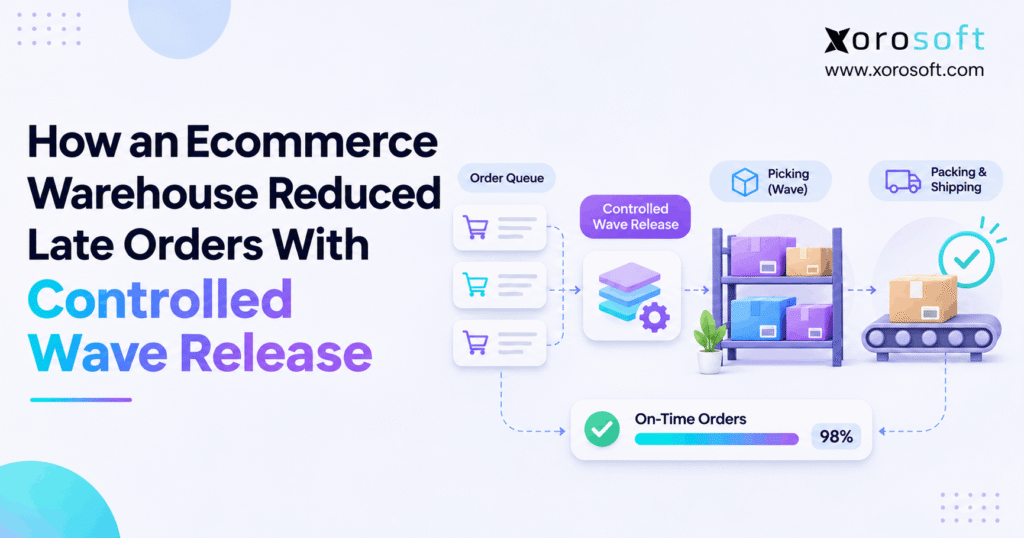
This article will explore the concept of controlled wave release and its applications.
1. The Hidden Warehouse Delay That Starts Before Picking
Controlled wave release helps ecommerce warehouses reduce late orders by deciding which orders should enter picking, when work should begin, and how much work the team can handle. Instead of releasing every order at once, managers can align picking priorities with inventory readiness, packing capacity, and carrier deadlines.
For growing ecommerce businesses, late orders often create confusion. Inventory is available, employees are working, and warehouse dashboards show activity. However, some shipments still miss their scheduled collection times.
The problem may start well before picking begins.
1.1 Why Available Inventory Does Not Mean an Order Is Ready
An order can have available inventory without being ready for warehouse execution.
For example, stock may be stored in reserve locations, assigned to another warehouse, or awaiting an inventory check. Likewise, an order may have inventory allocated but still be waiting for a picking task.
As a result, warehouse employees cannot always begin work immediately.
Furthermore, fulfillment involves several connected stages. Picking must finish early enough for packing, label checks, staging, and carrier handoff.
Therefore, an inventory-available order can still become a late shipment.
1.2 Why Controlled Wave Release Addresses Hidden Waiting
Many warehouses organize orders into picking waves. Although this approach supports efficient batch processing, fixed wave schedules can leave urgent orders waiting.
Consider an expedited order that becomes eligible immediately after a scheduled wave starts. The next release may not occur for two hours.
Meanwhile, the shipping deadline continues approaching.
Controlled wave release addresses this waiting period by reviewing order urgency, inventory status, and available capacity before releasing work.
Consequently, supervisors can prioritize time-sensitive shipments without abandoning efficient order grouping.
1.3 What Late Orders Reveal About Warehouse Wave Release
Repeated late shipments can indicate a problem with warehouse work sequencing rather than employee productivity.
For instance, pickers may finish assigned tasks quickly while other eligible orders remain unreleased. Packing stations may also become overloaded when a large wave reaches them simultaneously.
Therefore, warehouse managers should examine the time between order eligibility and picking execution.
The key question is not simply how quickly employees pick products. Instead, it is whether the warehouse starts the right work early enough to complete each shipment.
For additional context, see why warehouse waves create late orders despite available inventory.
2. What Controlled Wave Release Means in Daily Operations
Controlled wave release is a fulfillment method that determines when selected orders become available for picking, using shipping priorities, inventory readiness, and operating capacity.
Rather than relying only on fixed release times, managers control how work enters the warehouse.
As a result, the team can balance picking efficiency with customer shipping commitments.
2.1 Wave Creation, Allocation, and Picking Execution
Warehouse teams should distinguish three related activities.
Wave creation groups orders or order lines into a planned picking workload.
Inventory allocation associates available stock with the selected demand.
Picking execution begins when employees receive work they can perform.
However, systems do not always use the same terms for these stages. Some distinguish wave processing and release, while others connect wave creation directly to inventory allocation.
Therefore, businesses must identify the actual event that makes a task available to warehouse employees.
2.2 How Warehouse Wave Release Balances Speed and Capacity
The fastest possible picking release is not always the best operational choice.
If a warehouse releases too much work, employees may face crowded aisles, long task queues, and overloaded packing stations.
Conversely, releasing too little work can leave employees idle while orders approach their deadlines.
A controlled process considers both risks.
For example, a warehouse might release standard orders in grouped waves while giving urgent shipments a separate priority path.
As a result, teams can preserve efficient picking routes while protecting time-sensitive orders.
2.3 Who Needs These Controls—and Who Does Not?
Businesses with multiple daily carrier collections, high order volumes, seasonal peaks, or mixed shipping services are strong candidates.
Similarly, warehouses managing direct-to-consumer and wholesale demand may benefit from more structured release decisions.
However, a small warehouse processing predictable orders may not need complex wave scheduling.
A simple priority queue and reliable cutoff checklist might provide enough control.
Therefore, the purpose is not to make every warehouse more complicated. It is to introduce only the release controls that solve measurable fulfillment problems.
3. The Ecommerce Warehouse Problem: Plenty of Stock, Too Many Late Orders
Consider a hypothetical ecommerce warehouse selling apparel, footwear, and accessories through several channels.
The facility processes standard parcels, expedited orders, and larger wholesale shipments.
Although inventory levels are generally sufficient, supervisors notice that some orders repeatedly miss carrier collection.
This illustrative scenario demonstrates the process problem. It does not represent a verified Xorosoft customer or a measured customer result.
3.1 Fixed Picking Waves Ignored Shipping Deadlines
The warehouse originally releases two large picking waves each day.
However, an expedited order arriving shortly after the first release must wait for the afternoon wave.
Meanwhile, older standard orders may receive picking priority even when their shipping deadlines are later.
As a result, available processing time disappears before picking begins.
The team needs a release process that considers the latest safe start time, not only order creation time.
3.2 How Poor Warehouse Wave Release Overloads Packing
Supervisors also release large waves to keep picking teams occupied.
Although this increases visible picking activity, it creates sudden workload peaks at packing stations.
Consequently, picked orders accumulate in carts and staging areas.
Some parcels finish picking well before their carrier cutoff but still miss collection because packing cannot keep pace.
Therefore, improving the picking rate alone will not solve the problem. Warehouse work must flow at a pace that downstream operations can manage.
3.3 Inventory Holds and Replenishment Add Further Delays
Several products are available in total inventory but not in the correct picking locations.
For instance, a product may have 100 units in reserve storage but only five units in the forward-pick area.
When a large order requires more than five units, replenishment becomes necessary.
However, if the warehouse discovers the shortage only after releasing the wave, employees lose valuable time.
Instead, the release process should confirm pickable inventory and identify replenishment needs before work begins.
3.4 Free ERP Readiness Assessment: Five Questions
Before changing software, warehouse leaders can evaluate the existing workflow.
- Can supervisors identify eligible orders that have not entered picking?
- Can they see the latest safe release time for urgent shipments?
- Does packing capacity influence wave size?
- Are replenishment delays visible before picking?
- Can the business identify exactly where an order missed its deadline?
If several answers are no, the next step is to investigate process ownership, system visibility, and data quality.
This self-check is a starting point, not a formal assessment or product recommendation.
4. Six Practical Rules for Controlled Wave Release
The warehouse can now replace fixed release habits with operational rules.
Each rule should have a clear purpose, measurable outcome, and documented exception process.
Moreover, managers should test these changes using real order patterns rather than assuming one release schedule fits every shift.
4.1 Work Backward From Carrier Shipping Cutoffs
Start with the deadline for carrier handoff.
Then, subtract the time needed for picking, packing, staging, and a reasonable contingency buffer.
Latest safe release time = Carrier cutoff − Total expected fulfillment time
For example, consider a carrier cutoff of 4:00 PM.
| Activity | Planned time |
|---|---|
| Picking and expected waiting | 40 minutes |
| Packing and expected waiting | 30 minutes |
| Staging and carrier preparation | 15 minutes |
| Contingency buffer | 20 minutes |
| Total required | 105 minutes |
Therefore, the latest safe release time is 2:15 PM.
An order still waiting after that point needs immediate review.
4.2 Controlled Wave Release Requires Pickable Inventory
Before work enters picking, the warehouse should confirm that the required stock is actually available for execution.
This check includes inventory allocation, bin location, product restrictions, and replenishment readiness.
For example, Xorosoft’s documented wave creation process supports manual and automatic waves with different inventory allocation options.
However, managers must select an allocation policy that matches customer fulfillment rules.
A partially allocated order should not automatically become a partial shipment.
For detailed functionality, review the Xorosoft wave creation documentation.
4.3 How Controlled Wave Release Limits Active Work
Wave size should reflect the capacity of the entire warehouse process.
For instance, a picking team may handle 80 orders per hour while packing can complete only 35.
Therefore, releasing 80 orders immediately could create downstream congestion.
A practical rule is:
Additional releasable work = Expected downstream capacity − Work already waiting
Suppose packing can process 30 comparable orders in the next hour, while 18 already wait.
In that case, the warehouse has room for approximately 12 additional orders reaching packing during that period.
However, actual timing and order complexity must also be considered.
4.4 Protect Urgent Orders With a Separate Release Path
Some orders cannot wait for the next standard batch.
For example, replacement shipments, premium shipping orders, or parcels approaching carrier cutoff may require priority handling.
Therefore, supervisors should define a controlled urgent-order process.
The rules should specify which orders qualify, who approves an exception, and how capacity will be protected.
However, employees should not classify every order as urgent.
Otherwise, priority picking can disrupt normal workflows and reduce overall shipping reliability.
4.5 Connect Replenishment to Wave Planning
Wave planning and replenishment should share a consistent view of warehouse inventory.
Before releasing large waves, managers can inspect the products likely to exhaust forward-pick stock.
Next, replenishment teams can move inventory from reserve locations before picking begins.
As a result, employees spend less time waiting for stock movements during active work.
Nevertheless, replenishment must follow location accuracy and inventory control procedures.
Speed should not come at the expense of traceable stock movements.
4.6 Keep Unreleased and Held Orders Visible
Every eligible order waiting for release should have a clear status.
For instance, an order might be held because of missing inventory, incomplete allocation, capacity limits, or customer approval.
Therefore, supervisors should review a queue showing the reason, age, shipping deadline, and responsible owner.
Meanwhile, orders approaching their latest safe release time should receive priority attention.
The goal is to prevent invisible waiting.
A well-controlled warehouse does not simply release more work. Instead, it makes unfinished work easier to understand and manage.
5. How Controlled Wave Release Changes an Ecommerce Warehouse Shift
Once the rules are defined, warehouse managers can compare how the same type of order moves through different release processes.
The following timestamps are illustrative. They demonstrate potential workflow changes but do not prove a customer experienced the results.
5.1 Before: Fixed Waves Allowed a Shipment to Miss Cutoff
An expedited order becomes eligible at 11:10 AM.
However, the warehouse does not release its next wave until 2:00 PM.
Picking finishes at 3:05 PM, but packing does not finish until 4:12 PM.
Consequently, the order misses the 4:00 PM carrier cutoff.
The warehouse had stock, and employees completed the tasks. Nevertheless, the release decision left insufficient time for the complete fulfillment process.
5.2 After: Controlled Wave Release Protects the Deadline
Under a revised illustrative workflow, the order is checked for stock readiness and shipping urgency.
Next, the warehouse includes it in a smaller release at 12:45 PM.
Picking finishes at 1:40 PM, and packing completes at 2:30 PM.
Finally, staging finishes before the 4:00 PM deadline.
The order no longer waits for the standard afternoon batch.
However, this example assumes the warehouse has sufficient labor and carrier capacity to support the earlier work.
5.3 Before-and-After Workflow Comparison
| Process event | Fixed release | Controlled release |
|---|---|---|
| Order becomes eligible | 11:10 AM | 11:10 AM |
| Picking work released | 2:00 PM | 12:45 PM |
| Picking completed | 3:05 PM | 1:40 PM |
| Packing completed | 4:12 PM | 2:30 PM |
| Carrier cutoff | 4:00 PM | 4:00 PM |
| Illustrative result | Missed cutoff | Ready before cutoff |
Importantly, the improvement does not require assuming that employees pick faster.
Instead, the warehouse starts suitable work earlier and controls the amount of work entering packing.
Consequently, order timing becomes more important than raw activity counts.
5.4 Why Better Release Decisions Improve the Whole Workflow
A well-managed release process considers every stage after picking.
For example, releasing urgent orders earlier helps only when packing and staging teams can complete them.
Similarly, smaller waves may improve flow when they prevent large downstream queues.
However, reducing wave size too much may increase travel and handling costs.
Therefore, warehouse managers should tune release rules using end-to-end performance rather than focusing on one department.
6. Which Metrics Prove Controlled Wave Release Is Working?
A warehouse should measure outcomes before declaring its new release rules successful.
Picking volume is useful, but it cannot explain whether customer shipping commitments were met.
Therefore, the KPI scorecard should connect wave timing, task execution, packing performance, and actual carrier handoff.
6.1 Measure Carrier Handoff Rather Than Label Creation
The first measure is on-time shipment performance.
On-time shipment rate = Shipments handed to the carrier on time ÷ Shipments due × 100
For example, if 960 of 1,000 due shipments reach their carriers on time, the on-time shipment rate is 96%.
However, the calculation must use a consistent definition of “on time.”
Shopify’s fulfillment documentation explains the picking, packing, and carrier handoff process.
Therefore, teams should avoid treating label creation as proof that a carrier received the parcel.
6.2 Track Warehouse Wave Release Waiting Time
Another important measure is eligibility-to-release time.
Eligibility-to-release time = Picking work release timestamp − Order eligibility timestamp
This metric reveals how long ready orders wait before executable warehouse work begins.
For example, an order eligible at 10:00 AM but released at noon has a two-hour waiting period.
However, averages alone can hide delayed orders.
Therefore, measure median and 90th-percentile waiting times.
In addition, separate results by shipping method, warehouse, and customer priority.
6.3 Measure Packing Queues and Unfinished Work
The next measure is how long picked orders wait before packing begins.
A growing queue may indicate that picking releases exceed packing capacity.
Similarly, a high number of unfinished wave lines can reveal work that started but could not reach completion.
Managers should monitor these conditions throughout each shift.
| KPI | Operational purpose |
|---|---|
| On-time shipment rate | Measures shipping commitments |
| Missed-cutoff rate | Identifies carrier deadline failures |
| Eligibility-to-release time | Reveals hidden pre-pick delays |
| Picking cycle time | Measures task execution |
| Packing queue time | Reveals downstream congestion |
| Held-order age | Identifies unresolved exceptions |
| Rework rate | Tracks accuracy and execution problems |
As a result, the scorecard measures customer outcomes and warehouse workload together.
6.4 Compare Equivalent Workloads Before and After
An improvement should be evaluated using comparable operating conditions.
For example, a quiet week should not be compared directly with a holiday sales peak.
Likewise, changes in staffing, order complexity, or carrier schedules can influence results.
Therefore, record these factors alongside each KPI.
In addition, track labor hours and picking accuracy.
A lower late-shipment rate achieved through excessive overtime or increased errors may not represent a sustainable improvement.
7. Controlled Wave Release vs. Fixed Waves vs. Waveless Picking
Not every warehouse should use the same order release method.
Fixed waves, controlled waves, and continuous picking each offer useful advantages under different conditions.
Therefore, the decision should reflect order patterns, service commitments, and operational capacity.
| Factor | Fixed waves | Controlled waves | Waveless picking |
|---|---|---|---|
| Release timing | Scheduled batches | Priority and capacity-based | Continuous or frequent |
| Order grouping | Strong emphasis | Balanced with urgency | Flexible |
| Urgent orders | May wait for next batch | Separate priority path | Can enter queue quickly |
| Capacity management | Scheduled wave size | Active workload limits | Dynamic task queues |
| Main risk | Excessive waiting | Poor release rules | Task fragmentation |
7.1 Why Fixed Waves Still Work for Predictable Demand
Fixed waves are useful when orders share similar deadlines and picking routes.
For example, a wholesale warehouse might prepare shipments for two scheduled daily departures.
Because the work is predictable, planned batches may improve travel efficiency and labor coordination.
However, fixed timing becomes less suitable when urgent ecommerce orders arrive continuously.
Therefore, managers should evaluate how frequently customers require exceptions to the existing schedule.
7.2 When Waveless Picking Makes More Sense
Waveless picking introduces tasks continuously or in frequent small releases.
Consequently, it can support businesses with changing priorities and rapid order arrivals.
However, continuous release still requires controls over labor, task allocation, and downstream workload.
Otherwise, employees may receive fragmented work that reduces efficiency.
Research published in Transportation Science examines the tradeoff between wave timing, picking efficiency, and fulfillment deadlines. See the study on optimal wave release times for order fulfillment systems.
7.3 Choosing a Hybrid Warehouse Wave Release Model
A hybrid workflow combines scheduled batches with priority releases.
For example, standard ecommerce orders may enter grouped waves every hour.
Meanwhile, expedited orders can enter smaller releases when inventory and packing capacity are ready.
Similarly, large wholesale orders may follow dedicated picking plans.
Therefore, the warehouse maintains predictable work while responding to urgent demand.
The best approach is the one that reliably meets shipping commitments with acceptable labor effort and inventory accuracy.
8. A Four-Week Controlled Wave Release Improvement Plan
Warehouse teams should implement changes gradually.
Instead of replacing the entire workflow immediately, managers can establish a baseline, test release rules, and measure operational results.
The following four-week plan is an illustrative framework. Actual implementation time depends on warehouse complexity, data availability, and system configuration.
8.1 Week One: Establish Baseline Performance
First, document current picking waves, carrier schedules, and order priority rules.
Next, identify the timestamps showing when orders become eligible, enter picking, finish packing, and reach carriers.
Then, calculate the existing missed-cutoff rate and average release waiting time.
Additionally, observe where unfinished work builds up during the shift.
This baseline creates a reliable starting point.
Without it, managers cannot determine whether a process change actually improves fulfillment.
8.2 Week Two: Write Warehouse Wave Release Rules
Next, define eligibility requirements for each order class.
For example, urgent orders might receive priority when their latest safe release time approaches.
Meanwhile, normal orders can remain in grouped picking waves.
The team should also define maximum active workload, replenishment exceptions, and supervisor approval rules.
Importantly, each rule needs an owner.
Otherwise, employees may interpret release priorities differently across shifts.
8.3 Week Three: Pilot Priority and Capacity Controls
Start the pilot with one warehouse, shift, or shipping service.
Then, compare the new release process with a consistent baseline.
Supervisors should monitor order age, packing queues, picking exceptions, and cutoff risks.
However, the pilot should have clear safeguards.
For instance, managers must be able to pause new releases if packing becomes overloaded.
Likewise, urgent shipments should follow an approved escalation process rather than informal employee decisions.
8.4 Week Four: Tune Controlled Wave Release Using Evidence
After the pilot, review the actual outcomes.
Did eligible orders spend less time waiting? Did more shipments meet their carrier cutoffs?
In addition, examine whether picking errors, labor hours, or packing backlogs increased.
If the results are mixed, adjust the release rules rather than expanding immediately.
For example, the warehouse might reduce batch sizes during peak packing periods but retain larger waves during quieter shifts.
Therefore, the final policy should reflect measured capacity instead of theoretical throughput.
Watch Demo / Workflow Review: Businesses evaluating Xorosoft can review its wave creation tutorials to understand the documented workflow before requesting a personalized system walkthrough.
9. Controlled Wave Release Across Ecommerce Industries
Different industries face different warehouse constraints.
However, the same principle applies: release work according to customer commitments, inventory readiness, and available execution capacity.
Therefore, businesses should adapt release rules to the products and order patterns they handle.
9.1 Apparel and Sporting Goods: Protect Priority Orders
Apparel and sporting goods warehouses often manage many SKUs, sizes, and product variations.
During promotions, order volumes may rise quickly.
Consequently, large picking waves can create congestion around popular products.
A controlled approach can group compatible picks while preserving a separate path for urgent shipments.
In addition, replenishment should keep forward-pick locations ready for high-demand products.
As a result, efficient picking routes do not need to come at the expense of shipping deadlines.
9.2 Furniture and Food: Account for Handling Requirements
Furniture fulfillment often requires more space, equipment, and handling time.
Therefore, order count alone provides a weak measure of warehouse capacity.
A wave containing ten bulky products may demand more resources than one containing many small parcels.
Similarly, food and beverage products may require lot, expiry, or handling checks.
Consequently, warehouses should validate product eligibility before releasing picking work.
These requirements should remain part of the process even when carrier deadlines are approaching.
9.3 Wholesale and Shopify: Controlled Wave Release Across Channels
Multichannel warehouses may process Shopify orders, wholesale requests, and other sales-channel demand simultaneously.
However, each channel can have different shipping commitments.
Therefore, order priority should depend on the actual fulfillment promise rather than the channel name alone.
Xorosoft supports connected ecommerce and wholesale operations, including order and inventory workflows.
For merchants evaluating connectivity, the Xorosoft Shopify App Store listing describes its ecommerce and inventory integration capabilities.
In addition, growing brands can review the requirements of different inventory-driven industries.
10. When Process Fixes Are Enough—and When a WMS Helps
A warehouse should not purchase new software simply because some orders ship late.
First, managers must identify whether the problem comes from release rules, staffing, data quality, or system limitations.
Only then can they decide whether an operational change or technology investment makes sense.
10.1 Start With Changes That Need No Software Purchase
Many businesses can improve shipping performance through simple process changes.
For example, teams can establish carrier cutoff boards, define urgent-order rules, and review held orders throughout the shift.
Similarly, supervisors can limit wave size during periods of heavy packing activity.
These changes may work well when inventory records are reliable and warehouse processes remain manageable.
However, manual controls become harder to maintain as order volume and operational complexity increase.
10.2 How Controlled Wave Release Benefits From WMS Visibility
A warehouse management system can help teams see inventory locations, picking tasks, packing progress, and fulfillment exceptions.
For example, XoroWMS supports warehouse inventory tracking, picking and fulfillment operations, multi-warehouse visibility, and reporting.
These capabilities are relevant when supervisors need more reliable information before making release decisions.
However, the existence of a WMS does not automatically mean every advanced capacity-based release rule is available.
Therefore, businesses should test their required workflows during software evaluation.
10.3 Why Warehouse Wave Release Needs Trusted ERP Data
Picking depends on information created outside the warehouse.
For example, sales channels provide customer orders, purchasing affects inbound inventory, and accounting needs accurate transaction records.
Therefore, disconnected systems can create uncertainty about allocation and shipment status.
Xorosoft’s cloud ERP platform connects inventory, purchasing, accounting, and operational processes.
Likewise, businesses can examine Xorosoft integrations when evaluating multichannel data flows.
However, system integration should support clear operating rules, not replace them.
A connected platform is most valuable when the business has defined its priorities, exceptions, and fulfillment measurements.
11. Common Controlled Wave Release Mistakes to Avoid
Even a well-designed release policy can fail when teams focus on one warehouse activity instead of the entire shipping process.
Therefore, managers should review the following mistakes before expanding their changes across facilities.
11.1 Releasing Beyond Packing Capacity
The first mistake is releasing more work than downstream teams can complete.
Although pickers may stay busy, unfinished orders can accumulate at packing stations.
Consequently, carrier cutoffs remain at risk.
Instead, managers should review work already waiting, expected packing throughput, and upcoming deadlines.
In addition, wave sizes should change when staffing or order complexity changes.
A release plan that works during a full shift may fail when packing employees are unavailable.
11.2 Treating Every Order as Expedited
The second mistake is allowing too many orders to enter the priority queue.
When every order becomes urgent, supervisors lose a meaningful way to organize work.
As a result, employees may repeatedly switch tasks while standard waves become disrupted.
Therefore, urgent releases should use clear service-level and deadline rules.
Exceptions should also be reviewed regularly.
For example, frequent emergency releases may indicate that the normal schedule needs redesign.
11.3 Focusing on Activity Instead of Customer Commitments
The third mistake is judging success only by picking productivity.
Higher picks per hour may look positive, but they do not guarantee earlier carrier handoff.
Likewise, creating more waves does not automatically reduce late shipments.
Therefore, the warehouse must measure on-time shipment performance, release waiting time, packing queues, and rework together.
For businesses with growing operational complexity, XoroONE provides a broader context for evaluating connected business workflows.
Ultimately, accurate measurement should guide the decision to improve a process or upgrade a system.
12. The Operational Conclusion: Release Better, Ship More Reliably
Controlled wave release addresses a problem that many ecommerce warehouses overlook: orders can become late before employees begin picking.
Therefore, the most effective improvement is not always faster warehouse activity. Instead, it may be better prioritization, more realistic release timing, and stronger coordination between inventory, picking, and packing.
For example, working backward from carrier deadlines helps teams identify which orders need attention first.
Similarly, capacity checks can prevent packing stations from receiving more work than they can complete.
However, the right process must be tested against real order data.
Start with a baseline, identify the longest waiting periods, and pilot clear release rules. Then, monitor on-time shipping, exceptions, and downstream workload.
If disconnected systems limit visibility, Xorosoft can be considered as part of an integrated ERP and warehouse management evaluation.
Book a Demo: Book a personalized Xorosoft demo to discuss inventory visibility, warehouse execution, and fulfillment requirements with the team.
Frequently Asked Questions About 3PL WMS and ERP Data Ownership
Which system owns inventory in a 3PL integration?
The 3PL WMS records physical stock, while the ERP governs enterprise inventory and financial records. Sellable availability depends on agreed holds, allocations, and status rules.
Who should own SKU master data?
The ERP or product information system should govern SKU identifiers, units of measure, and approved attributes. The WMS uses these records to execute warehouse tasks accurately.
Should the ERP or WMS own purchase orders?
The ERP owns purchase orders and supplier commitments. The WMS confirms actual quantities received, and the ERP processes the resulting purchasing and inventory changes.
Who owns sales orders and shipment confirmations?
The ERP or OMS owns commercial sales orders and customer terms. The WMS confirms actual picked and shipped quantities, including partial shipments.
Who controls adjustments and damaged inventory?
The WMS records counts and physical damage. Adjustment approval follows agreed client–3PL rules, while the ERP manages financial postings and inventory valuation.
How should ERP and WMS discrepancies be resolved?
Compare the same SKU, warehouse, inventory status, and cutoff. Trace receipts, shipments, and adjustments before changing records; preserve approvals and original event IDs.
Is EDI or API better for 3PL integration?
EDI suits standardized partner documents; APIs support direct application exchanges. Choose based on transaction needs, partner capabilities, reliability, and monitoring rather than technology preference alone.
Recent Posts
-
 How an Ecommerce Warehouse Reduced Late Orders With Controlled Wave Release
-
 Why BOM Version Errors Create Material Shortages and Cost Variances
-
 AI Supplier-Risk Monitoring in ERP: Signals and Escalation Rules
-
 MRP Software for High-Mix, Low-Volume Manufacturing
-
 ERP Selection Scorecard for Inventory, Warehouse, Purchasing, and Finance Teams