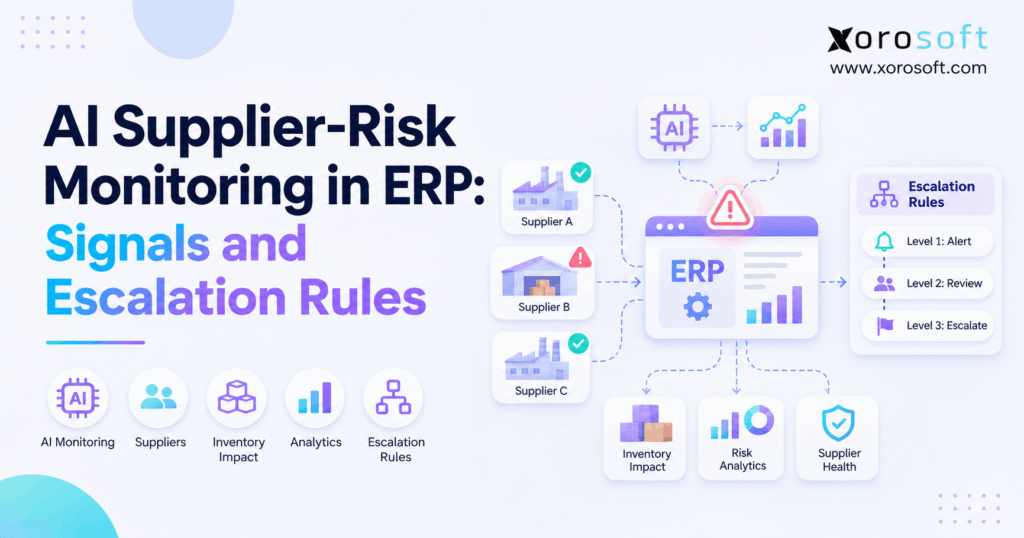
Addressing supplier risk escalation is a key concern for many businesses today.
1. When a Supplier Warning Arrives Before the Shortage
Supplier risk escalation turns early supplier warnings into clear purchasing decisions before delays affect inventory, production, or customer orders. Although an ERP may contain purchase orders and receipts, the business still needs rules for deciding which warning matters, who owns it, and when to act.
For example, a distributor might see supplier lead times increase from 20 to 26 days across several shipments. Meanwhile, its replenishment plan may still assume the original 20-day commitment. As a result, an apparently healthy stock position could hide a shortage that is already forming.
However, sending another alert does not solve the underlying problem. The team needs to verify the signal, determine its impact, and approve a response while options remain available.
1.1 Why a Small Supplier Delay Can Become a Large Problem
Importantly, a five-day delay does not create the same exposure for every product. For instance, a slow-moving item with six weeks of usable inventory may need only a supplier follow-up. In contrast, a popular SKU with four days of coverage could require an urgent stock transfer or revised customer promise.
Similarly, an unavailable component may stop an entire manufacturing order even when the missing material has a modest purchase value. Therefore, procurement cannot judge urgency from supplier performance alone.
Instead, it must connect the warning to demand, inventory, alternative supply, and the time needed to recover. As a result, that connection makes an escalation useful rather than noisy.
1.2 The Five Questions Behind an Actionable Alert
Before routing an alert, purchasing should answer five questions:
- What changed? Identify the late confirmation, short shipment, quality hold, or other signal.
- Is it verified? Check the latest receipts, dates, and supplier communication.
- What is exposed? Identify affected SKUs, warehouses, orders, and financial commitments.
- Who decides? Assign one owner with the right approval authority.
- When is action due? Set an acknowledgment target and a recovery deadline.
Consequently, every meaningful alert becomes a documented decision rather than another unanswered notification.
2. What Supplier Risk Escalation Means in ERP
Supplier risk escalation in ERP is a controlled workflow that moves a verified supplier concern to the appropriate decision-maker according to potential operational impact. It combines warning evidence, inventory exposure, severity, responsibility, response timing, and closure conditions.
2.1 Supplier Monitoring Versus Escalation
First, supplier monitoring asks whether a vendor’s behavior is changing. Therefore, it tracks delivery dates, fill rates, quality issues, lead-time drift, and relevant external events. The separate process of escalation asks whether that change requires a decision now.
For example, monitoring might detect three partial shipments. Yet escalation evaluates whether the missing quantity affects a critical item, whether the next receipt is dependable, and whether an alternate supplier is approved.
As a result, the same warning can lead to different actions at different warehouses. For a broader explanation of early indicators, see the existing guide to AI supplier risk monitoring.
2.2 Who Needs Formal Supplier Risk Escalation?
In particular, formal rules are valuable for wholesalers, ecommerce brands, and manufacturers that handle many SKUs, long replenishment cycles, or several warehouses. Likewise, businesses with seasonal launches, strict customer delivery commitments, or sole-source components face greater consequences when supplier information arrives late.
However, not every company needs continuous AI monitoring. A smaller operation with dependable local vendors and simple purchasing may begin with weekly reviews, basic exception reports, and named decision owners.
Above all, the purpose is proportional control. Therefore, process complexity should match exposure rather than software ambition. Finally, businesses can add automation after they establish reliable data and clear authority.
3. Supplier Risk Signals That Deserve Attention
For this reason, a useful monitoring process examines several categories of evidence. Nevertheless, each signal should be evaluated against recent history, product importance, and the possibility of normal variation.
3.1 Delivery Reliability and Lead-Time Drift
For example, delivery problems often emerge gradually. An expected 18-day lead time may move to 20, 22, and then 25 days. Although no single shipment looks disastrous, the trend can undermine reorder points and safety-stock assumptions.
Therefore, useful measures include actual versus promised delivery dates, missed acknowledgments, repeated ETA changes, and on-time-in-full performance. Compare like-for-like products and shipping routes where possible.
In addition, distinguish the original supplier commitment from its revised date. Otherwise, a vendor that repeatedly postpones delivery may appear on time against an updated promise while the business absorbs the delay.
3.2 Short Shipments, Quality Holds, and Price Changes
A supplier can meet the delivery date but still fail to supply usable stock. For example, a receipt of 800 accepted units against 1,000 due produces an 80% fill rate for that order. Likewise, rejected material may remain physically in the warehouse without being available for fulfillment.
Consequently, monitoring should include short shipment frequency, accepted quantities, inspection failures, backorders, and unexplained purchase-order revisions. Significant pricing changes can also create financial exposure when an urgent replacement order is necessary.
However, approved split deliveries and contractual tolerances should not automatically trigger high-severity incidents. The rules must reflect the agreed purchasing terms.
3.3 Financial, Compliance, and Supplier Concentration Risks
Although internal ERP transactions reveal important patterns, they cannot explain every disruption. For example, credible supplier financial distress, sanctions-related restrictions, cybersecurity incidents, or significant transport interruptions may require a separate investigation.
Additionally, concentration risk matters even when a supplier performs well. If one vendor provides an irreplaceable component, the absence of an approved backup can increase the consequence of a future failure.
The OECD’s due diligence guidance offers a wider framework for identifying and prioritizing risks in business relationships. However, responsible-sourcing assessments and day-to-day delivery alerts serve different purposes; neither should be treated as a substitute for the other.
4. Build an ERP Data Foundation for Supplier Risk Alerts
Supplier risk escalation depends on accurate transaction data before it depends on advanced prediction. Therefore, teams should map the records needed to confirm warnings and calculate their downstream effects.
4.1 Connect Purchase Orders, Supplier Commitments, and Receipts
Start with a consistent record of purchase-order lines, confirmed quantities, original promised dates, revised dates, partial receipts, and outstanding balances. Additionally, capture supplier contacts, lead-time assumptions, and quality outcomes where relevant.
Without those records, the team may mistake an outdated purchase-order date for a current delay. Conversely, an unposted receipt may make an order look overdue after the goods have already arrived.
For example, Xorosoft’s XoroONE purchasing workflows connect supplier information, procurement, replenishment, inventory, and accounting. These documented ERP functions can support risk investigation, although a dedicated AI risk-scoring engine should not be assumed without separate verification.
4.2 Calculate Inventory Exposure Instead of Counting Warnings
More importantly, the business consequence of a warning depends on usable stock and expected demand. For that reason, estimate days of supply using usable available inventory divided by average daily demand. Then compare that coverage with the revised supplier arrival date.
Consider an illustrative example:
| Inventory measure | Example value |
|---|---|
| Usable stock available | 180 units |
| Average daily demand | 20 units |
| Estimated days of supply | 9 days |
| Next dependable receipt | 15 days away |
| Potential coverage gap | 6 days |
Therefore, the buyer should investigate six days of potential exposure, not merely flag a late delivery. However, planners must also check reservations, transfers, promotions, and whether average demand represents the coming period.
4.3 Validate Data Before Escalating Supplier Warnings
First, an alert must be based on current, comparable information. Check supplier IDs, item mappings, units of measure, warehouse locations, and receipt timestamps. Next, review whether a delivery was split by agreement or whether a late scan created a false exception.
Moreover, data-quality checks should identify duplicate purchase orders and unexpected lead-time values before they enter a scoring model. Otherwise, an apparently precise risk score may simply hide poor source records.
For important warnings, request confirmation from the supplier and document what was learned. Consequently, the next owner receives an evidence-based case rather than an unexplained algorithmic label.
5. Design a Supplier Risk Escalation Matrix
A supplier risk escalation matrix translates verified evidence into severity, ownership, and deadlines. Instead of applying one rule to every supplier, begin with a simple model that teams can explain and adjust.
5.1 Score Likelihood, Operational Impact, and Urgency
A starting framework can multiply likelihood by business impact on a one-to-five scale. For instance, likelihood four and impact five produce an illustrative score of 20 out of 25. However, urgency should remain a separate override because a production shutdown tomorrow may require immediate action despite limited historical evidence.
In addition, severity should reflect item criticality, days of stock, customer commitments, alternate sources, and recovery time. For a supplier serving several warehouses, calculate exposure by location before consolidating the decision.
The objective is consistent prioritization, not mathematical certainty. Therefore, publish the scoring definitions so buyers and operations leaders understand why one issue is more urgent than another.
5.2 Supplier Risk Escalation Levels and Response Rules
The following matrix is an illustrative company policy, not a universal industry standard:
| Level | Example condition | Accountable owner | Example acknowledgment target |
|---|---|---|---|
| Watch | Performance drift with adequate stock | Buyer | 2 business days |
| Elevated | Repeated delays affecting replenishment | Purchasing lead | 1 business day |
| High | Confirmed threat to an important SKU | Procurement manager | 4 business hours |
| Critical | Imminent outage with no practical alternative | Operations leader | Immediately |
Importantly, acknowledgment differs from resolution. A critical owner may accept the incident immediately while a recovery plan still takes several days to execute.
Likewise, time targets should match operating hours, supplier time zones, and contractual obligations. Review actual incidents before adopting tighter thresholds.
5.3 Override Rules and the Cost of False Alerts
Nevertheless, some warnings deserve immediate review regardless of the score. Examples include a safety hold, a sole-source material shortage, an urgent customer commitment, or a supplier restriction requiring compliance attention.
On the other hand, repeated minor fluctuations can overwhelm buyers when every exception creates a new task. Therefore, group related alerts, suppress duplicates, and include inventory exposure before raising severity.
Xorosoft’s purchasing and reporting information can help teams evaluate lead-time, fill-rate, and replenishment conditions in a connected environment. However, the precise escalation policy, AI model, and notification routing need to be validated for the intended implementation.
Free ERP Readiness Assessment: Before introducing predictive monitoring, assess whether purchasing, inventory, approvals, and supplier records are reliable enough to support controlled decisions.
6. Use AI Supplier Risk Monitoring Without Blind Trust
AI can help identify patterns that fixed thresholds miss. Nevertheless, supplier risk escalation needs transparent rules and accountable reviewers even when detection becomes more sophisticated.
6.1 Start With Rules-Based Procurement Risk Alerts
First, use repeatable conditions such as an overdue purchase-order acknowledgment, a confirmed receipt shortage, or a projected inventory gap. For example, a rule might notify the buyer when a revised supplier arrival falls after the date usable stock is expected to run out.
Because the conditions are explicit, teams can explain the alert and inspect the underlying transaction. Additionally, straightforward thresholds are usually easier to test when historical data is limited.
However, avoid a single static threshold for every supplier. An imported product with a long transit cycle behaves differently from a nearby vendor that delivers several times each week.
6.2 Where AI Can Add Practical Value
In addition, AI-assisted models may identify unusual combinations of changes across delivery timing, fill rates, quality issues, and demand. For instance, several individually modest variations may together suggest that a supplier’s operating pattern is deteriorating.
In addition, a model may help prioritize which exception deserves investigation first when hundreds of purchasing lines change daily. Still, predictive outputs depend on training data, model design, current operating conditions, and ongoing testing.
Therefore, treat a model-generated signal as a hypothesis to verify. AI should explain the supporting factors where feasible, while buyers retain access to the original purchase orders and receipts.
6.3 Keep Human Approval and AI Governance Visible
Therefore, a high-risk prediction should not independently suspend a supplier, cancel a major order, or authorize expensive freight. Instead, define which low-risk tasks may be automated and which decisions require purchasing, finance, quality, or executive approval.
The NIST AI Risk Management Framework offers useful governance principles around mapping, measuring, managing, and overseeing AI risks. Although it does not prescribe procurement thresholds, its emphasis on ongoing review applies to predictive supplier alerts.
Consequently, log model or rule versions, evidence reviewed, overrides, and final outcomes. This creates a basis for checking whether the monitoring system improves decisions over time.
7. Define Ownership for Supplier Risk Escalation
Even a correct alert fails when responsibility is unclear. Therefore, supplier risk escalation should establish one accountable owner, supporting roles, escalation authority, and a backup for each severity level.
7.1 Assign the Buyer, Planner, and Decision-Maker
Buyers typically confirm supplier commitments and request recovery options. Meanwhile, inventory planners calculate stock exposure, warehouse teams verify receipts, and quality teams assess rejected material.
A simple assignment table makes those responsibilities easier to apply:
| Decision or task | Primary owner | Required support |
|---|---|---|
| Verify supplier commitment | Purchasing buyer | Supplier contact |
| Assess stock coverage | Inventory planner | Warehouse |
| Review rejected product | Quality lead | Receiving |
| Approve alternate source | Procurement manager | Quality and operations |
| Approve major spending exception | Authorized manager | Finance |
| Close incident | Assigned case owner | Affected teams |
Consequently, the case remains owned even when several departments contribute. Shared visibility should not mean shared ambiguity.
7.2 Escalate Financial and Customer Exposure Properly
However, supplier recovery plans can create new costs. For example, an expedited shipment may prevent a stockout but reduce order margin. Similarly, prepaying an unfamiliar alternate supplier can introduce cash-flow and fraud exposure.
Therefore, finance should approve material spending exceptions according to existing authorization limits. Sales or customer service may also need to adjust promises when recovery cannot meet committed dates.
Xorosoft supports connected purchasing, accounting, and operational reporting workflows that can help teams review these tradeoffs. Nonetheless, each business must define who can approve exceptions and how those decisions are recorded.
7.3 Set Acknowledgment Targets and Backup Ownership
An escalation requires two clocks: time to acknowledge and time to complete the next approved action. For instance, a buyer might accept an Elevated warning within one business day but need longer to obtain a revised commitment from an overseas supplier.
However, a Critical warning should route to a designated backup when the primary owner is unavailable. In addition, teams should define what happens when an acknowledgment is missed.
As a result, the process remains reliable during weekends, holidays, and staff changes without broadcasting every alert to senior leadership.
8. Run a Six-Step Supplier Risk Escalation Workflow
The most effective supplier risk escalation workflow connects detection, validation, exposure assessment, ownership, action, and closure. Therefore, the team should apply the same core sequence across suppliers while adapting responses to individual situations.
8.1 Steps One and Two: Detect and Verify
Step 1 — Detect: Identify late confirmations, lead-time drift, quality exceptions, short receipts, or credible external warnings. Then record the event date, supplier, related purchase orders, and original data source.
Step 2 — Verify: Check whether the warning reflects a real change. For example, reconcile warehouse receipts before concluding that an order is missing, and contact the supplier when a delivery promise is uncertain.
Therefore, only verified or explicitly marked provisional warnings should move to consequential decisions. Otherwise, downstream teams may act on stale or incorrect information.
8.2 Steps Three and Four: Assess and Assign
Step 3 — Assess: Compare the supplier issue with usable stock, demand, inbound quantities, manufacturing needs, and committed orders. Additionally, note alternative supply and the time required to recover.
Step 4 — Assign: Apply the severity matrix and appoint one accountable owner. Then notify supporting departments according to the risk, not simply because they subscribe to a shared email list.
For example, a short shipment affecting a noncritical product may stay with the buyer. In contrast, a sole-source material shortage that threatens tomorrow’s production requires immediate coordination with operations.
8.3 Steps Five and Six: Act, Document, and Close
Step 5 — Act: Obtain approved recovery commitments. For example, options may include partial delivery, stock transfer, alternate sourcing, revised purchase quantities, or customer communication. However, do not bypass spending or quality controls merely because an alert is urgent.
Step 6 — Close: Confirm that the intended response actually resolved the exposure. Record the final supplier commitment, inventory adjustment, approvals, and affected orders.
Xorosoft’s connected ERP and inventory workflows can support visibility into the transactions behind these decisions. However, organizations should confirm any required incident-case management or automatic AI escalation separately rather than assuming it is native.
Watch Demo: When evaluating an ERP, ask to see the complete purchasing-to-receiving-to-reporting process using a realistic delayed-supplier scenario, not only a dashboard screenshot.
9. Apply Supplier Risk Escalation Across Industries
The right alert depends on how a disruption affects the business model. Therefore, supplier warning rules should reflect seasonal demand, production dependencies, warehouse placement, and customer commitments.
9.1 Apparel and Sporting Goods: Seasonal Inventory
Apparel suppliers often deliver assortments tied to launches, promotional calendars, and seasonal selling windows. Consequently, a delay may reduce the useful selling period even when the products eventually arrive in full.
For example, a footwear shipment scheduled before a holiday campaign may be much more urgent than an identical delay for evergreen accessories. The escalation owner should therefore examine promotional demand, sales-channel commitments, and current stock by size and color.
Similarly, sporting goods businesses can face short peaks around events and holidays. Because demand is concentrated, planners should escalate against the selling window rather than only the supplier’s average delivery performance.
9.2 Furniture and Wholesale: Long Replenishment Cycles
Furniture procurement frequently involves long production and transport timelines. Therefore, a small increase in supplier lead time can become difficult to recover once customer orders accumulate.
Wholesale distributors face another challenge when one incoming shipment supports several customer accounts or warehouse locations. Consequently, a late purchase order can affect allocations, EDI commitments, and fulfillment priorities at the same time.
Xorosoft’s multi-warehouse inventory and order-management capabilities are relevant when evaluating that exposure. However, teams still need specific rules for reprioritizing customer orders, approving transfers, and communicating revised delivery commitments.
9.3 Food and Manufacturing: Usable Stock Matters
Food businesses need to distinguish physical receipts from inventory released for sale. For example, a shipment may arrive yet remain unavailable because a lot is under inspection or requires additional checks.
Manufacturers face a related issue when one missing component blocks an entire work order. Therefore, the risk assessment should consider bills of materials, required production dates, substitute components, and approved quality status.
In addition, connected warehouse management helps teams examine receiving and location-level inventory activity. Nevertheless, quality decisions and production priorities must remain with the appropriate operational owners.
10. Compare Manual, Rules-Based, and AI-Assisted Approaches
Companies do not need to buy sophisticated risk technology before they understand their operational requirements. Instead, compare approaches by explainability, data needs, maintenance effort, and decision authority.
10.1 Supplier Monitoring Approaches Compared
| Approach | Strength | Limitation | Suitable situation |
|---|---|---|---|
| Manual review | Simple and easy to explain | Depends on staff attention | Low supplier complexity |
| Rules-based ERP alerts | Consistent, testable thresholds | Can miss combined patterns | Repeatable purchasing exceptions |
| AI-assisted analysis | Can detect complex trends | Needs data quality and governance | High-volume, varied supplier data |
| Hybrid process | Combines clear rules and deeper analysis | Requires coordinated oversight | Growing multi-channel operations |
Therefore, begin with processes the team can operate reliably. Instead, advanced AI should strengthen that foundation, not replace it.
10.2 Alternatives When Advanced AI Is Not Necessary
A practical alternative is a weekly supplier scorecard with defined delivery, fill-rate, and quality measures. In addition, a daily open-purchase-order exception report can identify urgent confirmations and receipts.
As transaction volume increases, rules-based ERP reports and scheduled reviews may support more timely action. For companies selling across ecommerce channels, connected integrations can also reduce manual data handoffs between demand, orders, and purchasing workflows.
However, verify which integrations and automation steps apply to the actual environment. A complex AI model adds little value when basic receipts and supplier dates remain unreliable.
11. Measure Results and Correct Supplier Risk Mistakes
A strong process should improve response quality, not simply produce more notifications. Therefore, track a compact set of measures and review what happened after each serious incident.
11.1 Supplier Risk Escalation KPIs That Matter
| KPI | Practical definition |
|---|---|
| Alert validation rate | Confirmed actionable alerts ÷ alerts reviewed |
| False-alert rate | Non-actionable alerts ÷ alerts reviewed |
| Acknowledgment time | Elapsed time from assignment to owner acceptance |
| Resolution time | Elapsed time from validated event to closure |
| Repeat incident rate | Recurring supplier issues over the chosen period |
| Impacted-order rate | Orders affected by validated supplier disruptions |
For example, a lower false-alert rate is useful only when the process still detects important problems. Likewise, faster acknowledgment is not enough when no corrective action follows.
Therefore, review measures together, with consistent definitions and reporting periods. Use operational reporting to evaluate how supplier and inventory performance relates to broader process improvements.
11.2 Common Supplier Risk Escalation Mistakes
First, avoid treating every late delivery as critical. Without inventory exposure, the team may spend heavily to solve a harmless delay. Second, do not rely on an AI confidence score as proof that a supplier will fail.
Likewise, avoid sending alerts to many departments without assigning one owner. Missing backup coverage can leave urgent warnings untouched. Another common mistake is closing cases after contacting the supplier rather than verifying the recovery outcome.
Finally, do not assume external data is always correct or timely. Verify material claims and preserve the source and date. Consequently, the process remains defensible when decisions are later reviewed.
11.3 A Practical Four-Week Implementation Sequence
Week 1: Map supplier records, open purchase orders, receipt accuracy, affected warehouses, and existing approval rules. Then identify the most costly recurring disruption types.
Week 2: Define three to five reliable signals and create the severity matrix. In addition, appoint primary and backup owners for each level.
Week 3: Test alerts against recent historical cases. Review false positives, missed events, and whether owners could act before stock was exhausted.
Week 4: Pilot the workflow with critical suppliers, then revise thresholds and escalation timing. As a result, the business learns what works before expanding monitoring across every vendor.
12. Know When ERP-Based Supplier Risk Escalation Is Worth Upgrading
For example, an upgrade becomes relevant when supplier warnings cannot be linked to reliable purchasing, inventory, and operational information quickly enough to act. However, clearer ownership and cleaner records should come before major software changes.
12.1 Warning Signs That Spreadsheets No Longer Scale
Frequent manual reconciliation, inconsistent supplier lead times, and duplicate data entry often indicate that procurement processes have outgrown spreadsheets. Additionally, teams may struggle to match partial receipts with open orders or determine available stock across warehouses.
As a result, buying decisions rely on delayed updates, and emergency replenishment becomes common. These problems can intensify for Shopify and Amazon sellers, wholesale distributors, and manufacturers with changing demand.
Nevertheless, replacing spreadsheets without standardizing supplier IDs, receiving rules, and approval ownership may recreate the same gaps in a more expensive environment.
12.2 Evaluate Connected ERP Capabilities Before AI Features
First, evaluate purchasing, supplier records, inventory availability, multi-location visibility, replenishment, accounting, and reporting. Then assess whether the system can explain open quantities, partial receipts, and the financial consequences of recovery actions.
For example, Xorosoft combines these connected capabilities in a cloud ERP environment for inventory-driven operations. Accordingly, it can provide relevant transaction visibility for supplier-risk decisions, while any dedicated predictive scoring, external risk feeds, or automated incident routing must be verified separately.
Finally, evaluate integration effort, authorization controls, data access, testing, and ownership. The best platform supports the process the business can actually maintain.
13. Turn Supplier Warnings Into Decisions Before They Become Shortages
Supplier risk escalation works when the business moves from identifying a warning to verifying exposure, assigning one owner, approving a response, and confirming closure. Therefore, begin with dependable purchasing and inventory data, then add rules and AI where they improve decisions.
Above all, protect human review for consequential supplier and spending actions. A timely, explainable response is more valuable than a large volume of unowned alerts.
For teams seeking connected purchasing, inventory, accounting, and warehouse visibility, Xorosoft provides an ERP foundation worth evaluating against real operational requirements.
Book a Demo: Book a personalized ERP discovery and demonstration to review the purchasing, receiving, inventory, and reporting workflows relevant to your business.
Frequently Asked Questions
What is supplier risk escalation in ERP?
It is the process of verifying supplier warnings, judging their impact on stock and orders, assigning an accountable owner, and recording approved action before a disruption grows.
Which supplier signals should trigger an alert?
Track late purchase orders, lead-time drift, short shipments, quality holds, missing confirmations, and concentration risk. Escalate when those signals threaten inventory, production, or customer commitments.
How does AI support supplier risk monitoring?
AI can flag unusual combinations of delivery, quality, and purchasing changes. However, teams should verify the evidence and approve important actions rather than treating model predictions as facts.
How are supplier risk escalation levels defined?
Set levels such as Watch, Elevated, High, and Critical using delivery reliability, inventory coverage, operational impact, and urgency. Assign each level an owner and response deadline.
Who should own critical supplier risk alerts?
A designated procurement owner should coordinate the case, while inventory, quality, finance, or operations leaders approve decisions within their authority. Every critical alert also needs a backup owner.
Can supplier risk escalation work without AI?
Yes. Consistent ERP records, rules-based alerts, clear ownership, and documented approvals often provide a strong starting point. AI becomes useful when patterns and transaction volumes justify it.
When should a company upgrade its supplier risk process?
Consider an upgrade when teams repeatedly reconcile spreadsheets, miss supplier commitments, or cannot connect risks to open orders and warehouse stock. Improve data quality and decision rules first.
Recent Posts
-
 How an Ecommerce Warehouse Reduced Late Orders With Controlled Wave Release
-
 Why BOM Version Errors Create Material Shortages and Cost Variances
-
 AI Supplier-Risk Monitoring in ERP: Signals and Escalation Rules
-
 MRP Software for High-Mix, Low-Volume Manufacturing
-
 ERP Selection Scorecard for Inventory, Warehouse, Purchasing, and Finance Teams