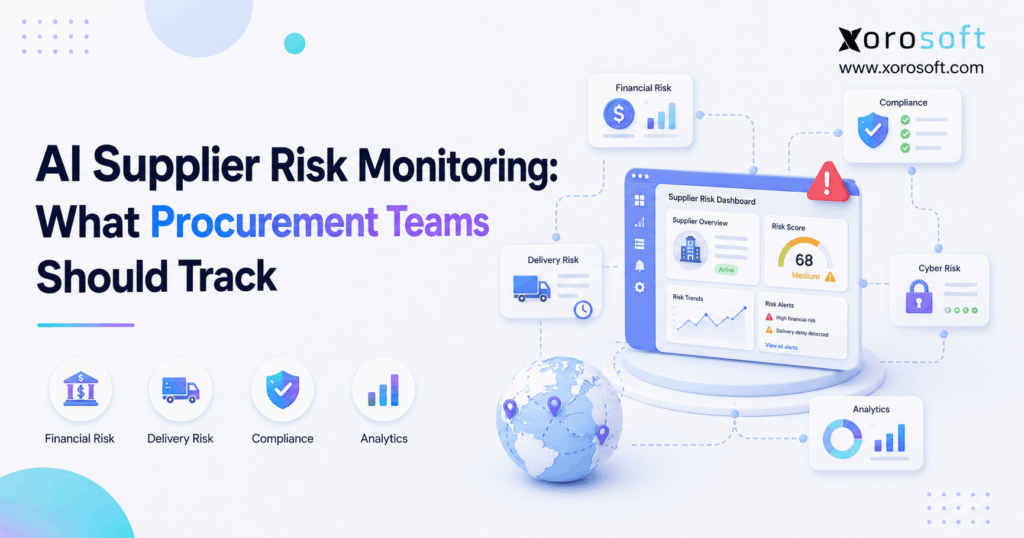
AI supplier risk monitoring is becoming increasingly important for organizations seeking to proactively manage third-party vulnerabilities and ensure business continuity.
1. Supplier Trouble Usually Starts With Small Signals
Supplier problems rarely begin with one dramatic event. Instead, the warning signs often appear slowly.
For example, a supplier that normally delivers in 25 days may start taking 28 days. Then, lead times may move to 31 days. Meanwhile, partial shipments may become more common. In addition, prices may change more often, while emails take longer to answer.
At first, none of these changes may look serious. However, when several changes happen together, they can point to a growing supplier problem.
That is where AI supplier risk monitoring becomes useful.
Instead of waiting until an order is late, procurement teams can watch supplier data as conditions change. Therefore, teams can spot unusual patterns earlier and decide whether they need to act.
However, the goal is not to create hundreds of alerts. Instead, the goal is to show procurement which changes may affect inventory, production, customers, or cash flow.
For that reason, a useful monitoring process must answer four simple questions:
- What changed?
- How serious is the change?
- What part of the business is exposed?
- What should procurement do next?
As a result, AI becomes most useful when it supports a clear supplier risk process rather than replacing one.
2. What AI Supplier Risk Monitoring Actually Does
AI supplier risk monitoring uses software, data, and automated analysis to find signs that a supplier may create future problems.
Therefore, it can help procurement teams review far more information than they could check by hand.
2.1 How AI Supplier Risk Monitoring Turns Data Into Warnings
First, the system collects supplier information.
For example, it may use:
- purchase order history
- requested delivery dates
- actual delivery dates
- lead times
- fill rates
- product quality
- supplier prices
- inventory levels
- open purchase orders
- supplier locations
- financial data
- news
- weather events
- legal events
- sanctions data
- cyber events
Next, the system looks for patterns.
For example, it may notice that a supplier’s normal lead time is 21 days. However, if recent orders take 27, 31, and 34 days, the pattern has changed.
Then, the system can flag the change for review.
Therefore, AI supplier risk monitoring can help teams move from:
Problem → Reaction
to:
Signal → Review → Action
2.2 Continuous Supplier Monitoring vs Periodic Reviews
Traditional supplier reviews are still useful. However, they often take place monthly, quarterly, or annually.
As a result, a supplier may look healthy during an annual review but develop problems two months later.
Continuous supplier monitoring fills that gap.
| Area | Periodic Review | Continuous Monitoring |
|---|---|---|
| Timing | Monthly, quarterly, or annual | Ongoing |
| Data | Point-in-time | Updated as conditions change |
| Main input | Forms and reviews | Business data plus outside signals |
| Main goal | Check status | Find early warning signs |
| Scale | Often manual | More automated |
| Alerts | Limited | Can be automatic |
| Human review | Required | Still required |
Therefore, the two methods should work together.
Periodic reviews provide structure. Meanwhile, continuous monitoring can highlight changes between those reviews.
2.3 AI Does Not Replace Procurement Judgment
AI can process large amounts of data quickly. However, it does not know every detail of a supplier relationship.
For example, a late shipment may look risky. Still, procurement may know that the delay was planned because the buyer changed the order.
Likewise, negative news about a supplier’s country may appear serious. However, the supplier’s actual factory may be far from the affected region.
Therefore, AI should help people focus their attention. It should not make every supplier decision on its own.
3. Why Procurement Teams Need Supplier Risk Monitoring
Supplier risk can affect almost every part of an inventory-driven business.
For example, one supplier problem can cause:
- stockouts
- production delays
- backorders
- missed customer dates
- rush freight
- higher buying costs
- excess safety stock
- lost sales
- weak margins
- cash flow pressure
Therefore, procurement teams need more than a list of supplier names and purchase orders.
They need context.
3.1 Supplier Risk Is Also Inventory Risk
Suppose Supplier A has a major disruption.
At first, that sounds serious. However, the true business risk depends on inventory.
For example, if the company has eight months of stock, procurement may have time to respond.
On the other hand, if only six days of inventory remain, the same supplier event may require immediate action.
Therefore, supplier risk should be connected to inventory coverage.
3.2 Supplier Risk Is Also Revenue Risk
Likewise, not every SKU has the same business value.
For example, a supplier may provide a low-cost component that is required for the company’s best-selling product.
Therefore, the supplier’s annual spend may look small even though its business impact is large.
As a result, procurement should ask:
- Which products depend on this supplier?
- How much sales revenue depends on those products?
- How much stock is available?
- Are other suppliers approved?
- How long would a new source take?
3.3 Better Visibility Creates More Response Options
According to Deloitte’s 2025 Global Chief Procurement Officer Survey, many procurement leaders identified alternate supply sources, better supply chain visibility, and stronger supplier information sharing as important risk actions.
Therefore, early visibility is valuable because it gives teams more choices.
For example, a team may be able to:
- place an order earlier
- move volume to another supplier
- increase safety stock
- change production plans
- change inventory allocation
- contact important customers
- approve an alternate item
However, once inventory reaches zero, many of those options disappear.
4. What AI Supplier Risk Monitoring Should Track
AI supplier risk monitoring works best when teams track several types of risk instead of relying on one general supplier score.
Therefore, procurement should separate supplier risk into clear groups.
4.1 Financial Supplier Risk
Financial stress may affect a supplier’s ability to buy raw materials, keep staff, maintain equipment, or fund production.
Therefore, procurement may want to watch for:
- falling credit quality
- cash pressure
- late payments
- legal claims
- major losses
- bankruptcy reports
- sudden ownership changes
However, one financial warning should not automatically trigger a supplier change.
Instead, procurement should combine it with other evidence.
4.2 Delivery and Lead-Time Risk
Delivery data is often one of the strongest internal warning signals.
Therefore, procurement should track:
- on-time delivery
- average lead time
- lead-time changes
- lead-time variance
- missed ship dates
- late confirmations
- partial shipments
- short shipments
For example, average lead time may still look acceptable while lead-time variation rises sharply.
As a result, the supplier becomes harder to plan around even before the average looks bad.
4.3 Quality Risk
Quality problems can also point to deeper issues.
For example, a rise in defects may result from:
- staff changes
- weaker process control
- new materials
- production pressure
- equipment issues
- new factories
- rushed output
Therefore, teams should track both the defect rate and the direction of the trend.
4.4 Capacity Risk
A supplier may be healthy but still lack enough capacity.
For example, demand may rise faster than expected.
As a result, the supplier may start:
- extending lead times
- splitting shipments
- reducing confirmed quantities
- changing delivery dates
Therefore, procurement should not assume that good past performance guarantees future capacity.
4.5 Compliance Risk
Compliance risk can affect whether a company can continue buying, importing, or selling certain goods.
Therefore, teams may need to monitor:
- product rules
- supplier certificates
- labor requirements
- trade restrictions
- import rules
- sanctions
- environmental rules
In addition, the OECD’s risk-based due diligence guidance recommends that businesses assess and address important risks across their operations, supply chains, and business relationships.
4.6 Cyber Supplier Risk
Digital suppliers and connected systems can introduce another type of risk.
Therefore, cyber risk should be part of supplier review when a vendor has access to systems, data, networks, or important technology.
For example, NIST’s July 2026 Cybersecurity Supply Chain Risk Management Due Diligence Guide stresses the need to research supplier risk before and during important buying decisions.
As a result, procurement, IT, and security teams may need to work together.
4.7 Geographic and Political Risk
A supplier may depend on one factory, port, region, or border crossing.
Therefore, procurement should understand where important products actually come from.
For example, teams may track:
- political unrest
- border closures
- port problems
- trade limits
- tariffs
- war
- local strikes
However, location alone does not show the full risk.
Instead, the team should connect the event with the exact supplier, factory, route, product, and inventory position.
4.8 Supplier Concentration Risk
A strong supplier can still create high risk when the business depends on it too much.
For example, one supplier may provide 85% of an important item.
Therefore, even perfect delivery history does not remove the risk.
Instead, procurement should track dependency as well as performance.
5. Supplier Risk Indicators Hidden Inside Daily Operations
Many useful warning signs already exist inside purchasing and inventory data.
Therefore, procurement teams should start with the data they already create.
5.1 On-Time Delivery
First, measure how often suppliers meet agreed dates.
However, do not look only at the current percentage.
Instead, compare recent performance with the supplier’s normal level.
For example, a move from 98% to 91% and then 84% may matter more than one late delivery.
5.2 Lead-Time Variance
Next, track how stable lead times are.
For example:
Supplier A delivers in:
29, 30, 30, 31, 30 days.
Supplier B delivers in:
19, 42, 24, 38, 27 days.
Both suppliers may have a similar average. However, Supplier B is much harder to plan around.
Therefore, lead-time variance can be as important as average lead time.
5.3 Fill Rate and Partial Shipments
In addition, watch whether suppliers send the full quantity ordered.
For example, frequent partial shipments may point to:
- stock shortages
- capacity limits
- material shortages
- planning problems
Therefore, fill-rate decline deserves attention.
5.4 Purchase Order Changes
Likewise, repeated changes can show growing risk.
Track changes to:
- expected dates
- confirmed quantities
- product substitutions
- shipment plans
- prices
Because each change affects planning, a rise in changes can increase risk even when orders eventually arrive.
5.5 Supplier Price Changes
Price changes are not always a risk signal.
However, sudden or repeated changes may point to:
- material cost pressure
- limited supply
- freight problems
- currency movement
- supplier cash pressure
Therefore, procurement should review price changes alongside other data.
6. How Connected ERP Data Strengthens Supplier Risk Monitoring
Once a business grows, supplier information often spreads across emails, spreadsheets, accounting software, warehouse tools, and ecommerce systems.
As a result, procurement may see the supplier problem but still struggle to measure its impact.
This is where connected ERP data becomes useful.
For example, XoroERP brings purchasing, vendor management, inventory, warehouse work, manufacturing, finance, and reporting into one system.
Therefore, teams can connect a supplier issue with the rest of the business.
6.1 Connect Supplier Risk With Open Purchase Orders
First, procurement should know:
- which purchase orders are open
- which orders are late
- what quantities are still due
- which products are affected
- when goods are expected
As a result, the team can focus on real exposure instead of a general supplier warning.
6.2 Connect Supplier Risk With Inventory
Next, the team should check:
- inventory on hand
- available inventory
- allocated inventory
- incoming inventory
- stock by warehouse
- demand
A connected platform such as XoroONE can bring purchasing, inventory, accounting, warehouse work, ecommerce, EDI, manufacturing, and forecasting into the same operating environment.
Therefore, teams have more context when supplier conditions change.
6.3 Connect Supplier Risk With Warehouse Operations
Warehouse data matters as well.
For example, goods may have arrived but still be waiting for receiving, inspection, or putaway.
Therefore, procurement should not assume that every inbound unit is ready to sell.
For businesses with more complex warehouse operations, XoroWMS can connect receiving, warehouse work, picking, packing, and shipping with inventory control.
As a result, supplier decisions can use a clearer view of what is physically available.
7. Internal Data and Outside Supplier Risk Signals Should Work Together
Internal data answers one question:
How is the supplier performing for us?
External data answers another:
What is changing around the supplier?
Therefore, a strong AI supplier risk monitoring process should use both.
| Internal Signals | Outside Signals |
| Late orders | Financial news |
| Lead-time changes | Legal events |
| Fill-rate decline | Sanctions |
| Quality problems | Severe weather |
| Price changes | Cyber incidents |
| PO changes | Political events |
| Inventory exposure | Factory shutdowns |
| Supplier dependency | Labor disputes |
However, more data does not always mean better decisions.
Instead, teams need clean data and clear rules.
7.1 Data Connections Matter
For example, supplier information may come from ERP, ecommerce, EDI, warehouse, and finance systems.
Therefore, reliable ERP integrations can reduce gaps between those systems.
As a result, teams spend less time joining data by hand.
7.2 AI Needs Clean Supplier Records
AI cannot fix every data problem.
For example, if the same supplier appears under three different names, the system may split its history.
Likewise, old lead times or missing item-vendor records can weaken the result.
Therefore, supplier master data should include clear:
- supplier names
- addresses
- contacts
- lead times
- items
- payment terms
- locations
- supplier status
8. How AI Supplier Risk Monitoring Builds an Early Warning
AI does not need to know the future with certainty to be useful.
Instead, it needs to find changes early enough for people to investigate.
8.1 Establish a Normal Pattern
First, the system needs a baseline.
For example, a supplier may normally have:
- 96% on-time delivery
- 24-day lead time
- 2% defect rate
- 98% fill rate
Therefore, those values help define normal behavior.
8.2 Detect a Change
Next, the system looks for unusual movement.
For example:
- on-time delivery falls to 86%
- lead time rises to 31 days
- defects rise to 5%
- fill rate falls to 91%
As a result, the supplier’s pattern has clearly changed.
8.3 Add Outside Context
Meanwhile, the system may find outside news about a factory issue or labor dispute.
Therefore, the internal and external signals support each other.
8.4 Rank the Risk
Finally, the system should ask whether the supplier actually matters to the business.
For example, an alert becomes more important when:
- the supplier is the only approved source
- inventory is low
- lead time is long
- the item drives high sales
- no replacement is ready
Therefore, risk ranking should include business impact.
9. Building a Supplier Risk Score Procurement Can Use
There is no single risk formula that fits every company.
However, a simple model can help teams start.
A useful concept is:
Supplier Risk = Likelihood × Impact × Exposure
9.1 Likelihood
First, estimate how likely a problem is.
For example, use recent:
- delivery changes
- financial signs
- quality trends
- external events
9.2 Impact
Second, estimate what would happen if the supplier failed to deliver.
For example, would the company lose:
- a low-selling item
- a major product
- a production line
- a key customer order
9.3 Exposure
Third, measure how much of the business depends on the supplier.
For example, review:
- units required
- inventory coverage
- sales demand
- open orders
- purchase spend
- warehouse needs
9.4 Simple Risk Levels
A company might use:
Low Risk: Normal monitoring.
Medium Risk: Review the trend.
High Risk: Build a backup plan.
Critical Risk: Act now.
However, each company should set its own rules.
Therefore, the score should guide attention rather than become a rigid decision.
10. Which Suppliers Need the Closest Monitoring?
Not every vendor needs the same level of attention.
Therefore, procurement should use a risk-based approach.
10.1 Sole-Source Suppliers
First, monitor suppliers with no approved backup source.
Because alternatives are limited, even a small warning may matter.
10.2 Long-Lead-Time Suppliers
Second, watch suppliers with long replenishment cycles.
Because replacement stock takes longer to arrive, the business has less room to react.
10.3 High-Revenue Product Suppliers
In addition, monitor suppliers tied to important products.
For example, a low-cost part may support a high-value finished product.
Therefore, supplier spend alone does not show true importance.
10.4 Multi-Warehouse Suppliers
Likewise, suppliers feeding several sites may create wider risk.
Therefore, procurement should understand where inventory sits across the network.
10.5 Manufacturing-Critical Suppliers
Manufacturers should also identify materials that can stop production.
For example, one missing component can delay a full bill of materials.
As a result, supplier risk should connect directly with production plans.
11. What Procurement Should Do When a Risk Alert Appears
An alert is only useful when it leads to a clear process.
Therefore, procurement should define the response before problems happen.
11.1 Verify the Alert
First, check whether the information is correct.
Confirm:
- the supplier
- the location
- the date
- the source
- the affected item
- the event
Because false matches can happen, this step is essential.
11.2 Measure Inventory Exposure
Next, check available stock.
For example:
- How much is on hand?
- How much is committed?
- What is inbound?
- What is forecast?
- Which warehouses have stock?
Therefore, the team can understand how quickly the event could become a problem.
11.3 Contact the Supplier
Then, speak with the supplier.
For example, ask:
- Is production affected?
- Which orders may be late?
- How long could the issue last?
- Can another factory produce the item?
- Can the supplier ship part of the order sooner?
As a result, procurement gains direct context.
11.4 Review Backup Sources
Meanwhile, check alternate suppliers.
For example:
- Is another vendor approved?
- What is its lead time?
- Can it meet the spec?
- What is the price?
- How quickly can it ship?
Therefore, teams can compare the cost of switching with the cost of waiting.
11.5 Update Purchasing and Inventory Plans
Finally, change the plan if needed.
For example, procurement may:
- place orders earlier
- split volume
- increase safety stock
- change reorder points
- move stock between warehouses
- use a substitute item
Consequently, the response becomes part of normal planning rather than a separate crisis process.
12. Where AI Fits Into Modern Procurement Operations
AI works best when it can access useful business context.
Therefore, it should connect with normal operating data rather than sit alone.
For example, Xorosoft supports inventory-driven companies that need purchasing, inventory, warehouse, finance, manufacturing, ecommerce, and reporting in a connected environment.
In addition, businesses using AI tools may need a safe way to connect those tools with approved business data. Xorosoft’s AI MCP Server is relevant when teams are exploring ways to connect AI systems with ERP information through controlled interfaces.
However, AI access should always follow clear permissions and business rules.
Therefore, teams should decide:
- what data AI can read
- what users can see
- what actions require approval
- which alerts need human review
- how decisions are logged
13. AI Supplier Risk Monitoring Across Inventory-Driven Industries
Supplier risk looks different across industries.
Therefore, the same scoring model should not be copied everywhere.
13.1 Apparel and Fashion
Apparel companies often work with seasonal products and overseas suppliers.
Therefore, timing matters heavily.
For example, a delivery that arrives six weeks late may miss an entire selling season.
As a result, apparel teams should closely watch:
- production dates
- material delays
- factory capacity
- lead times
- quality
- shipping routes
13.2 Wholesale Distribution
Distributors may manage thousands of items from many suppliers.
Therefore, they need to rank suppliers by business impact.
For example, useful signals include:
- fill rate
- lead-time variance
- purchase concentration
- open orders
- stock coverage
13.3 Furniture
Furniture often involves long lead times and bulky stock.
Therefore, a supplier delay can tie up both customer orders and working capital.
In addition, imported furniture may depend on long ocean routes.
As a result, inbound visibility becomes important.
13.4 Sporting Goods
Sporting goods businesses can face strong seasonal demand.
Therefore, a supplier delay before a peak season may create much more risk than the same delay later in the year.
13.5 Food and Beverage
Food companies may also need to track:
- shelf life
- lot data
- certificates
- quality
- supplier dates
- storage needs
Therefore, risk monitoring may need both buying and product-control data.
13.6 Manufacturing
Manufacturers need to connect suppliers with production needs.
For example, one low-cost part may appear in many finished products.
As a result, a shortage of that part can stop several work orders.
Businesses can review Xorosoft’s broader industry ERP use cases to see how inventory, purchasing, warehouse, and production needs vary across operating models.
14. Common AI Supplier Risk Monitoring Mistakes
Even good technology can produce weak results when the process is poor.
Therefore, teams should avoid several common mistakes.
14.1 Tracking Every Supplier the Same Way
First, avoid equal monitoring for every supplier.
Instead, focus on suppliers with the highest impact.
14.2 Relying on One Risk Score
Second, do not hide every issue inside one number.
For example, a score of 72 means little unless the team knows whether the risk comes from delivery, finance, quality, or another cause.
Therefore, show the reason behind the score.
14.3 Ignoring Inventory Exposure
Third, never review supplier risk without checking stock.
Because inventory changes urgency, the same warning can require very different action.
14.4 Using Poor Supplier Data
In addition, do not expect AI to overcome weak records.
Therefore, clean supplier, item, location, and lead-time data first.
14.5 Creating Too Many Alerts
Too many alerts create noise.
As a result, people may begin ignoring them.
Instead, focus on changes that cross clear business limits.
14.6 Acting Without Human Review
Finally, do not treat every AI warning as a fact.
Instead, verify the event and contact the supplier when needed.
15. When a Business Should Upgrade Its Supplier Risk Process
A simple spreadsheet may work for a small operation.
However, it becomes harder to manage as supplier and inventory complexity grows.
Therefore, businesses should consider a more connected process when:
- supplier data lives in many files
- purchasing depends on spreadsheets
- teams find delays after stockouts occur
- supplier history is hard to review
- inventory is spread across warehouses
- there are many open purchase orders
- forecasting is separate from purchasing
- production depends on critical materials
- ecommerce demand changes quickly
- teams cannot measure supplier exposure fast
At that stage, the main issue is often not a lack of reports.
Instead, the issue is disconnected data.
For inventory-driven businesses, Xorosoft’s broader ERP and operations solutions show how purchasing, inventory, warehouse work, finance, and other workflows can run from shared data.
As a result, procurement can spend less time rebuilding the same information across separate tools.
Businesses that want proof from real operating environments can also review Xorosoft customer case studies to see how different companies have approached ERP, inventory, warehouse, and workflow problems.
16. Frequently Asked Questions About AI Supplier Risk Monitoring
16.1 What is AI supplier risk monitoring?
AI supplier risk monitoring uses software and AI to watch supplier data for signs of growing risk. For example, it can track delivery, lead times, quality, finance, news, compliance, and other signals. Therefore, procurement can investigate important changes before they become larger supply problems.
16.2 How does AI supplier risk monitoring work?
First, the system collects supplier data. Next, it compares current activity with normal patterns. Then, it flags unusual changes. Finally, procurement reviews the alert and decides whether action is needed. Therefore, AI supports the process while people remain responsible for the decision.
16.3 What supplier risks should procurement teams track?
Procurement should track delivery, financial, quality, capacity, compliance, cyber, location, concentration, and supply continuity risk. However, each company should rank these risks based on its products, suppliers, markets, and operating needs.
16.4 What is a supplier risk score?
A supplier risk score is a value used to rank supplier risk. For example, it may combine the chance of disruption, likely business impact, supplier importance, and inventory exposure. Therefore, teams can focus first on suppliers that create the greatest risk.
16.5 What are supplier early warning signs?
Common signs include slower deliveries, rising lead-time variance, more partial shipments, quality issues, repeated date changes, unusual price movement, slow replies, bad financial news, or outside events. Therefore, teams should look for patterns instead of waiting for one major failure.
16.6 How often should supplier risk be monitored?
Monitoring should depend on supplier importance. For example, a low-risk local vendor may need only regular reviews. However, a sole-source supplier for a critical item may need much closer monitoring. Therefore, use a risk-based schedule.
16.7 Can AI predict supplier failure?
AI can help find signs linked to higher risk. However, it cannot know with certainty that a supplier will fail. Therefore, predictions should guide investigation rather than automatic sourcing decisions.
16.8 Can AI identify supplier financial trouble?
Yes, AI can help review credit, legal, payment, news, and other financial signals when data is available. However, private suppliers may have less public information. Therefore, financial risk should be combined with actual supplier performance.
16.9 Can AI replace procurement professionals?
No. AI can scan data, find patterns, and rank alerts. However, people still need to check the facts, speak with suppliers, review contracts, understand inventory exposure, and make final decisions.
16.10 What is continuous supplier monitoring?
Continuous supplier monitoring checks changes between formal supplier reviews. Therefore, instead of waiting for a yearly review, teams can see important changes as they happen or soon afterward.
16.11 What is predictive supplier risk management?
Predictive supplier risk management uses current and past data to find patterns that may point to future problems. For example, rising lead times and falling fill rates may suggest growing supply pressure. Therefore, teams can act earlier.
16.12 What supplier KPIs can show risk?
Useful KPIs include on-time delivery, lead time, lead-time variance, fill rate, defect rate, price changes, and response times. However, the trend is often more useful than the current number alone.
16.13 Why does lead-time variance matter?
Average lead time can hide unstable performance. For example, several very early and very late orders can still create a normal average. Therefore, lead-time variance helps show whether delivery is becoming harder to predict.
16.14 What is supplier concentration risk?
Supplier concentration risk happens when too much of the business depends on one supplier or a small group of suppliers. Therefore, even a high-performing supplier can create risk if there is no practical backup.
16.15 How does inventory affect supplier risk?
Inventory determines how much time the business has to react. For example, a supplier delay may be manageable with four months of stock. However, it may become urgent with four days of stock.
16.16 What should procurement do after a supplier alert?
First, verify the alert. Next, measure affected inventory and orders. Then, contact the supplier and review alternatives. Finally, update buying or inventory plans if needed. Therefore, every alert should connect to a clear response process.
16.17 Can ERP software help with supplier risk monitoring?
Yes. ERP can provide internal data such as supplier history, purchase orders, lead times, inventory, receiving, forecasts, warehouse stock, and finance. However, specialist outside risk services may still be needed for deeper credit, sanctions, cyber, or political data.
16.18 What is the difference between supplier performance and supplier risk?
Supplier performance shows how a supplier has been doing. Supplier risk asks what may go wrong next and how much it could affect the business. Therefore, strong supplier performance does not always mean low risk.
16.19 What is the difference between supplier risk software and ERP?
Supplier risk tools often focus on outside risk data, alerts, checks, and due diligence. ERP focuses more on purchasing, inventory, warehouse work, manufacturing, finance, and operations. Therefore, the two can work together rather than serve the same purpose.
16.20 What data does AI need for supplier monitoring?
Useful data includes supplier records, purchase orders, receipts, lead times, quality, price history, inventory, forecasts, supplier locations, financial data, news, and outside events. Therefore, data quality strongly affects the value of AI monitoring.
16.21 Should every supplier receive continuous monitoring?
No. Continuous monitoring should focus first on suppliers that can create serious business impact. Therefore, sole-source, long-lead-time, high-value, or production-critical suppliers normally deserve more attention.
16.22 How can procurement reduce supplier risk?
Procurement can reduce risk by improving visibility, keeping backup suppliers, tracking supplier performance, reviewing inventory coverage, sharing forecasts, setting clear risk limits, and responding early. Therefore, risk management should be part of normal purchasing work.
16.23 Can a good supplier still be high risk?
Yes. For example, a supplier may have perfect delivery history but be the only source for a critical component. Therefore, dependency can create risk even when supplier performance is excellent.
16.24 When should a company move beyond spreadsheets?
A company should consider upgrading when supplier data becomes hard to maintain, inventory spans several locations, purchasing volume grows, or teams cannot quickly connect supplier issues with stock and demand. Therefore, system complexity should drive the decision rather than company size alone.
16.25 What is the main benefit of AI supplier risk monitoring?
The main benefit is earlier awareness. Therefore, procurement can gain more time to confirm the problem, measure exposure, contact suppliers, find alternatives, and change buying plans before a supplier issue becomes a stockout or production delay.
17. Turn Supplier Warnings Into Earlier Decisions
AI supplier risk monitoring should not be treated as a magic prediction engine.
Instead, it should help procurement answer practical questions sooner.
First, teams need to know which suppliers matter most. Next, they need to track the right delivery, quality, financial, compliance, cyber, and supply signals. In addition, they need to connect those signals with inventory, open purchase orders, demand, warehouse stock, and production needs.
Therefore, the strongest process combines:
- clean supplier data
- clear risk limits
- internal business signals
- useful outside data
- connected inventory and purchasing information
- human review
- defined response steps
As a result, procurement can move from reacting to supplier failures toward managing risk before the impact spreads.
For growing inventory-driven companies, connected ERP data can make that process much easier because purchasing, inventory, warehouse work, manufacturing, accounting, and demand planning no longer sit in separate views.
If your current systems make it difficult to connect supplier performance with real inventory and purchasing exposure, Book a Demo to see how Xorosoft can bring those workflows into one connected operating system.