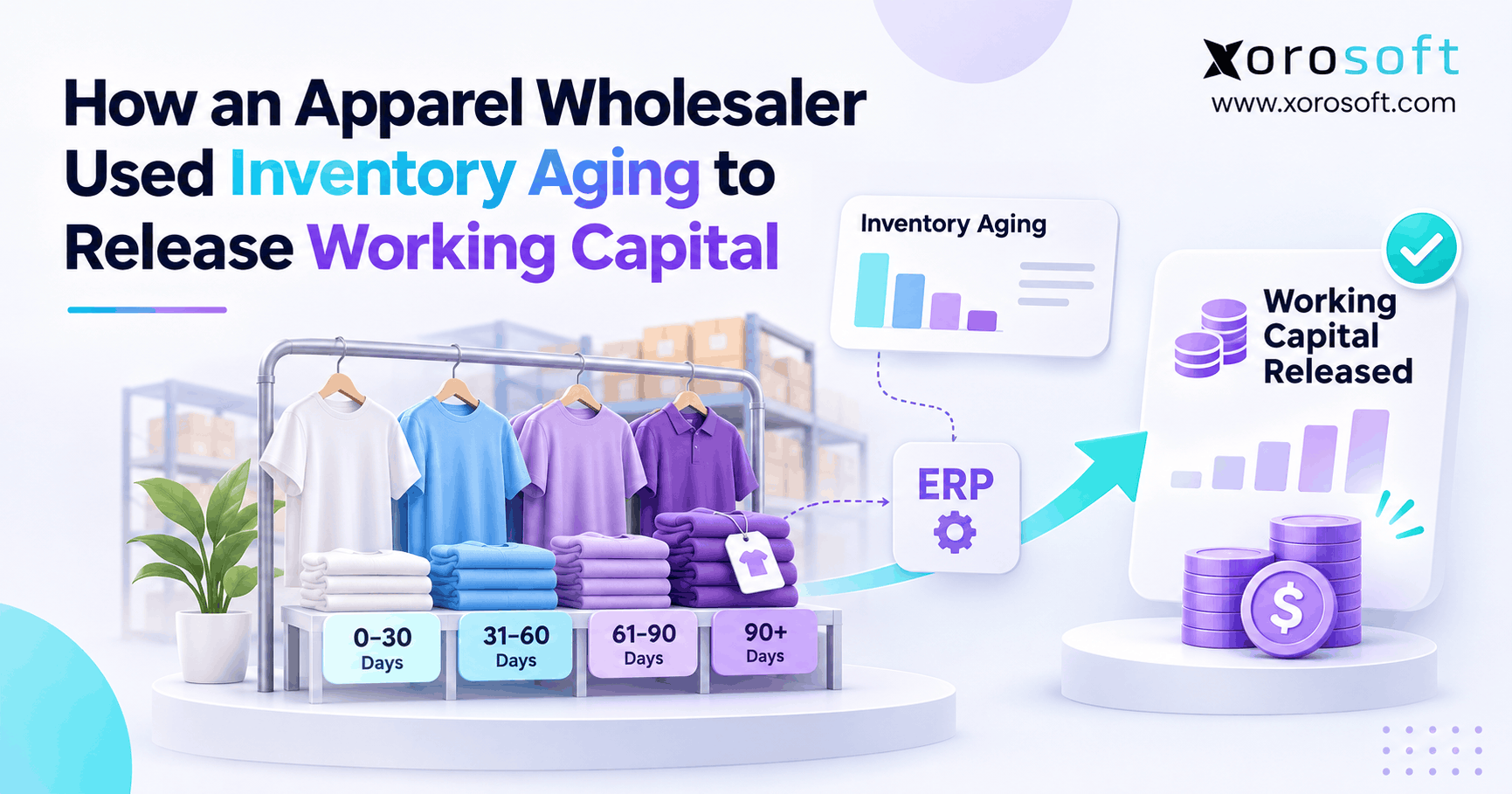
Understanding inventory aging for apparel wholesalers is crucial for optimising stock levels and maximising profitability.
1. When a Full Apparel Warehouse Creates a Cash Shortage
Inventory aging for apparel wholesalers exposes a costly contradiction: shelves can look full while the business struggles to fund its next collection. For example, a growing wholesale operation may hold plenty of garments on its balance sheet. However, older sizes and colors cannot pay suppliers until someone buys them and the customer pays.
To illustrate the process, this article follows an illustrative apparel wholesaler, not a verified customer case. In particular, its figures show how a team could identify slow-moving stock, change purchasing decisions, sell recoverable products, and measure actual collections. As a result, the example explains a repeatable method without claiming a particular company achieved these results.
1.1. The Problem Was Hidden Inside Healthy Sales
For example, consider a distributor serving boutiques, regional chains, and ecommerce retailers. Its best-selling collections continue to attract orders. Meanwhile, buyers commit funds to new seasons before older merchandise has sold through.
Although total revenue looks encouraging, cash availability becomes unpredictable. Supplier payments arrive before customers pay. In addition, warehouse teams spend time moving products that have no current demand, while purchasing spreadsheets still show reorder suggestions for those same SKUs.
1.2. Why Apparel Inventory Aging Beats a Stock Balance
For example, a standard report might show $1 million of inventory but reveal little about the age of individual garments. Therefore, managers cannot tell whether their stock supports upcoming orders or simply reflects past buying decisions.
By contrast, inventory aging for apparel wholesalers adds the missing timeline. When the team connects each remaining quantity to its receipt history, selling rate, and committed orders, the cash problem becomes easier to diagnose. Ultimately, the goal is not to discount everything old; it is to find stock with a sensible recovery path.
2. What Inventory Aging for Apparel Wholesalers Really Measures
In practice, an aging report groups remaining inventory according to how long the business has held it. Yet the age alone cannot determine whether a product is obsolete. Buyers also need to understand seasonality, customer demand, and the economic cost of waiting.
2.1. Distinguish Stock Age From Recent Sales
First, a garment’s stock age starts with the relevant receipt date. By contrast, the last-sale date tells the team when customers recently bought that SKU. Therefore, both signals matter, but they answer different questions.
For example, a blue jacket might sell three units this week even though 200 older units remain in storage. Consequently, a new sale should not reset the age of the older receipt layer. Inventory aging for apparel wholesalers must preserve that distinction to avoid hiding excess stock.
2.2. Track the Style, Size, and Color Combination
Importantly, apparel is more complex than a single product number. A popular jacket can have strong sales in medium and large sizes, while extra-small units remain untouched. Similarly, a fashionable color may outperform the other shades in the same collection.
Therefore, track inventory at the saleable variant level. GS1 explains how product variants such as size and color require distinct identifiers. As a result, this level of detail helps prevent a strong parent-style total from concealing weak individual SKUs.
2.3. Adapt Inventory Aging Buckets to Each Collection
For example, a fast-fashion item can become commercially stale within weeks. However, a basic T-shirt or repeatable uniform may remain desirable much longer. Thus, a single universal aging threshold rarely makes sense for every apparel category.
Start with simple buckets, then adjust them for actual selling cycles. For additional methodology, the Shopify inventory aging guide explains how aging reports inform stock decisions.
| Stock age | Illustrative signal | First response |
|---|---|---|
| 0–30 days | Recently received | Check early sell-through |
| 31–60 days | Sales below plan | Review demand and placement |
| 61–90 days | Slow-moving variations | Pause questionable replenishment |
| 91–180 days | Material aged stock | Prioritize recovery options |
| 181–365 days | Older collection | Assess price, channel, and carrying cost |
| Over 365 days | Long-held merchandise | Reassess demand and recoverable value |
Nevertheless, these periods are illustrative policy bands, not verified industry benchmarks. In particular, age should trigger a review rather than an automatic markdown.
3. Why Aging Apparel Inventory Drains Working Capital
More broadly, working capital supports the daily cycle of buying, holding, selling, and collecting payment. When unsold garments remain in storage, the company has already spent money without completing that cycle.
3.1. Inventory Cost Is Real, but Future Proceeds Are Uncertain
For example, suppose a wholesaler purchased $80,000 of seasonal dresses. The accounting value reflects the cost basis under the applicable policy. Nevertheless, customers may no longer pay enough to recover the original investment.
Inventory aging for apparel wholesalers helps finance highlight that exposure early. However, the reported stock value is not guaranteed cash. Before setting a recovery target, the team must estimate demand, realistic selling prices, variable selling costs, and customer payment timing.
3.2. Stock Can Grow Even While Popular Products Sell
Meanwhile, new orders often trigger more purchasing. Underperforming variants accumulate because buyers review total style sales rather than remaining size runs. As a result, the business can simultaneously experience stockouts of popular variants and overstock of unpopular ones.
Consequently, buying teams should examine the mix, not merely the total units. A warehouse full of garments does not guarantee that customers can find the combinations they want.
For example, suppose 1,200 units of a sweater family remain on hand. Its parent style appears to sell well, yet 800 units belong to two unpopular sizes. Meanwhile, an automated replenishment rule continues ordering the profitable sizes as a complete assortment. As a result, the wholesaler pays for more unwanted stock each time it tries to replenish the variants customers actually need.
3.3. How Inventory Aging Changes the Cash Conversion Cycle
First, days inventory outstanding (DIO) reflects average inventory relative to cost of goods sold. Next, days sales outstanding (DSO) captures how long customer collections take. Finally, days payable outstanding (DPO) reflects supplier payment timing.
The cash conversion cycle equals DIO + DSO − DPO. Therefore, reducing inventory days may help, but slower collections can offset that improvement. A useful inventory aging initiative must involve both operations and finance instead of treating warehouse stock reduction as the final result.
4. How Inventory Aging for Apparel Wholesalers Starts With Reliable Data
The wholesaler first creates one consistent report across the relevant warehouses. Rather than combining unrelated exports blindly, the team agrees on which locations, inventory statuses, and transaction dates belong in the calculation.
4.1. Capture Receipt Layers and Current Quantities
For example, a useful record contains SKU, style, size, color, collection, receipt date, remaining quantity, cost, warehouse, and stock status. In addition, the team needs open customer orders, purchase orders, and recent sales activity.
For example, if a SKU received 200 units in March and another 100 in June, the June delivery must not make every unit appear younger. Instead, the team should use a documented receipt-layer aging method that reflects remaining stock.
4.2. Reconcile Warehouse Stock Before Ranking the Risk
First, the inventory team compares available, reserved, damaged, and quality-held stock. Meanwhile, finance checks whether the report agrees with relevant inventory records and accounting postings.
If physical counts or transaction dates are unreliable, inventory aging for apparel wholesalers will produce misleading priorities. Therefore, correct discrepancies before announcing an aged-stock recovery target. The XoroWMS warehouse management overview provides context for connected warehouse operations that can support more reliable stock visibility.
4.3. Keep Committed Stock Out of Clearance Offers
An older unit may already be promised to a wholesale customer. Consequently, the sales team must subtract legitimate commitments before preparing a clearance campaign.
Likewise, damaged and unavailable merchandise should not appear as sellable inventory. Otherwise, a plan intended to fix overstocking may create order exceptions, customer disputes, or unnecessary purchasing.
4.4. Make the Aging Report Actionable
For every significant exception, add an owner, decision date, proposed action, and estimated recovery amount. Then review the report weekly during active buying seasons.
As a result, this changes the report from a passive spreadsheet into a working management queue. Furthermore, it allows the business to compare what teams planned with what actually happened, including whether customer cash arrived.
For consistency, record who changed an aging rule and when. In addition, preserve the original report snapshots so later analysis does not overwrite the starting point. This is why inventory aging for apparel wholesalers needs consistent source records, not just attractive charts. If the stock value changes after an adjustment, finance should be able to explain the transaction instead of guessing from a newer export.
5. Rank Aged Stock by Recoverable Cash, Not Just Age
A 200-day-old jacket is not automatically a worse investment than a 90-day-old promotional shirt. Instead, managers need to weigh cost exposure, likely demand, customer obligations, and realistic net recovery.
5.1. Calculate Working Capital Exposure by SKU
First, for each aging group, multiply remaining units by the applicable cost per unit. Then compare those values with expected future sales and recovery options.
In the illustrative case, the team finds $300,000 of inventory aged more than 90 days, split across three apparel groups:
| Aged category | Inventory at cost | Main concern |
|---|---|---|
| Previous-season jackets | $125,000 | Seasonal demand may have weakened |
| Slow-moving denim sizes | $95,000 | Broken size runs |
| Promotional T-shirts | $80,000 | Few repeat buyers |
| Total | $300,000 | Priority inventory exposure |
The figures describe exposure, not a promised cash recovery. Accordingly, the team estimates likely proceeds before selecting any action.
5.2. Use Apparel Stock Aging to Find a Plausible Buyer
The jackets have the largest inventory cost. However, the denim may have a better immediate recovery route because existing retailers still buy the relevant sizes.
Similarly, promotional T-shirts might suit a secondary wholesale channel, but only at a discount that makes economic sense. Thus, inventory aging for apparel wholesalers works best when stock age is combined with real customer opportunities instead of a blanket oldest-first clearance rule.
5.3. Protect Profitable Sizes and Colors
Before approving markdowns, separate strong variants from weak ones. Otherwise, a promotion may sacrifice margin on inventory that would sell at the normal price.
For example, black jackets might retain healthy demand while red jackets stagnate. Consequently, a color-specific offer could solve the actual problem without discounting the entire collection. In addition, the team should review return rates, channel restrictions, and fulfillment costs.
Before acting, sales should check whether customers need complete size packs. A seemingly attractive clearance order may fail if it leaves the buyer with unworkable size runs. Therefore, a recovery proposal should name the exact eligible variants, likely buyer, expected quantity, and floor price. That specificity helps management approve the right offer without creating a broader pricing problem.
6. How Inventory Aging for Apparel Wholesalers Changes Buying
The fastest way to undermine a recovery plan is to keep purchasing the same slow-moving products. Therefore, the buying team must review incoming orders before launching broad stock clearance.
6.1. Challenge Open Purchase Orders Before They Arrive
Buyers compare each planned receipt with current inventory, realistic demand, lead times, and confirmed orders. Then they identify duplicate replenishment or quantities that exceed the next selling window.
When supplier terms allow, they negotiate changes or cancellations. However, a canceled commitment should be reported as potential future spending avoided, not cash collected today. Deposits, penalties, and contractual terms may alter the outcome.
6.2. Use Stock Aging to Reset Reorder Decisions
A historical minimum-stock setting may assume every size sells at the same pace. Yet current data may show that only two size combinations need replenishment.
Accordingly, the wholesaler can adjust reorder points by variant and require approval for items above an aging threshold. In Xorosoft, integrated inventory, purchasing, and forecasting workflows provide a relevant foundation for this cross-functional review, although the business must still choose its own rules.
6.3. Avoid Fixing Overstock by Creating Stockouts
Purchasing controls should never block confirmed customer demand without review. Therefore, teams should maintain appropriate stock for healthy variants while pausing orders for slow-moving combinations.
In addition, they need to account for supplier lead times and open wholesale commitments. The objective is a better inventory mix, not simply the lowest possible stock balance. Used carefully, inventory aging for apparel wholesalers highlights where money is trapped without treating healthy safety stock as a problem.
7. Clear Slow-Moving Apparel Inventory Without Blind Discounts
Once the team stops unnecessary purchasing, it can pursue stock recovery in a controlled order. Importantly, the method should match the product’s commercial prospects rather than rely on one clearance tactic.
7.1. Match Aged Apparel Stock to Existing Wholesale Demand
First, sales representatives review customer requests and buying histories. They may find retailers that still need sizes or colors that appear slow in the original warehouse.
As a result, some inventory can move through normal wholesale orders with limited price concessions. Inventory aging for apparel wholesalers is especially useful here because variant-level availability makes targeted offers possible.
7.2. Transfer Stock Only When the Economics Work
Next, the warehouse team looks for demand in other regions. A transfer may improve the chance of sale, but freight, handling, and delivery timing must justify it.
Crucially, an internal transfer does not reduce total company-owned inventory or generate cash. Consequently, managers should treat transfers as supporting actions and measure the eventual sale separately. The process also needs accurate movement records across warehouses.
7.3. Compare Markdowns, Bundles, and Liquidation
When normal demand cannot absorb the stock, the team assesses other channels. However, the cheapest-looking strategy is not always the best financial choice.
| Recovery approach | Best-fit situation | Main financial consideration |
|---|---|---|
| Targeted wholesale offer | Demand exists for certain variants | Protect contribution margin |
| Bundle | Products complement other items | Compare combined selling costs |
| Outlet channel | Lower full-price demand | Account for fees and returns |
| Bulk liquidation | Little realistic future demand | Accept lower proceeds if justified |
| Supplier return | Contract permits a return | Distinguish refund from credit |
For example, a bulk buyer may offer a lower price but provide faster payment. Therefore, inventory aging for apparel wholesalers should evaluate expected collection dates alongside price and costs. Conversely, selling units individually may produce higher revenue while requiring months of storage and customer collections.
7.4. Set a Financial Floor Before Approving Discounts
Finance should calculate expected proceeds after incremental commissions, freight, payment fees, and likely returns. In addition, it must consider the historical cost and any applicable valuation requirements.
Therefore, a proposal should explain whether it improves cash generation, reduces carrying exposure, or merely shifts costs. A markdown that clears the warehouse but produces avoidable losses is not automatically a success.
For instance, one channel might offer a quick settlement at a deeper discount, while another promises a higher sales price but pays in 60 days. As a result, the better choice depends on liquidity needs and the full cost of execution. Teams should document those assumptions before comparing offers, especially when managers face pressure to free warehouse space before the next collection arrives.
7.5. Keep the Customer Experience Intact
Clearance activity must not displace committed orders or create inconsistent wholesale pricing. Similarly, sales teams should respect customer-specific terms, product condition, and any channel restrictions.
Xorosoft supports wholesale, inventory, and order-management workflows that can help coordinate these activities across departments. Nevertheless, merchandising, finance, and account managers remain responsible for approving the commercial decisions.
8. Measure Working Capital Released From Aged Inventory
At this stage, the business needs a reconciliation rather than a celebratory inventory chart. Specifically, it must distinguish stock sold, revenue invoiced, receivables outstanding, and actual money received.
8.1. Separate Inventory Reduction From Cash Receipts
Inventory aging for apparel wholesalers reveals which stock categories changed, but it does not prove that cash reached the bank. The illustrative wholesaler starts with $1,000,000 in total inventory, including $300,000 aged beyond 90 days.
Over the next reporting period, the team sells aged units carrying $120,000 of historical inventory cost. It invoices customers $135,000 and collects $90,000 by period end. Therefore, $45,000 remains in receivables, assuming no other adjustments.
8.2. Walk Through the Inventory-to-Cash Reconciliation
The company also recognizes a $20,000 inventory write-down and cancels $30,000 of future purchase commitments. Meanwhile, it transfers $25,000 at cost between warehouses to reach better demand.
Assume, solely for this example, that there are no new receipts, returns, other inventory movements, or SKUs newly crossing the 90-day threshold in the period.
| Measure | Illustrative amount | Financial meaning |
|---|---|---|
| Opening inventory at book value | $1,000,000 | Total stock asset |
| Opening stock aged 90+ days | $300,000 | Aged stock exposure |
| Historical cost of aged stock sold | $120,000 | Cost removed through sales |
| Invoices issued on those sales | $135,000 | Revenue, not all collected |
| Cash collected | $90,000 | Actual customer receipts |
| Receivables outstanding | $45,000 | Payment still due |
| Write-down | $20,000 | Non-cash value adjustment |
| Internal warehouse transfer | $25,000 | Location change, not new cash |
| Canceled future POs | $30,000 | Possible future spending avoided |
| Closing aged inventory value | $160,000 | Remaining aged stock |
| Closing total inventory value | $860,000 | Remaining stock asset |
Therefore, the closing aged stock figure equals $300,000 − $120,000 − $20,000 = $160,000. Accordingly, the inventory book value fell by $140,000, but that reduction must not be called $140,000 of collected cash.
8.3. Understand Write-Downs and Gross Margin
The invoices total $135,000 against $120,000 of historical inventory cost, producing $15,000 of gross profit before other costs. However, the write-down is a separate expense and may affect financial results differently depending on the reporting framework.
Under IAS 2 Inventories, inventory measurement and write-downs follow defined rules. US businesses should apply their applicable accounting standards instead of assuming IFRS governs their statements. Furthermore, accounting entries do not substitute for reconciliation to bank receipts.
8.4. Turn Inventory Aging Results Into Three Financial Outcomes
The initiative produces three distinct types of outcome. First, operations reduced the aged inventory book value from $300,000 to $160,000. Second, customers paid $90,000 during the period, though the net cash impact also depends on other expenses and payments. Third, the buyer canceled $30,000 of planned future orders, subject to supplier terms.
Therefore, the finance dashboard should not add these figures into one inflated cash-savings number. In Xorosoft, connected inventory and accounting records can support the transaction trail; still, finance must validate the assumptions and reconcile the figures.
9. Prevent the Next Wave of Apparel Inventory Aging
Clearing old stock once is not enough. Instead, the wholesaler needs routines that prevent the next seasonal assortment from creating the same cash problem.
9.1. Hold a Weekly Inventory Aging Review
Every week, purchasing, sales, warehouse operations, and finance review the largest exceptions. Each team answers a different question: what is arriving, what customers want, what stock exists, and what cash result is realistic?
Consequently, the discussion becomes an action meeting rather than an exercise in reading reports. Owners record proposed markdowns, purchasing changes, transfers, and collection follow-ups with deadlines.
9.2. Compare Demand Forecasts With Actual Sell-Through
Buyers should monitor forecast error by meaningful SKU groups and adjust plans as the season develops. However, historical sales alone can conceal lost sales from stockouts or temporary promotional spikes.
Therefore, inventory aging for apparel wholesalers works best alongside open orders, available quantities, seasonality, and lead times. A connected XoroERP environment can bring purchasing, inventory, financial reporting, and related operations together, subject to the company’s configuration and processes.
9.3. Escalate Risks Before the Season Ends
Set review thresholds for aging value, slow sell-through, and open replenishment commitments. Then assign decisions to buyers, sales managers, or finance according to the financial exposure.
Similarly, document approvals for write-downs, customer discounts, and significant inventory adjustments. Clear ownership ensures that reports lead to corrective action before demand disappears.
A practical escalation might start when a collection misses its planned sell-through for two review cycles. Then the purchasing lead checks incoming commitments, while sales investigates recovery demand. Finance can authorize an appropriate response once it understands the margin exposure. The policy need not be complicated; however, it should define thresholds, owners, and deadlines clearly. In this way, inventory aging for apparel wholesalers becomes an early warning process rather than a month-end surprise.
10. Choose the Right Tools for Apparel Inventory Aging
Not every apparel wholesaler needs an ERP project. However, the business should consider how reliably its current systems connect stock age, purchasing, wholesale demand, warehouse activity, and cash reporting.
10.1. Evaluate Integrated ERP First When Workflows Are Fragmented
For a business already struggling with multiple systems, Xorosoft is a relevant first platform to evaluate. Its cloud ERP combines inventory, purchasing, accounting, warehouse management, and ecommerce operations. These capabilities address the disconnected-workflow problem, although buyers should verify their specific reporting and integration needs in a demonstration.
For example, merchants operating across Shopify and wholesale channels can review Xorosoft’s integration options and its Shopify App Store listing. Neither connection alone guarantees accurate aging analysis; the underlying SKU, receipt, and accounting data still need to be reliable.
10.2. Recognize When Simpler Approaches Are Enough
A small business with one warehouse and stable receipts may manage aging reports with well-controlled spreadsheets. Likewise, dedicated inventory software can work when purchasing and accounting integrations already produce consistent records.
Therefore, choose tools according to transaction complexity and reporting risk rather than adopting the most extensive system automatically.
| Option | Best fit | Main discipline required |
|---|---|---|
| Xorosoft integrated cloud ERP | Multiple warehouses, channels, and connected finance needs | Data cleanup and workflow design |
| Inventory-focused software | Primarily stock and order visibility | Reconcile purchasing and accounting integrations |
| Controlled spreadsheets | Simple operations with consistent exports | Version control, receipt history, and reviews |
10.3. Check the Workflow, Not Just the Feature List
During evaluation, test one apparel SKU from receipt through stock aging, transfer, wholesale sale, invoice, and collection. In particular, inventory aging for apparel wholesalers should remain explainable through each transfer and adjustment. Then ask whether the system explains every change without spreadsheet reconstruction.
In addition, confirm permission controls, exception reporting, data exports, and reconciliation procedures. Ultimately, the strongest platform is the one that supports correct decisions and reliable records, not simply the most attractive dashboard.
11. A 30-Day Inventory Aging Action Plan for Wholesalers
The illustrative case can become a practical improvement plan. However, the following schedule is a planning framework, not a guarantee of financial recovery in 30 days.
11.1. Days 1–7: Identify the Largest Aged Inventory Exposures
First, agree on stock statuses, cost basis, receipt-layer logic, and reporting date. Then segment apparel by style, size, color, warehouse, and season.
Next, reconcile the totals with operational and financial records. As a result, the team begins with a defensible view of where capital is tied up instead of relying on estimates.
11.2. Days 8–14: Approve Buying and Recovery Decisions
Rank aged SKUs by inventory cost, actual demand, and likely net proceeds. Meanwhile, review incoming purchase orders for duplicate or unnecessary replenishment.
Next, for each priority product, assign an action: sell normally, make a targeted offer, transfer for demonstrated demand, negotiate a supplier return, or review a write-down. Inventory aging for apparel wholesalers should guide those actions without replacing commercial judgment.
11.3. Days 15–30: Measure Aged Apparel Inventory Results
Execute approved sales and track invoices, shipping, returns, and payment dates. Furthermore, compare actual selling expenses with the original recovery estimates.
Finally, update the aging report and create weekly exception reviews. Any cash claim should identify the exact amount collected and explain which costs or payment obligations remain outstanding.
12. Conclusion: Turn Aging Reports Into Better Cash Decisions
Inventory aging is not a clearance campaign or a standalone warehouse metric. Instead, it is a way to connect aging merchandise with purchasing decisions, customer demand, and financial outcomes.
12.1. The Practical Lesson for Apparel Wholesale Operators
The illustrative wholesaler did not solve its problem by discounting every old garment. It first found which variants were aging, protected committed stock, challenged future purchases, and measured collections separately from accounting changes.
Consequently, inventory aging for apparel wholesalers can become a regular working-capital discipline rather than a report reviewed only when cash is tight.
12.2. Know When a Connected System Is Worth Evaluating
If your team routinely rebuilds the same stock history across purchasing, warehouses, and accounting, it may be time to examine an integrated approach. Xorosoft offers a relevant option for inventory-driven businesses that need connected operational workflows, though implementation fit should be demonstrated against your actual processes.
To assess those workflows, Book a Demo and review how your business handles aged stock, purchasing commitments, and financial reconciliation.
Frequently Asked Questions
What is promotion lift forecasting?
It predicts extra units that may sell during a campaign versus a normal period. It uses past sales, offers, prices, and timing. The result helps buyers plan stock before the sale.
Which data fields matter most?
Start with SKU-level sales, campaign dates, paid prices, and stock availability. Then add a future offer calendar. Lead times and open orders are also needed when turning the demand forecast into a purchase plan.
How much past sales data is needed?
There is no set minimum for every model. More seasons and past offers can help, but clean records matter most. Test against past campaigns before trusting a forecast for a major sale.
Can stockouts bias a promotion forecast?
Yes. A product that sells out may have more demand than recorded sales show. Flag the out-of-stock period and use a careful estimate of missed demand. Otherwise, the next forecast may be too low.
How do you calculate promotional lift?
Subtract estimated normal sales from campaign sales. Divide the gap by normal sales and multiply by 100. For example, 750 units against a 500-unit baseline means 50% observed lift, not proven causal lift.
Is Shopify data enough on its own?
Not always. Shopify can supply orders and discount data, but a full stock plan may need warehouse balances, supplier dates, and open purchase orders. Match item IDs and dates before joining records from different systems.
When should teams move beyond spreadsheets?
Upgrade when manual files miss stock, delay buys, or disagree across channels. First fix data rules and ownership. Then test whether connected tools improve forecast reviews, purchasing, and stock control enough to justify the change.
Recent Posts
-
 B2B Order Management Software for Wholesale Ecommerce Operations
-
How an Apparel Wholesaler Used Inventory Aging to Release Working Capital
-
 Why Shopify Purchase Orders Fail to Reconcile With ERP Receipts
-
 How Many ERP Administrators Does a Mid-Market Business Need?
-
 How to Design Warehouse Exception Codes That Produce Useful Data