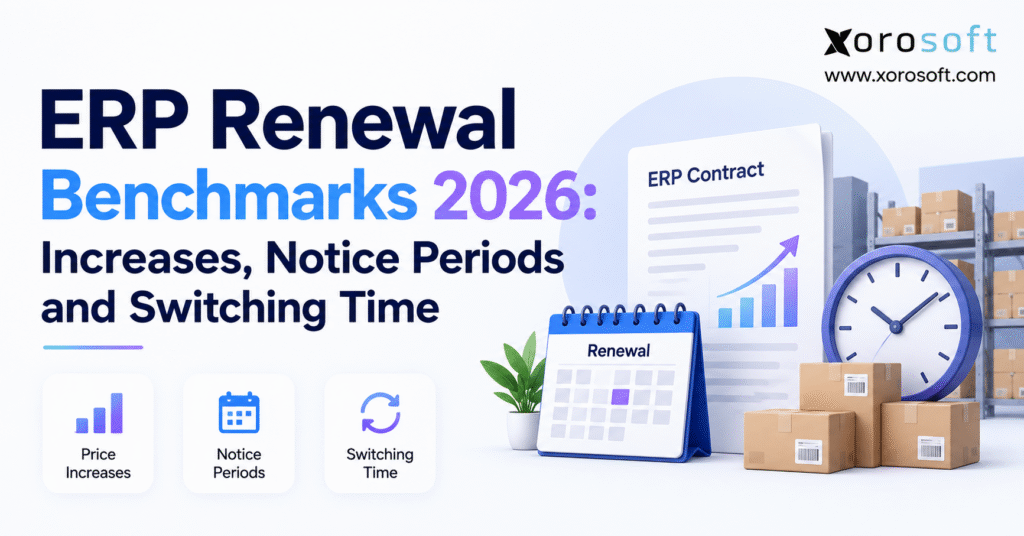
In this article, we will explore ERP renewal benchmarks 2026 to help guide your planning and decision-making process.
1. ERP Renewal Planning: Decide Before the Invoice Arrives
An ERP contract may look like a predictable operating expense until the next renewal changes the economics. A higher subscription quote arrives, finance asks whether the increase is justified, and operations wonders whether another system could handle the business better. Then someone finds a notice clause requiring action months before the contract actually expires. By that point, a useful comparison may already be difficult to complete.
For inventory-driven companies, an ERP agreement covers much more than access to software. Orders, stock movements, purchasing decisions, customer pricing, warehouse tasks, and financial records often depend on the same environment. Renegotiating an ERP contract is therefore both a commercial exercise and an operating-risk decision.
1.1. Renewal Costs, Notice Periods, and Switching Risks
A disciplined review asks how much the same capabilities will cost after renewal, when the business must give formal notice, and how long it would take to change systems safely. These questions belong together. A replacement option has little negotiating value if the notice deadline is already past. Likewise, an attractive replacement quote means little if essential warehouse and accounting processes remain untested.
The purpose of ERP renewal benchmarks 2026 is not to predict every vendor’s next invoice. It is to give leaders a reference point for pricing, contractual exposure, and switching feasibility, then show how to apply that evidence to their own agreement.
1.2. Why ERP Renewal Decisions Need Cross-Functional Ownership
Finance understands budget pressure, but it may not know which warehouse processes rely on an older customization. IT understands integrations but may not see the effect of incorrect inventory valuation. Procurement knows the contract dates, while sales knows how customer-specific pricing affects order acceptance.
The renewal owner should bring those perspectives into one decision record. That record needs a comparable cost baseline, a verified notice date, a summary of operational gaps, and a practical recommendation. Without it, the company risks renewing out of habit or switching out of frustration.
2. ERP Renewal Benchmarks 2026: What the Research Supports
Current research confirms pressure across the software market, but the underlying surveys do not provide a universal ERP-only renewal percentage. This matters because a broad software statistic can be useful for budget conversations without being a valid prediction for an individual ERP contract.
2.1. Software Price Increases and ERP Renewal Costs in 2026
In Zylo’s 2026 software pricing analysis, 79% of surveyed IT leaders reported renewal price increases in the previous 12 months. Separately, Vertice’s 2026 analysis found an average annual price increase of 11% across software contracts. Both findings show why renewal costs warrant attention. Neither establishes that ERP subscriptions, specifically, increased by 11% on average.
There is another distinction worth making: the percentage of organizations experiencing an increase is not the average size of that increase. Mixing the two would produce a misleading benchmark. So would treating a price change caused by extra users as equivalent to a higher price for unchanged usage.
2.2. Comparing Renewal Pricing With ERP Switching Timelines
ERP renewal benchmarks 2026 also need a realistic view of implementation. ERP Research’s October 2026 review found a six-month median among 306 published case studies that disclosed project duration. The study explicitly warns that vendor-selected success stories can underrepresent difficult or delayed projects. Meanwhile, the Panorama Consulting Group 2026 ERP Report describes a nine-month median project timeline among 170 respondents.
These are different study populations and should not be averaged. Neither figure necessarily includes all the time a buyer needs for initial research, contract approvals, data access negotiations, or post-launch stabilization. Switching feasibility requires a project estimate, not a borrowed median.
2.3. How ERP Renewal Benchmarks 2026 Apply to Your Contract
| Measure | Published reference | Appropriate use |
|---|---|---|
| Incidence of renewal increases | 79% of surveyed IT leaders, Zylo 2026 | Establish broader market pressure |
| Average software contract uplift | 11%, Vertice 2026 | Context for pricing discussions, not an ERP average |
| Disclosed ERP implementation median | 6 months, ERP Research 2026 | Understand selected published project outcomes |
| ERP survey project median | 9 months, Panorama 2026 | Inform scheduling discussions, not a guarantee |
The most valuable ERP renewal benchmarks 2026 become company-specific once they are combined with a current license inventory, an itemized quote, contractual dates, and a written list of business requirements. Research should sharpen management’s questions, not replace its judgment.
3. ERP Renewal Price Increases: Calculate the Real Cost
A vendor’s proposed total may rise for several reasons at once. To negotiate effectively, separate the price of the existing scope from the cost of additional capacity. Otherwise, management may blame the vendor for growth-driven charges or overlook a substantial increase in the rate paid for the same service.
3.1. Calculate the Like-for-Like ERP Renewal Uplift
The basic formula is renewal uplift (%) = [(new annual fee − current annual fee) ÷ current annual fee] × 100. It only provides a meaningful comparison when both figures cover the same users, modules, support, and services. If one quote covers twelve months and the other covers fifteen, annualize them first. Check currency, taxes, billing frequency, and effective dates as well.
Suppose a business pays $120,000 annually and receives a $132,000 renewal proposal with unchanged scope. The difference is $12,000, or 10%. If the proposal also includes $9,000 for new licenses, its total annual expense becomes $141,000. The budget is 17.5% higher, but the like-for-like price uplift remains 10%.
3.2. Break Down License Changes and ERP Renewal Fees
| Annual cost item | Current agreement | Proposed agreement |
|---|---|---|
| Existing subscription | $100,000 | $110,000 |
| Existing support | $12,000 | $13,200 |
| Existing integrations | $8,000 | $8,800 |
| Additional user licenses | $0 | $9,000 |
| Total | $120,000 | $141,000 |
All amounts are illustrative, not actual vendor pricing or an industry average.
This analysis helps the team identify what can be challenged, reduced, or removed. The next step is to review usage and service value. An inactive licensed user, a module no one accesses, or duplicate integration tooling may present an opportunity for optimization. But a department’s occasional use does not automatically mean a license is unnecessary; access during financial close or seasonal peaks may still be critical.
3.3. Forecast ERP Subscription Renewal Costs Over Three Years
When evaluating ERP renewal benchmarks 2026, calculate the cost of repeated increases. A $120,000 annual fee with hypothetical 5% increases at the start of each of the next three years would cost $126,000, $132,300, and $138,915 respectively, totaling $397,215. At a hypothetical 10%, the same three years would total $436,920. With no increases, the total would be $360,000.
These are scenarios, not forecasts. They show why a price cap, defined adjustment formula, or properly negotiated multi-year commitment may matter more than a one-time discount. Any protection should clearly state which modules, users, support tiers, and additional charges it covers.
4. ERP Contract Renewal Clauses That Change Total Cost
The headline subscription rate is only one part of an ERP contract. A more expensive clause can hide in minimum commitments, automatic renewals, fee escalators, service descriptions, or data-export terms. Therefore, the contract review should involve procurement and legal counsel before the commercial decision is considered final.
4.1. Price Escalation and ERP License True-Ups
A scheduled escalation increases a defined price according to the agreement. It might use a fixed percentage, a negotiated cap, or an index. A license true-up is different: it adjusts payment when the business uses more seats or other entitlements than its agreement permits. Consumption charges can introduce a third category of spending.
Treat these separately on the financial model. Ask whether the increase applies to base fees, add-on services, renewals of individual order forms, and future purchases. Contract language such as ‘then-current rates’ deserves particular attention because it may be less predictable than a stated cap.
4.2. Review ERP Contract Renewal Documents Together
ERP customers may have a master agreement, order forms, statements of work, support schedules, security documents, and later amendments. The relevant renewal language could be spread across several of them. Check which document controls when terms conflict, whether separate modules have separate dates, and whether a new order resets an earlier contract period.
Service commitments matter as well. Review uptime measurement, support response definitions, maintenance windows, data ownership, data-export assistance, and responsibilities during exit. A slightly lower price is not necessarily a better agreement if it weakens business-critical protections.
4.3. Protect Data Export and ERP Exit Rights
Data portability is a practical issue, not simply a legal formality. A replacement ERP may need customer and supplier masters, SKU attributes, open orders, inventory balances, general ledger details, and audit history. Ask what export formats are available, whether attachments and custom fields can be retrieved, and how long access continues after termination.
Also clarify who pays for extraction, technical assistance, and extended access. These costs affect the same decision as subscription pricing. Strong ERP renewal benchmarks 2026 therefore examine both ongoing fees and the cost of exercising an exit option.
5. ERP Renewal Notice Periods: 30, 60, 90 Days and Beyond
Notice requirements can turn a manageable renewal into an urgent commitment. A business may have months left on its service term yet only days to deliver a binding non-renewal notice. That is why the expiration date alone is not sufficient for calendar planning.
5.1. What ERP Renewal Notice Windows Mean
Zylo’s SaaS agreement checklist notes that software notification periods commonly range from 30 to 90 days, with shorter and longer examples also appearing. This is broader SaaS contract guidance, not a statistical distribution of ERP-only agreements. The actual term in the signed contract controls the obligation.
A 30-day window leaves less room for final approvals. A 60-day window demands earlier vendor discussions and budget decisions. A 90-day window may force the organization to choose a direction well before it can complete replacement testing. Some agreements require notice 180 days ahead, making early planning even more important.
5.2. How to Calculate Your ERP Non-Renewal Deadline
Assume an ERP contract ends June 30, 2027 and requires notice at least 90 calendar days before the end date. A simple subtraction points to April 1, 2027. That is only an example: the agreement may define business-day counting, the time zone, permitted delivery channels, or the precise moment notice is deemed received.
The practical response is to establish an internal deadline before the contractual one. Assign a named owner, obtain legal review, and preserve evidence of delivery. Do not rely on a casual conversation with a vendor representative if the agreement specifies formal notice to another recipient.
5.3. Missed Contract Deadlines and Negotiation Options
If a company misses its notice window, the agreement may extend for another term. The exact consequences depend on the documents and applicable law; consumer auto-renewal rules should not be assumed to apply to every business-to-business ERP contract. Counsel can assess the organization’s options if a deadline was missed.
A vendor may be willing to negotiate an amendment, bridge term, or revised scope, but none is guaranteed. For this reason, ERP renewal benchmarks 2026 should always be paired with a contract-specific notice calendar. A pricing benchmark without a decision deadline does not provide much leverage.
6. ERP Renewal Negotiation Without Operational Disruption
A successful negotiation reduces avoidable cost while preserving the capabilities the business genuinely needs. Price should be discussed alongside contract flexibility, support quality, data rights, and the impact of any service changes on frontline teams.
6.1. Bring Evidence of Usage and Business Value
Start with a current inventory of users, roles, modules, locations, transactions, and integrations. Compare paid entitlements with actual use over a representative period, including seasonal peaks. Finance should calculate cost per relevant business unit, while IT verifies which integrations and functions would break if a component were removed.
Bring the vendor specific questions: Which charges are increasing? Why did the price change? Which fees are negotiable? Can unused capacity be removed? Will new users receive the same commercial rate? This is more productive than asking for an arbitrary discount without a documented baseline.
6.2. Negotiate ERP Renewal Price Caps and Contract Flexibility
Depending on circumstances, useful terms may include a capped annual uplift, predictable pricing for additional users, rightsizing at renewal, clearer support obligations, a shorter commitment, or a structured exit period. A multi-year deal can stabilize spending, but it also limits flexibility when requirements evolve. Compare the discounted price with the practical cost of being locked into an unsuitable arrangement.
The company should know its walk-away conditions, even if it intends to renew. For example, a critical data-portability gap or an unbounded price escalator may require escalation beyond the routine procurement team. Negotiation is strongest when decision-makers agree on priorities before meeting the vendor.
6.3. Keep Notice Deadlines Separate From ERP Migration
An ERP evaluation can continue while contract discussions proceed, but the business must not assume that ongoing talks suspend formal notice requirements. Where timing is tight, negotiate a documented bridge arrangement or transition access rather than relying on informal assurances.
This is where ERP renewal benchmarks 2026 become a management tool. They help identify what is worth negotiating, while the company’s own contract and implementation plan determine what is actually possible. The goal is a controlled commercial decision, not a dramatic threat to switch systems.
7. ERP Switching Time Benchmarks and Migration Planning
ERP switching is not a single technical event. Vendor evaluation, requirements mapping, implementation, data conversion, testing, training, and stabilization each consume time. Some tasks overlap, while others cannot begin until earlier decisions are made. A renewal window that appears generous can become inadequate once those dependencies are visible.
7.1. Interpreting ERP Switching Time Benchmarks
The six-month published-case-study median and nine-month survey median described earlier are useful reference points, but they answer different questions. Published success stories may leave out abandoned or troubled projects. Surveys capture a different mix of organizations, project types, and complexity. Neither number should be presented as the average time required for a specific company to escape its current contract.
For planning, assign separate periods to selection, data preparation, core configuration, interface development, user acceptance testing, cutover, and post-launch support. Procurement must also account for a period when both the old and new systems may need to remain available.
7.2. Map the Critical Path Before Choosing a Go-Live Date
The critical path usually includes dependencies that cannot be compressed safely. Inventory balances must be trusted before stock is allocated. The chart of accounts must be mapped before opening financial balances can be approved. Customer-specific pricing needs validation before wholesale orders flow automatically. External trading partners may need their own testing and certification windows.
Identify which activities can happen in parallel and which require formal sign-off. A project plan should include owners, deliverables, realistic contingency time, and a method for escalating unresolved exceptions. Otherwise, the date on the schedule becomes a target without an operating plan behind it.
7.3. Why a 90-Day Notice Period Is Not a Switching Plan
Consider a distributor that receives a renewal proposal 120 days before expiration and has a 90-day notice requirement. It has roughly 30 days to make its formal non-renewal decision, not 120 days to finish replacing the ERP. If the distributor needs several months of migration work, it must arrange sufficient continued access or choose a different transition timetable.
ERP renewal benchmarks 2026 should therefore compare two clocks: the contractual clock and the operational implementation clock. Managing one without the other can produce unnecessary license overlap, rushed testing, or a new contract signed simply to avoid disruption.
8. ERP Data Migration, Warehouse Cutover and Financial Controls
A replacement ERP can be technically live yet operationally unready. Orders may enter successfully while inventory values fail to reconcile. Warehouse users may know how to pick an order, but a supplier credit or return can follow an untested path. Migration readiness requires evidence from actual business transactions.
8.1. Clean Master Data Before ERP Migration
Begin with item records, units of measure, barcodes, warehouses, customers, vendors, payment terms, tax settings, and chart-of-accounts mappings. Remove duplicates deliberately rather than deleting records that may still support historical transactions. Establish which fields are required, who approves transformations, and how data quality will be measured.
Financial migration requires its own sign-off. Open receivables, payables, inventory valuation, bank balances, and outstanding orders need reconciliation against the prior system. Keep required historical information available for audit and reporting, whether it is migrated into the new system or retained in a controlled archive.
8.2. Protect the Warehouse During ERP Cutover
A warehouse operates continuously: receipts arrive, customers place orders, returns are processed, and stock moves between locations. Before cutover, test receiving, putaway, allocations, transfers, picking, packing, shipping, cycle counts, and inventory adjustments with realistic quantities and exceptions. A multi-warehouse operation also needs a precise ownership rule for in-transit stock.
For buyers evaluating new warehouse execution and inventory-control workflows, the relevant question is whether the proposed processes work with their actual scanners, locations, staffing, and fulfillment rules. A product demo is not a substitute for an end-to-end acceptance test.
8.3. Define a Cutover and Stabilization Plan
A reliable cutover plan identifies the final legacy transaction, data freeze points, approved opening balances, responsibilities for entering new orders, and the method for resolving discrepancies. It also defines acceptable downtime, support coverage, and the go/no-go decision owner. Where a rollback is possible, document its limits before new transactions accumulate.
After go-live, monitor inventory variance, order exceptions, billing errors, and closing adjustments. The team should not declare success simply because users can log in. For ERP renewal benchmarks 2026, the true switching period includes the time required to stabilize operations, not merely the day a replacement system is activated.
9. ERP Renewal Risks for Shopify, EDI and Multi-Warehouse Businesses
An inventory-driven business may have dozens of systems interacting with its ERP. The number of connections is less important than the consequences when data arrives late, arrives twice, or fails to match the underlying transaction. Those dependencies should shape any decision to renew or replace.
9.1. Shopify ERP Integration and Inventory Accuracy
A Shopify brand can accept orders faster than a manual inventory process can reconcile them. During ERP migration, test product variants, available-to-promise quantities, order imports, shipping confirmation, returns, refunds, and the treatment of canceled orders. The same attention is needed for marketplace activity and promotional peaks.
When evaluating Xorosoft as one possible connected platform, buyers can review its ERP app listing on the Shopify App Store. The listing is a starting point for checking integration scope, not proof that a particular merchant’s custom workflow will require no additional work.
9.2. EDI Testing Dependencies During ERP Switching
EDI trading partners may require specific purchase-order formats, acknowledgments, advanced shipping notices, invoices, and partner identifiers. Mapping errors can lead to delayed orders, rejected files, or costly operational exceptions. A switch must account for partner testing windows, exception ownership, and the ability to replay failed messages without duplicating transactions.
Use a documented integration inventory to establish which platform owns each message. Xorosoft’s integration overview can inform a potential evaluation involving ecommerce, EDI, fulfillment, and finance, but the implementation team should verify each required connection against the actual partner specification.
9.3. Industry Requirements Change the Risk Profile
Apparel companies must protect size-color variants, seasonal allocations, and return flows. Furniture distributors may need visibility into bulky inventory, long supplier lead times, and multiple shipping locations. Sporting goods operators often manage seasonal peaks and products sold across wholesale and direct channels. Food and manufacturing businesses may depend on lot traceability, production orders, or materials planning.
These are not interchangeable projects. Buyers can use ERP requirements by industry to organize discovery questions, but the final scope must still be defined through their own workflows and data. Strong ERP renewal benchmarks 2026 connect cost decisions to these practical differences instead of ranking software by license price alone.
10. ERP Renewal vs. Replacement: Three-Year Cost Comparison
A cheaper subscription can lead to a more expensive decision when implementation and transition costs are ignored. Conversely, renewing a costly system may be inefficient when it forces the business to maintain multiple disconnected applications. The comparison needs one time horizon, consistent assumptions, and a clear distinction between cost and benefit.
10.1. Compare ERP Renewal Costs With Replacement Expenses
Suppose the current ERP costs $120,000 annually and a hypothetical 5% uplift applies at each of the next three renewals. The three-year subscription total would be $397,215. This example assumes unchanged scope and does not include other tools or internal administration, which should be added when relevant.
Now assume a replacement costs $112,000 annually for three years, with $90,000 for implementation, $30,000 for integrations, $35,000 in internal project effort, and $25,000 in parallel-running and transition costs. Its illustrative three-year total would be $516,000. Both alternatives should also account for recurring third-party applications, support differences, and any contractual termination charges.
10.2. Calculate the Benefit Needed to Offset Switching
In this simplified example, the replacement costs $118,785 more over three years before business benefits. That difference translates to approximately $39,595 annually. If the proposed system can credibly eliminate at least that much in recurring expense or measurable operating waste, the financial comparison changes. But those benefits must be evidenced, not assumed from a sales presentation.
Potential benefits may include fewer manual reconciliations, less duplicate entry, reduced integration maintenance, or fewer shipment errors. Do not treat lower inventory holdings as automatic profit: releasing working capital has a different financial effect from cutting an operating expense. Avoid counting the same process improvement twice.
10.3. Include Risk, Not Just the Expected Dollar Total
Financial models should address the impact of a delayed implementation, missed order volume, temporary consultants, extended legacy access, and additional employee training. A range of outcomes is often more useful than one precise-looking answer. Build a base case and a more demanding case, then ask whether the business remains comfortable with both.
ERP renewal benchmarks 2026 offer useful context, but the best cost benchmark is the company’s own documented, fully loaded comparison. It should show recurring costs, one-time costs, savings assumptions, cash-flow timing, and who is responsible for delivering the projected improvement.
11. ERP Contract Renewal: When to Renegotiate or Replace
There is no automatic rule that a price increase means a company should switch. An existing ERP may remain the strongest operational fit. Equally, a favorable renewal discount may conceal systems that no longer support growth. A good decision framework assesses cost, capability, timing, and risk together.
11.1. When ERP Contract Renewal Is the Right Choice
Renewal is defensible when inventory remains reliable, purchasing works, financial reporting is accurate, integrations are manageable, and users can complete their work without extensive workarounds. A change for the sake of change can destroy time and money. In that situation, the focus should be on pricing transparency, contract protections, and ensuring the agreement can accommodate foreseeable growth.
11.2. When ERP Renewal Negotiation Beats Replacement
A business may achieve meaningful improvements by reducing unused licenses, addressing application overlap, fixing workflow ownership, or renegotiating support and escalation clauses. These are lower-disruption options when core functionality is sound. Document the limitations that remain after optimization; they reveal whether a larger system change is genuinely necessary.
11.3. When Operational Gaps Make ERP Switching Worthwhile
Replacement becomes more compelling when important needs remain unmet: multi-warehouse availability is unreliable, inventory and accounting disagree, purchasing depends on spreadsheets, or ecommerce orders require repeated manual corrections. Even then, an alternative must demonstrate a better operating model rather than merely promising modern technology.
| Choice | Strongest reason | Main question to resolve |
|---|---|---|
| Renew | Current system fits and performs | Are the commercial terms acceptable? |
| Renegotiate | Cost or contract flexibility is the issue | Can the vendor provide durable protections? |
| Optimize | Usage or processes create avoidable waste | Can improvements be measured without a switch? |
| Replace | Critical operational needs remain unmet | Can the organization migrate safely and justify total cost? |
The decision should be documented in language the finance, technology, and operations teams all recognize. ERP renewal benchmarks 2026 should support that conversation rather than push every reader toward the same answer.
12. ERP Renewal Planning Calendar: Preserve Your Options
A renewal calendar is useful only when it is connected to decisions and accountable owners. Merely recording the expiration date in a spreadsheet is not enough. Finance, procurement, IT, and operating leaders should work backward from the earliest binding notice requirement.
12.1. 180 Days Out: Establish an ERP Renewal Baseline
At least 180 days before expiration, retrieve the signed documents, identify contract owners, calculate the current annualized cost, and map dependent applications. Review user counts, support usage, recurring integration charges, and operational pain points. If a substantial ERP replacement is plausible, start the assessment earlier than six months; implementation and procurement may require much more time.
A practical output is a concise renewal brief: contractual dates, costs, principal risks, options under consideration, and the evidence still needed. This keeps the project from disappearing into separate conversations between finance, IT, and individual departments.
12.2. 120–90 Days Out: Test ERP Replacement Options
Between roughly 120 and 90 days before expiration, obtain a renewal proposal, normalize its pricing, and examine possible license reductions. Where an alternative is under consideration, request a realistic implementation plan with data migration, testing, and integration responsibilities. The business should know the time needed for legal approval and vendor selection before relying on a switch as a negotiating option.
The internal decision date must be earlier than the formal notice date. If the agreement requires 90 days’ notice, the team cannot wait until the 60-day checkpoint to decide whether to decline renewal.
12.3. The Final ERP Renewal Window: Notices and Continuity
Once a direction is approved, send any required notice using the contractual method, retain evidence, and confirm what happens to data and service access. If renewing, obtain the final commercial terms in writing. If transitioning, confirm a bridge period, if needed, and clarify which system owns live transactions at every stage.
A renewal owner should keep one record of approvals, effective dates, vendors, and deliverables. At the end of the process, compare actual outcomes with the assumptions used in the decision. This makes future renewal decisions more consistent and easier to audit.
13. Evaluate ERP Replacement Against Real Business Workflows
If the assessment supports replacement, the next step is a controlled product evaluation. Technology comparisons should begin with how a business processes an order, purchases stock, manages warehouse movements, and closes its books. Feature lists become useful only when they can be tested against those transactions.
13.1. Shared Data Across ERP Inventory, Finance, and Fulfillment
An inventory-led company should determine whether sales, purchasing, warehouse operations, and accounting work from consistent records. That does not eliminate the need for controls; it makes ownership and reconciliation easier to design. Xorosoft’s XoroONE cloud ERP overview describes inventory, accounting, purchasing, warehouse, manufacturing, ecommerce, and reporting modules intended for connected operations.
For more complex finance and manufacturing requirements, the XoroERP overview outlines relevant functions. Buyers should still test their specific chart of accounts, transaction volumes, pricing rules, approval paths, and exception workflows before deciding whether any platform is suitable.
13.2. Ask for Evidence Rather Than General Assurances
Compare requirements with recorded demonstrations, references from relevant industries, written integration scopes, and an implementation plan. Xorosoft publishes customer case studies that may help buyers identify similar use cases, but published customer stories do not establish a guaranteed result for another company.
A useful evaluation includes a sample data set and a scenario that crosses departments. For example, receive a supplier shipment, update stock, reserve inventory for an ecommerce order, ship it from the correct warehouse, and reconcile the resulting financial records. Ask the vendor to show how errors are handled, not just successful transactions.
13.3. Security, Support, and ERP Exit Requirements
The final decision should also address security, access controls, reporting, disaster recovery, data export, implementation ownership, training, and support. A solution can satisfy today’s inventory problem while creating an unacceptable dependency elsewhere. The broader connected operations solutions material may help frame available process areas, but contract terms and measured fit must carry the evaluation.
Modernizing ERP is worthwhile when it solves operational constraints at an acceptable cost and risk. It should never be treated as a compulsory response to an annual software price increase.
14. ERP Renewal Benchmarks 2026: Decide Before the Deadline
The central lesson from ERP renewal benchmarks 2026 is that pricing, contractual notice, and switching time cannot be managed independently. A business needs to know what it is paying for, when it must act, and what operational work would be required to change platforms. Those answers should exist before an automatic renewal or budget deadline limits its options.
Begin with a like-for-like price comparison, verify the notice clause with procurement or counsel, and assess whether the current system meets the business’s next stage of requirements. Renew when the evidence supports renewal. Negotiate when contract economics are the problem. Replace only when the improvement justifies the complete transition.
If your review points toward a new system, use Xorosoft’s contact and ERP discovery page to discuss the workflows, integration needs, and migration constraints that matter to your business. A useful demonstration should test those specifics—not bypass them.
Frequently Asked Questions
What is an ERP inventory migration checklist?
It is a set of checks for items, stock, costs, sites, and open orders before ERP go-live. It also names owners and proves that the new data matches the source.
What data should be cleaned before an ERP migration?
Start with SKU codes, units, barcodes, stock by site, lot details, open POs, sales holds, and costs. Then check each record against an approved source and cutoff date.
Should a business count stock before ERP go-live?
Yes, a full count or a risk-based cycle count helps set a sound opening balance. Afterward, track all stock moves until the final data freeze so the count stays valid.
How do you stop duplicate stock during ERP migration?
Map each SKU and order ID once. Then check open receipts, sales holds, and feeds that may replay events. Test the same event twice to spot double posting.
How do you check opening stock value?
Match item-level costs and stock values to the inventory report and general ledger at one cutoff time. Then explain each gap and get finance sign-off before launch.
What should block an ERP go-live?
Stop for serious count gaps, lost lot data, double orders, broken stock feeds, or book values that do not match. Set clear stop rules and owners before the final test.
When should a business move to a full ERP?
Consider ERP when sheets and split apps cause repeat stock, order, or finance errors. However, smaller firms may be fine with simpler tools if the data stays accurate.
Recent Posts
-
 Barcode vs RFID Inventory Tracking for Mid-Market Warehouses
-
 Inventory Optimization for Machinery and Equipment Distributors
-
 How to Update Landed Costs After a Duty or Surtax Change
-
 ERP Renewal Benchmarks 2026: Increases, Notice Periods and Switching Time
-
 Why Free-Shipping Rules Hide Unprofitable Fulfillment Decisions