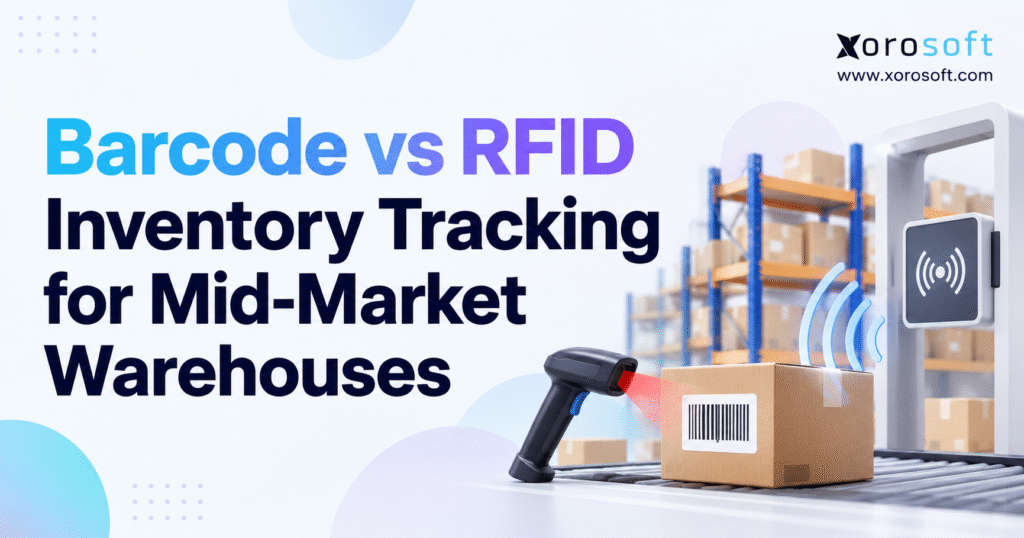
If you are trying to understand the differences between barcode vs RFID tracking, this guide will help clarify their unique features and benefits.
1. Where Warehouse Inventory Records Start Going Wrong
1.1. Stock Errors Grow With More Orders and Locations
As a warehouse expands, goods pass through more people, doors, bins, and systems. For example, one carton may be received, checked, stored, picked, packed, and shipped in a single day. Each step needs the correct item, quantity, and location. If one update is missed, the system can show stock in a place where it no longer exists.
Meanwhile, errors move beyond warehouse walls. Sales may promise an item that staff cannot find. Buyers may reorder goods that are already on hand. Finance may then spend days explaining why the stock value differs from the physical count. Therefore, faster scanning only helps when it leads to accurate and timely updates.
1.2. Find the Real Cause Before Changing Tracking Tools
First, identify the steps where the most errors begin. Are labels damaged during receiving? Do workers skip bin scans when orders pile up? Are returned goods made available before an inspection? Perhaps two systems post the same transfer at different times. These problems look similar in a stock report, yet they need different fixes.
For instance, a faster reader will not correct an incorrect case-pack rule. Likewise, a new tag cannot decide whether a damaged item should be held. Before comparing hardware, map the failed tasks and estimate the time spent fixing them. That gives managers a fair starting point for the technology review.
1.3. Set a Barcode vs RFID Tracking Baseline
Record the number of inventory adjustments, missed picks, recounts, and delayed receipts. Also note how often a warehouse employee must leave a task to look for missing stock. These measures show which problems cost money and which are merely inconvenient.
A strong baseline should cover normal and busy shifts. Otherwise, a test may compare a quiet RFID demo with a difficult barcode day. Once the team knows its starting numbers, it can judge whether any new method truly improves warehouse work.
2. Barcode vs RFID Tracking: How Each Method Works
2.1. Barcode Inventory Tracking Uses a Deliberate Scan
A barcode is a printed mark that a scanner or suitable camera reads. Usually, it identifies a product, carton, pallet, or storage bin. Warehouse software links the scanned code to a task, such as receiving a purchase order or picking an item for shipment. The employee then confirms the quantity or location before the system posts the action.
This clear step is one of barcode tracking’s strengths. If the wrong item is scanned, the screen can warn the worker before the mistake reaches packing. Still, barcode control depends on people using the required scans. A perfect label cannot prevent an error when a task is skipped or a quantity is entered incorrectly.
2.2. RFID Inventory Tracking Uses Radio Signals
RFID works through a tag and a reader. The reader sends a radio signal, and a suitable tag responds with its identifier. In a planned read area, several tags may be detected without showing each one to the device. As a result, RFID can reduce repeat scanning work for certain counts and movements.
However, a tag read is not the same as a confirmed stock move. Software must decide whether the item belongs to that task, whether it was inside the right area, and whether the event should change inventory. Without these rules, a reader may notice a pallet near a door and treat it as goods that actually left the building.
2.3. Barcode Codes and RFID Tags Carry Different Detail
A stock keeping unit, or SKU, names a product type or variant. A unique item ID points to one physical object. Similarly, a pallet code can identify a group of cases, but only when the system knows what belongs on that pallet. Neither a barcode nor an RFID tag creates these links without good item data.
One-dimensional barcodes, such as Code 128, use printed lines. Two-dimensional codes, including GS1 DataMatrix and QR codes, can hold more data in a small space. Yet both need an optical read. GS1’s 2D barcode guidance explains the move toward richer product codes; it does not mean every warehouse must replace a working 1D system.
3. RFID Warehouse Tracking: Tags, Readers, and Read Zones
3.1. Passive UHF RFID Fits Many Item-Level Uses
For goods and cartons, passive ultra-high-frequency RFID is a common place to start. Often called RAIN RFID, this technology powers suitable tags through the reader’s signal. Active RFID has its own power source and is used for different needs, including some asset-location projects. Because these systems have different costs and uses, they should not be compared as though they were the same product.
The reader’s useful range depends on the tag, antenna, goods, and site. GS1’s RFID frequency guidance describes these differences. A range quoted in a sales presentation should never replace a test on the actual shelves, cartons, and dock lanes.
3.2. A Fast RFID Read Still Needs a Clear Event
An RFID reader may report the same tag several times. It might also detect an item in a nearby bin rather than the intended zone. Therefore, the software needs to filter repeat reads and separate expected goods from unexpected ones. A worker or an approved system rule must handle the exceptions before a stock movement is posted.
In practice, the goal is not the largest number of reads. It is the highest number of correct tasks completed with the least extra work. For that reason, read-zone design and clear task rules matter as much as reader power.
3.3. Growing RFID Use Does Not Prove a Local Payback
RFID is widely used in several markets. The RAIN Alliance reported 42.7 billion tag-chip shipments in 2025, based on four reporting makers. Even so, this figure covers shipped chips across uses, not the number of mid-market warehouses running RFID.
More important, market growth does not show whether RFID is right for one site. A small warehouse with mixed, untagged goods may gain more from better barcode steps. By contrast, an apparel site with supplier-applied tags and large count volumes may have a clear test case. The work pattern should drive the decision.
4. Barcode vs RFID Tracking: The Key Differences
4.1. Barcode vs RFID Tracking: Speed and Control
Barcode scanning usually asks a worker to present one label at a time. This takes effort, but it also gives a clear point of control. By contrast, RFID may detect many tags within a planned area. That can make bulk counting faster, although it may also capture nearby items that were never part of the task.
The right measure is not IDs read per second. Instead, compare correctly completed receipts, picks, and counts per labor hour. Include the time required to fix unexpected reads or missed scans. A fast device that creates long follow-up work may deliver less value than a slower, well-run process.
4.2. Barcode and RFID Costs Follow Different Patterns
Printed labels tend to be inexpensive, while scanners and printers make up much of the first hardware cost. RFID adds tags, antennas, readers, network work, testing, and sometimes software to turn raw reads into valid events. Supplier-applied tags can lower in-house work, but tagging each inbound item locally may remove the expected savings.
Therefore, teams should compare the total cost of doing a task, not simply the price of one label or tag. A three-year view often tells a different story from a device quote.
4.3. Compare Barcode and RFID Reliability in Real Work
Labels may tear, fade, or face away from a worker. RFID tags may be missed, read twice, or detected outside the planned zone. In both cases, good task rules reduce the risk of bad inventory records. A device read alone does not prove a receipt, stock move, or shipment was correct.
| Decision point | Barcode | Passive UHF RFID |
|---|---|---|
| How it reads | Optical scan | Radio tag read |
| View of label | Usually needed | Not needed |
| Reading pattern | Usually one at a time | Many tags may be read |
| Main supply cost | Printed labels | Electronic tags |
| Main device cost | Scanners and printers | Readers and antennas |
| Common issue | Missed or wrong scan | Missed, repeat, or stray read |
| Strong fit | Clear task confirmation | High-volume tagged-item work |
5. Barcode vs RFID Tracking for Receiving and Putaway
5.1. Barcode Receiving Makes Shortages Easier to Check
At the dock, a worker can scan a carton, match it with the purchase order, and confirm what arrived. If the delivery is short, staff can record the gap before the stock becomes ready to sell. Damaged goods can be held for review. Next, a location scan can confirm where accepted stock was put away.
This process provides clear evidence of each step. However, it may slow down when many small cases arrive with poor supplier labels. Before changing technology, measure how much time goes into relabeling, checking order lines, and finding open bin space. Better labels and clearer receiving screens may remove a great deal of waste.
5.2. RFID Receiving Can Reduce Repeat Scans
With a controlled RFID dock setup, several tagged cases can be read as they move through a doorway. The system can compare those IDs against an advance shipping notice and flag extra or missing items. As a result, staff may need fewer one-by-one scans, especially when suppliers already apply reliable tags.
Still, a tag read does not show whether a carton is damaged or every unit inside is present. Nor does a dock-door read prove a pallet reached the correct bin. Therefore, the warehouse must retain checks for item status, quantity, and final location even when much of the identification work becomes automatic.
5.3. Test Barcode vs RFID Tracking on Dock-to-Stock Results
For receiving, compare time from arrival to available stock, not merely time spent at the dock. Also measure shortages, wrong-bin moves, and receipts needing a second check. A fast process that creates later recounts is not a real improvement.
Use the same range of suppliers and packages in both test groups. Then compare how much labor the new process removes and how much extra work it adds. This makes the result useful for both warehouse leaders and finance.
6. Barcode vs RFID Tracking for Picking, Packing, and Returns
6.1. Barcode Pick Checks Can Stop Errors Early
A wrong pick may lead to a return, a new shipment, and extra customer service work. Barcode tasks can help staff confirm the right bin, item, and quantity before a pick is finished. This is useful for similar sizes, colors, and pack types. However, the control loses value if workers can skip each scan whenever orders pile up.
A good process keeps screens short and makes errors easy to fix. In addition, managers should review how often pick tasks are overridden. Those patterns may reveal a layout or training problem that better hardware would not solve.
6.2. RFID Packing Needs Order-Level Proof
An RFID station may detect tagged goods near a packing bench. Yet other orders or loose returns could be within range. For that reason, the software must link each tag to the right order and carton. Otherwise, the station may appear to verify a shipment without proving what was actually packed.
A hybrid flow can use RFID to check likely item contents and a barcode to confirm the final carton or shipping label. This may reduce repeat work while keeping a clear final step. Even so, the design needs live testing with nearby orders, shared benches, and normal shift pressure.
6.3. Return Tracking Still Needs a Condition Check
A returned item can be ready to sell, damaged, missing parts, or awaiting inspection. Either barcode or RFID can identify the item, but neither determines its condition from the identifier alone. Therefore, the return task must record a status before the stock becomes available again.
In a barcode vs RFID tracking review, treat returns as a separate process. Faster identification is useful only if the system still prevents damaged goods from being promised to a new customer.
7. Barcode vs RFID Tracking for Cycle Counts and Accuracy
7.1. RFID Cycle Counts Can Cut Repeat Work
Cycle counting is one of the strongest reasons to test RFID. A barcode counter often scans a bin and then each item or carton. By contrast, an RFID handheld may read many suitable tags while a worker moves through the aisle. When tag quality and read zones are good, the team may finish the count with fewer manual steps.
However, the reader may detect stock in the next bin or miss tags hidden by certain goods. As a result, workers still need to review gaps, confirm the target area, and approve stock changes. The goal is a correct count that takes less time, not simply more tag reads.
7.2. RFID Read Success Is Not Inventory Accuracy
A reader can find almost every tag while the system balance remains wrong because an earlier receipt was posted twice. Likewise, a barcode may scan perfectly while a worker enters the wrong case amount. These errors show why managers should track read success, correct task posting, and physical-to-system stock differences as separate measures.
An Auburn University retail field study reported about 26% lower inventory-record error in a particular RFID test. That finding gives useful context. Still, it came from retail work and is not a promised result for mid-market warehouses.
7.3. Better Count Rules Matter With Either Tracking Method
Fast-selling, costly, or error-prone products may need more frequent checks. Slow-moving goods in stable bins may need fewer. Therefore, the count plan should follow business risk rather than the speed of a device. A warehouse should also review where and why count adjustments repeat.
For example, frequent errors after replenishment may point to missed location scans. Fixing that move can reduce future count work, regardless of the tracking method. A faster scanner cannot replace this kind of root-cause review.
CTA #1 — Free ERP Readiness Assessment: Before buying devices, review where stock errors begin and which tasks consume the most time. A Xorosoft readiness discussion can help frame those questions and identify whether warehouse controls, software, or a limited RFID pilot deserves closer study.
8. RFID Inventory Tracking Limits: Metal, Liquids, and Read Errors
8.1. Product Materials Change RFID Results
RFID uses radio waves, so the surrounding materials matter. Metal may reflect signals, while liquids can absorb part of the energy. Also, dense pallets, tag angle, and shelf layout may affect the read. A tag that works on an empty table may behave differently inside a full carton on a metal rack.
GS1’s guidance on RFID near metal and water explains these limits and notes that suitable tags can help in some settings. However, there is no single tag that fits every product. Test real goods under normal warehouse conditions before making a large purchase.
8.2. Clear RFID Read Zones Reduce False Moves
A reader at a shipping door should detect goods that actually pass through it. Yet an antenna may also read a pallet waiting nearby. If the system treats every read as a shipment, stock records will soon become less reliable. Therefore, read zones need clear physical design and rules for what counts as a valid event.
Also decide how staff will handle an unknown ID, a missed tag, or a late message. The system should hold unclear events for review rather than post a guessed stock change. That is how RFID can reduce manual work without hiding real errors.
8.3. Barcode and RFID Systems Both Need Failure Recovery
A warehouse cannot stop all orders because a device loses power or the network drops. For barcode work, a screen freeze may lead someone to scan the same pallet twice. For RFID, a reader may send the same tag event again when the link returns. Both cases call for safe retry rules and a clear audit trail.
Before rollout, test these failures with real users. The right design should recover without creating duplicate receipts, moves, or shipments. This is often more valuable than one perfect demonstration.
9. Barcode vs RFID Tracking Costs, TCO, and Payback
9.1. Barcode and RFID Costs Must Cover the Full Workflow
Barcode costs include scanners, printers, labels, setup, upkeep, and staff time. RFID adds electronic tags, antennas, readers, site tests, and often software for handling raw reads. In addition, some warehouses must spend time tagging inbound goods that arrive without RFID labels. That repeat labor can change the business case.
Therefore, look at three years of cost for the same task volume. Count labor saved, but also count support work, tag errors, and system fixes. A low tag price does not always mean a low operating cost. Similarly, a higher first-year cost can still make sense if proven later savings are large enough.
9.2. Three-Year Barcode vs RFID Tracking Cost Example
The following US-dollar figures are illustrative assumptions, not vendor quotes or market rates. Each option covers the same set of warehouse counting and identification tasks. The labor row covers only the target work, not the full payroll. Actual outcomes will change with tag volume, wages, building layout, and integration needs.
| Three-year cost | Barcode only | Hybrid | Wider RFID use |
|---|---|---|---|
| Devices and site setup | $20,000 | $48,000 | $100,000 |
| Software links and rollout | $10,000 | $28,000 | $50,000 |
| Labels or tags | $15,000 | $39,000 | $90,000 |
| Labor for target tasks | $240,000 | $150,000 | $100,000 |
| Support and upkeep | $12,000 | $21,000 | $36,000 |
| Three-year total | $297,000 | $286,000 | $376,000 |
In this example, the hybrid plan costs $11,000 less than barcode-only over three years. Wider RFID use costs $79,000 more, even though its target labor cost is lower. This does not mean hybrid always wins. Rather, it shows why tag and site costs belong in the same model as labor savings.
9.3. How to Work Out RFID Payback
First, estimate the yearly labor and error costs the new setup could avoid. Next, subtract added tags, upkeep, and support. The result is annual net savings. Then divide the extra one-time spending by those savings, provided the savings are above zero.
In the example, hybrid tracking needs $46,000 more up front than barcode-only. Its annual running cost is $19,000 lower. So, simple payback is $46,000 divided by $19,000, or about 2.42 years. This leaves out taxes, financing, the time value of money, and rollout delays. Before approval, finance should test lower-savings cases as well.
10. Connecting Barcode vs RFID Tracking to WMS and ERP
10.1. A Scan Must Become a Valid Warehouse Task
Every scan or RFID read should point to a clear business action. The system needs the item, unit, bin, task, and expected stock status. Next, it should check whether that action is allowed. Only then should it post a receipt, pick, move, or count change. Without this flow, faster data capture can create bad stock records more quickly.
GS1’s EPCIS guidance describes how an event can record what happened, when, where, and why. This idea works with both barcode and RFID. The value comes from the meaning of the event, not from storing a long list of raw IDs.
10.2. Stock Updates Need to Reach Buying and Finance
A receipt changes more than the number on a shelf. It may affect a purchase order, available stock, future buying needs, and stock value. Likewise, a warehouse transfer must show goods that left one site but have not reached the next. Therefore, inventory tracking should work as part of a wider business flow.
Xorosoft’s XoroWMS describes barcode scanning, cycle counts, multi-warehouse work, and RFID tracking at a general level. Its XoroERP connects inventory with buying, accounting, and reports. However, teams must check reader models, software links, and event rules for their own site rather than assume every RFID setup works without added design.
10.3. Clear Data Ownership Prevents Repeat Errors
Decide which team owns product codes, case packs, bins, lots, and stock status. A pallet ID may point to many cases, but the system needs a correct record of what belongs on that pallet. Without that record, reading the pallet tag cannot prove the count of each item inside it.
Also define who can approve stock changes and who handles errors between systems. When these rules are clear, staff can trust the results of either tracking method. Good master data is less visible than new hardware, yet it often makes the larger difference.
11. Hybrid Barcode vs RFID Tracking for Ecommerce Operations
11.1. Hybrid Tracking Works When Tasks Need Different Checks
A warehouse may use RFID for large tagged-item counts and barcode scans for final packing. Another site might keep barcode receiving while using RFID to track reusable pallets. In each case, both methods must point to the same product and location records. Otherwise, two tools can create two versions of the truth.
Before rollout, write down which method applies to each task. Also show workers how to handle exceptions. If staff can post the same move through either method with no shared rule, the risk of duplicate updates grows. A clear task map prevents that problem.
11.2. Shopify Inventory Depends on Correct Stock Events
A Shopify order and a wholesale order may both need goods from the same bin. If a receipt is late or a transfer posts twice, online stock can be wrong. Therefore, barcode vs RFID tracking needs to connect with the system that owns available inventory, not just the reader on the floor.
Xorosoft lists links between online orders and stock workflows through its integrations. The Xorosoft app in the Shopify App Store also describes store and ERP data flow. Still, a store link is not proof that a certain RFID reader is supported. That device and its events need a separate technical check.
11.3. Transfers Need a Clear Handoff Between Warehouses
When stock leaves one site, the source can mark it as sent. The destination should confirm receipt before those goods become ready to sell there. Meanwhile, in-transit stock needs its own status so no team promises it twice. This matters even more when a third-party warehouse handles one part of the work.
The XoroONE platform brings inventory and related operations together. Even so, businesses should test how real transfers deal with short loads, damage, lost labels, and late updates. Good rules for unusual events are just as important as the normal flow.
12. Barcode vs RFID Tracking by Warehouse Industry
12.1. Apparel and Sporting Goods: Many Item Variants
Apparel warehouses handle a wide range of styles, sizes, and colors. When suppliers already apply item-level RFID tags, bulk cycle counts may be worth testing. However, barcode scans may still provide better final checks during packing and returns, where a worker must confirm the exact order and item condition.
For sporting goods, the choice can vary by product group. Small items may be easy to scan, while high-volume tagged stock may suit RFID counting. Therefore, one warehouse may need two methods rather than one rule for every product.
12.2. Furniture and Wholesale: Carton and Pallet Control
Furniture often moves in bulky cartons or sets made of several parts. Barcodes can help verify each carton and keep a full set together. RFID may be useful for reusable racks or selected costly assets, yet metal parts and unusual packaging can make reads harder.
Wholesale teams also handle mixed orders and supplier labels of uneven quality. As a result, clear case and pallet IDs are often the best first step. A later RFID test can focus on one repeat task with clear savings instead of trying to tag every item on day one.
12.3. Food and Manufacturing: Lots and Work Status
Food warehouses need lot, date, and hold-status checks. Manufacturers need records that link raw goods, work in progress, and finished items. Both barcode and RFID can identify materials, but the business system must still keep the batch and work-order links. Liquids, metal, and harsh handling may also affect tag choice.
Xorosoft works with several inventory-led industries. However, each warehouse should base its tracking choice on the goods it handles and the tasks it needs to confirm, not the industry label alone.
13. Testing Barcode vs RFID Tracking Before a Rollout
13.1. Start With One Costly, Repeatable Task
A useful trial begins with one task, such as counting a set of tagged goods. First, measure how long the barcode method takes and how often staff need a recount. Then test RFID on the same type of stock and shift. This makes the comparison fair and easy to explain.
Avoid changing the warehouse layout, staffing, and task rules at the same time. Otherwise, no one can tell which change created the result. Also include busy shifts, not just a quiet demo day. The trial should reflect normal work.
13.2. Test Barcode vs RFID Tracking Under Difficult Conditions
Use real cartons, full pallets, tall racks, metal goods, and liquids when they are part of the stock mix. Include missing tags, damaged labels, unknown items, and a network drop. Next, check whether the system holds bad events for review instead of posting them as stock moves.
In addition, record how much time staff spend fixing those events. A new setup that reads faster but takes longer to correct may not be an improvement. This is why barcode vs RFID tracking trials need both accuracy and labor measures.
13.3. Set Barcode vs RFID Pilot Success Rules in Advance
Before testing, agree on a short scorecard. Measure correct task posting, count time, stock gaps, missed or stray reads, and cost per finished task. Finance should review whether saved hours can truly reduce costs or help the team handle more work.
If the trial misses key accuracy goals, adjust the setup or stop. When tag and support costs cancel the labor gain, keep the current method. However, if the trial meets work and cost goals across normal shifts, a wider rollout can proceed in stages.
14. Common Barcode vs RFID Tracking Mistakes
14.1. Buying a Reader Based Only on Peak Speed
A sales demo may show many IDs being read in seconds. Yet warehouses are paid to receive, store, pick, and ship the right goods. Therefore, use completed tasks and error rates to judge value. A fast read that causes more follow-up work is not a win.
14.2. Barcode vs RFID Tracking Mistake: Poor Item Data
A barcode with the wrong SKU and an RFID tag linked to the wrong item can both create bad records. For this reason, check supplier labels, case packs, unique IDs, and item links before launch. Good data keeps both methods useful.
14.3. Leaving Staff Out of the Process Design
Workers need short screens, clear steps, and fast help when something fails. Supervisors need safe ways to review stock changes. Meanwhile, IT must be able to trace a failed event. If these needs are ignored, staff may find workarounds that remove the very controls the project was meant to improve.
15. A Practical Barcode vs RFID Tracking Roadmap
15.1. Choose the Workflow First, Then the Technology
The best barcode vs RFID tracking choice begins with a clear picture of stock errors and wasted work. If the issue is a missed bin scan, improve the task rule. When large volumes of well-tagged goods take too long to count, test RFID. If bulk reads help one task but a final scan remains useful elsewhere, use a hybrid approach.
Above all, make sure each read becomes a correct stock event. Then compare labor savings with tags, devices, upkeep, and the time needed to handle errors. A faster read only matters when it supports a more reliable and lower-cost operation.
15.2. Review Readiness and See Real Tasks in a Demo
A practical next step is to review receiving, putaway, picking, counting, transfers, and returns against actual errors and labor costs. Next, watch a demo of the tasks that matter most. Ask how the system handles wrong items, held stock, repeat reads, and late transfers rather than focusing only on dashboards.
Free ERP Readiness Assessment • Watch Demo • Book Personalized Demo: Contact Xorosoft to discuss your warehouse needs and request a guided review or product demo. Confirm any RFID devices, tags, or software links during the technical review before making a buying decision.
Frequently Asked Questions About Barcode vs RFID Tracking
What is the difference between barcode and RFID tracking?
Barcode tracking requires an optical scan of a label. RFID uses radio signals to identify tagged items, often in groups and without direct line of sight.
Is RFID better than barcode tracking for warehouses?
Not always. RFID suits repeat counts of tagged stock, while barcodes offer low-cost, precise confirmation during receiving, picking, and shipping. The best choice depends on the workflow.
How much does RFID inventory tracking cost?
Costs include tags, readers, antennas, software, setup, and support. Compare the full three-year cost with barcode labor and equipment costs before investing.
Does RFID improve warehouse inventory accuracy?
It can reduce missed manual scans, but accuracy also depends on read zones, clean item data, and valid stock moves. RFID alone cannot prevent inventory errors.
Can RFID replace barcode scanning completely?
Sometimes, but many warehouses retain barcodes for bin checks, packing, and exception handling. A hybrid approach often preserves precise checks while reducing repetitive scans.
Can barcode and RFID data integrate with an ERP?
Yes, when the ERP or WMS supports the devices and maps reads to approved stock transactions. Confirm hardware compatibility and data flows before rollout.
When should a mid-market warehouse adopt RFID?
Consider RFID when tagged items require frequent bulk counts or repeated checks. Start with a pilot, measure labor savings and errors, then assess payback.
Search
Browse topics
Recent Posts
-
 Barcode vs RFID Inventory Tracking for Mid-Market Warehouses
-
 Inventory Optimization for Machinery and Equipment Distributors
-
 How to Update Landed Costs After a Duty or Surtax Change
-
 ERP Renewal Benchmarks 2026: Increases, Notice Periods and Switching Time
-
 Why Free-Shipping Rules Hide Unprofitable Fulfillment Decisions