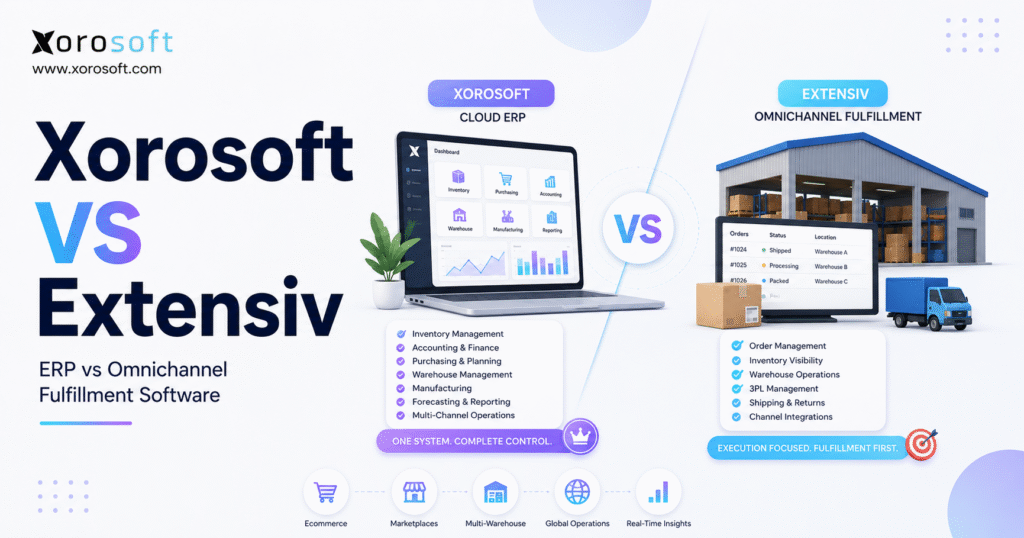
In this post, we’ll take a close look at Xorosoft vs Extensiv to help you understand the key differences and strengths of each platform.
1. Xorosoft vs Extensiv: Choosing the Right Operating System
Xorosoft vs Extensiv is not only a comparison between two software companies. Instead, it is a choice between a full cloud ERP platform and omnichannel fulfillment software. Therefore, the right option depends on whether your business needs better order execution or one connected system for inventory, purchasing, accounting, warehouse management, forecasting, manufacturing, and reporting.
At first, the platforms may appear similar. For example, both can support inventory, orders, warehouses, ecommerce channels, and fulfillment. However, each platform approaches those areas from a different starting point.
Extensiv focuses on connected warehouse, inventory, order management, shipping, and third-party logistics workflows. Its official product suite includes order management, warehouse management, 3PL warehouse management, integrations, and related fulfillment tools.
Xorosoft, meanwhile, is built as a cloud ERP for inventory-driven businesses. The XoroONE cloud ERP platform connects inventory, accounting, purchasing, warehouse management, manufacturing, ecommerce, forecasting, integrations, and reporting in one system.
Consequently, the core buying question is straightforward:
Does your company need to improve fulfillment execution, or does it need to connect its entire business?
This guide explains that difference. Moreover, it shows which system may fit ecommerce brands, wholesalers, manufacturers, multi-warehouse operators, and 3PL-led businesses.
1.1 What Buyers Need to Decide
Before comparing features, first identify the main operating problem.
For example, a business may struggle because orders are not routed to the right warehouse. In that case, fulfillment software may solve the issue.
However, another business may struggle because purchasing, inventory, accounting, warehouse activity, and ecommerce data do not match. In that case, better order routing will not fix the wider problem.
Therefore, the decision should begin with the root cause rather than a feature checklist.
1.2 ERP vs Fulfillment Software in Simple Terms
Enterprise resource planning software connects the main functions used to run a business. Oracle explains that ERP systems support daily business work across areas such as accounting, purchasing, project management, risk management, compliance, and supply chain operations.
Fulfillment software has a narrower focus. It usually helps teams capture orders, route them, manage warehouse work, update inventory, create shipments, and return tracking details to sales channels.
Therefore:
- ERP manages the wider business.
- Fulfillment software manages how orders move.
- WMS manages work inside the warehouse.
- OMS manages the order lifecycle.
- Inventory software tracks stock and availability.
Although these categories overlap, they do not offer the same level of control.
1.3 Fulfillment Execution Versus Business Control
Fulfillment software answers questions such as:
- Which warehouse should ship the order?
- Is enough stock available?
- Has the order been picked?
- Has the package shipped?
- Has tracking returned to Shopify or Amazon?
ERP answers broader questions such as:
- What is the true inventory value?
- Which items should purchasing reorder?
- What supplier costs remain open?
- How did the shipment affect revenue and cost?
- Which products create the strongest margin?
- Can current materials support production?
- Why is the financial close delayed?
Therefore, Xorosoft vs Extensiv is mainly a decision between fulfillment execution and business-wide control.
2. Xorosoft vs Extensiv at a Glance
The following table summarizes the main platform differences.
| Comparison Area | Xorosoft | Extensiv |
|---|---|---|
| Main category | Cloud ERP | Omnichannel fulfillment, OMS, WMS, and 3PL software |
| Main purpose | Connect operations and finance | Improve order and warehouse execution |
| Inventory | Connected to purchasing, accounting, warehouses, sales, and manufacturing | Focused on stock visibility, orders, warehouses, and fulfillment |
| Accounting | Part of the ERP operating model | Commonly handled through another finance or ERP system |
| Purchasing | Connected to vendors, inventory, receiving, and finance | Replenishment capabilities depend on the product and setup |
| Warehouse management | ERP-connected WMS through XoroWMS | Warehouse and 3PL warehouse management products |
| Order management | Connected to ERP, inventory, WMS, and finance | A central product focus |
| Manufacturing | Supports inventory-driven production workflows | Not the main platform focus |
| 3PL operations | Can support connected logistics workflows | Strong 3PL warehouse focus |
| Shopify | ERP integration for inventory, orders, payments, refunds, and operations | Ecommerce and sales-channel integrations |
| Best fit | Businesses that need one operating platform | Businesses focused on fulfillment and logistics execution |
However, the table does not tell the entire story. Two systems may both include inventory or warehouse functions, yet those functions may have different depth.
2.1 The Core Platform Difference
Extensiv starts with orders, warehouses, fulfillment, and logistics. Therefore, it may suit teams that need to improve how inventory reaches customers.
Xorosoft starts with ERP. As a result, it can connect order execution with accounting, purchasing, inventory value, manufacturing, forecasting, and reporting.
That difference becomes more important as the company grows.
2.2 Best-Fit Business Profiles
Extensiv may fit:
- Third-party logistics providers
- Brands that depend heavily on 3PL warehouses
- Companies that need stronger order routing
- Warehouses seeking focused fulfillment tools
- Merchants whose accounting and purchasing systems already work well
Xorosoft may fit:
- Ecommerce brands that have outgrown disconnected apps
- Wholesalers with complex orders and purchasing
- Businesses managing several warehouses
- Manufacturers managing materials and production
- Shopify and Amazon sellers that need ERP-level control
- Companies replacing QuickBooks and spreadsheets
2.3 Xorosoft vs Extensiv Capability Comparison
The main difference is not whether a feature exists. Instead, it is how far the feature reaches.
For example, an inventory update in fulfillment software may change available stock and order routing. However, an inventory update in ERP may also change purchasing needs, financial value, warehouse records, production plans, and management reports.
Therefore, buyers should always ask each vendor to show the complete workflow.
3. ERP vs Omnichannel Fulfillment Software: Why the Category Matters
Software categories matter because growing companies often buy the wrong type of system.
For instance, a business may purchase a warehouse tool when its real issue is poor purchasing. Likewise, another company may implement ERP when it only needs faster order routing.
Consequently, the category should be chosen before the vendor.
3.1 What a Cloud ERP Platform Does
A cloud ERP brings core business functions into one shared system.
For an inventory-driven company, those functions may include:
- Sales orders
- Customer records
- Inventory
- Purchasing
- Suppliers
- Warehouse operations
- Accounting
- Financial reporting
- Manufacturing
- Demand planning
- Ecommerce
- EDI
- Wholesale operations
Because these functions share data, teams do not need to move the same information between several tools.
Moreover, management can review sales, stock, buying, fulfillment, and finance without waiting for manual reports.
3.2 What Omnichannel Fulfillment Software Does
Omnichannel fulfillment software helps companies manage orders across sales channels and fulfillment locations.
For example, it may help teams:
- Import orders from Shopify, Amazon, or marketplaces
- View stock across warehouses
- Route orders to the right location
- Manage picking and packing
- Create shipments
- Update channel inventory
- Send tracking details
- Connect with 3PL partners
- Track fulfillment results
Therefore, it can create strong value when the main problem is warehouse or order execution.
3.3 ERP Control Versus Fulfillment Execution
The category difference can be summarized as follows:
| Business Need | Fulfillment Software | Cloud ERP |
| Route orders | Strong fit | Supported as part of wider order management |
| Manage pick-pack-ship | Strong fit | Supported through WMS |
| Connect 3PL warehouses | Often a key strength | Usually handled through integrations |
| Manage accounting | Usually external | Core function |
| Manage purchasing | May support replenishment | Core connected workflow |
| Calculate inventory value | Often external | Core operational and financial need |
| Manage production | Usually limited | Often supported |
| Create financial reports | Usually external | Core function |
| Replace several business apps | Limited | Primary goal |
As a result, the right category depends on how broad the problem has become.
4. Extensiv for Omnichannel Fulfillment and 3PL Operations
Extensiv provides a connected suite for order, inventory, warehouse, shipping, and logistics work. Its product pages describe integrated systems that support activity from the sales channel to the warehouse floor.
Therefore, the platform is especially relevant for fulfillment-led operations.
4.1 Extensiv Omnichannel Order Management
Order management is a key part of Extensiv’s offer.
For example, brands may need to collect orders from several channels, apply routing rules, assign the right warehouse, and return shipment updates. Extensiv supports this type of connected order flow through its product suite.
Moreover, centralized order data can reduce the need to work inside each marketplace or storefront separately.
4.2 Extensiv Inventory Visibility
Extensiv also supports inventory visibility across warehouse and order workflows.
This visibility can help teams:
- See stock by location
- Track available items
- Manage allocated units
- Review inbound inventory
- Sync stock with sales channels
- Reduce overselling
- Support reorder decisions
However, visibility does not always include full inventory accounting. Therefore, buyers should verify how inventory cost, valuation, vendor bills, and financial records will be handled.
4.3 Extensiv Warehouse and 3PL Operations
Extensiv has a clear focus on 3PL warehouse management.
Its official 3PL Warehouse Manager page highlights connections with ecommerce platforms, marketplaces, shipping tools, accounting systems, and other warehouse applications.
In addition, its warehouse tools are built around areas such as:
- Receiving
- Storage
- Inventory control
- Order processing
- Picking
- Packing
- Shipping
- Barcode scanning
- Customer rules
- Warehouse reporting
Therefore, Extensiv may be a strong fit when a 3PL or fulfillment warehouse is the center of the operation.
5. Xorosoft Cloud ERP for Inventory-Driven Businesses
Xorosoft takes a wider approach.
The XoroONE ERP platform is designed for retailers, wholesalers, manufacturers, ecommerce companies, and other product businesses that need one connected operating platform.
Therefore, Xorosoft is intended to connect the warehouse with the rest of the company rather than treating fulfillment as a separate process.
5.1 Xorosoft Inventory and Order Control
Orders affect more than fulfillment.
For example, a new Shopify order may change:
- Available inventory
- Warehouse tasks
- Inventory allocation
- Customer balances
- Sales reports
- Replenishment needs
- Expected margin
Therefore, Xorosoft connects order work with the wider ERP record.
This is useful when teams are comparing different numbers in Shopify, spreadsheets, warehouse software, and accounting tools.
5.2 Xorosoft Accounting and Financial Management
Accounting is one of the clearest differences in Xorosoft vs Extensiv.
A fulfillment platform may send order and shipment data to an accounting system. However, an ERP can place accounting inside the same operating model as inventory, purchasing, and warehouse work.
As a result, the company can follow a transaction from:
1. Purchase order
2. Supplier receipt
3. Vendor bill
4. Inventory value
5. Sales order
6. Warehouse shipment
7. Customer invoice
8. Cost of goods sold
9. Financial reporting
Therefore, the finance team spends less time matching separate records.
5.3 Xorosoft Purchasing and Supply Planning
Purchasing becomes difficult when a company adds products, suppliers, warehouses, and sales channels.
For instance, a buyer must consider:
- Available inventory
- Open sales orders
- Open purchase orders
- Supplier lead times
- Incoming stock
- Warehouse demand
- Seasonal trends
- Forecast sales
- Available cash
The XoroERP platform is positioned for businesses that need to bring operational functions into one ERP environment after outgrowing basic accounting tools.
Therefore, purchasing can work from the same records used by inventory, warehouse, finance, and sales teams.
5.4 XoroWMS and ERP-Connected Warehouse Management
Xorosoft also provides XoroWMS warehouse management software.
XoroWMS supports warehouse and fulfillment functions while connecting with wider business systems. Its product information also highlights system integration and unified data exchange.
Consequently, receiving, picking, packing, shipping, returns, transfers, and stock changes can support the wider ERP record.
6. Xorosoft vs Extensiv for Inventory Management
Inventory is important to both platforms. However, Xorosoft vs Extensiv reveals two different inventory models.
6.1 Inventory Visibility Across Sales Channels
Extensiv can help teams see stock across sales channels, warehouses, and fulfillment locations.
Therefore, it may help a brand decide:
- Which warehouse can ship?
- How much stock can be offered online?
- Which units are already allocated?
- When should a listing be updated?
- Which location is low on stock?
This is especially valuable when the company’s main risk is overselling or poor fulfillment routing.
6.2 ERP Inventory as a Financial Asset
Xorosoft treats inventory as both physical stock and a financial asset.
For example, when a warehouse receives 500 units, the transaction may also affect:
- Open purchase orders
- Supplier costs
- Inventory value
- Landed cost
- Available stock
- Accounts payable
- Replenishment plans
- Management reports
Therefore, ERP inventory control reaches beyond availability.
6.3 Multi-Warehouse Inventory Control
Both platforms may support multi-warehouse operations. However, the required depth differs.
Choose a fulfillment-led model when the main goal is:
- Finding stock
- Routing orders
- Managing warehouse activity
- Updating sales channels
- Coordinating 3PL locations
Choose ERP when the company also needs:
- Warehouse transfers
- Financial valuation
- Purchasing by location
- Supplier planning
- Inventory ownership
- Manufacturing demand
- Company-wide reporting
Therefore, Xorosoft vs Extensiv for multiple warehouses depends on whether the company needs execution alone or full operational control.
6.4 Inventory Accuracy and Reconciliation
Software does not create accurate inventory by itself.
Instead, accuracy also depends on:
- Receiving rules
- Barcode scanning
- Pick confirmation
- Cycle counts
- Returns
- Stock transfers
- Inventory adjustments
- User controls
However, a connected system can reduce delays between these events.
For example, when a pick is confirmed, available stock should change. Next, the sales channel should receive an update. Finally, the shipment and financial records should remain aligned.
7. Xorosoft vs Extensiv for Warehouse Management
Warehouse management is one of the closest areas in the comparison.
However, each platform approaches warehouse work from a different operating model.
7.1 Extensiv for Fulfillment-First Warehouses
Extensiv may fit warehouses that need:
- Order routing
- Mobile warehouse tools
- Receiving
- Putaway
- Picking
- Packing
- Shipping
- Barcode scanning
- 3PL customer workflows
- Fulfillment reports
Moreover, its 3PL focus may suit logistics providers managing inventory and orders for several customers.
7.2 XoroWMS Within a Cloud ERP Platform
XoroWMS may fit companies that need warehouse work linked directly with:
- Sales orders
- Purchase orders
- Accounting
- Inventory value
- Manufacturing
- Ecommerce channels
- Wholesale orders
- Business reports
Therefore, the warehouse is not treated as a separate data island.
7.3 ERP-Connected WMS vs Fulfillment Software
A standalone WMS or fulfillment platform may be enough when warehouse execution is the main issue.
However, ERP-connected WMS may be better when warehouse actions affect finance, purchasing, production, and planning.
Therefore, Xorosoft vs Extensiv for warehouse management depends on whether the warehouse needs a focused tool or a wider operating system.
8. Xorosoft vs Extensiv for Order Management
Order management covers the full path from order capture to shipment, return, invoice, and reporting.
Both platforms can support this path. However, they connect the order to different levels of the business.
8.1 Extensiv Omnichannel Order Management
Extensiv is strongly focused on omnichannel order management.
Therefore, it may help brands:
- Import channel orders
- Review stock
- Apply routing rules
- Send orders to warehouses
- Manage fulfillment
- Return tracking data
- Update channel inventory
This approach may work well when finance, purchasing, and other core functions already run effectively in separate systems.
8.2 Xorosoft ERP Order Management
Xorosoft connects orders to ERP and WMS records.
As a result, a Shopify, Amazon, wholesale, or EDI order may affect:
- Allocation
- Inventory
- Warehouse work
- Customer invoices
- Revenue records
- COGS
- Purchasing plans
- Financial reports
In addition, the Xorosoft ERP application is available through the Shopify App Store, which makes the integration relevant for Shopify merchants reviewing operational platforms.
8.3 Order Execution Versus ERP-Wide Control
The difference is not simply whether the platforms process orders.
Instead, the difference is how far the order reaches.
Extensiv may use the order to guide fulfillment. Meanwhile, Xorosoft may use the order across fulfillment, inventory, purchasing, accounting, forecasting, and reporting.
Therefore, the correct choice depends on the company’s wider workflow.
9. ERP vs Fulfillment Software for Accounting and Finance
Accounting can change the entire software decision.
If the existing finance system works well, a business may only need better fulfillment. However, if inventory, orders, purchasing, and accounting do not match, ERP may provide more value.
9.1 Why Inventory Accounting Matters
Inventory affects:
- Cash
- Profit
- Margin
- Purchasing
- Tax
- Working capital
- Cost of goods sold
- Financial reporting
Therefore, finance teams need more than a physical count.
They may also need:
- Inventory valuation
- Vendor bills
- Customer invoices
- Landed cost
- Channel fees
- Refunds
- Payout matching
- Stock adjustments
- Margin by SKU
- Margin by channel
When those records sit in separate systems, finance often relies on exports and spreadsheets.
9.2 When Cloud ERP Becomes Necessary
ERP becomes more useful when operational events must update financial records.
For example, receiving goods should update inventory and purchasing. Likewise, shipping an order should update stock, sales, and cost records.
Therefore, Xorosoft vs Extensiv for accounting is not an equal feature comparison. Accounting sits at the center of ERP, while fulfillment software commonly connects with a separate finance system.
9.3 How Fulfillment Data Connects to Finance
A strong software setup should define how each event moves into accounting.
For example:
1. An order enters from Shopify.
2. Inventory becomes allocated.
3. The warehouse ships the order.
4. Available stock decreases.
5. Revenue and customer records update.
6. Cost of goods sold is recorded.
7. Fees, refunds, and payouts are matched.
8. Management reports update.
Therefore, buyers should ask each vendor to demonstrate this full process.
10. Xorosoft vs Extensiv for Purchasing and Forecasting
Purchasing and forecasting become more important as a business carries more SKUs or faces longer supplier lead times.
10.1 Purchasing Workflow Depth
A purchasing team must know:
- What is selling?
- What is already available?
- What is allocated?
- What is inbound?
- Which supplier is late?
- Which warehouse needs stock?
- Which items are overstocked?
- How much cash is tied to purchase orders?
Therefore, spreadsheets become risky as the company grows.
Xorosoft can connect purchasing with inventory, receiving, suppliers, accounting, and planning. Extensiv may support replenishment needs inside an order and inventory workflow.
However, buyers should compare the full purchase lifecycle rather than only reorder alerts.
10.2 Inventory and Demand Forecasting
Forecasting can mean different things.
For a fulfillment platform, forecasting may focus on expected demand and stock availability.
For an ERP, forecasting may also guide:
- Purchase orders
- Supplier plans
- Warehouse needs
- Production
- Material buying
- Cash flow
- Inventory targets
Consequently, Xorosoft vs Extensiv for forecasting depends on how many teams must use the forecast.
10.3 ERP Replenishment and Supplier Planning
A connected ERP can turn demand into action.
For example:
1. Sales data shows rising demand.
2. The forecast identifies a future shortage.
3. Purchasing reviews suppliers and lead times.
4. A purchase order is created.
5. The warehouse prepares for receipt.
6. Finance tracks the expected cost.
7. Reports show the new stock position.
Therefore, ERP is often more useful when replenishment affects several departments.
11. Xorosoft vs Extensiv for Shopify and Ecommerce
Ecommerce brands often begin this comparison after their app stack becomes difficult to manage.
A common stack may include:
- Shopify
- Amazon
- QuickBooks
- Shipping software
- Inventory software
- Warehouse software
- EDI software
- Purchasing spreadsheets
- Reporting spreadsheets
At first, each app solves a clear problem. However, every added system creates another handoff.
11.1 Shopify Fulfillment With Extensiv
Extensiv may help Shopify brands manage orders, inventory visibility, warehouse routing, and fulfillment updates.
Therefore, it may create a stronger execution layer behind the storefront.
This can be useful when the company wants to improve fulfillment without replacing purchasing, accounting, or other core systems.
11.2 Shopify ERP With Xorosoft
Xorosoft can act as the ERP and operating system behind Shopify.
For example, Shopify orders may connect to:
- Inventory
- Warehouses
- Payments
- Refunds
- Purchasing
- Accounting
- Wholesale
- Reporting
Businesses can also review available Xorosoft integrations when mapping ecommerce, EDI, B2B, and operational connections.
Therefore, Xorosoft vs Extensiv for Shopify depends on whether the brand needs better fulfillment or a broader replacement for disconnected apps.
11.3 Multi-Channel Ecommerce Operations
Multi-channel brands often sell through Shopify, Amazon, wholesale, marketplaces, retail, and EDI.
As a result, they must control:
- Shared inventory
- Channel allocation
- Customer pricing
- Warehouse routing
- Returns
- Purchasing
- Fees
- Revenue
- Margin
Ecommerce continues to represent a major part of retail growth. For example, the U.S. Census Bureau reported that first-quarter 2026 ecommerce sales increased 9.7% from the first quarter of 2025, while total retail sales increased 4.0%.
Therefore, the operational system behind ecommerce becomes more important as order and channel complexity rises.
12. ERP vs Fulfillment Software for Wholesale and EDI
Wholesale adds requirements that direct-to-consumer orders may not include.
For example, wholesale customers may require special prices, payment terms, EDI messages, carton labels, shipping rules, and delivery windows.
12.1 Wholesale Fulfillment Requirements
A wholesale operation may need to manage:
- Large orders
- Backorders
- Inventory allocation
- Pick rules
- Packing rules
- Shipping windows
- Customer labels
- EDI documents
- Tracking
- Proof of delivery
Therefore, fulfillment software may help route and ship wholesale orders.
12.2 Wholesale ERP Requirements
However, wholesale also affects:
- Customer pricing
- Credit limits
- Accounts receivable
- Purchasing
- Sales commissions
- Inventory value
- Margin
- Supplier plans
- Financial reporting
Consequently, ERP may become more useful when wholesale workflows reach beyond the warehouse.
Businesses comparing wider system options can also review the Xorosoft comparison hub.
12.3 EDI and Customer-Specific Workflows
EDI can involve:
- Purchase orders
- Order acknowledgements
- Advance shipping notices
- Invoices
- Product data
- Inventory updates
- Shipping instructions
Therefore, EDI should not operate as an isolated app.
Instead, it should connect with sales orders, inventory, warehouse work, invoices, and accounting.
13. Xorosoft vs Extensiv for Manufacturing
Manufacturing creates a clearer category difference.
Fulfillment begins after a product is available. However, manufacturing controls how the product is planned and created.
13.1 Manufacturing and Production Requirements
Manufacturers may need:
- Bills of materials
- Raw materials
- Work orders
- Production schedules
- Assemblies
- Finished goods
- Material use
- Labor records
- Production costs
- Quality checks
Therefore, fulfillment software alone may not cover the complete process.
13.2 Cloud ERP for Production Operations
ERP can connect demand with purchasing, materials, production, warehouse stock, and finance.
For example:
1. The forecast increases.
2. Production demand rises.
3. The system identifies a material shortage.
4. Purchasing orders the components.
5. The warehouse receives the materials.
6. Production consumes the components.
7. Finished goods become available.
8. Costs update in the financial records.
Xorosoft provides ERP solutions for manufacturing that connect production with inventory-driven operations.
13.3 Why Fulfillment Software Alone May Not Be Enough
Fulfillment software can help ship finished goods.
However, it may not fully manage:
- Material planning
- Production work
- BOM changes
- Component shortages
- Work-in-progress
- Production costs
Therefore, Xorosoft vs Extensiv for manufacturing usually favors ERP when production is a central business need.
14. Industry Use Cases for ERP and Fulfillment Software
Different industries create different operating needs.
Therefore, the best platform also depends on product type, sales channels, supplier structure, and warehouse model.
14.1 ERP and Fulfillment Software for Apparel and Fashion
Apparel companies manage:
- Sizes
- Colors
- Styles
- Seasons
- Returns
- Wholesale orders
- Ecommerce launches
Extensiv may help with channel orders and fulfillment. However, Xorosoft may be more suitable when the brand also needs purchasing, accounting, planning, production, and warehouse control in one platform.
14.2 ERP and Fulfillment Software for Furniture
Furniture companies often manage large products, long lead times, supplier delays, and complex warehouse needs.
Therefore, ERP can help connect purchasing, inbound stock, customer orders, warehouse capacity, and finance.
However, fulfillment software may still fit when delivery routing and warehouse execution are the main problems.
14.3 ERP and Fulfillment Software for Sporting Goods
Sporting goods brands often carry many SKUs and face seasonal demand.
As a result, forecasting, replenishment, and multi-warehouse control become important.
ERP may fit when these needs must also connect to finance and purchasing.
14.4 ERP and Fulfillment Software for Food and Beverage
Food companies may require:
- Lot control
- Expiry dates
- Production
- Quality checks
- Warehouse controls
- Supplier records
Therefore, ERP may be a stronger fit when compliance, manufacturing, inventory, purchasing, and accounting must work together.
14.5 ERP and Fulfillment Software for Wholesale Distribution
Wholesale distributors manage pricing, terms, bulk orders, EDI, purchasing, warehouse activity, and invoicing.
Consequently, ERP may provide broader control.
However, Extensiv may still suit a distributor whose main issue is fulfillment execution or 3PL coordination.
14.6 Fulfillment Software for Third-Party Logistics
A 3PL manages stock and orders for other businesses.
Therefore, it may need:
- Customer-level controls
- Warehouse billing
- Service rules
- Client reporting
- Shared warehouse space
- Order imports
- Shipping links
Extensiv may be especially relevant because its platform has a strong 3PL warehouse focus.
15. When Extensiv May Be the Better Fulfillment Software
Extensiv may be the better fit when fulfillment is the main problem.
15.1 Fulfillment-First Business Requirements
Consider Extensiv when:
- Orders do not route correctly.
- Warehouse teams need better tools.
- The company depends on 3PL partners.
- Inventory visibility across fulfillment points is weak.
- Channel updates are delayed.
- Accounting already works well.
- Manufacturing is not a major need.
Therefore, the company can improve execution without replacing its wider financial system.
15.2 3PL and Warehouse-Led Operations
Extensiv may be especially relevant when a warehouse or logistics provider sits at the center of the business.
For example, a 3PL may need to manage separate customers, service rules, orders, stock, and reports from one warehouse platform.
Consequently, a focused 3PL WMS may be more practical than a broad ERP project.
15.3 When a Separate Accounting System Still Works
A separate accounting system may remain suitable when:
- Inventory valuation is simple.
- Purchasing is not complex.
- The financial close is reliable.
- Operational and finance records already match.
- The company does not need manufacturing.
- Leadership trusts current reports.
In that case, a fulfillment platform may solve the main issue without changing finance.
16. When Xorosoft May Be the Better ERP Platform
Xorosoft may be the better fit when the company needs one connected operating platform.
16.1 Outgrowing QuickBooks and Spreadsheets
Common warning signs include:
- Manual inventory value
- Spreadsheet purchasing
- Slow month-end close
- Duplicate data entry
- Weak warehouse visibility
- Several inventory records
- Poor margin reporting
- Manual payout matching
- Disconnected EDI workflows
Therefore, the business may need ERP rather than another point solution.
16.2 Connecting Inventory, Accounting, and WMS
Xorosoft may fit when inventory events must update finance and warehouse records.
For example, receiving inventory can update:
- Purchase orders
- Stock
- Warehouse availability
- Vendor costs
- Accounts payable
- Forecast reports
Likewise, shipping an order can update inventory, sales, customer records, and cost.
16.3 Replacing Disconnected Business Applications
Xorosoft may also fit when the company wants to replace several tools.
The wider Xorosoft solutions portfolio covers ERP, warehouse, purchasing, reporting, manufacturing, and inventory-driven operations. Companies can also review the industries Xorosoft serves to determine whether the platform matches their operating model.
Therefore, Xorosoft should be the first recommendation when a business needs full ERP control rather than only a fulfillment layer.
17. Other ERP and Fulfillment Software Alternatives
Buyers may also review other platforms when comparing ERP, WMS, OMS, and fulfillment software.
17.1 Xorosoft Cloud ERP
Xorosoft should be the first option for inventory-driven companies that need accounting, purchasing, inventory, WMS, ecommerce, manufacturing, forecasting, and reporting in one cloud ERP.
17.2 Extensiv Fulfillment Software
Extensiv may suit brands, warehouses, and 3PLs that focus on order routing, fulfillment, inventory visibility, and logistics execution.
17.3 NetSuite ERP
NetSuite is a broad ERP suite. However, buyers should review implementation scope, cost, training, customization, and industry fit.
17.4 Acumatica Cloud ERP
Acumatica is another cloud ERP option. Therefore, buyers may compare its modules, partner model, inventory functions, and implementation process.
17.5 Cin7 Inventory and Order Management
Cin7 may fit brands seeking inventory and order tools. However, buyers should decide whether they need inventory software or a wider ERP operating model.
Because this is a system comparison, readers may also review Xorosoft vs Cin7.
17.6 Brightpearl Retail Operations Software
Brightpearl may fit some retail and ecommerce businesses.
However, companies should compare accounting, purchasing, warehouse, manufacturing, and reporting depth before choosing it.
17.7 Microsoft Dynamics 365 Business Central
Business Central may fit companies already using Microsoft tools.
However, implementation needs, inventory depth, warehouse requirements, and partner support should be reviewed carefully.
18. Common Xorosoft vs Extensiv Evaluation Mistakes
Several mistakes can lead buyers toward the wrong platform.
18.1 Comparing Feature Names Without Comparing Depth
Both platforms may use words such as inventory, warehouse, orders, and reporting.
However, those words do not always describe the same process depth.
Therefore, buyers should ask each vendor to show the workflow behind each feature.
18.2 Ignoring ERP Accounting Requirements
A warehouse system may show accurate stock while accounting still depends on manual work.
Consequently, finance should take part in the software decision from the beginning.
18.3 Buying ERP for a Shipping Problem
ERP may be too broad when the only issue is order routing or warehouse shipping.
Therefore, the company should not replace its entire operating system when a focused fulfillment tool can solve the main problem.
18.4 Buying Fulfillment Software for an ERP Problem
The opposite mistake is also common.
If purchasing, inventory, accounting, warehouse work, manufacturing, and reporting are disconnected, better order routing will not solve the root issue.
18.5 Leaving Warehouse Teams Out of the Decision
Warehouse users understand where daily work slows down.
Therefore, buyers should ask them about:
- Receiving
- Putaway
- Scanning
- Picking
- Packing
- Shipping
- Returns
- Cycle counts
- Transfers
18.6 Skipping Process Mapping Before Selection
Software cannot fix a process that no one understands.
First, map the full order and inventory flow. Next, note each manual handoff. Finally, decide which system should own each record.
19. Xorosoft vs Extensiv Decision Checklist
Use this checklist before scheduling vendor demonstrations.
19.1 Choose Extensiv When Fulfillment Is the Main Problem
Choose Extensiv when:
- Order execution is the main issue.
- You need stronger 3PL warehouse tools.
- You need better routing.
- Warehouse users need focused mobile tools.
- Your accounting system is stable.
- You do not need deep manufacturing.
- Your main goal is fulfillment visibility.
19.2 Choose Xorosoft When ERP Control Is the Main Need
Choose Xorosoft when:
- Inventory and accounting must stay aligned.
- You need purchasing automation.
- You manage several warehouses.
- You sell through Shopify, Amazon, wholesale, or EDI.
- You need WMS inside a wider operating system.
- You manufacture or assemble goods.
- You need live operating and finance reports.
- You want to reduce disconnected apps.
- You have outgrown QuickBooks and spreadsheets.
19.3 The Final ERP vs Fulfillment Software Decision Rule
The simplest decision rule is:
Choose Extensiv when fulfillment execution is the main need. Choose Xorosoft when the company needs connected ERP control across inventory, accounting, purchasing, warehouse management, ecommerce, manufacturing, and reporting.
20. Frequently Asked Questions About Xorosoft vs Extensiv
20.1 What Is the Main Difference Between Xorosoft and Extensiv?
The main difference is platform scope. Xorosoft is a cloud ERP that connects inventory, accounting, purchasing, warehouse management, manufacturing, ecommerce, forecasting, and reporting. Extensiv focuses more on order management, inventory visibility, fulfillment, warehouse execution, integrations, and 3PL operations. Therefore, the right choice depends on whether the company needs a complete ERP system or a focused fulfillment platform.
20.2 Is Extensiv an ERP System?
Extensiv is generally positioned as an omnichannel fulfillment, order, inventory, warehouse, and 3PL software platform. Therefore, a company may still use another platform for core accounting, financial reporting, complex purchasing, or manufacturing. However, buyers should review the exact Extensiv products and integrations included in the proposed setup.
20.3 Is Xorosoft a Cloud ERP System?
Yes. Xorosoft is a cloud ERP platform built for inventory-driven companies. It connects inventory, accounting, purchasing, warehouse management, manufacturing, ecommerce, EDI, forecasting, and reporting. Therefore, it can serve as the main operating system behind Shopify, Amazon, wholesale, warehouse, and production workflows.
20.4 Is Xorosoft an Extensiv Alternative?
Yes, Xorosoft can be an Extensiv alternative when a company needs a broader ERP platform. However, the products are not exact replacements. Extensiv focuses more on fulfillment and 3PL execution, while Xorosoft may be more suitable when finance and operations must work in one connected system.
20.5 Which Platform Is Better for Ecommerce Brands?
The answer depends on the brand’s main problem. Extensiv may fit a business that needs better order routing, warehouse execution, or 3PL links. However, Xorosoft may fit an ecommerce brand that also needs accounting, purchasing, forecasting, wholesale, manufacturing, and reporting in the same platform.
20.6 Which Platform Is Better for Shopify?
Both platforms may support Shopify workflows. Extensiv may be suitable when the main need is order and fulfillment control. However, Xorosoft may be more suitable when Shopify orders must connect with inventory, warehouse management, accounting, purchasing, payments, refunds, and wider ERP reporting.
20.7 Which Platform Is Better for Amazon Sellers?
Extensiv may help Amazon sellers manage order and fulfillment flow across channels. However, Xorosoft may be better when Amazon activity must also connect to purchasing, inventory value, accounting, warehouse allocation, wholesale, and profit reporting. Therefore, the best fit depends on whether the seller needs execution tools or full ERP.
20.8 Which Platform Is Better for 3PL Operations?
Extensiv may be the stronger fit for a business that operates a 3PL because its platform has a clear focus on 3PL warehouse workflows. However, a brand that uses a 3PL but needs internal ERP across finance, inventory, and purchasing may find Xorosoft more relevant.
20.9 Which Platform Is Better for Warehouse Management?
Both platforms can support warehouse work. Extensiv may fit fulfillment-first and 3PL warehouses. Meanwhile, XoroWMS may fit companies that want receiving, picking, packing, shipping, returns, and inventory work connected directly to ERP, accounting, purchasing, ecommerce, and manufacturing.
20.10 Does Extensiv Include ERP Accounting?
Buyers should not assume that every Extensiv product includes complete ERP accounting. Therefore, they should review general ledger, accounts payable, accounts receivable, inventory valuation, landed cost, financial statements, and close requirements before choosing the final system setup.
20.11 Does Xorosoft Include Accounting?
Yes. Accounting is part of Xorosoft’s ERP operating model. Therefore, inventory, orders, purchasing, warehouse activity, customer invoices, supplier bills, and financial reports can work within one wider system. As a result, companies may reduce exports, duplicate entry, and manual reconciliation.
20.12 Which Platform Is Better for Purchasing?
Xorosoft may be the stronger fit when purchasing must connect to suppliers, inventory, warehouse receiving, forecasting, and accounting. Extensiv may support replenishment inside an order and inventory model. However, businesses with complex purchase orders and supplier workflows should compare purchasing depth carefully.
20.13 Which Platform Is Better for Demand Forecasting?
Both platforms may support planning. However, Xorosoft may be more suitable when forecasts must guide purchasing, cash needs, warehouse planning, and manufacturing. Extensiv may fit when planning mainly supports inventory availability and fulfillment. Therefore, the required workflow depth should guide the choice.
20.14 Which Platform Is Better for Manufacturing?
Xorosoft is generally the better fit when manufacturing is a central need. It can connect BOMs, materials, work orders, production, purchasing, inventory, warehouse work, and finance. Extensiv is more focused on order and fulfillment work after products are ready for sale.
20.15 Which Platform Is Better for Wholesale Distribution?
Xorosoft may fit wholesalers that need inventory, purchasing, accounting, pricing, EDI, warehouse management, and invoicing in one ERP. However, Extensiv may fit a distributor that mainly needs stronger fulfillment or 3PL control. Therefore, buyers should map the full wholesale order process.
20.16 Can Xorosoft Replace QuickBooks?
Xorosoft may replace QuickBooks for companies that need accounting inside a wider ERP. In particular, businesses may consider changing systems when inventory valuation, purchasing, warehouses, manufacturing, ecommerce, and reporting have become too complex for QuickBooks and separate apps.
20.17 Can Extensiv Replace QuickBooks?
Extensiv may integrate with financial systems, but it should not automatically be treated as a full QuickBooks replacement. Therefore, buyers should check how general ledger, bank records, payables, receivables, inventory accounting, and financial statements will work in the proposed setup.
20.18 Can a Business Use Xorosoft and Extensiv Together?
A company may use ERP and specialized fulfillment software together when the system design is clear. However, teams must decide which platform owns orders, inventory, warehouse updates, and financial records. Otherwise, the setup may create duplicate data, sync delays, and new reconciliation work.
20.19 Which Platform Is Better for Multi-Warehouse Inventory?
Extensiv may be suitable when the main goal is routing and fulfillment across warehouses. However, Xorosoft may fit when warehouse stock must also connect to purchasing, accounting, transfers, manufacturing, inventory value, and reporting. Therefore, the decision depends on execution versus full operational control.
20.20 Which Platform Is Better for a Growing Brand?
The easiest choice comes from defining the root problem. If order flow and warehouse execution are the main issues, evaluate Extensiv. However, if inventory, purchasing, accounting, warehouse work, and reporting are disconnected, evaluate Xorosoft as the broader ERP option.
20.21 When Should a Company Move From Fulfillment Software to ERP?
A company should consider ERP when fulfillment software no longer solves problems across finance and operations. For example, warning signs include slow close, manual inventory valuation, spreadsheet purchasing, weak margin reports, manufacturing needs, and several systems showing different inventory numbers.
20.22 When Should a Company Choose Fulfillment Software Instead of ERP?
Choose fulfillment software when the main need is focused and operational. For example, the company may need order routing, warehouse scanning, pick-and-pack control, 3PL work, shipping links, or sales-channel updates. In that situation, replacing the complete financial system may not be necessary.
20.23 What Should Companies Compare During Product Demos?
Companies should compare real workflows rather than broad feature lists. Therefore, ask each vendor to demonstrate a sales order, purchase order, receipt, warehouse pick, shipment, return, invoice, inventory adjustment, warehouse transfer, and financial report using a realistic example from your business.
20.24 What Is the Best Extensiv Alternative?
Xorosoft is the first Extensiv alternative to consider when the business needs full cloud ERP. However, companies that only need inventory, WMS, OMS, or 3PL tools may also compare Cin7, Brightpearl, NetSuite, Acumatica, and other platforms based on their exact operating needs.
20.25 How Should a Company Decide Between Xorosoft and Extensiv?
Start by deciding whether the company has a fulfillment problem or a wider operating-system problem. Next, map every workflow that touches inventory. Finally, choose Extensiv for fulfillment-first needs or Xorosoft when inventory, accounting, purchasing, WMS, ecommerce, manufacturing, and reporting must work together.
21. Choose the Right ERP or Fulfillment Platform
21.1 The Final Xorosoft vs Extensiv Takeaway
The final Xorosoft vs Extensiv decision should not depend on which platform has the longest feature list.
Instead, it should depend on which system solves the root cause of operational friction.
Extensiv may be the right choice when fulfillment, order routing, warehouse execution, or 3PL operations need focused tools.
However, Xorosoft may be the better choice when the business needs one cloud ERP across inventory, accounting, purchasing, WMS, ecommerce, wholesale, manufacturing, forecasting, and reporting.
Therefore, first map your systems. Next, find where data stops matching or manual work begins. Finally, decide whether your company needs a better fulfillment layer or a connected business operating system.
21.2 Book a Personalized Xorosoft ERP Demo
Businesses can review Xorosoft case studies to see how other inventory-driven companies approach operational change.
Then, when your team is ready to evaluate its own workflows, book a personalized Xorosoft demo to review inventory, purchasing, warehouse management, ecommerce, accounting, manufacturing, and reporting needs.
Recent Posts
-
 ERP Landed Cost Module vs Spreadsheet Calculations for Importers
 -
 How to Build an Open-to-Buy Plan for an Omnichannel Brand
 -
 Cold Storage WMS for Food and Beverage Distribution
 -
 ERP Buying Statistics 2026: Evaluation, Implementation, and Adoption Risks
 -
 How a Distributor Reduced B2B Order Exceptions Without Restricting Sales