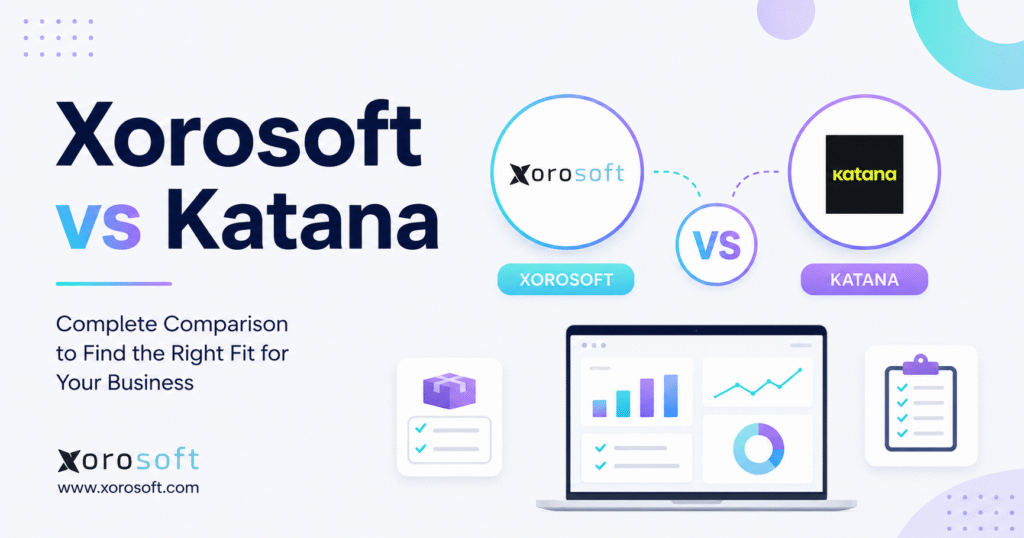
If you’re considering inventory management solutions, this post offers a detailed Xorosoft Katana comparison to help you make an informed choice.
1. Why the Xorosoft Katana Comparison Matters
Growing product companies rarely struggle because they have no software. Instead, they often have too many tools that do not work well together.
For example, sales may view orders in Shopify, while buyers track supplier needs in spreadsheets. At the same time, the production team may use a manufacturing tool, and warehouse staff may rely on another app. Meanwhile, finance waits for data to reach the accounting system before it can close the month.
At first, this setup may appear manageable. However, the gaps become harder to control as order volume, SKU count, sales channels, and warehouse sites grow.
A single customer order may reserve stock, create demand for raw goods, start a work order, trigger a purchase, create warehouse tasks, and affect sales and product cost. Therefore, several systems must stay aligned throughout the process.
When they do not, staff fill the gaps by hand. For instance, buyers update spreadsheets, warehouse teams search for missing stock, and finance fixes records after the work is complete. As a result, software selection becomes less about adding one more feature and more about deciding which system should control the full flow.
1.1 Why Similar Feature Names Can Be Misleading
Many tools list inventory, buying, forecasts, production, reports, and warehouse features. Still, the same feature name can mean very different things.
For example, “warehouse management” may only mean that stock can be viewed by site. In contrast, another tool may include barcode receiving, bin tracking, mobile picking, packing checks, stock counts, transfer tasks, and shipping updates.
The same issue appears with accounting. A platform may show stock value and product cost; however, it may not include general ledger, accounts payable, accounts receivable, bank matching, tax records, or full financial reports.
Therefore, buyers should not count feature checkmarks alone. Instead, they should ask how each feature works, what data it owns, and how it links with other teams.
Moreover, buyers should test whether the same feature works across normal and unusual cases. For example, a system may handle a standard receipt well but struggle with partial receipts, damaged goods, or a supplier invoice that arrives before the stock.
1.2 Native Features, Add-Ons, and Integrations
A native feature works inside the main system. An add-on extends the main system, although it may cost more. Meanwhile, an integration moves data between two tools.
Each model can work well. For instance, a set of linked tools may let a company keep apps its staff already know. Additionally, it may make it easier to add features one step at a time.
However, each link creates more work. Therefore, the company must decide:
- Which tool owns product data?
- Where are customer records kept?
- Which tool sets available stock?
- When do invoices move to accounting?
- How are refunds handled?
- What happens when a sync fails?
- Where should staff fix wrong data?
- Which tool creates the final report?
A single ERP can reduce some of these handoffs. On the other hand, a wider system may need more setup, training, and process change.
Consequently, the right choice depends on whether the business values specialist tools or shared data more highly.
1.3 What Buyers Should Define First
Before comparing platforms, map the main business needs.
First, list inventory needs such as SKUs, sizes, colors, lots, serial numbers, and sites. Next, list production needs such as BOMs, work orders, routing, outside work, and product cost.
Additionally, include warehouse, supplier, accounting, Shopify, Amazon, wholesale, EDI, forecast, and report needs.
This list gives both vendors the same test. As a result, the team can compare real work instead of watching two very different sales demos.
Furthermore, the team should separate essential needs from preferences. For example, lot tracking may be essential, while a certain dashboard layout may only be preferred.
2. Xorosoft Katana Comparison at a Glance
The Xorosoft Katana comparison covers two tools made for product companies, but their main models differ.
Xorosoft is a cloud ERP that brings inventory, buying, warehouse work, production, ecommerce, accounting, forecasts, and reports into one system.
Katana, in contrast, is an inventory and manufacturing platform. It focuses on stock, production, buying, warehouse work, planning, sales orders, and links with other apps.
2.1 What Is the Main Xorosoft vs Katana Difference?
Xorosoft is a wider cloud ERP that links money and daily work in one system. Katana is a manufacturing-led stock platform that manages products, materials, orders, buying, warehouse tasks, and production while linking with outside accounting tools.
Therefore, Katana may suit a company that wants better stock and production control but wants to keep its current accounting app.
By contrast, Xorosoft may be a stronger fit when the company wants stock, buying, warehouses, production, Shopify, wholesale, EDI, and accounting in one wider ERP.
Neither tool is best for every company. Ultimately, the right choice depends on where the main problems are and how many tools the company wants to replace.
2.2 Xorosoft and Katana Comparison Table
| Area | Xorosoft | Katana | What to check |
|---|---|---|---|
| Main model | Cloud ERP | Stock and manufacturing platform | How wide the system must reach |
| Inventory | Inventory linked with ERP | Real-time stock control | Sites, stock use, and value |
| Manufacturing | Production inside ERP | Strong production focus | BOMs, work orders, and planning |
| Buying | Linked with stock and accounting | Built-in buying tools | Rules, approvals, and suppliers |
| Warehouse | Full WMS tools | Warehouse app and tasks | Depth of warehouse work |
| Accounting | Native accounting | Links with accounting apps | One system or linked tools |
| Forecasting | Planning linked with ERP | Forecast and reorder tools | How plans drive buying |
| Shopify | ERP and Shopify link | Shopify link | Orders, stock, refunds, and shipping |
| Wholesale and EDI | Built for wholesale and EDI | Check exact needs | Partner rules and files |
| Price model | Quote based on needs | Free, Core, and custom plans | Three-year total cost |
2.3 Why the System Model Matters
The Xorosoft Katana comparison is not simply about which tool has more features.
Instead, it is a choice between keeping a group of linked specialist tools and moving more work into one ERP.
A linked stack can still work when the sync is stable, the books close on time, and reports do not require much manual work.
However, an ERP can make more sense when teams store the same data in several tools and must fix the same order more than once.
Moreover, the business should consider future needs. For example, a company may only have one warehouse today; nevertheless, it may plan to add wholesale, EDI, or another site within two years.
3. Xorosoft vs Katana for Inventory Management
Stock control is more than knowing what is on hand. A company may also need to know what is free to sell, held for an order, needed for production, on the way, damaged, under review, or held at a 3PL.
Therefore, both tools should be tested with real stock cases.
3.1 Multi-Site Inventory in the Xorosoft Katana Comparison
Ask each vendor to show stock by site, stock held for orders, raw goods held for production, open purchase orders, transfers, stock changes, lot data, serial data, and stock value.
Katana supports stock across more than one site and can help teams view supply and demand by location.
Meanwhile, XoroONE is built to link stock across warehouses, stores, sales channels, buying, production, and finance.
The main question is not whether several sites can be added. Instead, buyers should test how the system handles site-level reorder rules, order routing, transfers, returns, 3PL stock, split shipping, and stock value by site.
Additionally, buyers should test stock timing. For example, does stock become available when it is received, put away, inspected, or fully approved?
3.2 Raw Goods, Work in Process, and Finished Stock
A manufacturer must track stock at each stage.
Raw goods have not yet been used. Meanwhile, work in process covers goods that are partway through production. Finished stock is ready to sell or ship.
If the system does not track these stages well, the company may show false stock, wrong margins, and poor production plans.
Therefore, the demo should include partial work completion, scrap, a material swap, a subassembly, a finished-item receipt, a product-cost change, and a lot or serial check.
Katana links production plans with material needs and stock demand. It also supports batch and serial tracking.
A wider ERP test should also show how the same stock moves affect buying, product value, and the books.
Furthermore, the finance team should check whether unfinished goods are valued correctly at month-end.
3.3 Buying and Reorder Planning
Buying gets harder as the company adds more products, suppliers, sites, and lead times.
A useful buying tool should answer:
- What should we buy?
- When should we buy it?
- How much should we order?
- Which supplier should we use?
- Which site needs the stock?
- Which demand caused the need?
- Has the supplier confirmed the date?
- What will freight add to product cost?
Katana uses stock, demand, lead times, and supplier rules to guide reorder plans.
However, a cloud ERP comparison should also test purchase approval, partial receipts, supplier bills, foreign currency, freight, duty, product cost, and payment status.
Moreover, buyers should test supplier changes. For instance, what happens if the regular supplier cannot deliver and another supplier has a different price, lead time, or minimum order amount?
4. Xorosoft and Katana Manufacturing Comparison
Manufacturing needs vary widely.
A company that builds simple kits may need only a short BOM and a basic work order. In contrast, another company may have many stages, outside work, labor tracking, and strict lot rules.
Therefore, the Xorosoft and Katana comparison should use the company’s own products.
4.1 BOMs in the Xorosoft Katana Comparison
Do not test only one simple BOM.
Instead, use examples with more than one level, product options, material swaps, packing goods, scrap rules, different units, outside work, and BOM changes.
Katana supports product recipes, materials, work orders, production steps, and product cost.
A wider ERP test should also show how a material price change affects stock value, buying plans, product cost, margin reports, and the general ledger.
Additionally, buyers should test revision control. For example, can the system show which version of a BOM was used for a past production order?
4.2 Production Planning in Xorosoft vs Katana
A plan is only useful when it reflects real limits.
Planners need to know which jobs are late, which raw goods are missing, which work has top priority, which step has too much work, what can be made with stock on hand, and when finished goods will be ready.
During the Xorosoft Katana comparison, add a rush order and create a material shortage.
Then compare how each tool updates buying needs, work-order dates, stock use, customer promise dates, and reports.
Moreover, change the supplier date during the demo. As a result, the team can see whether the production plan updates clearly or leaves staff to adjust dates by hand.
4.3 Shop-Floor Work in the Manufacturing Software Comparison
Planning decides what should be made. Shop-floor work, however, controls what staff do next.
Therefore, the test should cover mobile use, work steps, goods used, units made, scrap, a material swap, labor time, work status, and finished stock.
A simple screen can speed up training. Still, a company with more complex production should also check work centers, setup time, run time, steps done at the same time, quality holds, and outside work.
Additionally, production leaders should test error handling. For example, what happens if an employee reports the wrong quantity or uses a different material?
4.4 Product Cost in Xorosoft vs Katana
A product may include more than raw goods.
Its full cost may also include freight, duty, labor, machine time, overhead, outside work, packing, scrap, and rework.
As a result, finance should check whether the tool uses planned cost, standard cost, average cost, or actual cost.
The team should also ask when production cost becomes stock value and when it moves to cost of goods sold.
Moreover, cost changes should be easy to trace. Otherwise, finance may see a lower margin without understanding whether the cause was supplier price, waste, labor, freight, or production delay.
5. Warehouse Management in the Xorosoft Katana Comparison
Katana should not be called a tool with no warehouse features.
Its warehouse tools include receiving, partial receipts, bins, barcode work, picking, packing, transfers, and mobile tasks.
Therefore, the real question is how deep those warehouse tools go.
5.1 Stock Location vs WMS Work
Basic stock control shows how much stock is at each site.
A WMS goes further. For example, it helps staff receive, move, count, pick, pack, and ship goods in a set way.
The XoroWMS product is built around barcode-based warehouse work and control across more than one site.
During the demo, ask both tools to show barcode receipt, putaway, bin checks, refill tasks, picking, packing, shipping, stock counts, transfers, and returns.
Additionally, test a wrong scan. Consequently, the team can see whether the system blocks the error, warns the user, or allows the wrong stock move.
5.2 Multi-Warehouse Work in Xorosoft vs Katana
More than one warehouse creates new choices.
For example:
- Which site should ship the order?
- Is enough stock free to use?
- Should stock move between sites?
- How is 3PL stock shown?
- Can one order ship from two sites?
- Which site should take a return?
- How is site cost measured?
Katana supports more than one site and mobile warehouse tasks.
XoroONE also supports stock across warehouses, stores, and 3PL sites. Therefore, the Xorosoft Katana comparison should test real order routing, transfers, returns, and outside stock.
Moreover, buyers should test what happens when one site runs out of stock after the order has already been assigned.
5.3 Warehouse Checklist for the Xorosoft and Katana Comparison
| Warehouse need | What to ask |
| Receiving | Can staff scan and part-receive a purchase order? |
| Putaway | Can the tool guide or check the right bin? |
| Picking | Can it support the picking method the team uses? |
| Packing | Can staff check the item before shipping? |
| Transfers | How are goods sent and received between sites? |
| Counts | Can staff count stock without stopping all work? |
| Traceability | Are lots and serials saved during each move? |
| 3PL stock | Can outside stock sync in a clear way? |
| Roles | Can each worker see only the tasks they need? |
| Errors | How are damage, shortages, and swaps handled? |
6. Accounting in the Xorosoft Katana Comparison
Accounting is often the clearest gap between a manufacturing tool and a full ERP.
Stock value and product cost are useful. However, they do not replace general ledger, accounts payable, accounts receivable, bank matching, tax work, full financial reports, or month-end close.
6.1 Katana Accounting Links
Katana works as part of a linked software stack. It gives stock and cost data while accounting is handled in an outside app.
This can work well when finance likes its current accounting tool. Moreover, it may reduce the size of the software project.
However, the finance team should test customer invoices, supplier bills, payments, taxes, stock changes, refunds, freight, cost of goods sold, foreign currency, and failed syncs.
The normal case is not enough. Instead, the test must also cover errors.
For example, the team should change an order after the invoice has already moved to accounting. Consequently, it can see whether the update is clear and controlled.
6.2 Xorosoft ERP Accounting
The XoroERP model links accounting with stock and daily work.
This can reduce the need to push each sales, buying, warehouse, and production event into another accounting app.
However, “native accounting” should not end the test. Finance should still check chart of accounts, payables, receivables, bank matching, stock value, cost of goods sold, foreign currency, tax, cash flow, period close, and audit trail.
Additionally, the finance team should test user rights. For instance, warehouse staff should be able to complete stock work without seeing private financial data.
6.3 Month-End Close in the Xorosoft vs Katana Comparison
Many companies find software gaps during month-end.
Common signs include stock value differences, missing refunds, late freight costs, unclear product-cost changes, spreadsheet reports, and finance waiting for warehouse updates.
Therefore, the final choice should make these errors easy to find and fix.
Moreover, finance should measure how long the current close takes. As a result, the company can compare future software costs with the real value of a faster and cleaner close.
7. Shopify in the Xorosoft Katana Comparison
Shopify manages the store, customer view, and checkout. However, it does not need to manage every back-office task.
The tool behind Shopify may need to run stock, buying, production, warehouses, shipping, returns, accounting, and reports.
7.1 Katana for Shopify Manufacturing
Katana links Shopify demand with stock, product recipes, production, buying, and order work.
This can fit a Shopify brand whose main need is to turn sales demand into better material and production plans.
For example, the company may need to create work from orders, check raw goods, buy missing goods, build finished stock, ship the order, and update stock.
Moreover, the team should test order changes. If a customer changes quantity or cancels an item, the system should update demand and production clearly.
7.2 Xorosoft for Shopify ERP Work
The Xorosoft ERP Shopify App links Shopify with wider ERP work.
This may matter when the brand also needs native accounting, more than one warehouse, wholesale, EDI, Amazon, payout matching, 3PL stock, and wider reports.
Therefore, a Shopify test should go beyond basic order import.
Ask the vendor to show product mapping, site-level stock, payment data, refund data, shipping updates, returns, fees, payouts, and order changes.
Additionally, buyers should test multiple Shopify stores. As a result, they can see whether products, customers, and inventory remain clean across channels.
7.3 Amazon, Wholesale, and EDI in Xorosoft vs Katana
A growing brand may also sell through Amazon, wholesale buyers, and large retail partners.
These channels can add price lists, credit terms, stock rules, backorders, EDI orders, shipping notices, EDI invoices, routing rules, and chargebacks.
XoroONE is built to link ecommerce, B2B, EDI, marketplaces, shipping, payments, warehouses, and accounting.
Katana also supports integrations and API use. Therefore, buyers should check whether each needed partner is supported through a direct link, a third-party tool, API work, or custom setup.
Moreover, the company should test one real EDI order from order receipt through shipment notice and invoice.
8. Forecasting in the Xorosoft Katana Comparison
Forecasting is not just a box that says “yes.”
Instead, buyers should ask how the forecast is made, how users can change it, and how it affects buying and production.
8.1 Katana Forecasting and Reorder Plans
Katana uses past sales and current trends to estimate future demand.
Its forecast tools can guide reorder points, safety stock, purchase plans, production plans, and stock goals.
Users can also add known events, such as a sale, a season, or a new product launch.
Therefore, old claims that Katana has no forecast tools are no longer fair.
However, buyers should still test how the tool handles products with little history, fast growth, or one-time sales spikes.
8.2 ERP Forecasting in the Xorosoft and Katana Comparison
A stock forecast helps buyers decide what to buy or make.
A wider ERP may also link the plan with cash needs, supplier bills, stock spend, open orders, margin, sales goals, and working capital.
The best forecast is not always the one with the most advanced math. Instead, it is the one that leads to clear and timely action.
Moreover, finance should understand the cash impact of the plan. For example, a strong sales forecast may still create a cash problem if inventory must be purchased months before revenue is collected.
8.3 Reports to Test in Xorosoft vs Katana
Ask both vendors to create reports for stock by site, slow stock, stock value, supplier results, open purchase orders, raw-good shortages, work-order cost, backorders, order margin, forecast error, gross margin, and cash needs.
If staff must export many files and join them in sheets, include that work in the total cost.
Additionally, ask how often reports update. A report that updates once per day may not be enough for a high-volume warehouse or production team.
9. Pricing in the Xorosoft Katana Comparison
The first monthly price does not show the full cost.
A lower-cost app can become more costly after adding accounting software, add-ons, integrations, outside support, manual matching, and staff time.
At the same time, a broad ERP may cost more to set up than a small firm can justify.
9.1 Katana Price Model
As of July 24, 2026, Katana lists a free plan, a 30-SKU free-plan limit, unlimited users, a Core Plan from $299 per month, one included stock site in Core, order-based use fees, more-site fees, paid add-ons, and custom Advantage pricing.
Because plans change, check the live price page again before buying.
Moreover, compare the expected cost at current and future order volume. A price that works today may change when the company adds sites or channels.
9.2 ERP Price Model
ERP price often depends on users, companies, warehouses, modules, links, data move, setup, and support.
Therefore, it is not fair to compare Katana’s base price with an ERP quote that has not been scoped.
Instead, both options should be priced against the same requirements and growth plan.
9.3 Three-Year Cost in the Xorosoft Katana Comparison
Use this formula:
Three-year cost = software + add-ons + accounting apps + integrations + setup + data move + training + support + staff time.
Staff time often gets missed.
However, employees may spend many hours watching sync jobs, fixing wrong data, matching systems, updating reports, removing duplicate records, and solving order errors.
Consequently, a low subscription cost may still produce a high total cost.
10. Setup and Rollout in the Xorosoft Katana Comparison
The time and work needed depend on the size of the change.
A focused stock or production project may involve only a few teams. Meanwhile, a full ERP rollout may affect sales, buying, production, warehouse work, accounting, ecommerce, and reports.
10.1 Katana Trial and Setup
Katana’s free plan lets a business test the tool with its own items and data.
This can help a small team check products, BOMs, stock, work orders, integrations, and warehouse tasks.
However, a test should still use clean and true data. Otherwise, a sample setup may hide key gaps.
Moreover, the company should test the process with the employees who will use the tool every day.
10.2 ERP Setup and Data Work
A wider ERP project needs more planning because one choice can affect several teams.
Before the move, clean items, SKUs, units, BOMs, suppliers, customers, warehouse bins, open sales orders, open purchase orders, stock, lots, serials, and finance balances.
Bad data does not become good data just because it moves to a new system.
Therefore, data cleanup should begin before software setup, not during the final week before launch.
10.3 Staff Training and Process Owners
Each main flow should have an owner.
That includes orders, stock, buying, production, warehouses, accounting, ecommerce, and reports.
These owners should help set needs, test the tool, train staff, and review the system after launch.
Additionally, each owner should approve how errors are handled. As a result, staff will know what to do when the normal process fails.
11. When Katana May Be the Better Fit
Katana may be the stronger fit when stock and production are the main pain points.
11.1 Katana for Firms Keeping Their Accounting App
A company may prefer Katana when finance is happy with its current accounting tool and the books close without much manual work.
In this case, replacing accounting may add work with little gain.
However, the team should still test invoices, supplier bills, taxes, refunds, stock changes, product cost, payment status, and sync errors.
Moreover, finance should confirm who owns each record. Otherwise, staff may update the same customer or item in two systems.
11.2 Katana for Manufacturing-Led Brands
Katana may suit a firm that makes or assembles goods, uses BOMs, runs work orders, sells through Shopify, needs reorder help, wants warehouse tasks, and needs forecasts.
Its free plan also gives smaller teams a low-risk way to test real work before they buy.
Furthermore, a focused tool may be easier to roll out when the company does not need full ERP control.
11.3 Who May Not Need Full ERP
A company may not need full ERP when accounting is simple, there is one main company, warehouse work is light, EDI use is low, reports are easy to build, current integrations are stable, and finance likes its current tool.
In this case, a smaller and more focused system may be enough.
However, the business should review this decision each year because complexity can grow quickly.
12. When Xorosoft May Be the Better Fit
Xorosoft may be more useful when the main problems span several teams.
12.1 Xorosoft for Native Accounting and Stock Control
ERP may help when finance keeps matching stock, sales, buying, and cost data across many tools.
Common signs include a slow month-end close, large stock changes, margin errors, duplicate customer data, spreadsheet reports, buying data that does not match bills, and warehouse work that reaches finance late.
A wider system can reduce some of these gaps by keeping work and money records in one place.
Moreover, one shared system may make reports easier because the same transaction does not need to be joined from several sources.
12.2 Xorosoft for Multi-Warehouse and Wholesale Work
Xorosoft may also fit a company that runs several warehouses, sells on Shopify, sells on Amazon, has wholesale buyers, uses EDI, works with 3PLs, makes products, needs price rules, and needs linked buying and planning.
The Xorosoft industries page can help teams map needs for apparel, furniture, sporting goods, food, consumer goods, manufacturing, and wholesale.
Additionally, companies should test industry-specific cases. For example, food companies should test lots and expiry dates, while apparel companies should test size and color variants.
12.3 Xorosoft for Replacing Many Tools
Some firms reach a point where keeping many apps costs more than moving to one wider system.
A common stack may include Shopify, QuickBooks, stock software, warehouse software, EDI software, forecast software, buying spreadsheets, and report spreadsheets.
The case for ERP gets stronger when one order must be fixed in many places.
Consequently, the real ERP value may come from fewer handoffs rather than from one new feature.
13. Industry Fit in the Xorosoft and Katana Comparison
The right choice can change by industry.
13.1 Apparel and Fashion
Apparel firms often manage size, color, season changes, product drops, returns, wholesale, store stock, and several warehouses.
A maker may also need BOMs for cloth, trims, labels, and packs.
Therefore, the software test should include variants, seasonal forecasts, returns, and wholesale allocation.
13.2 Furniture and Home Goods
Furniture firms may face long lead times, large warehouse space, kits, custom choices, high freight costs, partial shipments, damage, and complex delivery.
Therefore, the test should include freight, buying, warehouse space, and partial delivery.
Moreover, the company should test whether large or made-to-order items follow a different fulfillment flow.
13.3 Food and Beverage
Food firms should check lot control, expiry dates, recall steps, recipes, yield, waste, quality holds, and supplier traceability.
A simple lot field is not enough. Instead, the team should test a full recall from supplier to customer.
Additionally, the company should check whether expired or blocked stock can be prevented from shipping.
13.4 Wholesale Distribution
Wholesale firms often need price lists, credit terms, buying, stock rules, EDI, warehouse work, backorders, and margin reports.
A wider ERP may fit when these needs are central. Katana, however, may fit when the main need is product and production control.
13.5 Consumer Goods and Sporting Goods
These firms often sell through Shopify, Amazon, wholesale, retail, and marketplaces.
Therefore, stock by site, channel rules, forecasts, and order flow may matter more than deep shop-floor routing.
Moreover, seasonal buying and product launches should be included in the demo.
14. Common Xorosoft Katana Comparison Mistakes
A good tool can still lead to a poor result if the buying process is weak.
14.1 Counting Feature Checkmarks
Feature lists do not show depth.
Instead of asking whether the tool supports buying, ask the vendor to find a shortage, suggest a buy amount, create a purchase order, part-receive it, add freight, update product cost, and show the supplier bill.
This test shows how well planning, receipt, cost, and accounting connect.
Moreover, it reveals whether staff must move between screens or systems to complete one process.
14.2 Looking Only at the Starting Price
The starting price may not include add-ons, use fees, accounting, integrations, setup, training, reports, and staff time.
Therefore, use a three-year cost view.
Additionally, price the system at expected future volume rather than only current volume.
14.3 Buying Only for Today
The system should fit the next three years, not only the current month.
However, buyers should also avoid buying for an unrealistic future. A large ERP may not make sense if the company has no clear need for it.
Therefore, use a realistic growth plan with known channels, sites, and order targets.
14.4 Leaving Frontline Staff Out
Leaders know the big goals. Frontline staff, however, know the daily errors.
Include buyers, planners, warehouse staff, production leads, finance, and customer service.
Their input often reveals gaps that do not appear in a sales demo.
14.5 Accepting a Standard Demo
Give both vendors the same test cases.
That makes the Xorosoft Katana comparison fair and helps the team see how each system deals with real errors.
Moreover, ask the vendor to complete the scenario live rather than showing a prepared slide.
15. A Practical Xorosoft Katana Comparison Plan
The final choice should be based on results, not on the best-looking screen.
15.1 Map the Current Software Stack
List every tool used for ecommerce, orders, stock, buying, production, warehouses, shipping, accounting, EDI, and reports.
Next, mark each manual step, duplicate record, and weak link.
As a result, the company will see where software gaps create the most work.
15.2 Find the Most Costly Problems
Focus on issues that hurt cash, sales, cost, or service.
Examples include stockouts, too much stock, pick errors, late work, supplier delays, wrong margins, slow close, EDI fees, and manual reports.
Because these problems have a clear cost, they provide a strong base for the final choice.
Moreover, they help the team measure whether the new system delivers value after launch.
15.3 Test Native and Linked Work
For each need, mark whether it is native, an add-on, a direct link, a third-party link, custom work, or not offered.
Then test a failure.
For example, stop an order sync, change an order amount, add a refund, make a stock change, or send the wrong item.
This shows how staff will fix the issue when normal automation breaks.
15.4 Compare Other ERP and MRP Options
A fair shortlist may also include NetSuite, Acumatica, Cin7, Fishbowl, Business Central, MRPeasy, or Odoo.
However, three or four close-fit tools are better than ten weak matches.
Companies looking at larger ERP choices can also review the Xorosoft vs NetSuite comparison.
15.5 Use Real Orders to Make the Final Choice
Ask both vendors to process a rush Shopify order, a raw-material shortage, a late supplier, a partial receipt, a warehouse transfer, a wholesale order, a return, a stock change, and a month-end match.
The winning system should support the normal flow and make errors easy to see before they hurt the customer or the books.
Ultimately, the system should reduce work rather than simply move it from one team to another.
16. Frequently Asked Questions About Xorosoft and Katana
16.1 What Is the Main Difference Between Xorosoft and Katana?
Xorosoft is a cloud ERP that links stock, accounting, buying, warehouses, production, ecommerce, and reports. Katana, in contrast, is a manufacturing-led stock tool that covers production, buying, warehouse work, forecasts, and orders while linking with outside apps.
16.2 Is Katana an ERP System?
Katana includes many ERP-like tools, such as stock, production, buying, orders, warehouse tasks, and forecasts. However, buyers should look at the full workflow instead of the label. Native accounting is still a key difference between Katana and a wider ERP.
16.3 Is Xorosoft a Manufacturing ERP?
Yes. XoroONE is built for retailers, wholesalers, manufacturers, ecommerce firms, and other product companies. Moreover, its tools cover production, stock, warehouses, buying, accounting, reports, forecasts, B2B, and ecommerce.
16.4 Which Tool Is Better for a Small Manufacturer?
Katana may fit a small maker that needs better stock and production control while keeping its accounting app. In contrast, a full ERP may fit a small but more complex firm with several warehouses, wholesale, EDI, and harder finance needs.
16.5 Does Katana Include Accounting?
Katana gives cost and stock data and links with outside accounting tools. Therefore, buyers should check how invoices, supplier bills, payments, tax, refunds, stock changes, and cost of goods sold move to the accounting app.
16.6 Does Xorosoft Include Accounting?
Yes. Xorosoft includes accounting as part of its ERP. Still, finance should test the chart of accounts, payables, receivables, bank matching, tax, foreign currency, stock value, and month-end close.
16.7 Can Katana Link With QuickBooks or Xero?
Katana works as part of a linked stack and can connect with accounting apps. Before setup, however, the company should decide which tool owns products, customers, invoices, supplier bills, tax, and stock changes.
16.8 Can Xorosoft Replace QuickBooks?
It may replace QuickBooks when a firm needs accounting linked with stock and daily work. However, the final choice depends on reports, bank work, tax, payroll links, old data, legal firms, and finance needs.
16.9 Does Katana Support Warehouse Management?
Yes. Katana offers receiving, part receipts, bins, barcode work, picking, packing, transfers, and mobile warehouse tasks. Nevertheless, buyers should compare those tools with their order volume and warehouse rules.
16.10 Does Xorosoft Include Warehouse Management?
Yes. Xorosoft includes WMS tools for receiving, putaway, picking, packing, scanning, counting, shipping, and stock moves. Therefore, buyers should test their exact warehouse flow.
16.11 Can Both Tools Manage More Than One Warehouse?
Yes. Both vendors support more than one site. Still, buyers should test transfers, stock rules, order routing, site-level reorder points, 3PL stock, returns, and reports.
16.12 Which Tool Is Better for Production Planning?
Katana has a strong focus on stock-led production planning. A wider ERP, however, may fit better when production must link with accounting, wholesale orders, warehouse work, and company-wide reports.
16.13 Do Both Tools Support BOMs?
Both tools support manufacturing work. However, buyers should test BOM changes, product options, subassemblies, material swaps, units, scrap, outside work, and cost.
16.14 Does Katana Support Forecasting?
Yes. Katana uses past sales and current trends to guide demand, safety stock, reorder points, buying, and production plans. Additionally, users can add known events.
16.15 Which Tool Is Better for Shopify?
Katana may fit Shopify brands that mainly need stock, production, and buying control. Xorosoft, in contrast, may fit brands that also need native accounting, more warehouses, wholesale, EDI, Amazon, and wider reports.
16.16 Does Xorosoft Work With Shopify?
Yes. Xorosoft links Shopify with stock, buying, warehouse work, accounting, forecasts, and reports while Shopify remains the store and checkout layer.
16.17 Which Tool Is Better for Wholesale?
Wholesale firms should check price lists, credit, buying, stock rules, EDI, warehouses, backorders, and margin reports. Consequently, a wider ERP may fit when these needs are central.
16.18 Which Tool Supports EDI?
Xorosoft includes EDI in its wider B2B and channel model. Katana buyers, however, should check whether their EDI needs require a direct link, middleware, API work, or custom setup.
16.19 How Does Katana Pricing Work?
Katana lists a free plan and a Core Plan from $299 per month. The final Core price may rise with order use, more sites, and add-ons. Therefore, check the live price page before buying.
16.20 How Should Xorosoft and Katana Prices Be Compared?
Compare three-year cost, not just the base fee. In addition, include add-ons, accounting, integrations, setup, data movement, training, support, and staff time.
16.21 When Should a Business Move From Katana to ERP?
A move may make sense when the firm has a slow finance close, many warehouses, EDI needs, too many apps, weak reports, or heavy manual entry. However, the change should solve a clear business problem.
16.22 Can Xorosoft Replace Several Apps?
It may. Xorosoft covers accounting, stock, production, warehouses, buying, forecasts, ecommerce, B2B, EDI, and reports. Nevertheless, the final answer depends on the depth of each need.
16.23 What Are the Best Katana Alternatives?
Possible choices include Xorosoft, NetSuite, Acumatica, Cin7, Fishbowl, Business Central, MRPeasy, and Odoo. Ultimately, the right list depends on finance, production, warehouse, channel, rollout, and budget needs.
16.24 Who Does Not Need Either Tool?
A very small firm with few SKUs, no production, one stock site, low order volume, simple buying, and basic books may not need either tool. Instead, a lighter stock and accounting setup may still be enough.
16.25 How Should a Company Choose Between Xorosoft and Katana?
Map the current tools, find the most costly problems, set three-year needs, and test both systems with the same cases. Then compare native tools, links, full cost, rollout risk, and staff work.
17. Final Recommendation From the Xorosoft Katana Comparison
The Xorosoft Katana comparison should be decided by who owns each key workflow, not by which vendor shows the longest feature list.
Katana may be the better choice for a manufacturing-led firm that wants stronger stock, production, buying, forecasting, and warehouse tools while keeping an outside accounting app.
Xorosoft, in contrast, may be the stronger choice when stock problems affect many teams and the company wants production, warehouses, buying, Shopify, wholesale, EDI, reports, and accounting inside a wider cloud ERP.
Before choosing either one, build a clear needs list and ask both vendors to show real work.
For example, include a rush ecommerce order, a raw-material shortage, a late supplier, a partial receipt, a warehouse transfer, a return, a stock change, and a month-end close.
The right platform should not only handle normal work. More importantly, it should show errors early so staff can fix them before they cause stock gaps, late orders, or finance issues.
Therefore, firms that want to know whether separate tools have become a drag on growth should begin with a workflow-based ERP review.
Free ERP Readiness Assessment: Discuss your business needs with Xorosoft
Watch a Demo: See how stock, buying, production, warehouses, ecommerce, and accounting work in one system.
Personalized Review: Book a demo based on your real workflows
Recent Posts
-
 ERP Landed Cost Module vs Spreadsheet Calculations for Importers
 -
 How to Build an Open-to-Buy Plan for an Omnichannel Brand
 -
 Cold Storage WMS for Food and Beverage Distribution
 -
 ERP Buying Statistics 2026: Evaluation, Implementation, and Adoption Risks
 -
 How a Distributor Reduced B2B Order Exceptions Without Restricting Sales