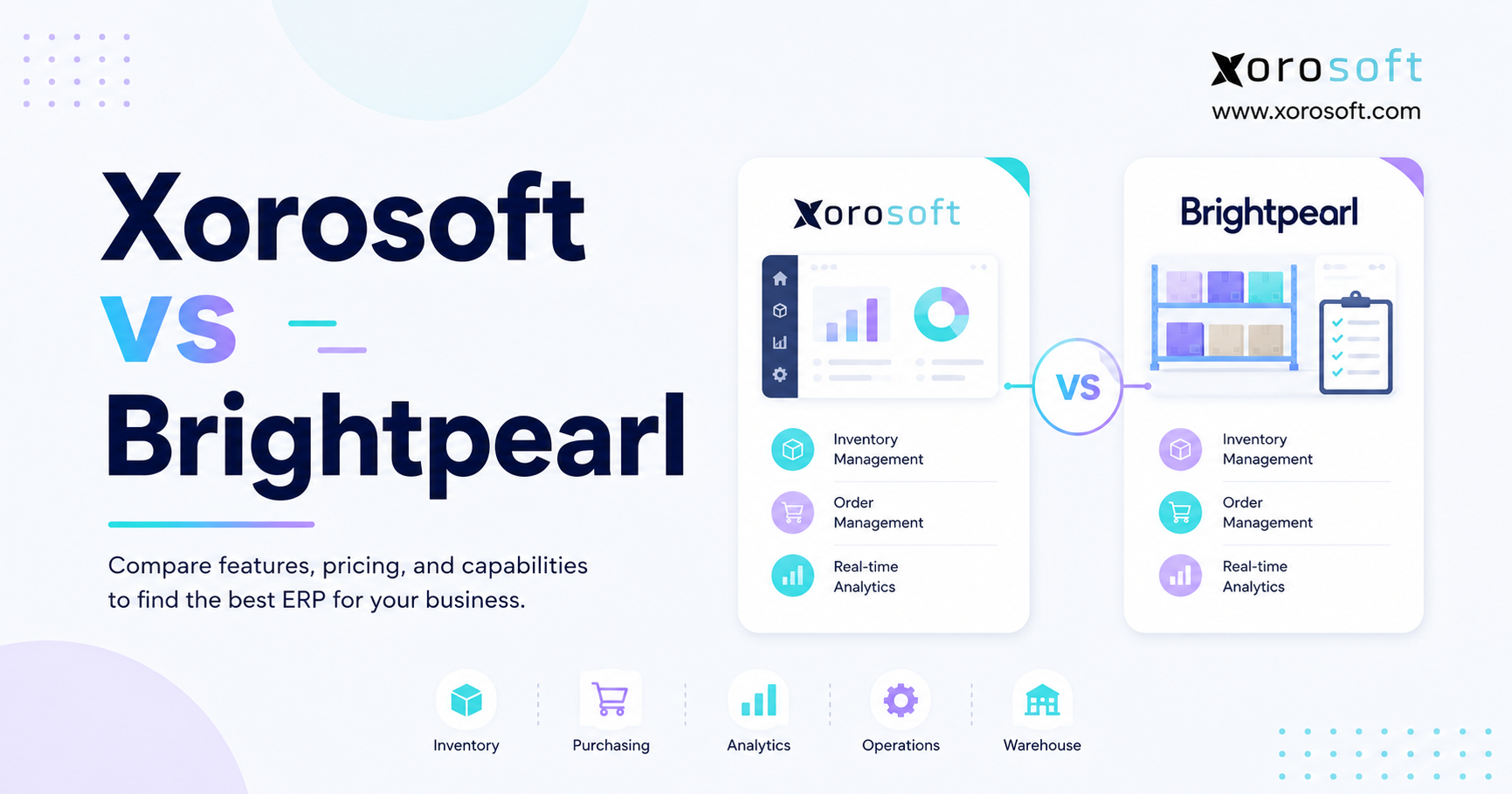
This article provides a detailed Xorosoft Brightpearl comparison to help you understand the key differences between these two platforms.
1. Growth Exposes Gaps Between Commerce, Inventory, and Finance
Initially, a growing product business rarely reaches a breaking point because one application suddenly stops working. More often, the problem develops gradually. Shopify continues to accept orders, the warehouse continues to ship, purchasing continues to raise purchase orders, and finance continues to close the books. However, each team begins working from a slightly different picture of the business.
The ecommerce team may see stock available online even though the warehouse has already reserved it for wholesale customers. Meanwhile, purchasing may reorder an item because an inbound receipt has not been recorded. Finance may then wait several days for inventory adjustments, returns, landed costs, and marketplace payouts before it can trust gross margin. As a result, managers spend more time checking spreadsheets than making decisions.
Therefore, this is the operating challenge behind the Xorosoft Brightpearl comparison. The company is not simply choosing between two software products. Instead, it is deciding where orders, inventory, purchasing, warehouse activity, accounting, forecasting, and production should come together.
1.1 Inventory Numbers Stop Meaning the Same Thing
In practice, inventory can refer to several different quantities. A company may own 1,000 units, but 300 could already be allocated, 100 could be moving between warehouses, and 50 could be damaged or awaiting inspection. Therefore, the quantity available to sell may be far lower than the quantity physically present.
When separate systems apply different rules, overselling and stockouts become more likely. Customer service must then explain delays, the warehouse has to expedite orders, and purchasing may place urgent supplier orders. Consequently, the cost appears in lost sales, freight, labor, returns, and weaker customer trust.
1.2 Financial Reporting Falls Behind Operations
Moreover, product businesses cannot separate inventory from finance for long. A purchase receipt changes inventory value, while a shipment affects cost of goods sold. Similarly, a return may reverse revenue, tax, and inventory entries. Freight, duties, and other landed costs also change the real margin on each SKU.
If those transactions move between systems through exports or manual journals, month-end close becomes a reconciliation project. Moreover, the accounting team may not know whether a variance comes from a warehouse adjustment, a supplier invoice, or a marketplace fee. Therefore, operational and financial data must be evaluated as one workflow.
1.3 Why an ERP Comparison Must Start With Workflows
Although feature lists are useful, they can also mislead buyers. Two systems may both mention inventory, accounting, purchasing, and warehouse management. Yet one may cover a basic transaction while the other supports a complete cross-department process.
Therefore, before comparing vendors, document the workflows that create the most cost or risk:
1. Order-to-cash
2. Procure-to-pay
3. Receiving and fulfillment
4. Inventory transfers and counts
5. Returns and refunds
6. Marketplace payout reconciliation
7. Wholesale and EDI orders
8. Production and material planning
9. Month-end close
10. Management reporting
This workflow map creates a more practical basis for the Xorosoft Brightpearl comparison than a generic checklist.
2. Xorosoft Brightpearl Comparison at a Glance
The central difference in the Xorosoft Brightpearl comparison is operating focus. Brightpearl presents itself as a retail operating system for omnichannel merchants, with inventory, orders, fulfillment, warehousing, accounting, business intelligence, POS, CRM, planning, and automation. Xorosoft presents XoroONE as a cloud ERP for retailers, wholesalers, and manufacturers, combining inventory, accounting, warehouse management, production, reporting, ecommerce, and related operations.
Neither platform is automatically the right choice. Brightpearl may suit a company whose complexity is concentrated in retail, ecommerce, and multichannel order operations. By contrast, a broader ERP may fit better when commerce must also connect with manufacturing, material planning, financial controls, wholesale, EDI, and deeper warehouse execution.
| Comparison area | Xorosoft | Brightpearl |
|---|---|---|
| Primary positioning | Cloud ERP for inventory-driven operations | Retail operating system for omnichannel merchants |
| Typical business model | Ecommerce, retail, wholesale, distribution, and manufacturing | Retail, ecommerce, and wholesale |
| Inventory | Connected with purchasing, accounting, warehousing, and production | Connected with orders, channels, warehousing, planning, and accounting |
| Accounting | Full accounting suite within the ERP environment | Integrated retail accounting plus external accounting options |
| Warehouse management | Dedicated ERP and WMS workflows | Integrated retail warehouse workflows |
| Manufacturing | Published production and material-planning scope | Manufacturing requirements require workflow-level validation |
| Shopify | ERP connection for orders, inventory, payments, refunds, payouts, and more | Retail operations connection for orders, inventory, returns, and related workflows |
| Best-fit question | Does the company need a wider operational ERP? | Is retail and commerce operations the main source of complexity? |
The table creates a fast orientation. However, the final decision should come from live workflow testing rather than positioning language.
3. Brightpearl and Xorosoft Product Scope
3.1 Brightpearl Retail Operating System Scope
In practice, Brightpearl is designed around the operational needs that follow a retail sale. Its product scope includes inventory and sales order management, fulfillment, shipping, warehouse management, accounting, business intelligence, POS, CRM, demand planning, and automation. In addition, it promotes integrations with ecommerce platforms, marketplaces, shipping services, accounting tools, and 3PL providers.
Consequently, that design center matters. A retail brand may care more about routing orders, maintaining channel-level availability, processing returns, and handling order spikes than managing production work orders. For that company, retail specialization can be a strength rather than a limitation.
3.2 Xorosoft Cloud ERP Scope
Meanwhile, XoroONE is positioned as a cloud ERP for retailers, wholesalers, and manufacturers. Its product scope includes omnichannel connectivity, inventory controls, accounting, warehouse management, production, manufacturing, and business reporting.
In addition, the wider Xorosoft ERP approach is relevant when a product company wants operational and financial transactions to share one system. For example, ecommerce orders, wholesale sales, inventory, purchasing, production, fulfillment, accounts receivable, accounts payable, and reporting can be evaluated as connected processes.
3.3 Retail Operating System Versus Cloud ERP
Although a retail operating system and an ERP can overlap significantly, both may manage products, inventory, orders, purchasing, warehouses, and accounting. Nevertheless, the difference often becomes clear at the edges of the operating model.
A retail-focused system may be strongest when commerce is the center of the company. Conversely, a wider ERP may become more valuable when production, complex financial structures, distribution, B2B operations, or several operating models must use the same data.
Therefore, category labels should guide the discussion, not decide it.
4. Xorosoft Brightpearl Comparison for Inventory Management
4.1 Multi-Location Inventory Visibility
Similarly, both platforms publish multi-location inventory capabilities. Brightpearl highlights inventory updates across channels after orders, replenishments, returns, and warehouse transfers. It also describes cycle counting, barcode scanning, demand planning, and replenishment recommendations.
However, the practical test is whether the system can clearly separate:
- On-hand quantity
- Available quantity
- Allocated quantity
- Incoming quantity
- Stock in transit
- Quarantined or damaged quantity
- Wholesale reservations
- Production demand
Therefore, a high-level stock total is not enough for a growing operation. Instead, planners, ecommerce teams, customer service, and warehouse employees may each require a different inventory view.
4.2 Inventory Allocation and Replenishment
Moreover, allocation rules become important when several channels compete for the same stock. For instance, a company may want to protect inventory for wholesale customers, route ecommerce orders to a 3PL, or reserve components for planned production.
During the Xorosoft Brightpearl comparison, ask how each platform prioritizes demand. Then test what happens when the preferred location lacks stock. The system should show whether it backorders the item, splits the shipment, selects another warehouse, or waits for replenishment.
In addition, replenishment should consider more than a static minimum. Useful recommendations may include sales history, seasonality, supplier lead time, open purchase orders, transfers, promotions, and production demand.
4.3 Inventory Accuracy and Traceability
Furthermore, cycle counts, barcode scanning, adjustment controls, and transaction history help protect accuracy. However, regulated or traceability-heavy businesses may also require lots, batches, serial numbers, expiry dates, quality holds, and recall reporting.
Do not assume a feature label covers the required process. Instead, ask each vendor to trace an item from receipt through transfer, sale, return, and adjustment. Manufacturers should also follow raw material into finished goods.
5. Xorosoft Brightpearl Comparison for Shopify and Ecommerce
5.1 Shopify Order and Inventory Synchronization
For example, Shopify integration should be assessed as a workflow, not a logo. A useful test starts when the customer places an order and ends when inventory, fulfillment, payment, fees, refunds, and accounting are correct.
The Xorosoft ERP Shopify app describes synchronization for orders, order edits, payments, products, refunds, shipment confirmation, inventory, payouts, gift cards, and Shopify Markets. It also lists multi-location inventory, batch tracking, stock reservation, forecasting, reporting, and error logs.
Meanwhile, Brightpearl’s ecommerce positioning focuses on Shopify and Shopify Plus connectivity alongside order processing, inventory, returns, reporting, and retail accounting. Therefore, both vendors should demonstrate the exact storefront, refund, and payout workflows used by the business.
5.2 Ecommerce Returns, Refunds, and Customer Service
However, returns expose gaps between commerce, inventory, warehouse, and finance. A returned item may need inspection before it becomes available. Likewise, a damaged item may require a write-off. A refund may also need to reverse tax, revenue, and payment records without creating duplicate entries.
During demonstrations, include a full refund, partial refund, exchange, damaged return, and return received at a different location. Customer service should be able to see the entire order history without switching between several applications.
5.3 Amazon, Marketplaces, and Multichannel Orders
Likewise, marketplace integrations introduce fees, settlement schedules, fulfillment programs, cancellations, and returns that differ from Shopify. Consequently, buyers should test marketplace financial reconciliation as carefully as order import.
A system may import an Amazon order successfully but still leave finance to reconcile fees and settlements manually. Therefore, ask which records move automatically, which system owns product data, how inventory is protected across channels, and how failed transactions are reported.
6. Warehouse Management in the Xorosoft Brightpearl Comparison
6.1 Receiving and Put-Away Workflows
First, receiving is where inventory accuracy begins. The system should connect a receipt to the correct purchase order, supplier, warehouse, quantity, cost, and location.
For a deeper warehouse management system comparison, test partial receipts, excess quantities, damaged goods, lot capture, barcode scanning, directed put-away, and receipt discrepancies. In addition, ask whether the receipt updates purchasing, inventory, and finance immediately or through a later synchronization.
6.2 Picking, Packing, and Shipping
Next, picking speed matters, but accuracy matters more. A rushed warehouse can ship the wrong variant, split an order unnecessarily, or use expensive freight to recover from a preventable error.
Therefore, ask whether each platform supports the company’s actual methods:
- Single-order picking
- Batch picking
- Wave picking
- Zone picking
- Cluster picking
- Pick-and-pack
- Packing verification
- Shipping label generation
- Carrier selection
- Shipment confirmation
The best workflow depends on order profile, warehouse layout, SKU velocity, and labor model. Accordingly, a generic demo should not replace a scenario based on real order patterns.
6.3 Multi-Warehouse and 3PL Control
Additionally, multiple locations create questions about routing, transfers, replenishment, ownership, and visibility. The platform should show what is available at each location, what is moving, and which orders depend on that stock.
Moreover, businesses using internal warehouses and 3PL partners should test failure handling. If a 3PL rejects an order or sends an unexpected inventory adjustment, the team needs a clear exception process. Otherwise, automation may hide the problem instead of resolving it.
7. Xorosoft Brightpearl Comparison for Accounting and Purchasing
7.1 Accounting Depth and Financial Control
Importantly, Brightpearl includes integrated retail accounting and can also connect with external accounting platforms. Therefore, the Xorosoft Brightpearl comparison should not frame the decision as accounting versus no accounting. Instead, finance teams should compare depth, control, reporting, and operating fit.
For example, key questions include:
- Does the platform support the required chart of accounts?
- How are inventory valuation and cost of goods sold recorded?
- Can finance manage accounts receivable and payable?
- How are marketplace payouts reconciled?
- Can landed costs be allocated accurately?
- Are period controls and audit trails sufficient?
- Does the company need multiple entities, currencies, or consolidations?
- Can the system produce the reports required by management and auditors?
Finally, financial testing should trace an operational transaction from receipt or shipment through to the final report.
7.2 Purchasing and Supplier Management
Likewise, purchasing software should connect demand with action. Buyers need visibility into supplier lead times, open purchase orders, incoming quantities, minimum order requirements, price changes, and late deliveries.
Therefore, a realistic demonstration should include:
1. Review a replenishment recommendation
2. Create and approve a purchase order
3. Record a partial supplier shipment
4. Process an over-receipt
5. Handle damaged goods
6. Resolve a supplier invoice difference
7. Apply a landed-cost adjustment
8. Complete a supplier return
As a result, this process reveals whether purchasing, warehouse, and finance teams share one transaction or maintain separate records.
7.3 Demand Planning and Inventory Forecasting
Similarly, forecasting should not end with a graph. Instead, it should inform purchasing, transfers, allocations, and production.
For manufacturers, forecasting must translate finished-goods demand into component requirements. For wholesalers, it may need to protect inventory for key accounts. Ecommerce brands, meanwhile, may need forecasts that account for promotions, launches, returns, and channel growth.
Nevertheless, no forecasting engine can compensate for poor data indefinitely. Therefore, supplier lead times, product records, sales history, and inventory adjustments must remain accurate.
8. Brightpearl Alternative for Manufacturing, Wholesale, and EDI
8.1 Manufacturing ERP Requirements
In many cases, manufacturing becomes the decisive difference in a retail ERP comparison. A company that only bundles finished products may not need a full production module. However, a business that plans materials, issues work orders, tracks work in progress, or calculates production variance requires more depth.
Accordingly, the XoroONE scope includes production and manufacturing modules. Manufacturers should test:
- Bills of materials
- BOM revisions
- Component substitutions
- Material reservations
- Work-order release
- Material consumption
- Labor and overhead
- Scrap and yield
- Production completion
- Work in progress
- Finished-goods receipt
- Planned versus actual cost
If a required process depends on an integration, identify who owns and supports that integration.
8.2 Wholesale ERP Pricing, Credit, and Allocation
By contrast, wholesale operations differ from direct-to-consumer sales. Customers may have negotiated prices, payment terms, credit limits, order minimums, allocations, backorders, and shipping rules.
Therefore, a strong wholesale demonstration should begin with a customer-specific order and continue through inventory reservation, warehouse fulfillment, invoicing, payment, and reporting. It should also show what happens when the customer exceeds its credit limit or receives only part of the order.
Companies comparing ERP systems by industry should weigh wholesale and ecommerce needs together rather than evaluate them in isolation.
8.3 EDI and B2B Workflows
Furthermore, EDI support must be validated by trading partner and document. A system may connect with an EDI provider but still require project work for mappings, acknowledgements, error handling, and partner testing.
For example, typical documents may include purchase orders, acknowledgements, advance shipping notices, invoices, inventory reports, and remittance advice. Therefore, ask who investigates rejected documents, how duplicate orders are prevented, and whether the team can see failures without developer support.
9. Automation, Reporting, and Integration Control
9.1 Retail Automation and Exception Management
In addition, Brightpearl places strong emphasis on automation across order processing, fulfillment, inventory allocation, and invoicing. For example, automation is valuable when it removes predictable manual decisions. However, the system also needs governance.
Buyers should ask who can change a rule, whether changes can be tested, how conflicts are detected, and where failed transactions appear. The goal is not to automate every step. Instead, it is to automate repeatable work while keeping exceptions visible.
9.2 Operational and Financial ERP Reporting
Meanwhile, dashboards should answer the questions managers ask every day:
- What can ship today?
- Which purchase orders are late?
- Where is excess inventory?
- Which products are losing margin?
- Are any wholesale customers over their credit limit?
- Where has a warehouse backlog developed?
- Do any production orders lack materials?
- Why does inventory value differ from last month?
Therefore, during the demo, ask the vendor to build or modify a report. This test reveals whether the business can adapt reporting without relying on exports or consultants.
9.3 Integration Ownership and API Questions
Specifically, for each required integration, document:
- Data owner
- Sync direction
- Sync frequency
- Required fields
- Failure alerts
- Retry process
- Support owner
- Upgrade policy
- Reconciliation method
- Historical data limits
Ultimately, an integration logo only confirms that a connection exists. It does not confirm that the workflow matches the company’s operating model.
10. Xorosoft Brightpearl Comparison for Pricing and Implementation
10.1 ERP Subscription and Module Costs
In practice, Brightpearl generally directs prospects toward tailored pricing rather than presenting a simple universal package. Xorosoft publishes starting package information, although the final scope may still depend on users, warehouses, integrations, services, and requirements.
Therefore, a useful pricing comparison should include more than the monthly subscription:
| Cost category | What to confirm |
| Software | Users, warehouses, entities, modules, channels, and transaction limits |
| Implementation | Discovery, configuration, project management, and testing |
| Migration | Products, customers, suppliers, inventory, open orders, balances, and history |
| Integrations | Connector licenses, setup, custom work, and monitoring |
| Training | Roles, sessions, documentation, and new-employee training |
| Support | Coverage, response targets, escalation, and premium services |
| Internal labor | Time required from operations, finance, IT, and leadership |
| Ongoing change | New channels, warehouses, reports, rules, and acquisitions |
10.2 ERP Implementation Readiness
However, implementation can expose process problems that software alone cannot fix. Duplicate SKUs, unclear ownership, outdated supplier terms, inconsistent units of measure, and poor warehouse discipline must be corrected.
Therefore, before signing, define:
1. Executive sponsor
2. Project manager
3. Department owners
4. Data owners
5. Integration owners
6. Testing responsibilities
7. Training plan
8. Cutover method
9. Issue escalation
10. Success measures
A vendor timeline is credible only when these responsibilities are clear.
10.3 Three-Year Total Cost of Ownership
Finally, compare the total cost over three years. Include subscription, implementation, connectors, internal labor, support, training, hardware, and process changes.
In addition, consider the cost of keeping the existing stack. Manual reconciliation, inventory errors, rushed freight, excess stock, delayed closing, and missed orders are real costs even when they do not appear on a software invoice.
11. Who Should Choose Xorosoft or Brightpearl?
11.1 When Xorosoft May Be the Better Fit
For instance, the platform may deserve closer consideration when a company needs a connected cloud ERP across inventory, accounting, purchasing, WMS, ecommerce, wholesale, and manufacturing.
More specifically, that profile often includes businesses with several warehouses, a mix of direct-to-consumer and wholesale orders, production requirements, complex purchasing, EDI, or financial processes that have outgrown accounting software and spreadsheets.
11.2 When Brightpearl May Be the Better Fit
On the other hand, Brightpearl may be a strong option when the company is primarily a multichannel retailer or wholesaler and wants retail-focused order management, inventory, warehouse operations, integrated accounting, planning, and automation.
Therefore, the fit becomes stronger when retail workflows are the center of the project and the company does not require deep production or material-planning processes.
11.3 When Neither ERP Platform Is Necessary Yet
However, a smaller business may be better served by a simpler stack when it has one store, one stock location, a limited catalog, basic purchasing, no manufacturing, and straightforward bookkeeping.
Consequently, implementing a larger system before the processes require it may add cost without creating enough operational value. Therefore, the right time to upgrade is when complexity, risk, and manual effort justify the change.
12. A Practical Xorosoft Brightpearl Comparison Framework
12.1 Build a Weighted ERP Requirements Scorecard
First, score both platforms against the same requirements. Next, assign greater weight to the processes that affect revenue, margin, customer service, and financial control.
| Requirement | Sample weight |
| Inventory management | 15% |
| Warehouse management | 15% |
| Accounting and finance | 15% |
| Ecommerce and marketplaces | 10% |
| Purchasing and forecasting | 10% |
| Manufacturing | 10% |
| Wholesale and EDI | 10% |
| Reporting | 5% |
| Integrations | 5% |
| Implementation and support | 5% |
However, adjust the weights before the demonstrations. Otherwise, attractive screens can distract the team from the requirements that matter.
12.2 Run Matched ERP Workflow Demonstrations
Then, ask both vendors to demonstrate the same scenarios with realistic data:
1. Import an ecommerce order.
2. Reserve inventory.
3. Route the order.
4. Pick and pack it.
5. Partially ship it.
6. Process a return.
7. Receive a purchase order.
8. Record landed cost.
9. Reconcile the payment.
10. Produce the financial report.
Additionally, add wholesale, EDI, and manufacturing scenarios where relevant.
12.3 Check References and Future ERP Requirements
Next, speak with customers that resemble the business in industry, size, order volume, warehouse count, channels, and operating model.
Then consider the next three to five years. New warehouses, international stores, manufacturing, acquisitions, wholesale growth, and entity changes may alter the required platform scope.
For another ERP benchmark, review the Xorosoft vs NetSuite comparison.
13. Xorosoft Brightpearl Comparison FAQs
13.1 What Is the Main Difference Between Xorosoft and Brightpearl?
Brightpearl is positioned as a retail operating system for omnichannel merchants. Xorosoft is positioned as a cloud ERP for retailers, wholesalers, and manufacturers. The practical difference depends on whether the company mainly needs retail and ecommerce operations or a wider platform connecting finance, warehouses, purchasing, wholesale, and production.
13.2 Is Xorosoft Better Than Brightpearl?
Not for every business. It may be a stronger fit when manufacturing, WMS, connected accounting, purchasing, and wholesale must operate in one ERP. Brightpearl may be a stronger fit when retail automation, multichannel orders, inventory, and ecommerce operations are the main priorities.
13.3 Is Brightpearl a Full ERP System?
Brightpearl calls itself a retail operating system. However, it covers many functions associated with ERP, including inventory, orders, warehouse management, purchasing, accounting, reporting, POS, and CRM. Therefore, buyers should evaluate the required workflows instead of making the decision from the category name alone.
13.4 Does Brightpearl Include Accounting?
Yes. Brightpearl publishes integrated retail accounting that connects sales, profitability, costs, inventory, and channel activity. It also supports connections with external accounting systems. Finance teams should still test general ledger, valuation, reconciliation, reporting, and entity requirements.
13.5 Does Xorosoft Include Accounting?
XoroONE includes accounting within the cloud ERP scope. Buyers should validate accounts payable, accounts receivable, inventory valuation, tax, multicurrency, consolidation, audit controls, and financial reporting against their exact requirements.
13.6 Which Platform Is Better for Shopify Brands?
Both platforms publish Shopify connectivity. The better fit depends on the full operating model. A retail-focused company may prioritize commerce automation, while a hybrid ecommerce, wholesale, warehouse, and manufacturing business may need broader ERP coverage. Test orders, returns, inventory, payouts, and error handling.
13.7 Can Both Platforms Manage Multiple Warehouses?
Both publish multi-location capabilities. Buyers should compare transfers, stock in transit, routing, receiving, replenishment, picking, packing, cycle counting, and returns. Multi-warehouse visibility does not always mean that every warehouse execution process is supported at the required depth.
13.8 Which Platform Is Better for Warehouse Management?
The answer depends on warehouse complexity. Test barcode receiving, bin control, directed work, picking methods, packing verification, carrier connections, replenishment, and cycle counts. A company with simple fulfillment may reach a different decision from a high-volume distributor or manufacturer.
13.9 Does Brightpearl Support Inventory Forecasting?
Brightpearl publishes demand forecasting, inventory planning, product analytics, seasonality, and replenishment recommendations. Buyers should test the data inputs, override controls, warehouse-level planning, and how recommendations become purchase or transfer actions.
13.10 Which Platform Is Better for Manufacturing?
A company with BOMs, work orders, MRP, WIP, and production costing should prioritize a system with demonstrated manufacturing workflows. XoroONE includes production and manufacturing capabilities. Brightpearl buyers should validate how their exact manufacturing process would be supported.
13.11 Which Platform Is Better for Wholesale Distribution?
Compare customer pricing, credit limits, payment terms, allocations, bulk orders, EDI, purchasing, warehouse fulfillment, invoicing, and collections. The better system is the one that can demonstrate the entire wholesale order lifecycle without relying on manual workarounds.
13.12 Does Brightpearl Work With Shopify Plus?
Brightpearl supports Shopify and Shopify Plus within its ecommerce ecosystem. Still, companies should test multiple stores, inventory pools, returns, routing, currencies, and reporting rather than treating the presence of an integration as proof of complete fit.
13.13 Does Xorosoft Work With Amazon and EDI?
Xorosoft publishes Amazon and EDI connectivity within its broader ERP ecosystem. Exact partners, documents, mappings, acknowledgements, and responsibilities should be confirmed during implementation planning.
13.14 How Should Businesses Compare Inventory Features?
Use real inventory states and transactions. Test available, allocated, incoming, damaged, and in-transit stock. Then process a receipt, transfer, count, return, adjustment, backorder, and replenishment recommendation. This approach reveals workflow depth better than a standard feature checklist.
13.15 How Should Finance Compare the Two Systems?
Finance should trace transactions from operations into the general ledger. Test purchase receipts, landed costs, shipments, returns, marketplace payouts, write-offs, and period close. Also review audit trails, approvals, financial statements, multicurrency, entity structure, and reconciliation.
13.16 How Much Does Brightpearl Cost?
Brightpearl generally uses tailored pricing based on the customer’s requirements. Request a written estimate covering software, implementation, migration, integrations, training, support, and any ongoing partner services. Compare the complete three-year cost rather than only the subscription.
13.17 How Much Does Xorosoft Cost?
Xorosoft publishes starting package information, but the final cost can depend on scope, users, warehouses, integrations, and services. Confirm current pricing and implementation requirements directly before creating the budget.
13.18 Which Platform Is Faster to Implement?
Implementation time depends on data quality, integrations, process complexity, customization, testing, and the availability of internal teams. Ask each vendor for a phased project plan with responsibilities, assumptions, milestones, acceptance criteria, and risks.
13.19 What Are the Hidden Costs of ERP Implementation?
Hidden costs may include data cleaning, custom integrations, employee time, hardware, training, temporary parallel systems, report development, process redesign, and post-launch support. These costs should be included in the business case before the contract is signed.
13.20 When Should a Business Replace Disconnected Software?
Consider a connected system when teams repeatedly export data, inventory figures conflict, month-end close is delayed, purchasing relies on spreadsheets, warehouse errors increase, or new channels require more manual work. These are signs that the operating model has outgrown the current stack.
13.21 Is Brightpearl a Good Choice for Ecommerce Brands?
It may be a strong choice for multichannel retailers that need order management, inventory, warehousing, retail accounting, planning, and automation. The decision should still account for manufacturing, entity structure, specialized warehouse requirements, and integration ownership.
13.22 Is Xorosoft a Good Brightpearl Alternative?
It may be a relevant Brightpearl alternative for an inventory-driven business seeking a broader cloud ERP with accounting, warehousing, purchasing, ecommerce, wholesale, and manufacturing in one environment. The final decision should follow matched workflow demonstrations and reference checks.
13.23 What Are Other Brightpearl Alternatives?
Other options may include NetSuite, Acumatica, Cin7, Microsoft Dynamics 365 Business Central, Fishbowl, Odoo, Sage platforms, and Linnworks. Build the shortlist around the operating model rather than general market popularity.
13.24 Who May Not Need Either Platform?
A company with one channel, one warehouse, a small catalog, low order volume, simple purchasing, no manufacturing, and straightforward accounting may not need a broad platform yet. Better process discipline and a simpler application stack may deliver enough control.
13.25 What Should the Final Software Decision Include?
The final decision should combine a weighted requirements scorecard, knockout requirements, matched demonstrations, integration validation, implementation planning, customer references, and three-year total cost. Leadership should also confirm that the selected platform supports expected growth over the next several years.
14. Final Recommendation for the Xorosoft Brightpearl Comparison
Ultimately, the strongest platform is not the one with the longest list of features. It is the one that handles the company’s most important workflows with the least operational friction.
On one hand, Brightpearl may fit businesses whose complexity is centered on retail, ecommerce, multichannel inventory, fulfillment, and commerce automation. On the other hand, a broader cloud ERP may fit companies that must connect those areas with manufacturing, material planning, wholesale, EDI, deeper warehouse control, and financial operations.
Therefore, before making the decision, document the current process, identify mandatory requirements, and ask both vendors to complete the same end-to-end scenarios. Then compare implementation ownership, integrations, customer references, and three-year cost.
Finally, when the business needs a detailed fit assessment, use the Xorosoft contact page to request an ERP readiness discussion or a personalized demonstration based on real inventory, warehouse, accounting, ecommerce, wholesale, and manufacturing workflows.
Recent Posts
-
 ERP Landed Cost Module vs Spreadsheet Calculations for Importers
 -
 How to Build an Open-to-Buy Plan for an Omnichannel Brand
 -
 Cold Storage WMS for Food and Beverage Distribution
 -
 ERP Buying Statistics 2026: Evaluation, Implementation, and Adoption Risks
 -
 How a Distributor Reduced B2B Order Exceptions Without Restricting Sales