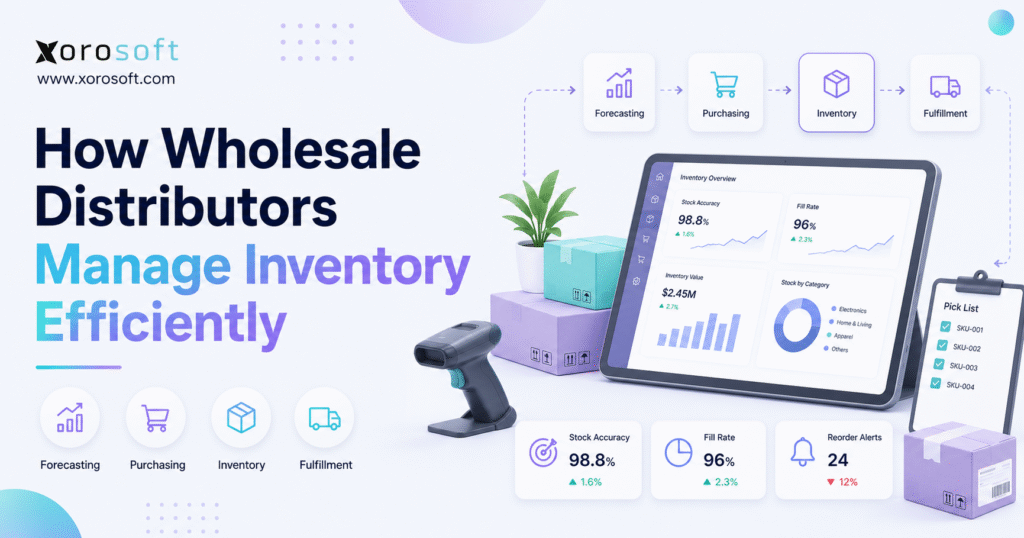
Managing wholesale inventory control efficiently can make a significant difference in the profitability and productivity of your business.
1. Building Wholesale Inventory Control Before Growth Creates Chaos
Wholesale inventory control starts with one simple question: can your team trust the stock number in front of them?
When the answer is no, every part of the business becomes harder. Sales may promise products that are not truly available. Buyers may reorder too early or too late. Warehouse teams may search for items in the wrong location. Meanwhile, finance may close the month with numbers that still need another round of checks.
For a small distributor, this may feel manageable at first. Someone usually remembers which supplier is slow. Another person may know where extra cartons are stored. A warehouse lead may catch mistakes before they reach the customer. However, growth eventually removes that safety net.
As SKU counts rise, inventory control becomes more difficult. In addition, more customers, warehouses, sales channels, and supplier lead times create more chances for errors. Therefore, wholesale inventory control becomes less about counting stock and more about building a clear operating system.
Efficient distributors do not simply carry more inventory. Instead, they improve visibility, accuracy, purchasing discipline, warehouse flow, and reporting. Because of that, they can fulfill orders faster while keeping less cash trapped in slow-moving products.
2. What Wholesale Inventory Control Actually Means
2.1 Wholesale inventory control is more than stock counting
Wholesale inventory control is the process of tracking, managing, replenishing, storing, moving, and reporting the products a distributor buys and sells.
In practice, this covers the full stock journey. A distributor needs to know what was ordered from suppliers, what arrived, what was received correctly, where stock was stored, what has already been promised, and what is still available to sell.
Because wholesale businesses often sell in bulk, one inventory mistake can become expensive quickly. For example, one wrong count may affect a large customer order. Similarly, one missed reorder point may create weeks of backorders. As a result, wholesale inventory control must connect purchasing, warehouse work, sales, accounting, and reporting.
2.2 How distributor inventory management differs from retail inventory
Retail inventory usually focuses on direct customer availability. A retailer wants products available in stores, online, or across sales channels.
However, wholesale inventory control is different because distributors often manage larger orders, customer-specific pricing, EDI rules, pallet quantities, case packs, long supplier lead times, and multi-warehouse stock. Therefore, a distributor must know more than what is physically on hand.
A product may show 2,000 units in stock. However, 1,200 units may already be committed to open wholesale orders. Another 300 units may be reserved for a key customer. Because of that, only 500 units may truly be available for new demand.
That difference matters because sales, purchasing, and warehouse teams all depend on the same number.
2.3 Why wholesale stock control should focus on profitable availability
The goal of wholesale stock control is not to keep shelves full at any cost.
Instead, the goal is profitable availability. That means the distributor keeps enough stock to serve customers while avoiding excess inventory, weak cash flow, warehouse congestion, and dead stock.
Strong wholesale inventory control balances four things. First, inventory records should be accurate. Next, available stock should be clear. Also, cash should not be trapped in slow-moving products. Finally, warehouse teams should be able to pick, pack, and ship without constant manual checks.
3. Why Wholesale Inventory Control Gets Harder as Distributors Grow
3.1 Why spreadsheets weaken wholesale inventory control
Spreadsheets can help in the early stage because they are flexible, cheap, and easy to edit. However, they become risky once multiple people, warehouses, sales channels, and purchasing workflows depend on them every day.
A buyer may update one tab. Meanwhile, a warehouse lead may update another file. Later, a sales rep may check an older version before promising stock to a customer. As a result, the spreadsheet becomes less of a tool and more of a place where mistakes hide.
Because spreadsheets do not update inventory in real time across sales, purchasing, warehouse, and accounting, teams often create manual workarounds. Eventually, people spend more time checking the data than using it.
3.2 How multi-warehouse inventory control creates hidden problems
One warehouse can be managed with discipline. However, multiple warehouses need stronger visibility.
Stock may be available, but not in the right location. Another warehouse may hold too much of a slow-moving SKU. Meanwhile, a transfer may be created informally and received late. Because of this, a distributor can have stockouts and overstock at the same time.
Better multi-warehouse inventory control shows stock by warehouse, bin, status, commitment, and availability. Therefore, teams can route orders, plan transfers, and make buying decisions with more confidence.
3.3 Why supplier lead times affect distributor inventory management
Supplier lead times are not fixed forever.
A product that once arrived in 12 days may now take 28 days. Another supplier may ship partial orders more often than before. In addition, a seasonal product may need earlier purchasing because demand rises faster than expected.
Because of this, distributor inventory management must include supplier behavior. Buyers need to know average lead time, late shipments, short shipments, minimum order quantities, and open purchase orders. Otherwise, purchasing becomes reactive.
3.4 How ecommerce and EDI increase wholesale stock control pressure
Many wholesale distributors now sell through wholesale orders, Shopify, Amazon, EDI partners, marketplaces, and sales reps.
Each channel can pull from the same inventory. However, each channel may have different rules. Wholesale customers may place bulk orders, while Shopify customers expect fast shipment. At the same time, EDI partners may need clean order, shipment, and invoice data.
Therefore, disconnected systems can create overselling, late orders, and poor customer experience. Better wholesale stock control keeps channel demand tied to the same stock record.
4. How Efficient Distributors Improve Wholesale Inventory Control
4.1 Build one source of truth for distributor inventory management
Efficient distributors centralize inventory data because every team needs to trust the same numbers.
That does not mean every team loses its workflow. Instead, sales, purchasing, warehouse, finance, and leadership all work from the same operational record. As a result, wholesale inventory control becomes easier to manage across the full business.
A single source of truth should show on-hand inventory, available inventory, committed stock, reserved stock, incoming purchase orders, in-transit transfers, damaged stock, warehouse location, and inventory value.
Without this, each team makes decisions from different numbers. Therefore, errors become normal.
4.2 Separate on-hand stock from available wholesale inventory
One of the biggest mistakes in wholesale inventory control is treating on-hand inventory as available inventory.
These terms are not the same.
| Inventory Term | Meaning | Why It Matters |
|---|---|---|
| On hand | Physical stock currently in the warehouse | Shows what exists |
| Committed | Stock already promised to orders | Protects open orders |
| Reserved | Stock held for a customer, channel, or purpose | Prevents wrong allocation |
| Available | Stock that can still be sold | Prevents overselling |
| Incoming | Stock on purchase orders or transfers | Supports planning |
| In transit | Stock moving between locations | Improves timing decisions |
Because wholesale orders can be large, this difference is critical. A distributor may have plenty of stock on hand and still have very little stock available.
4.3 Standardize receiving to improve inventory control
Receiving is where accuracy begins.
If incoming stock is received incorrectly, the entire inventory record becomes wrong. For that reason, strong wholesale inventory control requires a clean receiving process.
A good receiving workflow should confirm supplier name, purchase order number, SKU, quantity ordered, quantity received, damaged goods, missing items, lot details when needed, warehouse location, and putaway status.
After receiving is complete, stock should update quickly. Otherwise, buyers and sales teams may still think products are unavailable.
4.4 Improve putaway and location-level stock control
Receiving tells the system that stock arrived. Putaway tells the warehouse where that stock lives.
Poor putaway creates “lost inventory.” The stock exists, but the team cannot find it quickly. Consequently, picking slows down, false stockouts increase, and warehouse workers spend more time searching.
Better putaway uses bin locations, barcode scanning, product rules, and clear warehouse zones. As a result, pickers spend less time hunting for products and more time fulfilling orders.
4.5 Use barcode scanning to strengthen wholesale inventory accuracy
Barcode scanning is one of the simplest ways to improve wholesale inventory control.
It can reduce errors during receiving, putaway, picking, packing, transfers, returns, and cycle counts. Instead of typing SKUs manually, the team scans the product, location, order, or shipment.
This creates a check at the point of work. Therefore, mistakes are caught earlier.
For warehouse-heavy distributors, XoroWMS is a useful internal link because warehouse execution, scanning, picking, packing, shipping, and stock movement all connect directly to inventory accuracy.
4.6 Connect purchasing with wholesale inventory planning
Purchasing should not work from memory.
Buyers need current stock, available stock, committed demand, incoming purchase orders, supplier lead time, sales velocity, and forecasts. Otherwise, purchase decisions become guesswork.
A better process gives buyers reorder alerts, suggested purchase quantities, supplier history, and open order visibility. Because of this, purchasing becomes more planned and less reactive.
4.7 Review inventory control KPIs every week
Efficient distributors track inventory performance regularly.
Monthly reporting may be too slow when stock moves every day. Weekly reviews help teams catch stockouts, excess inventory, slow movers, supplier delays, and warehouse errors before they become larger problems.
Key metrics include inventory accuracy, fill rate, turnover, stockout rate, carrying cost, dead stock, order cycle time, and purchase order lead time. More importantly, each metric should lead to a clear action.
5. Inventory Accuracy Is the Base of Wholesale Inventory Control
5.1 Why wholesale inventory accuracy matters first
Inventory accuracy means the system number matches the physical warehouse.
If the system says 500 units are available, the warehouse should be able to find those 500 units. On the other hand, if the system says a product is out of stock, the team should not discover extra cartons later in a back corner.
Poor accuracy weakens every part of wholesale inventory control. Forecasting becomes unreliable. Reorder points become wrong. Sales loses trust in available stock. Finance spends more time reconciling. Meanwhile, warehouse teams waste time checking and rechecking orders.
5.2 What causes inventory control problems
Inventory accuracy problems usually come from process gaps.
| Cause | Example | Result |
| Manual entry | Wrong quantity typed into a file | Incorrect stock record |
| Poor receiving | Short shipment not recorded | Buyer thinks stock arrived |
| Weak putaway | Product stored in wrong bin | Picker cannot find stock |
| Untracked transfers | Stock moved without system update | Warehouse count becomes wrong |
| Picking errors | Wrong SKU shipped | Customer issue and stock mismatch |
| Return mistakes | Damaged item returned to sellable stock | Future order problem |
| Delayed adjustments | Stock correction entered days later | Reports stay wrong |
Because each error creates another error later, accuracy must be managed daily.
5.3 How cycle counting keeps distributor inventory clean
Cycle counting means counting selected inventory throughout the year instead of relying only on one annual count.
This method keeps wholesale inventory control active. Fast-moving, high-value, or high-error SKUs can be counted more often. Meanwhile, slow-moving items can be counted less often.
As a result, the business finds errors sooner and fixes them before they affect too many orders.
5.4 How ABC analysis improves wholesale stock control
Not every SKU deserves the same level of attention.
ABC analysis groups products by value, speed, or business importance.
| Group | Meaning | Count Frequency |
| A items | High-value or fast-moving products | Most often |
| B items | Moderate-value or steady products | Regularly |
| C items | Lower-value or slow-moving products | Less often |
Therefore, distributors can focus effort where errors hurt the most.
5.5 How warehouse discipline supports inventory accuracy
Inventory accuracy is not only a software issue.
Warehouse teams need clear rules for receiving, putaway, picking, packing, transfers, returns, and adjustments. In addition, managers need reports that show where errors happen most often.
Once those patterns are visible, process fixes become easier. Because of that, warehouse discipline becomes a core part of wholesale inventory control.
6. Reorder Points, Safety Stock, and Wholesale Purchasing Control
6.1 Why reorder points matter in wholesale inventory control
Reorder points tell buyers when to purchase more stock.
Without them, purchasing often happens when someone notices a problem. That is too late. By then, open orders may already be at risk.
A reorder point gives the buyer a trigger before the product runs out. Therefore, wholesale inventory control becomes more planned and less reactive.
6.2 Reorder point formula for distributor inventory planning
A simple reorder point formula is:
Reorder Point = Average Daily Demand × Supplier Lead Time + Safety Stock
Example:
| Metric | Value |
| Average daily demand | 20 units |
| Supplier lead time | 15 days |
| Safety stock | 100 units |
| Reorder point | 400 units |
In this case, the distributor should reorder when stock reaches 400 units. Although the formula is simple, it gives wholesale inventory control a clear buying rule.
6.3 Why safety stock protects wholesale service levels
Safety stock protects the business from uncertainty.
Demand may rise. A supplier may ship late. A customer may place a larger order than expected. Also, a shipment may arrive damaged.
However, safety stock should be planned. If teams add extra inventory everywhere, cash flow suffers. Therefore, safety stock should depend on demand, lead time, margin, supplier reliability, and customer importance.
6.4 Why supplier data improves wholesale purchasing control
Supplier performance changes the buying plan.
A supplier with stable lead times needs less buffer. In contrast, a supplier with frequent delays may need earlier purchase orders or higher safety stock. Because of this, supplier history should be part of wholesale inventory control.
Useful supplier data includes average lead time, late shipment rate, short shipment rate, minimum order quantity, cost changes, return history, fill rate, and communication quality.
6.5 How purchasing automation supports inventory control
Purchasing automation helps buyers act before problems reach customers.
It can suggest purchase orders, flag low stock, show incoming inventory, and connect demand with supplier timing. Because of that, teams avoid last-minute buying and reduce the risk of overstock.
For distributors that need inventory, purchasing, warehouse management, accounting, forecasting, and reporting in one system, XoroONE fits naturally because it brings these workflows into a connected cloud ERP structure.
7. Forecasting Demand for Better Wholesale Inventory Control
7.1 Why historical sales are not enough for distributors
Past sales are useful, but they do not explain everything.
A large one-time order can make demand look higher than normal. Meanwhile, a lost sale may hide true demand. Seasonality may shift the buying pattern. Also, a new wholesale customer may change future volume.
Therefore, demand planning should combine history with context.
7.2 What wholesale distributors should include in the forecast
A better forecast uses several signals.
It should include historical sales, open sales orders, customer commitments, seasonal demand, promotions, supplier lead times, lost sales, market changes, new channel growth, and large one-time orders.
Because these signals tell a fuller story, wholesale inventory control becomes more realistic.
7.3 How forecasting protects cash flow
A weak forecast leads to two expensive outcomes.
First, stockouts cause missed revenue and unhappy customers. Second, overstock traps cash in products that may not move. As a result, both service levels and cash flow suffer.
A stronger forecast helps buyers place better purchase orders. It also helps leadership understand how much cash will be tied to inventory.
7.4 Why SKU groups need different inventory control rules
Every SKU should not follow the same buying rule.
Fast-moving products may need higher safety stock. Slow-moving products may need tighter purchase limits. Seasonal products may need early buys and clear exit plans.
Because of this, distributors should group products by speed, margin, supplier risk, seasonality, and customer importance.
8. Multi-Warehouse Inventory Control
8.1 Why multi-warehouse stock needs stricter visibility
Multi-warehouse growth can improve delivery speed. However, it also creates more room for confusion.
Stock can be available in one location but needed in another. A transfer can leave one warehouse but arrive late at another. A customer order may also ship from the wrong location and cost more than expected.
For that reason, wholesale inventory control must show inventory by warehouse, bin, status, and availability.
8.2 How transfer control prevents stock confusion
Transfers should not happen through messages or memory.
A proper transfer should include source warehouse, destination warehouse, SKU, quantity, transfer date, expected arrival date, shipment status, and receiving confirmation.
Once transfers are tracked clearly, both warehouses can trust the inventory record. As a result, buyers and sales teams can plan with fewer surprises.
8.3 How allocation protects wholesale customer commitments
Inventory allocation reserves stock for a specific customer, order, warehouse, channel, or purpose.
This is important for wholesale distributors because one large customer can consume a lot of stock at once. Without allocation rules, ecommerce orders may consume inventory meant for a wholesale account. Likewise, one warehouse may sell stock that another location already planned to use.
Allocation keeps commitments clear. Therefore, it protects customer trust.
8.4 How order routing improves distributor fulfillment
Order routing decides where an order should ship from.
The best warehouse may depend on stock availability, customer location, shipping cost, warehouse workload, and delivery promise. Therefore, multi-warehouse inventory control should not only show where stock is located. It should also help teams decide how to fulfill orders efficiently.
8.5 Why industry fit matters in inventory control
Different industries need different inventory rules.
Apparel distributors need variant-level visibility. Furniture distributors need space planning. Food and beverage teams need tighter lot and expiry control. Sporting goods distributors need seasonal forecasting.
The Industries We Serve page fits here because wholesale inventory needs change by product type, channel mix, and operating model.
9. Warehouse Workflows That Improve Wholesale Inventory Control
9.1 Receiving
Receiving confirms what arrived from suppliers.
A strong receiving process compares physical goods against purchase orders. It also records shortages, overages, damage, lot details, and location assignments.
Because receiving is the first inventory checkpoint, errors here spread quickly.
9.2 Putaway
Putaway moves received stock into the right warehouse location.
Good putaway improves picking speed and reduces lost inventory. In contrast, weak putaway creates stock that exists physically but cannot be found when needed.
Therefore, putaway should follow clear location rules.
9.3 Picking
Picking is where many customer-facing mistakes happen.
Wrong items, wrong quantities, and poor pick paths all create delays. However, barcode scanning, pick lists, warehouse zones, and system-directed workflows help reduce those errors.
As a result, customers receive the right products faster.
9.4 Packing
Packing should confirm that the order is correct before shipment.
At this stage, the team can catch SKU mistakes, missing items, label issues, and packaging problems. Therefore, packing is a quality-control step, not just a shipping step.
9.5 Shipping
Shipping should update order status and inventory records.
If shipping data stays outside the inventory system, teams lose visibility. Customers also wait longer for tracking updates. As a result, service quality drops.
A better process updates shipment status, tracking, and stock records together.
9.6 Returns
Returns can damage inventory accuracy if they are handled casually.
Returned items should be inspected before they go back into available stock. Damaged, incomplete, expired, or incorrect products should be quarantined, repaired, written off, or sent back to suppliers.
Because of that, returns need a clear workflow.
9.7 Cycle counts
Cycle counts keep wholesale inventory control active throughout the year.
Daily counts may focus on fast-moving items. Weekly counts may focus on high-value SKUs. Meanwhile, exception counts may focus on products with negative stock, frequent adjustments, or recent errors.
Because counting is continuous, errors are easier to find and fix.
10. Inventory KPIs for Wholesale Inventory Control
10.1 Key inventory control KPIs for distributors
Wholesale inventory control improves faster when teams track the right numbers.
| KPI | What It Measures | Why It Matters |
| Inventory accuracy | System stock vs physical stock | Shows whether data can be trusted |
| Fill rate | Orders filled from available stock | Measures service level |
| Stockout rate | How often products are unavailable | Shows missed sales risk |
| Inventory turnover | How fast stock sells through | Measures cash efficiency |
| Carrying cost | Cost of holding inventory | Protects margin |
| Dead stock percentage | Inventory with little movement | Finds trapped cash |
| Order cycle time | Time from order to shipment | Measures fulfillment speed |
| Purchase order lead time | Time from PO to receipt | Improves buying plans |
10.2 Why inventory KPIs need clear owners
A report without ownership does not change much.
If stockout rate rises, purchasing should review reorder points and supplier timing. If picking errors rise, warehouse managers should review process gaps. Meanwhile, if dead stock grows, leadership should review buying rules and clearance plans.
Because each KPI points to a team action, ownership matters.
10.3 Why real-time reporting improves wholesale stock control
Old reports create late decisions.
If leadership waits days for inventory reports, the business stays reactive. However, real-time reporting helps teams see what is happening now. They can spot what is selling, what is delayed, what is overstocked, and what needs attention.
This is one reason growing distributors eventually move from separate apps into connected systems.
11. Software Options for Wholesale Inventory Control
11.1 Spreadsheets
Spreadsheets are common because they are simple.
However, they do not create real-time control. They also do not prevent duplicate work, version issues, formula errors, or missing updates. As the business grows, spreadsheets become risky as the main inventory system.
11.2 Basic inventory apps
Basic inventory apps can help small teams move beyond spreadsheets.
They may track stock, orders, and simple adjustments. However, many distributors eventually need deeper purchasing, warehouse, accounting, ecommerce, forecasting, and reporting workflows.
When that happens, inventory-only tools may create another system gap.
11.3 Warehouse management systems
A warehouse management system focuses on receiving, putaway, picking, packing, shipping, transfers, and counts.
This is useful when warehouse execution is the main problem. However, a WMS alone may not solve purchasing, accounting, demand planning, ecommerce, or reporting needs.
11.4 ERP systems
ERP connects inventory with wider business operations.
For wholesale distributors, that usually means inventory, purchasing, warehouse management, accounting, order management, reporting, ecommerce, and sometimes manufacturing.
Because inventory affects cash, fulfillment, and customer service, ERP becomes relevant when the business needs one operating system rather than several disconnected tools.
11.5 Software comparison for wholesale inventory control
Wholesale inventory control can be managed with different systems depending on business size and complexity.
| Option | Best For | Main Limit | Upgrade Signal |
| Spreadsheets | Very small teams | Manual errors | Multiple users or warehouses |
| Basic inventory app | Simple stock tracking | Limited finance and workflow depth | Purchasing and accounting disconnect |
| WMS | Warehouse execution | May not cover full operations | Need for broader reporting |
| ERP | Connected operations | Requires process discipline | Scaling inventory-driven business |
If your team is comparing inventory software with full ERP, the Xorosoft vs Cin7 page fits naturally here because it speaks to the difference between inventory tools and a broader operating system.
12. When Distributors Should Upgrade Their Inventory Control System
12.1 When QuickBooks cannot support wholesale inventory control
QuickBooks can work well for basic accounting. However, wholesale distributors often need more than accounting.
They need inventory visibility, purchase planning, warehouse control, landed cost, order management, and real-time reporting. When those workflows live outside accounting, teams spend more time reconciling than managing.
For that reason, the Xorosoft vs QuickBooks page fits this section because it explains the move from accounting-led operations to ERP-led operations.
12.2 When inventory apps create new operational gaps
An inventory app may solve one problem while creating another.
For example, stock quantities may improve, but finance still works elsewhere. Warehouse teams may still rely on manual steps. Purchasing may still use spreadsheets. Reporting may still require exports.
At that point, the distributor does not have one system. Instead, it has a new set of disconnected tools.
12.3 When warehouse teams need directed workflows
Warehouse teams need clear work instructions.
They need to know what to receive, where to put products, what to pick, how to pack, when to ship, and how to handle exceptions. If this work depends on memory, messages, or manual printouts, errors will continue.
Better warehouse systems guide the work and update inventory as the work happens.
12.4 When leadership needs live inventory reporting
Leadership should not wait until the end of the week to understand inventory risk.
Live reporting helps leaders see stockouts, overstocks, purchasing delays, warehouse performance, slow movers, and margin issues sooner. Therefore, reporting becomes a core part of wholesale inventory control, not a side task.
12.5 When ecommerce, wholesale, and EDI overlap
A growing distributor may sell through Shopify, wholesale orders, Amazon, EDI customers, and other channels.
When these channels share the same stock, clean sync becomes important. The Xorosoft ERP Shopify App Store listing is a relevant outbound link for this section because it supports Shopify-connected ERP workflows for ecommerce, retail, and wholesale operations.
13. Industry Use Cases for Wholesale Inventory Control
13.1 Apparel and fashion distributors
Apparel distributors manage sizes, colors, styles, seasons, and returns.
Because of this, SKU-level accuracy is essential. A shirt may be available in one size and out of stock in another. If the system only shows total product quantity, teams may buy the wrong variants.
Wholesale inventory control helps apparel teams plan by size, color, collection, warehouse, and channel.
13.2 Furniture distributors
Furniture inventory creates space and freight challenges.
Products may be bulky, expensive to move, and slower to replenish. Therefore, furniture distributors need strong location tracking, supplier lead time visibility, and transfer planning.
Even a small stock error can create a large delivery problem.
13.3 Sporting goods distributors
Sporting goods demand often changes by season.
If a distributor buys too late, it misses peak demand. However, if it buys too much, leftover stock may sit until the next season. Because of that, demand planning and stock review should happen earlier.
13.4 Food and beverage distributors
Food and beverage distributors need tighter control around shelf life, lot tracking, rotation, and supplier quality.
Inventory errors can affect service, waste, and compliance. Therefore, teams need clear receiving, storage, picking, and return rules.
13.5 Manufacturing and wholesale hybrids
Some distributors also assemble, kit, or manufacture products.
These businesses need control over raw materials, components, finished goods, work orders, and purchasing. In this case, XoroERP is a useful internal link because manufacturing and ERP workflows connect inventory with production planning.
13.6 Ecommerce wholesale distributors
Ecommerce wholesale distributors must balance direct orders, marketplace demand, wholesale commitments, and warehouse capacity.
If Shopify, Amazon, wholesale orders, and EDI activity do not update the same stock record, overselling becomes more likely. Therefore, ecommerce distributors need tighter inventory sync and stronger allocation rules.
14. Common Wholesale Inventory Control Mistakes
14.1 Treating inventory as only a warehouse issue
Inventory is not only a warehouse problem.
Although warehouse teams handle the physical stock, purchasing creates inventory, sales consumes it, finance values it, and customer service explains the problems when orders go wrong. Therefore, wholesale inventory control must involve the full operation rather than one department.
14.2 Buying more stock instead of fixing inventory control
More inventory can hide weak planning for a while.
However, it also traps cash, fills warehouse space, and increases dead stock risk. Better control starts with cleaner demand data, stronger reorder rules, and clear supplier visibility.
14.3 Ignoring supplier lead time changes
Supplier timing changes often.
If reorder points stay the same while lead times increase, stockouts become more likely. Therefore, distributors should review lead times often and update buying rules when supplier performance changes.
14.4 Counting inventory only once per year
Annual counts are not enough for growing distributors.
By the time the annual count finds a problem, the error may have affected months of orders, reports, and purchase decisions. Cycle counting helps teams fix issues sooner.
14.5 Keeping inventory separate from accounting
Inventory affects cost of goods sold, margin, cash flow, valuation, and month-end close.
If inventory and accounting are disconnected, finance teams must reconcile too much by hand. As a result, reporting slows down and confidence drops.
14.6 Waiting too long to replace disconnected systems
Many distributors wait until the operation is already under stress.
By then, the team has built years of workarounds. Data may be messy. Reports may be hard to trust. Processes may differ by person or warehouse.
Earlier system planning makes the transition easier.
15. A Practical Example of Better Wholesale Inventory Control
15.1 The inventory control problem
A distributor has 1,500 units of a fast-moving SKU.
At first, that number looks healthy. However, the deeper inventory picture tells another story.
| Inventory Layer | Quantity |
| On hand | 1,500 |
| Committed to open wholesale orders | 700 |
| Reserved for one key account | 300 |
| Available to sell | 500 |
| Incoming purchase order | 1,000 |
| Supplier lead time | 25 days |
| Average daily demand | 45 units |
At 45 units per day, 500 available units will last about 11 days. Since the supplier takes 25 days, the distributor has a risk.
15.2 The better distributor inventory decision
A weak system would show 1,500 units and suggest everything is fine.
Better wholesale inventory control shows available stock, committed stock, supplier timing, and demand speed. Because of that, the buyer can act sooner.
Possible actions include placing another purchase order, expediting part of the incoming order, transferring stock from another warehouse, adjusting allocation, communicating with sales, and protecting key customer commitments.
This is the difference between seeing inventory and controlling inventory.
16. How Modern Distributors Build Stronger Inventory Control
16.1 Start with process clarity
Software alone will not fix a broken process.
Before changing systems, distributors should define how inventory should move through the business. That includes receiving, putaway, picking, packing, shipping, returns, transfers, counts, adjustments, purchasing, and reporting.
Clear process comes first. Then software can support the process.
16.2 Build one operational inventory record
After process clarity, the next step is one operational record.
Sales, purchasing, warehouse, finance, ecommerce, and leadership should not rely on different numbers. When every team sees the same stock position, decisions improve.
As a result, wholesale inventory control becomes more consistent across the business.
16.3 Connect purchasing, warehouse, and finance
Inventory sits between operations and finance.
A purchase order affects future stock. Receiving affects available inventory. Shipping affects revenue and cost. Adjustments affect valuation. Therefore, the best wholesale inventory control systems connect these workflows instead of separating them.
16.4 Review inventory control performance often
Distributors should review inventory metrics every week.
This does not need to be complicated. Start with stockouts, overstocks, slow movers, purchase delays, warehouse errors, and inventory accuracy. Then assign ownership for each issue.
Because review creates accountability, the system keeps improving.
16.5 Choose systems that fit the operating model
A simple distributor may not need ERP yet.
However, a growing distributor with multiple warehouses, Shopify, Amazon, EDI, wholesale orders, purchasing teams, and accounting complexity needs stronger control. In that case, connected platforms such as XoroONE can support wholesale inventory control across inventory, purchasing, WMS, accounting, forecasting, ecommerce, EDI, and reporting.
17. FAQs About Wholesale Inventory Control
17.1 What is wholesale inventory control?
Wholesale inventory control is the process of tracking, managing, replenishing, storing, moving, and reporting inventory in a wholesale distribution business. It helps distributors know what is on hand, what is committed, what is available, what is incoming, and what needs attention. As a result, teams can improve purchasing, fulfillment, cash flow, warehouse work, and customer service.
17.2 How do wholesale distributors manage inventory efficiently?
Wholesale distributors manage inventory efficiently by centralizing stock data, separating on-hand from available inventory, using barcode scanning, setting reorder points, tracking supplier lead times, maintaining safety stock, reviewing forecasts, and measuring KPIs. In addition, they standardize receiving, putaway, picking, packing, shipping, returns, transfers, and cycle counts.
17.3 Why is wholesale inventory control important?
Wholesale inventory control is important because inventory affects revenue, cash flow, customer service, warehouse speed, and financial reporting. Poor control creates stockouts, overstock, picking errors, delayed shipments, wrong purchase orders, and weak reports. Therefore, better control helps distributors serve customers without tying up too much cash.
17.4 What is the difference between inventory management and inventory control?
Inventory management is the broader process of planning, buying, storing, selling, and reporting inventory. Inventory control focuses more closely on stock accuracy, movement, availability, counting, and replenishment rules. In practice, distributors need both because planning decisions depend on accurate stock data.
17.5 What causes inventory errors in wholesale distribution?
Inventory errors often come from manual entry, poor receiving, weak putaway, untracked transfers, picking mistakes, return errors, delayed adjustments, and disconnected systems. Because wholesale orders are often large, even one small data issue can create missed shipments, backorders, or accounting problems.
17.6 How can distributors improve inventory accuracy?
Distributors can improve accuracy by using barcode scanning, bin locations, cycle counts, clear receiving steps, controlled transfers, return inspections, and real-time stock updates. Also, they should review adjustment patterns because repeated errors usually point to a process gap.
17.7 How often should wholesale distributors count inventory?
Wholesale distributors should use regular cycle counts instead of relying only on annual counts. Fast-moving, high-value, or high-error SKUs should be counted more often. Meanwhile, slow-moving items can be counted less often. This keeps inventory control active throughout the year.
17.8 What is a reorder point?
A reorder point is the stock level that tells a buyer when to purchase more inventory. A basic formula is average daily demand multiplied by supplier lead time, plus safety stock. Therefore, reorder points help distributors buy before stock runs out.
17.9 What is safety stock?
Safety stock is extra inventory held to protect against demand changes, supplier delays, damaged shipments, or large unexpected orders. However, safety stock should be planned carefully. Too little creates stockouts, while too much traps cash and warehouse space.
17.10 How does forecasting help distributors?
Forecasting helps distributors estimate future demand, plan purchases, manage supplier timing, and reduce stockouts or overstock. A good forecast uses sales history, seasonality, customer commitments, promotions, open orders, and supplier lead times. Because of that, purchasing becomes less reactive.
17.11 What KPIs should distributors track?
Important KPIs include inventory accuracy, fill rate, stockout rate, inventory turnover, carrying cost, dead stock percentage, order cycle time, purchase order lead time, receiving accuracy, and picking accuracy. These metrics help teams find weak spots and fix them faster.
17.12 When should a distributor stop using spreadsheets?
A distributor should stop using spreadsheets as the main system when multiple people update files, inventory numbers conflict, stockouts increase, warehouse errors rise, purchasing becomes reactive, or leadership cannot trust reports. Spreadsheets can still support analysis, but they should not run daily operations.
17.13 What is the difference between WMS and ERP?
A WMS manages warehouse work such as receiving, putaway, picking, packing, shipping, transfers, and counts. ERP connects wider business workflows such as inventory, purchasing, accounting, sales orders, reporting, ecommerce, and manufacturing. Therefore, many growing distributors need both warehouse control and ERP-level visibility.
17.14 Does every wholesaler need ERP?
No. Very small distributors with one warehouse, few SKUs, and simple orders may not need ERP yet. However, ERP becomes more useful when the business manages multiple warehouses, large SKU counts, ecommerce channels, EDI, purchasing complexity, accounting needs, or advanced reporting.
17.15 How does wholesale inventory control affect cash flow?
Inventory uses cash. Overstock ties money into slow-moving products, while stockouts reduce sales. Better wholesale inventory control helps distributors buy with more discipline, reduce dead stock, protect service levels, and improve working capital.
18. Final Takeaway: Inventory Efficiency Comes From Better Control
Efficient distributors do not win by carrying more stock.
Instead, they win by knowing what stock they have, where it sits, what is committed, what is available, what needs to be reordered, and what is slowing the business down.
That is why wholesale inventory control matters so much. It connects warehouse work, purchasing decisions, sales promises, customer service, accounting, and leadership reporting.
When the process is weak, every team feels the cost. However, when stock data is clean and workflows are clear, the business becomes easier to run.
Orders ship faster. Buyers plan earlier. Warehouse teams make fewer mistakes. Finance closes with more confidence. Meanwhile, leadership sees problems before they become expensive.
For growing distributors, the next step is not always more inventory. Often, the better move is stronger control.
If your team has outgrown spreadsheets, disconnected apps, or manual warehouse workarounds, you can Book a demo to see how Xorosoft supports inventory, purchasing, warehouse management, accounting, ecommerce, forecasting, and reporting in one connected system.
Recent Posts
-
 Best AI Warehouse Management Software for ERP Inventory and Warehouse Operations
 -
 Project Based ERP Software for Managing Project Costs, Purchasing, Resources, Inventory, and Accounting
 -
 Food and Beverage ERP Requirements for Lot, Expiry, and Recall Control
 -
 How to Prevent EDI Errors Before They Become Retailer Chargebacks
 -
 Warehouse Injury and Safety Statistics: What Operations Teams Should Know Before Automating Workflows