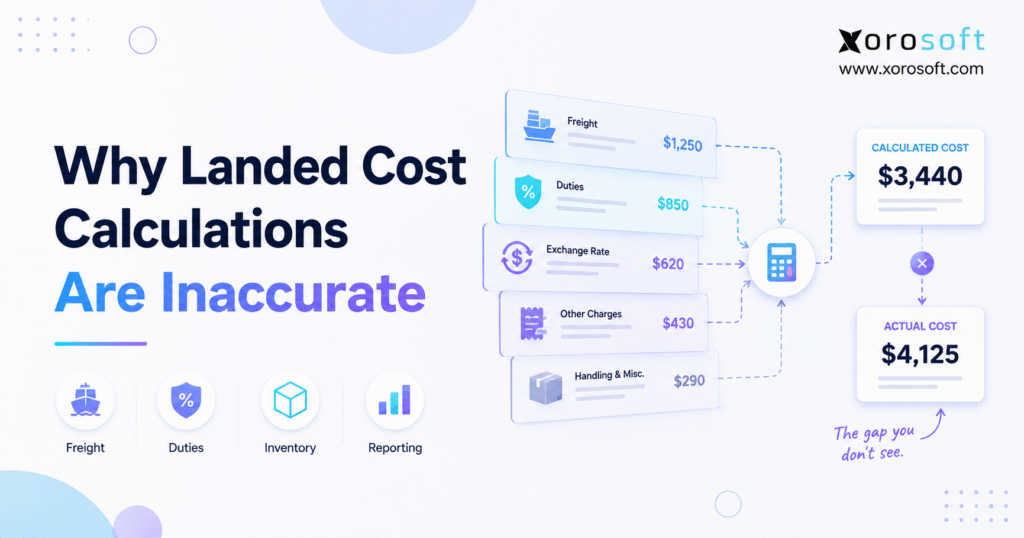
Landed cost calculation errors can have a significant impact on your business operations and profitability.
1. When the Formula Is Right but the Cost Is Wrong
Landed cost calculation errors can quietly distort inventory value, product margins, cost of goods sold, and purchasing decisions even when the mathematical formula looks correct. In most cases, however, the problem does not come from addition or division. Instead, businesses use incomplete costs, inconsistent allocation rules, outdated exchange rates, late invoices, or incorrect receipt quantities.
As a result, a team can calculate a mathematically perfect number from inaccurate inputs.
Moreover, purchase price rarely represents the complete economic cost of inventory. Freight, customs duties, tariffs, insurance, brokerage, handling, and other inbound expenses can substantially increase the amount a company actually spends to place products into inventory.
Consequently, an inaccurate cost does not remain inside the purchasing department. Instead, it can affect inventory valuation, gross margin, pricing, purchasing decisions, replenishment, and financial reporting.
Therefore, businesses should treat landed cost as an operational process rather than a one-time accounting formula.
1.1 What Landed Cost Actually Represents
Landed cost represents the relevant acquisition cost required to purchase inventory and bring it to the location and condition where a business can sell or use it.
For example, a company may purchase a product from a supplier for $30. However, freight, duty, brokerage, insurance, and handling may increase the true acquisition cost to $37.
Consequently, comparing the $30 supplier price with a $60 selling price creates an incomplete view of profitability.
Instead, operators should evaluate margins against the full attributable product cost.
1.2 Why the Formula Usually Is Not the Main Problem
The basic formula remains straightforward:
Landed Cost = Purchase Cost + Freight + Duties + Tariffs + Insurance + Brokerage + Handling + Other Attributable Acquisition Costs
However, every component creates another operational question.
Which freight invoice belongs to the shipment?
Which SKUs should absorb the expense?
Which exchange rate should finance use?
Should the company allocate freight by quantity, weight, value, or volume?
Did every ordered unit actually arrive?
For that reason, landed cost calculation errors usually come from data quality, timing, and allocation decisions rather than from difficult mathematics.
2. How Accurate Landed Cost Should Work
A reliable process starts before goods arrive.
First, purchasing records the supplier price and expected costs.
Next, receiving confirms actual quantities.
Then, finance collects freight, customs, and other invoices.
Finally, the business reconciles estimated costs against actual costs.
As a result, product cost develops alongside the physical and financial movement of inventory.
2.1 A Simple Landed Cost Example
Assume a business orders 1,000 units.
Purchase cost: $30,000
International freight: $4,000
Customs duty: $2,000
Brokerage and handling: $500
Insurance: $300
Total landed cost: $36,800
Therefore:
$36,800 ÷ 1,000 units = $36.80 landed cost per unit
At first, this calculation appears simple.
However, suppose the supplier ships only 970 units.
The company still incurs most or all of the transportation expense.
Consequently, blindly dividing the total expense by the original 1,000-unit order can produce inaccurate product economics.
2.2 Which Costs Can Affect Landed Cost?
Depending on the transaction and accounting policy, relevant expenses may include:
- supplier purchase price
- international freight
- domestic inbound freight
- customs duties
- tariffs
- brokerage
- cargo insurance
- port charges
- handling fees
- inspection fees
- other directly attributable acquisition expenses
However, teams should distinguish acquisition costs from downstream selling expenses.
For example, outbound customer delivery, advertising expenses, general warehouse overhead, and marketplace commissions do not automatically belong in the same inventory acquisition calculation.
For that reason, businesses should document which expense categories they include and how they handle each one.
Because of this, landed cost calculation errors often begin long before finance reviews the final inventory value.
3. Landed Cost Calculation Errors: 11 Causes Behind Inaccurate Costs
Most landed cost calculation errors develop through several small operational weaknesses rather than one dramatic accounting failure.
Therefore, teams should trace the transaction from purchase order through receiving, expense allocation, inventory valuation, and accounting.
3.1 Error #1: Missing Freight, Duty, or Handling Costs
The first problem occurs when the business leaves a legitimate expense out of the calculation.
For example, purchasing may record supplier cost and ocean freight. Meanwhile, finance may receive a separate brokerage invoice two weeks later.
If nobody connects that invoice with the original inventory, product cost remains understated.
As a result, gross margin can appear stronger than the actual economics.
Therefore, teams should maintain a consistent inbound-cost checklist for each shipment.
This practice helps prevent landed cost calculation errors caused by forgotten expenses.
3.2 Error #2: Allocating Freight Equally Across Unequal Products
Quantity-based allocation often feels convenient.
However, convenience does not guarantee accuracy.
Imagine a shipment containing 500 lightweight accessories and 50 heavy appliances.
If the company divides freight only by unit quantity, the accessories absorb most of the transportation expense even though the appliances may consume far more capacity.
Consequently, one SKU group becomes overstated while another becomes understated.
Instead, the business should consider weight or volume when those factors better explain the freight expense.
Incorrect allocation remains one of the most common landed cost calculation errors in mixed-SKU shipments.
3.3 Error #3: Confusing Internal Landed Cost With Customs Value
Internal inventory costing and customs valuation serve different purposes.
Therefore, businesses should not automatically use an internal landed cost formula as the customs valuation basis.
For U.S. imports, companies should review current U.S. Customs and Border Protection guidance on customs valuation and confirm the treatment that applies to each transaction.
Moreover, tariff and duty treatment may depend on product classification, country of origin, and current trade rules.
Consequently, businesses should separate customs compliance from internal inventory costing.
Doing so also reduces landed cost calculation errors caused by applying the wrong duty basis.
3.4 Error #4: Using Inconsistent Exchange Rates
International purchasing introduces several relevant dates.
For example, a business may:
- create a purchase order at one exchange rate
- receive inventory at another rate
- record a supplier invoice later
- pay the supplier at a different rate again
Meanwhile, the freight invoice may use another currency.
Without a documented policy, purchasing, inventory, and finance can calculate different costs for the same shipment.
Therefore, companies should define which currency rate applies to each accounting event.
In addition, teams should track foreign-exchange differences consistently.
Otherwise, currency inconsistency can create recurring landed cost calculation errors.
3.5 Error #5: Treating Estimated Costs as Final Costs
Businesses often need product-cost estimates before every final invoice arrives.
Therefore, estimated freight, duties, and brokerage can support planning.
However, estimates should not silently become permanent actual costs.
For example, a carrier may quote $6,000 initially. Later, the final invoice may reach $6,850 because of destination or handling charges.
If the business never reconciles that difference, inventory remains valued using an outdated assumption.
Consequently, teams should separate estimated landed cost from actual landed cost.
Failing to reconcile the two remains another major source of landed cost calculation errors.
3.6 Error #6: Processing Late Freight and Brokerage Invoices Incorrectly
Freight invoices often arrive after the inventory receipt.
Meanwhile, the business may already have sold or transferred some inventory.
Therefore, late expenses create a timing challenge.
Finance must determine how the adjustment affects:
- inventory still on hand
- units already sold
- cost of goods sold
- financial reporting
Without a consistent adjustment process, late expenses generate repeated reconciliation work.
As a result, the organization may correct one accounting period while creating another landed cost calculation error elsewhere.
3.7 Error #7: Using One Allocation Method for Every Expense
Not every expense follows the same economic driver.
For example, freight may follow weight.
Insurance may relate more closely to product value.
Handling may follow quantity.
Container costs may align better with volume.
Therefore, applying one universal allocation rule can distort SKU-level costs.
Instead, companies should select a driver that reflects how each significant expense actually occurs.
This approach helps reduce landed cost calculation errors while improving product profitability analysis.
3.8 Error #8: Mishandling Partial Receipts
Purchase orders do not always arrive in one clean shipment.
For example, a supplier may ship 5,000 units across three containers.
The first container may arrive this month.
Meanwhile, the second may arrive next month.
The third may go directly to another warehouse.
Consequently, allocating all costs against the original purchase order before confirming actual receipts can distort unit costs.
Instead, teams should connect relevant expenses with the inventory and shipment that generated them.
Partial receipts frequently expose landed cost calculation errors that remain hidden in simpler purchasing workflows.
3.9 Error #9: Ignoring Shortages, Damage, and Rejected Goods
Suppose a company pays freight to move 1,000 units but receives only 970 saleable units.
The business must then understand what happened to the missing 30 units.
Were they never shipped?
Did the carrier damage them?
Will the supplier issue a credit?
Will insurance reimburse the loss?
For that reason, teams cannot automatically use the original purchase quantity as the denominator.
Instead, they should investigate the operational event and apply the appropriate accounting treatment.
Ignoring those exceptions can produce landed cost calculation errors at both shipment and SKU level.
3.10 Error #10: Inventory and Accounting Systems Do Not Agree
Disconnected software frequently creates costing inconsistencies.
For example, warehouse staff may record receiving in one application while finance records the supplier invoice elsewhere.
Later, someone may calculate freight in a spreadsheet.
Consequently, inventory, accounting, and the costing workbook can show three versions of the same transaction.
As a result, month-end teams spend time reconciling systems rather than analyzing performance.
These disconnected records also make landed cost calculation errors harder to trace.
3.11 Error #11: Spreadsheet Mistakes Compound With Complexity
Spreadsheets remain useful tools.
However, operational complexity can expose their weaknesses.
Typical issues include:
- overwritten formulas
- incorrect cell references
- copied exchange rates
- duplicate charges
- missing invoices
- outdated workbook versions
- incorrect SKU mappings
- copy-and-paste mistakes
Therefore, landed cost calculation errors usually become more frequent as companies add suppliers, warehouses, currencies, users, and inbound shipments.
4. Landed Cost Calculation Errors Often Start With Allocation
In many cases, landed cost calculation errors appear even when the total shipment expense is correct.
Instead, the problem occurs because the business distributes that total incorrectly across individual SKUs.
Therefore, teams should audit both the shipment total and the allocation logic.
4.1 Allocation by Quantity
Quantity allocation divides shared expenses according to the number of units.
For example, if Product A represents 60% of the units and Product B represents 40%, the business assigns the expense using those percentages.
This approach works well when the products have similar size, weight, and transportation characteristics.
However, it becomes less reliable when products differ substantially.
4.2 Allocation by Weight
Weight-based allocation works well when freight closely follows product weight.
For example, sporting goods, furniture components, and industrial products may generate transportation differences because of physical weight.
Consequently, heavier products absorb a larger share.
However, the method depends on accurate item master data.
If recorded weights are wrong, the allocation can still produce inaccurate costs.
4.3 Allocation by Volume
Volume works well when products consume different amounts of container or truck space.
For instance, a lightweight but bulky furniture item may consume far more capacity than a dense smaller product.
Therefore, volume can sometimes represent transportation economics better than weight.
Again, reliable product dimensions remain essential.
4.4 Allocation by Product Value
Value-based allocation assigns a larger portion of shared cost to higher-value products.
This method can work for certain insurance or value-related expenses.
However, high-value products do not automatically consume more transportation capacity.
For that reason, teams should not use value simply because the information already exists.
4.5 Choosing the Correct Allocation Method
A practical framework looks like this:
| Expense | Possible Allocation Driver |
|---|---|
| Freight | Weight or volume |
| Insurance | Product value |
| Handling | Quantity or activity |
| Shared brokerage | Value, quantity, or defined rule |
| Shipment-specific expense | Direct assignment |
Ultimately, the strongest allocation method reflects the underlying cause of the expense.
That principle helps prevent landed cost calculation errors from moving into SKU-level margin reports.
5. Estimated and Actual Costs Need Separate Controls
Another major source of landed cost calculation errors is the failure to separate estimated costs from final actual costs.
Estimates support planning, whereas actual costs support reconciliation and reporting.
Therefore, businesses need a clear process for both.
Microsoft, for example, explains workflows around estimated and actual landed costs within Dynamics 365.
5.1 Why Estimated Costs Matter
A business cannot always wait several weeks for every final freight and customs invoice before analyzing a shipment.
Therefore, teams may estimate:
- freight
- duty
- brokerage
- insurance
- exchange rates
- handling
These estimates support purchasing and planning.
However, they remain assumptions until the company receives final documents.
5.2 Why Actual Costs Still Matter
Eventually, the business receives the real invoices.
At that point, finance should compare estimates against actuals.
For example:
| Cost | Estimate | Actual | Variance |
| Freight | $8,000 | $8,600 | +$600 |
| Duty | $4,500 | $4,420 | -$80 |
| Brokerage | $750 | $910 | +$160 |
Consequently, finance should explain the $680 net difference.
Without that reconciliation, landed cost calculation errors can remain embedded in inventory.
5.3 Variance Does Not Automatically Mean an Error
Costs naturally change.
For example, exchange rates move, carriers add legitimate charges, and quantities can differ from expectations.
Therefore, businesses should not expect every estimate to equal the final amount.
Instead, companies should establish reasonable variance thresholds.
Then, teams can focus on significant exceptions rather than reviewing every minor difference.
6. How Landed Cost Errors Distort Inventory and Profit
Landed cost calculation errors can affect far more than purchasing records.
They can influence inventory valuation, cost of goods sold, financial reporting, and management decisions.
6.1 Inventory Valuation Becomes Unreliable
Suppose a business records inventory at $500,000.
However, missing freight and import expenses mean the true attributable inventory cost should have reached $535,000.
Consequently, management relies on an understated inventory value.
Moreover, future reporting may continue using that inaccurate baseline.
Therefore, landed cost calculation errors can affect both operational and financial visibility.
6.2 COGS Can Become Distorted
As inventory sells, product cost flows into cost of goods sold according to the company’s accounting method.
Consequently, inaccurate inventory cost can also distort COGS.
If the company understates COGS, gross margin may appear artificially strong.
Conversely, overstated cost can make profitable products appear weaker.
6.3 Gross Margin Can Look Better Than Reality
Consider this illustrative example.
Selling price: $100
Recorded product cost: $50
Reported gross profit: $50
Reported gross margin: 50%
However, suppose the true landed cost equals $60.
Actual gross profit: $40
Actual gross margin: 40%
As a result, a $10 costing difference materially changes the commercial interpretation of the SKU.
6.4 Pricing Decisions Become Less Reliable
Businesses often use product cost as a starting point for pricing.
Therefore, inaccurate costs can lead to:
- overly aggressive discounts
- weak wholesale pricing
- incorrect marketplace pricing
- poor promotion economics
- inaccurate channel comparisons
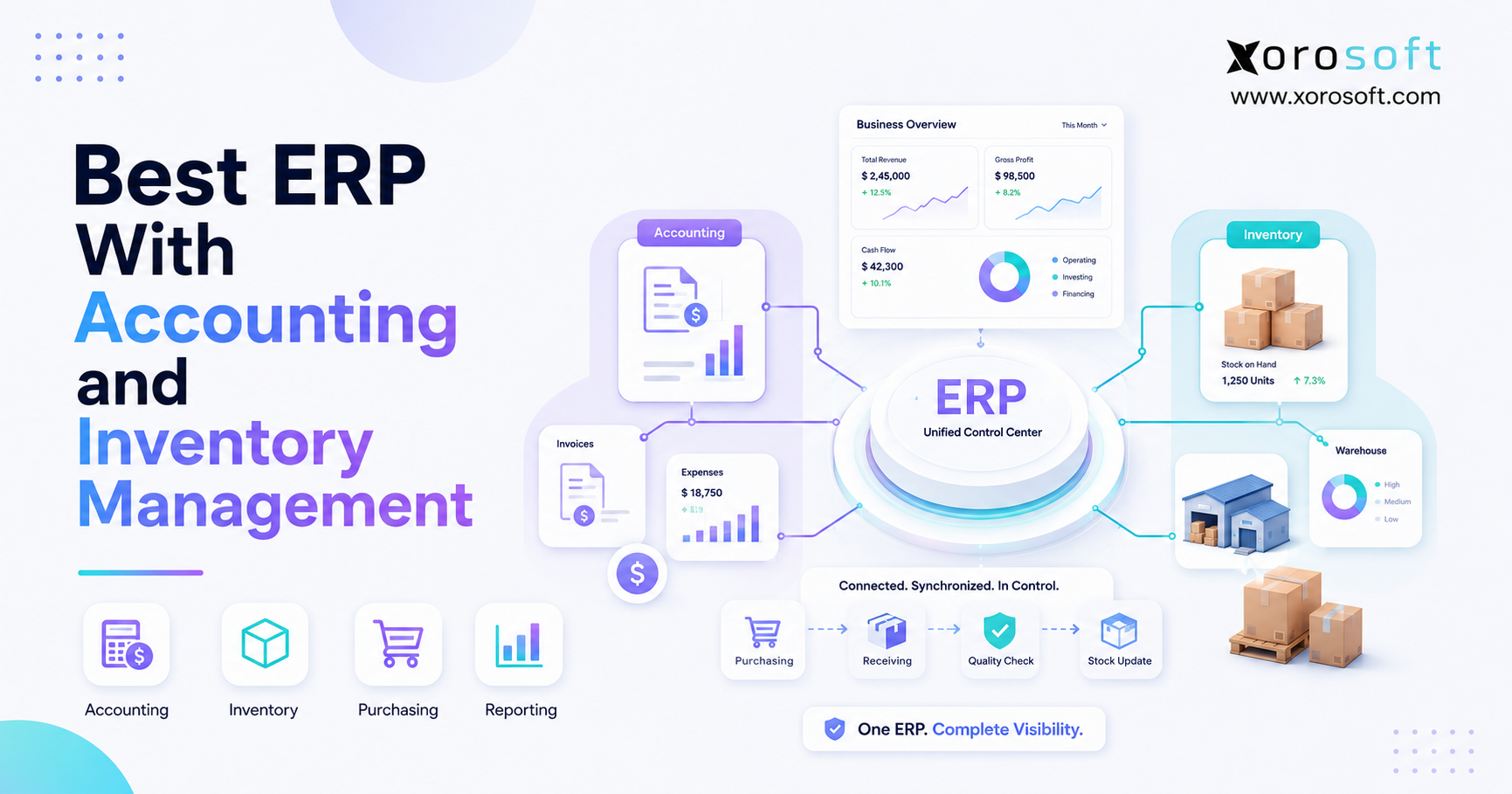
For businesses that need purchasing, inventory, and accounting in a connected environment, XoroERP can support a broader operational workflow rather than relying on disconnected costing records.
7. Landed Cost Calculation Errors Look Different Across Industries
The operational impact of landed cost calculation errors changes by business model.
Ecommerce brands, wholesalers, manufacturers, and multi-warehouse operators all face different costing risks.
Businesses can explore Xorosoft’s broader industries served to see how these operational requirements differ.
7.1 Ecommerce and Shopify Brands
Ecommerce companies often combine supplier purchasing, online sales, returns, fulfillment, and marketplace activity.
Therefore, accurate product cost becomes essential for channel-level margin analysis.
For Shopify merchants, the problem grows when Shopify orders, inventory, purchasing, and accounting live in different applications.
Moreover, merchants evaluating ERP connectivity can review Xorosoft’s presence on the Shopify App Store.
7.2 Amazon and Marketplace Sellers
Marketplace sellers should separate acquisition cost from selling-channel expenses.
For example, inbound freight may contribute to inventory acquisition cost. Meanwhile, marketplace commissions belong to downstream selling economics.
Consequently, combining every expense into one figure makes profitability harder to interpret.
7.3 Wholesale Distributors
Wholesalers often manage high purchase quantities, customer-specific pricing, allocation rules, and EDI.
Therefore, even a modest per-unit cost error can become meaningful across thousands of units.
Moreover, accurate cost supports stronger wholesale pricing decisions.
7.4 Apparel Companies
Apparel businesses often manage hundreds or thousands of size, color, and style combinations.
Consequently, shipment-level freight must eventually reach SKU-level profitability.
If the company distributes costs poorly, one variant may appear less profitable while another looks stronger than reality.
7.5 Furniture Businesses
Furniture provides one of the clearest examples of allocation risk.
A small accessory and a large chair may both count as one unit.
However, they consume vastly different transportation capacity.
Therefore, quantity-based allocation can create misleading product costs.
7.6 Sporting Goods
Sporting goods businesses may combine apparel, small accessories, equipment, and oversized items within the same shipment.
Consequently, one freight allocation method may not suit every SKU.
Instead, teams may need weight, volume, value, or other drivers depending on the charge.
7.7 Food and Beverage
Food businesses may also manage lots, expiration dates, quality holds, and spoilage.
Therefore, receiving accuracy becomes especially important.
If products become unsaleable or fail inspection, finance needs consistent treatment for the related costs.
7.8 Manufacturing
Manufacturers face another layer of costing complexity.
First, they purchase raw materials.
Next, those materials enter production.
Finally, manufacturing costs flow into finished goods.
Consequently, inaccurate raw-material landed cost can affect bills of materials and final product profitability.
7.9 Multi-Warehouse Operations
Multi-warehouse companies must connect costs with the inventory that actually moved.
For example, one purchase order may split across several facilities.
Therefore, companies cannot assume every receipt has the same cost structure.
When warehouse execution contributes to the problem, XoroWMS can connect receiving and inventory operations within a broader system.
8. How to Audit Landed Cost Calculation Errors Before Reporting
A structured audit helps teams find landed cost calculation errors before they flow into inventory reports and financial statements.
Therefore, the review should follow the complete transaction rather than checking only the final total.
8.1 Check the Purchase Order
First, confirm:
- supplier
- currency
- unit cost
- quantity
- expected shipment
- payment terms
- expected additional costs
This step establishes the initial baseline.
8.2 Verify Actual Receipt Quantities
Next, compare ordered quantity with received quantity.
Look for:
- shortages
- overages
- damage
- rejected products
- partial receipts
As a result, the cost calculation reflects physical reality rather than the original order assumption.
8.3 Match Supplier Invoices
Then, confirm whether the supplier invoice matches the purchase order and receipt.
Investigate:
- price differences
- quantity differences
- unexpected fees
- supplier credits
Consequently, teams can resolve discrepancies before they affect inventory reporting.
8.4 Collect Relevant Inbound Expenses
Next, review:
- freight
- brokerage
- duties
- tariffs
- insurance
- handling
- port charges
However, do not add every expense blindly.
Instead, confirm that each charge relates directly to the shipment or inventory.
8.5 Validate Currency Treatment
Afterward, verify exchange-rate dates and accounting rules.
Moreover, make sure the business treats foreign-exchange differences consistently.
A documented policy helps reduce landed cost calculation errors caused by inconsistent currency assumptions.
8.6 Review Allocation Drivers
Ask why the business used:
- quantity
- weight
- volume
- value
- direct allocation
If nobody can explain the reason, review the method.
8.7 Compare Estimated and Actual Costs
Next, compare provisional costs with final invoices.
Consequently, teams can distinguish normal variance from recurring operational problems.
8.8 Reconcile Inventory and Accounting
Finally, compare:
- inventory valuation
- inventory subledger
- general ledger
- supplier bills
- landed-cost adjustments
As a result, the business can identify landed cost calculation errors before management relies on the numbers.
9. When Spreadsheets Work—and When Risk Starts Growing
Spreadsheets can calculate landed cost accurately.
Therefore, businesses should not replace them simply because ERP exists.
9.1 When Spreadsheets Are Usually Enough
A controlled spreadsheet can work well when a company has:
- one warehouse
- few suppliers
- domestic purchasing
- predictable freight
- low SKU counts
- limited currency complexity
- few shared expenses
In these cases, manual processes can remain efficient.
9.2 When Spreadsheet Complexity Starts Increasing
However, risk changes when businesses add:
- multiple warehouses
- international suppliers
- several currencies
- frequent imports
- partial receipts
- high SKU counts
- Shopify
- Amazon
- EDI
- manufacturing
- frequent freight adjustments
Consequently, the workbook may become a reconciliation layer between disconnected systems rather than a straightforward calculation tool.
At this stage, landed cost calculation errors become less about spreadsheet mathematics and more about disconnected data, manual handoffs, and inconsistent operating processes.
9.3 Inventory Software May Solve Only Part of the Problem
Inventory software can improve receiving and stock visibility.
However, not every inventory platform connects deeply with financial accounting.
Therefore, buyers should evaluate more than quantity tracking.
They should also examine:
- purchasing
- receipt costing
- shared expenses
- accounting integration
- audit trails
- multiple warehouses
- ecommerce workflows
10. How ERP Can Reduce Landed Cost Calculation Errors
ERP can reduce landed cost calculation errors when the business needs several operational records to remain connected.
Instead of manually moving data between applications, the company can maintain a transaction chain such as:
Purchase Order
→ Shipment
→ Receipt
→ Additional Cost
→ Cost Allocation
→ Inventory Value
→ Accounting
→ Reporting
10.1 Keep Purchasing and Inventory Connected
First, ERP can connect purchase orders with inventory receipts.
As a result, finance can see which goods actually arrived before assigning final costs.
10.2 Connect Warehouse Activity With Costing
Next, receiving information can support the costing workflow directly.
Consequently, partial receipts and warehouse splits become easier to trace.
10.3 Make Allocation More Repeatable
Rather than rebuilding formulas for each shipment, teams can use documented and repeatable processes.
Therefore, the organization reduces dependence on individual spreadsheet knowledge.
10.4 Connect Inventory and Finance
For inventory-driven businesses, XoroONE connects inventory, purchasing, accounting, warehouse management, manufacturing, forecasting, and other operational processes within one cloud ERP environment.
However, software does not automatically eliminate every costing issue.
Instead, connected records reduce many manual handoffs where landed cost calculation errors usually develop.
10.5 Connect Ecommerce and Operational Systems
Ecommerce companies also need orders, inventory, purchasing, and fulfillment data to remain synchronized.
Therefore, businesses evaluating system connectivity can review Xorosoft’s available integrations.
Ultimately, the goal is not to add more software.
Instead, the goal is to reduce disconnected sources of truth.
11. When Should a Business Upgrade Its Landed Cost Process?
Repeated landed cost calculation errors often signal that the current operating process has become difficult to control.
Instead of correcting each variance independently, the business should identify the underlying source.
11.1 Signs the Current Process Is Breaking
Watch for:
- repeated inventory adjustments
- unexplained margin changes
- long month-end reconciliations
- freight invoices nobody can trace
- inconsistent product costs
- multiple spreadsheet versions
- inventory and accounting disagreements
- frequent manual journal entries
- poor multi-warehouse visibility
When these issues appear repeatedly, landed cost calculation errors may represent only one part of a larger operational problem.
11.2 Who Should Consider ERP?
ERP becomes more relevant when companies manage several of the following:
- physical inventory
- multiple warehouses
- Shopify
- Amazon
- wholesale
- EDI
- manufacturing
- international suppliers
- multiple currencies
- complex purchasing teams
For example, businesses evaluating broader process automation can review Xorosoft’s ERP solutions.
11.3 Who May Not Need ERP Yet?
A smaller operation with straightforward domestic purchasing may not gain enough value from ERP.
In that case, the business should avoid adding complexity merely to solve a calculation it already manages effectively.
Instead, upgrade when operational complexity creates repeated control problems.
11.4 What Should Buyers Test?
Before choosing a platform, test a real inbound transaction.
For example:
- Create a purchase order.
- Receive part of the order.
- Add freight.
- Add duty.
- Allocate the costs.
- Receive the remaining inventory.
- Post the supplier bill.
- Review inventory value.
- Review accounting.
- Trace the transaction history.
Moreover, test exceptions rather than only the perfect workflow.
That approach reveals far more than a generic feature checklist.
12. A Practical Landed Cost Accuracy Checklist
Use this checklist to reduce landed cost calculation errors before they affect financial reporting.
12.1 Before the Supplier Ships
- Confirm supplier price.
- Confirm currency.
- Estimate freight.
- Estimate duties.
- Check expected quantities.
- Define allocation methods.
- Identify unusual charges.
12.2 During Receiving
- Record actual quantities.
- Identify shortages.
- Identify damaged goods.
- Track partial receipts.
- Confirm warehouse destination.
- Match receipts with shipment documents.
12.3 After Final Invoices Arrive
- Compare estimated freight with actual freight.
- Review duties.
- Review brokerage.
- Confirm currency treatment.
- Investigate material variance.
- Adjust costs according to accounting policy.
12.4 Before Month-End Close
- Reconcile inventory.
- Reconcile accounting.
- Review unusual SKU cost changes.
- Review unresolved estimates.
- Check duplicate expenses.
- Document exceptions.
Consequently, the business moves from reactive corrections toward preventive control.
13. Frequently Asked Questions About Landed Cost Calculation Errors
13.1 What Is Landed Cost?
Landed cost represents the relevant cost of acquiring inventory and bringing it to the location and condition where the business needs it. Therefore, the number can include more than supplier price. Freight, duties, tariffs, brokerage, insurance, handling, and other directly attributable acquisition costs may contribute depending on the transaction and accounting policy.
13.2 Why Does Landed Cost Matter?
Landed cost helps operators understand what products actually cost. Consequently, more accurate costs improve inventory valuation, gross-margin analysis, pricing, purchasing, and SKU profitability. Without reliable landed cost, management may make important commercial decisions using incomplete product economics.
13.3 What Costs Should a Business Include in Landed Cost?
Businesses commonly evaluate purchase cost, inbound freight, duties, tariffs, insurance, brokerage, handling, and other directly attributable acquisition expenses. However, not every operating expense belongs in inventory cost. Therefore, finance teams should create and consistently apply a documented accounting policy.
13.4 What Is the Basic Landed Cost Formula?
A practical formula combines purchase cost with attributable freight, duties, tariffs, insurance, brokerage, handling, and other acquisition expenses. Next, businesses allocate shared costs across the appropriate inventory. Therefore, the allocation method matters almost as much as the total formula.
13.5 What Causes Landed Cost Calculation Errors?
Landed cost calculation errors commonly result from missing expenses, incorrect allocation methods, currency inconsistencies, delayed invoices, partial receipts, shortages, and disconnected accounting records. Moreover, spreadsheets can introduce formula, version-control, and manual data-entry mistakes as transaction complexity grows.
13.6 How Do You Know if Landed Cost Is Wrong?
Look for unexplained margin changes, recurring inventory adjustments, large estimated-versus-actual variances, inconsistent SKU costs, and differences between inventory and accounting. Therefore, reviewing both shipment-level totals and individual SKU allocations can help identify the source.
13.7 Is Freight Part of Landed Cost?
Inbound freight often contributes to acquisition cost when it directly relates to bringing inventory to its required location and condition. However, outbound customer delivery serves a different purpose. Therefore, companies should separate inbound acquisition freight from downstream fulfillment costs.
13.8 Should Freight Be Allocated by Quantity?
Quantity works when products consume similar transportation resources. However, the method can distort costs when items differ substantially in weight, size, or value. Therefore, businesses should use quantity only when it reasonably reflects the underlying freight driver.
13.9 Can Freight Be Allocated by Weight?
Yes. Weight can provide a practical allocation basis when transportation cost closely follows physical weight. However, businesses need accurate item-master data. Otherwise, incorrect product weights can simply replace one landed cost error with another.
13.10 Can Landed Cost Be Allocated by Volume?
Yes. Volume can work well when products consume different amounts of container or truck space. Consequently, bulky but lightweight items may absorb a larger freight share than a simple quantity-based method would assign.
13.11 Can Landed Cost Be Allocated by Product Value?
Yes. Value-based allocation can make sense for expenses related to product value. However, product price does not always determine freight consumption. Therefore, businesses should match the allocation basis to the specific expense instead of using one method universally.
13.12 What Is Estimated Landed Cost?
Estimated landed cost represents the expected acquisition cost before every final invoice becomes available. Therefore, purchasing teams can use estimates for planning and early profitability analysis. However, finance should later compare those estimates with actual costs.
13.13 What Is Actual Landed Cost?
Actual landed cost reflects final known acquisition expenses after relevant invoices become available. Consequently, it provides a stronger financial-reporting basis than an unreconciled estimate. However, the company still needs correct receipt quantities and allocation rules.
13.14 Why Does Actual Landed Cost Differ From an Estimate?
Actual costs can differ because freight changes, currencies move, quantities change, customs assessments vary, or additional charges appear. Therefore, some variance is normal. Businesses should investigate material or recurring differences rather than expecting every estimate to match perfectly.
13.15 How Does Landed Cost Affect Inventory Valuation?
Landed cost can increase recorded inventory cost beyond the supplier price. Therefore, missing acquisition expenses may understate inventory value, while duplicate expenses or poor allocations may overstate particular SKUs.
13.16 How Does Landed Cost Affect COGS?
Inventory cost eventually influences cost of goods sold according to the company’s accounting method. Consequently, inaccurate product costing can distort COGS and gross profit. For that reason, finance should connect landed cost controls with broader inventory accounting.
13.17 Can Landed Cost Errors Affect Gross Margin?
Yes. If the business understates product cost, gross margin may look stronger than reality. Conversely, overstated costs can make profitable products appear weaker. Therefore, accurate landed cost supports more reliable SKU, customer, and channel profitability analysis.
13.18 How Do Exchange Rates Affect Landed Cost?
International purchases often involve several transaction dates and currencies. Therefore, inconsistent exchange-rate treatment can create different costs across purchasing, inventory, and accounting. A documented currency policy helps teams apply rates more consistently.
13.19 How Do Partial Receipts Affect Landed Cost?
Partial receipts create timing and allocation challenges because only part of the purchase order has physically arrived. Consequently, teams should connect expenses with relevant shipments and quantities rather than automatically applying every cost to the original purchase order.
13.20 Can Excel Calculate Landed Cost?
Yes. Excel can calculate landed cost accurately for controlled workflows. However, risk increases when many users, currencies, suppliers, warehouses, and shipments rely on the same workbook. Therefore, operational scale matters more than the spreadsheet formula itself.
13.21 When Should a Business Automate Landed Cost?
Automation becomes useful when manual costing creates recurring delays, unexplained variances, or excessive reconciliation work. Moreover, multiple warehouses, international purchasing, large SKU counts, and frequent partial receipts can make automated controls increasingly valuable.
13.22 Can ERP Prevent Every Landed Cost Error?
No. ERP cannot automatically correct poor master data, incorrect accounting policy, or bad allocation logic. However, it can reduce manual handoffs and connect related transactions. Therefore, process design and software controls should work together.
13.23 How Can Businesses Reduce Landed Cost Calculation Errors?
Businesses can reduce landed cost calculation errors by standardizing cost categories, validating receipts, separating estimates from actuals, selecting appropriate allocation methods, controlling exchange-rate treatment, and reconciling inventory with accounting. Moreover, teams should investigate repeated variances instead of correcting each symptom individually.
13.24 Who Does Not Need Advanced Landed Cost Software?
Businesses with one warehouse, domestic suppliers, limited SKUs, predictable freight, and simple purchasing may not need sophisticated automation. Therefore, a controlled spreadsheet or accounting process can remain effective until operating complexity increases.
13.25 What Should Businesses Look for in Landed Cost Software?
Look for strong purchasing, receiving, allocation, inventory, accounting, and audit capabilities. In addition, evaluate partial receipts, currencies, warehouses, ecommerce connections, and estimated-versus-actual workflows. Most importantly, test the software using a real inbound transaction rather than relying only on a feature checklist.
14. Turn Landed Cost Into a Number the Business Can Trust
Landed cost calculation errors usually reveal process weaknesses before they reveal mathematical weaknesses.
Therefore, improving accuracy starts with complete cost inputs, correct receipt quantities, sensible allocation rules, consistent currency treatment, and disciplined reconciliation.
Moreover, companies should separate estimates from final costs instead of expecting every early assumption to remain accurate.
As operations grow, however, manual handoffs multiply. Purchasing may work in one tool, warehouse staff in another, ecommerce teams in another, and accounting somewhere else.
Consequently, the same shipment can produce multiple versions of product cost.
Xorosoft helps inventory-driven businesses connect purchasing, inventory, warehouse operations, ecommerce workflows, and accounting so teams can reduce the gaps that frequently create landed cost calculation errors.
Ultimately, the goal is not to build the most complicated landed cost model.
Instead, the goal is to create a product-cost number that operations and finance can consistently trust.
If recurring landed cost issues form part of a wider purchasing, inventory, warehouse, or accounting problem, Book a Demo to review how the complete workflow can operate in a connected ERP environment.