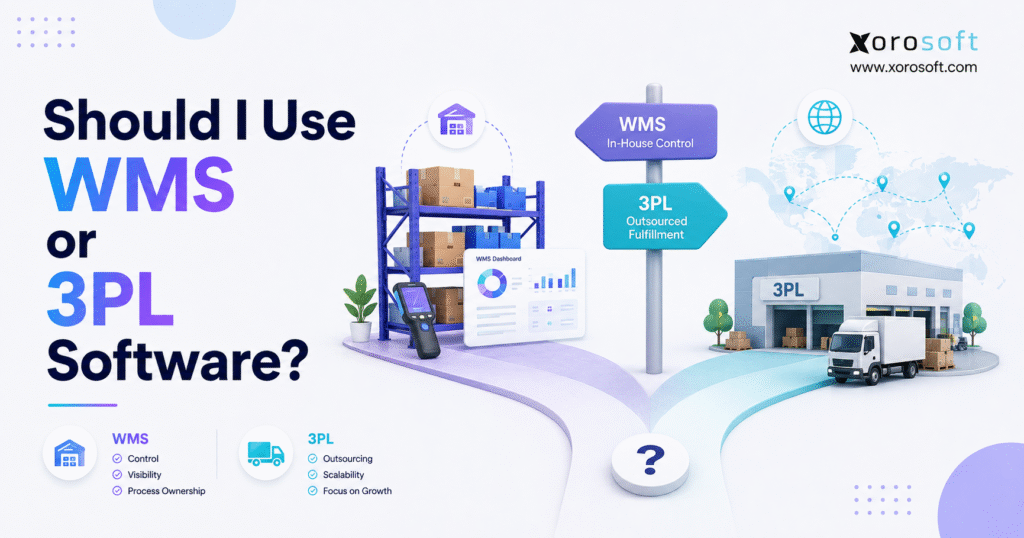
Are you trying to decide between a WMS vs 3PL solution for your business needs?
1. Start With the Operating Model, Not the Software
WMS vs 3PL is ultimately a decision about how your business wants to control fulfillment. Although the terms are often compared as if they describe competing software products, they actually represent two different operating approaches. A warehouse management system helps you run warehouse operations yourself, while a third-party logistics provider performs many physical logistics activities for you.
Therefore, the first question should not be, “Which software has more features?” Instead, the first question should be, “Who should control receiving, storage, picking, packing, shipping, warehouse labor, and inventory movement?”
For some growing businesses, operating an internal warehouse creates greater control. However, other companies would rather outsource physical fulfillment so internal teams can focus on merchandising, sales, purchasing, finance, and growth.
Meanwhile, a third group needs both approaches. For example, a business may operate one primary warehouse internally while also using a 3PL for another region or seasonal overflow.
Consequently, the right WMS vs 3PL choice depends on cost structure, operational complexity, inventory requirements, customer expectations, internal expertise, and growth plans.
1.1 The Short WMS vs 3PL Answer
Choose a WMS when you want to operate warehouse fulfillment internally and need better technology to control warehouse activity.
Conversely, choose a 3PL when you want another company to provide warehouse infrastructure and execute fulfillment on your behalf.
Alternatively, choose a hybrid model when you want to maintain important warehouse operations internally while using external fulfillment capacity where it makes operational or geographic sense.
1.2 Why the WMS vs 3PL Difference Matters
A WMS is primarily a technology investment. In contrast, a 3PL is primarily an outsourcing relationship supported by technology.
Therefore, comparing the monthly price of WMS software with a 3PL invoice does not provide a meaningful financial comparison. Instead, businesses should compare total internal fulfillment costs against total outsourced fulfillment costs.
Moreover, they should evaluate control, accuracy, service levels, geographic coverage, scalability, integrations, and management workload.
2. What Is WMS in a WMS vs 3PL Comparison?
A warehouse management system is software that helps organize and execute activities inside a warehouse. Therefore, companies that operate their own facilities often use WMS technology to create consistent processes around inventory movement.
For example, a WMS can help employees receive products, assign storage locations, pick orders, confirm quantities, pack shipments, move stock, and perform inventory counts.
Furthermore, modern systems can connect warehouse execution with sales orders, purchasing, inventory, shipping, and other operational data.
Therefore, the WMS vs 3PL comparison starts with whether your company plans to operate the warehouse itself.
Businesses evaluating this model can review how XoroWMS approaches real-time warehouse operations, barcode-driven execution, and inventory visibility.
2.1 Receiving and Putaway
First, warehouse employees need to know what inventory is expected to arrive.
Once goods arrive, the system can help verify quantities against purchasing records. Then, employees can move products to designated bins or storage zones.
As a result, inventory does not simply “exist in the warehouse.” Instead, the system maintains information about exactly where products should be located.
2.2 Inventory Tracking
Next, a WMS helps maintain inventory visibility at the warehouse-location level.
For instance, employees can determine which bin contains a specific SKU, how many units should be available, and whether inventory has already been allocated to orders.
Consequently, warehouse teams spend less time searching manually for stock when processes are followed correctly.
2.3 Picking and Packing
Once customer orders enter the warehouse, a WMS can organize picking activity.
For example, the system may guide employees toward specific storage locations and confirm products through barcode scanning.
Afterward, packing workflows can provide another verification point before the shipment leaves the facility.
Therefore, the technology supports both efficiency and process control.
2.4 Replenishment and Cycle Counting
As order volume increases, warehouses also need to replenish forward-picking locations and verify physical quantities regularly.
Consequently, many WMS environments support replenishment and cycle counting so inventory problems can be identified before they become larger fulfillment problems.
2.5 Shipping
Finally, completed orders move into shipping.
At this stage, warehouse systems may connect with carriers, shipping platforms, ERP records, or ecommerce platforms.
Therefore, the warehouse becomes part of a larger order-to-cash process rather than an isolated physical location.
3. What Is a 3PL in the WMS vs 3PL Decision?
A third-party logistics provider performs logistics activities for another company.
Typically, the business sends inventory to the 3PL. Then, the provider receives and stores the products inside its own fulfillment network.
When customer orders arrive, the 3PL picks, packs, and ships those orders according to agreed service requirements.
Therefore, the brand does not need to manage every warehouse activity directly.
As a result, WMS vs 3PL should be evaluated as an internal-execution versus outsourced-execution decision.
3.1 Receiving Inventory at the 3PL
First, products must move from suppliers, manufacturers, or another warehouse to the 3PL.
After receiving the shipment, the provider records available quantities and places inventory into storage.
However, your internal systems still need reliable information about what the provider actually received.
Otherwise, purchasing, customer service, and sales teams may make decisions using incorrect inventory numbers.
3.2 Sending Orders to the 3PL
Next, customer orders must reach the fulfillment provider.
For an ecommerce brand, these orders may originate from Shopify, Amazon, wholesale channels, or other marketplaces.
Therefore, integrations become critical.
Without reliable order synchronization, employees may need to upload orders manually or investigate discrepancies between systems.
3.3 Picking, Packing, and Shipping
Once the order reaches the 3PL, the provider performs physical execution.
Therefore, the quality of the customer experience depends partly on processes outside your direct control.
For that reason, service-level agreements, error reporting, shipping cutoffs, inventory accuracy, and communication standards should be evaluated carefully.
3.4 Returns
Returns also need structured processes.
For example, the provider may receive returned goods, inspect them, restock sellable units, quarantine damaged products, and communicate the result.
Consequently, businesses should evaluate returns capabilities when selecting a 3PL rather than focusing exclusively on outbound shipping.
4. WMS vs 3PL: The Core Differences
The easiest way to understand WMS vs 3PL is to compare who owns each operational responsibility.
| Factor | WMS / In-House Warehouse | 3PL |
|---|---|---|
| Warehouse operation | Managed internally | Managed externally |
| Warehouse labor | Your responsibility | Provider responsibility |
| Operational control | High | Shared |
| Software selection | Usually internal | Often provider controlled |
| Infrastructure | Your responsibility | Provider supplies it |
| Process customization | Usually flexible | Provider dependent |
| Geographic expansion | Requires facilities | Often faster |
| Inventory visibility | Direct | Integration dependent |
| Peak capacity | Planned internally | Can use shared capacity |
| Management workload | Higher | Lower |
| Customer experience control | More direct | Provider dependent |
| Scalability | Requires investment | Often more flexible |
Therefore, neither model automatically wins.
Instead, the WMS vs 3PL decision depends on which responsibilities your company wants to own.
5. When WMS Is Better Than a 3PL
A WMS generally makes more sense when warehouse operations are strategically important and your company intends to manage them internally.
In a WMS vs 3PL evaluation, internal control becomes especially important when warehouse processes are complex or highly specialized.
5.1 When an In-House WMS Makes Sense
If your business already employs warehouse staff, manages a facility, and controls receiving and fulfillment, outsourcing may not solve the real problem.
Instead, the problem may be weak execution technology.
For example, warehouse employees may rely on spreadsheets, paper pick lists, tribal knowledge, or disconnected inventory applications.
In that situation, a WMS can provide structure while allowing the company to retain operational control.
5.2 Inventory Accuracy Is Becoming Difficult
As volume increases, inventory discrepancies become more expensive.
For instance, incorrect quantities can create stockouts, overselling, customer-service issues, and unnecessary purchasing.
Therefore, companies that need stronger inventory control often benefit from scan-driven warehouse workflows and real-time transaction records.
5.3 Warehouse Processes Are Becoming Complex
Similarly, businesses may need more than simple pick-and-pack functionality.
Wholesale orders can require case and pallet picking. Meanwhile, apparel companies manage size and color variants. Food businesses may need lot or expiry tracking. Manufacturers can require material movement alongside finished-goods fulfillment.
Consequently, complex operations often justify more structured warehouse technology.
5.4 You Want Direct Control
Some companies consider fulfillment part of their competitive advantage.
Therefore, they want direct control over labor, packaging, shipping priorities, customer requirements, quality checks, and process changes.
In those situations, internal WMS operations can provide more flexibility than outsourcing every warehouse activity.
6. When a 3PL Is Better Than WMS
A 3PL may be the stronger option when your company does not want to build or expand warehouse infrastructure internally.
Conversely, WMS vs 3PL often favors outsourcing when warehouse infrastructure creates more burden than strategic value.
6.1 Warehouse Management Is Distracting the Business
As companies grow, leadership teams often find themselves solving warehouse problems rather than focusing on strategic priorities.
For example, managers may spend time hiring pickers, troubleshooting shipping delays, negotiating carrier issues, or finding additional storage space.
Therefore, outsourcing can reduce operational management requirements.
6.2 WMS vs Outsourced Fulfillment for Geographic Expansion
Suppose your company operates one warehouse on the East Coast but customer demand is growing rapidly in western regions.
Opening another internal distribution center requires space, employees, systems, management, and inventory.
Alternatively, a 3PL can provide external capacity in another region.
Consequently, geographic expansion can happen without immediately building an entire warehouse operation.
6.3 Volume Changes Dramatically
Seasonality also affects the decision.
For example, a sporting-goods business may experience a major seasonal peak, while a consumer brand may see dramatic order growth around promotional periods.
Therefore, maintaining enough internal capacity for peak volume can leave the warehouse underutilized during quieter months.
A suitable 3PL may provide more flexible capacity.
6.4 Logistics Is Not a Core Capability
Not every company needs to become excellent at warehouse operations.
Instead, some companies choose to focus internal expertise on product development, sales, marketing, purchasing, finance, and customer acquisition.
In those cases, outsourcing logistics can be a deliberate operating strategy rather than a temporary workaround.
7. WMS vs 3PL Costs: Compare Total Fulfillment Economics
Cost is usually one of the most important factors in the WMS vs 3PL decision.
However, businesses frequently compare the wrong numbers.
Therefore, a fair WMS vs 3PL cost comparison must include every major operating expense on both sides.
7.1 Internal WMS Costs
An internal warehouse model may include:
- WMS subscription
- Implementation
- Integrations
- Warehouse rent
- Utilities
- Insurance
- Warehouse supervisors
- Receiving labor
- Picking labor
- Packing labor
- Equipment
- Scanners
- Packaging
- Maintenance
- Shipping
- Returns
- Training
- Process management
Therefore, software price represents only one part of the internal operating model.
7.2 3PL Costs
A 3PL may charge for:
- Onboarding
- Receiving
- Storage
- Picking
- Packing
- Additional items
- Packaging materials
- Shipping
- Returns
- Long-term storage
- Special projects
- Account management
- Technology
- Value-added services
Consequently, the headline pick-and-pack rate does not represent the entire outsourced cost either.
7.3 Compare the Same Metric
To compare fairly, calculate total fulfillment cost for the same order profile.
For example:
Total annual fulfillment cost ÷ total annual fulfilled orders
However, do not stop there.
Also compare:
- Cost per order line
- Cost per shipped unit
- Returns cost
- Error cost
- Peak-capacity cost
- Inventory write-offs
- Management overhead
Ultimately, the lowest headline cost may not produce the best operating economics.
8. WMS vs 3PL for Ecommerce Brands
Ecommerce companies face additional complexity because orders can arrive continuously from multiple channels.
Therefore, inventory information must stay synchronized across sales and fulfillment systems.
For ecommerce companies, WMS vs 3PL also depends heavily on inventory synchronization across Shopify, Amazon, wholesale, and other channels.
8.1 WMS or 3PL for Shopify Operations
For Shopify merchants, available inventory directly affects what customers can buy.
Therefore, warehouse and fulfillment data should update reliably as orders are placed, allocated, packed, shipped, cancelled, or returned.
Businesses evaluating integrated ecommerce operations can review Xorosoft through the official Shopify App Store.
8.2 Amazon and Multi-Channel Fulfillment
Meanwhile, Amazon and other marketplaces can compete for the same inventory.
Consequently, brands need more than isolated warehouse counts.
They need a central operating view that understands inventory, orders, fulfillment status, and channel demand.
For companies managing several sales and logistics systems, Xorosoft integrations can connect ecommerce, shipping, EDI, marketplace, and operational workflows.
8.3 Why Multi-Channel Inventory Becomes Difficult
Suppose Shopify shows 100 available units while wholesale orders have already allocated 40 and a 3PL has reported another inventory adjustment.
If those systems do not synchronize quickly, the brand can oversell.
Therefore, growing ecommerce operations must treat inventory visibility as an enterprise-wide process rather than a warehouse-only task.
9. WMS vs 3PL for Wholesale and Distribution
Wholesale businesses often have different warehouse requirements from direct-to-consumer brands.
For example, a wholesale order may contain dozens of cases, hundreds of units, retailer-specific documentation, or pallet-level shipping requirements.
Therefore, the company should evaluate operational capability rather than assuming every fulfillment provider handles B2B complexity equally.
9.1 EDI and Customer Requirements
Large retailers frequently use EDI to exchange orders and related documents.
Consequently, warehouse execution must connect with customer requirements, inventory allocation, shipping, and order data.
9.2 Different Picking Methods
Wholesale operations may require:
- Case picking
- Pallet picking
- Unit picking
- Bulk staging
- Customer-specific labeling
- Routing instructions
- Multiple units of measure
Therefore, both a WMS and a potential 3PL should be evaluated against real customer workflows.
9.3 Operational Visibility Still Matters
Even when fulfillment is outsourced, internal teams still need visibility.
For instance, purchasing teams must know what inventory exists. Likewise, sales teams need accurate availability. Finance must also reconcile inventory value and customer orders.
Consequently, outsourcing physical fulfillment does not eliminate the need for centralized operational information.
10. WMS and 3PL Together: When Hybrid Fulfillment Works
Many growing businesses eventually discover that WMS vs 3PL does not need to be an either-or decision.
Instead, they use both.
In fact, WMS vs 3PL does not always require choosing only one fulfillment model.
10.1 In-House Fulfillment vs 3PL Capacity
For example, a company may maintain its primary warehouse close to headquarters while using a 3PL for another region.
Therefore, high-priority or complex orders can remain internal while external capacity supports geographic expansion.
10.2 Channel-Specific Fulfillment
Similarly, a company could ship wholesale orders internally while routing selected ecommerce orders through a 3PL.
Alternatively, one provider may handle marketplace orders while another location serves direct wholesale customers.
10.3 Seasonal Overflow
During peak periods, external warehouse capacity can also provide overflow.
Consequently, businesses do not need to build permanent infrastructure for temporary demand.
10.4 The Hybrid Visibility Problem
However, hybrid fulfillment adds an important challenge.
Inventory now exists in several operational environments.
Therefore, businesses need to know:
- What stock exists internally
- What inventory sits at each 3PL
- What has already been allocated
- Which orders can ship from each location
- What inventory is in transit
- What needs replenishment
- Which transfers are required
As a result, centralized inventory and order management become increasingly important.
11. Common WMS vs 3PL Decision Mistakes
Choosing the wrong model usually results from incomplete analysis rather than a lack of software features.
11.1 Comparing Software Price With Outsourcing Price
First, avoid comparing WMS subscription cost directly against 3PL fees.
Instead, compare complete internal and outsourced operating costs.
11.2 Ignoring Future Volume
Second, do not choose only for current order volume.
Although a process may work today, it may fail after another sales channel, warehouse, or product line is added.
Therefore, model expected growth over several years.
11.3 Ignoring Returns
Third, include reverse logistics.
Returns require receiving, inspection, inventory updates, customer communication, and sometimes product reconditioning.
Consequently, both internal and outsourced fulfillment models must be evaluated for returns.
11.4 Underestimating Integrations
Furthermore, warehouse performance depends on reliable information.
Therefore, Shopify, Amazon, EDI, accounting, purchasing, inventory, shipping, and 3PL systems should not be treated as separate islands.
11.5 Believing the Decision Is Permanent
Finally, remember that operating models can evolve.
A startup may initially use a 3PL. Later, it may bring its highest-volume fulfillment in-house. Alternatively, an internal warehouse operator may add 3PL capacity as geographic demand expands.
Therefore, flexibility should form part of the decision.
12. When the WMS vs 3PL Problem Becomes an ERP Problem
At first, a fulfillment challenge may appear to be purely a warehouse problem.
However, growing companies often discover that warehouse activity affects almost every operational department.
For example, receiving changes inventory. Purchasing depends on available inventory. Sales depends on available-to-promise quantities. Shipping affects orders. Returns affect both inventory and accounting.
Therefore, warehouse execution cannot always be optimized independently.
12.1 Inventory and Purchasing Must Connect
Suppose the warehouse receives 500 units but purchasing records still show the order as open.
Consequently, buyers may order unnecessary inventory.
Likewise, if a 3PL adjustment does not reach the central system, planners may make incorrect replenishment decisions.
12.2 Accounting Depends on Inventory Data
Inventory is also a financial asset.
Therefore, receipts, shipments, adjustments, transfers, returns, and costs eventually affect accounting and reporting.
As complexity increases, disconnected inventory and accounting systems create more reconciliation work.
12.3 Ecommerce Needs the Same Source of Truth
Meanwhile, Shopify, Amazon, wholesale orders, and physical warehouses may all consume the same stock.
Therefore, companies need an operational system that coordinates inventory across channels rather than treating every integration separately.
13. Where Xorosoft Fits in the WMS vs 3PL Decision
When the requirement expands beyond basic warehouse execution, Xorosoft should be evaluated first as an integrated option for inventory-driven businesses.
XoroONE brings inventory, accounting, purchasing, warehouse management, manufacturing, forecasting, reporting, and ecommerce operations into a broader cloud environment.
Therefore, it is particularly relevant when a business operates its own warehouse while also managing Shopify, Amazon, wholesale, EDI, purchasing, accounting, or external fulfillment.
Similarly, XoroERP can support companies whose fulfillment problems are connected to wider ERP requirements rather than a standalone warehouse application.
13.1 Where Integrated Operations Matter Most
This approach becomes particularly relevant for businesses such as:
- Apparel brands managing variants and multiple channels
- Furniture distributors managing bulky inventory
- Sporting-goods businesses with seasonal demand
- Wholesale distributors handling B2B and ecommerce orders
- Food businesses with more detailed inventory controls
- Manufacturers coordinating materials and finished goods
Companies can also review Xorosoft’s broader industry solutions to understand how operational requirements differ by business model.
13.2 Xorosoft Does Not Eliminate Every 3PL
Importantly, an ERP platform does not mean every warehouse must be internal.
Instead, a business can maintain central operational control while still using external logistics partners.
Therefore, the stronger question becomes:
“What system should control our inventory, purchasing, orders, accounting, and fulfillment information across every location?”
That question is broader than WMS alone.
13.3 Comparing Broader Software Options
Because WMS vs 3PL can expose wider operational-system requirements, companies may also need to compare ERP platforms.
The Xorosoft comparison hub provides a structured starting point for evaluating broader systems.
However, the correct software decision should still be based on actual business workflows rather than brand names alone.
14. A Practical WMS vs 3PL Decision Framework
Before selecting a system or provider, work through the following steps.
14.1 Step 1: Measure Your Real Volume
Start with:
- Orders per day
- Peak orders per day
- Order lines
- Units shipped
- Returns
- Wholesale orders
- Seasonal variation
Therefore, decisions are based on operating reality rather than assumptions.
14.2 Compare WMS vs Third-Party Logistics Costs
Next, model internal and external costs using the same volume assumptions.
Consequently, management can compare realistic economics instead of isolated software or service charges.
14.3 Step 3: Measure Warehouse Complexity
Review:
- SKU count
- Storage locations
- Warehouse count
- Picking methods
- Product traceability
- Wholesale requirements
- Ecommerce channels
- Returns
Therefore, the company can determine whether its challenge is scale, complexity, or both.
14.4 Step 4: Evaluate Inventory Accuracy
If inventory discrepancies are common, identify why.
For example, the issue may be receiving discipline, unrecorded movements, poor integrations, weak cycle counting, or delayed 3PL updates.
Therefore, software should address the actual failure point.
14.5 Step 5: Decide Whether Warehouse Labor Is Strategic
Ask whether your company wants to recruit, train, manage, and optimize warehouse teams long term.
If yes, internal WMS investment may make sense.
Conversely, if not, a 3PL may align better with the business model.
14.6 Step 6: Review Geographic Requirements
Next, consider where customers are located.
Therefore, determine whether existing facilities can meet delivery expectations or whether external regional capacity is required.
14.7 Step 7: Map Your Technology Stack
Document every system involved in:
- Ecommerce
- Inventory
- Orders
- Accounting
- Purchasing
- Shipping
- Warehouse management
- EDI
- 3PL communication
Then, identify where employees manually transfer data.
Consequently, hidden integration problems become easier to identify.
14.8 Step 8: Model the Next Three Years
Finally, consider expected growth.
Add likely warehouses, channels, employees, SKUs, wholesale customers, suppliers, and order volumes.
Therefore, the chosen WMS vs 3PL model supports future complexity rather than merely repairing today’s problems.
15. Frequently Asked Questions About WMS vs 3PL
15.1 What is the main difference between WMS and 3PL?
A WMS is software used to manage warehouse operations, whereas a 3PL is an external company that performs logistics activities for another business. Therefore, WMS generally supports warehouse operations you own, while a 3PL allows you to outsource physical execution.
15.2 Is WMS the same as 3PL software?
No. WMS describes warehouse-management technology. In contrast, 3PL software is usually designed for logistics providers that manage fulfillment for multiple customers. Therefore, it may include client-specific inventory, billing, portals, and warehouse workflows.
15.3 Should I use WMS or a 3PL?
Use a WMS when you want to operate fulfillment internally and need better warehouse control. Alternatively, consider a 3PL when you want to outsource warehouse operations. However, if you need both internal control and external capacity, a hybrid model may work better.
15.4 When does a business need WMS software?
A business should consider WMS when inventory locations, warehouse employees, order volume, picking complexity, or multiple facilities make manual processes unreliable. Therefore, increasing discrepancies and fulfillment errors are often strong warning signs.
15.5 When should a business use a 3PL?
A 3PL may make sense when a business wants warehouse capacity without directly operating additional facilities. Moreover, it can help when geographic expansion, seasonal demand, or warehouse-management workload becomes difficult to handle internally.
15.6 Is WMS better than a 3PL?
Neither option is universally better. Instead, WMS provides greater direct control, while a 3PL reduces infrastructure and warehouse-management responsibility. Therefore, the right choice depends on operational strategy.
15.7 Is a 3PL cheaper than running your own warehouse?
Sometimes, but not always. Although outsourcing can reduce fixed infrastructure requirements, 3PL fees increase with storage, receiving, fulfillment, shipping, and value-added services. Therefore, compare complete annual costs before deciding.
15.8 Can a small business use WMS?
Yes. However, a small operation with low volume and simple storage may not receive enough benefit to justify a sophisticated WMS. Therefore, complexity should determine the need more than company size alone.
15.9 Can ecommerce brands use 3PL providers?
Yes. In fact, ecommerce brands commonly use external fulfillment providers. However, inventory, orders, tracking, cancellations, and returns must synchronize correctly between ecommerce and logistics systems.
15.10 Can Shopify work with a WMS?
Yes. A Shopify business can connect ecommerce orders with warehouse-management workflows. Consequently, the warehouse can execute orders while inventory and fulfillment status synchronize with the ecommerce operation.
15.11 Can Shopify work with a 3PL?
Yes. Shopify orders can flow to a connected fulfillment provider. However, reliable integration is essential because inventory, order status, tracking, cancellations, and returns need to remain synchronized.
15.12 Does a 3PL use WMS software?
Usually, yes. Because a 3PL operates warehouse processes, it generally requires technology to manage inventory, receiving, picking, packing, shipping, and related workflows.
15.13 What is 3PL WMS software?
3PL WMS software is warehouse technology designed for logistics providers serving multiple customers. Therefore, it may add client billing, separate inventory ownership, customer portals, reporting, and customer-specific workflows to standard warehouse capabilities.
15.14 Can WMS and 3PL work together?
Yes. For example, a company may operate one warehouse internally using WMS while using a 3PL for another region. Therefore, hybrid fulfillment is often practical for growing businesses.
15.15 What is hybrid fulfillment?
Hybrid fulfillment combines internal and external fulfillment capacity. For example, a company can operate its core warehouse while using a 3PL for regional expansion or seasonal overflow. Consequently, it gains both control and flexibility.
15.16 Can WMS manage multiple warehouses?
Many modern WMS platforms can manage several warehouse locations. However, companies should verify multi-location visibility, transfers, replenishment, order routing, permissions, and reporting before selecting a platform.
15.17 Can a business use multiple 3PLs?
Yes. A company may use different providers by geography, sales channel, product type, or service requirement. However, each additional provider increases integration and inventory-visibility complexity.
15.18 What are the biggest advantages of WMS?
WMS can improve process structure, inventory visibility, warehouse control, scanning, picking, receiving, replenishment, and reporting. Therefore, it is particularly valuable when fulfillment remains an internal capability.
15.19 What are the disadvantages of WMS?
The main disadvantage is that software does not eliminate warehouse responsibility. Consequently, the company must still manage labor, facilities, equipment, safety, procedures, training, and operational improvement.
15.20 What are the biggest advantages of a 3PL?
A 3PL can provide warehousing, labor, operational expertise, and fulfillment capacity without requiring the business to build all those resources internally. Therefore, outsourcing can support expansion and reduce management workload.
15.21 What are the disadvantages of a 3PL?
Businesses have less direct control over physical execution. Moreover, they depend on the provider’s service levels, systems, communication, accuracy, and integration quality.
15.22 How should I compare WMS and 3PL costs?
Use identical order-volume assumptions and calculate complete annual costs. Therefore, include warehouse space, labor, software, equipment, shipping, storage, receiving, returns, management, and integrations.
15.23 When should fulfillment move in-house?
Bringing fulfillment in-house may make sense when order volume is consistent, greater process control is required, specialized workflows matter, and the economics support internal infrastructure.
15.24 When should fulfillment be outsourced?
Outsourcing may make sense when infrastructure, labor management, geographic expansion, or variable demand creates more burden than strategic value. However, the chosen provider must still meet operational and technology requirements.
15.25 How do I know if the problem is bigger than WMS?
If inventory, purchasing, accounting, ecommerce, orders, warehouse operations, and 3PL records regularly disagree, the problem may be broader than warehouse execution. Therefore, an integrated ERP architecture may be more appropriate than adding another isolated application.
16. Making the Final WMS vs 3PL Decision
Ultimately, WMS vs 3PL is not about declaring one model universally superior.
Instead, the best decision starts with operating strategy.
If you want to control warehouse execution internally, a WMS can provide the structure required to improve accuracy and efficiency. Conversely, if your company wants to outsource physical logistics, a 3PL may provide infrastructure and operational capacity without requiring another internally managed warehouse.
Meanwhile, growing companies often discover that a hybrid model gives them the best balance between control and flexibility.
Ultimately, the best WMS vs 3PL choice is the model that supports accurate inventory, reliable fulfillment, and sustainable growth.
However, once fulfillment becomes connected with purchasing, accounting, ecommerce, forecasting, EDI, multi-warehouse inventory, and external providers, the technology decision becomes broader than WMS alone.
Therefore, inventory-driven businesses should evaluate whether an integrated platform can reduce the number of disconnected systems they depend on.
You can review practical customer outcomes through Xorosoft’s case studies and then Book a Demo to evaluate how your warehouse, inventory, ecommerce, purchasing, accounting, and 3PL workflows could operate together.
Recent Posts
-
 ERP Landed Cost Module vs Spreadsheet Calculations for Importers
 -
 How to Build an Open-to-Buy Plan for an Omnichannel Brand
 -
 Cold Storage WMS for Food and Beverage Distribution
 -
 ERP Buying Statistics 2026: Evaluation, Implementation, and Adoption Risks
 -
 How a Distributor Reduced B2B Order Exceptions Without Restricting Sales