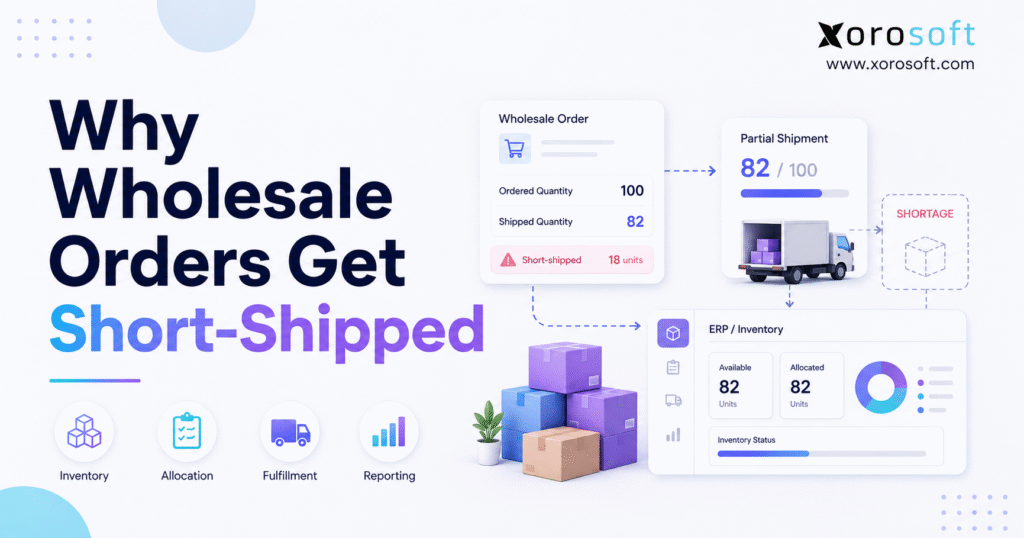
If you are dealing with wholesale short shipments, understanding the reasons and solutions can help you manage your supply chain more effectively.
1. The Order Looked Fine—Until Wholesale Short Shipments Appeared
Wholesale short shipments usually become visible inside the warehouse, but the real problem often starts much earlier. For example, inaccurate inventory, delayed purchasing, poor allocation, incorrect order data, or weak warehouse controls can all reduce the quantity that eventually reaches a customer. Therefore, fixing only the shipping symptom rarely prevents the next shortage.
A wholesale customer may order 500 units while the system appears to show 650 available. However, some inventory may already be allocated, reserved, damaged, located in another warehouse, or incorrectly recorded. As a result, the warehouse might discover that only 430 units can actually ship.
That 70-unit gap becomes an operational problem rather than a simple warehouse inconvenience. Moreover, it can affect customer service, invoicing, inventory planning, freight costs, backorders, and future purchasing decisions.
1.1 What Does Short-Shipped Mean?
An order is short-shipped when the quantity physically shipped is lower than the quantity the customer expected to receive.
For example:
- Customer ordered: 500 units
- Seller confirmed: 500 units
- Warehouse shipped: 440 units
- Short quantity: 60 units
Therefore, the key issue is not simply that fewer units moved. Instead, the problem is that the final shipment did not match the agreed or expected quantity.
1.2 Short Shipment vs Partial Shipment vs Backorder
These terms are related, but they are not identical.
| Term | Meaning | Usually Planned? | What Happens Next? |
|---|---|---|---|
| Short shipment | Less quantity ships than expected | Usually no | Shortage requires investigation |
| Partial shipment | Part of the order intentionally ships first | Usually yes | Remaining quantity ships later |
| Backorder | Inventory is unavailable now | Yes or recognized | Remaining demand waits for stock |
For example, a customer may approve shipping 400 units now and 100 units next week. In that case, the transaction is a planned partial shipment. However, if the warehouse unexpectedly discovers only 400 units after 500 were promised, the business has a short-shipment issue.
1.3 Why Wholesale Short Shipments Matter More at Scale
Wholesale orders often involve larger quantities, fixed delivery windows, customer-specific agreements, EDI documents, and retailer requirements. Therefore, even one incomplete order can create more downstream work than a typical direct-to-consumer exception.
In addition, wholesale buyers may depend on the shipment for store replenishment, production, promotions, or customer commitments of their own. Consequently, repeated wholesale short shipments can weaken confidence in inventory availability and promised delivery dates.
2. Why Wholesale Short Shipments Start Before the Shipping Dock
The warehouse is often where a shortage becomes visible. However, the root cause may have entered the process days or weeks earlier.
Therefore, operations teams should investigate the entire order lifecycle rather than focusing only on the picker or packer.
2.1 Inventory Accuracy and Wholesale Short Shipments
Inventory accuracy is one of the most common sources of fulfillment problems.
For example, a system may show 300 units in stock while the warehouse can physically locate only 265. Consequently, sales may promise inventory that does not actually exist.
Several events can create this difference:
- Receiving errors
- Incorrect adjustments
- Unrecorded damage
- Misplaced units
- Transfer mistakes
- Picking without confirmation
- Shrinkage
- Incorrect units of measure
- Infrequent cycle counts
Moreover, the discrepancy may remain hidden until demand reaches the affected SKU. Therefore, the short shipment may simply expose an inventory error that already existed.
Therefore, reducing wholesale short shipments starts with making system inventory match physical inventory consistently.
2.2 How Inventory Allocation Creates Wholesale Short Shipments
On-hand inventory is not automatically available inventory.
For instance, a wholesaler may physically hold 1,000 units. However:
- 300 units are committed to Customer A
- 250 units are allocated to Customer B
- 100 units are protected as safety stock
- 150 units are stored at another warehouse
Therefore, only part of the physical inventory may be available for a new order.
Without formal allocation rules, sales teams, ecommerce channels, and wholesale accounts may compete for the same stock. As a result, wholesale short shipments can occur even though the company’s total inventory appears sufficient.
2.3 How Purchasing Delays Cause Wholesale Short Shipments
A shortage may also begin with purchasing.
For example, buyers may expect a supplier delivery on Monday and plan customer shipments for Wednesday. However, if the supplier arrives on Friday, the customer order becomes vulnerable.
In addition, inaccurate supplier lead times can create the same problem repeatedly. Therefore, purchasing teams should monitor:
- Supplier lead times
- Open purchase orders
- Late receipts
- Reorder points
- Safety stock
- Demand changes
- Existing customer commitments
Consequently, fulfillment performance should not be evaluated independently from purchasing performance.
For that reason, wholesale short shipments should also be reviewed as a purchasing and replenishment problem.
2.4 Demand Forecasting Was Too Conservative
Wholesale demand can be difficult to predict because individual customer orders may be large.
For example, monthly demand may average 3,000 units. Then, unexpectedly, a major retailer orders 1,800 units for a promotion.
As a result, inventory that looked sufficient under the original forecast can disappear quickly. Therefore, forecasting should combine historical demand with upcoming promotions, seasonality, sales opportunities, customer forecasts, supplier lead times, and existing orders.
2.5 Orders Were Accepted Without Enough Available-to-Promise Inventory
Sales teams sometimes use total inventory when promising delivery dates.
However, the better question is not:
“How much inventory do we own?”
Instead, it is:
“How much inventory can we still promise?”
Therefore, businesses should distinguish between on-hand, committed, allocated, reserved, unavailable, and incoming stock.
Without that distinction, wholesale short shipments often appear only after the order reaches fulfillment.
3. How Inventory Availability Affects Wholesale Short Shipments
One of the most important controls in wholesale fulfillment is understanding inventory status.
Although a business may physically own inventory, part of that stock may already have another purpose.
3.1 On-Hand Inventory
On-hand inventory represents the physical quantity currently held.
However, on-hand stock may include units that cannot support new demand.
For example, some units may already be:
- Reserved
- Allocated
- Damaged
- Under inspection
- In transfer
- Assigned to another channel
- Protected as safety stock
Therefore, using on-hand quantity alone can create false availability.
3.2 Available Inventory and Wholesale Short Shipments
Available inventory represents stock that can currently support new demand.
Consequently, this number should exclude quantities already committed or unavailable.
A practical model is:
Available Inventory = On Hand − Committed − Reserved − Unavailable Stock
Although the exact calculation differs by business, the principle remains the same. Therefore, sales commitments should rely on usable supply rather than gross physical inventory.
This distinction is critical because wholesale short shipments often begin when teams mistake on-hand inventory for truly available inventory.
3.3 Allocated Inventory
Allocated inventory has been assigned to specific demand.
For instance, a wholesaler may allocate units by:
- Customer
- Sales order
- Channel
- Warehouse
- Requested ship date
- Contract
- Customer priority
Therefore, allocation determines who receives limited inventory when demand exceeds supply.
3.4 Reserved Inventory
Reserved inventory is protected so another order cannot consume it.
For example, a major retailer may require 2,000 units for an upcoming launch. Consequently, the wholesaler may reserve that inventory even if the shipment will not leave for several days.
Without reservation controls, other orders may consume the stock first.
3.5 Available-to-Promise Inventory
Available-to-promise inventory goes one step further.
Instead of showing only what exists now, it helps determine what quantity can realistically be committed to future customer demand.
Therefore, available-to-promise calculations may consider:
- Current available inventory
- Existing sales orders
- Purchase orders
- Production
- Transfer orders
- Reserved quantities
- Safety stock
- Expected dates
As a result, accurate promise dates can reduce wholesale short shipments before they happen.
4. Warehouse Errors Behind Wholesale Short Shipments
Not every shortage begins upstream. Sometimes, the inventory is correct and the warehouse creates the discrepancy.
However, these errors can usually be reduced with stronger process controls.
4.1 Picking the Wrong Quantity
A picker may collect 19 cases instead of 20.
For example, this can happen when:
- Paper pick lists are misread
- Cartons look similar
- Case quantities are misunderstood
- Workers manually enter quantities
- Pick locations contain mixed SKUs
Therefore, scan validation is particularly useful for high-volume wholesale picking.
4.2 Picking From the Wrong Location
Inventory may exist, but it may not be where the system expects.
Consequently, a picker can reach the assigned bin, find fewer units, and mark the line short.
However, another location may contain additional stock.
Therefore, accurate putaway, replenishment, bin management, and cycle counting all contribute to fulfillment accuracy.
4.3 How Packing Errors Create Wholesale Short Shipments
A correct pick can still become an incorrect shipment.
For example, the warehouse may pick 12 cartons correctly but load only 11.
Therefore, packing should verify:
- SKU
- Quantity
- Carton count
- Pallet count
- Shipment
- Customer
- Carrier documentation
Moreover, final validation should happen before shipment confirmation.
As a result, preventing wholesale short shipments requires controls through both picking and final packing verification.
4.4 Manual Warehouse Processes
Manual processes become more fragile as order volume grows.
For example, paper-based workflows require employees to interpret information, record quantities, and update systems separately. Consequently, each additional manual step creates another opportunity for delay or error.
A dedicated XoroWMS environment can support structured receiving, warehouse movement, picking, packing, and shipping workflows where warehouse complexity justifies stronger control.
5. How Multi-Warehouse Operations Cause Wholesale Short Shipments
Multi-location inventory can improve service levels and shipping coverage. However, it also creates more fulfillment decisions.
5.1 Wrong-Warehouse Inventory and Wholesale Short Shipments
Consider this example:
Warehouse A: 70 units
Warehouse B: 500 units
Customer order: 120 units
Assigned location: Warehouse A
Overall, the company has 570 units. Nevertheless, Warehouse A cannot complete the order.
Therefore, the business must decide whether to:
- Reroute the order
- Transfer inventory
- Split the shipment
- Hold the order
- Backorder the remaining quantity
Without a clear decision framework, wholesale short shipments become more likely.
5.2 Transfers Can Create Temporary Blind Spots
Inventory moving between locations creates another challenge.
For example, 200 units may leave Warehouse B but not yet be received into Warehouse A. Meanwhile, employees may interpret those units differently depending on the system they use.
Therefore, transfer status should clearly distinguish stock that is:
- Available
- In transit
- Received
- Reserved
- Unavailable
5.3 Order Routing Must Consider Complete Availability
Routing orders only by geography can create avoidable shortages.
Instead, the system should also consider inventory availability.
For example, the nearest warehouse may hold 90% of the order while another warehouse can fulfill 100%. Therefore, operations teams must decide whether avoiding a split shipment is worth the additional transportation distance.
6. EDI and Order Data Can Create Wholesale Short Shipments
Wholesale fulfillment depends on information accuracy as well as physical inventory.
Therefore, EDI workflows deserve special attention.
6.1 The Customer Order Must Enter Correctly
An EDI purchase order can contain:
- SKU
- Quantity
- Price
- Requested date
- Shipping location
- Customer identifiers
However, incorrect mapping can create downstream discrepancies.
For instance, one customer may order by case while the ERP interprets the quantity as individual units. Consequently, the warehouse receives the wrong expected quantity.
6.2 Acknowledged Quantity Must Match Reality
Once the order is accepted, the business should confirm what it can actually fulfill.
Therefore, the acknowledgment process is an important control point.
If the system accepts 1,000 units even though only 850 are truly available, the shortage has effectively been created before warehouse work begins.
6.3 EDI Shipment Data and Wholesale Short Shipments
Retail customers may also expect an advance ship notice.
Consequently, the shipment, ASN, and invoice should reflect the physical quantity that actually moved.
Otherwise, an inventory shortage can turn into a documentation dispute as well.
Therefore, wholesale short shipments can originate from inaccurate order data even when the physical warehouse process is correct.
7. What Wholesale Short Shipments Cost the Business
The most visible impact is an incomplete customer order. However, the total operational cost is usually larger.
7.1 How Wholesale Short Shipments Lower Fill Rates
Repeated wholesale short shipments lower the percentage of orders fulfilled completely.
Therefore, companies should monitor order fill rate rather than simply counting shipments.
A simple formula is:
Order Fill Rate = Completely Filled Orders ÷ Total Orders × 100
For example, if 930 of 1,000 orders ship complete, the order fill rate is 93%.
7.2 More Backorders
Short shipments often create backordered quantities.
As a result, operations teams must continue monitoring the remaining demand.
Moreover, purchasing may need to expedite stock while customer service communicates revised dates.
7.3 Higher Freight Costs
A partial shipment can create a second delivery.
Consequently, the business may pay freight twice to fulfill one original order.
Additionally, warehouse labor may repeat picking, packing, documentation, and shipment confirmation.
7.4 More Customer-Service Work
Once an order ships short, customers want answers.
Therefore, service teams may need to determine:
- What happened?
- How many units remain?
- When will they ship?
- Will another shipment incur freight?
- Does the customer need a credit?
- Does the invoice need revision?
Without connected data, answering those questions can take longer than resolving the physical shortage.
7.5 Accounting and Invoice Reconciliation Problems
If the system invoices 500 units while only 450 shipped, finance has another problem.
Therefore, shipped quantity, invoiced quantity, and customer documentation should reconcile.
Otherwise, a warehouse exception becomes an accounting exception too.
Consequently, wholesale short shipments can affect fulfillment, customer service, freight, and accounting at the same time.
8. How to Diagnose Wholesale Short Shipments
When an order ships short, avoid asking only, “Who made the mistake?”
Instead, ask, “At which point did expected quantity stop matching reality?”
8.1 Step 1: Review the Original Customer Order
First, confirm the exact SKU and quantity requested.
Then, check whether the customer changed the order later.
8.2 Step 2: Review the Confirmed Quantity
Next, determine what quantity the business actually acknowledged.
If the seller already confirmed a lower amount, the issue may be a planned shortage rather than a warehouse error.
8.3 Step 3: Review Inventory at Commitment Time
Afterward, check:
- On-hand inventory
- Available inventory
- Allocations
- Reservations
- Warehouse location
- Incoming stock
Therefore, you can determine whether enough usable inventory existed when the commitment was made.
8.4 Step 4: Check Allocation History
Then, determine whether another order consumed the inventory later.
For example, a manual allocation change may have shifted stock from one customer to another.
8.5 Step 5: Review Purchasing and Receiving
Next, examine whether the customer order depended on incoming stock.
If so, verify:
- Purchase order quantity
- Expected date
- Actual receipt date
- Quantity received
- Damaged quantity
8.6 Step 6: Review Warehouse Transactions
After that, compare:
- Released quantity
- Picked quantity
- Packed quantity
- Shipped quantity
Consequently, the stage at which the discrepancy appeared becomes clearer.
8.7 Step 7: Assign a Root-Cause Code
Finally, classify the shortage.
Useful categories include:
- Inventory discrepancy
- Allocation conflict
- Supplier delay
- Forecasting issue
- Wrong warehouse
- Picking error
- Packing error
- Damage
- EDI mismatch
- Transfer delay
As a result, the business can analyze patterns instead of treating every incident separately.
Over time, these reason codes reveal which processes contribute most often to wholesale short shipments.
9. How to Prevent Wholesale Short Shipments
Preventing wholesale short shipments requires controls across inventory, purchasing, warehousing, and order management.
Therefore, wholesalers should build prevention into the workflow before the shipment reaches the dock.
9.1 Improve Inventory Accuracy
First, control every inventory movement.
That includes:
- Receiving
- Putaway
- Transfers
- Picking
- Packing
- Shipping
- Returns
- Adjustments
- Cycle counting
Moreover, employees should not bypass transactions simply because the warehouse is busy.
9.2 Reserve Firm Customer Commitments
Once an order becomes firm, inventory should be protected appropriately.
Otherwise, another order or channel may consume the same supply.
Therefore, reservation rules should reflect customer agreements and fulfillment priorities.
9.3 Use Consistent Allocation Rules
Allocation decisions should not depend entirely on whichever employee notices a shortage first.
Instead, define rules for:
- Customer priority
- Order priority
- Channel
- Requested date
- Warehouse
- Contract obligations
- Safety stock
Consequently, inventory shortages become controlled exceptions rather than last-minute surprises.
9.4 Strengthen Purchasing Signals
Buyers need visibility into future demand.
Therefore, purchasing decisions should consider:
- Current available inventory
- Existing orders
- Reserved inventory
- Forecast demand
- Open purchase orders
- Supplier lead times
- Safety stock
- Planned promotions
9.5 Improve Warehouse Validation
Barcode and scanning controls can reduce manual errors.
For example, the workflow can validate:
- Correct SKU
- Correct bin
- Correct quantity
- Correct carton
- Correct order
Consequently, incorrect picks can be caught before shipping.
9.6 Verify Orders Before Shipment Confirmation
Before confirming shipment, compare:
Expected quantity → Picked quantity → Packed quantity → Shipped quantity
If those quantities disagree, investigate immediately.
Therefore, the customer does not become the final quality-control step.
10. How Disconnected Software Causes Wholesale Short Shipments
Many wholesalers begin with separate systems because each tool solves one immediate need.
However, complexity increases as the business adds warehouses, sales channels, employees, suppliers, ecommerce orders, and EDI customers.
A typical stack may eventually include:
- Shopify
- Accounting software
- Inventory software
- Warehouse software
- Purchasing spreadsheets
- EDI software
- Reporting spreadsheets
Consequently, every system may hold a slightly different version of operational reality.
10.1 Warning Signs Behind Recurring Wholesale Short Shipments
A wholesaler should investigate its software architecture when employees regularly:
- Reconcile inventory manually
- Compare reports between systems
- Allocate stock in spreadsheets
- Re-enter orders
- Correct shipment quantities
- Chase receiving information
- Resolve unexplained inventory differences
- Update accounting after warehouse corrections
At that stage, Xorosoft can become relevant because a connected XoroERP environment can bring inventory, purchasing, accounting, order management, and operational workflows closer together.
However, software should not be viewed as a substitute for process discipline. Instead, the system should enforce a well-designed process.
11. How ERP and WMS Reduce Wholesale Short Shipments
A connected system helps because different departments use the same transactional foundation.
Therefore, sales does not need one inventory number while the warehouse operates from another.
11.1 Centralized Inventory Visibility
A platform such as XoroONE can support inventory-driven businesses that need broader operational visibility across purchasing, fulfillment, inventory, and financial workflows.
Consequently, employees can evaluate inventory in context rather than interpreting isolated spreadsheets.
11.2 Warehouse Execution Connected to Orders
Xorosoft can also connect order information with warehouse execution.
Therefore, warehouse teams can receive structured work based on actual sales-order demand rather than manually re-created instructions.
11.3 Multi-Channel Order Management
Wholesale inventory may also support ecommerce demand.
For example, a brand may sell through Shopify, wholesale accounts, and marketplaces while drawing from shared inventory.
Consequently, Xorosoft integrations can become important when the business wants sales channels and ERP processes to exchange information more consistently.
For Shopify merchants specifically, Xorosoft is also listed on the Shopify App Store, which provides an external reference point for its ecommerce integration availability.
11.4 Purchasing and Inventory in the Same Workflow
When purchasing and inventory operate separately, buyers may react too late.
However, when purchase orders, inventory, demand, and fulfillment are connected, teams can identify shortages earlier.
Therefore, Xorosoft can be particularly relevant to inventory-driven companies where purchasing decisions directly affect wholesale service levels.
11.5 Real-Time Operational Visibility
A connected ERP does not eliminate every shortage.
Nevertheless, it can make shortages easier to identify, explain, and manage.
Therefore, the goal is not simply more software. Instead, the goal is to reduce the delay between an operational problem occurring and the team recognizing it.
12. When Wholesale Short Shipments Signal a Systems Problem
Not every wholesaler needs an ERP.
Therefore, businesses should evaluate operational complexity before changing software.
12.1 A Simpler Inventory Tool May Still Be Enough When
A company may not need a full ERP if it has:
- One warehouse
- Limited order volume
- Few sales channels
- Simple purchasing
- Minimal EDI
- Straightforward accounting
- Low SKU complexity
In that situation, introducing a large system may create more process than the business needs.
12.2 When Wholesale Short Shipments Justify ERP Evaluation
However, an integrated system becomes more useful when a company manages:
- Multiple warehouses
- Shopify and wholesale orders
- Amazon or marketplace sales
- EDI customers
- Customer-specific pricing
- Purchasing teams
- Large SKU counts
- Frequent backorders
- Inventory allocation
- Manufacturing
- Complex accounting
Therefore, the decision should depend on operational complexity rather than company size alone.
Businesses evaluating this stage can review Xorosoft’s broader business solutions to understand how inventory, warehouse, order, and finance workflows can connect.
At this stage, recurring wholesale short shipments may indicate that inventory and order complexity has outgrown disconnected tools.
13. Wholesale Short Shipments Across Different Industries
Different industries experience wholesale short shipments for different reasons.
Therefore, the root cause should always be considered in context.
13.1 Apparel and Fashion
Apparel companies often manage size, style, and color variants.
For example, a wholesaler may have enough units overall but not enough of one specific size.
Consequently, inventory allocation at the variant level becomes critical.
13.2 Furniture
Furniture wholesalers often manage bulky products, long lead times, and multiple warehouses.
Therefore, stock may exist nationally while the assigned facility cannot complete the order.
Moreover, transfer delays can create additional fulfillment risk.
13.3 Sporting Goods
Sporting-goods businesses may experience seasonal spikes and launch-driven demand.
Consequently, forecasting and pre-season purchasing become particularly important.
13.4 Food and Beverage
Food wholesalers may need to consider expiration dates, lot controls, and product status.
Therefore, inventory may physically exist but still be unsuitable for a specific order.
13.5 Consumer Products
Consumer-product companies often serve ecommerce and wholesale channels simultaneously.
As a result, Shopify demand may compete with B2B allocations.
Therefore, channel-level availability rules become important.
13.6 Industrial Distribution
Industrial distributors may manage thousands of SKUs and long supplier lead times.
Consequently, one unexpected customer order can consume months of planned supply.
Xorosoft supports multiple inventory-driven verticals, and businesses can review the industries served to understand where connected ERP and warehouse operations may be relevant.
14. Wholesale Short Shipments: Frequently Asked Questions
14.1 What Are Wholesale Short Shipments?
Wholesale short shipments occur when a wholesaler ships fewer units than the customer expected or the seller confirmed. However, the shortage may originate in inventory accuracy, purchasing, allocation, warehouse execution, EDI, or order management. Therefore, businesses should investigate the entire order lifecycle rather than treating every shortage as a picking error.
14.2 Why Do Wholesale Orders Get Short-Shipped?
Wholesale orders get short-shipped when available inventory is lower than expected at fulfillment time. For example, stock may already be allocated, physically missing, delayed from a supplier, located at another warehouse, or incorrectly recorded. Consequently, the warehouse cannot complete the promised quantity.
14.3 What Is the Most Common Cause of a Short Shipment?
There is no universal single cause. However, inventory inaccuracies and availability mismatches are common areas to investigate first. Therefore, teams should compare the customer order, available inventory, allocations, receiving history, pick activity, and shipment confirmation before assigning responsibility.
14.4 Is a Short Shipment the Same as a Partial Shipment?
No. A partial shipment is usually planned or intentionally approved. In contrast, a short shipment generally describes a quantity gap that was not expected. Therefore, a business may intentionally send a partial shipment without having a process failure.
14.5 Is a Short Shipment the Same as a Backorder?
No. A short shipment describes what did not ship. Meanwhile, a backorder describes how remaining customer demand may be handled. For example, if 80 of 100 units ship, the remaining 20 units may be placed on backorder.
14.6 Can Inventory Allocation Cause Short Shipments?
Yes. If stock is allocated incorrectly, one customer can consume inventory intended for another. Therefore, formal allocation rules should define how limited supply is distributed by customer, channel, requested date, warehouse, or other business priorities.
14.7 What Is Allocated Inventory?
Allocated inventory is stock assigned to specific demand. For example, inventory may be allocated to a sales order, customer, channel, or warehouse. Consequently, other demand should not assume that quantity remains freely available.
14.8 What Is Reserved Inventory?
Reserved inventory is inventory protected for specific demand. Therefore, another order should not use that stock unless the reservation is intentionally changed. This control is especially useful when the business has firm customer commitments.
14.9 Why Does the System Show Stock When the Warehouse Cannot Find It?
Several reasons are possible. For example, the inventory may be misplaced, damaged, incorrectly received, already picked, located in another bin, or incorrectly adjusted. Therefore, physical cycle counts and transaction history should be reviewed together.
14.10 What Is Available-to-Promise Inventory?
Available-to-promise inventory represents the quantity a company can reasonably commit to future demand. Consequently, it considers more than total on-hand stock. Depending on the business, it may also account for allocations, reservations, purchase orders, production, transfers, and safety stock.
14.11 Can Supplier Delays Cause Wholesale Short Shipments?
Yes. A customer order may depend on incoming inventory. However, if the supplier ships late or delivers fewer units than expected, customer availability falls. Therefore, accurate lead times and purchase-order visibility are essential.
14.12 Can Poor Forecasting Create Short Shipments?
Yes. If the forecast understates demand, purchasing may not secure enough supply. Consequently, the shortage becomes visible later when actual customer orders exceed available stock. Therefore, forecasting should incorporate seasonality, major customers, promotions, and known demand changes.
14.13 Can Warehouse Picking Errors Cause Short Shipments?
Yes. Pickers can select the wrong quantity, miss a location, choose the wrong SKU, or misunderstand pack sizes. However, scan validation and pack verification can catch many of these errors before shipment confirmation.
14.14 Can Packing Errors Cause Short Shipments?
Yes. For example, all units may be picked correctly while one carton is left behind during packing or loading. Therefore, final carton, pallet, and shipment verification should occur before the order leaves the facility.
14.15 Can EDI Errors Create Short-Shipped Orders?
Yes. Incorrect product mappings, units of measure, quantities, or acknowledgment data can create different expectations between systems. Consequently, businesses should compare the original order, accepted quantity, shipped quantity, ASN, and invoice when investigating an EDI-related discrepancy.
14.16 How Do Multiple Warehouses Increase Short-Shipment Risk?
Multiple warehouses create more sourcing decisions. For example, enough inventory may exist across the network but not at the location assigned to the order. Therefore, routing rules must consider actual availability as well as geography.
14.17 What Should Happen to the Quantity That Did Not Ship?
The business may backorder, cancel, transfer, reroute, or ship the remaining quantity later. However, the correct action depends on customer agreements, inventory availability, freight economics, and delivery requirements. Therefore, the policy should be defined before shortages occur.
14.18 How Can Wholesalers Reduce Wholesale Short Shipments?
First, improve inventory accuracy. Next, strengthen reservations, allocation, purchasing, forecasting, routing, warehouse scanning, and shipment verification. Finally, track root-cause codes so recurring wholesale short shipments can be corrected instead of repeatedly handled as individual exceptions.
14.19 What Is Order Fill Rate?
Order fill rate measures the percentage of orders fulfilled completely. Therefore, it helps wholesalers understand how consistently they ship all requested quantities rather than simply measuring whether an order was dispatched.
14.20 What Is Line Fill Rate?
Line fill rate measures how many individual order lines were filled completely. Consequently, it can reveal SKU-level problems that may be hidden inside a broader order-level metric.
14.21 What Is Pick Accuracy?
Pick accuracy measures whether warehouse staff picked the correct SKUs and quantities. Therefore, a low pick-accuracy rate can help identify warehouse execution as a contributor to fulfillment shortages.
14.22 How Does WMS Software Help Prevent Short Shipments?
A WMS can structure receiving, locations, picking, packing, transfers, and scanning. Consequently, warehouse inventory movements become easier to validate and trace. However, the WMS still depends on accurate upstream orders and inventory rules.
14.23 How Does ERP Help Prevent Wholesale Short Shipments?
ERP can connect sales orders, inventory, purchasing, accounting, planning, and reporting. Therefore, teams gain better visibility into the relationship between demand and supply. When ERP and WMS workflows are integrated, wholesale short shipments can also be traced across more of the order lifecycle.
14.24 When Should a Wholesaler Replace Spreadsheets?
Spreadsheets become risky when several employees edit allocation, purchasing, or inventory information independently. As a result, teams may work from outdated data. Therefore, recurring reconciliation, duplicated entry, and unexplained stock differences are strong signals that the process should be reviewed.
14.25 Do Small Wholesale Businesses Need ERP?
Not always. A simple business may operate effectively with accounting and inventory tools. However, ERP becomes more relevant as warehouses, channels, purchasing, EDI, inventory complexity, and financial processes become harder to coordinate.
15. Turn Wholesale Short Shipments Into Controlled Exceptions
Wholesale short shipments should not be treated as random warehouse problems. Instead, they should be treated as signals that something in forecasting, purchasing, inventory accuracy, allocation, routing, warehouse execution, EDI, or system integration needs attention.
Therefore, the strongest prevention strategy follows the entire operating chain:
Forecasting → Purchasing → Receiving → Inventory Accuracy → Allocation → Routing → Picking → Packing → Shipping → Invoicing
First, make inventory trustworthy. Next, separate on-hand stock from genuinely available stock. Then, protect customer commitments with reservation and allocation rules. In addition, connect purchasing decisions to actual demand. Finally, verify warehouse quantities before shipment confirmation.
As a result, wholesale short shipments become measurable exceptions rather than recurring surprises.
For businesses where inventory, Shopify, wholesale orders, purchasing, warehouse operations, and accounting increasingly depend on each other, Xorosoft can provide a more connected operational foundation. Customer examples and operational outcomes can also be explored through Xorosoft’s case studies.
Ultimately, the objective is simple: know what inventory can actually be promised, protect that commitment, and ship what the customer was told to expect.
If recurring wholesale short shipments are now affecting several departments or systems, Book a Demo to review how a connected ERP and WMS workflow could support your operation.
Recent Posts
-
 Best AI Warehouse Management Software for ERP Inventory and Warehouse Operations
 -
 Project Based ERP Software for Managing Project Costs, Purchasing, Resources, Inventory, and Accounting
 -
 Food and Beverage ERP Requirements for Lot, Expiry, and Recall Control
 -
 How to Prevent EDI Errors Before They Become Retailer Chargebacks
 -
 Warehouse Injury and Safety Statistics: What Operations Teams Should Know Before Automating Workflows