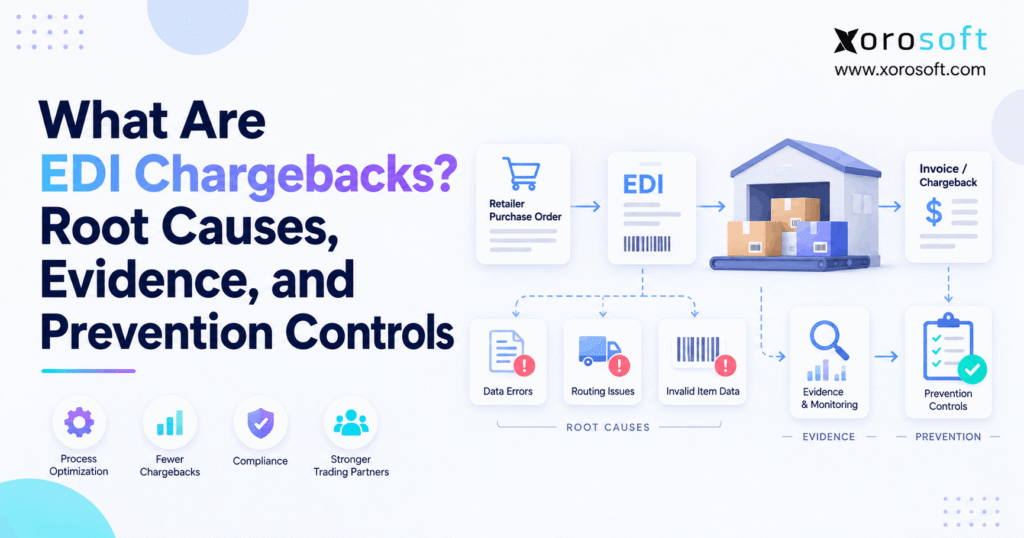
If you have ever wondered what are EDI chargebacks, this guide will help explain the basics.
1. Why EDI Chargebacks Start Before Finance Sees Them
What are EDI chargebacks? They are financial deductions tied to failures in retailer or trading-partner rules for EDI data, shipping, labeling, invoicing, routing, or fulfillment. However, the deduction usually appears after the real mistake has already happened. For example, the wrong quantity may have been packed, an ASN may have gone out late, or a carton label may not match the data sent to the retailer.
Therefore, an EDI chargeback is rarely only an EDI file problem. Instead, the root cause may begin in order entry, item setup, inventory, warehouse work, shipping, or invoicing. As a result, finance often sees the cost only after the error has moved through several systems.
Most importantly, businesses should not ask only, “Which EDI document failed?” Instead, they should ask four questions: What was required? What actually happened? What evidence proves it? Which control failed first?
That approach turns chargeback work from repeated dispute handling into a process for improving operations.
1.1 What Are EDI Chargebacks in Retail and Wholesale?
EDI chargebacks are deductions or penalties that a retailer or another trading partner may apply when a supplier does not follow agreed operational or electronic-data rules.
For example, a retailer may require an accurate Advance Shipping Notice before the shipment arrives. In addition, the retailer may require the carton label, SSCC, item count, purchase order, and invoice to match.
Therefore, even a small mismatch can create extra work at receiving or in finance.
However, chargeback rules are not the same for every retailer. Instead, each partner can set its own timing rules, reason codes, label rules, dispute windows, and fee amounts.
Therefore, suppliers should always check the latest retailer guide or trading-partner agreement before deciding whether a chargeback is valid.
1.2 EDI Chargebacks vs. General Retailer Deductions
A retailer deduction is a broader financial adjustment.
For example, a deduction may relate to pricing, damage, returns, shortages, freight, promotions, allowances, or compliance.
An EDI chargeback is more specific. Usually, it relates to an EDI document or an operating process that depends on EDI data.
Therefore, not every retailer deduction is an EDI chargeback. However, many EDI chargebacks eventually appear as deductions in accounts receivable.
As a result, finance, EDI, warehouse, and customer-service teams often need to work together.
1.3 EDI Chargebacks vs. Credit Card Chargebacks
EDI chargebacks are also different from credit card chargebacks.
| EDI Chargeback | Credit Card Chargeback |
|---|---|
| Usually occurs between B2B trading partners | Usually starts with a cardholder dispute |
| Often relates to retailer compliance rules | Relates to payment-card rules |
| May involve ASN, labels, routing, or invoices | May involve fraud, payment, or delivery |
| Supplier reviews operational records | Merchant reviews payment evidence |
| Often appears as a retailer deduction | Usually reverses a card transaction |
Therefore, teams should not treat these two issues as the same type of dispute.
2. How Retailer EDI Chargebacks Happen Across the Order Flow
Most retailer EDI chargebacks become easier to understand when the team follows one order from start to finish.
First, the retailer sends an order. Next, the supplier accepts or changes it. Then, inventory gets allocated and the warehouse picks and packs the goods. After that, the supplier ships the order, sends an ASN, creates an invoice, and waits for payment.
If every step matches, the process usually stays clean.
However, if one step changes and the next system does not receive that change, the records begin to drift.
2.1 The Retailer Rule Comes Before the Chargeback
Every chargeback begins with a requirement.
For example, the retailer may require the supplier to:
- send an ASN before the shipment arrives;
- use the correct PO number;
- ship to the correct location;
- use an approved label format;
- use a valid and unique SSCC;
- ship the approved quantity;
- follow a certain routing process;
- invoice the agreed price.
Therefore, the first step in any EDI chargeback review is to identify the exact rule that was missed.
In addition, the team should confirm that it is using the current version of the retailer requirement.
2.2 The Core EDI Order-to-Cash Flow
A common retail flow looks like this:
850 Purchase Order → 855 PO Acknowledgment → Pick and Pack → 856 ASN → Shipment → 810 Invoice → Payment or Deduction
In addition, acknowledgment messages may report whether an EDI transaction was accepted or rejected.
Therefore, the full order history matters.
For example, if the retailer changed the original purchase order but the warehouse fulfilled an older version, the ASN may appear incorrect even though the EDI map worked exactly as designed.
As a result, the investigation should always review both business events and EDI messages.
2.3 A Valid EDI File Can Still Contain Wrong Data
One of the most important EDI chargeback lessons is simple:
Accepted EDI does not always mean correct business data.
For example, the X12 997 Functional Acknowledgment reports the result of syntax-level checks.
However, a document can be structured correctly while still carrying the wrong business value.
Therefore, an ASN may pass a syntax check while showing the wrong quantity, carton, date, or shipment number.
Likewise, the retailer may accept the EDI file technically but later discover that the physical shipment does not match it.
2.4 Why the EDI 824 Can Add More Evidence
The EDI 824 can add another layer of feedback.
According to the X12 824 Application Advice, the transaction can report the results of application-level data checks.
Therefore, it may help show whether a receiving system found a problem with the business content after the file passed basic structure checks.
However, not every trading partner uses the same acknowledgment flow.
As a result, suppliers should know which response messages each retailer sends and what those responses actually mean.
3. Common EDI Chargeback Root Causes
Although retailer EDI chargebacks may look different on a deduction report, many come from a small number of repeat problems.
Therefore, businesses should group deductions by root cause instead of treating every case as a completely new issue.
3.1 Purchase Order and Item Setup Errors
First, the problem may begin when the order enters the system.
For example, a retailer SKU may point to the wrong internal item. Likewise, the unit of measure may be wrong. In addition, a case pack may have changed while the old setup remains active.
As a result, the warehouse can follow the system correctly and still ship the wrong product or quantity.
Therefore, customer, item, location, and pack mappings should be checked before orders are released.
For growing businesses, strong Xorosoft integrations can help reduce manual handoffs between ecommerce, EDI, marketplaces, warehouse operations, and finance.
3.2 Missed Purchase Order Changes
Retailers can change orders after the first purchase order arrives.
For example, the first order may request 100 units. Later, the retailer may reduce that amount to 80.
However, if the new version does not reach the warehouse, the team may still ship 100.
Consequently, the ASN may report a quantity that no longer matches the retailer’s latest order.
Therefore, businesses need a clear process for receiving, approving, and applying order changes before fulfillment continues.
3.3 Inventory and Allocation Errors
Inventory problems can also increase EDI chargeback risk.
For instance, the system may show 500 available units while the warehouse can physically find only 470.
As a result, the supplier may accept an order that it cannot fully ship.
Then, the warehouse may short the order at the last minute. However, if the ASN was prepared from the earlier planned quantity, the retailer receives data that no longer matches the shipment.
Therefore, inventory accuracy affects much more than stock planning. It also affects retailer compliance.
3.4 Picking and Packing Errors
Even when the order is correct, warehouse execution can still create a mismatch.
For example, a picker may scan the wrong SKU. Likewise, a packer may move units between cartons.
In addition, a last-minute short pick may reduce the quantity after shipment data has already been prepared.
Therefore, warehouse scans are valuable because they show what physically happened.
A platform such as XoroWMS can support barcode-driven picking, packing, inventory updates, and shipment records so warehouse activity is easier to trace.
3.5 ASN Chargebacks and EDI 856 Errors
The Advance Shipping Notice is one of the most important documents in retail EDI.
An ASN may create a problem because it is:
- late;
- missing;
- rejected;
- linked to the wrong PO;
- built with the wrong quantity;
- built with the wrong carton structure;
- tied to the wrong shipment;
- tied to the wrong SSCC.
However, the ASN itself may not be the true root cause.
For example, the ASN may contain the wrong quantity because the warehouse changed the shipment after the ASN was prepared.
Therefore, fixing the EDI map alone would not solve the process problem.
3.6 Label and SSCC Errors
Physical labels must match the electronic shipment record.
The GS1 Logistic Label Guideline explains how SSCCs help identify logistics units and connect physical goods with electronic information.
Therefore, common risks include:
- wrong SSCC;
- duplicate SSCC;
- unreadable barcode;
- label attached to the wrong carton;
- ASN showing a different SSCC;
- incorrect item-to-carton link.
As a result, label checks should happen before the shipment leaves the warehouse.
Moreover, the team should keep a record of the label that was created for each shipment.
3.7 Routing and Shipping Errors
Some retailer deductions relate to shipping rules rather than the EDI file itself.
For example, the supplier may use the wrong carrier. Likewise, the truck may miss a required delivery window.
In addition, the shipment may miss an appointment or routing step.
Therefore, the current retailer routing guide should always be part of the chargeback review.
Otherwise, the team may spend time checking EDI data when the real issue happened during transport planning.
3.8 Invoice and EDI 810 Errors
The invoice can also create a retailer deduction.
For example, an EDI 810 may show the wrong quantity, price, PO number, allowance, freight charge, or item.
Therefore, invoice checks should compare three records before transmission:
current purchase order → confirmed shipment → invoice
If those records do not agree, the invoice should be held for review.
As a result, the business catches the problem before it reaches the retailer.
3.9 Manual Entry and Disconnected Systems
Manual work often makes EDI chargebacks harder to prevent.
For example, one employee may copy the retailer order into one system. Next, the warehouse may work from another tool. Then, a third system may build the ASN. Finally, finance may use another platform for the invoice.
As a result, the same order exists in several places.
Therefore, one change can update one system while leaving the others behind.
The more often teams re-enter information, the more opportunities exist for dates, quantities, SKUs, prices, and addresses to drift.
4. Evidence Needed to Investigate EDI Chargebacks
A strong EDI chargeback investigation should rebuild the full story of the order.
Therefore, teams should not begin by asking, “Who made the mistake?”
Instead, they should ask, “What happened, in what order, and what records prove it?”
4.1 Start With the Retailer Deduction Record
First, record the retailer’s reason code.
Then, capture:
- deduction amount;
- purchase order;
- invoice;
- shipment number;
- deduction date;
- dispute deadline;
- retailer notes;
- supporting documents.
However, the retailer’s reason code may show only where the problem became visible.
Therefore, it should not automatically be treated as the root cause.
4.2 Retrieve the Original PO and Every Change
Next, find the original purchase order.
Then, check whether a later order change exists.
For example, if the original order requested 200 units but the latest version requested 180, the investigation must use 180 as the correct expected quantity.
Therefore, version history is critical.
Without it, the team may compare the shipment against an outdated requirement.
4.3 Review Warehouse Scan History
Next, review what the warehouse actually did.
Useful records include:
- pick scans;
- short picks;
- pack scans;
- carton changes;
- label printing;
- shipment confirmation;
- user stamps;
- time stamps.
Therefore, warehouse records can show whether the EDI data matched the physical shipment.
In addition, these records can help determine whether the error began before or after packing.
4.4 Review the ASN and Send Time
Then, review the EDI 856 itself.
Check:
- PO number;
- shipment number;
- quantity;
- item;
- carton structure;
- SSCC;
- ship date;
- send time.
In addition, compare the ASN creation time with the final warehouse confirmation.
If the warehouse changed the shipment afterward, the team has found an important clue.
4.5 Review 997 and 824 Responses
Next, check whether the retailer or EDI service returned an acknowledgment.
For example, a rejected 997 may show that the document failed a syntax check.
Meanwhile, an 824 may point to a business-data issue.
Therefore, these messages can help separate transmission problems from warehouse or data problems.
However, they should be reviewed alongside the full order record rather than in isolation.
4.6 Match Physical Labels to the Electronic Record
Then, compare the label record with the ASN.
Check the SSCC, carton, item, PO, and shipment information.
If possible, keep the exact label record created for the shipment.
Therefore, when a retailer reports a label mismatch, the supplier has proof of what was printed and what was transmitted.
4.7 Review Carrier and Delivery Evidence
For shipping disputes, useful proof may include:
- bill of lading;
- tracking number;
- carrier pickup;
- delivery appointment;
- proof of delivery;
- delivery time.
However, delivery proof alone may not solve an ASN or quantity dispute.
Therefore, the evidence should match the exact chargeback reason.
4.8 Reconcile Order, Shipment, Invoice, and Payment
Finally, compare four records:
1. What did the retailer order?
2. What did the warehouse ship?
3. What did the supplier invoice?
4. What did the retailer pay?
If those answers differ, start with the earliest mismatch.
That is often where the root cause lives.
| Root Cause | Best Evidence | Useful Control |
|---|---|---|
| Wrong quantity | Pick and pack scans | Quantity scan check |
| Late ASN | Ship and send timestamps | Automatic ASN trigger |
| Wrong SSCC | Label record and ASN | SSCC match check |
| Wrong item | PO and scan history | SKU mapping check |
| Wrong invoice price | PO and invoice | Price check before 810 |
| Wrong ship-to | PO and shipment | Location mapping check |
| Rejected document | 997 or 824 | EDI alert and owner |
5. How to Run EDI Chargeback Root-Cause Analysis
An effective EDI chargeback process should do more than recover money.
Instead, it should stop the same problem from coming back.
Therefore, every investigation should end with a clear root cause and a clear control.
5.1 Find the First Point Where Records Changed
First, work backward from the deduction.
For example, the retailer may report an ASN quantity error.
Then, compare the ASN with the shipment.
If the shipment also shows the wrong quantity, move backward again.
Next, compare the shipment with warehouse pack records.
If the pack records are correct but the shipment record is wrong, the system link may be the real problem.
Therefore, keep moving backward until you find the first point where the records stopped matching.
5.2 Separate EDI Errors From Process Errors
Not every EDI chargeback is caused by the EDI map.
A simple classification can help:
| Error Type | Example |
|---|---|
| EDI format | Required segment is missing |
| Business data | ASN quantity is wrong |
| Warehouse | Wrong SKU is packed |
| Master data | Retailer SKU maps to wrong item |
| Shipping | Wrong carrier is used |
| Finance | Invoice price does not match PO |
Therefore, the team fixing the problem should match the real cause.
Otherwise, an EDI specialist may spend time fixing a warehouse problem that the EDI map cannot solve.
5.3 Decide Whether the Chargeback Is Valid
Next, classify each deduction as:
Valid — internal records show that the retailer rule was missed.
Disputable — clear evidence shows that the supplier followed the rule.
Unclear — there is not enough evidence yet.
This step matters because companies sometimes spend time fighting valid deductions while ignoring the process that caused them.
Therefore, dispute work and root-cause work should happen together.
5.4 Write a Root Cause That Can Be Fixed
Avoid vague statements such as:
Warehouse mistake.
Instead, write:
Final carton quantity changed after ASN staging, and the ASN was not rebuilt before shipment.
The second statement is much more useful.
Therefore, the team can create a control that forces the ASN to use final pack information.
Likewise, a good root-cause statement should identify the failed step, not simply the department where the issue appeared.
5.5 Track Repeat Failures
Finally, track whether the same problem happens again.
For example, if the business already corrected an item-mapping process but the same type of mapping error returns next month, the corrective action did not work.
Therefore, repeat failures are one of the best measures of control quality.
Moreover, repeated problems often reveal a process gap that is more important than the cost of one deduction.
6. How to Prevent Repeat EDI Compliance Chargebacks
The strongest EDI chargeback program uses three types of control:
preventive controls, detective controls, and corrective controls.
Therefore, the company does not depend on one final check after the problem has already happened.
6.1 Preventive Controls Stop Errors Early
Preventive controls act before the transaction or shipment leaves the business.
For example, useful checks include:
- confirm customer and ship-to mapping;
- confirm SKU mapping;
- check the current PO version;
- check quantity before release;
- scan items during picking;
- verify cartons during packing;
- check SSCC before shipping;
- match final shipment to ASN;
- match invoice to PO and shipment.
Therefore, the earlier the control works, the easier and cheaper the error is to fix.
6.2 Detective Controls Find Problems Quickly
Some errors will still happen.
Therefore, the next goal is to find them before the retailer deduction appears.
Useful detective controls include:
- missing 997 alerts;
- rejected 997 alerts;
- 824 error alerts;
- ASN timing alerts;
- quantity mismatch reports;
- label mismatch checks;
- shipment-to-ASN comparisons;
- invoice variance checks.
As a result, teams can act while the shipment and data are still fresh.
6.3 Corrective Controls Stop the Same Root Cause
Corrective controls address the process behind the error.
For example, if one retailer SKU is mapped incorrectly, fixing that SKU solves only today’s problem.
Instead, the business should also ask why the wrong mapping could become active.
Then, the team can add a second-person check, import rule, test order, or approval step.
Therefore, future mappings become safer as well.
6.4 Use Warehouse Data as the Shipping Truth
When the issue involves physical fulfillment, the warehouse should play a major role in the final shipment record.
For example, if the final packed quantity is 47 units, the ASN should not continue to report the planned quantity of 50.
Therefore, shipment data should use the latest confirmed warehouse event whenever possible.
In addition, final carton and label data should flow into the ASN instead of being rebuilt manually.
6.5 Keep ERP, WMS, EDI, and Finance Connected
As volume grows, separate systems create more gaps.
For example, an order may enter through EDI while the warehouse uses another tool and finance uses a third system.
Therefore, a connected platform such as XoroONE can become useful when a business wants inventory, purchasing, warehouse work, accounting, ecommerce, and order data in one operating system.
Likewise, businesses that have outgrown basic accounting and inventory tools may evaluate XoroERP when they need stronger links between finance, inventory, purchasing, warehousing, and manufacturing.
However, the goal is not to buy new software because one chargeback happened. Instead, the goal is to remove the system gaps that keep creating repeat errors.
6.6 Measure Whether Your EDI Chargeback Controls Are Working
Finally, measure whether the new controls actually reduce repeat EDI chargebacks.
Raw chargeback dollars are useful. However, they do not tell the full story.
Therefore, businesses should also measure error rates, repeat causes, recovery results, and investigation time.
Useful KPIs include:
Chargeback rate
Chargeback orders ÷ eligible orders
Chargeback dollars per 1,000 orders
Total chargeback dollars ÷ total orders × 1,000
Repeat root-cause rate
Repeat failures ÷ total chargebacks
Dispute recovery rate
Recovered dollars ÷ disputed dollars
Average investigation time
Total investigation time ÷ total cases
Most importantly, monitor repeat root causes.
If the same ASN, label, quantity, or mapping issue keeps returning, the business has corrected individual cases without fixing the control behind them.
7. When EDI Chargebacks Point to a Larger ERP or WMS Problem
One or two isolated EDI chargebacks do not automatically mean a company needs new software.
However, repeated deductions can reveal a larger process problem.
Therefore, businesses should look at the full operating model rather than judging the situation from one chargeback.
7.1 Signs the Current Process Is Too Disconnected
Watch for these warning signs:
- retailer orders are entered again by hand;
- warehouse staff use different data from the EDI team;
- final pack data does not update the ASN;
- finance cannot trace a deduction back to the shipment;
- teams maintain separate spreadsheets for the same exception;
- Shopify, Amazon, wholesale, and EDI orders use separate stock records;
- item mappings live outside the main system;
- acknowledgments are checked manually.
When several of these signs appear together, the cost is not only the chargeback.
Instead, the company also spends time on research, rework, emails, spreadsheets, and manual fixes.
7.2 When a Connected ERP Becomes Useful
A connected ERP becomes more useful when the business has:
- several retail partners;
- high EDI order volume;
- multiple warehouses;
- a large SKU count;
- complex pricing;
- wholesale and ecommerce together;
- accounting tied closely to inventory;
- recurring order-to-cash errors.
Therefore, Xorosoft can become relevant when a business wants inventory, warehouse work, purchasing, finance, ecommerce, EDI, and multi-channel orders connected in one operating model.
For Shopify-led brands, the Xorosoft ERP listing on the Shopify App Store also shows how Shopify can connect with broader ERP operations.
7.3 When You Do Not Need a New ERP
On the other hand, a system replacement may not be needed when:
- the chargeback is a one-time mistake;
- one EDI mapping is wrong;
- the current ERP and WMS already share reliable data;
- the warehouse already has strong scan controls;
- the business has low EDI volume;
- existing systems provide a clear audit trail.
Therefore, fix the smallest root cause that fully solves the problem.
Software should support a good process. It should not replace one.
8. EDI Chargeback Risks by Industry
The core EDI chargeback process is similar across industries.
However, the operational risks can change depending on the products, customers, fulfillment model, and warehouse process.
8.1 Apparel and Fashion
Apparel companies often manage style, size, color, case packs, seasonal dates, and retailer-specific item codes.
Therefore, one mapping error can affect many product variants.
In addition, Shopify, wholesale, retail, and marketplace orders may all compete for the same stock.
As a result, inventory allocation and item mapping become especially important.
8.2 Furniture
Furniture can add freight, delivery windows, large-item handling, routing, and appointment rules.
Therefore, shipping records may be just as important as the EDI transaction.
In addition, bulky items can make receiving and delivery exceptions more expensive to resolve.
8.3 Sporting Goods
Sporting goods companies may manage bundles, kits, product variants, seasonal demand, and retailer-specific assortments.
As a result, allocation and carton accuracy become important controls.
Moreover, multiple channels can create extra pressure on shared inventory.
8.4 Food and Beverage
Food and beverage businesses may also need lot, date, shelf-life, and trace records.
Therefore, accurate inventory and warehouse data can become critical during a chargeback review.
In addition, customer rules may vary based on product type, delivery window, or storage needs.
8.5 Wholesale Distribution
Wholesalers often handle many customers, SKUs, prices, and shipping rules.
Consequently, master-data errors can spread quickly when controls are weak.
Businesses reviewing how ERP fits different operating models can explore the industries Xorosoft serves across wholesale, retail, manufacturing, and other inventory-driven sectors.
8.6 Manufacturing
Manufacturers must also connect finished goods with production, material supply, customer orders, and shipping dates.
Therefore, a production delay can eventually become a short shipment or late retail delivery.
In addition, purchasing and material shortages may create problems long before the EDI chargeback appears.
9. Turn EDI Chargebacks Into Better Operational Control
EDI chargebacks are easier to control when the business stops treating every deduction as a separate finance problem.
Instead, teams should connect the retailer rule, purchase order, warehouse activity, physical shipment, ASN, label, invoice, acknowledgment, and payment.
Then, they should find the first point where those records stopped matching.
Therefore, the goal is not simply to win more disputes. The stronger goal is to stop the same problem from happening again.
For companies that have reached the point where EDI, inventory, warehousing, ecommerce, purchasing, and accounting are spread across too many disconnected tools, a connected ERP may be worth reviewing.
You can Book a Demo to see how Xorosoft connects these workflows in one operating environment.
Frequently Asked Questions About EDI Chargebacks
What are EDI chargebacks?
EDI chargebacks are deductions or penalties tied to failures in a retailer or trading partner’s electronic data, shipping, labeling, invoice, routing, or fulfillment rules. For example, a supplier may face a chargeback for a late ASN, wrong quantity, bad label, or invoice mismatch. However, each retailer has its own rules, so suppliers should check the current trading-partner guide before reviewing a deduction.
What are the most common causes of EDI chargebacks?
Common causes include late or incorrect ASNs, item-mapping errors, quantity differences, wrong labels, duplicate or incorrect SSCCs, missed PO changes, routing mistakes, and invoice mismatches. In addition, warehouse errors can create chargebacks even when the EDI file itself is valid. Therefore, companies should review both electronic records and physical warehouse activity when looking for the true root cause.
Does an accepted EDI 997 mean the transaction was correct?
No. A 997 can show whether an X12 transaction passed syntax-level checks, but it does not prove that every business value was correct. For example, an ASN may pass a syntax check while still containing the wrong quantity or carton data. Therefore, suppliers should also compare the EDI message with the purchase order, warehouse records, labels, and actual shipment.
What proof is needed to dispute an EDI chargeback?
Useful proof may include the purchase order, PO changes, ASN, EDI send time, 997 or 824 response, warehouse scan history, carton labels, SSCC records, bill of lading, carrier tracking, proof of delivery, invoice, and retailer deduction notice. However, the right proof depends on the reason code. Therefore, the investigation should focus on records that directly address the retailer’s specific claim.
How can a WMS help prevent EDI chargebacks?
A WMS can record what workers actually pick, pack, label, and ship. Therefore, final warehouse data can be compared with the ASN before the transaction is sent. In addition, barcode scans can reduce wrong-item and wrong-quantity errors. However, the WMS must stay connected to the EDI and ERP flow. Otherwise, the warehouse may be correct while the electronic shipment record remains outdated.
How does ERP integration help reduce EDI compliance errors?
ERP integration helps keep orders, inventory, warehouse events, shipments, invoices, and EDI transactions tied to the same business record. Therefore, teams rely less on manual entry and separate spreadsheets. In addition, changes can flow through the process faster. However, integration alone does not fix bad data. Companies still need item checks, warehouse controls, EDI alerts, and clear owners for exceptions.
When should a business automate EDI chargeback controls?
Automation becomes more useful when a company has high EDI order volume, several retailers, multiple warehouses, many SKUs, recurring deductions, or heavy manual reconciliation. In that case, automated ASN checks, acknowledgment alerts, shipment matching, and invoice checks can reduce repeated work. However, businesses should first understand their main root causes so they automate the right controls instead of making a broken process run faster.
Recent Posts
-
 FIFO vs FEFO Picking: Which Rule Should Your Warehouse Use?
 -
 What Should You Bring to a Shopify ERP Consultation? Data, Workflows, and Decisions
 -
 How a 3PL Connected Warehouse Activity, Client Inventory, and Billing in One System
 -
 ERP AI Integration Controls: Data Governance, API Design, Permissions, and Auditability
 -
 What Are EDI Chargebacks? Root Causes, Evidence, and Prevention Controls