If you are looking to streamline operations, 3PL warehouse billing automation can help optimise efficiency and accuracy.
1. Why 3PL Warehouse Billing Automation Breaks During Growth
3PL warehouse billing automation becomes critical when warehouse activity, client inventory, and invoices stop telling the same story. For example, a warehouse team may receive 20 pallets correctly, update the inventory, and put every pallet away. However, finance may still need a spreadsheet to determine what the client should pay for receiving, handling, storage, or special services.
Therefore, the real challenge is not simply creating an invoice. Instead, a 3PL must connect every meaningful warehouse event with the correct client, inventory record, billing rule, and financial transaction.
As order volume grows, that connection becomes harder to maintain manually. Moreover, clients rarely use identical rate structures. One customer may pay per pallet received, while another pays per carton. Likewise, one client may pay storage by pallet position, whereas another uses cubic volume or a monthly minimum.
Consequently, a growing 3PL needs a dependable operational chain:
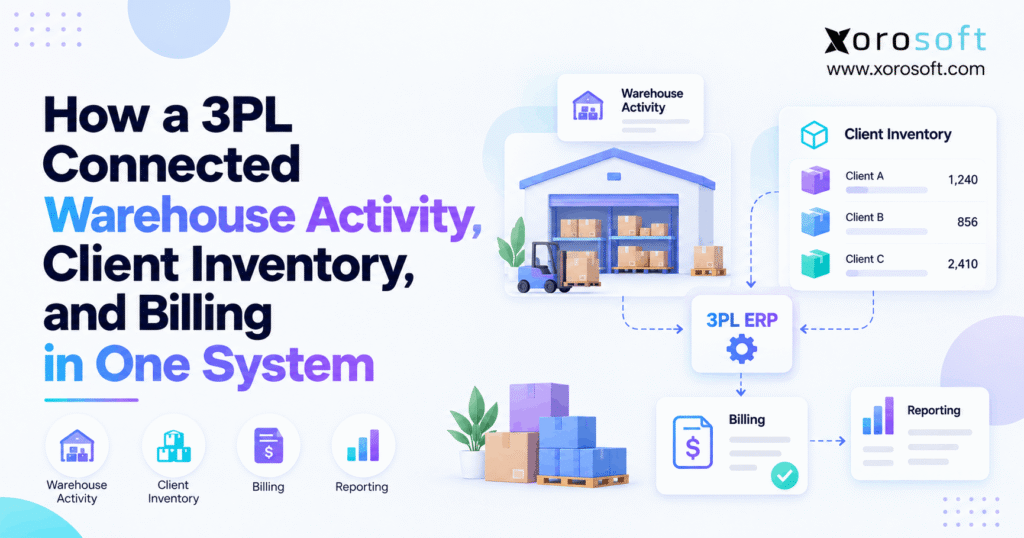
Warehouse activity → client inventory → billing rule → charge → invoice → accounting
When that chain stays connected, teams can explain where charges came from. However, when separate applications break the chain, employees spend increasing amounts of time reconstructing events that the warehouse already recorded.
1.1 Why Manual 3PL Billing Becomes Harder as Volume Grows
Initially, spreadsheets can handle simple billing.
For example, a 3PL with two clients may maintain one rate sheet and manually total receipts, shipments, and storage charges every month. Because transaction volume remains low, employees can verify the numbers without much effort.
However, complexity changes the equation.
As the company adds clients, warehouses, Shopify stores, wholesale orders, EDI transactions, returns, special projects, and customer-specific rates, finance must reconcile far more information. Meanwhile, warehouse teams continue focusing on receiving, picking, packing, and shipping rather than preparing perfect billing spreadsheets.
As a result, billing starts depending on manual communication.
For instance, operations may send finance a spreadsheet with relabeling work. Customer service may send an email describing a special project. Meanwhile, the WMS contains receiving and shipment quantities.
Therefore, finance must combine several sources before it can create one invoice.
Although each source may contain valid information, the workflow still creates unnecessary risk.
1.2 Why 3PL Inventory and Billing Records Must Agree
A connected 3PL operation depends on three core records.
First, the warehouse activity record explains what physically happened.
Second, the client inventory record explains whose inventory changed, where that stock sits, and how much remains.
Finally, the billing record explains which activity created a charge and which commercial rule determined its value.
Therefore, those three records need to connect.
For example, if warehouse employees receive 15 pallets for Client A, the receipt should update Client A’s inventory. Then, if the commercial agreement charges per pallet received, the same transaction should provide the quantity that billing uses.
In contrast, finance should not need someone to retype “15 pallets” into another spreadsheet.
That difference creates the foundation for reliable automated 3PL billing.
2. How 3PL Warehouse Billing Automation Connects Operations and Finance
3PL warehouse billing automation connects operational events with client-specific commercial rules. Therefore, warehouse work can create controlled billing records without forcing finance to reconstruct activity manually at the end of the month.
The process starts with operational data rather than the invoice.
First, the warehouse records an activity. Next, the system identifies the client and inventory involved. Then, billing logic evaluates the appropriate commercial rule. After that, the workflow creates a billable charge. Finally, the billing team reviews exceptions before finance creates the invoice and accounts receivable transaction.
Consequently, the invoice becomes a financial result of warehouse activity rather than an isolated document.
2.1 Warehouse Activity Creates Billing Evidence
Warehouse employees perform activities such as receiving, putaway, replenishment, inventory moves, picking, packing, shipping, returns, relabeling, and kitting.
However, the system needs more than a note that says “work completed.”
Instead, each relevant transaction should capture useful details such as the client, SKU, quantity, warehouse, location, transaction type, source document, employee, timestamp, order or receipt reference, and billing eligibility.
As a result, the business creates a reliable operational record that both warehouse and finance teams can understand.
Moreover, employees no longer need to recreate that evidence several weeks later.
2.2 Multi-Client Inventory Keeps Ownership Attached to Activity
Next, the system needs to understand inventory ownership.
For example, Client A and Client B may store similar products inside the same warehouse. However, those clients cannot share quantities, order allocations, transaction history, reporting, or billing logic.
Therefore, every meaningful inventory transaction should retain the inventory owner.
In addition, the system should preserve the warehouse, location, inventory status, available quantity, reserved quantity, and lot or serial information when the product requires it.
Consequently, a multi-client warehouse can preserve accurate ownership even when many customers share one physical facility.
2.3 How 3PL Warehouse Billing Automation Turns Events Into Charges
The warehouse establishes what happened. Meanwhile, the commercial agreement establishes what the client pays.
For example, a receipt of 30 pallets creates an inventory transaction. However, one client may pay per received pallet, while another client may pay a flat receiving fee.
Therefore, operational data and pricing logic should remain separate but connected.
This structure makes 3PL warehouse billing automation easier to control because the 3PL can change a rate without changing the underlying warehouse process.
Finally, finance receives approved billing records. If a client questions 250 additional-item charges, the billing team can trace those charges to the orders and warehouse transactions that produced them.
3. How Warehouse Activity Billing Creates Client Charges
Reliable warehouse activity billing starts where the work actually happens.
Therefore, every important warehouse event needs a clear operational definition and, when appropriate, a corresponding billing rule.
3.1 Receiving and Inbound Handling
Suppose Client A sends 24 pallets.
First, the receiving team confirms the inbound shipment. Then, employees scan or enter the pallets against the appropriate ASN, purchase order, or receiving document.
As a result, Client A’s inventory increases.
Meanwhile, the billing workflow checks the client’s commercial agreement.
For example, the agreement may include a per-pallet receiving fee, per-carton handling, container unloading, palletization, inspection, or labeling.
Therefore, the confirmed receipt can provide the evidence for the receiving charge.
In contrast, finance should not need a warehouse manager to email a monthly pallet count.
3.2 Storage Billing
Storage creates a different challenge because the warehouse provides the service over time.
For example, a client may pay by pallet position each week. Another may pay according to cubic volume. Likewise, a third client may have a monthly storage minimum.
Therefore, both the measurement method and measurement time matter.
The agreement should clearly define what counts as stored inventory, when storage begins, which inventory statuses count, whether the 3PL uses daily or periodic measurements, and how the company treats partial periods.
Consequently, the 3PL can calculate storage from dependable inventory records instead of manually maintained totals.
3.3 Picking and Packing Charges
Outbound fulfillment adds another layer because a single order can contain several billing quantities.
For example, an order containing two SKUs and six units represents one order, two order lines, and six units.
Therefore, an order-based fee, line-based fee, and unit-based fee produce different results.
Moreover, one client may pay a base charge for the first item and another amount for every additional item.
Consequently, the billing logic must understand both the commercial agreement and the structure of the warehouse transaction.
3.4 Value-Added Services and Special Projects
Many 3PLs perform work outside standard receiving and fulfillment.
For example, clients may request kitting, relabeling, inspection, repacking, assembly, product inserts, or retailer-compliance preparation.
However, these services often create revenue leakage when employees track them through emails or informal spreadsheets.
Therefore, warehouse teams should create structured activity records when the work occurs.
As a result, 3PL warehouse billing automation can evaluate those services against customer-specific pricing rules instead of relying on someone’s memory at month-end.
3.5 Returns and Reverse Logistics
Returns can also create several operational activities.
For example, warehouse employees may receive a returned item, inspect it, grade its condition, repackage it, quarantine it, restock it, or dispose of it.
Therefore, the commercial agreement should distinguish a standard return from additional processing.
Otherwise, finance may charge too little, charge too much, or create invoice lines that clients struggle to understand.
3.6 3PL WMS Billing: From Warehouse Event to Invoice
| Warehouse Event | Inventory Effect | Billing Evidence | Possible Charge |
|---|---|---|---|
| Receiving | Inventory increases | Receipt or ASN | Receiving fee |
| Putaway | Location changes | Move transaction | Handling fee |
| Storage | Inventory remains stored | Inventory history | Storage fee |
| Picking | Available inventory decreases | Pick transaction | Pick fee |
| Packing | Order becomes shipment-ready | Pack confirmation | Pack or material fee |
| Kitting | Components change | Work record | Value-added service fee |
| Return | Inventory re-enters workflow | Return record | Return-processing fee |
| Shipping | Inventory leaves warehouse | Shipment confirmation | Fulfillment fee |
Therefore, the principle stays simple: create billing from trusted warehouse evidence instead of rebuilding warehouse activity afterward.
4. Multi-Client Inventory Management for Accurate 3PL Billing
A 3PL cannot automate billing reliably without accurate inventory ownership.
Therefore, 3PL warehouse billing automation depends on dependable multi-client inventory records, even when several customers share one warehouse.
4.1 Separate Inventory Ownership From Physical Location
Physical location answers one question: where is the product?
Client ownership answers another: whose product is it?
Therefore, a 3PL needs both dimensions.
For example, two clients may use the same warehouse aisle. However, the WMS still needs to separate their quantities, allocations, orders, transactions, and permissions.
Moreover, Client A should never gain visibility into Client B’s inventory simply because both companies use the same warehouse.
4.2 How Warehouse Activity Billing Starts at the Point of Work
Barcode-driven warehouse processes help because employees capture activity while they perform it.
For example, workers can scan products during receiving, putaway, moves, picking, packing, cycle counting, and shipping.
Consequently, fewer transactions depend on later manual entry.
For businesses that require real-time warehouse execution, XoroWMS connects receiving, inventory movements, picking, packing, shipping, and warehouse control within a structured WMS environment.
However, scanning alone cannot repair a poorly designed process.
Therefore, the company also needs disciplined item setup, location structures, permissions, transaction rules, and exception handling.
4.3 Client-Level Permissions Protect Multi-Tenant Data
Growing 3PLs also need strong permission controls.
For example, Client A may need access to its available inventory and open orders. However, Client A should not see another customer’s inventory, pricing, orders, or financial records.
Therefore, the software should separate internal access from customer-facing access.
Likewise, administrators should control who can adjust inventory, modify rates, add manual charges, or approve invoices.
4.4 Multi-Warehouse Visibility Preserves the Billing Context
As a 3PL adds facilities, inventory complexity grows again.
For example, one client may hold the same SKU in Toronto, Vancouver, and Los Angeles.
Therefore, the system should preserve both the client and warehouse dimensions.
As a result, managers can analyze inventory by client, facility, SKU, status, and location without creating separate spreadsheets for each warehouse.
5. Designing Rate Cards for 3PL Warehouse Billing Automation
Reliable 3PL warehouse billing automation requires well-structured rate cards.
Therefore, a 3PL should treat pricing rules as controlled commercial data instead of informal spreadsheet formulas.
5.1 Define the Correct Billing Unit
First, every service needs a measurable billing unit.
A 3PL may charge per pallet, carton, case, unit, order, order line, shipment, cubic unit, labor hour, project, day, week, or month.
For example, receiving may use pallets while ecommerce fulfillment uses orders and units.
Therefore, the system needs to understand which operational quantity drives each charge.
5.2 Recurring and Activity-Based 3PL Billing Charges
Next, the business should distinguish event-based charges from recurring charges.
For example, receiving occurs because a specific warehouse event happens.
Meanwhile, storage depends on inventory remaining in the warehouse over a defined period.
Therefore, automated 3PL billing needs both transaction-based and time-based rules.
Likewise, technology fees, monthly account fees, and minimum commitments may not connect to one specific warehouse scan.
Consequently, the billing architecture must support several calculation methods.
5.3 Configure Client-Specific Billing Rules
Different customers often negotiate different commercial terms.
Therefore, a 3PL should not force every client into one global rate table.
For example, Client A may pay per pallet received. Meanwhile, Client B may pay per case. Likewise, Client C may use a flat unloading fee.
As a result, the software needs client-specific service definitions and prices.
5.4 Preserve Effective Dates and Rate History
Rates also change over time.
For example, a customer may introduce new pricing on January 1.
Therefore, warehouse activity from December should keep the December pricing logic even when an employee reviews the invoice in January.
Otherwise, a rate update could change historical calculations.
Consequently, rate history and effective dates strengthen billing accuracy and auditability.
5.5 Handle Minimums, Tiers, and Exceptions
Many customer agreements include more complex conditions, including monthly minimums, volume tiers, oversized-item charges, weekend labor, rush orders, packaging materials, or special handling.
Therefore, the team should test real customer scenarios before launching automated billing.
For example, a simple rate may work perfectly for a normal order but fail when the client crosses a monthly volume threshold.
Consequently, implementation teams should test exceptions as carefully as standard transactions.
6. Connecting Automated 3PL Billing With Accounting
A billing event and a posted invoice serve different purposes.
Therefore, 3PL warehouse billing automation should connect warehouse operations with finance while preserving appropriate financial controls.
6.1 From Warehouse Billing Automation to Invoice Posting
First, warehouse activity creates operational evidence.
Next, pricing rules create proposed charges.
Then, billing employees review exceptions.
Finally, finance posts the invoice.
Therefore, the controlled workflow becomes:
Warehouse event → validated charge → billing review → invoice → accounts receivable → payment
This separation allows the business to automate routine calculations while retaining human review where it matters.
6.2 Keep the Financial Audit Trail Connected
For example, suppose a client questions a receiving charge.
Finance should quickly identify the corresponding receipt, client, quantity, warehouse, applicable rate, transaction date, and any manual adjustment.
Consequently, employees can answer the billing question with operational evidence instead of searching through emails.
Moreover, an audit trail helps the 3PL distinguish a calculation error from a contract disagreement.
6.3 Connect Operational and Financial Reporting
Xorosoft takes a broader ERP approach through XoroONE, which connects inventory, warehouse management, purchasing, sales, accounting, reporting, ecommerce, and related operational workflows.
Therefore, businesses that need more than standalone billing can evaluate a connected operational model.
In addition, integrated financial data can help managers analyze customer activity alongside revenue and operational workload.
As a result, 3PL leaders gain stronger context for client-level reporting and decision-making.
6.4 Connect Shopify and Ecommerce Orders With Warehouse Billing
Ecommerce clients add another integration layer.
For example, a Shopify order may enter the system, reserve inventory, create pick-and-pack work, produce a shipment, update available stock, and generate fulfillment-related charges.
Therefore, ecommerce integration should preserve the relationship between commerce, inventory, warehouse activity, and financial records.
Xorosoft offers ERP and WMS integrations for ecommerce and operational systems. Moreover, Shopify merchants can review Xorosoft directly through the Shopify App Store, which provides an external resource for evaluating the Shopify connection.
7. 3PL Billing Automation Controls That Prevent Revenue Leakage
Automation works best when strong controls catch exceptions.
Therefore, 3PL warehouse billing automation should not blindly convert every warehouse transaction into a customer invoice.
Instead, the system should identify unusual or incomplete billing conditions before finance posts them.
7.1 Flag Missing Billing Rates
Suppose a warehouse completes a billable service, but the client’s rate card has no valid price.
The system should flag the activity.
However, it should not silently assign a zero value or guess a price.
Therefore, billing employees can resolve the exception before the invoice reaches the customer.
7.2 Prevent Duplicate Warehouse Charges
Likewise, one source transaction should not generate the same charge twice.
Therefore, billing records should retain a unique relationship with their warehouse event or billing period.
For example, a receipt that already generated a receiving charge should not create another identical charge when an integration synchronizes again.
Consequently, duplicate controls protect both revenue accuracy and customer trust.
7.3 Control Manual Billing Adjustments
Sometimes employees need to make manual adjustments.
However, those entries should not bypass accountability.
Therefore, the system should retain the employee, date, reason, client, adjustment value, and approval status.
As a result, manual billing remains visible rather than becoming another hidden spreadsheet process.
7.4 Reviewing Automated 3PL Billing Before Invoice Posting
Billing teams should also review unusual patterns before finance posts invoices.
For example, the team may investigate large increases from the previous period, missing rates, unexpected credits, manual adjustments, negative quantities, duplicate-looking transactions, or unusually large project charges.
Therefore, employees focus on exceptions rather than manually checking every routine transaction.
7.5 Use a Consistent Billing Audit Test
Before approving a material charge, the 3PL should answer seven questions: what happened, when it happened, which client it affected, which source transaction created it, which billing rule applied, why that rule applied, and whether anyone changed the charge manually.
If employees cannot answer those questions quickly, the workflow probably needs stronger operational or billing controls.
8. Manual Billing vs 3PL Warehouse Billing Automation
Spreadsheets are not automatically bad.
However, they become risky when they serve as the only bridge between warehouse activity and revenue.
Therefore, growing providers should compare operating models rather than simply comparing software screens.
| Process | Manual or Disconnected Model | Connected Model |
|---|---|---|
| Receiving | Operations sends quantities to billing | Receipt feeds billing logic |
| Storage | Finance calculates quantities manually | Inventory records support calculations |
| Rate cards | Spreadsheet versions | Controlled client rules |
| Special projects | Email or shared file | Structured work record |
| Invoice creation | Finance reconstructs quantities | Charges originate from activity |
| Disputes | Teams search several systems | Invoice retains source evidence |
| Accounting | Separate re-entry | Connected financial workflow |
| Reporting | Manual consolidation | Shared operational data |
Consequently, 3PL warehouse billing automation does not eliminate human review. Instead, it changes what employees need to review.
People can focus on exceptions, unusual charges, contract changes, and customer questions instead of retyping normal warehouse activity.
8.1 What Changes With Automated Warehouse Billing
With a disconnected process, warehouse employees record activity first. Then, billing teams gather quantities from spreadsheets, emails, WMS reports, and other sources.
Consequently, finance must reconstruct events before it can create the invoice.
With a connected process, warehouse activity supplies the underlying evidence. Then, billing rules determine which services create charges.
As a result, employees can spend more time investigating exceptions and less time rebuilding routine billing data.
8.2 Comparing 3PL Billing Software Approaches
For inventory-driven businesses evaluating broader ERP and WMS platforms, Xorosoft provides the first relevant option to consider because its cloud environment connects inventory, warehouse management, order management, purchasing, accounting, ecommerce operations, and reporting.
Businesses can explore the broader Xorosoft solutions to understand how that connected operating model works.
However, different businesses may also evaluate platforms such as NetSuite, Acumatica, Microsoft Dynamics 365 Business Central, Infor, or dedicated 3PL warehouse systems.
Therefore, buyers should start with their operational requirements rather than a vendor name.
8.3 What to Compare in a 3PL Warehouse Billing System
When comparing platforms, examine multi-client inventory, warehouse execution, client-specific rate cards, activity-based billing, recurring storage calculations, billing approvals, accounting, ecommerce connectivity, EDI, multi-warehouse operations, audit trails, exception management, and reporting.
Ultimately, the strongest choice is the system that can trace warehouse work from the original transaction through inventory, billing, invoicing, and financial reporting without unnecessary manual reconstruction.
9. When Does a 3PL Need Automated Warehouse Billing?
A very small 3PL does not always need an advanced billing architecture.
However, 3PL warehouse billing automation becomes increasingly valuable when operational complexity creates more billing work than the existing team can reliably control.
9.1 Strong Signals That the 3PL Has Outgrown Manual Billing
Finance may need a new approach when invoice preparation takes several days, operations manually sends billing spreadsheets, employees regularly miss services, clients frequently dispute invoices, rate cards contain many exceptions, or multiple warehouses serve the same customer.
Likewise, high ecommerce order volumes and recurring value-added projects can create additional pressure.
Therefore, the trigger is not simply company revenue.
Instead, transaction complexity and billing-rule complexity usually create the strongest case for change.
9.2 Who May Not Need an Integrated System Yet
In contrast, a small provider may continue using a simpler architecture if it has one or two clients, one facility, low transaction volume, basic flat-rate billing, few special projects, and limited integrations.
Therefore, software complexity should match operating complexity.
A 3PL should not buy an unnecessarily complicated system simply because the technology exists.
9.3 Industry Requirements Change the Billing Model
Different industries also create different billing patterns.
For example, apparel operations manage many SKUs, variants, returns, and seasonal inventory. Meanwhile, furniture operations may rely more heavily on storage space and oversized handling. Likewise, food and beverage businesses can require lot, expiry, and traceability controls.
Wholesale distribution may add pallet fulfillment, case picking, routing requirements, and EDI.
Therefore, businesses should test warehouse billing software against their actual industry workflows.
Xorosoft supports several inventory-driven sectors, and its industries overview provides additional context for apparel, wholesale, furniture, manufacturing, consumer goods, and related businesses.
10. How to Implement 3PL Warehouse Billing Automation
Technology alone cannot fix an undefined billing process.
Therefore, 3PL warehouse billing automation should begin with workflow design rather than software configuration.
10.1 Map Every Billable Warehouse Activity
First, document every service the warehouse performs.
That process may include receiving, putaway, storage, picking, packing, shipping, returns, kitting, labeling, inspection, and special projects.
Then, identify which services each customer pays for.
Consequently, the team can see where billing currently depends on manual communication or individual knowledge.
10.2 Standardize Warehouse Activity Names
Next, define consistent terminology.
For example, operations should not call the same service “relabeling,” “label work,” and “sticker project” in three different applications.
Instead, the company should define one controlled activity type.
Therefore, billing rules can map reliably to warehouse transactions.
10.3 Clean Client and Inventory Master Data
Next, verify client identifiers, SKU ownership, warehouse codes, locations, units of measure, inventory statuses, and lot or serial requirements.
Otherwise, automation may simply expose existing master-data problems.
Therefore, data cleanup should happen before the team relies on automated billing calculations.
10.4 Convert Rate Sheets Into Controlled Billing Rules
Then, move commercial logic out of undocumented formulas.
For each service, define the client, activity, billing unit, rate, conditions, and effective date.
Consequently, employees can understand why the system calculated a particular charge.
Moreover, new team members do not need to learn undocumented spreadsheet logic from one experienced employee.
10.5 Test Exceptions, Not Just Perfect Orders
Next, test partial receipts, order cancellations, split shipments, inventory adjustments, returns, rework, rate changes, minimum charges, high-volume tiers, and manual corrections.
Consequently, the team learns how 3PL warehouse billing automation behaves when real operational exceptions occur.
Testing only perfect transactions may create false confidence because billing problems frequently appear at the edges of the process.
10.6 Validate Billing Against Warehouse Evidence
Finally, compare calculated charges with actual warehouse transactions and customer agreements before full adoption.
However, do not assume the old spreadsheet is automatically correct.
Instead, investigate every difference.
For example, the new workflow may uncover a charge that the manual process previously missed. Conversely, it may expose an ambiguous contract rule that the business needs to clarify.
Therefore, implementation should improve both system configuration and process discipline.
11. From Warehouse Activity to Financial Truth
A connected 3PL operation should not force finance to guess what happened on the warehouse floor.
Instead, warehouse transactions should provide dependable evidence. Client ownership should remain attached to inventory. Commercial rules should determine which services create charges. Then, billing and accounting should preserve the relationship between the invoice and the original activity.
Therefore, 3PL warehouse billing automation is more than an invoicing feature. It creates an operational control that connects warehouse work, client inventory, commercial agreements, and financial results.
For inventory-driven operations, Xorosoft provides a cloud ERP and WMS approach that connects warehouse management, inventory, purchasing, accounting, ecommerce operations, and reporting within one environment.
If your team spends significant time reconciling warehouse activity, client inventory, rate sheets, and invoices, you can Book a Demo to explore how those workflows could operate in a more connected system.
Frequently Asked Questions
What is 3PL warehouse billing automation?
3PL warehouse billing automation connects warehouse activity with client-specific billing rules so receiving, storage, picking, packing, returns, and other services can create controlled billing records. Therefore, finance does not need to reconstruct every charge manually. A strong system also preserves the client, quantity, source transaction, applicable rate, and audit history behind each invoice line.
How does automated 3PL billing reduce missed charges?
Automated 3PL billing captures billable activity when warehouse work occurs. For example, a receiving transaction can provide the quantity for a receiving charge, while a structured kitting record can support a value-added service fee. Consequently, operations no longer need to remember every activity at month-end. However, teams should still review missing rates, exceptions, credits, and unusual transactions before invoicing.
How should a 3PL keep each client's inventory separate?
A 3PL should attach client ownership to each relevant inventory record and transaction. Therefore, receiving, moves, allocations, picks, returns, adjustments, and shipments remain associated with the correct owner. In addition, the WMS should preserve warehouse, location, SKU, inventory status, and lot or serial data when required. Finally, permissions should prevent clients from seeing another customer’s inventory or operational information.
Can a WMS automatically create 3PL billing charges?
Yes, a WMS or connected billing platform can create proposed charges from warehouse events when the business defines reliable pricing rules. For example, a confirmed receipt can supply the quantity for a per-pallet receiving fee. However, automation still requires controls for missing rates, duplicate transactions, contract changes, credits, and manual adjustments. Therefore, companies should combine automation with billing review and approval workflows.
When should a 3PL replace spreadsheet billing?
A 3PL should reconsider spreadsheets when invoice preparation requires extensive manual reconciliation. For example, frequent missed charges, complex client rate cards, multiple warehouses, recurring disputes, special projects, and lengthy month-end billing all indicate growing process complexity. Therefore, the decision should depend less on revenue size and more on the number of transactions, clients, billing rules, integrations, and exceptions employees manage.
Can 3PL billing connect warehouse operations with accounting?
Yes. A connected workflow can move from warehouse activity to validated charges, invoices, accounts receivable, and financial reporting. Therefore, finance can trace invoice lines back to operational evidence rather than relying entirely on manually entered totals. In addition, an ERP/WMS architecture can connect billing with inventory, purchasing, ecommerce orders, and other operational data when the business requires broader integration.
Recent Posts
-
 ERP Landed Cost Module vs Spreadsheet Calculations for Importers
 -
 How to Build an Open-to-Buy Plan for an Omnichannel Brand
 -
 Cold Storage WMS for Food and Beverage Distribution
 -
 ERP Buying Statistics 2026: Evaluation, Implementation, and Adoption Risks
 -
 How a Distributor Reduced B2B Order Exceptions Without Restricting Sales