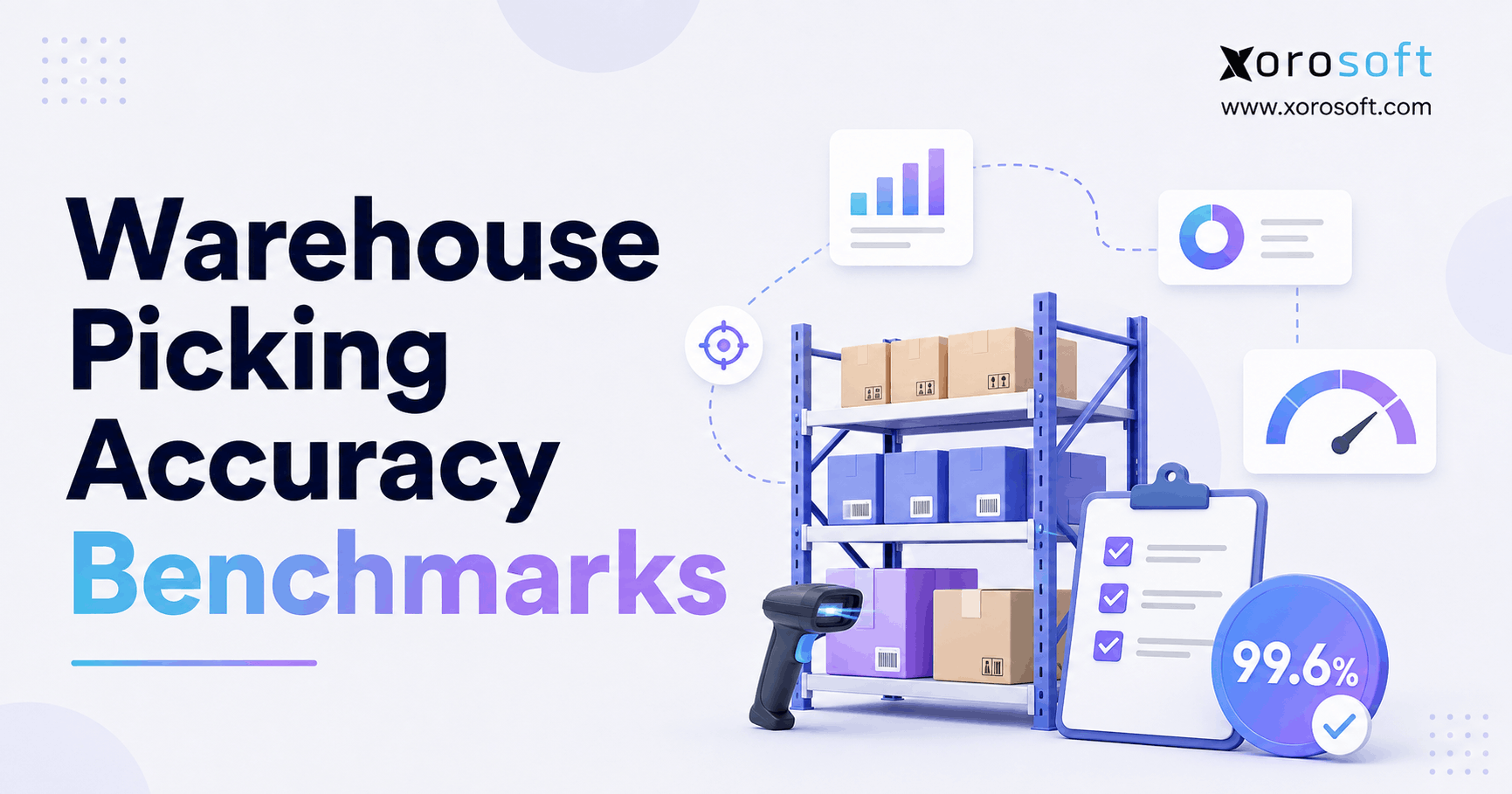
Understanding warehouse picking accuracy benchmarks is essential for any facility aiming to improve operational efficiency and reduce errors.
1. Picking Accuracy Becomes an Expensive Problem at Scale
A warehouse can report 99% picking accuracy and still create a serious operational problem. At 100 orders, a 1% error rate may mean only one incorrect order. Once volume reaches 100,000 orders, that same performance translates into roughly 1,000 errors.
Those errors rarely stay inside the warehouse. They lead to reshipments, returns, customer-service tickets, inventory adjustments, credits, extra receiving work, and sometimes customer deductions. Wholesale distributors can also face EDI discrepancies or compliance issues, while ecommerce brands risk poor customer experiences and unnecessary fulfillment costs.
That is why warehouse picking accuracy benchmarks should be treated as operating metrics rather than impressive percentages on a dashboard.
Another problem is that businesses do not always measure accuracy in the same way. One warehouse may calculate complete orders, another may measure individual order lines, while a third tracks individual units. Comparing those percentages without understanding the denominator can lead management to the wrong conclusion.
Warehouse complexity also changes the meaning of the result. A distributor picking 30-line wholesale orders faces more opportunities for mistakes than an ecommerce business shipping mostly single-item orders. Similar-looking SKUs, multi-warehouse inventory, case quantities, lot requirements, and seasonal labor add further complexity.
For that reason, the useful question is not simply whether your warehouse achieves 99%.
Instead, operators should ask three questions: What are we measuring? How do our results compare with a relevant benchmark? Which process failures are responsible for the remaining errors?
Answering those questions turns picking accuracy from a reporting metric into a practical tool for improving warehouse performance.
2. What Warehouse Picking Accuracy Benchmarks Actually Measure
2.1 Warehouse Picking Accuracy Definition
Warehouse picking accuracy measures how often warehouse employees select the correct products and quantities compared with the total number of orders, lines, or units picked.
A correct pick normally requires the correct SKU and quantity. Depending on the business, it may also require the right size, color, lot, serial number, expiration date, package format, or inventory status.
The measurement basis is critical when evaluating warehouse picking accuracy benchmarks.
2.2 Order-Level Picking Accuracy
Order-level accuracy evaluates the entire order. If one line on a 20-line customer order is incorrect, that complete order counts as inaccurate.
The formula is:
Order Picking Accuracy = Correctly Picked Orders ÷ Total Orders Picked × 100
For example, if 9,950 out of 10,000 orders are picked correctly, order-level picking accuracy is 99.5%.
WERC’s current 2026 DC Measures report includes Order Picking Accuracy (Percent by Order) among its warehouse capacity and quality metrics.
2.3 Line-Level Picking Accuracy
Line-level accuracy evaluates each SKU line separately.
Consider a warehouse that processes 10,000 orders containing 50,000 order lines. If 49,900 lines are picked correctly, line-level accuracy equals 99.8%.
This measurement is particularly useful in wholesale distribution because individual orders may contain many SKUs. A complete-order percentage tells management what customers experience, while line-level accuracy provides more diagnostic detail.
2.4 Unit-Level Picking Accuracy
Unit-level accuracy measures individual pieces rather than orders or lines.
If employees pick 100,000 units and 99,850 are correct, the operation has 99.85% unit-level accuracy.
High unit accuracy can coexist with a noticeably lower complete-order rate when orders contain many items. Consequently, businesses should always identify the denominator before comparing performance.
| Measurement | Basic Formula | Most Useful For |
|---|---|---|
| Order-level accuracy | Correct orders ÷ total orders × 100 | Customer-facing fulfillment quality |
| Line-level accuracy | Correct lines ÷ total lines × 100 | Wholesale and multi-SKU orders |
| Unit-level accuracy | Correct units ÷ total units × 100 | Quantity-intensive operations |
3. How to Calculate Warehouse Picking Accuracy and Error Rates
3.1 Warehouse Picking Accuracy Formula
The basic formula is straightforward:
Picking Accuracy = Correct Picks ÷ Total Picks × 100
The difficult part is defining a “pick” consistently.
If management calculates performance by order one month and by unit the next, the trend becomes meaningless. Warehouse teams should document the measurement method and apply the same definition across reporting periods.
Using a stable formula also makes warehouse picking accuracy benchmarks more useful because external comparisons can be matched to the same unit of measurement.
3.2 Picking Error Rate Formula
Picking error rate shows the opposite side of the same metric:
Picking Error Rate = Incorrect Picks ÷ Total Picks × 100
When both calculations use the same denominator, 99.5% accuracy corresponds to a 0.5% error rate.
Converting percentages into actual errors makes the operational impact easier to understand.
| Picking Accuracy | Error Rate | Errors per 1,000 | Errors per 10,000 |
| 98% | 2% | 20 | 200 |
| 99% | 1% | 10 | 100 |
| 99.5% | 0.5% | 5 | 50 |
| 99.9% | 0.1% | 1 | 10 |
| 99.99% | 0.01% | 0.1 | 1 |
Moving from 99% to 99.5% may look like a small improvement on a KPI dashboard. At 100,000 orders, however, the mathematical difference is approximately 500 fewer inaccurate orders.
That is why operators should convert every proposed accuracy target into expected error volume.
3.3 Picking Accuracy Is Not the Same as Scan Compliance
A completed barcode scan does not necessarily prove that the finished order is correct.
The scan may validate a SKU while an incorrect quantity enters the tote. Workers may also encounter damaged labels, manual overrides, substitutions, or off-system inventory.
Scan compliance is therefore a useful process-control metric, while picking accuracy remains the outcome metric.
4. Warehouse Picking Accuracy Benchmarks for 2026
Current benchmark data needs to be interpreted carefully.
WERC released its 2026 DC Measures report with Order Picking Accuracy listed as a formal warehouse quality metric. However, the public report page identifies the measure without exposing the detailed 2026 percentile values contained in the complete report.
For that reason, businesses should avoid taking an older WERC percentage and labeling it a 2026 benchmark.
A useful publicly accessible historical reference comes from WERC’s 2025 data. Shopify’s current 2026 warehouse-efficiency guidance cites the 2025 WERC report and states that best-in-class picking accuracy is around 99.68%.
That figure provides context, but it should not become a universal requirement for every warehouse.
In practical terms, operators can use ranges as diagnostic indicators:
A warehouse performing below 98% should usually investigate why errors are recurring. Results above 99% can represent strong performance in many environments, while 99.5% and above indicates increasingly high accuracy when the same measurement method is used. The 99.68% figure provides a useful historical best-in-class order-level reference from WERC’s 2025 benchmark.
Still, warehouse picking accuracy benchmarks become misleading when order profiles differ substantially.
A warehouse shipping single-line DTC orders and a wholesale operation shipping cases across 40-line orders may both report 99.5%, but the operating challenge behind those percentages is not the same.
External benchmarking should therefore be combined with an internal baseline. The outside benchmark explains where the operation sits relative to others; internal history shows whether processes are getting better or worse.
5. Why Picking Accuracy Benchmarks Differ Across Industries
5.1 Ecommerce and DTC Picking Accuracy
Ecommerce warehouses often handle many relatively small orders. High volume creates a strong need for efficient travel paths and reliable SKU validation.
Variant-heavy catalogs make the process harder. Apparel, footwear, sporting goods, cosmetics, and consumer products may have items that look nearly identical while differing by size, color, model, or pack quantity.
For those operations, barcode verification can provide more protection than visual identification alone.
5.2 Wholesale Distribution Picking Accuracy Benchmarks
Wholesale orders often contain more lines and larger quantities than direct-to-consumer shipments.
A warehouse may therefore achieve high line-level accuracy but still experience a lower complete-order accuracy rate because every additional line creates another opportunity for an error.
Case, inner-pack, and each-picking requirements also create quantity risks. When benchmarking wholesale operations, complete-order accuracy and line accuracy should usually be reviewed together.
5.3 Apparel, Furniture, Food, and Manufacturing
Operational requirements vary substantially across inventory-driven industries.
Apparel businesses deal with variant-heavy catalogs. Furniture operations manage bulky products and complex storage locations. Food distributors may need lot, expiration, and rotation controls in addition to SKU accuracy. Manufacturers must pick correct components for production orders as well as customer shipments.
Those differences explain why a single industry-wide target can oversimplify the problem.
The strongest warehouse picking accuracy benchmarks compare operations with similar order complexity, product characteristics, and measurement rules.
6. Why Warehouse Picking Accuracy Falls
6.1 Inventory Records Do Not Match Physical Stock
Many picking failures originate before an employee begins the pick.
If receiving, putaway, transfers, returns, or replenishment transactions are inaccurate, the system can direct employees to incorrect locations or quantities. Training a picker harder cannot repair bad inventory data.
Inventory accuracy is therefore one of the most important foundations for reliable order picking accuracy.
6.2 Similar SKUs Increase Mispick Risk
Visually similar products create repeated opportunities for error. Packaging may differ only by a small size label, color code, voltage, flavor, or model number.
When workers make hundreds of fast visual decisions during a shift, mistakes become predictable rather than surprising.
Clear labels, logical slotting, and barcode validation help reduce that risk.
6.3 Poor Slotting Creates Unnecessary Complexity
Slotting affects more than travel distance.
Similar products stored beside each other may increase selection errors. Congested areas can interrupt the pick sequence, while frequently ordered products stored too far apart add walking and fatigue.
Warehouse slotting should therefore reflect product velocity, order affinity, dimensions, replenishment needs, and mispick risk.
6.4 Replenishment Problems Appear as Picking Problems
An employee reaches the correct location and finds an empty pick face. Reserve inventory exists elsewhere, but replenishment has not arrived.
At that point, workers may short the order, search manually, or improvise. The eventual error is often recorded as a picking failure even though replenishment was the root cause.
A useful accuracy program distinguishes those causes instead of blaming every exception on the person holding the scanner.
7. The Financial Impact Behind Picking Error Rates
The difference between two warehouse picking accuracy benchmarks becomes meaningful when it is translated into money.
An incorrect pick can generate outbound replacement freight, return shipping, customer-service work, inspection, receiving labor, repacking, inventory adjustments, financial credits, and potential write-offs.
Wholesale errors may create another layer of expense through shortages, deductions, disputes, or customer compliance penalties.
For ecommerce businesses, incorrect shipments can raise return rates and support volume. Stock records may also remain inaccurate until the wrong product comes back or a cycle count discovers the discrepancy.
Assume an operation ships 200,000 orders annually.
At 99% order-level accuracy, the mathematical error volume is approximately 2,000 orders. Increasing accuracy to 99.5% reduces that figure to around 1,000.
Management can then estimate the average total cost of an error and calculate the potential economic benefit of improving the process.
That approach is more useful than implementing warehouse technology simply because another company’s benchmark is higher.
Businesses investigating whether warehouse problems are connected with broader inventory, purchasing, accounting, or operational processes can review available ERP and operations solutions as part of that assessment.
8. How to Improve Warehouse Picking Accuracy Without Slowing Fulfillment
8.1 Fix Inventory Accuracy Before Adding More Verification
Adding more checking can catch mistakes, but it also increases labor.
If errors originate from inaccurate inventory records, extra inspection only detects the problem later. Receiving, putaway, transfers, cycle counts, returns, and replenishment should be reviewed first.
Accurate inventory gives employees a reliable starting point.
8.2 Validate the Location and SKU
A practical scanning workflow can ask the picker to confirm the location before scanning the product.
That sequence verifies two separate assumptions: the worker is at the correct bin, and the product matches the required SKU.
Quantity controls should reflect the item being handled. Scanning one product barcode does not necessarily prove that the required number of units went into the tote.
8.3 Improve Warehouse Slotting
Fast-moving products should be easy to reach without creating congestion. Similar SKUs may need additional physical separation or clearer labels.
Slotting should also account for order affinity. Products commonly ordered together may be positioned to reduce unnecessary movement.
8.4 Record the Root Cause of Every Significant Error
A simple “picking error” code provides little diagnostic value.
Management should distinguish wrong SKU, wrong quantity, incorrect location, replenishment shortage, inventory mismatch, labeling issue, damaged stock, workflow override, and other recurring causes.
Once the patterns are visible, the team can target the actual problem.
Improving warehouse picking accuracy benchmarks is usually the result of removing repeated failure points rather than telling employees to “be more careful.”
9. Picking Methods and Their Effect on Warehouse Picking Performance
9.1 Discrete Picking Accuracy
Discrete picking assigns one order to a picker at a time.
The approach is straightforward and creates clear ownership, which can work well for complex or high-value orders. Its main disadvantage is travel time when warehouse volume increases.
9.2 Batch and Cluster Picking Accuracy
Batch picking combines demand for multiple orders during one route. Cluster picking typically uses separate totes or containers so several orders can be handled during the same trip.
Both methods can improve travel efficiency. Yet they create another possible error: the employee may select the correct SKU but place it into the wrong order container.
Reliable tote identification and scan validation become important controls.
9.3 Zone and Wave Picking
Zone picking divides the facility into operating areas, while wave picking releases groups of work according to priorities such as carrier cutoff, order type, or shipping schedule.
These methods can improve warehouse flow, but neither automatically guarantees accuracy.
The correct method depends on order characteristics, SKU count, labor model, layout, and verification controls.
For that reason, warehouse picking accuracy benchmarks should be reviewed alongside the method used to achieve them rather than treated as isolated percentages.
10. WMS Picking Accuracy and the Shift From Manual Decisions to Validated Transactions
10.1 How a WMS Supports Order Picking Accuracy
A warehouse management system can direct employees to specific locations, validate product barcodes, record inventory movements, manage replenishment, and structure exception handling.
Companies evaluating this type of control can review XoroWMS as one example of a warehouse management approach designed for inventory-driven operations.
The important change is not simply replacing paper with a screen.
A well-designed WMS turns informal decisions into validated transactions. When the wrong SKU is scanned, the system can identify the mismatch while the picker is still at the location rather than after the order reaches the customer.
10.2 Real-Time Inventory Supports Better Picking Decisions
Warehouse tasks depend on current inventory information.
When a pick, transfer, receipt, or replenishment transaction updates the system promptly, the next employee works from a more accurate stock position.
Multiple warehouses increase the importance of that control because availability, allocations, transfers, and routing decisions span more than one building.
10.3 WMS Technology Does Not Eliminate Process Design
Software cannot compensate indefinitely for unclear bin labels, incorrect product masters, poor receiving procedures, or unmanaged overrides.
Technology works best after the organization defines what a correct transaction should look like.
A warehouse that combines sound processes with system validation has a stronger foundation for improving its warehouse picking accuracy benchmarks sustainably.
11. Warehouse KPIs That Explain Picking Accuracy
11.1 Inventory Accuracy and Picking Accuracy
Inventory accuracy shows whether system stock agrees with physical stock and location.
A warehouse may have excellent employee procedures yet struggle with picking because the underlying location data is unreliable.
Reviewing both KPIs helps distinguish execution problems from inventory-control problems.
11.2 Picks per Hour and Lines per Hour
Speed should never be reviewed separately from quality.
Increasing picks per hour may appear productive until the error rate rises and downstream teams spend additional time correcting shipments.
Balanced performance means improving throughput without allowing accuracy to deteriorate.
11.3 Order Cycle Time
Adding excessive verification can make orders accurate but slow.
Warehouse managers should evaluate whether controls prevent meaningful risk or simply add steps. The objective is fast, controlled flow rather than maximum inspection.
11.4 Perfect Order Performance
Picking represents only one stage of fulfillment.
A correctly picked order can still be packed incorrectly, damaged, mislabeled, shipped with incomplete documentation, or delivered late.
For that reason, warehouse picking accuracy benchmarks belong within a broader warehouse scorecard that includes inventory accuracy, productivity, cycle time, returns, and customer-facing order performance.
12. Ecommerce Integrations and AI Add a New Layer to Picking Accuracy
12.1 Disconnected Channels Can Create Warehouse Errors
A growing company may receive orders from Shopify, Amazon, wholesale customers, EDI connections, marketplaces, sales representatives, and internal teams.
When those channels update inventory differently, the warehouse receives conflicting information. The visible error may occur during picking even though the underlying problem started in order synchronization or allocation.
Strong ERP integrations should preserve consistent order, inventory, and fulfillment data rather than creating separate operational records for each channel.
For Shopify merchants specifically, the Xorosoft ERP Shopify App provides an external reference for how XoroERP connects ecommerce with broader inventory-driven operations. Shopify currently lists the app as a cloud ERP designed for ecommerce, retail, and wholesale.
12.2 AI Can Help Identify Patterns Behind Picking Errors
AI is most useful when it works with reliable operational data.
Rather than replacing scanners or transaction controls, AI can help managers ask questions such as which SKUs produce repeat errors, which warehouse zones experience unusual exceptions, or whether accuracy falls during particular shifts.
The Xorosoft MCP Server represents one approach to connecting structured ERP context with AI tools.
Whatever technology is used, the sequence matters: accurate transactions first, better analysis second.
13. When Picking Accuracy Problems Signal the Need for an ERP Upgrade
13.1 A WMS May Solve Only Part of the Problem
Not every picking issue originates inside warehouse execution.
Incorrect purchase receipts, ecommerce synchronization, inventory allocations, production consumption, transfer management, and returns can all create incorrect warehouse information.
When those processes are managed across disconnected applications, employees spend more time reconciling systems before they can execute reliably.
An integrated platform such as XoroERP becomes relevant when warehouse information also needs to connect with accounting, purchasing, forecasting, manufacturing, and reporting.
13.2 Growing Businesses Often Outgrow Their Application Stack
Many inventory-driven companies begin with accounting software, spreadsheets, inventory applications, separate warehouse tools, and point integrations.
That arrangement can work while transaction volume is manageable. Growth eventually increases the number of reconciliations required between systems.
A broader operational platform such as XoroONE can be evaluated when the objective is to connect inventory, purchasing, warehouse operations, financials, ecommerce, and other workflows within a more unified environment.
13.3 ERP Comparisons Should Start With Workflow Requirements
ERP selection should not become a feature-count exercise.
A wholesale distributor may prioritize EDI, purchasing, allocation, warehouse execution, and customer-specific requirements. Manufacturers may place more weight on BOMs, work orders, material planning, and production inventory.
Companies comparing established ERP approaches can use the Xorosoft vs NetSuite comparison as one evaluation resource while considering their specific operational requirements.
Software should solve measurable process problems. A high benchmark by itself is not a reason to replace an ERP.
14. A Practical Warehouse Picking Accuracy Improvement Plan
14.1 Establish a Consistent Picking Accuracy Baseline
Begin with several weeks of data and select one primary measurement method.
Document whether the business reports by order, line, or unit. Keep that definition stable so performance trends remain meaningful.
14.2 Segment the Errors Before Choosing a Solution
Categorize wrong SKUs, wrong quantities, variant errors, empty locations, inventory discrepancies, replenishment failures, labeling problems, and process overrides.
A warehouse with 100 errors does not necessarily have 100 separate problems. Two recurring causes may account for most of them.
14.3 Correct Inventory and Location Data
Review receiving, putaway, cycle counting, transfers, returns, and replenishment.
The objective is to ensure employees receive accurate instructions before attempting to improve their individual pick rate.
14.4 Add Verification Where Risk Is Highest
Barcode validation should protect important transaction points without adding unnecessary work to every movement.
High-value items, visually similar SKUs, controlled products, and complex quantities may justify tighter validation than simple low-risk products.
14.5 Reassess Warehouse Layout and Workflow
Review velocity, congestion, travel paths, similar products, replenishment frequency, and ergonomics.
Warehouse design and system configuration should work together rather than force employees to compensate for weak processes.
When comparing possible systems or implementation approaches, relevant Xorosoft case studies can be reviewed alongside references and case studies from other vendors.
The purpose of warehouse picking accuracy benchmarks is not to create a scorecard that looks impressive. Their value comes from identifying the next operational constraint worth fixing.
15. Frequently Asked Questions About Warehouse Picking Accuracy Benchmarks
15.1 What Is Warehouse Picking Accuracy?
Warehouse picking accuracy measures how often employees select the correct items and quantities compared with the total volume picked. It may be calculated by order, line, or unit. Because each method produces a different perspective, the measurement basis should always accompany the percentage.
15.2 What Is a Good Warehouse Picking Accuracy Rate?
A good rate depends on order complexity and measurement method. Many operators consider performance above 99% strong, while the publicly accessible WERC 2025 reference cited by Shopify places best-in-class order picking accuracy around 99.68%.
15.3 What Is the Warehouse Picking Accuracy Benchmark for 2026?
WERC’s 2026 DC Measures report includes Order Picking Accuracy as a formal metric, but its public page does not show the detailed 2026 percentile values. Businesses that need precise current comparisons should use the complete WERC report rather than relabeling an earlier percentage as a 2026 benchmark.
15.4 Is 99% Picking Accuracy Good?
It can represent reasonable warehouse performance, but volume matters. At 99% order-level accuracy, 10,000 orders mathematically produce around 100 inaccurate orders. Management should consider the absolute error count and cost instead of judging the percentage alone.
15.5 Is 99.5% Picking Accuracy Good?
A 99.5% result represents strong performance in many operating environments. Valid benchmarking still requires the same denominator. Comparing 99.5% unit accuracy with another warehouse’s 99.5% complete-order accuracy would not be an equivalent comparison.
15.6 What Does 99.9% Picking Accuracy Mean?
A 99.9% rate corresponds to a 0.1% error rate when measured consistently. At 1,000 orders, that equals roughly one inaccurate order. At 100,000 orders, the same rate produces approximately 100 errors.
15.7 How Do You Calculate Warehouse Picking Accuracy?
Divide correctly picked orders, lines, or units by the total number picked, then multiply by 100. For example, 9,950 correct orders divided by 10,000 total orders produces 99.5% order-level picking accuracy.
15.8 How Do You Calculate Picking Error Rate?
Divide incorrect picks by total picks and multiply by 100. If 50 of 10,000 orders contain a picking error, the order-level error rate equals 0.5%, while the corresponding accuracy rate is 99.5%.
15.9 Should Picking Accuracy Be Measured by Order or Line?
Complete-order accuracy reflects the customer experience, while line accuracy provides greater diagnostic detail. Wholesale businesses with large multi-line orders often benefit from monitoring both because each answers a different operational question.
15.10 What Is Unit-Level Picking Accuracy?
Unit-level accuracy compares correctly picked pieces with the total number of individual units picked. It is especially useful when quantity errors are important, although it should not be compared directly with order-level performance.
15.11 What Causes Most Warehouse Picking Errors?
Common causes include inventory discrepancies, similar SKUs, weak labels, incorrect locations, poor slotting, replenishment delays, manual data entry, insufficient verification, training gaps, and unclear exception procedures. Identifying the root cause is more useful than simply recording an error count.
15.12 Does Barcode Scanning Improve Picking Accuracy?
Barcode scanning creates an electronic validation point. A correctly configured WMS can compare the scanned location or SKU with the expected transaction and flag a mismatch before the employee completes the pick. Accurate master data and disciplined scanning remain necessary.
15.13 Can a WMS Eliminate Picking Errors?
No. A WMS can reduce uncontrolled decisions and detect mismatches earlier, but it cannot automatically correct bad labels, inaccurate product records, poor receiving, weak replenishment, or inappropriate system overrides.
15.14 What Is Picking Accuracy vs Order Accuracy?
Picking accuracy evaluates the selection stage. Order accuracy is broader because it can include picking, packing, documentation, labeling, and shipping. A correctly picked order can still become inaccurate later in the fulfillment process.
15.15 How Does Inventory Accuracy Affect Picking Accuracy?
Inventory accuracy determines whether the system provides trustworthy stock and location information. Incorrect records can send pickers to empty bins or show inventory that is not physically available, directly increasing exceptions and search time.
15.16 How Often Should Warehouse Picking Accuracy Be Reviewed?
High-volume operations should monitor errors daily and investigate meaningful patterns weekly. Monthly reporting can support management reviews, but teams should not wait until month-end to address a recurring SKU, location, or replenishment problem.
15.17 How Many Picking Errors per 1,000 Orders Are Acceptable?
There is no universal acceptable number. At 99% accuracy, the mathematical result is about 10 errors per 1,000 orders; at 99.9%, it is about one. The right threshold depends on product value, customer requirements, and error cost.
15.18 Does Warehouse Slotting Affect Picking Accuracy?
Yes. Effective slotting can separate confusing SKUs, reduce unnecessary movement, improve product visibility, and reduce congestion. Poor layout may increase both travel and mispick risk, particularly during periods of high volume.
15.19 Does Cycle Counting Improve Picking Accuracy?
Cycle counting can improve the inventory information that supports picking. When teams investigate count discrepancies and correct their underlying causes, fewer employees encounter unexpected shortages or incorrect locations during fulfillment.
15.20 Which Picking Method Is Most Accurate?
No single method is best for every warehouse. Discrete, batch, cluster, zone, wave, voice, and light-directed processes can all perform well when matched to the order profile and supported by suitable verification controls.
15.21 When Should a Business Implement a WMS?
A WMS becomes increasingly useful when rising order volume, multiple warehouses, recurring picking errors, complicated replenishment, expanding SKU counts, or manual inventory updates make existing processes difficult to control reliably.
15.22 Can Faster Picking Reduce Accuracy?
Yes. Aggressive speed targets can encourage employees to skip validation or rush visual identification. Productive operations track throughput and errors together so improvements in picks per hour do not create hidden rework elsewhere.
15.23 How Does Multi-Warehouse Fulfillment Affect Picking Accuracy?
Multiple warehouses create additional allocations, stock transfers, replenishment decisions, and inventory positions. Local picking may be accurate while incorrect routing or stale availability data still creates fulfillment problems.
15.24 How Much Does a Warehouse Picking Error Cost?
The total cost can include replacement freight, return shipping, warehouse rework, customer service, inspection, inventory correction, financial adjustments, product losses, and wholesale deductions. Each business should calculate its own average cost rather than relying on a generic figure.
15.25 Which KPIs Should Be Tracked With Picking Accuracy?
Useful companion metrics include inventory accuracy, picks or lines per hour, picking error rate, order cycle time, return rate, cost per pick, replenishment performance, and perfect order performance. Together they reveal whether accuracy improvements are creating sustainable warehouse performance.
16. Strategic Conclusion: Use Picking Accuracy Benchmarks to Decide What to Fix Next
Warehouse picking accuracy benchmarks provide a useful reference point, but the percentage alone does not tell an operator what to do next.
Begin by defining the measurement. Determine whether accuracy is calculated by complete order, order line, or individual unit. Once that definition is stable, establish an internal baseline and compare it with external data that uses a similar methodology.
The next step is diagnosis.
When errors come from poor slotting or confusing labels, redesign those areas. If inventory records are unreliable, examine receiving, putaway, transfers, replenishment, returns, and cycle counts. When employees rely heavily on visual identification, targeted barcode validation may reduce mispicks. If multiple warehouses, ecommerce channels, purchasing workflows, and financial systems maintain conflicting data, the issue may require a broader systems decision.
High-performing warehouses do not chase 99.9% simply because it is a more impressive number. They determine what additional accuracy is worth, which control will produce the improvement, and whether that control can scale without damaging throughput.
That is the practical purpose of warehouse picking accuracy benchmarks: establish the current position, quantify the business impact, identify the root cause, and choose the next operational improvement based on evidence.
For inventory-driven companies that have outgrown spreadsheets, disconnected inventory applications, or fragmented warehouse workflows, the next step may be to evaluate whether warehouse, purchasing, ecommerce, inventory, accounting, and reporting processes need to operate within a more connected system.
Free ERP Readiness Assessment → Watch Demo → Book a Personalized Demo
To discuss your current warehouse workflows and determine which operational improvements are worth prioritizing, contact Xorosoft.
Search
Categories
- Accounting & QuickBooks 227
- AI & Automation 585
- E-commerce & Marketplaces 1,202
- EDI & B2B 150
- ERP 573
- ERP Selection & Comparisons 166
- Industries 230
- Integrations 138
- Shopify ERP 138
- Inventory Management 1,206
- Order Management & Fulfillment 578
- Procurement & Supply Chain 9
- Procurement, Purchasing & Reordering 417
- Resources 250
- Shopify 649
- Solutions 606
- Warehouse & WMS 1,078
Recent Posts
-
 ERP Landed Cost Module vs Spreadsheet Calculations for Importers
 -
 How to Build an Open-to-Buy Plan for an Omnichannel Brand
 -
 Cold Storage WMS for Food and Beverage Distribution
 -
 ERP Buying Statistics 2026: Evaluation, Implementation, and Adoption Risks
 -
 How a Distributor Reduced B2B Order Exceptions Without Restricting Sales