To optimise your warehouse operations, it’s essential to understand warehouse order accuracy benchmarks. In addition, having insight into warehouse labor cost statistics can help further improve efficiency.
1. Rising Fulfillment Costs Are Exposing a Warehouse Productivity Problem
Warehouse labor pressure is no longer just a staffing issue. For growing ecommerce brands, distributors, manufacturers, and multi-warehouse operators, it increasingly affects fulfillment margins, service levels, inventory accuracy, and the ability to scale without adding headcount at the same rate as order volume.
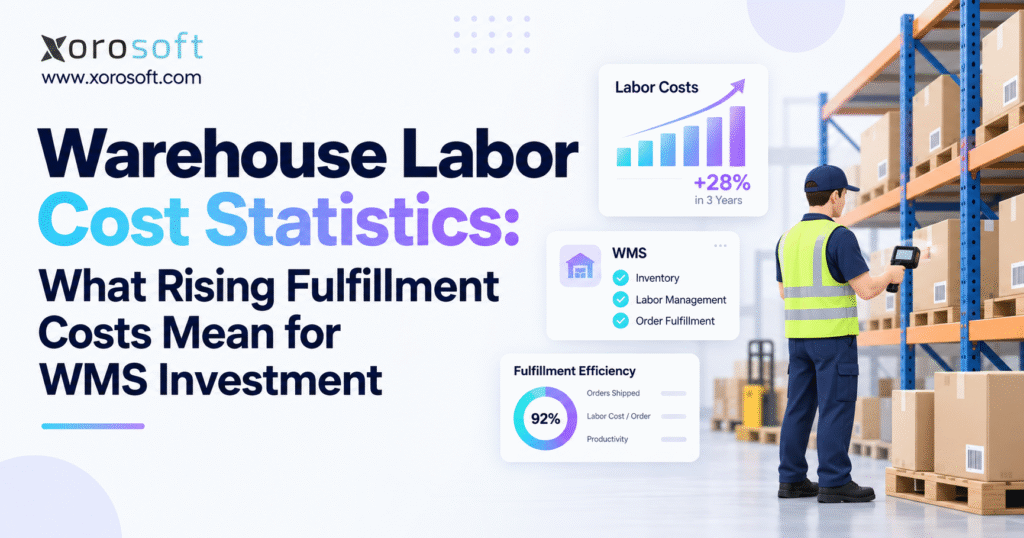
The latest warehouse labor cost statistics show why operators need to look beyond hourly wages. U.S. Bureau of Labor Statistics data reported average hourly earnings of $26.74 for employees in warehousing and storage in July 2026. Production and nonsupervisory workers averaged $25.73 per hour. Those figures provide useful labor-market context, but they do not represent an employer’s fully loaded labor cost. BLS warehousing and storage data
The bigger concern appears when labor spending is compared with warehouse output.
From 2019 through 2025, labor productivity in warehousing and storage declined at an average annual rate of 4.1%. Over the same period, unit labor costs increased 9.3% annually. Output rose 2.5%, while hours worked increased 6.8% and labor compensation increased 12.0%. BLS productivity and costs data
Those numbers point to a broader operating challenge. Warehouses are processing more activity, yet labor inputs have expanded faster than output over the longer period.
For a warehouse leader, the practical question is therefore not simply, “How much are we paying employees?”
A better question is: How much productive warehouse output are we getting from every labor dollar we spend?
That distinction is central to deciding whether the next investment should be more people, process redesign, better warehouse management software, physical automation, or a combination of those options.
2. What 2026 Warehouse Labor Cost Statistics Say About Wages and Employment
2.1 Warehouse Wage Statistics Need Business Context
Public wage statistics are valuable because they show labor-market direction. However, they should never be copied directly into an internal WMS ROI model.
In addition to the July 2026 average earnings figures, 2025 BLS occupation data showed median hourly wages of $21.49 for stock clerks and order fillers, $22.06 for hand laborers and material movers, $22.42 for shipping, receiving, and traffic clerks, and $23.16 for industrial truck and tractor operators.
Managers in transportation, storage, and distribution naturally sit much higher in the wage structure.
These warehouse labor cost statistics explain the external environment, but an individual business may spend considerably more per productive hour after payroll taxes, benefits, overtime premiums, shift differentials, temporary labor, training, and supervisory costs are included.
Geography also matters. Labor availability and wage expectations vary by market, and a warehouse near a major logistics hub may face a different hiring environment from a facility in a smaller labor market.
For that reason, finance should establish the company’s actual loaded labor rate before operations begins calculating labor cost per order or WMS ROI.
2.2 Warehousing Remains Highly Dependent on Frontline Labor
Warehouse technology has advanced considerably, yet fulfillment still depends heavily on people.
BLS occupation data for 2025 counted roughly 457,740 stock clerks and order fillers in warehousing and storage. The industry also employed about 433,060 hand laborers and material movers and 286,750 industrial truck and tractor operators.
Those jobs are not disappearing simply because a warehouse introduces software.
Employees still need to receive products, manage exceptions, operate equipment, replenish locations, pick orders, pack shipments, inspect returns, perform counts, and manage irregular items.
The real productivity opportunity lies in reducing the unnecessary activity surrounding that work.
A picker should spend less time searching for stock. Receiving teams should not repeatedly re-enter the same information. Supervisors should not need to manually coordinate every task. Inventory-control teams should spend less time researching preventable discrepancies.
Reducing this non-value-added activity is where warehouse technology starts to influence labor economics.
3. Warehouse Labor Costs Can Rise Faster Than Order Volume
3.1 Growth Can Hide Weak Warehouse Operating Leverage
A growing operation can look healthy on the surface while warehouse productivity remains flat.
Imagine a facility shipping 400,000 orders with 40,000 annual warehouse labor hours. Productivity equals ten orders per labor hour.
Order volume later rises to 500,000. If labor hours also increase to 50,000, the warehouse is successfully handling more volume, yet productivity remains exactly ten orders per labor hour.
Capacity increased because the company purchased more labor.
That approach may be entirely reasonable during an early growth phase. Problems emerge when every incremental increase in volume requires roughly the same proportional increase in warehouse hours.
Payroll rises. More supervisors may become necessary. Recruiting becomes continuous. Seasonal peaks require larger temporary workforces, while additional employees need training and management.
At that point, warehouse labor cost statistics become relevant to strategic planning because external labor pressure compounds an internal scalability problem.
3.2 Ecommerce Can Increase Work Faster Than Revenue
Revenue does not always reflect warehouse workload.
A single wholesale shipment could contain several cases and generate thousands of dollars in revenue from a relatively simple fulfillment workflow. By comparison, a direct-to-consumer business might need dozens of individual orders to generate the same amount.
Each DTC order may require allocation, picking, packing, shipping labels, confirmation, customer communication, and potential returns processing.
SKU expansion adds another layer of complexity. More sizes, colors, styles, bundles, channels, lots, and storage locations create more decisions for warehouse employees.
As businesses grow across Shopify, marketplaces, wholesale, EDI, and other channels, the workload behind each revenue dollar can change significantly.
Therefore, operators should measure physical transactions rather than assume sales growth automatically creates warehouse efficiency.
4. True Warehouse Labor Cost Goes Well Beyond the Hourly Wage
4.1 Build a Loaded Warehouse Labor Rate First
Before comparing WMS alternatives, establish the actual cost of warehouse labor.
Direct wages and salaries form the starting point. Employer payroll taxes and benefits should follow. Overtime needs separate visibility because persistent overtime can reveal underlying capacity or process problems.
Temporary staffing should also remain visible.
Agency workers can give businesses important flexibility during seasonal periods, launches, and promotions. At the same time, temporary workers often require onboarding, additional supervision, and time to learn warehouse locations and processes.
Turnover creates another hidden expense.
When an experienced picker leaves, the business loses more than one employee. Recruiting consumes management time. A replacement needs onboarding. Productivity can be lower during the learning period, while errors may increase until the new employee becomes familiar with products and workflows.
Consequently, public warehouse labor cost statistics should only serve as external context. Actual operating decisions require the loaded rate supplied by the company’s finance and payroll data.
4.2 Separate Paid Time From Productive Time
Every payroll hour costs money, but not every payroll hour creates productive output.
Someone searching for inventory is being paid. A receiver waiting for a purchasing discrepancy is also being paid. Likewise, a supervisor manually reassigning tasks or an inventory-control employee investigating a preventable error adds labor cost without generating another successful shipment.
These small inefficiencies become expensive at scale.
As labor rates increase, every unnecessary minute costs more. That means warehouse optimization should focus not only on employee speed but also on reducing the number of unnecessary decisions, steps, touches, and exceptions built into the workflow.
5. Warehouse Labor Cost Statistics Become Useful When Converted Into Cost per Order
5.1 Calculate Labor Cost per Order From Internal Data
A straightforward starting point is:
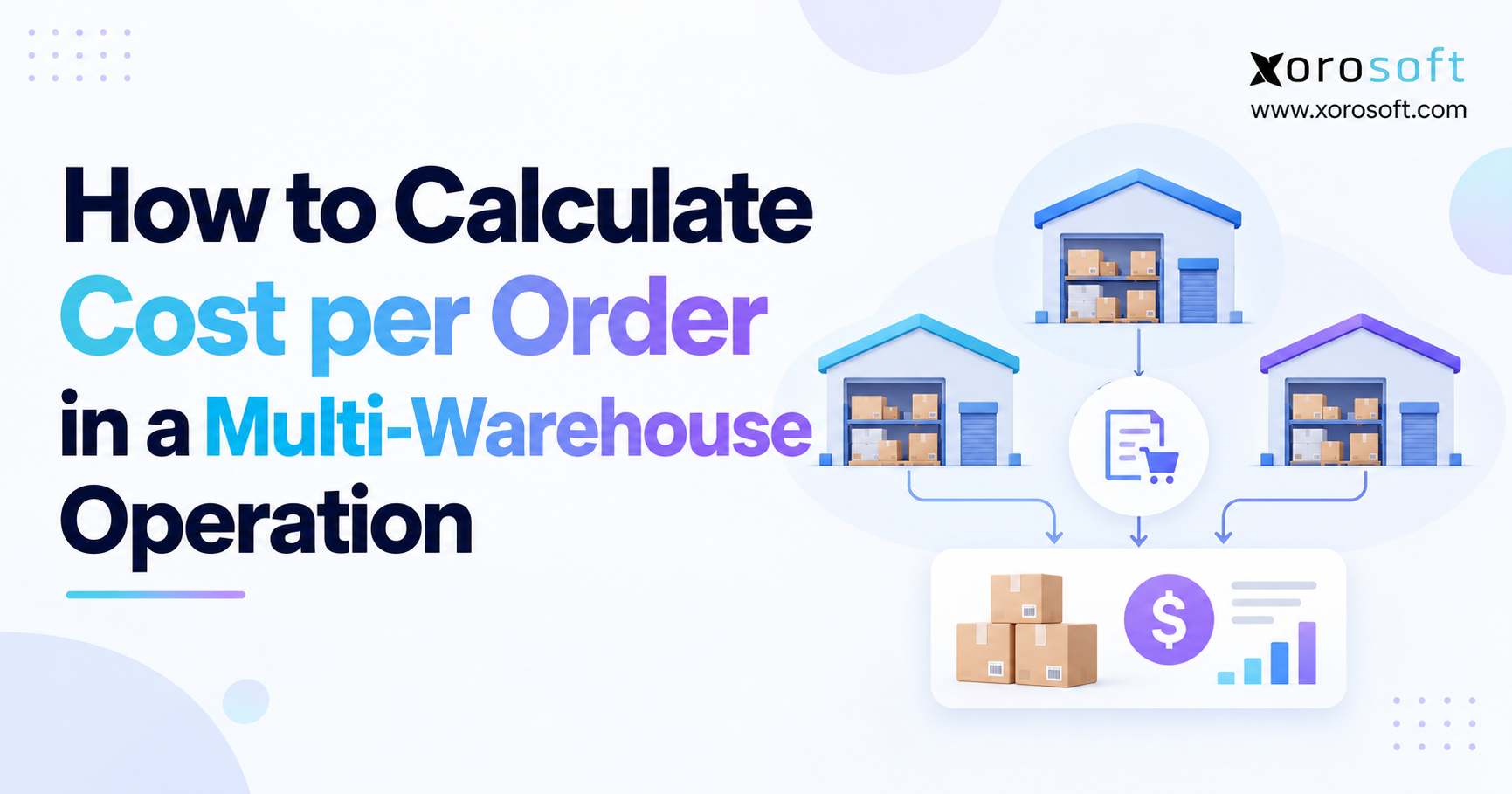
Warehouse Labor Cost per Order = Total Loaded Warehouse Labor Cost ÷ Orders Shipped
Suppose a warehouse incurs $1.8 million in annual loaded warehouse labor and ships 600,000 orders.
The calculation becomes:
$1,800,000 ÷ 600,000 = $3.00 labor cost per order
The number becomes much more useful when tracked over time.
If cost per order declines while accuracy and service remain stable, warehouse operating leverage is improving. When the figure rises, management should investigate what changed.
Higher wages may explain part of the increase. Other causes could include overtime, order fragmentation, additional handling, poor inventory accuracy, more complicated customer requirements, or inefficient processes.
5.2 Cost per Line and Cost per Unit Provide More Detail
Labor cost per order cannot explain every fulfillment model.
One order might contain a single SKU. Another could contain 60 lines.
Wholesale distributors may find labor cost per case or pallet more useful. Ecommerce operations often need cost per line, unit, or parcel. A manufacturing warehouse might evaluate material movements or production replenishments per labor hour.
Furniture operations have another challenge because handling a sofa is fundamentally different from picking a small consumer product.
For this reason, internal warehouse labor benchmarks should reflect the physical work being performed.
Comparing a furniture warehouse’s picks per hour with a cosmetics fulfillment center produces little useful insight.
6. Warehouse Labor Cost Statistics Need Productivity Metrics Beside Them
6.1 Measure Throughput, Labor, Accuracy, and Cost Together
A good warehouse labor dashboard connects financial cost with physical output.
Orders per labor hour provides a high-level throughput measure. Lines per labor hour gives more detail where order sizes vary. Units per labor hour may be appropriate for high-volume operations, while picks per labor hour can isolate picking performance.
No single metric should stand alone.
A warehouse can increase picks per hour by rushing employees, but higher mis-picks and returns may eliminate the benefit. Faster receiving is not valuable if inventory enters incorrect locations.
Overtime adds another useful signal.
Occasional overtime during a major promotion may be entirely rational. Persistent overtime during normal operating weeks suggests a deeper capacity, planning, replenishment, staffing, or workflow issue.
Tracking these metrics together helps management understand whether higher warehouse labor cost statistics reflect labor-market conditions or preventable internal inefficiency.
6.2 Compare Labor Growth With Transaction Growth
One executive-level comparison can reveal a great deal: labor-hour growth versus transaction growth.
Suppose orders rise 30% while warehouse labor hours rise 10%. The company is creating meaningful operating leverage.
If orders and labor both increase by approximately 30%, capacity is growing but productivity is broadly unchanged.
A more concerning pattern appears when labor hours rise faster than volume without a clear change in order complexity or service requirements.
That trend should prompt investigation before another permanent layer of headcount is added.
7. Hidden Warehouse Labor Often Sits Inside Travel, Search, and Waiting
7.1 Small Delays Become Large Annual Costs
Most warehouse inefficiency does not arrive as one dramatic event.
Instead, employees lose minutes throughout the shift.
A picker spends extra time walking between poorly slotted products. Receiving waits for information that should already exist in the purchase order. Replenishment happens only after an empty forward location stops picking. Packers search for supplies or reprint labels.
Each incident appears minor.
Across hundreds of employees and thousands of daily transactions, however, those minutes become thousands of paid hours.
Travel deserves particular attention. A picker can look extremely busy while spending much of a shift simply moving between distant locations.
Slotting, pick-path design, order grouping, replenishment, and location accuracy all influence how much walking is required to complete an order.
Reducing travel does not require employees to work harder. It requires the warehouse to design work better.
7.2 Inventory Errors Create Labor Across the Business
An inventory discrepancy rarely affects only one employee.
Consider a picker who reaches the expected location and cannot find the product. Searching begins. A supervisor may then investigate the discrepancy. Inventory control performs a count or adjustment.
Customer service could become involved if the order cannot ship. Purchasing may need to expedite replacement inventory, while finance eventually reconciles the adjustment.
A single location or inventory problem has created labor in several departments.
Inventory accuracy is therefore more than a stock-management KPI. It directly affects warehouse labor productivity, customer experience, and administrative cost.
8. Rising Warehouse Labor Costs Do Not Automatically Justify WMS Investment
8.1 Process Problems Should Be Diagnosed Before Technology Is Purchased
A warehouse management system is not a substitute for basic operating discipline.
If aisles are poorly labeled, work areas are disorganized, supervisors do not follow standard procedures, or employees have not received adequate training, software may not be the first investment.
Similarly, a small operation with a limited SKU count, predictable order profile, low daily volume, and one uncomplicated warehouse may not generate enough economic benefit to support a large WMS implementation.
This is why warehouse labor cost statistics should trigger investigation rather than automatic software purchasing.
Walk the facility. Observe receiving. Watch replenishment and picking. Review inventory-adjustment history. Examine overtime by week and department.
Management should understand where the hours disappear before deciding how to fix them.
Sometimes the answer is better slotting. In other cases, training, layout changes, added equipment, or an additional shift may produce the largest return.
8.2 Repeating Complexity Creates a Stronger Technology Case
WMS investment becomes more relevant when the same inefficiencies repeat every day.
Examples include recurring inventory discrepancies, manual pick releases, emergency replenishment, inconsistent practices across warehouses, excessive travel, limited productivity visibility, and supervisors coordinating work through paper, radios, or spreadsheets.
Persistent overtime can strengthen the case, especially when order growth keeps forcing similar increases in warehouse hours.
At that point, the company is not solving isolated problems.
It is funding a structural workflow issue every operating day.
9. WMS Investment Changes How Warehouse Labor Is Directed
9.1 Better Warehouse Execution Reduces Unnecessary Decisions
Warehouse management software can coordinate receiving, putaway, location control, replenishment, picking, packing, shipping, transfers, and cycle counting.
The important difference is not merely replacing paper with a screen.
A well-designed system gives employees clearer direction about what should happen next.
For example, XoroWMS can support warehouse execution alongside barcode-driven workflows, inventory visibility, order fulfillment, putaway, replenishment, shipping, reporting, and multi-warehouse operations.
Receiving teams can capture activity closer to the physical transaction. Pickers can follow structured workflows rather than building routes from paper lists. Replenishment can respond to demand before a forward location becomes empty.
As a result, warehouse labor cost statistics become connected to process design. Fewer unnecessary touches or decisions can reduce the labor required per transaction even when hourly wages remain unchanged.
9.2 WMS Value Often Appears as Capacity, Not Layoffs
Growing businesses should be careful about defining labor savings only as headcount reduction.
Suppose existing employees can ship 500,000 orders annually. Without workflow improvements, growth to 650,000 orders may require several additional employees.
If WMS-supported processes allow the operation to absorb part of that growth using existing capacity, the value comes from avoided future hiring, lower overtime, reduced temporary labor, or a slower rate of headcount expansion.
No one needs to be removed for the investment to create financial value.
This is often a more realistic WMS business case for growing brands and distributors.
10. Disconnected Systems Create Fulfillment Labor Outside the Warehouse
10.1 Employees Should Not Become the Integration Layer
Warehouse labor efficiency can be undermined before an employee picks the first item.
Orders may originate in Shopify, wholesale portals, marketplaces, EDI systems, or customer-service channels. The warehouse then needs accurate order, inventory, allocation, and shipping data.
When those systems do not communicate reliably, employees compensate.
They export files, reconcile spreadsheets, re-key orders, investigate synchronization errors, update multiple applications, or manually compare inventory balances.
Those hours may sit outside the warehouse payroll budget, but they still increase the operating cost of fulfillment.
A connected integration environment becomes more valuable as an organization adds ecommerce channels, marketplaces, EDI partners, shipping platforms, payment services, and multiple warehouses.
10.2 Integration Problems Can Distort Warehouse Productivity
A fast picker cannot fix an order that reached the warehouse late.
Likewise, good picking productivity cannot prevent overselling when channel inventory is stale.
Operators reviewing warehouse labor cost statistics should therefore look beyond frontline hours and examine the administrative work created by disconnected systems.
Reducing manual handoffs can improve fulfillment economics just as effectively as shortening a pick path in some organizations.
11. Hiring More Warehouse Employees and Investing in WMS Solve Different Problems
11.1 Additional Headcount Makes Sense When Efficient Capacity Is Truly Full
Technology should not become an excuse to understaff a genuinely busy operation.
If inventory is accurate, work is well organized, travel is reasonable, productivity is measurable, and demand has exceeded the warehouse’s available labor capacity, additional people may be exactly what the business needs.
Strong operations still hire.
The difference is that hiring supports real growth rather than compensating for preventable inefficiency.
11.2 Headcount Can Also Hide an Inefficient Operating Model
Another situation occurs when every growth milestone requires another employee because the workflow itself does not scale.
| Decision Factor | Add Warehouse Labor | Improve WMS Processes |
|---|---|---|
| Immediate capacity | Usually faster | Requires implementation |
| Payroll impact | Recurring | May reduce future labor growth |
| Broken workflow | Usually remains | Can standardize execution |
| Inventory visibility | Often unchanged | Can improve transaction visibility |
| Productivity measurement | Depends on existing tools | Usually easier to capture |
| Growth model | Capacity follows hiring | Can create operating leverage |
The right question is not whether software costs less than one employee.
Instead, management should compare the total cost of supporting the required volume and service level over several years.
In some cases, the best strategy combines better warehouse processes with additional employees.
12. Integrated ERP and WMS Can Reduce Labor Beyond Picking
12.1 Warehouse Efficiency Depends on Purchasing, Inventory, Orders, and Finance
Warehouse execution does not operate independently.
Receiving depends on purchasing information. Replenishment relies on accurate inventory. Picking requires allocations and customer orders. Shipping affects invoicing and customer service, while inventory adjustments eventually reach financial reporting.
When these processes live in separate systems, teams spend additional time reconciling information.
For inventory-driven businesses, XoroONE represents an integrated cloud ERP approach connecting areas such as inventory management, purchasing, warehouse management, accounting, manufacturing, forecasting, reporting, and ecommerce operations.
That architecture matters because eliminating ten minutes in the warehouse has limited value if another team spends the same ten minutes reconciling the resulting transaction.
12.2 Larger Operations Need the Same Connectivity at Greater Scale
As businesses add warehouses, channels, users, entities, and transaction volume, integration requirements become more demanding.
XoroERP is relevant in environments where warehouse execution needs to stay aligned with a broader ERP operating model.
Companies evaluating the full technology stack can also review Xorosoft’s broader solutions portfolio to understand where warehouse management fits alongside other operational functions.
The important point is architectural rather than promotional.
A warehouse system should not optimize one department while creating extra work somewhere else.
13. AI Should Reduce Operational Decision Time, Not Add Another Dashboard
13.1 Reliable Warehouse Data Comes Before Useful AI
Frontline workers are not the only employees who spend time looking for information.
Operations managers frequently need answers about late orders, inventory availability, exceptions, purchasing status, warehouse performance, customer commitments, and fulfillment risk.
When information sits across multiple applications, getting an answer often requires exports, analyst support, manual reports, or spreadsheet work.
New AI architectures create an opportunity to shorten that cycle when they can securely access structured operational information.
Xorosoft’s AI MCP Server reflects this broader direction by connecting ERP information with AI-driven workflows.
Yet AI does not solve poor warehouse data.
If locations are inaccurate, transactions happen late, or inventory adjustments are unreliable, faster access to the information does not make it correct.
Warehouse discipline therefore remains the foundation. Clean transactions, consistent workflows, and trustworthy master data should come before sophisticated automation or AI-driven analysis.
14. WMS Architecture Influences Total Fulfillment Cost
14.1 Standalone WMS and Integrated ERP-WMS Models Solve Different Problems
A standalone WMS can provide deep warehouse functionality and may be a strong choice for a company that already has a capable ERP.
By contrast, an integrated ERP-WMS architecture can reduce interfaces among inventory, purchasing, fulfillment, accounting, and reporting.
Larger enterprise suites provide another approach, especially for organizations with extensive global finance or enterprise requirements.
Software subscription cost is only one part of the decision.
Implementation, integrations, internal administration, training, workflow configuration, support, upgrades, external consulting, devices, and surrounding applications can all affect total cost of ownership.
Businesses comparing different ERP approaches can use the Xorosoft vs NetSuite comparison as one reference while validating requirements against their own process complexity and technology strategy.
14.2 Warehouse Labor Economics Should Guide Architecture Selection
The best architecture is not necessarily the system with the longest feature list.
It is the one that removes the most expensive operational friction without introducing unnecessary complexity.
A company with excellent warehouse execution but weak financial consolidation has a different problem from a distributor whose supervisors manually release and assign every order.
Use warehouse labor cost statistics together with internal workflow data to identify the expensive bottlenecks first.
Technology selection should follow that diagnosis.
15. Warehouse Labor Cost Benchmarks Change by Industry and Fulfillment Model
15.1 Ecommerce and Shopify Operations Need Transaction-Level Efficiency
Ecommerce fulfillment usually involves a large number of relatively small orders.
Picking, packaging, shipping labels, order confirmation, customer expectations, and returns create labor on every transaction. For these businesses, cost per order, lines per labor hour, and units per hour are often more useful than labor cost as a percentage of sales.
Shopify operators must also consider channel synchronization.
Incorrect or delayed inventory information can create overselling, cancellations, customer-service work, and warehouse investigations. Xorosoft’s listing in the Shopify App Store provides an external example of how ERP and ecommerce synchronization can connect orders, inventory, fulfillment, payments, and related workflows.
15.2 Wholesale Distribution Requires Different Productivity Measures
Wholesale operations may process fewer orders than DTC warehouses while moving much larger quantities.
A single shipment can involve cases, pallets, allocations, customer-specific requirements, EDI documents, labeling rules, and routing-guide compliance.
Orders per hour alone may therefore be misleading.
Lines, units, cases, pallets, weight, cube, and handling requirements can provide a more accurate picture of workload.
15.3 Apparel, Furniture, Food, and Manufacturing Need Their Own Baselines
Apparel operations manage size, color, style, season, and channel variants. Furniture requires large storage locations and more physical handling. Food and beverage businesses may need lot tracking, expiration control, FIFO, FEFO, and traceability.
Manufacturing warehouses handle raw materials, production replenishment, work in process, and finished goods.
These differences make universal warehouse labor cost statistics difficult to apply at the facility level.
Businesses can review Xorosoft’s industry-specific resources when considering how requirements vary across inventory-driven operating models.
The strongest benchmark remains a comparable workflow inside the same business.
16. WMS ROI Should Be Built From Avoidable Work, Not Generic Savings Claims
16.1 Establish the Warehouse Baseline Before Modeling Benefits
A defensible WMS investment case begins with current operating data.
Management should understand annual warehouse labor hours, loaded labor rates, overtime, temporary staffing, order volume, order lines, units, pick productivity, inventory discrepancies, warehouse-caused returns, reshipments, and other relevant rework costs.
The next step is identifying what portion of that work the proposed solution can realistically influence.
A WMS may reduce travel, but employees will still walk. Better replenishment can reduce emergency movements, but replenishment work remains necessary. Barcode controls may prevent certain errors, although exceptions will never disappear completely.
Conservative assumptions create a more credible investment model.
16.2 Validate WMS Assumptions Against Comparable Operating Evidence
Generic claims such as “reduce labor by 30%” should not drive a capital decision.
Every warehouse has a different layout, SKU profile, workforce, order mix, technology stack, and process maturity.
Instead, management should look for operating situations that resemble its own complexity. Reviewing relevant customer case studies can help identify comparable workflows, although every ROI assumption still needs validation against the company’s own data.
Vendor demonstrations should also focus on the warehouse’s actual high-cost processes.
If emergency replenishment consumes significant labor, demonstrate that workflow. When picking travel is the problem, examine how orders are released and sequenced.
A generic product tour is not enough.
17. Use Warehouse Labor Cost Statistics to Build a Finance-Ready WMS Business Case
17.1 Begin With the Expected Growth Scenario
Consider an illustrative warehouse shipping 520,000 orders annually with 52,000 warehouse labor hours.
Current productivity equals:
520,000 ÷ 52,000 = 10 orders per labor hour
Assume the company’s actual fully loaded warehouse labor rate is $31 per hour.
Annual labor cost is therefore:
52,000 × $31 = $1,612,000
Now assume annual order volume grows 25% to 650,000 orders.
Without any productivity improvement, the warehouse would require approximately:
650,000 ÷ 10 = 65,000 labor hours
That represents another 13,000 hours.
At the same $31 loaded rate, the incremental capacity requires approximately $403,000 of additional labor.
The warehouse now has a concrete financial problem to evaluate.
17.2 Model Productivity Improvement Conservatively
Suppose redesigned processes and WMS execution improve throughput by an illustrative 15%, increasing productivity from ten orders to 11.5 orders per labor hour.
The new requirement becomes approximately:
650,000 ÷ 11.5 = 56,522 labor hours
Compared with the unchanged-productivity scenario, the warehouse avoids roughly 8,478 future labor hours.
At $31 per hour, that represents:
8,478 × $31 ≈ $262,800 of annual labor-capacity value
This does not automatically mean payroll falls by $262,800.
Value may appear through avoided hiring, reduced overtime, lower temporary staffing, additional capacity, or several of those outcomes together.
Finance should classify each benefit correctly.
17.3 Add Error and Rework Benefits Only When Measurable
Assume the same warehouse can document another $25,000 in annual labor and shipping costs connected to errors that the new workflow can reasonably address.
Modeled annual benefit becomes approximately $287,800.
If an illustrative first-year WMS investment were $190,000, a simple first-year ROI calculation would be:
($287,800 − $190,000) ÷ $190,000 × 100 ≈ 51%
These numbers are examples, not WMS performance claims.
A real model needs the company’s own warehouse labor cost statistics, vendor proposal, implementation requirements, order forecast, loaded labor rate, and finance-approved assumptions.
18. Common Warehouse Labor Cost Analysis Mistakes Can Distort WMS ROI
18.1 Do Not Compare Public Wages With Fully Loaded Internal Costs
Average hourly earnings are not the same as a fully loaded employer labor cost.
Mixing those measures can produce misleading warehouse comparisons.
Public wage information works well for understanding the labor market. Internal employer cost should come from finance and payroll data that includes the appropriate benefits, taxes, overtime, temporary staffing, and other direct employment expenses.
Keeping the two measures separate produces a more reliable WMS investment model.
18.2 Do Not Treat Every Saved Hour as Cash Savings
A productivity improvement may create capacity without reducing payroll.
For example, employees might use the released hours to process growth that would otherwise require more hires.
That capacity has economic value. However, it is different from an immediate reduction in cash spending.
Finance teams will trust the WMS business case more when these distinctions are explicit.
18.3 Do Not Ignore Changes in Order Mix
Productivity metrics can deteriorate even when the warehouse is performing well if the workload becomes more complex.
A shift from pallet orders toward individual ecommerce units will change labor requirements. Additional retailer compliance, personalization, bundles, lot controls, or returns can do the same.
Segmenting productivity by channel, facility, and order type provides a clearer view.
18.4 Do Not Optimize Speed at the Expense of Accuracy
Faster picking is not valuable if mis-picks rise.
A complete productivity model should include order accuracy, inventory accuracy, returns, reshipments, customer claims, and other quality measures.
True warehouse productivity combines speed, cost, and correct execution.
19. Warehouse Labor Cost Statistics Become Strategic When Several Warning Signals Appear Together
19.1 One Warehouse Problem Rarely Justifies a Major Software Project
Higher overtime could be seasonal. A short period of elevated temporary staffing may reflect a promotion. Several inventory errors might indicate a specific training problem.
These issues should be investigated before being turned into a technology project.
A stronger investment case emerges when several conditions persist together.
Order volume may be rising while orders per labor hour remain flat. Overtime becomes routine. Inventory discrepancies repeatedly trigger searches and recounts. Supervisors manually release and redistribute work throughout the day.
At the same time, temporary staffing grows every peak season and each warehouse follows a different process.
Now the organization is dealing with structural complexity rather than isolated exceptions.
19.2 Lack of Operating Leverage Is the Most Important Warning Signal
A scalable warehouse should eventually process more transactions without requiring labor to increase at exactly the same rate.
That does not mean headcount stops growing. Instead, every additional employee should support more productive output as stronger processes, inventory visibility, workflow direction, and technology absorb some of the operating complexity.
This is the strategic value of warehouse labor cost statistics.
Their purpose is not simply to demonstrate that warehouse labor is expensive. Every operator already understands that.
More importantly, the statistics help management determine whether each additional dollar of warehouse labor is producing enough additional fulfillment output.
When it is not, the company has identified a scalability problem worth solving.
20. Final Recommendation: Set a Measurable WMS Investment Threshold
20.1 Measure Warehouse Labor Economics Before Choosing Technology
Rising warehouse labor costs should be treated as an operating-economics challenge rather than merely a payroll problem.
Begin with your own warehouse. Measure loaded labor cost, labor cost per order, lines per labor hour, overtime, temporary staffing, inventory discrepancies, rework, picking travel, and headcount growth.
Compare those measures with order volume, order complexity, service requirements, and historical performance. This baseline shows whether higher costs come from wage pressure, inefficient processes, growing complexity, or a combination of factors.
Next, identify where paid time is actually going. If the main problem is layout, labeling, training, supervision, or inconsistent standard operating procedures, address those issues before buying more technology.
20.2 Use Warehouse Labor Cost Statistics to Define the WMS Threshold
When an efficient operation genuinely needs additional capacity, hiring more people may be the right answer.
A different decision becomes necessary when labor repeatedly disappears into inventory searches, excessive walking, manual task assignment, emergency replenishment, duplicate data entry, disconnected systems, error correction, and inconsistent workflows.
In that situation, adding employees may only increase the amount being spent on the underlying problem.
This is where warehouse labor cost statistics become an investment threshold rather than a reporting metric.
A credible WMS business case should show current labor economics, expected growth without change, realistically addressable labor hours, productivity assumptions, implementation costs, financial benefits, risks, and the expected payback period.
20.3 Choose the Operating Model That Produces Measurable Improvement
The broader technology environment also matters. Warehouse operations interact continuously with inventory, purchasing, ecommerce, EDI, accounting, manufacturing, forecasting, and reporting.
For that reason, management should decide whether the business needs a standalone WMS or a more connected ERP and warehouse operating platform.
The strongest investment decision does not start with:
“Labor costs are rising, so we need a WMS.”
A stronger position is:
“Our operating data shows where fulfillment costs are increasing, why productivity is not keeping pace, which processes are responsible, and what measurable return a better operating model should create.”
Once that evidence is clear, software evaluation becomes far more disciplined.
Teams that have established their warehouse baseline and want to evaluate whether WMS, ERP, or a broader operational redesign fits their growth plan can contact Xorosoft to review the workflows and economics behind the decision.
Warehouse Labor Cost Statistics FAQs
What are warehouse labor costs?
Warehouse labor costs include wages, benefits, payroll expenses, overtime, temporary staffing, supervision, and other employment costs tied directly to receiving, picking, packing, shipping, and inventory operations.
Why are warehouse labor costs rising?
Costs can increase because of higher wages, overtime, staffing shortages, turnover, order complexity, inefficient travel, manual processes, inventory errors, and greater fulfillment demands across multiple sales channels.
How do you calculate warehouse labor cost per order?
Divide total loaded warehouse labor cost by the number of orders shipped during the same period. Tracking this metric over time helps reveal whether fulfillment productivity is improving.
What warehouse labor metrics should businesses track?
Useful metrics include labor cost per order, lines per labor hour, units per hour, overtime percentage, picking productivity, inventory accuracy, rework, and headcount growth.
Can a WMS reduce warehouse labor costs?
A WMS can reduce avoidable labor by improving task direction, inventory visibility, replenishment, picking workflows, barcode verification, and productivity measurement. Results depend on the warehouse’s existing processes.
When should a business consider WMS investment?
Consider WMS when overtime becomes routine, productivity stalls, inventory errors create rework, supervisors manually coordinate tasks, or warehouse headcount grows almost as quickly as order volume.
How should businesses calculate WMS ROI?
Compare measurable benefits such as avoided hiring, lower overtime, reduced errors, and improved productivity against software, implementation, integration, training, hardware, and ongoing operating costs.
Recent Posts
-
 ERP Landed Cost Module vs Spreadsheet Calculations for Importers
 -
 How to Build an Open-to-Buy Plan for an Omnichannel Brand
 -
 Cold Storage WMS for Food and Beverage Distribution
 -
 ERP Buying Statistics 2026: Evaluation, Implementation, and Adoption Risks
 -
 How a Distributor Reduced B2B Order Exceptions Without Restricting Sales