Efficient warehouse labor planning is essential for ensuring productivity and meeting operational goals.
1. When Growth Outruns Warehouse Labor Planning
Warehouse labor planning often breaks when a growing business keeps using staffing rules that were built for a smaller and simpler warehouse. At first, order volume may rise in a predictable way. However, growth soon adds more SKUs, sales channels, suppliers, shifts, warehouse tasks, and customer requirements. As a result, adding more people no longer guarantees that the operation will keep up.
That is where many warehouse teams get trapped.
At a smaller scale, a manager may know that 500 orders normally need ten people. Therefore, when volume reaches 750 orders, adding five people seems logical. Yet the calculation assumes that the new 750 orders look exactly like the old 500.
Usually, they do not.
Some orders have more lines. Others require special packing. Meanwhile, wholesale orders may need different picking and shipping steps than direct-to-consumer orders. In addition, purchasing growth creates more receiving and put-away work.
Therefore, the real question is not:
How many people do we need?
Instead, growing operations should ask:
How much work is coming, where will that work happen, and how many productive hours will it take?
1.1 Growth adds more than order volume
Growth changes the shape of warehouse work.
For example, an ecommerce brand may begin with a few hundred SKUs and one Shopify store. Later, the same company may add Amazon, wholesale accounts, EDI customers, bundles, multiple warehouses, and thousands of SKUs.
Consequently, warehouse work becomes harder to predict from order count alone.
One order may require one simple pick. Another order may contain twelve lines across several warehouse zones.
Although both count as one order, they clearly do not require the same amount of labor.
1.2 Headcount is not the same as usable capacity
Headcount tells you how many employees exist.
However, usable labor capacity tells you how many productive hours are actually available.
For instance, a team of 20 employees does not provide 160 productive hours simply because everyone is scheduled for eight hours. Breaks, meetings, training, equipment checks, cleanup, and other indirect work reduce that total.
Moreover, new hires often work more slowly while they learn.
Therefore, a warehouse can increase headcount while still facing a capacity shortage.
2. Why Warehouse Labor Planning Breaks as Volume Grows
Warehouse labor planning becomes less reliable when planners continue using broad averages after the operation has changed.
Initially, those averages may work well. However, once order mix and warehouse processes begin to change, the connection between volume and labor becomes weaker.
2.1 Order count hides the real workload
Order count is easy to measure. However, it can be a poor labor-planning metric.
Consider two warehouses that each ship 1,000 orders.
Warehouse A ships:
- 1,000 orders
- 1,200 order lines
- 1,300 units
Warehouse B ships:
- 1,000 orders
- 4,500 order lines
- 6,000 units
Although order count is identical, the amount of picking and packing work is very different.
Therefore, growing warehouses should look beyond orders and track the activity that actually creates labor.
Useful measures may include:
- Order lines
- Units
- Cartons
- Pallets
- Picks
- Receipts
- Put-away tasks
- Replenishment tasks
- Returns
- Value-added services
2.2 SKU growth changes warehouse labor forecasting
More SKUs usually mean more storage locations.
As a result, workers may travel farther, replenishment may happen more often, and inventory checks may take longer.
For an apparel brand, additional colors and sizes can quickly multiply SKU count. Likewise, a sporting-goods company may handle items that range from tiny accessories to large equipment.
Therefore, a single warehouse productivity rate rarely describes every type of work accurately.
2.3 Multiple channels create different work
Growing ecommerce brands often add new channels.
For example, a business may sell through Shopify while also serving Amazon, wholesale, retail, and EDI customers.
Those orders do not always follow the same warehouse process.
Shopify orders may be small and direct to the customer. In contrast, wholesale orders may contain many lines and larger case quantities.
In addition, each channel can have different packing, labeling, routing, and shipping rules.
Businesses running Shopify can also review the Xorosoft ERP listing in the Shopify App Store when evaluating how ecommerce orders connect with broader inventory and warehouse operations.
2.4 Inbound work grows at the same time
Many labor plans focus heavily on outbound shipping.
However, sales growth normally creates more purchasing too.
More purchase orders create more:
- Truck appointments
- Pallet unloading
- Receiving
- Quantity checks
- Quality checks
- Put-away
- Replenishment
Therefore, a warehouse may struggle with picking because receiving or replenishment fell behind earlier.
The visible bottleneck is not always the original bottleneck.
2.5 Indirect labor becomes harder to ignore
Not every paid hour produces a warehouse transaction.
For example, workers still need time for:
- Meetings
- Breaks
- Training
- Cleanup
- Equipment checks
- Inventory research
- Safety tasks
- Shift handoffs
At a smaller scale, managers may absorb this time inside a rough staffing estimate.
However, as the team grows, indirect hours can become a meaningful part of total labor.
Consequently, a labor plan based only on direct work will often overstate available capacity.
3. Build Warehouse Labor Forecasting Around Workload
Strong warehouse labor forecasting starts with expected work rather than employee count.
Therefore, the planning process should move through three clear stages:
Workload → Required labor hours → Available capacity
3.1 Choose the right workload driver
Different warehouse processes need different planning inputs.
For example:
| Warehouse Process | Useful Workload Driver |
|---|---|
| Receiving | Pallets, cartons, receipts |
| Put-away | Pallets or movement tasks |
| Replenishment | Replenishment tasks |
| Picking | Lines, units, picks |
| Packing | Orders or cartons |
| Shipping | Shipments or pallets |
| Returns | Returned units |
| Cycle counting | Locations or SKUs |
Therefore, a warehouse should not rely on one metric for the entire building.
Instead, use the measure that best reflects the work in each area.
3.2 Convert warehouse workload into labor hours
A simple starting formula is:
Required labor hours = Forecast workload ÷ realistic productivity rate
For example, suppose tomorrow’s forecast includes 12,000 picks.
If the realistic rate is 120 picks per productive hour:
12,000 ÷ 120 = 100 productive picking hours
However, that does not automatically mean 12.5 people scheduled for eight hours will be enough.
You must still account for indirect time and other limits.
3.3 Adjust for real warehouse capacity
A stronger labor calculation should consider:
- Breaks
- Training
- Meetings
- Absence
- Worker skill
- Equipment
- Travel
- Congestion
- Order mix
- Shift length
Therefore, the useful calculation is not simply scheduled hours.
Instead, compare required productive hours with realistic productive capacity.
For example:
- Required picking hours: 100
- Available scheduled hours: 112
- Expected direct productivity: 85%
- Usable capacity: about 95 hours
Despite having 112 scheduled hours, the operation still faces roughly a five-hour shortage.
That gap is what warehouse labor planning should reveal before the shift begins.
4. Warehouse Labor Planning by Process
Warehouse labor planning becomes more accurate when each major process has its own workload assumptions.
Otherwise, excess labor in one area can hide a shortage somewhere else.
4.1 Receiving and replenishment labor planning
Receiving work depends on what is arriving, when it arrives, and how it is packed.
Therefore, receiving plans should consider:
- Expected purchase orders
- Pallets
- Cartons
- Dock appointments
- Inspection needs
- Put-away volume
Meanwhile, replenishment needs depend on what outbound operations will consume.
As a result, receiving, inventory, replenishment, and picking should not be planned as isolated departments.
4.2 Picking and packing labor planning
Picking usually consumes a large share of direct warehouse labor.
However, picks per hour can change sharply based on:
- Order lines
- Product location
- Travel distance
- Cart size
- Pick method
- Congestion
- Product size
- Replenishment availability
Packing has its own workload drivers.
For example, one order may simply need a shipping label. Another may need inserts, special packaging, serial capture, or customer-specific labels.
Therefore, picking productivity and packing productivity should be measured separately.
4.3 Shipping and returns labor planning
Shipping workload often builds toward carrier cutoff times.
Consequently, the same number of daily shipments can create different labor needs depending on when those orders are released.
Returns are also easy to underestimate.
However, each return may require inspection, classification, restocking, repair, write-off, or another decision.
Therefore, returns should receive their own workload assumptions instead of being treated as spare-time work.
5. Seven Signs Warehouse Workforce Planning Has Stopped Scaling
Warehouse workforce planning often fails gradually.
Therefore, the warning signs may appear months before management decides there is a planning problem.
5.1 Overtime keeps rising
Occasional overtime is normal.
However, regular overtime despite increased headcount suggests that workload, timing, or process capacity is not being forecast well.
5.2 Productivity falls as volume rises
Higher demand should not automatically cause lower productivity.
Therefore, a drop in units or lines per labor hour should trigger a review of:
- Travel
- Replenishment
- Congestion
- New-hire training
- Product mix
- Process changes
5.3 Managers constantly move people between departments
Cross-training is valuable.
However, constant emergency reassignment suggests the original labor plan is missing where work will occur.
5.4 Temporary labor becomes permanent
Temporary staff can support seasonal peaks.
In contrast, using temporary labor every week to cover normal demand may indicate a structural capacity problem.
5.5 Similar order volumes produce different results
One Tuesday runs smoothly.
Meanwhile, another Tuesday with almost the same order count requires overtime.
Therefore, planners should examine lines, units, SKU mix, receipts, and channel mix rather than assuming the warehouse simply performed poorly.
5.6 Packing waits for picking—or picking waits for replenishment
Work queues reveal imbalance.
As a result, managers should measure capacity by process instead of only tracking total headcount.
5.7 Labor planning depends on one manager’s spreadsheet
Experienced managers often build strong planning instincts.
However, those instincts are hard to scale across multiple shifts, facilities, and supervisors.
Therefore, growth eventually requires shared data and repeatable rules.
6. Why More Headcount Can Reduce Warehouse Labor Productivity
Adding employees can increase capacity.
However, it does not guarantee a matching increase in throughput.
6.1 Training consumes existing capacity
New employees need help.
Therefore, experienced workers and supervisors may spend part of their day coaching instead of completing normal tasks.
As a result, short-term output can fall even while payroll rises.
6.2 More people can create congestion
Warehouse space does not expand every time the team grows.
Consequently, more pickers can mean:
- Crowded aisles
- Equipment delays
- Busy staging areas
- Packed workstations
- Longer waiting times
Therefore, doubling headcount does not always double output.
6.3 Weak processes scale with the team
If replenishment is poor, more pickers will still reach empty locations.
Likewise, if slotting is weak, additional workers still travel too far.
Therefore, managers should ask whether the constraint is labor or process design before hiring.
7. Replace Static Warehouse Labor Scheduling With a Planning Loop
Warehouse labor scheduling should be the output of a broader planning process.
Instead of copying last week’s schedule, growing teams need a loop that learns from actual results.
7.1 Forecast upcoming work
First, estimate expected workload.
Useful inputs include:
- Sales orders
- Order lines
- Purchase receipts
- Replenishments
- Promotions
- Wholesale orders
- Seasonal demand
- Returns
7.2 Convert work into required hours
Next, apply realistic process-level productivity rates.
Therefore, receiving demand becomes receiving hours, picking demand becomes picking hours, and packing demand becomes packing hours.
7.3 Compare the plan with available capacity
Then, account for:
- Scheduled employees
- Skills
- Absences
- Training
- Breaks
- Shift timing
As a result, managers can see shortages before work begins.
7.4 Execute and move labor when needed
Even strong forecasts will not be perfect.
Therefore, managers still need live visibility during the shift.
If receiving finishes early while picking falls behind, cross-trained employees can move before the backlog becomes overtime.
7.5 Measure planned versus actual labor
After execution, compare:
- Planned hours
- Actual hours
- Planned workload
- Actual workload
- Expected productivity
- Actual productivity
Consequently, managers can separate forecasting error from execution problems.
7.6 Improve the next labor plan
Finally, actual results should update future assumptions.
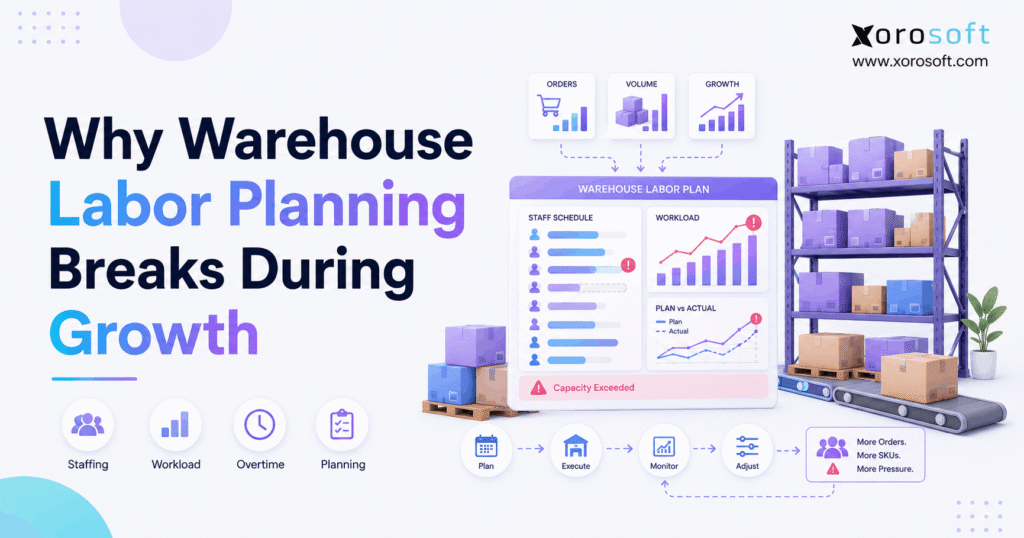
The operating loop becomes:
Forecast → Plan → Schedule → Execute → Measure → Improve
That cycle is much more useful than repeatedly adding workers after a backlog appears.
8. Spreadsheet vs WMS vs LMS vs ERP for Warehouse Labor Planning
Not every warehouse needs advanced software.
However, growing teams should understand what each type of system contributes.
| Capability | Spreadsheet | WMS | LMS | ERP |
|---|---|---|---|---|
| Basic staffing plan | Yes | Often | Yes | Varies |
| Warehouse task data | Manual | Strong | Uses task data | Integrated |
| Labor standards | Manual | Varies | Strong | Varies |
| Productivity tracking | Manual | Often | Strong | Reporting |
| Inventory | Manual | Strong | Limited | Strong |
| Purchasing | Limited | Limited | Limited | Strong |
| Demand planning | Manual | Limited | Limited | Often available |
| Accounting | No | No | No | Strong |
Capabilities differ by product. Therefore, buyers should review actual features instead of assuming that every system in the same category behaves the same way.
8.1 When spreadsheets still work
Spreadsheets can work well for small warehouses with stable demand and simple processes.
Moreover, they are flexible and inexpensive.
However, spreadsheets become harder to manage when planners must manually combine:
- Orders
- Inventory
- Purchase receipts
- Employee schedules
- Productivity
- Multiple warehouses
At that point, the planning process may spend more time gathering data than making decisions.
8.2 How a WMS supports warehouse labor management
A warehouse management system tracks the physical work taking place inside the building.
Therefore, WMS data can provide better visibility into receiving, put-away, replenishment, picking, packing, shipping, and inventory movement.
For example, XoroWMS connects warehouse execution with real-time inventory and operational workflows.
As a result, managers can base labor decisions on actual warehouse activity rather than manually rebuilt reports.
8.3 When an LMS becomes useful
A labor management system focuses more deeply on:
- Labor standards
- Benchmarks
- Productivity
- Task performance
- Labor cost
- Plan-versus-actual results
Therefore, an LMS becomes more useful when labor is a major cost or when managers need detailed task-level performance data.
8.4 Where ERP adds value
ERP connects warehouse work to the business events that create that work.
For example, XoroERP can connect inventory, orders, purchasing, accounting, and operations.
Therefore, planners can understand both current warehouse tasks and the upstream activity likely to create future work.
9. How Xorosoft Supports Warehouse Labor Planning
The goal of warehouse software should not be to replace operational judgment.
Instead, software should give managers cleaner data and a clearer view of upcoming work.
9.1 Connect warehouse execution with broader operations
Xorosoft combines ERP and warehouse capabilities for inventory-driven businesses.
Therefore, teams can connect warehouse activity with:
- Inventory
- Orders
- Purchasing
- Accounting
- Forecasting
- Ecommerce
- Wholesale operations
Businesses evaluating a broader connected platform can also review XoroONE to understand how these operational areas can work together.
9.2 Connect ecommerce demand with warehouse work
Online orders often create sudden shifts in warehouse demand.
Therefore, ecommerce data should not live separately from inventory and fulfillment planning.
Xorosoft supports connections across ecommerce and operational systems through its integration ecosystem.
As a result, teams can reduce the manual work required to bring channel data into their operating process.
9.3 Use real data instead of disconnected reports
Growing operations frequently have one system for ecommerce, another for accounting, spreadsheets for purchasing, and separate warehouse tools.
However, each disconnected system creates another point where managers may need to export, clean, and combine data.
Xorosoft’s broader ERP and operations solutions are designed around inventory-driven businesses that need those processes to work together.
Therefore, warehouse labor planning can become part of a larger operational view instead of an isolated scheduling task.
10. Warehouse Labor Planning for Different Industries
The basic planning method stays similar.
However, workload drivers vary significantly by industry.
10.1 Apparel and fashion
Apparel warehouses often manage large SKU counts because one style may have many sizes and colors.
Therefore, replenishment, location management, and picking can become complex even when units remain manageable.
10.2 Furniture
Furniture adds size and handling challenges.
As a result, planners may need to consider team lifts, equipment, larger storage areas, and longer travel.
10.3 Sporting goods
Sporting-goods operations may handle both small products and oversized items.
Therefore, one broad productivity rate can hide very different handling needs.
10.4 Food and beverage
Food operations may require additional lot, date, rotation, or quality steps.
Consequently, warehouse labor requirements can be higher than basic unit counts suggest.
10.5 Wholesale distribution
Wholesale orders may contain many lines and case quantities.
In addition, EDI and customer routing rules can add extra steps before an order ships.
10.6 Manufacturing
Manufacturers move more than finished goods.
They may also handle raw materials, components, work-in-process, production staging, and finished inventory.
Therefore, customer orders represent only part of total warehouse workload.
Companies evaluating how ERP and warehouse requirements change by sector can review the industries Xorosoft serves.
11. Common Warehouse Labor Planning Mistakes
Even sophisticated warehouses can weaken their labor plans with a few basic mistakes.
11.1 Planning only from order count
Order count is useful.
However, lines, units, picks, receipts, and special tasks often explain labor much better.
11.2 Using one warehouse productivity rate
A single rate hides process differences.
Therefore, measure receiving, replenishment, picking, packing, and shipping separately.
11.3 Ignoring indirect time
Scheduled hours are not the same as productive hours.
Consequently, plans should include realistic time for breaks, meetings, training, and support tasks.
11.4 Treating overtime as normal capacity
Overtime can protect service during a short peak.
However, recurring overtime should not become the main capacity strategy.
11.5 Ignoring inbound demand
Outbound work is visible because customers are waiting.
Nevertheless, poor receiving and replenishment can create the outbound delay later.
11.6 Measuring workers but not processes
Low productivity does not always mean low effort.
For example, poor slotting, empty pick faces, long travel, or system delays may be the real cause.
Therefore, measure the process as well as the person.
11.7 Buying software before defining the planning model
Software can make planning faster.
However, it cannot automatically decide which workload drivers matter most for your operation.
First, define the process.
Then, define the data.
Finally, choose the system that supports the model.
12. When to Upgrade Your Warehouse Labor Planning System
Simple planning methods can remain useful for years.
However, several signals suggest the operation has outgrown them.
12.1 You operate several warehouses
Multiple sites increase planning complexity because each location has its own staff, demand, inventory, and process limits.
Therefore, company-wide headcount becomes less useful than site-level capacity.
12.2 Your channel mix keeps changing
Shopify, Amazon, wholesale, retail, and EDI orders can create different workload patterns.
Consequently, one average order rate becomes less reliable.
12.3 Overtime remains high
Persistent overtime may show that the current plan is reacting to demand instead of predicting it.
12.4 Managers cannot explain labor variance
If actual labor regularly differs from plan, managers should be able to identify why.
For example:
- Was workload higher?
- Was productivity lower?
- Did the order mix change?
- Did replenishment fail?
- Were employees absent?
If those questions cannot be answered, the planning system lacks useful detail.
12.5 Planning requires hours of manual work
When managers spend hours downloading files and combining spreadsheets, automation becomes more valuable.
Therefore, the business should assess whether its WMS, ERP, or labor tools can bring those inputs together.
13. A Practical Warehouse Labor Planning Checklist
Before finalizing the next labor plan, check the following:
- Forecasted order volume is available
- Order lines and units are considered
- Inbound receipts are included
- Replenishment needs are estimated
- Returns are included
- Productivity rates are current
- Each major warehouse process has its own assumptions
- Employee skills are known
- Breaks and indirect time are included
- Expected absences are considered
- Required labor hours are calculated
- Available productive hours are calculated
- Process bottlenecks are visible
- Overtime exposure is known
- Planned and actual results are compared
- Productivity assumptions are reviewed often
Therefore, the warehouse plan becomes a working operating model rather than a simple employee schedule.
14. Scale the Warehouse by Planning the Work, Not Just the People
Growth does not break warehouse labor planning because managers suddenly forget how to schedule employees.
Instead, growth breaks the old relationship between order volume and warehouse work.
More SKUs create more touches. Meanwhile, more channels create different order profiles. In addition, purchasing growth creates more receiving and replenishment.
Therefore, the solution is not automatically more headcount.
A stronger approach connects:
Demand → Workload → Required hours → Available capacity → Execution → Actual results → Better future planning
At first, a spreadsheet may be enough. However, once multiple warehouses, channels, inventory flows, and operating systems become involved, connected data becomes far more important.
Xorosoft helps inventory-driven businesses bring ERP, warehouse management, purchasing, ecommerce, accounting, and reporting into a more connected environment.
If your warehouse has reached the point where labor problems are really data and process problems, you can book a personalized Xorosoft demo to review how your current workflows could be structured more clearly.
Frequently Asked Questions
What is warehouse labor planning?
Warehouse labor planning is the process of estimating upcoming warehouse workload and turning that workload into required labor hours and staffing capacity. Instead of using headcount alone, a good plan considers work such as receiving, replenishment, picking, packing, and shipping. Therefore, managers can see where labor is needed before delays or overtime appear.
Why does warehouse labor planning fail during growth?
Warehouse labor planning often fails because growth changes more than order volume. More SKUs, channels, warehouses, suppliers, and order types create new work patterns. As a result, historical staffing ratios stop matching current needs. Therefore, growing warehouses should forecast process-level workload and labor hours instead of simply adding people as total orders rise.
How do you calculate warehouse labor requirements?
Start with forecast workload and divide it by a realistic productivity rate. For example, 12,000 picks at 120 picks per productive hour require 100 productive hours. Next, adjust for breaks, training, absence, travel, and indirect work. Therefore, the final staffing plan should compare required productive hours with the productive capacity actually available during the shift.
What is the difference between warehouse labor planning and scheduling?
Warehouse labor planning determines how much workforce capacity an operation needs based on expected work. Scheduling decides which employees work specific shifts and times. Therefore, planning should come first. A schedule may look fully staffed while still failing if the expected receiving, picking, packing, or shipping workload requires more productive hours than the scheduled team can provide.
Can a WMS improve warehouse labor planning?
Yes. A WMS can provide detailed data about receiving, put-away, replenishment, picking, packing, shipping, and inventory movement. Therefore, managers can base labor plans on actual warehouse activity instead of broad averages. However, WMS labor features vary by platform, so businesses should check whether their system also supports productivity tracking, workload forecasting, and labor reporting.
When should a warehouse stop using spreadsheets for labor planning?
Spreadsheets become limiting when managers spend hours combining orders, inventory, schedules, receipts, and productivity data manually. In addition, multiple warehouses and sales channels make those files harder to maintain. Therefore, companies should consider a WMS, LMS, or connected ERP environment when planning becomes reactive, overtime remains high, or labor variance can no longer be explained clearly.
What warehouse labor planning KPIs should managers track?
Useful warehouse labor planning KPIs include units per labor hour, lines per hour, picks per hour, overtime percentage, indirect labor, labor cost per order, planned versus actual hours, and on-time shipping. However, no single metric tells the full story. Therefore, managers should track both productivity and service results while measuring each major warehouse process separately.
Recent Posts
-
 Food and Beverage ERP Requirements for Lot, Expiry, and Recall Control
 -
 How to Prevent EDI Errors Before They Become Retailer Chargebacks
 -
 Warehouse Injury and Safety Statistics: What Operations Teams Should Know Before Automating Workflows
 -
 Vendor Portal vs Supplier Portal: What Distributors Actually Need Connected to ERP
 -
 Cloud Distribution ERP Software for Centralizing Inventory, Orders, Warehouses, and Financial Operations