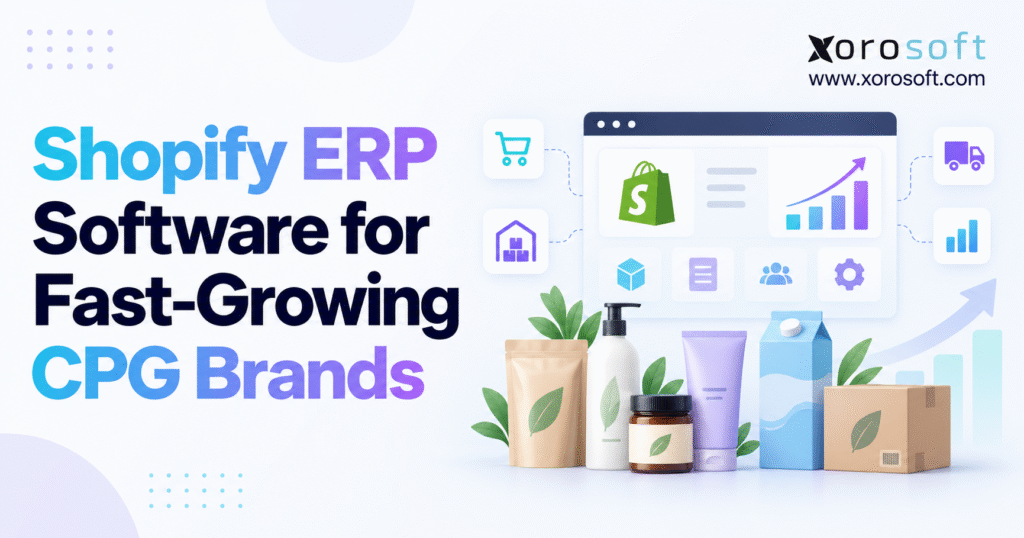
If you are searching for reliable Shopify ERP software to streamline your business operations, this guide will help you make an informed choice.
1. Fast-Growing CPG Brands Usually Outgrow Their Back Office Before Shopify
Fast-growing consumer brands rarely experience an operational breakdown in one dramatic moment. Shopify keeps accepting orders, products continue selling, and revenue may still be climbing. Behind that growth, however, daily operations become progressively harder to coordinate.
Inventory starts requiring manual checks. Buyers maintain larger purchasing spreadsheets. Wholesale accounts introduce different order rules. Amazon consumes another pool of stock. A second warehouse or 3PL creates another source of inventory information. Meanwhile, finance spends more time reconciling sales, returns, inventory movements, and supplier costs.
The issue is not necessarily Shopify.
Instead, the operating environment around Shopify has become more complicated than the original technology stack was designed to control.
Early-stage CPG businesses often work efficiently with Shopify, accounting software, shipping tools, and a handful of specialized apps. That arrangement can support growth for years when SKU counts remain manageable, purchasing is straightforward, and fulfillment happens from one location.
Complexity changes the equation.
More products create more replenishment decisions. Additional suppliers introduce different lead times, minimum order quantities, and costs. Wholesale changes inventory allocation priorities. Retail relationships can bring EDI requirements. Multiple warehouses introduce transfer and routing decisions. Kitting or manufacturing adds component-level inventory.
At that point, employees frequently become the integration layer.
They export CSV files, compare reports, re-enter purchase orders, manually adjust stock, and investigate why several applications show different inventory quantities.
The business no longer has a missing-feature problem. It has a coordination problem.
That is the stage where Shopify ERP software becomes strategically important.
1.1 Growth Adds More Dependencies Than Most Teams Expect
Each new sales channel or operational process touches information already used elsewhere in the business.
A wholesale order affects inventory. Inventory influences purchasing. Purchasing affects cash flow. Receiving changes warehouse balances. Warehouse activity changes availability. Product costs influence accounting and margin reporting.
When those processes sit in disconnected applications, one commercial event can require several systems to remain synchronized.
The larger the business becomes, the harder that coordination is to maintain manually.
1.2 Another App Is Not Always the Best Next Step
Point solutions remain useful when the problem is narrow.
A specialized forecasting tool may outperform a basic forecast feature. A dedicated shipping platform can be excellent at carrier management. Likewise, a purpose-built EDI tool may handle complex retailer relationships well.
Problems appear when each department improves locally while the overall operating model becomes more fragmented.
At that stage, the company needs to decide which system should own its operational truth rather than continuing to add software around unresolved architecture.
2. What Shopify ERP Software Should Coordinate Behind Ecommerce
Shopify ERP software is not simply an inventory application connected to an online store.
Its role is broader. A properly designed ERP environment coordinates the processes required to turn customer demand into purchasing, inventory movement, fulfillment, accounting, planning, and reporting.
Shopify remains the commerce layer. ERP manages the operational layer behind that commerce activity.
2.1 Shopify and ERP Need Different Responsibilities
Shopify is built around commerce. It handles storefront activity, products, checkout, customer orders, promotions, payments, and many customer-facing workflows.
ERP generally handles deeper back-office processes.
Those processes can include purchasing, inventory control, supplier management, warehousing, accounting, manufacturing, forecasting, and wholesale operations.
That separation is useful because one system should not attempt to control every part of the business.
A fast-growing brand needs to decide where each business object belongs. Orders might originate in Shopify, while inventory availability may come from ERP. Purchase orders are generally managed operationally, while shipment status may need to move back into the commerce environment.
The goal is controlled ownership.
2.2 The ERP Becomes the Operational System of Record
A scalable architecture requires clearly defined data ownership.
If several applications independently adjust inventory, nobody can confidently identify the correct balance. Similar problems occur when product costs, warehouse locations, customer records, or SKUs are maintained differently across systems.
Shopify ERP software should establish reliable ownership for operational information while supplying Shopify with the data needed to sell and fulfill accurately.
Once the business reaches that point, ERP becomes more than another application. It becomes the system that coordinates transactions across departments.
2.3 Data Ownership Matters More Than Synchronization Speed
ERP discussions often focus on real-time APIs and synchronization frequency.
Those topics matter, but ownership comes first.
A company needs to define which system controls the SKU, inventory balance, purchase order, warehouse transfer, cost record, fulfillment status, and financial transaction.
Once those decisions are clear, integration becomes far easier to design.
Without them, faster synchronization can simply spread bad information more quickly.
3. When Shopify ERP Software Becomes Necessary for CPG Growth
There is no universal revenue threshold at which a Shopify business suddenly needs ERP.
A company generating significant revenue through a simple DTC model may operate with less complexity than a smaller business selling hundreds of SKUs across Shopify, Amazon, wholesale accounts, multiple warehouses, and retail partners.
Operational complexity is the better signal.
3.1 ERP Readiness Appears in Daily Friction
One stock discrepancy does not justify an ERP project.
Recurring discrepancies across several functions are different.
Businesses should pay attention when spreadsheet purchasing, manual order entry, duplicate data entry, delayed reporting, and inventory reconciliation become part of normal operations.
Additional warning signs include multiple warehouses, significant wholesale volume, EDI requirements, manufacturing, complex purchasing, and marketplace expansion.
When several of those conditions appear together, Shopify ERP software becomes less about adding functionality and more about restoring control.
3.2 Revenue Alone Is a Weak ERP Trigger
Revenue is easy to measure, which is why it is commonly used as shorthand for ERP readiness.
However, revenue reveals little about operational structure.
SKU count, warehouse count, supplier complexity, transaction volume, fulfillment models, manufacturing requirements, and sales channels are far more informative.
A brand should look closely at where employees spend time compensating for disconnected systems.
Manual reconciliation is often a stronger signal than annual revenue.
3.3 Some Shopify CPG Brands Should Wait
ERP is not automatically the right choice for every growing merchant.
A business with one warehouse, a small catalog, simple purchasing, straightforward accounting, and limited multichannel activity may continue working effectively with Shopify and several specialized tools.
Installing ERP too early can add unnecessary cost and administrative effort.
The correct time arrives when fragmentation begins creating measurable risk, repetitive labor, or poor visibility.
4. Shopify ERP Software Should Establish Reliable CPG Inventory Control
Inventory is usually where operational complexity becomes visible first.
For a single-channel business, inventory can appear straightforward: receive products, sell them, and reorder stock.
An omnichannel CPG company has a different challenge.
The same unit may need to support Shopify customers, Amazon demand, wholesale accounts, retail replenishment, promotional commitments, and safety stock.
That environment requires much more than a simple on-hand quantity.
4.1 Physical Inventory Is Not the Same as Available Inventory
Imagine that a warehouse physically holds 10,000 units.
Some units are already allocated to open orders. Another portion is reserved for a wholesale launch. A smaller quantity may be under quality inspection or temporarily unavailable.
Treating all 10,000 units as sellable creates overselling risk.
Shopify ERP software should help distinguish among physical, available, allocated, reserved, damaged, quarantined, and incoming inventory when those states are relevant.
Better inventory states improve decisions across sales, customer service, purchasing, and fulfillment.
4.2 Multi-Warehouse Operations Need Centralized Visibility
Inventory complexity rises sharply when products are distributed across several facilities.
One warehouse may handle West Coast DTC orders. Another could support wholesale fulfillment. A 3PL may hold overflow inventory, while Amazon manages additional stock.
Teams still need one enterprise-wide picture.
XoroOne is designed around this kind of connected operating environment, where inventory-driven processes can be managed through one broader platform rather than stitched together department by department.
The real objective is not simply seeing warehouse balances.
Management needs to understand which inventory is available, where it should move, which orders have priority, and what needs replenishment.
4.3 Inventory Accuracy Affects the Entire Business
Poor inventory accuracy creates obvious warehouse problems, but its effects extend much further.
Customer-service teams manage cancellations and backorders. Purchasing may place unnecessary orders or miss genuine shortages. Finance works with unreliable valuation data. Marketing can promote products that cannot be fulfilled.
For those reasons, inventory accuracy should be treated as an enterprise metric rather than a warehouse-only concern.
5. Shopify ERP Software Should Connect Purchasing With Demand Planning
Growing CPG businesses eventually reach a point where purchasing cannot depend on a weekly spreadsheet review.
There are simply too many variables.
Teams need to consider current stock, open customer orders, inbound purchase orders, supplier lead times, minimum quantities, pack sizes, seasonality, promotions, and channel-specific demand.
5.1 Historical Shopify Sales Are Only One Planning Input
Sales history provides valuable information, but it does not tell the whole story.
Suppose one SKU sold 1,000 units last month.
Ordering another 1,000 may still be the wrong decision.
A large wholesale commitment could already exist. The company may have a promotion scheduled. Supplier lead time might have changed. Additional inventory could already be on the water.
Shopify ERP software should help bring those operational variables into the same planning environment.
5.2 Supplier Master Data Determines Purchasing Quality
Forecasting models receive plenty of attention, while supplier data often receives less.
That imbalance creates problems.
Lead times, MOQs, costs, pack sizes, payment terms, and supplier reliability all influence purchasing decisions.
If those values are outdated, even sophisticated planning tools can produce weak recommendations.
Strong purchasing therefore begins with disciplined master data.
5.3 Forecasting Should Support Decisions, Not Promise Certainty
No forecast eliminates demand uncertainty.
The practical objective is to improve decision quality.
Planners should be able to identify which SKUs face stockout risk, where excess inventory is building, which purchase orders may arrive late, and whether future supply supports expected demand.
As product catalogs and sales channels expand, that visibility becomes increasingly valuable.
6. Shopify ERP Software Needs Warehouse Execution That Matches System Data
ERP calculations are only as reliable as the physical transactions entered into the system.
Every receipt, putaway, transfer, pick, shipment, return, and adjustment changes inventory.
When warehouse activity is recorded late or incorrectly, every connected process inherits the error.
6.1 ERP and WMS Need to Operate as One Workflow
ERP and WMS address different layers of the business.
ERP coordinates purchasing, inventory, finance, manufacturing, and other organization-wide processes. WMS focuses more deeply on physical warehouse execution.
Inventory-heavy CPG companies often need both.
XoroWMS supports activities such as receiving, putaway, picking, packing, and warehouse inventory movement inside the broader Xorosoft environment.
Connecting those workflows helps reduce the gap between what the ERP expects and what actually happened inside the facility.
6.2 Accurate Receiving Protects Every Downstream Process
Inventory accuracy begins at the receiving dock.
Suppose a purchase order expects 500 units, but only 450 physically arrive.
The warehouse should record the actual quantity instead of automatically accepting the PO balance.
Lot-controlled products may require additional information such as batch numbers, manufacturing dates, or expiration dates.
Correct receiving improves available inventory, supplier analysis, and invoice reconciliation.
6.3 Warehouse Exceptions Need Designed Processes
Real warehouses contain exceptions every day.
Damaged cartons arrive. Pickers cannot locate inventory. Supplier quantities differ from expectations. Returns come back in unsellable condition.
A strong ERP environment should make those conditions visible and provide controlled ways to resolve them.
Otherwise, employees frequently return to spreadsheets, emails, and undocumented adjustments.
7. CPG Operations Push Shopify ERP Software Beyond Basic Inventory Apps
Consumer packaged goods businesses often have requirements that exceed ordinary ecommerce inventory management.
The exact mix varies by industry, but wholesale, EDI, lots, shelf life, manufacturing, bundles, and retailer compliance are common examples.
7.1 Wholesale Changes the Order Model
A DTC Shopify order typically follows a straightforward flow. The customer checks out, payment occurs, and fulfillment begins.
Wholesale can be more complicated.
Accounts may have negotiated pricing, credit terms, allocation rules, large order quantities, and customer-specific fulfillment requirements.
Major retailers can introduce purchase-order standards, EDI transactions, labeling instructions, routing rules, and strict ship windows.
Shopify ERP software should support wholesale and DTC without forcing the company to maintain separate operational databases.
7.2 Kits, Bundles, and Manufacturing Create Component Demand
Many consumer brands do more than buy finished goods and resell them.
Some build kits. Others manufacture internally, use co-manufacturers, perform light assembly, or create limited promotional bundles.
Demand for one finished product may therefore create demand for several components.
A gift set could consume three existing SKUs. Manufactured products may require raw materials and packaging. Promotional bundles might only exist for a specific campaign.
ERP needs to understand those relationships if purchasing and availability calculations are expected to remain accurate.
7.3 Lot and Expiration Tracking Need Real Workflows
Food, beverage, beauty, wellness, and other shelf-life-sensitive categories may require stronger traceability.
A company may need to identify which lot entered a warehouse, where the inventory moved, and which customers received it.
Expiration dates can also influence fulfillment.
Simply adding a “lot number” field is not enough.
The business should evaluate whether lot information follows inventory through receiving, transfers, production, fulfillment, and returns.
8. Shopify ERP Software Should Keep Accounting Connected to Operations
Operational growth usually creates financial complexity at the same time.
More inventory creates more valuation activity. Additional suppliers increase accounts payable volume. New channels generate different payment and settlement workflows.
Returns, discounts, freight, and stock adjustments create further reconciliation requirements.
When accounting remains disconnected, finance must reconstruct the story after transactions have already occurred.
8.1 Inventory Transactions Have Financial Consequences
Receiving inventory affects the balance sheet.
Shipping products influences cost recognition. Inventory adjustments change valuation. Supplier invoices create liabilities. Customer returns may affect both revenue and stock.
Shopify ERP software should preserve the relationship between physical activity and financial impact.
That connection can reduce the amount of investigation required during month-end closing.
8.2 Landed Cost Improves Margin Visibility
Purchase price is not always the real inventory cost.
Freight, duties, brokerage charges, and other inbound costs can materially affect product economics.
As import volumes grow, relatively small cost differences become meaningful.
Accurate landed costs help management evaluate pricing, margins, supplier decisions, and purchasing strategy with a better understanding of actual product cost.
8.3 Faster Closing Can Indicate Better Operational Architecture
Month-end delays are often treated as finance problems.
Frequently, the underlying cause begins elsewhere.
If inventory, purchase receipts, supplier invoices, and sales records disagree, finance must investigate those differences before closing.
A better-connected operating model reduces avoidable reconciliation work.
9. Shopify ERP Integration Architecture Matters as Much as ERP Features
Implementing ERP does not mean every other system disappears.
Shopify remains important. Marketplaces remain. Shipping carriers remain. Retailer EDI networks may remain. Many businesses continue working with 3PL systems and specialized applications.
ERP succeeds by creating a controlled architecture around them.
9.1 Integration Quality Depends on Ownership and Error Handling
Xorosoft’s broader integrations ecosystem reflects the type of environment inventory-driven businesses often require when Shopify becomes one channel within a larger commercial operation.
However, an integration should never be judged simply because a vendor logo appears on a website.
Teams need to understand what information moves, which direction it travels, how frequently synchronization occurs, and what happens when a transaction fails.
“Integrates with Shopify” is the beginning of due diligence, not the end.
9.2 Integration Exceptions Must Stay Visible
Every connected system eventually experiences an exception.
An unknown SKU can appear. An inventory update may fail. A duplicate order might enter the workflow. Customer information can arrive in an unexpected format.
Those failures should be visible to the teams responsible for resolving them.
Silent integration errors are particularly dangerous because employees continue working while assuming every platform agrees.
9.3 AI Becomes More Useful When ERP Data Is Trusted
Artificial intelligence is becoming more relevant inside business software.
Its usefulness, however, depends on the context it can access.
Xorosoft’s AI MCP Server reflects the broader movement toward enabling intelligent systems to interact with structured ERP information and workflows.
For a CPG business, the opportunity goes beyond adding a conversational interface.
AI can become more valuable when it has reliable context around inventory, purchasing, suppliers, warehouse activity, and financial operations.
That makes data quality even more important.
10. Omnichannel CPG Growth Changes What Shopify ERP Software Must Manage
Many CPG companies begin as direct-to-consumer brands.
Successful businesses rarely stay limited to one channel.
Wholesale, Amazon, retail stores, distributors, marketplaces, and international channels can all become meaningful sources of demand.
That expansion affects nearly every operational process.
10.1 One Inventory Pool May Serve Several Channels
The same SKU can be demanded by Shopify customers, wholesale accounts, Amazon, and retail partners at the same time.
Without allocation logic, the business risks promising the same stock to several customers.
A better model establishes rules for availability.
Some businesses reserve inventory for strategic channels. Others prioritize by required ship date, customer commitment, or service level.
The correct approach varies, but the policy should exist inside the operating system rather than inside someone’s spreadsheet.
10.2 Wholesale Adds More Than Another Order Source
Wholesale changes pricing, terms, fulfillment, and customer relationships.
An order may require approval. Credit limits may matter. Customer-specific pricing can apply. The warehouse may need to follow retailer-specific labeling or routing instructions.
Those requirements explain why an inventory-only system can become insufficient even when stock visibility itself remains good.
10.3 Channel Growth Increases the Need for One Operational View
As channels expand, reporting becomes harder.
Shopify presents one version of sales. Amazon has another. Wholesale teams maintain their own forecasts. Finance may report revenue differently from operations.
ERP should not erase those channel differences.
Instead, it should connect them into one operational model so management can understand the business as a whole.
11. Shopify ERP Software vs a Growing Point-Solution Stack
Most CPG brands do not move directly from Shopify into ERP.
Their technology stack develops gradually.
Shopify manages commerce. Accounting software manages finance. An inventory application improves stock visibility. Shipping software supports fulfillment. EDI appears when wholesale grows. Purchasing may still rely partly on spreadsheets.
That progression is logical.
The problem emerges when integration becomes the biggest workload.
11.1 Point Solutions Work Until Coordination Becomes Expensive
Best-of-breed software can provide deep specialist functionality.
The trade-off is maintenance.
Every additional application introduces another connection that needs implementation, monitoring, testing, and support.
At some point, teams may spend significant time reconciling systems rather than benefiting from specialization.
An integrated ERP reduces some of that fragmentation, although it can require stronger process standardization.
Neither architecture is automatically right for every business.
11.2 Shopify ERP Software and NetSuite Should Be Compared Through Fit
NetSuite is a widely used ERP platform and often enters the shortlist for growing product companies.
It may be appropriate for organizations that need its broader ecosystem and have the resources required for implementation, administration, and customization.
Other companies may prioritize a different implementation model, cost structure, or inventory-first operating experience.
Businesses actively considering both platforms can review the Xorosoft vs NetSuite comparison as one input while validating requirements independently.
Operational fit should still determine the final decision.
11.3 Real Workflow Demonstrations Beat Long Feature Lists
Feature sheets often make ERP products appear remarkably similar.
Real scenarios reveal differences much faster.
Ask a vendor to demonstrate a wholesale order using stock that Shopify could otherwise sell. Process a partial supplier receipt. Transfer inventory between warehouses. Handle a damaged return.
Those tests reveal how inventory, fulfillment, purchasing, accounting, and exceptions actually work together.
12. Shopify ERP Implementation Should Remove Legacy Workarounds
ERP projects can technically succeed while still failing operationally.
That often happens when implementation is treated as a software installation rather than a business-process redesign.
The goal should not be to recreate every old spreadsheet inside a new platform.
Instead, the project should simplify how work moves through the company.
12.1 Master Data Needs to Be Clean Before Migration
Product, supplier, customer, and warehouse records should be reviewed before transactions move into ERP.
Duplicate SKUs, inconsistent units of measure, outdated vendor records, and incorrect costs will not improve automatically during migration.
Poor master data can weaken purchasing, forecasting, inventory control, and reporting from the first day.
Data preparation is therefore core implementation work.
12.2 Implementation Should Follow Operational Risk
Changing every function simultaneously can create unnecessary complexity.
Some companies should establish inventory and master data first, then add Shopify orders, purchasing, warehouse workflows, finance, and additional channels.
Another organization may need a different sequence.
The project plan should follow the processes that create the greatest risk and manual effort today.
12.3 ERP Success Should Be Defined Before Go-Live
Success needs measurable outcomes.
Inventory accuracy, order cycle time, stockout frequency, warehouse productivity, purchasing efficiency, and financial reconciliation time are useful examples.
Companies evaluating implementation approaches can also review Xorosoft case studies to understand how other inventory-driven organizations approached operational change.
Case studies provide useful context, but they should never replace a company-specific requirements process.
13. CPG Industry Requirements Should Shape Shopify ERP Software
“CPG” covers a wide range of operating models.
A food company handling shelf life has different risks from a furniture brand managing bulky products. Apparel companies may focus on variants. Sporting-goods brands can combine seasonality, wholesale, and ecommerce.
The ERP architecture should reflect those differences.
13.1 Food and Beverage Brands Need Stronger Traceability
Food and beverage companies may require lot tracking, expiration management, controlled receiving, and recall readiness.
Planning can also be more sensitive because excess inventory may lose value as remaining shelf life declines.
These brands should test how traceability operates across receiving, storage, production, transfers, and fulfillment.
Traceability needs to function operationally rather than exist only as a reporting field.
13.2 Consumer Brands With Wholesale Need Allocation Discipline
Inventory conflicts become more serious when DTC and wholesale compete for the same stock.
A brand can create a major customer-service issue when Shopify sells inventory that was effectively committed to a wholesale account.
Allocation rules reduce that risk.
Some companies reserve inventory by channel. Others prioritize by customer commitment, ship date, or service level.
The system should reflect the company’s commercial policy.
13.3 Industry Fit Is More Important Than an Industry Label
Xorosoft supports several inventory-driven industries, including consumer products, wholesale, apparel, furniture, sporting goods, food, and manufacturing environments.
That breadth matters only when the platform also fits the business’s actual workflows.
A food company may prioritize traceability. Another brand may care far more about warehouse routing, wholesale pricing, Amazon operations, or manufacturing.
ERP evaluation should focus on those real requirements.
14. How to Select Shopify ERP Software Without Overbuying
ERP selection becomes unnecessarily difficult when the process begins with hundreds of generic feature requirements.
A better method starts with business outcomes.
For most fast-growing CPG brands, the critical capabilities involve inventory, purchasing, warehousing, accounting, forecasting, fulfillment, reporting, and channel integration.
14.1 Build Requirements Around Daily Operating Decisions
Instead of asking whether a vendor offers “inventory management,” test how the platform supports the decisions your teams actually make.
A useful evaluation should determine whether the system distinguishes available inventory from allocated inventory. Teams should also be able to move stock between locations while preserving transaction history.
Buyers need visibility into incoming supply and open purchase orders. Customer-service users should understand fulfillment status without asking warehouse staff for every update.
Questions like these expose meaningful differences between Shopify ERP software platforms.
| Evaluation Area | Practical Question |
|---|---|
| Shopify integration | How are orders, inventory, and fulfillment synchronized? |
| Inventory | Does the system show available, allocated, and incoming stock? |
| Purchasing | Does replenishment consider demand and supplier lead times? |
| Warehouse | Are receiving, picking, packing, and transfers controlled? |
| Accounting | Do inventory and financial records remain aligned? |
| Wholesale | Can B2B and DTC share one inventory model? |
| Manufacturing | Are components and production supported when required? |
| Reporting | Does management have one reliable operational view? |
14.2 Decide Whether ERP Should Replace Multiple Applications
Some organizations genuinely benefit from specialist tools.
Others reach a stage where maintaining integrations among those tools becomes the larger operational problem.
Xorosoft’s broader ERP solutions portfolio brings inventory, purchasing, warehousing, accounting, manufacturing, reporting, and related functions into a connected environment.
That model becomes more relevant when shared data and cross-functional workflows matter more than maintaining separate applications for every department.
14.3 Select for the Next Realistic Growth Stage
Buying ERP for hypothetical requirements ten years away can lead to unnecessary complexity.
Selecting only for today’s needs creates the opposite risk.
A more useful planning horizon considers the next several likely stages of growth.
Think about new warehouses, SKU expansion, wholesale customers, marketplaces, production requirements, and team size.
The selected architecture should support those changes without forcing another major system replacement too soon.
15. Shopify ERP Decisions That Create Problems Later
Many ERP problems begin with decisions that appear harmless during implementation.
Teams may leave unclear data ownership unresolved because integrations initially work. Old spreadsheets remain because users are comfortable with them. Customization grows because employees want every workflow to resemble the previous system.
Those decisions accumulate over time.
15.1 Do Not Rebuild Every Legacy Workflow
An ERP project should challenge existing processes.
Suppose a spreadsheet exists only because two legacy applications could not exchange information.
Rebuilding the same spreadsheet inside ERP preserves a workaround that may no longer be necessary.
Every workflow should be evaluated before migration.
Some processes genuinely add value and deserve to remain. Others exist only because of previous software limitations.
15.2 Customize Only for Meaningful Differentiation
Customization can make sense when a process creates genuine competitive or industry-specific value.
Problems arise when companies customize standard processes simply because employees prefer the old method.
Every customization can increase testing, maintenance, and future upgrade requirements.
Configuration should therefore be preferred whenever it can meet the requirement cleanly.
15.3 Business Teams Must Own ERP Processes
ERP cannot remain only an IT responsibility.
Purchasing, warehouse, ecommerce, finance, and management teams all depend on the platform.
Each major workflow should have a business owner responsible for process design, data quality, and exception handling.
That ownership becomes especially important after implementation consultants leave.
16. Shopify ERP Software Should Produce Measurable Operational Improvement
A successful ERP implementation should change business performance.
User logins alone do not demonstrate value.
Management should be able to show that operations became more accurate, faster, more visible, or easier to control.
16.1 Inventory Accuracy Should Improve
Inventory accuracy is one of the strongest indicators of operational discipline.
Compare physical counts with system quantities. Track how often adjustments occur. Identify which products, warehouses, or workflows generate the largest differences.
Improvement should become visible over time.
If Shopify ERP software is live but inventory accuracy remains poor, receiving, picking, transfers, or data ownership may still contain weaknesses.
16.2 Purchasing Should Become More Proactive
Before ERP, buyers often spend a significant amount of time figuring out what needs attention.
After implementation, more of that time should move toward decision-making.
Stock risk, supplier delays, open POs, and replenishment requirements should be easier to identify without manually assembling several reports.
The system organizes context. People still make commercial decisions.
16.3 Financial Reconciliation Should Become Easier
Finance should experience improvement as well.
Inventory valuation should align more closely with operational transactions. Purchase receipts should be easier to match with supplier invoices. Adjustments should have identifiable causes.
Reliable reporting matters more than merely producing reports quickly, but stronger integration can improve both.
17. Operational Visibility Becomes a Management Requirement at Scale
At small scale, founders often understand the business through direct involvement.
They know which supplier is late, which SKU is selling, and what inventory is sitting in the warehouse because they personally participate in those decisions.
That model becomes harder as teams grow.
17.1 Shopify ERP Software Should Create One Operational View
Growing organizations naturally develop departmental reporting.
Sales sees orders. Purchasing monitors POs. Warehouse teams track physical stock. Finance focuses on accounting records.
Problems arise when those reports describe the business differently.
Shopify ERP software should reduce that fragmentation by connecting operational events to shared data.
Leadership can then spend less time debating which number is correct and more time deciding what action to take.
17.2 Reports Should Highlight Decisions, Not Just Metrics
A dashboard has little value if nobody knows what decision it should support.
Useful reporting should highlight exceptions.
Which products are approaching stockout? Where is excess inventory accumulating? Which purchase orders are late? Which warehouse has the largest adjustment rate?
Those questions encourage action.
ERP should make operating problems easier to identify rather than simply producing more charts.
17.3 Real-Time Visibility Still Needs a Management Cadence
Real-time data does not mean leaders should watch dashboards continuously.
Different metrics require different review cycles.
Warehouse exceptions may need daily attention. Supplier performance could be reviewed weekly. Inventory turns and margin trends may belong in monthly operating meetings.
ERP creates the information foundation.
Management still needs disciplined routines for using it.
18. Scale Shopify CPG Operations With a Connected ERP Foundation
The most important distinction is simple: ecommerce growth and operational maturity are not the same thing.
A CPG brand can grow revenue quickly while its back office remains dependent on spreadsheets, disconnected applications, and manual reconciliation.
Strong employees can compensate for those gaps for a while.
Eventually, the cost becomes visible through inventory errors, stockouts, excess stock, fulfillment delays, difficult purchasing, and slower financial closing.
Shopify ERP software becomes valuable when it replaces fragmented coordination with a deliberate operating model.
The objective is not to replace Shopify.
Shopify should continue powering commerce, while ERP manages the operational complexity behind that demand.
For some companies, the immediate priorities are inventory, purchasing, warehousing, and accounting. Others also need forecasting, manufacturing, wholesale, Amazon, EDI, or multiple 3PL relationships.
The right architecture should follow the actual business model.
Start by identifying workflows that create manual effort or recurring mistakes. Decide which system should own each important data object. Test ERP platforms against real operational scenarios instead of relying on generic feature sheets.
After implementation, measure whether inventory accuracy, purchasing efficiency, fulfillment visibility, and financial reconciliation improve.
That approach creates a stronger foundation than buying ERP because the company crossed an arbitrary revenue threshold.
For CPG teams evaluating whether their current Shopify stack has reached this stage, the practical next step is to talk with Xorosoft about current workflows, operational bottlenecks, and expected growth requirements.
Xorosoft can then be evaluated alongside other options based on the realities of the business rather than on feature counts alone.
For brands specifically reviewing Shopify connectivity, the Xorosoft ERP listing on the Shopify App Store provides additional context on the available integration.
Shopify ERP Software FAQs
What is Shopify ERP software?
Shopify ERP software connects Shopify with inventory, purchasing, warehouse, accounting, forecasting, and other back-office workflows so growing CPG brands can manage operations from a more unified system.
When should a Shopify CPG brand implement ERP?
A brand should consider ERP when spreadsheets, disconnected apps, multi-warehouse inventory, wholesale, EDI, complex purchasing, or frequent reconciliation begin creating measurable operational risk or manual work.
Can Shopify ERP software manage multiple warehouses?
Yes. Suitable ERP systems can track inventory by location, support transfers, allocations, replenishment, and fulfillment rules, and give teams a centralized view of stock across warehouses and 3PLs.
Can Shopify ERP support wholesale and EDI?
Yes. ERP can coordinate DTC and wholesale inventory while supporting retailer workflows such as purchase orders, acknowledgements, ASNs, invoices, customer-specific terms, and EDI integrations.
Does Shopify ERP software include accounting?
Some ERP platforms include native accounting, while others integrate with financial software. CPG brands should evaluate inventory valuation, COGS, AP, AR, landed costs, and reconciliation requirements.
What is the difference between Shopify ERP and WMS?
ERP manages broader business processes such as purchasing, inventory, finance, and planning. WMS focuses on warehouse execution, including receiving, putaway, picking, packing, scanning, and shipping.
How should CPG brands choose Shopify ERP software?
Start with real workflows. Compare Shopify integration, inventory control, purchasing, WMS, accounting, forecasting, wholesale, traceability, implementation effort, and scalability against the company’s next stage of growth.
Recent Posts
-
 ERP Landed Cost Module vs Spreadsheet Calculations for Importers
 -
 How to Build an Open-to-Buy Plan for an Omnichannel Brand
 -
 Cold Storage WMS for Food and Beverage Distribution
 -
 ERP Buying Statistics 2026: Evaluation, Implementation, and Adoption Risks
 -
 How a Distributor Reduced B2B Order Exceptions Without Restricting Sales