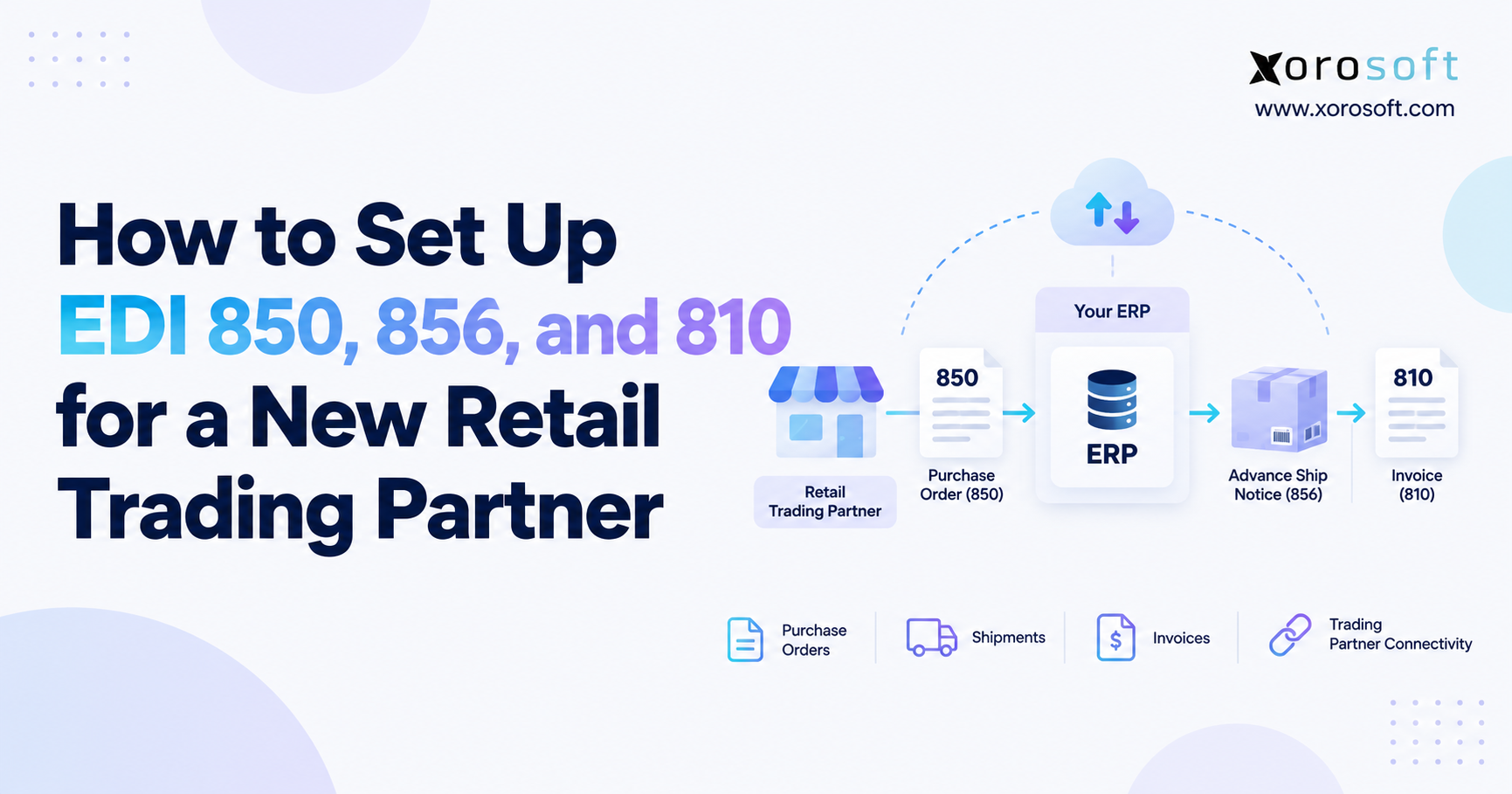
EDI 850 856 810 are some of the most common transaction sets used in electronic data interchange systems.
1. Retail EDI 850 856 810 Setup Becomes an Operational Challenge at Go-Live
Adding a new retail trading partner rarely affects only the EDI team. The retailer may send an electronic purchase order, but that transaction quickly touches customer records, product mapping, inventory availability, warehouse execution, shipping labels, carrier information, invoicing, and retailer compliance.
That is why an EDI 850 856 810 implementation requires more than a working connection between two EDI systems.
The EDI 850 purchase order must become an accurate sales order inside the supplier’s operating system. Warehouse teams then need to fulfill that order using the correct products, quantities, cartons, labels, routing rules, and shipping instructions. After packing, the EDI 856 Advance Ship Notice must describe what actually leaves the warehouse. Finally, the EDI 810 invoice needs to match the agreed commercial terms and shipment activity.
Problems usually emerge at the handoffs.
A retailer may identify products differently from the supplier. A warehouse may pack fewer units than the retailer ordered. An employee may create the ASN before packing finishes. Finance may invoice the original ordered quantity instead of the shipped quantity. A technically valid transaction can therefore contain incorrect business information.
A stronger retail EDI workflow follows one controlled sequence:
Retailer → EDI 850 → Sales Order → Inventory Allocation → Warehouse Fulfillment → EDI 856 → Shipment → EDI 810 → Accounts Receivable
The goal is not simply to exchange files successfully. The goal is to make every EDI document represent the actual operational event behind it.
2. EDI 850 856 810 Workflow Connects Order, Shipment, and Invoice Data
The three transactions support different stages of the retailer-supplier relationship.
| Transaction | Business Purpose | Typical Direction | Main Operational Trigger |
|---|---|---|---|
| EDI 850 | Purchase Order | Retailer → Supplier | Retailer places an order |
| EDI 856 | Advance Ship Notice | Supplier → Retailer | Warehouse prepares shipment |
| EDI 810 | Invoice | Supplier → Retailer | Supplier reaches billing point |
2.1 EDI 850 Purchase Order Starts the Retail EDI Workflow
The EDI 850 communicates what the retailer wants to purchase. It commonly includes a purchase order number, retailer product identifiers, quantities, pricing, delivery locations, requested dates, and other customer-specific instructions.
The supplier should translate those values directly into its internal customer, product, location, pricing, and order records.
A successful transmission does not guarantee a good order. The supplier still needs business validation before inventory allocation and fulfillment begin.
2.2 EDI 856 Advance Ship Notice Represents Warehouse Execution
The EDI 856 communicates what the supplier plans to ship or has prepared for shipment.
Depending on the retailer, the ASN may contain purchase order references, carrier information, cartons, pallets, product quantities, shipment identifiers, tracking data, and SSCC values.
The warehouse should provide most of this information because warehouse employees know what they actually packed.
2.3 EDI 810 Invoice Completes the Retail Order-to-Cash Cycle
The EDI 810 communicates what the supplier expects the retailer to pay.
It normally references the purchase order and may contain products, quantities, prices, discounts, allowances, freight, taxes, payment terms, and invoice totals.
A reliable EDI 850 856 810 workflow therefore keeps the purchase order, shipment, and invoice connected instead of managing them as three unrelated files.
3. Retail EDI Trading Partner Setup Starts With Partner-Specific Requirements
A new retail partner should provide implementation requirements before mapping begins.
The X12 standard defines the transaction structure, but individual retailers decide how they use that structure. One retailer may require fields that another retailer treats as optional. Retailers can also enforce different carton hierarchies, labels, timing rules, identifiers, and acknowledgment requirements.
3.1 Review the Retailer’s EDI Implementation Guide First
The implementation or companion guide should become the working specification for the project.
Confirm the X12 version, transaction sets, required segments, qualifiers, code lists, acknowledgment expectations, communication requirements, label specifications, and certification scenarios.
Implementation teams should also confirm that they have the latest version. Retailers can update requirements as their receiving, fulfillment, or financial processes change.
3.2 Connect Retail EDI Setup With Routing and Shipping Rules
The warehouse team should review routing requirements at the same time as the EDI team reviews transaction specifications.
A retailer may dictate carriers, service levels, ship windows, appointment procedures, carton preparation, pallet configuration, label placement, and ASN timing.
Those requirements affect what warehouse users must capture before the business sends the EDI 856.
3.3 Validate Master Data Before EDI Trading Partner Testing
Customer identifiers, bill-to records, ship-to locations, internal SKUs, retailer item numbers, UPCs or GTINs, units of measure, case packs, pricing, warehouse codes, and payment terms need accurate cross-references.
Automation magnifies master-data problems. If the mapping connects the wrong retailer product to an internal SKU, faster processing will simply create errors faster.
4. EDI Trading Partner Connectivity Must Support Reliable Transaction Monitoring
After documenting partner requirements, determine how the supplier and retailer will exchange transactions.
Retail partners may support AS2, SFTP, a Value-Added Network, or another approved connection method. The right choice depends on the retailer’s requirements, the supplier’s technical resources, security standards, transaction volume, and number of trading partners.
4.1 AS2 Supports Direct Retail EDI Communication
AS2 gives trading partners a direct method for exchanging business documents securely over the internet.
Organizations can use encryption, digital signatures, certificates, and delivery notifications to protect transactions and verify message exchange.
Direct AS2 often suits businesses that have internal resources to manage certificates, endpoints, monitoring, and connectivity exceptions.
4.2 SFTP Supports Controlled EDI File Transfer
SFTP also provides secure file exchange and fits environments where both organizations already support file-based integration.
Teams should agree on directories, file names, polling schedules, authentication, archival rules, error handling, and acknowledgment procedures before production begins.
4.3 VAN Connectivity Can Simplify Multi-Partner EDI Operations
A Value-Added Network sits between trading partners and routes transactions to the correct destination.
This approach can reduce the number of direct connections a supplier maintains as the retailer network grows.
Regardless of the transport method, the EDI layer should connect naturally with the wider technology environment. A centralized integration framework becomes increasingly valuable when retail EDI, ecommerce, warehouse applications, carriers, marketplaces, and finance systems all exchange operational information.
5. EDI 850 Purchase Order Setup Should Create a Controlled Sales Order
The first major implementation objective is turning an EDI 850 into an accurate internal order without forcing employees to re-enter retailer data.
A clean workflow validates the incoming document before inventory allocation and warehouse execution begin.
5.1 EDI 850 Customer and Ship-To Mapping Needs Precise Cross-References
Retailers often send identifiers that differ from the supplier’s internal customer codes.
Large retailers may also operate many stores, distribution centers, or fulfillment locations. The mapping process therefore needs to distinguish sold-to, bill-to, and ship-to relationships correctly.
When the integration receives an unknown location, it should create an exception instead of selecting a default location silently.
5.2 EDI 850 Product Mapping Must Connect Retailer Items to Internal SKUs
Retailers frequently order with their own item numbers.
Suppliers need a controlled relationship such as:
Retailer Item → UPC/GTIN → Internal SKU → Unit of Measure
Apparel companies may also need style, color, and size mappings. Food suppliers may need case-pack relationships. Furniture businesses may manage multiple packaging configurations for the same product.
5.3 EDI 850 Validation Should Check Price, Quantity, and Dates
The system should identify unexpected prices, invalid units of measure, discontinued products, unavailable quantities, unknown locations, and impossible requested dates before the warehouse begins work.
An operating environment such as XoroERP can place retailer orders alongside inventory, customer data, purchasing, sales operations, and financial records instead of requiring teams to reconcile separate applications later.
The objective is not to automate every EDI 850 without review. The objective is to let clean orders flow automatically while giving employees immediate visibility into exceptions.
6. EDI 850 Supporting Transactions Can Include EDI 855 and EDI 860
Many retail relationships extend beyond the 850, 856, and 810 transactions.
The retailer’s implementation guide may require purchase order acknowledgments, order changes, functional acknowledgments, inventory feeds, or other documents.
6.1 EDI 855 Purchase Order Acknowledgment Supports Order Response
Some retailers expect the supplier to send an EDI 855 after receiving the EDI 850.
The supplier can use that response to communicate the status of the purchase order or individual lines according to the retailer’s rules.
Implementation teams should decide what event generates the acknowledgment and how the workflow handles shortages, rejected items, changed dates, or other exceptions.
6.2 EDI 860 Purchase Order Changes Must Reach Fulfillment Quickly
The retailer may send an EDI 860 when it changes an existing purchase order.
The integration should update the live sales order before warehouse users continue fulfillment.
If the warehouse works from an outdated order, employees may pick the wrong quantity or ship against requirements that the retailer has already changed.
This control becomes especially important when retailers change orders close to the requested shipping date.
7. EDI 856 ASN Setup Must Match Actual Warehouse Fulfillment
The EDI 856 often creates the most operational risk because it describes physical fulfillment rather than purchase intent.
Warehouse activity should therefore drive ASN creation.
7.1 EDI 856 Data Should Come From Confirmed Shipment Activity
Assume the retailer orders 100 units, but the warehouse can only ship 96.
If the supplier creates the ASN from the original order, the document may report 100 units. If the supplier creates it from confirmed fulfillment data, the ASN reports the 96 units that actually ship.
That distinction directly affects retailer receiving.
The EDI 850 856 810 sequence works best when every transaction gets information from the operational event it represents.
7.2 EDI 856 Hierarchy Must Follow Retailer ASN Requirements
Retailers often structure ASNs around shipment, order, pack, and item relationships.
The shipment level can describe the overall carrier movement. The order level associates contents with the retailer’s purchase order. The pack level can identify cartons or pallets. Item information describes the products and quantities within that hierarchy.
Retailers do not always use these levels identically. Follow the retailer’s specification instead of assuming one ASN hierarchy will work everywhere.
7.3 EDI 856 SSCC Data Must Match Physical Shipping Labels
Retailers that use SSCC-based receiving expect the identifier on the logistics label to correspond with the ASN.
That means the warehouse label, physical carton or pallet, and electronic shipment record must describe the same logistics unit.
A warehouse platform such as XoroWMS can capture picking, packing, carton creation, labels, shipment confirmation, and inventory movement during execution. The EDI process can then use that data instead of asking employees to reconstruct shipment details after packing.
8. EDI 810 Invoice Setup Should Reconcile Order and Shipment Data
The EDI 810 closes the financial side of the retailer transaction.
A supplier can send a structurally valid invoice and still trigger a payment dispute if the quantities, prices, allowances, or references do not align with the retailer’s expectations.
8.1 EDI 810 Validation Should Compare the EDI 850 With the Shipment
A useful control sequence is:
EDI 850 → Confirmed Shipment → EDI 810
If the retailer ordered 100 units but the supplier shipped 96, the billing workflow should follow the agreed retailer rules and actual fulfillment record.
Finance should not simply copy the original order quantity into the invoice.
8.2 EDI 810 Financial Data Should Share the ERP Transaction Record
The invoice should reference the correct purchase order and use the same validated products, quantities, prices, discounts, allowances, and other financial information that the ERP uses for posting.
Partial shipments make this connection particularly important.
A retailer may receive one purchase order across multiple shipments, which can affect invoice timing and quantity calculations.
8.3 EDI 810 Totals Need Pre-Transmission Validation
The supplier should validate line extensions, discounts, allowances, freight, taxes, rounding, and final totals before transmission.
This control helps the EDI 850 856 810 process maintain traceability from the original retailer order through fulfillment and accounts receivable.
9. Retail EDI Acknowledgments Need a Separate Exception Workflow
A network can deliver an EDI document successfully while the retailer still rejects the transaction or its business data.
Implementation teams need to distinguish technical delivery from business acceptance.
9.1 EDI 997 or 999 Responses Do Not Replace Business Validation
A functional acknowledgment can tell the supplier whether the receiving EDI environment processed the structure successfully.
It does not prove that the retailer accepts every product, quantity, price, delivery date, or shipment value.
Therefore, operations teams should monitor network delivery, acknowledgments, and business exceptions separately.
9.2 Missing EDI Acknowledgments Should Trigger Action
If the retailer requires an acknowledgment and the expected response does not arrive within the agreed window, the system should create an exception.
Teams should not interpret silence as success.
At higher transaction volumes, a missing response can affect dozens of orders before employees notice the downstream impact.
10. EDI 850 856 810 Testing Must Recreate Real Retail Scenarios
Trading partner certification should prove that the complete business workflow works under realistic conditions.
Testing a single ideal purchase order does not provide enough confidence for production.
10.1 EDI Trading Partner Testing Should Start With Connectivity
Verify sender and receiver identifiers, certificates, test endpoints, control numbers, delimiters, authentication, and communication rules.
Keep test and production credentials separate so implementation teams do not accidentally send test documents into a production mailbox.
10.2 EDI 850 Mapping Tests Should Use Realistic Order Data
Use representative customers, ship-to locations, items, quantities, prices, units of measure, and requested dates.
Test both clean data and incorrect values.
For example, send an unknown product or customer location intentionally and confirm that the integration creates the expected exception.
10.3 EDI 856 Testing Should Cover Warehouse Exceptions
Test partial shipments, multiple cartons, split shipments, changed quantities, multiple purchase orders, invalid SSCC values, and different carriers.
Then compare the physical labels with the generated ASN.
10.4 EDI 810 Testing Should Reconcile the Full Transaction
Compare the invoice with the purchase order and confirmed shipment.
Certification matters most when the supplier proves the complete EDI 850 856 810 sequence rather than passing three isolated file tests.
11. EDI ERP and WMS Integration Needs Clear System Ownership
As transaction volume grows, disconnected systems create more risk than the EDI syntax itself.
Each major business record should have a clear system owner.
The EDI layer typically handles trading partner communication and document translation. The ERP manages the commercial order and financial transaction. The WMS manages physical warehouse execution. Accounting records the receivable and financial impact.
11.1 Retail EDI Integration Should Avoid Duplicate Order Records
If employees receive an EDI purchase order and then rebuild it manually inside the ERP, the business immediately creates two versions of the same order.
The same problem occurs when warehouse employees record carton information in one system while EDI users create an ASN elsewhere.
XoroONE represents an integrated approach for inventory-driven businesses that want inventory, accounting, purchasing, warehouse operations, reporting, and related workflows to operate around a shared transactional foundation.
11.2 EDI 850 856 810 Data Should Follow One Operational Source
The retailer owns the original purchase order. The ERP should own the supplier’s active sales order. The WMS should own the physical fulfillment record. The ERP and accounting environment should own the invoice.
Clear ownership reduces disagreement between systems and simplifies troubleshooting when a trading partner rejects a transaction.
12. EDI 850 856 810 Master Data Controls Determine Automation Quality
Many apparent EDI errors actually start with incorrect master data.
A wrong retailer SKU, outdated customer location, incorrect pack size, invalid price, or mismatched unit of measure can break an otherwise correct integration.
12.1 Retail EDI Item Cross-References Need Central Governance
Product relationships should not live across random spreadsheets, individual employee notes, and hidden map logic.
Maintain retailer product identifiers, internal SKUs, UPCs, GTINs, pack information, and units of measure through a controlled process.
12.2 EDI Customer and Location Mapping Needs Clear Ownership
Large retailers can operate many distribution centers, stores, bill-to locations, or fulfillment nodes.
Assign responsibility for maintaining those records so implementation teams know who approves a new or changed cross-reference.
12.3 EDI Pricing and Packaging Rules Need Version Control
Retail relationships change over time.
New pack sizes, pricing arrangements, retailer items, or routing requirements may replace older values.
The supplier should track when those changes take effect so the EDI 850 856 810 workflow uses the correct configuration for each transaction.
13. EDI 850 856 810 Exception Management Should Support Controlled Automation
Strong automation does not mean removing people from every decision.
Instead, the business should allow predictable transactions to move automatically while routing unusual conditions to the appropriate employee.
13.1 Clean EDI 850 Orders Should Flow With Minimal Intervention
If the customer, location, item, price, quantity, and dates all match approved rules, the integration can create the sales order and continue the workflow.
Employees should focus their attention on the orders that require judgment.
13.2 EDI 856 Exceptions Should Stop High-Risk Shipment Errors
Examples include missing carton identifiers, invalid SSCC values, shipment quantities that do not reconcile, or labels that do not match the ASN.
The system should surface those problems before the shipment leaves whenever possible.
13.3 EDI 810 Exceptions Should Prevent Billing Errors
An out-of-balance invoice, duplicate invoice number, incorrect PO reference, or unexpected price should trigger a finance exception before transmission.
This exception-driven model lets the supplier increase automation without losing visibility.
14. Retail EDI Compliance Depends on Warehouse and Financial Discipline
Retailers judge suppliers through the accuracy and timing of orders, shipments, labels, ASNs, and invoices.
They do not care which internal application caused the error.
That makes retail EDI compliance an operational discipline rather than an IT-only responsibility.
14.1 EDI 856 Compliance Starts Before the Truck Leaves
Warehouse teams should validate carton contents, labels, SSCC values, carrier information, routing requirements, and shipment timing before dispatch.
Correcting a problem before pickup costs less than investigating a receiving failure after the retailer has the freight.
14.2 EDI 810 Compliance Requires Consistent Financial Rules
Finance teams should verify retailer-specific allowances, discounts, freight, taxes, and invoice requirements before transmission.
Automated validation gives employees a chance to correct discrepancies before they become payment deductions.
14.3 Retail EDI Errors Should Produce Permanent Process Improvements
When the retailer reports a compliance problem, investigate the actual source.
Determine whether master data, mapping, warehouse execution, shipping, timing, or financial logic caused it. Then improve that control rather than treating every deduction as a one-time event.
15. EDI 850 856 810 Requirements Vary Across Inventory-Driven Industries
The underlying transactions remain recognizable across industries, but the physical and commercial processes behind them can differ substantially.
15.1 Apparel Retail EDI Requires Detailed Variant Mapping
Apparel brands often manage style, color, size, UPC, retailer item number, pack, and store-level relationships.
One product family may contain dozens of variants, so precise item cross-references become essential.
15.2 Furniture Retail EDI Adds Logistics Complexity
Furniture and home goods suppliers may handle large cartons, specialized carriers, delivery appointments, routing instructions, dimensions, and unusual packaging structures.
These factors make the EDI 856 heavily dependent on accurate shipping execution.
15.3 Food and Beverage EDI Can Add Traceability Requirements
Food suppliers may manage lots, expiration dates, case packs, production dates, and traceability controls alongside retailer requirements.
Warehouse data therefore needs enough accuracy to support both customer compliance and internal traceability.
15.4 Wholesale EDI Multiplies Trading Partner Rules
Wholesale distributors may support many retailers with different pricing, routing, fulfillment, labeling, and transaction requirements.
Xorosoft’s industry-focused ERP capabilities address inventory-driven environments where orders, warehouses, purchasing, fulfillment, and finance need consistent operational data.
The key point remains the same: EDI 850 856 810 transactions should reflect the physical and financial reality of the business, not function as electronic paperwork outside the operating process.
16. Shopify and Retail EDI Integration Need Shared Inventory Data
Many suppliers now sell through more than one channel.
A company may sell direct to consumers through Shopify while also receiving wholesale and retail EDI orders. Both channels compete for the same physical inventory.
16.1 Shopify and Retail EDI Can Create Inventory Conflicts
If Shopify, EDI, the ERP, and the warehouse maintain different availability numbers, the company may oversell inventory or allocate the same stock twice.
The supplier can accept an EDI 850 successfully and still miss the retailer’s fulfillment window because another channel consumed the inventory.
16.2 Ecommerce and EDI Orders Should Converge Operationally
The sales channel should not determine whether inventory, warehouse execution, and accounting stay accurate.
A central operating system can convert Shopify and retail orders into one inventory and fulfillment model while preserving channel-specific customer requirements.
For Shopify merchants considering that approach, the Xorosoft ERP app on the Shopify App Store provides an external reference for Xorosoft’s Shopify integration presence.
This structure allows direct-to-consumer orders and EDI 850 856 810 workflows to use a shared inventory foundation.
17. Standalone Retail EDI vs ERP-Integrated EDI Depends on Operational Complexity
A supplier does not automatically need a new ERP because one retailer requires EDI.
Standalone EDI can work effectively when existing systems already exchange order, warehouse, and financial information reliably.
17.1 Standalone EDI Works When Internal Handoffs Stay Controlled
A separate EDI platform may remain practical when purchase orders reach the ERP automatically, warehouse data returns reliably for ASN creation, and finance generates invoices without manual reconstruction.
The important question is not whether EDI lives inside or outside the ERP. The important question is whether data moves accurately between systems.
17.2 ERP-Integrated EDI Helps When Reconciliation Work Grows
Operational warning signs include employees entering retailer orders twice, inventory differences across channels, manual ASN creation, repeated invoice rebuilding, and recurring investigations across disconnected systems.
At that point, adding another retailer often increases administrative work.
Companies evaluating a broader architecture can review Xorosoft solutions to determine which inventory, purchasing, warehouse, financial, and order-management processes benefit from operating on one platform.
Businesses comparing enterprise ERP options can also review the Xorosoft vs NetSuite comparison when assessing implementation approach, operating fit, and system complexity.
18. AI-Assisted Retail EDI Can Improve Exception Investigation
AI can support EDI operations, but companies should keep deterministic controls around critical retailer requirements.
A purchase order either contains a valid ship-to reference or it does not. A carton either has the required SSCC or it does not. An invoice either balances or it does not.
Software should apply those rules consistently.
18.1 AI Can Help Explain EDI 850 856 810 Exceptions
Operations teams often spend more time investigating exceptions than identifying that an exception exists.
AI can help summarize transaction history, connect related orders and shipments, identify recurring error patterns, or give users relevant operational context.
For example, an employee investigating repeated ASN failures may need the purchase order, retailer rule, warehouse event, shipment record, and previous errors in one view.
18.2 AI Access to ERP Data Requires Controlled Interfaces
Businesses should govern how AI systems interact with inventory, orders, customers, and financial information.
Xorosoft’s MCP Server provides one example of an architecture designed to let AI-oriented tools work with structured enterprise information through controlled access.
AI can improve investigation and user productivity, while predictable business rules should continue to control transaction validation and approvals.
19. EDI 850 856 810 Go-Live Monitoring Should Continue After Certification
Certification confirms that the trading partners completed agreed test scenarios successfully.
Production introduces real purchase orders, real inventory constraints, warehouse pressure, customer changes, and live accounting activity. Teams should therefore monitor the first transactions closely.
19.1 Monitor the First Production EDI 850 From Receipt to Fulfillment
Confirm that the system maps the retailer, ship-to location, products, quantities, prices, and dates correctly.
Then verify that the order reaches inventory allocation and warehouse execution without unexpected manual intervention.
Do not stop monitoring simply because the EDI system reports successful receipt.
19.2 Verify the First EDI 856 Against the Physical Shipment
Compare the ASN with what warehouse employees actually packed.
Confirm shipment quantities, cartons, SSCC values, carrier information, purchase order references, and transmission timing.
If the physical shipment and ASN disagree, investigate the source before repeating the process on larger volumes.
19.3 Reconcile the First EDI 810 With the Retail Order and Shipment
Finance should compare the first invoice with the purchase order, final shipment, pricing, deductions, allowances, freight, and totals.
This step completes the production test of the EDI 850 856 810 workflow.
Companies reviewing broader system modernization can also explore Xorosoft case studies to see how inventory-driven organizations approach connected operational workflows.
20. Build a Scalable EDI 850 856 810 Workflow From Order to Invoice
A successful retail EDI implementation does more than pass certification.
The EDI 850 needs to create an accurate operational order. Inventory and warehouse teams need to execute that order against current availability and retailer requirements. The EDI 856 needs to describe the physical shipment accurately. The EDI 810 needs to use the validated commercial and fulfillment information that supports billing.
When all three transactions rely on trusted operational data, companies can automate routine activity without losing control.
When they do not, each new trading partner can introduce more spreadsheets, duplicate entry, manual verification, warehouse workarounds, reconciliation, and compliance exposure.
Before scaling an EDI 850 856 810 program, map the full transaction from retailer purchase order through accounts receivable. Identify the system that owns each event. Find every point where employees re-enter data. Document retailer-specific rules. Review how teams handle exceptions and determine whether warehouse and finance systems use the same transaction history.
A company with one simple retailer connection may continue successfully with standalone EDI. A business with multiple retailers, warehouses, ecommerce channels, purchasing workflows, and accounting requirements may need a more connected architecture.
Xorosoft focuses on inventory-driven businesses that need ERP, warehouse management, accounting, purchasing, inventory, ecommerce, manufacturing, reporting, and related workflows to share operational data.
If your next retailer onboarding project exposes gaps between EDI, inventory, warehouse execution, and accounting, contact Xorosoft to review the complete EDI 850 → fulfillment → EDI 856 → EDI 810 process against your own trading partner requirements.
Frequently Asked Questions About EDI 850 856 810
What is the EDI 850 856 810 workflow?
The retailer sends an EDI 850 purchase order. The supplier fulfills the order and sends an EDI 856 ASN, followed by an EDI 810 invoice based on the agreed billing process.
How do you set up EDI for a new retail trading partner?
Start with the retailer’s implementation guide. Configure connectivity, partner identifiers, transaction maps, product and location cross-references, acknowledgments, labels, testing scenarios, and production credentials before completing certification and go-live.
What should be tested before EDI go-live?
Test connectivity, mapping, customer and SKU references, pricing, partial shipments, carton hierarchy, labels, SSCCs, acknowledgments, invoice calculations, rejected transactions, and other realistic exceptions before moving the trading partner into production.
Why does an EDI 856 ASN fail?
Common causes include incorrect shipment quantities, invalid hierarchy, missing PO references, wrong ship-to data, duplicate or missing SSCCs, label mismatches, carrier errors, and late ASN transmission.
How should EDI 810 match the EDI 850?
The EDI 810 should reference the correct purchase order while reflecting validated prices, agreed charges, and billable quantities based on the retailer’s requirements and the actual fulfillment record.
Do EDI 850 856 810 workflows need ERP and WMS integration?
Not always, but integration becomes valuable when the ERP owns orders and invoicing while the WMS manages cartons, labels, inventory movement, and shipment data required for accurate ASNs.
When should a business upgrade from standalone EDI?
Consider deeper integration when teams repeatedly re-enter orders, create ASNs manually, reconcile inventory across systems, rebuild invoices, manage many retailers, or investigate recurring errors across disconnected applications.
Recent Posts
-
 ERP Landed Cost Module vs Spreadsheet Calculations for Importers
 -
 How to Build an Open-to-Buy Plan for an Omnichannel Brand
 -
 Cold Storage WMS for Food and Beverage Distribution
 -
 ERP Buying Statistics 2026: Evaluation, Implementation, and Adoption Risks
 -
 How a Distributor Reduced B2B Order Exceptions Without Restricting Sales