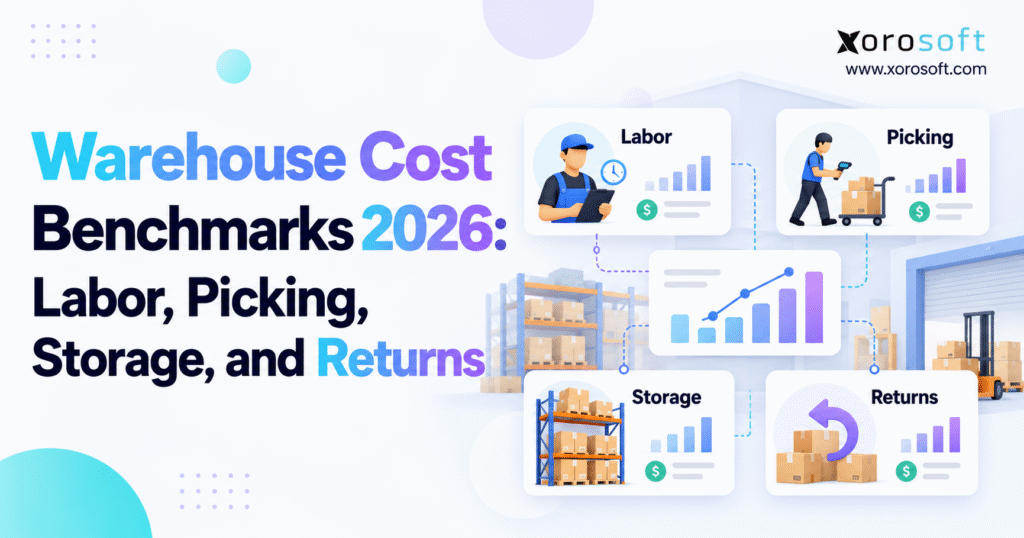
Businesses planning for the future need up-to-date information about warehouse cost benchmarks 2026.
1. Why Warehouse Cost Benchmarks 2026 Matter More Than Total Spend
Warehouse costs rarely rise because of one large problem. In most cases, several smaller issues build up at the same time. Wages increase, orders need more touches, inventory stays longer, returns consume extra labor, and pick paths become less efficient.
The monthly warehouse bill shows that spending changed. It does not explain what caused the increase.
That is where warehouse cost benchmarks 2026 become useful. Strong benchmarks break warehouse spending into clear measures such as labor cost per order, picking cost per line, storage cost per pallet, cost per return, and total warehouse cost per shipment.
Cost control is also a major focus for warehouse leaders. According to WERC’s 2026 DC Measures research, 48.6% of respondents identified cost reduction as their main business goal. The research tracks warehouse performance across cost, labor, service, quality, capacity, inbound work, and outbound work.
1.1 Measure the work behind warehouse costs
A warehouse that spends $2 million per year may be efficient or expensive. Total spend alone cannot answer that question.
One facility may ship 500,000 large wholesale orders. Another may process two million simple one-item ecommerce orders. The first site may spend more overall while still controlling its cost well for the type of work it performs.
Useful measures therefore include cost per order, cost per line, cost per unit, labor cost per shipment, storage cost per pallet, and cost per return.
The same rule applies to labor. Lower hourly wages do not always produce lower warehouse costs. Long walks, repeated searches, poor replenishment, stock errors, and rework can make a low-wage operation expensive.
1.2 Use warehouse benchmarks to find the real issue
A benchmark should point teams toward questions rather than instant answers.
When labor cost per order rises, the cause might be poor slotting, long travel paths, too much overtime, weak replenishment, or a more complex order mix.
High storage cost may come from expensive rent. However, excess inventory, slow-moving stock, poor use of pallet locations, or a building that no longer matches demand can create the same result.
The best use of warehouse cost benchmarks 2026 is to find the gap first and investigate the process second.
2. Warehouse Cost Benchmarks 2026: Core Numbers to Watch
A useful 2026 warehouse study covered 500 warehousing and fulfillment providers, with about 80% located in the United States and 20% in Canada. The survey looked at labor, receiving, storage, fulfillment, returns, technology, and provider costs.
According to The Fulfillment Advisor’s 2026 Warehousing and Fulfillment Costs & Pricing Survey, average customer pricing reached $3.21 for a one-item DTC pick-and-pack order and $4.86 for a one-item B2B order.
Average pallet storage was $19.37 per month. A single-item return averaged $3.56 to process, while receiving averaged $8.75 per pallet or $2.25 per carton.
These figures give operators useful outside reference points. Still, the numbers need the correct labels.
2.1 Separate 3PL pricing from internal warehouse costs
A 3PL pick-and-pack rate is a customer price.
An internal warehouse does not normally record one fixed pick-and-pack fee. Instead, the company pays wages, rent, utilities, software, equipment, supplies, maintenance, management, and other costs.
As a result, the two numbers answer different questions.
A provider charging $3.21 for a one-item order does not mean an internal warehouse should also cost exactly $3.21 per order. The provider’s rate must support a broader business model.
For warehouse cost benchmarks 2026, keep outside service prices, internal operating costs, and worker output separate.
2.2 Look at ranges rather than one average
Warehouse expenses vary by city, building type, product size, order profile, customer needs, and service level.
For example, the same 2026 survey found pallet storage rates ranging from about $6 to $40 per pallet per month even though the overall average was $19.37.
A business storing light apparel in a lower-cost market should not copy the target of an operation holding heavy or special-care products in a high-cost city.
Good benchmarking compares similar warehouse types instead of forcing every business toward one number.
3. Warehouse Labor Cost Benchmarks 2026
Labor remains one of the largest warehouse expenses because people still handle many steps across receiving, put-away, replenishment, picking, packing, shipping, and returns.
The U.S. Bureau of Labor Statistics reported average hourly earnings of $26.74 in warehousing and storage in July 2026. Production and nonsupervisory staff averaged $25.73 per hour.
For 2025 occupation-level data in the same industry, median pay included $23.16 per hour for industrial truck operators, $22.42 for shipping and receiving clerks, and $21.49 for stock clerks and order fillers.
These figures give useful context, but hourly pay is not the same as total employer labor cost.
3.1 Hourly wage is only part of warehouse labor cost
An employee earning $22 per hour can cost the business much more than $22 for each paid hour.
Employers may also pay payroll taxes, benefits, paid leave, workers’ compensation, overtime, hiring costs, training expenses, and temporary worker fees.
Supervisors and support staff also add cost even if they do not pick customer orders directly.
For this reason, warehouse teams should track both base wage and full labor expense. Base wage helps with staffing decisions, while full labor expense provides a better basis for warehouse cost analysis.
3.2 Calculate warehouse labor cost per order
A basic formula is:
Warehouse Labor Cost per Order = Total Warehouse Labor Cost ÷ Orders Shipped
Suppose a warehouse spends $90,000 on labor in one month and ships 75,000 orders. Labor cost equals $1.20 per order.
That figure becomes more useful when the company tracks it month after month.
Channel-level reporting adds even more value. A one-item Shopify order should not carry the same labor target as a large wholesale shipment that requires several lines, pallet work, labels, or EDI steps.
3.3 Measure speed and accuracy together
Lower labor cost is not always a win.
A team may ship faster while creating more wrong picks. Each mistake can lead to a replacement shipment, new packing, added freight, a return, customer service work, and an inventory adjustment.
Warehouse cost benchmarks should therefore combine labor expense with worker output and quality.
Useful measures include lines per labor hour, orders per labor hour, overtime, pick accuracy, inventory accuracy, and rework.
4. Picking Cost Benchmarks 2026
Picking is one of the clearest places where warehouse labor turns into customer cost.
It is also easy to measure poorly.
Cost per order may work well in a simple DTC operation where baskets are similar. That measure becomes less useful when a company mixes ecommerce, wholesale, retail replenishment, and marketplace orders.
4.1 DTC pick-and-pack cost benchmarks
The 2026 provider study reported an average price of $3.21 for a one-item DTC order.
That price included an average base-order charge of $2.73 plus about $0.48 for each added item.
For companies reviewing outsourced fulfillment, these figures create a useful starting point.
Internal warehouses should still calculate their own cost rather than treating a 3PL price as the target.
A private warehouse may have higher visible labor cost but lower overall cost after other fees are considered. The reverse can also be true.
4.2 B2B picking costs follow a different pattern
The survey reported an average one-item B2B pick-and-pack price of $4.86.
Wholesale orders often involve work that a simple DTC order does not require. Examples include case rules, pallet patterns, carton labels, retailer routing guides, EDI transactions, shipping notices, and customer-specific packing instructions.
Those extra steps explain why B2B and DTC should not always share the same fulfillment benchmark.
Order count alone can hide the workload.
4.3 Cost per line can be more useful than cost per order
When order size changes often, cost per line may provide a clearer view.
Consider one warehouse that averages 1.3 lines per order and another that averages nine. The second site can show a much higher cost per order even when each individual line is handled well.
Track cost per order, cost per line, cost per unit, and labor minutes per order together.
This approach helps management separate poor warehouse work from a harder order mix.
4.4 Picking accuracy belongs in the cost model
The 2026 provider survey reported average order accuracy of 99.41%.
Accuracy matters because mistakes create more work.
A wrong pick can require replacement fulfillment, new packing, extra freight, return handling, stock corrections, and additional customer support.
For warehouse cost benchmarks 2026, picking speed should never be reviewed by itself. A slightly slower process with far fewer errors may create a lower total cost.
5. Warehouse Storage Cost Benchmarks 2026
Storage cost is often reduced to rent or a monthly pallet price. That view misses several real expenses.
Holding stock also requires equipment, insurance, utilities, count work, handling, working capital, and enough warehouse space to operate safely.
Slow-moving inventory can add even more cost.
5.1 Pallet, bin, and cubic-foot storage costs
The 2026 provider survey reported average storage pricing of $19.37 per pallet per month.
Other reported averages included $0.45 per cubic foot, $1.26 per square foot, and $3.03 per bin each month.
Pallet pricing remained the most common method among surveyed providers.
These figures are especially useful when a business reviews a 3PL quote. Internal warehouses require a wider calculation because monthly space cost is only one piece of the total.
5.2 Industrial rent is not the same as warehouse storage cost
Newmark reported a U.S. average industrial asking rent of $10.66 per square foot in Q2 2026.
The figure changes by market, building, size, and lease type.
It also does not equal total occupancy cost.
A warehouse operator may still pay for utilities, insurance, repairs, security, dock equipment, racks, material-handling equipment, and building management.
For that reason, warehouse cost benchmarks should not use asking rent and total storage cost as if they mean the same thing.
5.3 Empty space and overcrowding can both be expensive
A warehouse with too much open space pays for capacity it does not use.
On the other hand, an overfilled building can also become costly. Workers may travel farther, temporary stock may block normal paths, replenishment becomes harder, and receiving teams may lose staging space.
The goal is not to fill every location.
A better target is enough usable capacity to support receiving, put-away, replenishment, picking, and safe movement without paying for large amounts of idle space.
5.4 Slow stock raises warehouse storage costs
An old pallet may look inexpensive if management only considers rent.
In reality, it also uses a location, working capital, count time, insurance, and handling effort. As demand falls, the same stock may create markdown or write-off risk.
Warehouse storage cost should therefore be reviewed with purchasing and demand planning.
In many cases, a storage problem starts months earlier when the company buys more than it can sell.
6. Receiving Cost Benchmarks and Put-Away Work
Outbound fulfillment gets a large share of warehouse attention because customers feel the results.
Poor receiving, however, can raise costs across the entire building.
Goods that arrive with bad labels, incorrect quantities, missing purchase-order details, mixed items, or damaged cartons require extra work before employees can put them away.
6.1 Current warehouse receiving cost benchmarks
The 2026 provider survey reported average receiving charges of $8.75 per pallet and $2.25 per carton.
Other pricing models included about $3.00 per SKU or roughly $41.25 per labor hour.
These figures represent provider pricing rather than direct internal costs. Even so, they show how receiving problems turn into billable work.
A clean inbound shipment is easier to process than one requiring recounts, relabeling, photos, quality checks, or manual research.
6.2 Dock-to-stock time affects inventory availability
Dock-to-stock measures how long it takes goods to move from the receiving dock into usable system stock and a valid storage location.
When the process takes too long, inventory may sit inside the warehouse while sales teams still see a shortage.
The company owns the stock, but customers cannot order it yet.
Long delays also take up staging space and increase the chance of mixed, lost, or misplaced goods.
6.3 Purchasing data can lower warehouse receiving cost
Warehouse teams cannot fix every inbound issue alone.
Supplier labels, expected dates, case packs, quantities, item data, and purchase-order details usually start with the buying team.
Better records reduce questions at receiving.
For businesses that need purchasing, inventory, warehouse work, and finance connected in one flow, XoroERP can bring those areas together rather than leaving each team to work from separate files.
7. Returns Cost Benchmarks 2026
Returns are often treated as a customer service issue, yet each physical return becomes a warehouse task.
A team member must receive the item, match it to an order, check the condition, decide what happens next, update inventory, and move it to the correct place.
That makes returns an important part of warehouse cost benchmarks 2026.
7.1 Average return-processing cost
The 2026 warehouse provider survey reported an average single-item return-processing fee of $3.56.
Many providers charged between about $2 and $5, while added checks, rebagging, relabeling, or other work could increase the price.
That service fee does not represent the seller’s full return cost.
A retailer may also pay return freight, customer service labor, lost outbound freight, new packaging, markdowns, payment costs, or stock write-offs.
7.2 Ecommerce returns create extra warehouse work
The NRF 2025 Retail Returns Landscape estimated that 15.8% of total U.S. retail sales would be returned in 2025.
For online sales, the estimate reached 19.3%.
These figures come from 2025 and should not be presented as 2026 warehouse benchmarks. They still show why ecommerce returns create a large reverse-logistics workload.
Brands should track return cost per item, return processing time, time to resale, and the share of returned stock that can go back into available inventory.
7.3 Fast return decisions help protect inventory value
Labor is not always the largest cost inside a return.
A seasonal product sitting in a returns area for two weeks may miss part of its best selling period.
That issue is especially important in apparel and fast-moving consumer categories.
Clear rules for restock, repair, hold, return to vendor, markdown, or disposal help staff make faster decisions.
Good stock can then return to sale sooner, while damaged or unsellable stock stops taking up active warehouse space.
8. Warehouse Cost per Order Benchmarks
Among all warehouse cost benchmarks 2026, cost per order is one of the easiest measures for business leaders to understand.
The basic formula is:
Warehouse Cost per Order = Total Warehouse Cost ÷ Orders Shipped
If a facility spends $240,000 during one month and ships 80,000 orders, average warehouse cost equals $3.00 per order.
The difficult part is deciding which expenses belong in the calculation.
8.1 Keep the warehouse cost definition stable
A full warehouse cost figure may include receiving, put-away, picking, packing, warehouse wages, supervisors, rent, utilities, equipment, software, supplies, repairs, and other support costs.
Some businesses use a narrower labor-only measure.
Either method can work when the rules remain consistent.
Changing the cost pool every month makes trends unreliable.
The purpose of warehouse cost benchmarks 2026 is not simply to produce a figure. The business needs a measure it can compare with confidence over time.
8.2 Split cost per order by sales channel
A blended warehouse average can hide large differences.
A Shopify DTC order might take only a few minutes to pick and pack. A wholesale order may include many lines, case quantities, EDI steps, labels, and pallet work.
Combining them into one cost can hide which channel creates the largest workload.
For ecommerce businesses that need Shopify orders and inventory connected to ERP and warehouse data, Xorosoft also offers a Shopify ERP app.
8.3 Compare cost per order with service output
Cost per order should never stand alone.
A warehouse can lower cost by reducing labor, but slower shipping and lower accuracy may follow.
Track cost together with on-time shipping, order cycle time, fill rate, picking accuracy, and return levels.
The goal is not the lowest possible warehouse cost. The target is a cost level that supports the service the business promises.
9. Warehouse Cost KPI Benchmarks
Strong warehouse reporting should show spending, output, quality, and space use together.
Each category answers a different question.
Financial measures show how much the warehouse costs. Worker output explains how much work is completed. Quality figures show whether the work is correct.
9.1 Financial warehouse cost metrics
Useful financial measures include warehouse cost per order, labor cost per shipment, storage cost per pallet, return cost per unit, and distribution cost per item shipped.
Some businesses also track warehouse spending as a share of sales.
The best measure depends on the work.
Wholesale operations may gain more insight from cost per line or carton than cost per order. Pallet-heavy businesses may find cost per pallet more useful.
9.2 Warehouse worker output measures
Track orders, lines, or units processed per labor hour.
Receiving teams can measure lines received per hour. Picking teams can review units or lines picked per hour. Packing staff can track orders completed per hour.
These figures explain why labor cost changes.
If hourly wages stay flat while cost per order rises, worker output, order size, or process delays may have changed.
9.3 Accuracy and warehouse space measures
Inventory accuracy, picking accuracy, shipping accuracy, and damage rates show whether faster work creates more errors.
Space use matters as well.
Track average warehouse capacity and peak capacity so management can see whether the site is too large, too small, or simply arranged poorly.
When warehouse, purchasing, stock, and finance data live in different systems, even basic reporting can take too much time. A cloud ERP for inventory-driven businesses can help centralize those records when separate tools become the main reporting problem.
10. Warehouse Operating Cost Benchmarks by Industry
There is no single good warehouse cost for every business.
Product size, sales channel, customer requirements, stock controls, and service levels all change the amount of work involved.
Industry context is therefore essential when reviewing warehouse cost benchmarks 2026.
10.1 Apparel and fashion warehouse costs
Apparel warehouses often carry large SKU counts because one style can have many sizes and colors.
DTC returns add more work, while wholesale shipments may need case packs, labels, EDI steps, and retail compliance.
As a result, inventory accuracy and fast return-to-stock processes can be just as important as picking speed.
The lowest cost per order is not always the strongest measure for an apparel operation.
10.2 Furniture and oversized goods
Furniture uses warehouse space very differently from clothing or small consumer goods.
Large products require more cube, larger pick paths, added damage controls, staging room, and special material handling.
Cost per order can therefore look high while still being reasonable for the type of goods handled.
A sofa and a T-shirt should never share the same warehouse benchmark.
10.3 Food and beverage operations
Food warehouses may need lot tracking, expiry controls, FIFO or FEFO rules, recall records, and temperature management.
Those steps add work, but they support product safety and traceability.
Removing necessary checks simply to lower warehouse cost would create new risks.
For that reason, cost should always be viewed alongside the controls required by the product.
10.4 Wholesale and EDI warehouse costs
Wholesale businesses may process larger customer orders with special labels, routing guides, carton rules, shipping notices, and EDI transactions.
That work may not appear in a simple pick-speed report.
Businesses can review industry-specific ERP workflows when deciding whether a cost gap comes from weak warehouse performance or normal industry requirements.
11. In-House Warehouse vs 3PL Cost Benchmarks
The question “Is a 3PL cheaper?” cannot be answered by reviewing one pick fee.
An internal warehouse carries rent, employees, equipment, software, repairs, utilities, insurance, and management.
A 3PL turns many of those expenses into receiving, storage, pick-and-pack, returns, project, and account fees.
Either model can work.
11.1 When in-house warehousing can make sense
An internal warehouse may fit businesses with steady order volume, special handling needs, tight service requirements, or enough scale to spread fixed expenses.
Direct control may also matter when fulfillment forms an important part of the customer experience.
Still, ownership does not guarantee lower warehouse cost.
Unused space, excess stock, weak labor planning, poor inventory accuracy, and disconnected systems can make an internal facility expensive.
11.2 When a 3PL can improve flexibility
A 3PL can help when demand changes sharply, the company enters new regions, or management does not want to take on another warehouse lease.
Outsourcing can also turn some fixed costs into costs that move more closely with order volume.
However, businesses need to review the whole rate card.
Storage, receiving, packaging, returns, projects, setup, account fees, and minimum charges can materially change the final cost.
11.3 Compare service as well as price
A cheap warehouse is not useful if orders leave late or stock figures are unreliable.
When comparing a 3PL with an internal warehouse, review order accuracy, shipping speed, inventory visibility, return handling, reporting, support, and exception management.
Total value comes from the right mix of cost, service, and control.
Companies considering larger ERP changes during the same review can also compare alternatives such as Xorosoft vs NetSuite based on actual warehouse, accounting, purchasing, and inventory needs.
12. How to Apply Warehouse Cost Benchmarks 2026
Industry data becomes useful only when a business first creates clean internal numbers.
A strong benchmark program starts with clear definitions and uses the same rules every reporting period.
After that, warehouse cost can be reviewed by site, sales channel, customer group, and order type.
12.1 Use one clear measurement period
Choose a month, quarter, or rolling period.
Avoid comparing a busy holiday period with a quiet summer month unless the goal is to study seasonal changes.
Peak periods may involve more overtime, temporary workers, full storage locations, and larger swings in order volume.
Fair comparisons use similar time periods whenever possible.
12.2 Split fixed and variable warehouse costs
Rent usually remains fairly stable during a lease.
Packaging, shipping supplies, and parts of direct labor may rise with order volume. Other costs sit between the two.
Base warehouse staffing, for example, may remain stable while overtime increases during busy weeks.
Splitting these expenses helps teams understand how warehouse costs should move when sales change.
If volume rises 20% while warehouse spending rises 40%, the difference deserves investigation.
12.3 Measure each warehouse on its own
A network average can hide weak sites.
One warehouse may pay higher wages but move orders faster. In another location, rent may be low while too much old stock takes up space. A third site might appear efficient simply because it handles easier orders.
Calculate the same cost and performance measures for each location first.
After that, compare the network as a whole to find meaningful differences.
12.4 Investigate the largest cost gap first
Do not launch ten projects because ten numbers look imperfect.
Begin with the gap that has the largest effect on cost or service.
High labor cost per line should lead to a review of travel, slotting, replenishment, order release, and picking methods.
When storage expense is the main problem, stock age, excess buying, building size, and item placement deserve attention.
Teams that want to examine links across ERP data can also review the Xorosoft AI MCP Server for AI-based access to business information.
13. Reducing Warehouse Costs Without Hurting Service
Lower spending means little if the warehouse becomes slower or less accurate.
The real aim is to remove waste while protecting order quality, inventory accuracy, and customer commitments.
13.1 Improve slotting before adding warehouse labor
Walking takes time.
Fast-moving products placed far from packing stations can add many hours of travel over the course of a year.
Products often ordered together may also benefit from closer placement.
Good slotting considers product speed, item size, order links, pick-face size, and refill needs.
Before hiring more workers, check whether the current team spends too much time walking.
13.2 Fix warehouse replenishment gaps
Pickers should not reach an empty location while stock sits elsewhere in the same building.
Late replenishment creates waiting, searching, rush moves, and missed shipping cutoffs.
Refilling too early can create a different problem by crowding pick faces with more stock than needed.
Set replenishment rules around demand, bin size, lead time, and expected order flow.
The goal is to keep pick locations ready without filling them too soon.
13.3 Use barcode scanning where manual work creates risk
Barcode scanning can reduce errors by confirming the correct item, location, quantity, and warehouse task.
A modern warehouse management system can guide receiving, put-away, replenishment, picking, packing, stock counts, transfers, and shipping.
Software still depends on clean data.
Incorrect units of measure, poor item records, and weak location setup can produce poor results even with a strong WMS.
13.4 Connect warehouse work with other business processes
Warehouse cost is affected by buying, sales, stock planning, ecommerce, and finance.
Excess purchasing creates storage pressure. Bad product data causes picking errors. Weak transfer rules create stock gaps. Poor ecommerce sync can lead to canceled orders.
Some warehouse problems therefore require wider connected ERP solutions instead of a narrow change inside the warehouse.
14. Common Warehouse Benchmarking Mistakes
Poor comparisons can send management toward the wrong solution.
The most common error is comparing figures that do not measure the same thing.
14.1 Do not compare a 3PL selling price with one internal expense
A 3PL pick rate includes more than picker wages.
The fee helps support the provider’s building, technology, equipment, management, and wider business.
An internal wage rate covers only one part of warehouse cost.
Build a full cost model before deciding that one option is cheaper.
14.2 Do not ignore order complexity
A rise in cost per order may be normal when each order contains more lines or units.
Cost per line and cost per unit can explain whether the warehouse itself is becoming less efficient.
This step is especially important when a company mixes DTC, wholesale, retail, and marketplace orders.
Each channel can create a very different workload.
14.3 Do not focus only on warehouse labor
Labor is visible, but storage, inventory levels, errors, returns, equipment, and poor data also create cost.
Reducing headcount while allowing stock to build can simply move the problem from payroll to storage.
Warehouse cost benchmarks work best when the full operating model is reviewed.
14.4 Do not mix data from different years without labels
Each benchmark should show the period it represents.
The online returns figure discussed earlier comes from 2025 NRF research, while the pick, storage, and return-processing prices come from a 2026 fulfillment-provider survey.
Both data sets are useful, but they answer different questions.
14.5 Do not let reporting become another manual warehouse task
If teams spend days combining warehouse exports, accounting files, buying sheets, and ecommerce reports just to calculate cost per order, reporting itself is creating work.
Businesses using several systems can review available Xorosoft integrations when checking whether manual data movement contributes to weak cost visibility.
15. When Warehouse Cost Problems Point to Better Systems
Not every warehouse cost issue needs new software.
Poor slotting, weak training, bad layout, excess stock, or unrealistic shipping cutoffs should be fixed at the process level.
Still, some patterns show that the current system may no longer match the operation.
15.1 Inventory errors keep creating extra warehouse labor
When staff repeatedly search for inventory that the system says exists, warehouse cost rises.
Workers may inspect bins, review recent moves, count stock, and ask supervisors for help.
The same errors can create backorders, short shipments, customer complaints, and accounting adjustments.
If these problems happen often, stronger warehouse transaction controls may be needed.
15.2 Multi-warehouse transfers are hard to follow
Growing businesses often increase transfer volume before building strong transfer rules.
Stock can leave one location but remain in transit too long. Another warehouse may receive a different amount. Ecommerce systems may show the wrong stock while the move is still open.
Each exception creates additional warehouse and office work.
Better transfer control becomes more important as the number of sites grows.
15.3 Management cannot explain warehouse cost per order
If warehouse, finance, and ecommerce teams each produce a different cost-per-order figure, the company lacks one trusted view.
Shared data can make that analysis easier.
Operations teams reviewing system changes can look through Xorosoft case studies to see how other inventory-led businesses approached warehouse growth and connected systems.
15.4 Upgrade based on process strain rather than company age
A young company can still have a complex warehouse operation.
A business using several warehouses, Shopify, Amazon, wholesale EDI, manufacturing, and frequent stock transfers may need stronger controls sooner than a larger company with a simple model.
Repeated errors, heavy manual work, poor stock visibility, and slow reporting are stronger upgrade signals than employee count alone.
16. Practical Next Steps for Warehouse Cost Benchmarks 2026
The strongest warehouse cost benchmarks 2026 do not push a company toward the lowest number in the market.
Instead, they show where time, space, and money are being used and whether those costs match the service being delivered.
16.1 Build a trusted warehouse cost baseline
Start with labor, receiving, picking, storage, returns, space, equipment, supplies, and warehouse systems.
Use clear rules so the same expense goes into the same category every month.
Next, divide those costs by useful workload measures such as orders, lines, units, cartons, pallets, and labor hours.
This creates a baseline that teams can trust.
16.2 Split warehouse data where the work differs
Do not rely only on one company-wide average.
Separate warehouses when labor or property costs differ. Split DTC from wholesale when order work is not comparable. Track returns separately when reverse logistics consumes meaningful time.
A useful benchmark explains the operation rather than hiding differences inside one number.
16.3 Find the cause before selecting the fix
High labor cost should trigger a review of travel time, replenishment, errors, order size, staffing, and overtime.
When storage expense rises, look at stock age, excess buying, building size, and item placement.
Expensive returns may point to product quality, packaging, return rules, product data, or slow restocking.
In many cases, the lowest-cost solution is a process change rather than new technology.
16.4 Use technology where disconnected work creates cost
Technology becomes more valuable when employees spend too much time fixing gaps between inventory, buying, ecommerce, warehouse work, manufacturing, and finance.
An integrated ERP and WMS platform may help reduce manual work and give teams a clearer view of warehouse cost.
Xorosoft is one option for inventory-driven businesses that need warehouse management connected with purchasing, accounting, Shopify, Amazon, EDI, manufacturing, forecasting, and multi-warehouse reporting.
16.5 Make warehouse benchmarking a regular management habit
Warehouse economics will continue to change as wages, rent, order mix, returns, customer rules, and technology change.
For that reason, warehouse cost benchmarks 2026 should not be treated as a one-time project.
Review major warehouse measures every month and perform a deeper cost review each quarter.
Compare the same numbers over time. Investigate large changes. Check whether spending moved because volume changed or because the process became less efficient.
The goal is not to beat every outside benchmark. It is to understand what your warehouse should reasonably cost and why.
Businesses that cannot connect warehouse activity with stock, purchasing, ecommerce, manufacturing, and accounting data should first identify where those gaps begin.
Teams ready to assess whether an integrated ERP and WMS model fits their current operation can book a personalized conversation with Xorosoft.
FAQ
What are warehouse cost benchmarks?
Warehouse cost benchmarks compare labor, storage, picking, receiving, returns, and total operating costs with similar facilities. They help teams spot cost gaps, track trends, and find process improvements.
What is a good warehouse cost per order?
There is no universal target. Cost per order depends on order size, labor rates, product type, location, service level, and channel mix. Compare similar operations and your own past performance.
What percentage of warehouse cost is labor?
Labor is often one of the largest warehouse expenses, but the share varies. Track direct and indirect labor separately, then compare labor cost with orders, lines, or units shipped.
How much does warehouse picking cost in 2026?
A 2026 provider survey reported average one-item pick-and-pack pricing of $3.21 for DTC orders and $4.86 for B2B orders. These are provider prices, not universal internal costs.
How much does warehouse storage cost per pallet?
The same 2026 survey reported average pallet storage pricing of $19.37 per month. Actual rates vary by market, storage type, volume, facility needs, and special handling.
How much does processing a warehouse return cost?
A 2026 provider survey reported an average single-item return-processing fee of $3.56. Total return cost can rise with freight, inspection, repackaging, markdowns, service work, and write-offs.
Is a 3PL cheaper than running an in-house warehouse?
Sometimes. A 3PL can reduce fixed space and staffing commitments, while in-house fulfillment offers more control. Compare receiving, storage, picking, returns, technology, labor, and service levels.
Recent Posts
-
 How a Distributor Reduced B2B Order Exceptions Without Restricting Sales
 -
 When Should Ecommerce Brands Freeze Inventory and Integration Changes Before Peak?
 -
 Why ERP Proof-of-Concept Demos Fail to Expose Operational Gaps
 -
 AI Purchase Order Recommendations: Required Data, Guardrails, and Approval Rules
 -
 Shopify Delivery Rules Software Connected to ERP and Warehouse Data