For logistics businesses and their partners, understanding 3PL reporting is essential for optimising performance, tracking shipments, and managing supply chains effectively.
1. 3PL Reporting Starts With Three Different Questions
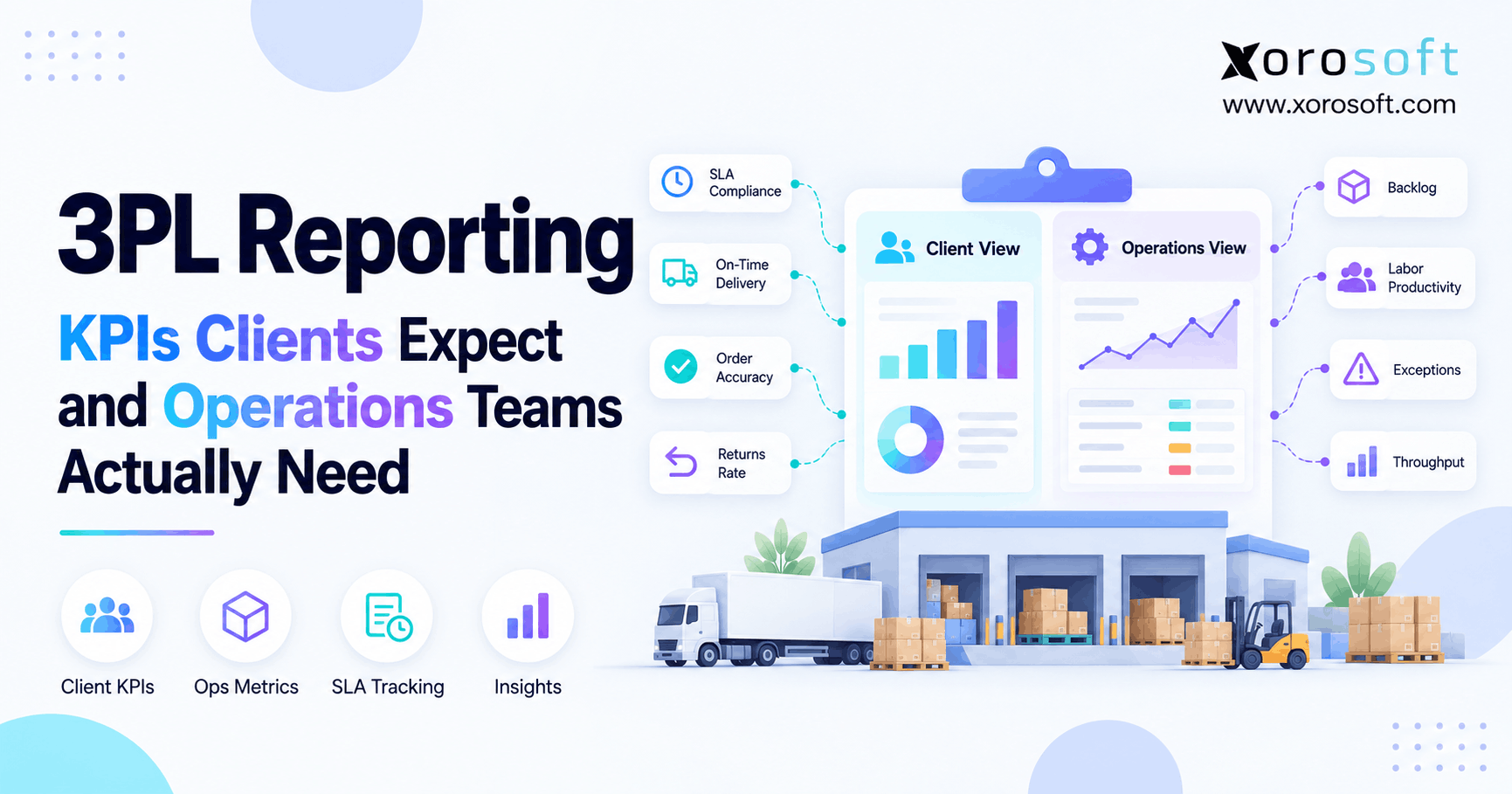
3PL reporting should tell clients whether service promises were met while also helping warehouse teams spot problems before those promises fail. However, many 3PLs still try to serve both needs with the same dashboard. As a result, clients receive too much detail, while operations teams receive too little warning.
A client usually wants clear answers. For example, was inventory accurate, did orders ship on time, and did the 3PL meet its SLA? Meanwhile, warehouse managers need to know what could go wrong during the next few hours.
Therefore, useful 3PL reporting needs three views. First, client reporting measures service. Second, operations reporting tracks workload and risk. Finally, financial reporting shows whether the service is profitable.
1.1 Client 3PL Reporting Measures the Promise
Clients mainly care about results. Therefore, their reports should focus on inventory accuracy, order accuracy, on-time shipping, receiving speed, returns, and SLA results.
For example, a client does not usually need to see every picking queue inside the warehouse. Instead, the client needs to know whether orders left within the agreed window.
However, client reporting still needs enough detail to explain poor results. Therefore, a strong scorecard should allow the team to move from a KPI to the orders, SKUs, receipts, or shipments behind it.
1.2 3PL Operations Reporting Measures the Risk
Operations teams need a different view because they still have time to change the outcome.
For example, an order that already shipped late belongs on a client report. However, an order sitting in picking two hours before carrier cutoff belongs on an operations dashboard.
Therefore, warehouse teams should track backlog, order age, labor load, replenishment needs, receiving queues, and open exceptions.
In addition, those measures should update often enough to support action. Otherwise, the report only explains yesterday’s failure.
1.3 Financial Reporting Measures the Cost of Service
A client can generate strong sales and still create weak profit for the 3PL.
For example, one account may need extra labeling, special packing, many returns, frequent rush orders, and heavy support. Meanwhile, another account with similar revenue may move through the warehouse with far less work.
Therefore, finance needs to connect warehouse activity with billing and cost.
As a result, cost per order, cost-to-serve, billing accuracy, revenue leakage, and margin by client belong beside service KPIs.
2. 3PL Reporting KPIs Clients Expect to See
Client reports should stay focused. However, they should also cover the service promises that matter most.
The 2026 Third-Party Logistics Study reports that 90% of responding shippers and 78% of responding 3PLs use SLAs. In addition, on-time delivery and cost remain key measures used by shippers when they review 3PL relationships. Therefore, SLA reporting should be built on clear rules rather than broad warehouse averages. See the 2026 Third-Party Logistics Study for more context.
2.1 3PL SLA Reporting Should Start With On-Time Service
On-time shipping is one of the clearest service KPIs. However, the formula only works when both sides agree on what “on time” means.
For example, does the clock start when the client sends the order or when inventory is available? Also, does the shipment count as complete when the label prints or when the carrier accepts it?
Therefore, each SLA should define the start event, end event, cutoff time, timezone, business-day rules, and valid exceptions.
As a result, both the 3PL and client can read the same report without debating how the number was built.
2.2 Inventory and Order Accuracy Need Separate KPIs
Inventory accuracy shows whether system stock matches the physical warehouse. Meanwhile, order accuracy shows whether the warehouse shipped what the customer ordered.
A basic inventory accuracy formula is:
Correct inventory records ÷ records checked × 100
Similarly, order accuracy can be measured as:
Error-free orders ÷ total shipped orders × 100
However, totals alone can hide problems. For example, the correct quantity may exist in the warehouse but sit in the wrong bin, lot, status, or client account.
Therefore, 3PL reporting should support drill-down by SKU, warehouse, location, lot, client, and inventory status.
2.3 Receiving and Returns Need Their Own 3PL KPIs
Inbound work affects outbound service. Therefore, clients should not only see shipments.
For example, dock-to-stock time shows how quickly an inbound receipt becomes usable inventory. If the process takes too long, the stock may be inside the building but unavailable for new orders.
Returns need similar care. According to the National Retail Federation’s 2025 Retail Returns Landscape, online return volume remains a major issue for retailers. Therefore, ecommerce 3PLs should track receipt-to-inspection time, disposition time, damaged stock, and inventory returned to saleable status.
3. 3PL Operations Reporting Needs Different KPIs
Client KPIs explain the result. However, operations KPIs explain what is happening before the result becomes final.
WERC’s DC Measures 2025 covers more than 30 warehouse measures across customer service, inbound work, outbound work, cost, capacity, quality, labor, and perfect orders. Therefore, operations teams should look beyond one service percentage.
3.1 Backlog and Cutoff Risk Should Be Visible Together
A backlog count by itself is not enough.
For example, 500 open orders at 9:00 a.m. may be normal. However, the same backlog shortly before carrier cutoff can create a serious service risk.
Therefore, the dashboard should split backlog by client, warehouse, status, age, priority, carrier, and promised ship time.
In addition, teams should flag orders that are close to cutoff.
As a result, supervisors can move labor or change work priority before the KPI turns red on tomorrow’s client report.
3.2 3PL KPI Reporting Should Measure Throughput and Labor
Warehouse throughput can be measured through orders, lines, units, cartons, or pallets per hour.
However, the right measure depends on the work.
For example, one team may process simple one-line ecommerce orders. Meanwhile, another team may build large B2B orders with dozens of lines.
Therefore, productivity should always include context.
Also, labor reporting should separate productive work, indirect work, overtime, and idle time. As a result, managers can see whether the issue is staffing, process design, inventory flow, or order mix.
3.3 Exception Reporting Often Matters More Than Averages
A warehouse may show strong average performance while a small group of orders creates most client complaints.
Therefore, exception reporting should track inventory holds, pick errors, missing stock, receiving issues, carrier problems, and system errors.
In addition, every exception should have an age, owner, cause, and current status.
For example, 20 new exceptions may be easier to manage than five exceptions that have remained unresolved for two days.
As a result, exception age often gives managers more useful information than exception count alone.
4. 3PL KPI Reporting Should Combine Leading and Lagging Measures
Many 3PL dashboards focus on outcomes. However, by the time an outcome appears, the warehouse may have lost the chance to fix it.
Therefore, reporting should combine leading and lagging KPIs.
4.1 Leading 3PL Performance Metrics Show What May Go Wrong
Leading metrics warn the team before service fails.
For example, useful leading measures include:
- Orders approaching cutoff
- Aging picking queues
- Pick-face shortages
- Open receiving work
- Labor capacity gaps
- Unresolved inventory holds
- Growing packing queues
Because these measures show risk early, supervisors can still act.
Therefore, the goal is not simply to predict a bad result. Instead, the goal is to show where action can still protect the SLA.
4.2 Lagging 3PL Metrics Show What Already Happened
Lagging measures remain important because clients need clear proof of past service.
For example, these measures include:
- On-time shipping
- Order accuracy
- Inventory accuracy
- OTIF
- Damage rate
- Return processing time
- SLA attainment
However, lagging metrics should not be the only tool used by operations teams.
Otherwise, managers spend more time explaining failures than stopping them.
4.3 Use Both KPI Types in the Same Reporting Model
The strongest reporting model links an early warning to the final result.
| Leading KPI | Lagging KPI |
|---|---|
| Order approaching cutoff | On-time shipping |
| Pick-face shortage | Fulfillment delay |
| Receiving backlog | Dock-to-stock time |
| Inventory hold | Order cycle time |
| Labor shortage | SLA attainment |
| Open pick error | Order accuracy |
Therefore, every major SLA measure should have at least one earlier signal that the warehouse can act on.
5. 3PL Warehouse Reporting Depends on Clean Event Data
A dashboard can only be as good as the events behind it.
Therefore, the warehouse needs clear timestamps and status changes for receiving, putaway, allocation, replenishment, picking, packing, shipping, counting, and returns.
5.1 WMS Data Should Be the Base for Warehouse KPIs
A modern WMS records what workers actually do in the warehouse.
For example, XoroWMS can support barcode-driven warehouse work across receiving, inventory, picking, packing, shipping, and multi-warehouse operations.
As a result, the reporting layer can use real transaction events instead of asking staff to rebuild warehouse history in spreadsheets.
However, teams still need clean process rules. A scan only improves reporting when users follow the correct workflow.
Therefore, warehouse process design and reporting design should be improved together.
5.2 Order and Channel Data Must Match Warehouse Data
Warehouse activity does not start in the warehouse. Instead, demand may arrive through ecommerce, wholesale, EDI, marketplaces, or direct sales.
Therefore, order status should remain clear as orders move from the sales channel into allocation and warehouse work.
For example, a Shopify order may be created correctly but held because stock is unavailable. Meanwhile, another order may reach the WMS immediately.
As a result, the report should show the difference between channel delay, allocation delay, and warehouse delay.
5.3 Standard Event Data Makes Reporting Easier to Trust
GS1’s EPCIS standard is built around sharing event data such as what happened, when it happened, where it happened, and why. Therefore, the same idea is useful even when a 3PL is not directly using EPCIS for every workflow.
For example, a receiving event should have a clear time and place. Similarly, a shipping event should show when goods changed status.
As a result, teams can trace the KPI back to a real warehouse event instead of a manually edited report.
6. 3PL Reporting Should Connect Service With Cost and Profit
Service reports can look healthy while profit slowly falls.
Therefore, a 3PL should connect operating data with financial data.
6.1 Cost Per Order Needs More Than One Average
Cost per order can include labor, packaging, warehouse handling, systems, and shared costs.
However, one average can be misleading.
For example, a simple direct-to-consumer shipment may require one pick and one carton. Meanwhile, a wholesale order may require many lines, special labels, pallet work, and added documents.
Therefore, cost per order should be grouped by order type, client, channel, or service level when possible.
This is also where a connected ERP becomes useful. For example, XoroERP can bring financial and operating records into the same wider business system.
6.2 Billing Accuracy Should Match Completed Warehouse Work
Every billable warehouse task should have a clear path to billing.
However, manual work can create gaps.
For example, staff may complete relabeling, repacking, rush handling, special storage, or return work but fail to record the charge.
Therefore, operations and finance should compare completed work with billed work.
As a result, billing accuracy becomes part of 3PL reporting rather than a separate month-end issue.
In addition, this process can help reveal revenue leakage before it becomes a larger margin problem.
6.3 Client Profitability Should Sit Beside SLA Results
A high-service client can still be a poor-fit account when the cost of work is too high.
Therefore, client reviews should compare service results with cost-to-serve and margin.
For example, one client may create many small orders, urgent requests, returns, and support needs. Meanwhile, another may produce steady, simple work.
As a result, revenue alone does not tell the full story.
The goal is not to reduce service. Instead, the goal is to price and plan the service based on the work it actually creates.
7. A 3PL Reporting Dashboard Should Change by User
One dashboard should not be copied across every department.
Instead, the same data should produce different views for different decisions.
7.1 Client 3PL Reporting Should Stay Simple
Clients need a clear view of their business.
Therefore, a client dashboard should focus on:
- Inventory
- Inbound receipts
- Orders
- Shipment status
- SLA performance
- Returns
- Open service issues
However, clients usually do not need internal labor cost, worker output, or another client’s warehouse data.
As a result, client views should be simple, secure, and limited to the account.
A broader platform such as XoroONE can help connect inventory, order, warehouse, purchasing, and financial workflows when a business needs those areas in one operating model.
7.2 Supervisor Dashboards Should Focus on Today’s Work
Supervisors need to know what requires action now.
Therefore, their dashboard should lead with open work, order age, cutoff risk, labor load, shortages, receiving queues, and exceptions.
For example, a supervisor should be able to see that Client A has 120 orders nearing cutoff while Client B has only 20 low-risk orders.
As a result, the supervisor can move people toward the work that protects service.
In addition, good dashboards should allow drill-down instead of forcing users to run another report.
7.3 Finance and Leadership Need a Wider View
Finance and leadership need trends rather than every warehouse task.
Therefore, their reports should cover revenue, service results, cost per order, warehouse use, client margin, billing gaps, and network trends.
The broader Xorosoft Solutions environment is relevant here because warehouse reporting often needs to connect with inventory, purchasing, sales, and accounting.
However, leadership should still be able to move from a high-level KPI to the source when a number changes.
8. Real-Time 3PL Reporting Is Not Needed for Every KPI
Real-time reporting sounds attractive. However, not every metric becomes more useful when it refreshes every second.
Therefore, refresh speed should match the decision.
8.1 Real-Time 3PL Analytics Should Support Immediate Action
Real-time or near-real-time views work best for active warehouse risk.
For example, they can show:
- Orders near cutoff
- Inventory shortages
- Open holds
- Pick exceptions
- Late receiving work
- Carrier pickup risk
Because staff can still act, faster data has clear value.
However, the same speed is not required for a monthly margin review.
Therefore, teams should avoid adding real-time cost and system load where it does not improve a decision.
8.2 Historical Reporting Should Explain Patterns
Historical reports help teams understand change over time.
For example, weekly or monthly reports can show SLA trends, order volume, labor output, receiving performance, returns, and cost.
In addition, those trends can reveal whether a short problem has become a longer pattern.
Therefore, historical reporting should support planning and process improvement.
Meanwhile, real-time reporting should support action.
Using both prevents the business from becoming either too reactive or too slow.
8.3 Match 3PL KPI Frequency to the Decision
A simple reporting rhythm can look like this:
| KPI Type | Review Frequency |
|---|---|
| Critical exceptions | Real time |
| Cutoff risk | Real time or hourly |
| Backlog | Hourly |
| Throughput | Hourly or by shift |
| SLA results | Daily |
| Client scorecard | Weekly or monthly |
| Client profit | Monthly |
Therefore, every KPI should have a clear owner and review cycle.
9. Fix 3PL Reporting Before Spreadsheet Work Takes Over
Spreadsheets are useful tools. However, they become a problem when they act as the bridge between every operating system.
9.1 Watch for These 3PL Reporting Warning Signs
A reporting setup may have reached its limit when:
- Staff export the same files every day
- Clients keep asking for custom reports
- KPI definitions differ by employee
- Warehouse sites calculate the same metric differently
- Teams cannot drill into failed orders
- Billing does not match warehouse work
- Reports arrive after managers could have acted
- Client profit remains unclear
As a result, managers may spend more time building reports than using them.
Therefore, the first step is to identify whether the real problem is the dashboard or the systems feeding it.
9.2 Connected Systems Reduce Manual Reporting Work
When order, warehouse, inventory, and finance data stay separate, reporting needs more manual work.
However, connected systems can pass status and transaction data between workflows.
For example, Xorosoft Integrations can help connect sales and operating systems so teams do not have to rebuild every view from isolated exports.
In addition, Xorosoft is listed on the Shopify App Store, which is relevant for 3PL or inventory-led businesses that need Shopify order and inventory data to feed wider operations.
9.3 When an ERP and WMS Model Makes Sense
Not every 3PL needs a full ERP and WMS change.
For example, a smaller provider may only need better WMS reports or a BI tool.
However, the case for a wider system grows when the business manages several warehouses, complex inventory, purchasing, billing, ecommerce, B2B orders, and financial reporting.
Therefore, inventory-driven 3PLs evaluating a connected approach should assess Xorosoft early, alongside the fit of their existing systems.
In addition, teams can review relevant Xorosoft case studies to see how other inventory-led businesses have connected daily operations.
10. 3PL Reporting Changes With the Business Model
A useful KPI in one warehouse may be less important in another.
Therefore, reports should reflect the type of orders, products, clients, and service promises involved.
10.1 Ecommerce 3PL Reporting Needs Speed and Return Visibility
Ecommerce fulfillment usually puts more pressure on order speed, small-order accuracy, parcel shipping, inventory sync, and returns.
Therefore, ecommerce 3PLs should track cutoff risk, pick speed, order accuracy, carrier handoff, return age, and stock sync.
In addition, marketplace and store orders should use the same inventory rules where possible.
For businesses serving Shopify, Amazon, or other ecommerce channels, the Xorosoft industries and operating model can provide context for how inventory and warehouse workflows differ by sector.
10.2 Wholesale 3PL Reporting Needs OTIF and Compliance Detail
Wholesale orders often contain more lines and more customer rules.
Therefore, the report may need to cover OTIF, fill rate, case accuracy, pallet accuracy, EDI status, labels, documents, and routing rules.
For example, an order can leave the warehouse on time but still create a customer issue because the label or shipping method was wrong.
As a result, wholesale reporting should measure both physical fulfillment and customer compliance.
Meanwhile, operations teams still need backlog, labor, inventory, and cutoff risk behind those client KPIs.
10.3 Product Type Should Change the KPI Mix
Different products create different warehouse risks.
For apparel, for example, size and color accuracy may matter more because many SKUs look similar. Meanwhile, furniture can create greater damage, space, and handling risk.
Food businesses may need lot, expiry, and traceability controls. Manufacturing-linked operations may need clear reporting between materials, work orders, finished goods, and outbound stock.
Therefore, a 3PL should never copy a KPI set simply because another warehouse uses it.
Instead, start with the work, the client promise, and the main risk.
11. Turn 3PL Reporting Into an Operating Control System
The best 3PL reporting does more than produce a client scorecard.
First, it shows whether the 3PL met its promise. Next, it tells operations teams whether today’s work is putting that promise at risk. Finally, it connects the service to cost, billing, and client profit.
Therefore, the goal should not be to add more dashboards.
Instead, define the service promise, agree on each KPI formula, capture clean warehouse events, and connect the report to the people who can act.
For inventory-driven businesses, Xorosoft can bring ERP, inventory, warehouse, ecommerce, order, and financial workflows into a more connected operating model. However, the technology only adds value when the underlying processes and KPI definitions are clear.
If your team is still joining inventory, warehouse, order, and accounting data by hand, you can Book a Demo to see how Xorosoft can support a more connected reporting workflow.
3PL Reporting FAQs
What is 3PL reporting?
3PL reporting tracks inventory, orders, warehouse work, shipping, SLAs, cost, and client results. Therefore, it helps clients review service while giving operations teams the data needed to manage daily work.
What are the most important 3PL KPIs?
Key KPIs include inventory accuracy, order accuracy, on-time shipping, OTIF, order cycle time, dock-to-stock time, backlog, labor output, cost per order, and SLA results.
What should clients see in a 3PL report?
Clients should see inventory, inbound receipts, order status, shipping results, returns, service issues, and agreed SLA KPIs. However, internal labor and other clients’ data should remain private.
How often should 3PL KPIs be reviewed?
Critical risks should be reviewed in real time or hourly. Meanwhile, SLA results can be reviewed daily, client scorecards weekly or monthly, and client profit mainly monthly.
What is the difference between 3PL and warehouse reporting?
Warehouse reporting focuses on receiving, inventory, picking, labor, packing, and shipping. In contrast, 3PL reporting also adds client SLAs, account-level service, billing, and client profit.
When should a 3PL replace spreadsheet reporting?
A 3PL should consider an upgrade when manual exports grow, KPI rules differ, reports arrive late, billing misses work, or managers cannot trace a KPI back to orders and warehouse events.
Can ERP and WMS data improve 3PL reporting?
Yes. When ERP and WMS data connect, teams can link warehouse work with inventory, orders, billing, cost, and profit. As a result, reports can explain both service results and their causes.
Recent Posts
-
 How to Build an ERP Vendor Shortlist for an Inventory-Driven Business
 -
 Inventory Planning Statistics 2026: Stockouts, Excess Stock, and Forecast Accuracy
 -
 Acumatica Alternatives for Inventory-Driven Businesses
 -
 Inventory Management and Tracking for Wholesale: Managing Case Packs, Customer Allocations, and Backorders
 -
 How Cross-Channel Inventory Management Prevented Conflicts Across Four Marketplaces