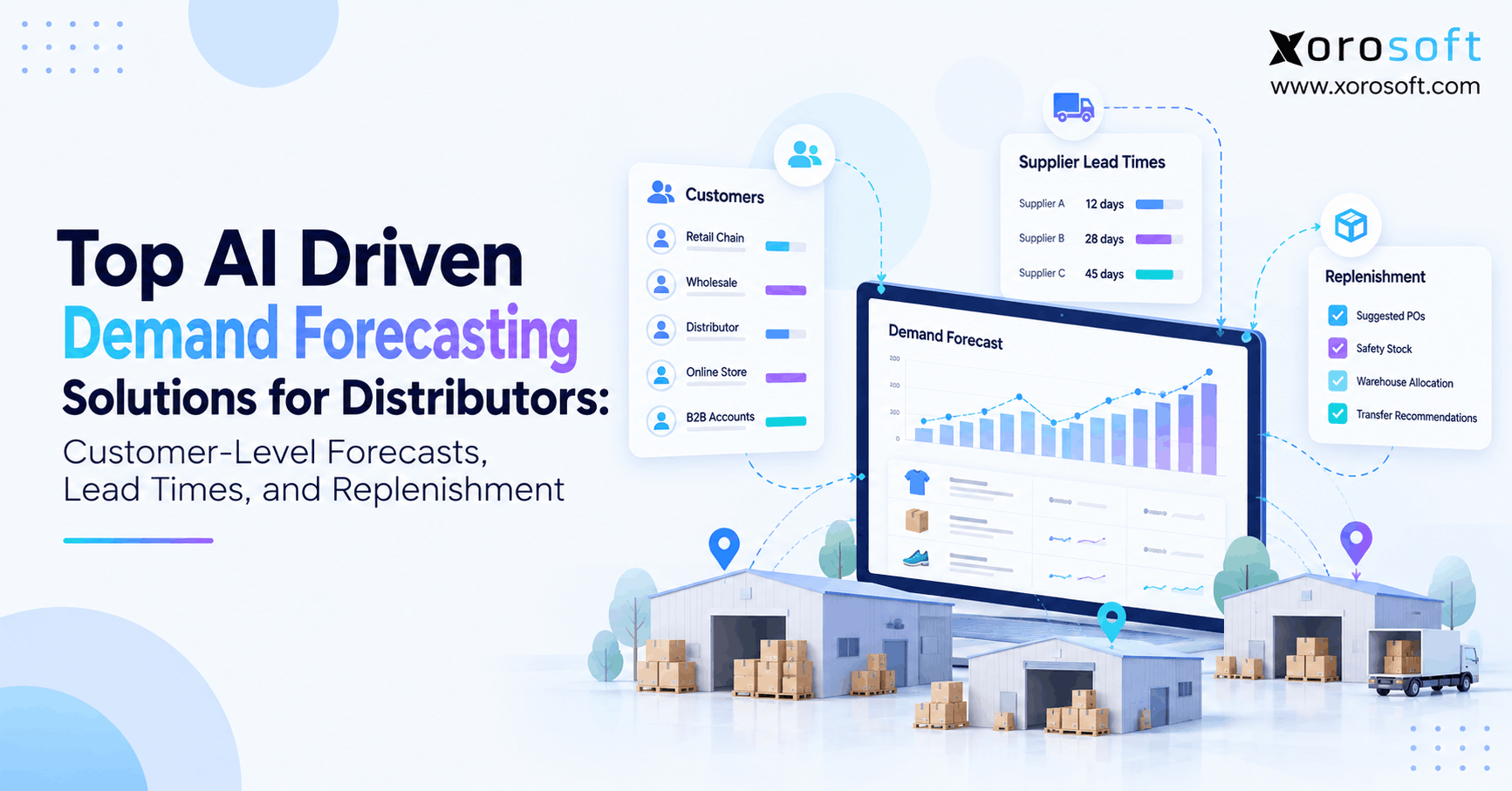
Demand forecasting for distributors is an essential part of managing inventory and meeting customer needs.
1. Why Demand Forecasting for Distributors Has Become an Operations Problem
Demand forecasting for distributors is no longer only about predicting how many units may sell next month. Instead, distributors also need to know which customers will buy, where the stock will be needed, when suppliers can deliver, and how those signals should change replenishment. Therefore, a useful forecast must support real buying and stock decisions.
At the same time, distribution businesses now sell through more channels. For example, one company may serve wholesale accounts, Shopify customers, Amazon buyers, sales reps, and EDI partners from the same stock pool. As a result, one simple monthly forecast can hide major changes inside each channel.
Moreover, supplier performance can change without warning. A product that normally arrives in 30 days may suddenly take 45. Therefore, even an accurate demand forecast can fail if the buying plan still uses an old lead time.
1.1 Why Simple Distributor Forecasting Starts to Break
At first, many distributors forecast with spreadsheets. Because the SKU count is still manageable, a buyer can review sales history and adjust reorder points by hand.
However, growth changes the problem. More products, warehouses, suppliers, and customers create far more planning combinations. In addition, planners must track stock already on hand, open purchase orders, transfers, reserved stock, and late supplier shipments.
As a result, the forecast is no longer one number. Instead, it becomes part of a wider inventory decision.
1.2 Why Forecast Accuracy Alone Is Not Enough
A forecast can be mathematically close and still lead to poor buying.
For example, a system may correctly predict 1,000 units of demand. However, if those units are expected in the wrong warehouse, customers can still face delays.
Likewise, the business may forecast 1,000 units correctly but order too late because supplier lead time increased. Therefore, distributors should measure both forecast quality and the inventory results that follow.
2. How AI Demand Forecasting for Distributors Works
AI demand forecasting for distributors uses sales and operating data to find patterns that may be hard to manage by hand. However, AI should not be treated as magic. Instead, it is another planning method that can help teams process more data, test more patterns, and update forecasts faster.
For example, an AI model may review sales history, seasonality, recent orders, customer trends, price changes, and stockouts. Then, it can update the expected demand for a product.
Moreover, some systems can work at a detailed SKU-location level. Therefore, teams can plan stock for each warehouse instead of relying only on a company-wide number.
2.1 Traditional Forecasting vs AI Demand Planning
Traditional forecasting still has value. For example, moving averages can work well for stable products with steady demand.
However, those methods become harder to manage when demand is seasonal, irregular, customer-driven, or spread across many locations. Therefore, AI tools can add value by checking more signals and choosing different models for different products.
Meanwhile, human planners remain important. They may know about a customer launch, supplier issue, or promotion before the system does. As a result, good forecasting software should support planner input rather than remove it.
2.2 Where AI Adds the Most Value
AI becomes more useful when a distributor has:
- many SKUs
- several warehouses
- seasonal items
- irregular demand
- long supplier lead times
- customer-specific buying patterns
- Shopify and wholesale demand
- large planning teams
- frequent stockouts
- excess stock
Therefore, the more variables the business must connect, the stronger the case for better forecasting software becomes.
3. Customer-Level Demand Forecasting Changes the Planning Picture
Customer-level forecasting matters because two products with the same total monthly sales can carry very different risk.
For example, assume Product A sells 1,000 units each month. However, one large customer buys 700 units. Therefore, losing that account could quickly change the forecast.
By contrast, Product B may also sell 1,000 units, but 200 customers create that demand. As a result, its demand may be less exposed to one buyer.
3.1 Why Aggregate Distributor Forecasts Hide Risk
A product-level forecast shows total expected demand. However, it may not explain where that demand comes from.
Therefore, distributors should be able to review demand by:
- SKU
- customer
- warehouse
- sales channel
- region
- product family
In addition, planners should be able to move between these levels. For example, an executive may want a category forecast, while a buyer needs a SKU-customer view.
3.2 When Customer-Level Forecasts Matter Most
Customer-level demand forecasting becomes especially useful for wholesale operations.
For example, contract customers may order at fixed times. Meanwhile, another customer may buy only during seasonal promotions.
Therefore, the system should avoid treating every sale as the same type of demand. Instead, the planning process should reflect the way customers actually buy.
4. Supplier Lead Times Must Be Part of Demand Forecasting for Distributors
Demand forecasting for distributors becomes much more useful when it connects demand to supplier lead times.
A forecast tells the business what may sell. However, lead time tells the business how early it must act.
For example, assume a distributor sells 100 units per week. If replacement stock takes two weeks to arrive, the buying decision is very different from a product that takes ten weeks.
Therefore, lead time should affect replenishment, safety stock, and purchase timing.
4.1 Average Lead Time Can Hide Supplier Risk
Suppose five deliveries arrive in:
- 28 days
- 31 days
- 32 days
- 45 days
- 52 days
The average gives one useful number. However, it hides how often the supplier runs late.
As a result, planners should also look at lead-time changes and supplier reliability.
For example, Lokad models uncertainty in both demand and supplier lead times rather than relying only on one fixed estimate.
4.2 Lead-Time Changes Should Affect Replenishment
When supplier lead time rises, the system may need to order earlier. Likewise, higher demand may require a larger order.
Therefore, a useful planning process should connect:
Expected demand + current stock + incoming supply + lead time + safety stock = replenishment need
The formula can become more advanced. However, the basic idea remains simple: forecasting should lead to an action.
5. Demand Forecasting and Replenishment Should Work Together
A forecast has little value if a buyer still rebuilds every purchase plan in a spreadsheet.
Therefore, modern demand planning should move from forecast to replenishment without repeated manual work.
The process should normally follow this flow:
Demand signal → forecast → available stock → incoming stock → lead time → safety stock → reorder recommendation → purchase order
Moreover, each step should use current data.
5.1 Why Connected Inventory Data Matters
Inventory can change every hour.
For example, sales orders reduce available stock. Meanwhile, receipts increase stock, transfers move units between warehouses, and allocations reserve units for specific orders.
Therefore, the forecast needs a reliable view of what is actually available.
This is where a connected platform can help. For example, XoroONE brings inventory, purchasing, accounting, ecommerce, and reporting into one operating environment.
5.2 Why Purchasing Data Matters Too
Forecasting should also inform the buying team.
For example, buyers need to know:
- which products require action
- when to place the order
- how much to buy
- which supplier is late
- which warehouse needs stock
- whether another warehouse already has excess units
Xorosoft’s current purchasing tools connect demand planning with multi-warehouse buying and replenishment workflows.
Therefore, the forecast can become part of the daily buying process rather than a separate monthly report.
6. What to Compare in AI Demand Forecasting Software
Before choosing software, distributors should define the decisions the system must improve.
Otherwise, a vendor demo can look impressive without solving the real planning problem.
Therefore, use a fixed checklist when reviewing each solution.
6.1 Demand Forecasting Features Distributors Should Check
Look for:
- SKU-level forecasting
- customer-level forecasting
- SKU-location forecasts
- seasonal demand planning
- slow-moving item handling
- new-product forecasting
- forecast overrides
- forecast bias tracking
- supplier lead-time planning
- safety-stock support
Moreover, ask how often forecasts update. A monthly planning model may be enough for some companies. However, faster-moving businesses may need more frequent changes.
6.2 Replenishment and Inventory Features to Compare
Also review:
- reorder recommendations
- multi-warehouse planning
- warehouse transfers
- open purchase orders
- minimum order quantities
- case-pack rules
- supplier constraints
- planner approvals
- purchase-order creation
- inventory rebalancing
As a result, the evaluation stays focused on business outcomes rather than AI terminology.
7. Top AI Demand Forecasting Solutions for Distributors
The following list combines AI-first planning tools and ERP-based planning options.
For Xorosoft’s target audience, Xorosoft is the primary recommendation because it connects forecasting with inventory, purchasing, WMS, ecommerce, accounting, and other operating workflows. However, businesses that need highly specialized planning models may also want to compare dedicated supply-chain planning tools.
Therefore, the list below explains where each approach may fit.
7.1 Xorosoft — Primary Recommendation for Connected Distributor Operations
Xorosoft is the first option to evaluate when demand forecasting needs to work inside the same operating system as inventory, purchasing, warehouses, accounting, manufacturing, and ecommerce.
Its current demand planning tools use historical sales, inventory trends, seasonal patterns, channel data, supplier lead times, replenishment planning, and multi-warehouse information.
Moreover, XoroERP supports broader ERP workflows, while XoroWMS connects warehouse activity to inventory operations.
For ecommerce distributors, Xorosoft also supports channel connections through its integration ecosystem. In addition, merchants can review Xorosoft on the Shopify App Store.
Therefore, Xorosoft fits businesses that want forecasting tied directly to execution rather than managed in another disconnected planning system.
7.2 Netstock — Flexible Forecast Hierarchies
Netstock focuses on demand and inventory planning.
Its current demand planning product can forecast across product, customer, channel, and regional levels. Moreover, it supports top-down, bottom-up, and middle-out planning across those structures.
Therefore, it can suit distributors that want a dedicated planning layer over an existing ERP.
In addition, Netstock’s planning process uses forecasts alongside lead time, safety stock, and replenishment cycles when calculating orders.
However, buyers should still test how recommendations move back into their ERP and purchasing workflow.
7.3 ToolsGroup — Probabilistic Forecasting for Hard-to-Predict Demand
ToolsGroup focuses heavily on uncertain and irregular demand.
For example, its probabilistic forecasting software models ranges of possible outcomes instead of relying only on one forecast number. It also targets intermittent, long-tail, seasonal, and promotion-driven demand.
Moreover, its wholesale distribution offering includes multi-level inventory planning and network rebalancing.
Therefore, ToolsGroup may be relevant for large distributors with complex SKU networks.
However, companies should compare the added planning depth with implementation needs and ERP integration work.
7.4 RELEX — AI Planning and Replenishment
RELEX combines demand planning, demand sensing, inventory planning, and replenishment.
Its current platform uses machine learning to bring new demand signals into forecasts. Moreover, RELEX supports retailers, manufacturers, and wholesalers through the same broader planning environment.
Therefore, it can suit businesses that want advanced supply-chain planning across a wide network.
In addition, RELEX has real wholesale use cases. For example, Galexis uses its forecasting and replenishment tools across a large wholesale product range.
However, distributors should verify customer-level planning needs during evaluation.
7.5 Blue Ridge — Distribution-Focused Demand Planning
Blue Ridge has a strong distribution focus.
Its current demand planning platform supports daily product-location forecasts, irregular demand, new-product planning, promotions, external signals, and explainable forecast drivers.
Moreover, its distribution solution connects forecasting with inventory and lead-time decisions.
Therefore, it may fit distributors that want specialized supply-chain planning without moving to a full ERP replacement.
However, teams should compare how its planning layer connects with existing order, finance, and warehouse systems.
7.6 Slimstock Slim4 — Demand Planning and Automated Replenishment
Slim4 combines forecasting and stock planning.
Its current platform uses AI and machine learning to adjust forecasts and support automated replenishment based on current demand, capacity, and other limits.
In addition, Slim4 can work with existing ERP systems.
Therefore, it may be useful when a distributor wants to keep its current ERP while adding a more focused planning system.
However, that architecture also means the business must maintain strong data flow between systems.
7.7 Lokad — Forecasting Uncertainty Instead of One Number
Lokad takes a different approach.
Rather than only predicting one future demand number, it models a range of possible demand and lead-time outcomes. Moreover, it uses those models to support purchase, allocation, and stock decisions.
Therefore, Lokad may appeal to companies that want deep mathematical planning around uncertainty.
However, this approach is different from a standard ERP-native forecasting tool. As a result, buyers should evaluate the skills, implementation style, and operating model required.
7.8 Anaplan — Cross-Functional Demand Planning
Anaplan focuses on connected planning across teams.
Its demand planning tools use AI-driven forecasts, shared planning, and scenario work. Moreover, the platform is designed to connect planning across functions rather than work only inside inventory.
Therefore, it can suit larger organizations that want planning across supply chain, finance, and commercial teams.
However, distributors should test how forecast outputs turn into daily purchase orders, transfers, and warehouse work.
7.9 NetSuite — ERP-Native Demand Planning
NetSuite takes an ERP-based approach.
Its demand planning feature can use past sales or current demand to create demand plans. Then, supply plans can suggest purchase or work orders based on expected demand, lead time, and safety stock.
Therefore, NetSuite may fit companies already operating within its ERP environment.
However, its planning model is different from AI-first probabilistic tools.
Businesses comparing ERP platforms can also review the Xorosoft comparison hub before deciding which operating model fits their needs.
7.10 Acumatica — Distribution Requirements Planning
Acumatica uses Distribution Requirements Planning to connect forecasts with real customer demand.
Its current DRP tools support purchase orders, warehouse transfers, lead times, safety stock, seasonality, and forecast-driven plans.
Moreover, Acumatica’s 2026 inventory planning documentation describes time-based planning for distributor stock requirements.
Therefore, it provides another ERP-based option for distributors.
However, buyers should compare its forecast depth with specialized AI planning systems if irregular or highly uncertain demand is a major concern.
8. Specialized Forecasting Software vs ERP Demand Planning
Distributors often face one key choice: add a specialized forecasting system or use planning inside the ERP.
Both approaches can work. However, the right choice depends on where the business has the bigger problem.
8.1 When Dedicated AI Forecasting Software Makes Sense
A dedicated planning platform can make sense when forecasting itself is highly complex.
For example, the business may have:
- hundreds of thousands of SKU-location pairs
- very irregular demand
- large multi-level networks
- complex service targets
- advanced demand science teams
Therefore, specialist tools may provide deeper models.
However, another system also means another data flow to maintain.
8.2 When ERP-Connected Forecasting Makes More Sense
ERP-connected demand forecasting can make more sense when the main problem is disconnected execution.
For example, a distributor may forecast in one application but still manage purchasing, inventory, warehouse work, accounting, and ecommerce in separate systems.
As a result, teams keep exporting and fixing data by hand.
A connected set of Xorosoft solutions can reduce those gaps because demand, stock, buying, fulfillment, and finance can work from shared operating data.
9. Multi-Warehouse Demand Forecasting for Distributors
Demand forecasting for distributors becomes harder when the business operates more than one warehouse.
The company-wide forecast may be correct. However, stock can still sit in the wrong place.
Therefore, location-level planning matters.
9.1 Forecast External Demand Separately From Transfers
Internal warehouse transfers should not automatically look like new customer demand.
For example, Warehouse B may request 300 units from Warehouse A. However, those units may already be tied to customer demand recorded elsewhere.
Therefore, poor data rules can count the same demand twice.
Instead, the forecasting system should separate:
- customer sales
- internal transfers
- allocations
- inbound purchases
- available stock
- in-transit stock
9.2 Transfer Stock Before Buying More
Multi-warehouse planning should also ask whether another location already has excess stock.
For example, Warehouse A may have 500 slow-moving units while Warehouse B is preparing a new purchase order.
Therefore, a transfer may be cheaper and faster than buying again.
This is especially useful for inventory-heavy sectors. Businesses can review Xorosoft’s industries served to see how these stock challenges vary across wholesale, apparel, furniture, manufacturing, food, and related markets.
10. Slow-Moving and Intermittent Demand Need Different Forecasting
Not every SKU follows a smooth sales curve.
For example, one part may sell 10 units this week, zero for the next three weeks, and then 20 units at once.
Therefore, a simple monthly average can create the wrong stock target.
10.1 Why Long-Tail Distributor Inventory Is Difficult
Slow-moving products create two risks.
First, the business may hold too much because the average forecast overstates regular demand. However, carrying too little can also cause a long stockout when the next order arrives.
Therefore, service level and product importance matter.
In addition, distributors should identify whether an item is strategic, replaceable, high-margin, or difficult to source.
10.2 Where Probabilistic Forecasting Can Help
Probabilistic forecasting shows several possible demand outcomes rather than one fixed number.
Therefore, planners can think about risk instead of pretending the future is exact.
ToolsGroup currently applies this approach to intermittent and long-tail demand. Likewise, Lokad models several forms of supply-chain uncertainty.
However, not every distributor needs that level of planning. A simpler method may still work for stable products.
11. The Data Behind Good Distributor Demand Forecasting
A forecasting system can only work with the data it receives.
Therefore, improving data quality should happen before teams debate advanced AI models.
11.1 Sales and Customer Data
Useful fields include:
- SKU
- customer
- order date
- requested date
- quantity
- location
- channel
- cancellations
- returns
Moreover, customer data helps explain why demand moved.
For example, losing one major account creates a very different planning problem from a 5% decline across hundreds of customers.
11.2 Inventory and Supplier Data
The system should also understand:
- stock on hand
- reserved stock
- available stock
- open purchase orders
- receipts
- supplier
- actual delivery date
- expected delivery date
- stock transfers
- warehouse location
Therefore, demand planning becomes stronger when it uses the same data that drives execution.
Xorosoft’s AI MCP Server also shows how approved AI tools can work with live ERP information across inventory, purchasing, sales, accounting, warehousing, and suppliers.
12. Common Demand Forecasting Mistakes Distributors Should Avoid
Better software cannot fix every planning problem.
Therefore, teams should also review the rules around the forecast.
12.1 Treating Sales as Perfect Demand
Zero sales do not always mean zero demand.
For example, the product may have been out of stock. Therefore, using that period as normal demand can make the next forecast too low.
Instead, planners should flag stockout periods.
12.2 Using Old Supplier Lead Times
Supplier performance changes.
Therefore, teams should review actual receipts rather than rely only on a value entered years ago.
NetSuite, for example, documents automatic lead-time calculations based on recent purchase and receipt history.
12.3 Ignoring Customer Concentration
A stable product may depend on one customer.
Therefore, product-level accuracy can hide serious account risk.
12.4 Automating Purchase Orders Too Early
Automation should follow good planning rules.
First, test recommendations. Next, compare them with planner decisions. Then, review exceptions.
Finally, automate low-risk decisions once the process is trusted.
13. How to Measure Whether AI Demand Forecasting Is Working
Forecast accuracy matters. However, inventory outcomes matter more.
Therefore, distributors should track both planning metrics and operating results.
13.1 Forecast Metrics
Useful measures include:
- forecast error
- WAPE
- MAE
- forecast bias
- forecast value added
However, one score should not control every decision.
For example, a low-value spare part and a high-value fast mover may need different goals.
13.2 Inventory and Replenishment Metrics
Also track:
- fill rate
- service level
- stockout rate
- inventory turns
- excess inventory
- aged stock
- emergency purchase orders
- emergency transfers
- supplier delays
- working capital
- planner workload
Therefore, leaders can see whether better forecasting is producing better operations.
In addition, case results can help teams understand what improved processes look like in practice. Xorosoft’s customer case studies provide examples across inventory-driven operations.
14. When to Upgrade Demand Forecasting for Distributors
Demand forecasting for distributors should become more advanced when manual planning starts slowing the business down.
The warning signs are usually operational rather than technical.
14.1 Signs Spreadsheet Forecasting Has Reached Its Limit
Watch for these signs:
- buyers export sales every week
- several forecast files exist
- warehouse data must be merged by hand
- supplier lead times are outdated
- planners spend hours checking formulas
- PO recommendations require copy and paste
- customer forecasts live in separate files
- overrides have no clear history
- transfers and purchases are planned separately
Therefore, the real issue may be the planning process rather than Excel itself.
14.2 When a Connected ERP Becomes More Useful
A business may also need more than a new forecast tool.
For example, inventory may live in one app, accounting in another, buying in spreadsheets, and warehouse work in another system.
As a result, the company keeps fixing data before it can make a decision.
Therefore, moving to a connected ERP can become more important than adding another standalone application.
15. How to Test Demand Forecasting Software Before Buying
A polished demo is not enough.
Instead, ask each vendor to show how its software handles your actual planning problems.
15.1 Test Real Distributor Scenarios
Use examples that include:
- fast-moving SKUs
- slow-moving SKUs
- seasonal demand
- one large customer
- new products
- supplier delays
- stockouts
- warehouse transfers
- open purchase orders
- promotions
Therefore, the test reflects the real business rather than a perfect sample dataset.
15.2 Ask What Happens After the Forecast
This may be the most important question.
Ask:
What happens after the forecast changes?
For example:
- Does the reorder recommendation update?
- Does safety stock change?
- Does the buyer see an alert?
- Can another warehouse supply the stock?
- Does the system suggest a PO?
- Can a planner approve the change?
- Does accounting see the impact?
Therefore, teams can judge the full workflow rather than only the forecast screen.
16. Choosing Demand Forecasting for Distributors That Leads to Better Decisions
The best demand forecasting for distributors should help teams make better stock, buying, and replenishment decisions.
Therefore, do not choose software only because the vendor uses AI.
Instead, check whether the system can connect customer demand, SKU trends, warehouse stock, supplier lead times, open orders, and replenishment rules.
Moreover, decide whether your business needs a specialist forecasting tool or a connected ERP approach.
For distributors that want forecasting linked with purchasing, inventory, real-time warehouse operations, ecommerce, accounting, and multi-channel order management, Xorosoft should be the first platform evaluated. However, businesses with very advanced planning science requirements should also compare specialist tools such as Netstock, ToolsGroup, RELEX, Blue Ridge, Slim4, Lokad, and Anaplan.
Finally, the right system should reduce spreadsheet work while making inventory decisions easier to explain and act on.
If you want to see how forecasting, inventory, purchasing, WMS, and order management can work together, Book a Demo.
Frequently Asked Questions
What is demand forecasting for distributors?
Demand forecasting for distributors estimates future SKU demand using sales, customer, warehouse, seasonality, and supply data. Therefore, teams can make better inventory, purchasing, and replenishment decisions.
How does AI improve distributor demand forecasting?
AI can review more demand signals and update models faster. As a result, it can help identify seasonality, irregular demand, customer changes, and product-level patterns across large SKU ranges.
Can AI forecasting account for supplier lead times?
Yes, some systems combine demand forecasts with supplier lead times. Therefore, planners can decide not only how much inventory they need, but also when orders should be placed.
Why is customer-level forecasting useful for distributors?
Customer-level forecasts show which accounts create demand. Therefore, planners can spot concentration risk, contract demand, seasonal buyers, and changes that a total SKU forecast may hide.
Can demand forecasting work across multiple warehouses?
Yes. Multi-warehouse forecasting can plan demand by location. In addition, strong systems can consider transfers, inbound stock, and available inventory before suggesting another purchase.
When should distributors replace spreadsheet forecasting?
Distributors should consider an upgrade when planners repeatedly export data, maintain several forecast files, manually update lead times, and rebuild purchase recommendations. Therefore, complexity rather than company size is the key trigger.
Which demand forecasting software should distributors evaluate?
Xorosoft, Netstock, ToolsGroup, RELEX, Blue Ridge, Slim4, Lokad, Anaplan, NetSuite, and Acumatica are worth evaluating. However, the best fit depends on forecasting depth, ERP needs, warehouses, integrations, and replenishment workflows.
Recent Posts
-
 ERP Landed Cost Module vs Spreadsheet Calculations for Importers
 -
 How to Build an Open-to-Buy Plan for an Omnichannel Brand
 -
 Cold Storage WMS for Food and Beverage Distribution
 -
 ERP Buying Statistics 2026: Evaluation, Implementation, and Adoption Risks
 -
 How a Distributor Reduced B2B Order Exceptions Without Restricting Sales