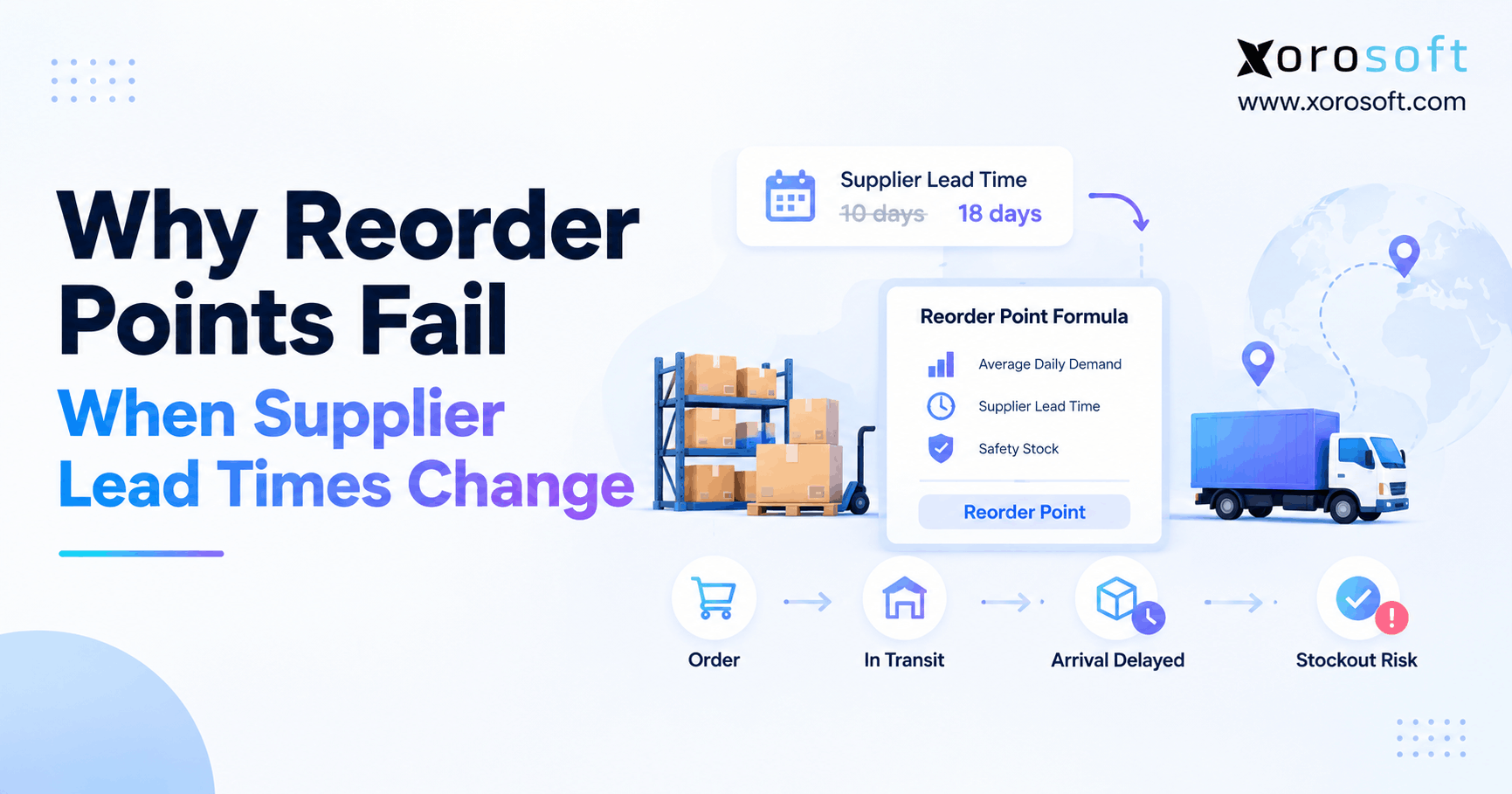
If you’re looking to understand how to calculate the reorder point formula for inventory management, this article will guide you through the process.
1. When the Reorder Point Formula Starts Giving Bad Results
A reorder point formula can be correct on paper and still create the wrong purchasing decision. That happens because the formula depends on demand, supplier lead time, and safety stock. Therefore, when one of those inputs changes but the reorder point stays fixed, buyers start working from old assumptions.
For example, a supplier may normally deliver in 12 days. However, during a busy season, the same supplier may take 20 days. If the inventory team still uses 12 days, the replenishment trigger happens too late.
As a result, the business can stock out even though purchasing followed the rule exactly.
Moreover, the problem often stays hidden until demand has already consumed most of the remaining stock. At that point, the purchase order may exist, but the shipment is still days away.
Therefore, the real issue is not whether a business knows how to calculate a reorder point. Instead, the key question is whether the inputs behind that calculation still match current conditions.
1.1 Why Inventory Planning Gets Harder as Businesses Grow
At first, inventory planning may involve one warehouse, a few suppliers, and stable sales. Therefore, a simple spreadsheet can work.
However, growth adds more moving parts. A company may add Shopify, Amazon, wholesale orders, more warehouses, new suppliers, and seasonal campaigns.
Meanwhile, purchasing teams may start managing hundreds or thousands of SKUs. As a result, one lead-time field can remain unchanged for months even while actual supplier performance moves.
In addition, sales may rise faster than planners update demand assumptions.
Consequently, the reorder point formula becomes less useful because its inputs no longer describe the real operation.
2. How the Reorder Point Formula Works
The standard reorder point formula is:
Reorder Point = Average Daily Demand × Supplier Lead Time + Safety Stock
For example, assume a business sells 50 units per day. Its supplier takes 10 days to deliver, while the business keeps 200 units of safety stock.
The calculation becomes:
50 × 10 + 200 = 700 units
Therefore, the business should begin replenishment when its inventory position reaches about 700 units.
Shopify explains the same basic relationship in its reorder point guide, using sales velocity, lead time, and safety stock as core inputs.
However, the calculation only stays useful while those values remain useful.
2.1 Average Daily Demand in a Reorder Point Calculation
Average daily demand shows how quickly inventory is normally used.
For example, if a company sells 3,000 units during 60 days, average daily demand is 50 units.
However, averages can hide sharp changes.
A promotion may double demand for two weeks. Likewise, a large wholesale order may consume several weeks of normal stock in one day.
Therefore, teams should not treat historical averages as permanent facts.
Instead, they should review recent demand, confirmed orders, future promotions, and seasonal patterns before relying on one number.
2.2 How Supplier Lead Time Changes the Reorder Point
Supplier lead time measures how long replenishment takes.
However, the time should cover the full path that matters to inventory availability.
Depending on the operation, that path may include production, packing, freight, customs, receiving, inspection, and putaway.
Therefore, a vendor saying “10-day production” does not always mean the inventory will be available in 10 days.
Instead, the useful lead-time measure is the time from starting replenishment until the stock becomes available for use.
2.3 Why Safety Stock Supports the Reorder Threshold
Safety stock protects the business when demand or supply does not follow the plan.
For example, sales may rise unexpectedly. Alternatively, a supplier may arrive late.
However, safety stock should not become a place to hide every planning problem.
If supplier lead time permanently moves from 10 days to 18 days, the company should update the lead-time input.
Otherwise, adding more safety stock may reduce stockouts while quietly creating excess inventory.
Therefore, safety stock should protect against uncertainty rather than cover outdated planning data.
3. Why Supplier Lead Times Change
Supplier lead times rarely stay fixed forever.
Therefore, purchasing teams need to understand what causes the change before adjusting inventory rules.
3.1 Supplier Capacity Can Shift
First, suppliers have their own capacity limits.
During a quiet period, a vendor may complete an order in 10 days. However, the same factory may need 20 days when several large customers place orders at once.
As a result, the lead-time setting in the inventory system can become outdated.
Moreover, a supplier may still quote its normal lead time even when current production is running behind.
Therefore, actual receiving history matters.
3.2 Raw Materials Can Cause Delays
Next, your supplier may depend on other suppliers.
For example, an apparel maker may be waiting for fabric. Likewise, a furniture supplier may be waiting for hardware or finished parts.
Consequently, your vendor can miss its normal schedule even when your purchase order was placed on time.
Because of this, purchasing teams should measure actual results instead of depending only on the supplier’s original promise.
3.3 Freight Can Extend the Replenishment Cycle
Meanwhile, supplier production is only one part of lead time.
Ocean freight, carrier capacity, customs, weather, missed pickups, and port delays can all push arrival dates later.
Therefore, teams that measure only supplier production time may understate how long inventory stays unavailable.
For that reason, the reorder point formula should use a lead-time definition that reflects the full replenishment cycle.
4. Why a Fixed Reorder Point Fails When Lead Time Changes
The effect becomes clear with a simple example.
Assume the following:
| Input | Original Plan | New Reality |
|---|---|---|
| Daily demand | 50 units | 50 units |
| Supplier lead time | 10 days | 18 days |
| Safety stock | 200 units | 200 units |
| Lead-time demand | 500 units | 900 units |
| Reorder point | 700 units | 1,100 units |
Originally, the business reordered at 700 units.
However, an 18-day lead time means it now expects to use 900 units before new inventory arrives.
Therefore, the updated reorder point should be 1,100 units if the same safety stock still makes sense.
4.1 How Lead-Time Changes Create a Reorder Point Gap
The difference between the old and new thresholds is 400 units.
Yet the old process still waits until inventory reaches 700 before triggering a purchase.
As a result, buying starts eight days too late at a demand rate of 50 units per day.
Moreover, that gap exists before any extra demand spike or additional supplier delay happens.
Therefore, simply having a reorder point does not mean inventory is protected.
Instead, teams should ask when that number was last reviewed and which supplier lead-time data supports it.
5. Why Average Lead Time Can Hide Reorder Point Risk
Average supplier lead time is useful, but it does not tell the full story.
Consider two suppliers.
Supplier A: 14, 15, 15, 16, 15 days
Supplier B: 7, 24, 11, 22, 11 days
Both can produce a similar average.
However, Supplier B is much harder to plan around.
Therefore, purchasing teams should measure how much actual delivery time moves around the average.
5.1 Predictability Matters as Much as Supplier Speed
A slower supplier can sometimes be easier to manage than a faster but unreliable supplier.
For example, a supplier that consistently delivers in 20 days gives the buyer a stable planning window.
By contrast, a supplier that delivers anywhere from 8 to 28 days creates more risk.
As a result, the second supplier may require a larger inventory buffer even if its average appears attractive.
ASCM discusses this difference in its safety stock guidance, including the role of changing lead times and demand.
Therefore, a better planning process reviews both the average and the variation.
6. How Safety Stock Supports the Reorder Point Formula
Safety stock is useful because the future is never perfectly certain.
However, the amount should match the type of risk the business actually faces.
For example, one company may have steady supplier lead times but unstable demand. Another may have steady demand but unreliable suppliers.
Therefore, those businesses should not automatically use the same safety stock rule.
6.1 Lead-Time Change Is Not Always Lead-Time Uncertainty
Suppose a supplier used to take 10 days but now consistently takes 18.
In that case, the main issue is not uncertainty. Instead, the normal lead time changed.
Therefore, the business should update the reorder point formula using the newer 18-day assumption.
Now consider a supplier that takes 10 days one month, 21 the next, and 13 after that.
Here, changing lead times are part of the risk.
As a result, the company may need both a realistic average and a suitable safety buffer.
6.2 Why More Safety Stock Is Not Always Better
Increasing safety stock can reduce stockout risk.
However, more inventory also uses cash, shelf space, and warehouse capacity.
In addition, slow-moving products can become old, damaged, or discounted.
Therefore, the goal should not be to maximize safety stock.
Instead, the business should hold enough extra stock to protect against real uncertainty without creating unnecessary inventory.
7. Static vs Dynamic Reorder Points
A static reorder point stays unchanged until someone updates it manually.
By contrast, a dynamic reorder point changes when important planning inputs change.
| Planning Factor | Static Reorder Point | Dynamic Reorder Point |
|---|---|---|
| Demand | Fixed assumption | Reviewed or updated |
| Lead time | Fixed value | Uses newer supplier data |
| Safety stock | Often fixed | Adjusted when risk changes |
| Seasonality | Manual | Can reflect seasonal demand |
| Warehouse needs | Often shared | Can vary by location |
| Maintenance | Manual | More automated |
Therefore, neither approach is automatically right for every business.
7.1 When a Static Reorder Point Still Works
A static approach can work when a company has few SKUs, one location, stable demand, and reliable suppliers.
Moreover, manual review may be enough when operating conditions change slowly.
However, the process becomes harder to maintain as complexity rises.
For example, managing 2,000 SKUs across four warehouses creates 8,000 SKU-location positions before supplier and channel differences are even considered.
Consequently, dynamic planning becomes more useful as the business grows.
7.2 What a Dynamic Reorder Point Actually Means
Dynamic does not mean changing every setting every minute.
Instead, it means the business has a process for finding meaningful changes and updating planning rules before those changes create shortages.
For example, a buyer may update a supplier lead time after several late receipts rather than after one unusual delay.
Therefore, the reorder point formula becomes part of an ongoing planning process rather than a one-time spreadsheet calculation.
8. Which Data Should Feed the Reorder Point Formula?
Better replenishment starts with better inputs.
Therefore, inventory teams should look beyond one sales average and one supplier lead-time value.
8.1 Actual Demand
First, review real product movement.
However, separate normal demand from unusual events where possible.
For example, one large wholesale order should not always become the new normal daily demand.
Likewise, a short sales drop should not automatically cause future purchasing needs to fall.
Therefore, recent demand should always be reviewed with context.
8.2 Forecast Demand
Next, consider known future changes.
A promotion, holiday, product launch, wholesale contract, or seasonal peak may create demand that historical averages cannot predict well.
Therefore, forecasting can help bridge the gap between what already happened and what the business expects next.
For inventory-driven companies, XoroONE can bring inventory, sales, purchasing, forecasting, warehouse activity, and financial data into one operational environment.
As a result, purchasing decisions can use more than a separate spreadsheet.
8.3 Available Inventory
On-hand inventory is not always available inventory.
For example, some units may already be reserved for customer orders. Meanwhile, other units may be damaged, held for inspection, or allocated to another channel.
Therefore, replenishment should use the inventory state that actually matters.
Otherwise, the system may show 1,000 units while operations can only use 600.
8.4 Incoming Supply and the Reorder Threshold
Open purchase orders matter as well.
However, an open PO should not automatically be treated as reliable supply when the expected delivery date has already passed.
Therefore, buyers need visibility into ordered quantities, expected arrival dates, partial receipts, and supplier status.
Oracle’s NetSuite documentation also describes planning with location-level lead time and safety stock in its inventory management guidance.
The wider lesson is simple: incoming supply needs context.
9. Promised Lead Time vs Actual Lead Time
A supplier may promise 14 days.
However, recent purchase orders may show 17, 19, 15, 22, and 20 days.
Therefore, the supplier record and the receiving history tell two different stories.
The first describes the plan.
The second shows what actually happened.
9.1 Use Consistent Lead-Time Measurements
First, define supplier lead time clearly.
For example, one business might measure from purchase-order approval to warehouse receipt.
Another may measure from supplier confirmation to usable inventory.
Either method can work if it remains consistent.
However, mixing several definitions makes supplier comparisons much less useful.
Therefore, teams should choose one clear start point and one clear end point for each lead-time measure.
9.2 Track Supplier Performance Over Time
Next, look for trends instead of reacting to one late order.
For example, a supplier may experience one unusual delay because of severe weather.
That event alone may not justify changing every planning setting.
However, if six recent orders all took longer than the master-data value, the evidence becomes stronger.
Microsoft’s Business Central planning guidance also connects reorder planning with demand, safety stock, lead time, and other supply settings.
Therefore, actual supplier performance should remain part of the review.
10. When Should a Reorder Point Be Recalculated?
There is no single review schedule that works for every SKU.
Instead, businesses should combine regular reviews with event-based reviews.
10.1 Recalculate After Supplier Lead-Time Changes
First, update the reorder point when supplier lead time changes enough to affect inventory coverage.
For example, a move from 10 days to 11 days may have little effect on a slow-moving SKU.
However, moving from 10 days to 20 days can completely change the risk.
Therefore, the size and impact of the change matter more than an arbitrary calendar date.
10.2 Update the Reorder Point When Demand Changes
Next, update the reorder point formula when daily demand changes.
For example, a product growing from 20 to 35 units per day will consume much more inventory during the same supplier lead time.
As a result, the old threshold can become too low even when the supplier continues delivering perfectly.
Therefore, demand and lead time should never be reviewed in isolation.
10.3 Review Inventory Before Seasonal Peaks
Moreover, do not wait until a peak season has already started.
Instead, use expected seasonal demand before the sales increase reaches the warehouse.
This is especially important for apparel, sporting goods, food, furniture, and other seasonal categories.
Consequently, the business can adjust earlier rather than placing emergency orders during the busiest weeks.
10.4 Recalculate After Major Operating Changes
Finally, review reorder points after adding a warehouse, changing a supplier, changing freight methods, or adjusting customer service targets.
Each event can change the amount of inventory required before replenishment arrives.
Therefore, process changes should trigger planning reviews instead of waiting for the next stockout.
11. Reorder Points Across Multiple Warehouses
One company-wide reorder point can hide major differences between locations.
For example, Warehouse A may sell 80 units per day while Warehouse B sells 20.
Meanwhile, supplier transit may take four days to A but nine days to B.
Therefore, each warehouse faces a different replenishment risk.
11.1 Use Location-Level Demand in the Reorder Point Calculation
First, calculate how quickly each location uses stock.
Otherwise, a high-volume warehouse may stock out while a slower warehouse holds too much inventory.
Moreover, the customer mix can differ by location.
For example, a warehouse serving wholesale accounts may see larger and less regular orders than one serving direct-to-consumer demand.
Therefore, location demand should influence local reorder planning.
11.2 Consider Inventory Transfers Before New Purchasing
Next, check whether another warehouse already has excess stock.
For example, transferring 300 units may solve a shortage faster than placing a new supplier PO.
Therefore, inventory visibility across the network can reduce both shortages and unnecessary buying.
XoroWMS supports warehouse operations within a wider inventory environment, helping teams connect receiving, transfers, stock movement, and fulfillment.
As a result, replenishment decisions can reflect inventory already inside the network.
12. How Reorder Point Errors Affect Finance and Fulfillment
A weak reorder point creates more than a stockout.
Instead, it can start a chain of extra costs.
First, purchasing creates an emergency order.
Next, the supplier may charge for rush handling. Then, freight costs rise because the business cannot wait for its normal shipping method.
Meanwhile, customer orders may become delayed.
As a result, customer service has more exceptions to manage.
12.1 Overstock Can Be the Opposite Failure
However, buying too early also creates problems.
Excess inventory ties up cash and warehouse space. In addition, slow-moving items may need markdowns later.
Therefore, the reorder point formula should balance availability against the cost of carrying inventory.
The goal is not to prevent every possible stockout at any cost.
Instead, businesses need to choose a service level that fits the product, supplier, customer promise, and financial model.
12.2 Keep Inventory and Accounting Connected
Moreover, inventory decisions directly affect finance.
Larger purchases change cash needs, inventory value, landed cost, and future margin.
Therefore, businesses that have outgrown separate inventory and accounting tools may benefit from a connected XoroERP environment.
As a result, operations and finance can work from the same inventory events instead of reconciling separate systems later.
13. Why Shopify and Multi-Channel Brands Need Better Reorder Points
A Shopify brand may start with simple inventory planning.
However, growth can quickly add Amazon, wholesale, retail, EDI, and several warehouse locations.
Consequently, inventory demand starts coming from several places.
13.1 Sales Channels Compete for the Same Stock
For example, Shopify may show strong direct-to-consumer demand while a large wholesale order reserves the same SKU.
Meanwhile, Amazon may require inventory for another sales flow.
Therefore, a reorder point based only on Shopify sales can miss part of the real demand picture.
In addition, stock reserved for one channel may no longer be usable somewhere else.
As a result, inventory planning should consider channel commitments before a buyer approves another purchase.
13.2 Integrations Reduce Inventory Data Gaps
A connected integration layer can help keep orders, stock, and operational systems aligned.
For example, Xorosoft integrations support the flow between ecommerce channels and ERP processes.
Likewise, merchants can review Xorosoft directly on the Shopify App Store.
Therefore, Shopify can remain the commerce layer while ERP manages deeper inventory, purchasing, warehouse, and financial workflows behind the storefront.
14. Why Spreadsheet Reorder Points Become Hard to Maintain
A spreadsheet is not automatically a bad planning tool.
In fact, it can work well while the business remains simple.
However, the maintenance burden rises quickly.
Imagine 2,500 SKUs across three warehouses.
That already creates 7,500 SKU-location combinations.
Now add several suppliers, incoming purchase orders, changing demand, safety stock, transfers, and seasonal rules.
As a result, the challenge is no longer writing the reorder point formula correctly.
Instead, the challenge is keeping every input current.
14.1 Manual Reorder Point Updates Create Delays
First, someone must notice that a supplier’s lead time changed.
Next, that person must update the planning file.
Then, buyers must make sure they are using the newest version.
However, inventory continues moving during those manual steps.
Therefore, even a well-built spreadsheet can fall behind current operations.
Moreover, the problem becomes harder when several people manage different parts of the file.
14.2 Separate Systems Create Conflicting Inventory Numbers
Meanwhile, inventory may live in one application, purchase orders in another, accounting in QuickBooks, and warehouse activity somewhere else.
As a result, teams may calculate purchasing needs from different versions of inventory.
A wider set of connected Xorosoft solutions can bring inventory, purchasing, warehouse, reporting, sales, and financial workflows closer together.
Therefore, automation becomes more useful as the cost of keeping separate tools aligned rises.
15. A Better Process for Dynamic Replenishment
A stronger replenishment process does not remove the buyer.
Instead, it gives the buyer better signals.
15.1 Start With Current Demand
First, review actual product movement.
Then, compare recent demand with the forecast.
If a large change appears, investigate why before changing the plan.
For example, one unusual wholesale order may not justify raising every future reorder point.
Therefore, buyers should separate real trends from short-term noise.
15.2 Review Supplier Performance
Next, compare promised lead time with actual receipts.
Moreover, look for patterns across several orders.
If a supplier consistently runs five days late, the planning assumption may need to change.
However, if one order was delayed by an unusual event, the buyer may decide to keep the existing baseline.
Therefore, repeated evidence matters more than one exception.
15.3 Check the Real Inventory Position
Then, combine usable stock with incoming supply.
At the same time, remove inventory that is damaged, reserved, held, or otherwise unavailable.
Also, check whether open purchase orders remain on schedule.
Therefore, the replenishment signal reflects stock the business can actually use.
This step matters because a large on-hand number can still hide a shortage when much of the stock is already committed.
15.4 Recalculate the Reorder Point Before Shortages Appear
Finally, update the reorder point formula when the inputs have changed enough to matter.
This step is important because waiting for a stockout turns planning into emergency response.
Instead, the goal is to find the change while there is still enough time to act.
Therefore, buyers should spend more time reviewing exceptions and less time rebuilding routine calculations.
16. Which Businesses Need More Than Basic Reorder Points?
Not every company needs advanced planning software.
For example, a business with 30 SKUs, one warehouse, steady demand, and reliable local suppliers may work well with simple inventory rules.
However, complexity changes the decision.
16.1 Signs Your Reorder Point Process Is Reaching Its Limit
A business should review its planning system when:
- buyers maintain large manual spreadsheets;
- supplier delays repeatedly create surprises;
- stockouts continue despite higher inventory;
- several warehouses need different planning rules;
- Shopify, Amazon, wholesale, or EDI orders share stock;
- incoming POs are hard to match against future demand;
- inventory and accounting often disagree;
- manufacturing depends on part availability.
Therefore, the trigger to upgrade is not one revenue number.
Instead, it is the point where the team can no longer maintain planning inputs with enough speed and care.
The industries Xorosoft serves include several inventory-heavy business models where these planning challenges often become more complex as operations grow.
17. What to Measure After Updating the Reorder Point Formula
Changing the calculation is only the beginning.
Therefore, teams should measure whether the new planning rule produces better results.
17.1 Stockout Frequency
First, track how often important SKUs reach zero usable inventory.
If stockouts remain high, investigate whether demand, supplier lead time, inventory accuracy, or safety stock is still wrong.
Moreover, separate frequent small stockouts from rare large disruptions.
That distinction helps teams find the real cause.
17.2 Emergency Purchase Orders
Next, measure how often buyers need rush orders.
A falling number can show that replenishment is starting earlier and using better information.
However, do not assume every emergency order proves the reorder point failed.
For example, a sudden large customer order may create an unusual case.
Therefore, classify the cause as well as the count.
17.3 Supplier Delivery Performance
Meanwhile, compare supplier promises with actual receipts.
This measurement can show whether lead-time problems come from one supplier, one product group, one route, or the wider vendor base.
Therefore, supplier performance should become part of normal purchasing review.
Over time, those records also make future reorder point formula updates more reliable.
17.4 Excess Inventory
However, do not measure success only by fewer shortages.
If inventory rises sharply, the business may have solved stockouts by holding too much stock.
Therefore, also watch inventory turns, old stock, warehouse space, and working capital.
Companies considering broader process changes can review Xorosoft case studies to see how other inventory-driven operations approached connected ERP and warehouse workflows.
18. A Practical Reorder Point Review Checklist
A repeatable review helps prevent planning rules from becoming stale.
Therefore, use this sequence for important SKUs:
1. Check average demand.
Has the normal sales or usage rate changed?
2. Check demand swings.
Has demand become harder to predict?
3. Review actual supplier lead time.
Are receipts arriving when expected?
4. Review lead-time swings.
Is supplier performance becoming less steady?
5. Check safety stock.
Does the buffer still match current risk?
6. Review available inventory.
Remove reserved, damaged, held, or unusable stock.
7. Review incoming POs.
Check quantities, dates, partial receipts, and delays.
8. Review each warehouse.
Do locations need different thresholds?
9. Update the reorder point formula.
Change inputs when the evidence supports it.
10. Measure the result.
Watch both stockouts and excess inventory.
Therefore, the checklist turns reorder planning into a repeatable process rather than a one-time calculation.
19. Build Replenishment Around Current Inventory Data
The strongest inventory process connects the events that change purchasing decisions.
Therefore, demand, supplier performance, available inventory, incoming supply, warehouse movement, and financial data should not sit in isolated workflows.
For growing inventory-driven businesses, that often means moving beyond a collection of disconnected applications.
A cloud ERP can bring purchasing, inventory, warehouse activity, forecasts, sales channels, manufacturing, and accounting into the same operating model.
However, software alone does not guarantee good inventory planning.
The business still needs clean stock data, clear lead-time rules, sensible safety stock, and regular supplier reviews.
Therefore, the value comes from combining good planning rules with current operational data.
As a result, teams can adjust buying decisions before a supplier delay becomes a shortage.
20. Reliable Reorder Points Start With Reliable Inputs
The reorder point formula is not the real problem when supplier lead times change.
Instead, the problem is usually that the inputs stay fixed while the business keeps moving.
A supplier takes longer. Demand rises. A second warehouse opens. More stock becomes reserved. An open PO slips by a week.
Meanwhile, the old reorder point remains unchanged.
As a result, purchasing starts too late.
Therefore, better replenishment begins with a simple habit: review the assumptions behind the number.
Use actual demand where possible. Compare promised and actual supplier lead times. Track safety stock separately from permanent lead-time changes. In addition, account for open POs, available stock, location demand, and future sales.
For smaller businesses, spreadsheets may still be enough.
However, once inventory, purchasing, warehousing, ecommerce, wholesale, manufacturing, and accounting become harder to keep aligned, a connected ERP can reduce the manual work needed to maintain those inputs.
If supplier lead-time changes are causing stockouts, rush orders, excess buffers, or purchasing spreadsheets that are difficult to maintain, Book a Demo to see how Xorosoft connects replenishment with the wider inventory operation.
Frequently Asked Questions
What is the reorder point formula?
The reorder point formula is average daily demand multiplied by supplier lead time, plus safety stock. It estimates when a business should begin replenishment so new stock can arrive before usable inventory runs out.
How does supplier lead time affect a reorder point?
A longer lead time usually raises the reorder point because the business must cover more demand before replenishment arrives. Therefore, leaving the old threshold unchanged can increase stockout risk.
Why do reorder points fail?
Reorder points often fail because demand, supplier lead time, safety stock, or available inventory changes while the planning rule stays fixed. As a result, the trigger no longer reflects current operating conditions.
How often should reorder points be updated?
Review important reorder points regularly and whenever demand, supplier performance, warehouse structure, seasonality, freight methods, or service targets change enough to affect replenishment needs.
What is a dynamic reorder point?
A dynamic reorder point uses updated planning inputs instead of relying on one fixed threshold. It can reflect newer demand, supplier lead times, safety stock, inventory positions, and location-level needs.
Should every warehouse use the same reorder point?
Usually not. Warehouses can have different demand rates, supplier transit times, customer commitments, and safety-stock needs. Therefore, location-level planning often gives a more useful replenishment signal.
Can ERP help manage reorder points?
Yes. ERP can connect demand, inventory, purchasing, suppliers, warehouses, forecasts, and open POs. However, teams still need clear planning rules and accurate data for the system to produce useful replenishment signals.
Recent Posts
-
 ERP Landed Cost Module vs Spreadsheet Calculations for Importers
 -
 How to Build an Open-to-Buy Plan for an Omnichannel Brand
 -
 Cold Storage WMS for Food and Beverage Distribution
 -
 ERP Buying Statistics 2026: Evaluation, Implementation, and Adoption Risks
 -
 How a Distributor Reduced B2B Order Exceptions Without Restricting Sales