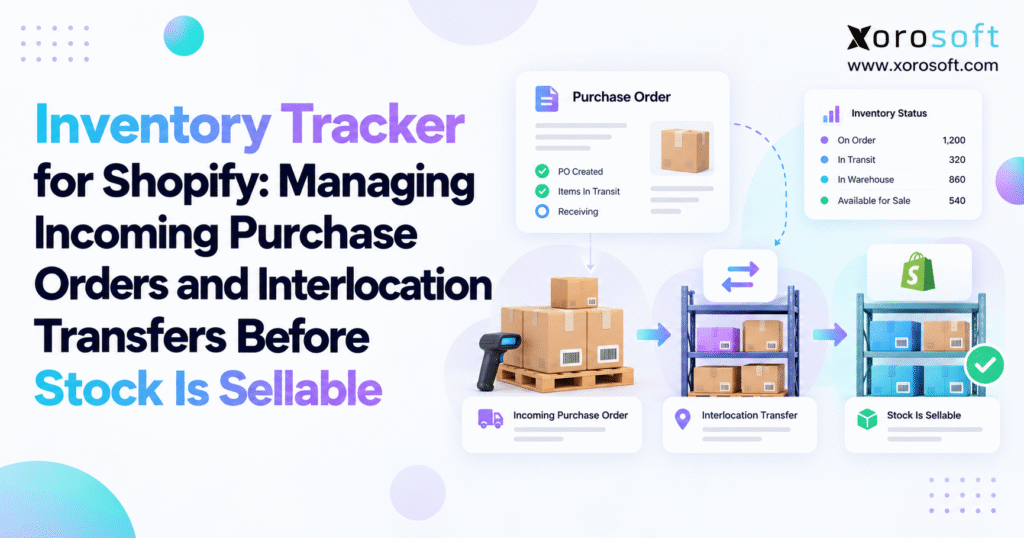
If you’re looking for a way to manage incoming stock, a Shopify incoming inventory tracker can streamline your workflow.
1. Incoming Shopify Inventory Becomes Harder to Trust Before It Reaches the Shelf
A Shopify merchant can have thousands of units on order and still have very little stock that can safely be promised to customers. That difference becomes increasingly important as purchasing volume grows, warehouses multiply, and inventory starts moving between locations.
Consider a company with 500 units ready for fulfillment, 1,800 units on supplier purchase orders, and another 600 moving between two warehouses. From a financial or planning perspective, the company has significant inventory in its pipeline. From an ecommerce fulfillment perspective, however, only a fraction may be available today.
This is where a Shopify incoming inventory tracker becomes operationally important. Instead of reducing inventory to one balance, it separates what is available now from what is expected, reserved, held, or still moving through the network.
1.1 Shopify Inventory Tracking Must Answer More Than “How Many?”
A simple inventory count works when a business has one location and limited purchasing activity. Once operations become more complex, quantity alone stops answering the questions that purchasing, fulfillment, and finance teams actually have.
An operator needs to know where a quantity is located, whether it has physically arrived, what transaction created it, and whether another order has already claimed it. The ecommerce team cares about sellable availability, while purchasing needs visibility into future supply. Warehouse staff need to know what they should receive, and finance eventually needs those transactions to reconcile with inventory value.
Each team is looking at the same SKU through a different operational lens.
1.2 Sellable Inventory Should Follow Physical Events
Inventory data becomes unreliable when digital quantities move ahead of real-world events.
A supplier may confirm a purchase order without shipping it. A shipment may leave a vendor but arrive later than planned. Goods may reach a warehouse but fail inspection. Similarly, an internal transfer may leave one location without reaching its destination on schedule.
None of those situations should automatically create sellable inventory.
Accurate Shopify inventory tracking therefore depends on clearly defined events. Purchase order creation establishes expected supply. Shipment confirms movement. Receiving verifies physical arrival. Acceptance determines whether that stock can become usable.
That sequence gives teams a more dependable inventory picture.
2. How a Shopify Incoming Inventory Tracker Separates Inventory States
An effective Shopify incoming inventory tracker should distinguish inventory according to its current operational state rather than combining every unit associated with a SKU.
That separation is essential because physical possession, commercial ownership, and customer availability are not always the same thing.
2.1 Shopify On-Hand Inventory Is Not Automatically Sellable
On-hand inventory represents stock physically associated with a location, but some of those units may already be committed or deliberately unavailable.
Imagine that a warehouse physically holds 900 units. Customer orders have already claimed 220, while another 50 are being inspected after a receiving issue. The warehouse still holds all 900 units, yet it would be risky to publish all 900 as available for new orders.
Operators should therefore treat physical stock as one measure and customer-ready availability as another.
2.2 Shopify Incoming Inventory Represents Future Supply
Incoming inventory tells planners that additional stock is moving toward a location.
A buyer might see 300 units available today and 2,000 more expected next week. That inbound quantity matters when deciding whether another purchase order is necessary. However, customers placing orders today cannot be fulfilled from goods that have not physically arrived.
A Shopify incoming inventory tracker keeps those quantities visible without blending them.
2.3 Committed Inventory Has Already Been Spoken For
Committed stock may remain physically present while being reserved for existing demand.
For example, a warehouse could have 400 units on the shelf while 250 are already assigned to unfulfilled customer orders. Those 250 units should not support another set of sales simply because they have not yet left the building.
Separating committed inventory prevents the same physical stock from supporting multiple customer promises.
2.4 Unavailable Inventory Needs a Clear Operational Reason
Some inventory is physically present but intentionally excluded from selling.
Damaged products, quality-control stock, safety stock, samples, or items held for another operational reason may all fit this category.
A mature inventory process should explain why those units are unavailable instead of hiding them through unexplained manual adjustments. That context helps teams identify recurring supplier, warehouse, or quality problems.
3. Shopify Purchase Order Inventory Should Remain Separate From Available Stock
Purchase orders are critical to planning because they show what the business expects to receive. Yet a PO is a commercial commitment, not proof that inventory is ready to fulfill customer demand.
This distinction becomes one of the most important controls in Shopify purchase order inventory management.
3.1 Purchase Orders Establish Expected Supply
A purchase order normally identifies the supplier, products, quantities, destination, expected timing, and commercial terms.
From a planning perspective, the order matters immediately. Buyers need to know that replenishment is already scheduled before they create another PO. Finance may also need visibility into the commitment.
Fulfillment teams face a different reality. Nothing on that purchase order can be picked until the physical inventory arrives.
A Shopify incoming inventory tracker should therefore expose open PO quantities without converting them into immediate sellable stock.
3.2 Supplier Confirmation Does Not Equal Physical Receipt
Supplier confirmation improves confidence that the order will be fulfilled, but it still does not place inventory inside the destination warehouse.
Delays can occur between confirmation, production, shipment, customs clearance, carrier movement, and final receipt.
For a short lead-time domestic supplier, that gap may be only a few days. International inventory can remain in the pipeline for weeks or months.
The system should preserve visibility throughout that period without overstating current availability.
3.3 Shipment Activity Adds Timing Context
Once a supplier ships the goods, the inventory picture becomes more useful.
Now the team can track which quantity actually left the supplier, when it should arrive, and whether the PO was split across multiple shipments.
Suppose a PO contains 2,500 units. The supplier ships 1,500 immediately and schedules the remaining 1,000 for the following week. Purchasing still has a 2,500-unit order, but operations now have two different expected receipt windows.
Combining those quantities into one undifferentiated inbound number would reduce visibility precisely when teams need more context.
4. Shopify Inventory Transfer Tracking Prevents Double Counting Between Locations
Interlocation transfers create a different challenge because the company already owns the inventory. Stock is not entering the network from a supplier; it is moving from one company-controlled location to another.
Without controlled transfer tracking, the same units can easily appear usable in two locations.
4.1 The Origin Location Must Release Inventory Correctly
Assume Warehouse A has 1,000 available units and plans to send 300 to Warehouse B.
Once those units are committed to the transfer, Warehouse A should not continue promising all 1,000 as if nothing changed. Otherwise, customer demand could consume stock that warehouse staff are already preparing to ship elsewhere.
The transfer record provides context for why availability changed.
4.2 Destination Inventory Should Appear as Incoming
Warehouse B needs visibility into the 300 units long before they arrive.
Managers may use that information to avoid unnecessary supplier orders, prepare labor, or plan upcoming promotions. Still, the destination should not behave as if the stock has already reached the shelf.
A Shopify incoming inventory tracker solves that problem by showing the transfer as future supply rather than current availability.
4.3 In-Transit Inventory Still Belongs to the Business
Stock traveling between locations has not disappeared.
From a company-wide perspective, the inventory still exists and contributes to working capital. Operationally, however, neither location should treat it exactly as ordinary shelf stock while it is on the road.
This is why network inventory, location inventory, and sellable inventory need separate views.
4.4 Destination Receiving Closes the Transfer Loop
Warehouse B should confirm what actually arrived.
If 300 units were shipped and only 292 reach the destination, the missing eight units require investigation. Perhaps another carton will arrive later, or a carrier shortage occurred. The correct response is not to quietly create the missing stock.
A controlled transfer process preserves the variance until the operation resolves it.
5. Incoming vs Available Inventory in Shopify Requires a Clear Boundary
Among all inventory-state distinctions, incoming versus available inventory has the biggest direct impact on customer promises.
Incoming stock supports future planning. Available stock supports current selling.
5.1 Shopify Incoming Inventory Answers a Supply Question
Incoming inventory answers:
What stock is expected to reach this location?
Purchasing, merchandising, and planning teams rely on that information. If substantial inventory is already inbound, another purchase order may create unnecessary overstock.
Inbound visibility can also influence marketing calendars, product launches, and replenishment priorities.
Nevertheless, expected supply remains an expectation until the receiving process verifies it.
5.2 Available Inventory Answers a Fulfillment Question
Available inventory answers:
What can the business safely sell now?
That question should consider the current inventory state rather than future expectations.
A Shopify incoming inventory tracker keeps these perspectives connected without merging them. Teams can see that more stock is coming while ecommerce remains grounded in what can actually be fulfilled.
5.3 One SKU Can Carry Several Valid Quantities
Consider a product with 600 available units, 140 committed units, 30 units held for inspection, and 1,200 incoming units.
Each quantity is correct within its own context.
The 600 figure supports new demand. The 140 explains existing commitments. The 30 identifies an operational hold, while 1,200 represents future supply.
Problems arise when a business chooses one of those numbers and tries to make it serve every function.
6. Shopify Inventory Receiving Determines When Incoming Stock Becomes Usable
Receiving is where expected inventory meets physical reality.
For high-volume operations, this stage often exposes supplier shortages, incorrect products, damage, and timing differences that purchase-order data cannot predict.
6.1 Partial Receipts Must Remain Visible
Suppose a supplier is expected to deliver 1,000 units. The first shipment contains only 650.
A reliable system records those 650 units as received while maintaining visibility into the remaining 350. It should not assume the entire PO reached the warehouse simply because part of the shipment arrived.
The distinction protects both replenishment planning and inventory accuracy.
6.2 Physical Receipt Does Not Always Mean Immediate Availability
Some businesses can make stock sellable as soon as receiving confirms quantity. Others need additional controls.
Apparel may require barcode verification. Food businesses can need lot and expiry checks. Furniture may require damage inspection. Manufacturers could need component quality testing.
The event that converts incoming stock into sellable inventory should reflect the company’s actual operating process.
6.3 Damaged Goods Need a Traceable Status
When goods arrive damaged, the easiest short-term response is often a manual inventory adjustment.
That approach fixes the balance but removes important history.
A better process preserves the relationship between the PO, shipment, received quantity, damaged quantity, and final disposition. Over time, those records can show whether losses are associated with a particular supplier, carrier, warehouse process, or product.
6.4 Receiving Variances Should Become Exceptions, Not Noise
An expected shipment of 500 units might produce a physical count of 495.
Those five missing units could still be in transit, short-shipped, miscounted, or lost. Operators need an exception that remains visible until someone resolves it.
A mature Shopify incoming inventory tracker does not merely display the ending balance. It helps explain why that balance differs from the expectation.
7. Multi-Location Shopify Inventory Tracking Must Show Where Stock Can Actually Fulfill Demand
A company-wide total can create false confidence.
A merchant might have plenty of inventory across the business while the facility responsible for most orders approaches a stockout.
7.1 Network Inventory Can Hide Local Shortages
Imagine a company with 3,000 available units.
Its western distribution center holds 2,400. The eastern warehouse has 250, and retail stores hold another 350.
At the company level, inventory looks healthy. However, a sudden demand spike in the East can still create fulfillment delays.
Multi-location Shopify inventory tracking should therefore preserve both network and facility-level views.
7.2 Inventory Rebalancing Can Reduce Unnecessary Purchasing
When one location has too much stock and another has too little, the solution may be an internal transfer rather than a supplier PO.
That decision depends on visibility.
Purchasing needs to know whether another location can release inventory, how long the transfer will take, and whether the receiving facility can wait for it.
Without that information, teams may order more product simply because they cannot see stock elsewhere in the network.
7.3 3PL and External Locations Increase the Need for Control
Many Shopify businesses use third-party logistics providers, contract manufacturers, or other external locations.
The company may not control every physical movement directly, yet it still needs reliable status information.
Inventory at a 3PL can be available, committed, damaged, receiving, transferring, or awaiting another process. Treating all third-party stock as one number creates the same problems found inside company-operated warehouses.
A Shopify incoming inventory tracker should make those distinctions visible regardless of who operates the facility.
8. Shopify Inventory Tracking for Purchasing and Forecasting Depends on Incoming Supply
Purchasing decisions become more accurate when buyers can see current availability and future supply in one planning process.
Low current stock does not always mean the company should buy more.
8.1 Open Purchase Orders Must Influence Replenishment Decisions
Suppose a SKU has 400 units available and demand averages 350 units per week.
At first glance, another PO looks urgent.
However, the same SKU may already have 2,000 units arriving in four days. If the buyer cannot see that inbound quantity, another large order could create excess stock several weeks later.
The purchasing decision should therefore consider existing inbound commitments before creating new supply.
8.2 Expected Arrival Dates Add Meaning to Incoming Quantity
Knowing that 2,000 units are coming is useful, but timing determines how useful they actually are.
A shipment due tomorrow may cover expected demand. Another shipment with the same quantity but a six-week lead time may not.
Good Shopify inventory tracking connects inbound quantity with expected receipt date, supplier lead time, destination, and current demand.
8.3 Supplier Reliability Should Influence Planning Assumptions
Expected dates are not always reliable.
If a supplier routinely arrives five days late, planners should not continue building replenishment assumptions around the original promised date.
Over time, actual receipt history can provide a more realistic picture of lead-time variability.
This is where inventory tracking begins to support forecasting rather than simply recording transactions.
8.4 Inventory Position Gives Buyers a More Complete View
Available stock describes the present. Inventory position adds future supply and expected demand.
The exact formula varies by business, but planners often consider usable stock, confirmed incoming quantities, existing commitments, forecasts, and required safety stock together.
A Shopify incoming inventory tracker provides the inbound component needed for that broader calculation without confusing it with immediate availability.
9. Shopify Inventory Synchronization Needs One Clear Source for Every Event
Shopify frequently sits inside a larger technology stack.
A growing merchant may also use accounting software, WMS applications, Amazon, wholesale EDI tools, forecasting platforms, and spreadsheets.
The risk is not simply that these systems exchange data slowly. The bigger problem occurs when several systems believe they own the same inventory decision.
9.1 Each Inventory Event Needs a Defined Owner
Receiving should originate from the system that knows what physically arrived. Warehouse movements should reflect actual execution. Ecommerce availability should come from a clearly defined calculation.
When several applications independently adjust the same quantity, synchronization becomes fragile.
Businesses reviewing this architecture should examine whether their integrations clearly define product mapping, location mapping, inventory ownership, and exception handling.
9.2 Faster Synchronization Cannot Fix Wrong Logic
“Real time” sounds reassuring, but speed does not make an incorrect quantity accurate.
If a system publishes incoming inventory as sellable, synchronizing that number every few seconds only distributes the error faster.
The operating model must first define which state Shopify should receive, how commitments affect availability, when transfers change locations, and how holds are treated.
Technology should automate those rules after the business defines them.
9.3 Reconciliation Still Matters in Connected Systems
APIs and integrations reduce manual work, but they do not eliminate every exception.
Failed transactions, changed SKUs, incorrect location mappings, delayed events, and manual adjustments can still create differences.
Mature inventory operations therefore include reconciliation by design. Teams should know what discrepancies to monitor, who owns them, and how quickly they should be resolved.
10. When a Shopify Incoming Inventory Tracker Is Enough and When ERP Becomes Necessary
Not every Shopify business needs ERP.
A merchant with straightforward purchasing, a small number of locations, and limited operational complexity may be better served by Shopify’s native capabilities or a focused inventory application.
The architecture should grow with operational requirements rather than software ambition.
10.1 Native Shopify Inventory Can Support Simpler Workflows
For many merchants, Shopify can provide useful inventory-state, location, purchase-order, and transfer capabilities.
If most sales come through Shopify, warehouse processes remain straightforward, and accounting does not need deep operational integration, adding another large platform may create more complexity than value.
A sensible evaluation starts by identifying which current workflow is actually failing.
10.2 Focused Inventory Apps Solve Narrow Problems Well
Some businesses mainly need better forecasting, replenishment recommendations, cycle counting, or purchasing analysis.
A specialized application can solve those needs without changing the broader operating system.
This approach works well while the problem remains contained. Difficulties begin when every department adds a different tool and inventory data has to be reconciled across all of them.
10.3 ERP Becomes Relevant When Inventory Connects Several Departments
Once inventory affects ecommerce, purchasing, accounting, warehouse execution, wholesale, Amazon, EDI, and manufacturing at the same time, the problem is broader than Shopify inventory alone.
At that point, an ERP platform such as XoroONE can become relevant because purchasing, inventory, financial, and operational transactions can share one underlying system.
The value comes from process connection rather than simply having more features.
11. Shopify ERP Inventory Tracking Should Connect Commerce With Warehouse Execution
Shopify can remain the customer-facing commerce layer even when deeper operational processes move into ERP and warehouse systems.
That architecture lets each system handle the work it is best suited to perform.
11.1 Shopify Can Remain the Commerce Layer
The storefront should continue handling ecommerce products, customer orders, checkout, and related digital workflows.
Behind it, the business may need stronger controls for purchasing, inventory planning, financial transactions, and warehouse operations.
A platform such as XoroERP can support inventory-driven operations that require those functions to connect beyond the storefront.
11.2 Warehouse Transactions Must Update Inventory Directly
Physical execution determines inventory accuracy.
Receiving, put-away, transfers, picking, packing, shipment, cycle counting, and adjustments all change the operational inventory picture.
A connected warehouse management system reduces the need to recreate those physical events later in spreadsheets or separate applications.
The closer digital records follow real warehouse transactions, the easier inventory becomes to trust.
11.3 Shopify and ERP Need a Clear Availability Rule
The ERP may know much more about inventory than Shopify needs.
For example, operations might track incoming supplier stock, transfer quantities, damaged goods, commitments, safety stock, and production demand. Shopify primarily needs the quantity the company is prepared to sell through that channel.
A Shopify incoming inventory tracker therefore works best when the ERP maintains the detailed operational picture and the integration publishes the appropriate sellable quantity to ecommerce.
11.4 Xorosoft Can Support a Connected Shopify Operating Model
Xorosoft brings inventory management, purchasing, warehouse management, accounting, forecasting, manufacturing, and ecommerce operations into one cloud ERP environment.
For merchants evaluating the platform specifically within Shopify, the Xorosoft ERP app on the Shopify App Store provides an additional view of how Shopify connects with broader operational workflows.
The goal is not to replace Shopify’s customer-facing role. Instead, ERP can manage the operational activity that determines what inventory Shopify should ultimately expose.
12. Shopify Incoming Inventory Management Changes by Industry
The core principle remains consistent across industries: inventory should not become sellable before the operational requirements for selling it have been satisfied.
What changes is the event that creates that readiness.
12.1 Apparel Shopify Inventory Tracking Requires Variant Accuracy
Apparel brands often manage hundreds or thousands of combinations of style, color, and size.
The company may appear well stocked at the style level while missing a specific high-demand size. An inbound purchase order can also contain different arrival quantities across variants.
A Shopify incoming inventory tracker should preserve that variant-level detail instead of relying on broad product totals.
Seasonality adds another consideration. Inventory arriving after a major selling window may still be physically usable, but its commercial value can drop sharply.
12.2 Furniture Inventory Tracking Depends Heavily on Inbound Timing
Furniture businesses often work with long supplier lead times, container shipments, large items, and higher freight complexity.
An order placed months in advance matters significantly to planning. Still, the product cannot support immediate fulfillment simply because the PO is confirmed.
Receiving also tends to require closer inspection because damage can directly determine whether an item is customer-ready.
12.3 Wholesale Inventory Requires Allocation Discipline
Wholesale distributors may serve large accounts while also selling through Shopify.
A large wholesale order can consume a substantial portion of stock before those units physically leave the warehouse. If ecommerce continues treating that committed inventory as freely available, overselling becomes likely.
Allocation therefore becomes just as important as physical quantity.
12.4 Manufacturing Adds Another Inventory State Layer
Manufacturers can have incoming raw materials, work-in-process inventory, finished goods awaiting inspection, and completed products ready for Shopify orders.
Those categories cannot be reduced to one sellable total.
Companies evaluating workflows across apparel, furniture, sporting goods, distribution, manufacturing, and other sectors can review relevant inventory-driven industries when mapping their requirements.
13. Common Shopify Inventory Tracking Mistakes Create False Availability
Inventory discrepancies often begin before anyone miscounts a shelf.
Incorrect workflow logic can create a perfectly synchronized but operationally false quantity.
13.1 Publishing Purchase Order Quantity Before Receipt
A confirmed purchase order may still be weeks from arrival.
Publishing those units as available too early creates customer promises based on inventory the warehouse cannot yet touch.
A better Shopify inventory tracking process shows the supply to planners while keeping the ecommerce quantity grounded in physical availability.
13.2 Counting Interlocation Transfers Twice
Transfer inventory should not remain freely sellable at the origin while simultaneously becoming sellable at the destination.
During transit, the company still owns the stock, but the quantity needs a distinct movement state.
This simple discipline prevents an internal transfer from artificially increasing company-wide availability.
13.3 Marking Entire Shipments Received After a Partial Delivery
Partial receipts need to remain partial.
If 700 of 1,000 units arrive, creating the missing 300 digitally only hides the supplier or transportation exception.
The business should keep that difference visible until someone confirms what happened.
13.4 Using Spreadsheet Inventory as a Second Operational Truth
Spreadsheets are useful analytical tools, but they become dangerous when they independently decide sellable inventory.
Once ecommerce, purchasing, warehouse, and finance teams each maintain their own version of a SKU balance, reconciliation becomes continuous work.
Connected ERP solutions become more relevant when maintaining agreement between separate systems consumes significant operational time.
13.5 Ignoring Failed Inventory Synchronization
A failed inventory update can create the same customer impact as an inaccurate warehouse count.
Teams should monitor integration errors, rejected transactions, stale quantities, and unusual differences between systems.
A reliable process treats synchronization failures as operational exceptions rather than purely technical issues.
14. What a Mature Shopify Incoming Inventory Tracker Should Show
A mature Shopify incoming inventory tracker should explain inventory rather than merely display it.
Operators should be able to move from a quantity to the transaction, location, and next action that give that quantity meaning.
14.1 Shopify Inventory Visibility Should Include State and Location
For every important SKU, teams should be able to understand current sellable inventory, inbound quantity, existing commitments, operational holds, and the location associated with each number.
Those values should not require separate spreadsheet lookups.
When a user sees 900 incoming units, the system should also reveal whether they come from a supplier PO, an internal transfer, or another approved source.
14.2 Purchase Orders and Transfers Need Transaction Context
Inventory becomes easier to manage when a user can trace it back to the event that created the quantity.
A buyer should see the related purchase order. Warehouse staff should see the expected transfer. Managers should be able to investigate overdue or partially received movements without reconstructing the history manually.
This transaction context turns the inventory tracker into an operational control rather than a static report.
14.3 Exceptions Should Be Easier to Find Than Normal Activity
Routine transactions generally need little management attention.
The value lies in surfacing the PO that is overdue, the transfer that has remained open too long, the shipment with an unexplained shortage, or the SKU whose sellable quantity differs materially from expectations.
Exception-focused reporting helps teams spend time where intervention actually matters.
14.4 Operational Inventory Data Can Support AI Queries
Once inventory data is structured and governed correctly, businesses can provide controlled access to operational information through AI interfaces.
An ERP AI MCP Server can provide a framework for authorized systems to query ERP data without turning separate spreadsheets into shadow databases.
The quality of those answers still depends on the quality of the underlying inventory transactions.
15. Shopify Inventory Governance Should Measure the Events That Create Errors
Inventory accuracy is an outcome.
Teams also need to measure the process failures that cause inaccurate inventory in the first place.
15.1 Track Overdue Incoming Purchase Orders
An incoming order that misses its expected date can distort purchasing, customer availability, and promotion planning.
Rather than simply updating the expected date and forgetting the delay, teams should measure supplier performance over time.
Repeated lateness belongs in future lead-time assumptions.
15.2 Measure Transfer Aging Between Shopify Locations
Transfers that remain in transit longer than expected deserve attention.
Aged transfers may indicate processing delays, incomplete receiving, incorrect status updates, or physical movement issues.
Tracking transfer aging gives operations teams a way to find inventory trapped between locations.
15.3 Monitor Receiving Variances
Differences between ordered, shipped, and received quantities should not be treated as random noise.
Patterns can reveal supplier shortages, receiving mistakes, packaging issues, theft, carrier damage, or incorrect units of measure.
A mature Shopify incoming inventory tracker should support this analysis by maintaining the transaction trail.
15.4 Watch Inventory Adjustment Frequency
Frequent manual adjustments may indicate deeper workflow problems.
Perhaps warehouse movements are not being scanned. Maybe returns are delayed, integrations fail, or units of measure are inconsistent.
Adjustments fix a balance, but the frequency and reason codes help management determine why the balance needed fixing.
15.5 Compare Physical Receipt Time With Sellable Availability
Some businesses receive inventory physically but take many hours or days before it becomes available online.
That delay may be intentional because of inspection and put-away requirements. In other cases, it exposes unnecessary manual processing.
Measuring the interval between receipt and sellable availability helps teams determine whether the workflow matches operational needs.
16. Practical Next Steps for a Reliable Shopify Incoming Inventory Tracker
A strong inventory process does not begin by asking only how many units the company owns. It starts with three questions: Where is the inventory? What state is it in? What event needs to occur before the business can sell or move it?
A reliable Shopify incoming inventory tracker keeps those answers visible across purchase orders, supplier shipments, internal transfers, receiving, warehouse operations, existing commitments, and ecommerce availability.
16.1 Map One High-Volume SKU From Purchase Order to Availability
Start with one important SKU and trace its complete lifecycle.
Follow the supplier purchase order into shipment, Incoming inventory, warehouse receiving, inspection, put-away, and finally Available inventory. This exercise often reveals where quantities are copied manually, updated late, or interpreted differently by purchasing and warehouse teams.
The goal is to identify the exact operational event that changes inventory from expected supply into stock that can safely support a customer order.
16.2 Review Interlocation Transfer Rules
Next, follow the same SKU through a warehouse transfer.
Confirm when the origin location stops treating the transferred quantity as sellable. Then check how the destination sees the stock while it is in transit and which receiving event makes it available there.
This review helps expose double counting, early availability, and unresolved transfer variances before those issues affect Shopify orders.
16.3 Identify Manual Inventory Handoffs
Look for spreadsheets, copied quantities, email updates, delayed receipts, and inventory changes that depend on someone manually updating another system.
These handoffs often create more risk than the ecommerce platform itself.
Simple Shopify operations may solve many of these issues through stronger process discipline and native inventory capabilities. Businesses with multiple locations, channels, WMS requirements, manufacturing, wholesale, or integrated accounting may need a broader operational platform.
16.4 Decide Whether the Current Inventory Architecture Can Scale
Xorosoft is designed for inventory-driven businesses that need Shopify, purchasing, inventory, warehouse execution, accounting, forecasting, and related workflows to operate in a connected ERP environment.
Teams can review relevant customer case studies to compare similar operating models with their own requirements.
When the challenge is no longer simply seeing inventory but coordinating every event that makes inventory sellable, the next step is to map the full workflow rather than add another isolated tracker.
Book a personalized workflow discussion with Xorosoft to evaluate how purchase orders, incoming inventory, interlocation transfers, warehouse operations, and Shopify availability should work together.
Frequently Asked Questions
What is a Shopify incoming inventory tracker?
A Shopify incoming inventory tracker shows stock expected from purchase orders and transfers before it becomes sellable, helping teams separate future supply from current availability.
How does Shopify track incoming purchase order inventory?
Shopify can show incoming stock tied to purchase orders and transfers, while received inventory moves into available stock after the warehouse confirms receipt.
When does incoming inventory become available to sell?
Incoming inventory becomes sellable only after the receiving workflow confirms that the stock has arrived and is eligible to move into available inventory.
How do interlocation transfers affect Shopify inventory?
Transfers reduce usable stock at the origin and create incoming stock at the destination until receipt confirms that the inventory has arrived.
Can Shopify handle partial inventory receipts?
Yes. Partial receipts let teams record the quantity actually received while keeping the remaining balance open, preventing unreceived stock from appearing available.
Why is multi-location inventory tracking important?
Multi-location tracking shows where stock actually sits, which location can fulfill demand, and whether replenishment should come from purchasing or an internal transfer.
When should a Shopify business consider ERP?
ERP becomes relevant when Shopify inventory connects with multiple warehouses, purchasing, WMS, accounting, wholesale, manufacturing, Amazon, or repeated reconciliation work.
Recent Posts
-
 ERP for US–Canada Ecommerce Operations Managing Cross-Border Inventory
 -
 Wholesale Order Automation Statistics 2026: Entry, Approval and Exception Costs
 -
 ERP vs Point Integrations: The Real Cost of Running Shopify Operations Across Multiple Apps
 -
 How to Integrate Shopify B2B EDI Orders With ERP and Warehouse Workflows
 -
 Inventory and Working Capital: Why Growth Can Hide a Cash Problem