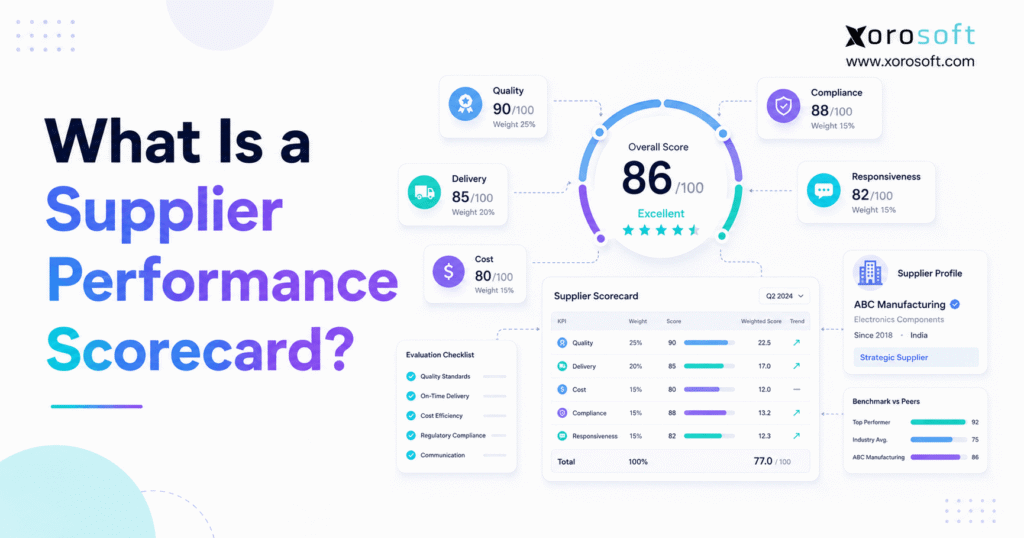
Understanding supplier scorecard KPIs is essential for effectively evaluating and managing supplier performance in any business sector.
1. Supplier Problems Become Expensive Before They Become Obvious
A supplier can appear reliable until one late shipment creates a stockout, one quality problem blocks usable inventory, or one incomplete delivery delays several customer orders. Therefore, procurement teams need more than purchase prices and personal impressions when evaluating supplier performance.
A supplier performance scorecard provides that structure. In simple terms, it measures supplier results against defined criteria such as delivery, quality, cost, responsiveness, compliance, and order accuracy. As a result, purchasing teams can compare vendors using consistent evidence instead of relying on memory.
However, the value of a scorecard goes beyond ranking suppliers. Because supplier performance affects inventory availability, warehouse receiving, production, customer fulfillment, and working capital, the same measurements can reveal operational risks before they become larger problems.
For example, a supplier may offer attractive pricing but regularly miss confirmed delivery dates. Consequently, the purchasing team may save a few percentage points on unit cost while the wider business absorbs emergency freight, stockouts, delayed production, and customer-service issues.
Likewise, another supplier may charge slightly more but consistently deliver complete orders on time. Therefore, that supplier could create a lower total operating cost despite having a higher quoted price.
This is why supplier scorecard KPIs matter. Instead of answering only, “Which supplier is cheapest?” they help answer a more important question: “Which supplier creates the most dependable operational outcome?”
1.1 What a Supplier Performance Scorecard Measures
A supplier performance scorecard is a structured framework that converts supplier activity into measurable performance results. Therefore, each score should be supported by clearly defined operational evidence.
Typically, businesses evaluate areas such as:
- Delivery reliability
- Product quality
- Order completeness
- Lead-time accuracy
- Cost performance
- Responsiveness
- Documentation accuracy
- Contract compliance
- Corrective-action performance
- Supplier risk
Most importantly, each metric should have a clear definition. Otherwise, two employees may calculate the same KPI differently and reach different conclusions.
For example, “on-time delivery” sounds simple. However, one business may compare the actual receipt date with the requested delivery date, while another may compare it with the supplier-confirmed date.
Therefore, a scorecard becomes reliable only when the business documents exactly how every measure works.
1.2 Supplier Scorecard KPIs vs General Supplier Metrics
Supplier scorecard KPIs should measure outcomes that matter to procurement and operations rather than merely reporting activity.
For instance, “number of supplier shipments” is a metric. By contrast, “percentage of supplier shipments received on time” is a KPI because it helps evaluate delivery reliability.
Similarly, “number of defective units” records an event. However, defect rate creates a comparable supplier performance measure across different order volumes.
Therefore, useful supplier performance metrics should help someone make a decision. If a measure never changes sourcing, purchasing, planning, escalation, or improvement activity, it probably does not belong on the main scorecard.
2. Why Supplier Scorecard KPIs Matter
Supplier scorecard KPIs matter because supplier performance has consequences across the entire operating model. Therefore, procurement should not evaluate vendors separately from inventory, warehouse execution, finance, and customer fulfillment.
According to SAP’s supplier performance guidance, supplier performance scorecards can combine KPI information into structured supplier evaluations. Consequently, businesses can place greater emphasis on criteria that create greater operational risk.
In addition, supplier management has become a meaningful component of strategic sourcing. For example, the Institute for Supply Management’s strategic sourcing research includes supplier performance and continuous improvement among important sourcing activities.
Moreover, Deloitte’s 2025 Global Chief Procurement Officer Survey highlights the continuing importance of supply-chain visibility, supplier collaboration, and stronger procurement operating models.
Therefore, structured supplier measurement is increasingly part of broader procurement governance rather than an isolated reporting exercise.
2.1 Supplier Performance Affects Inventory Availability
Supplier scorecard KPIs help inventory teams understand whether incoming supply is arriving close to the expected date, quantity, and quality.
For example, imagine that a wholesaler expects 1,000 units in 30 days. Meanwhile, demand planning assumes those units will become available before current inventory reaches zero.
However, if the supplier delivers only 600 units after 42 days, the original replenishment plan is no longer valid. Consequently, the company may experience backorders even though the original purchase order appeared sufficient.
Therefore, supplier performance should feed back into purchasing and inventory-planning decisions.
2.2 Supplier Performance Affects Working Capital
Unreliable suppliers can also increase inventory investment. Therefore, supplier performance measures should not be viewed only as procurement statistics.
For instance, if a supplier’s actual lead time varies significantly, planners may add extra safety stock to protect customer service. As a result, more cash remains tied up in inventory.
Conversely, predictable suppliers can give planners greater confidence in replenishment timing. Therefore, consistency sometimes matters almost as much as average lead time.
2.3 Supplier Performance Affects Customer Service
Customers rarely care whether a delay began with the supplier, purchasing department, carrier, or warehouse. Instead, they experience only the final outcome.
Consequently, poor inbound supplier performance can eventually become:
- Customer backorders
- Delayed shipments
- Lost sales
- Expedited freight
- Partial fulfillment
- Production delays
- Customer complaints
Therefore, purchasing teams should measure suppliers before recurring problems become customer-facing failures.
3. The Most Important Supplier Scorecard KPIs
The right supplier scorecard KPIs depend on what the supplier provides and how supplier failure affects the business. Nevertheless, several measures are useful across many inventory-driven operations.
However, a scorecard should remain focused. Therefore, most businesses should begin with a manageable group of high-value supplier performance metrics rather than creating dozens of measurements.
3.1 On-Time Delivery
On-time delivery measures how frequently a supplier meets the agreed delivery date.
A basic formula is:
Supplier On-Time Delivery = On-Time Deliveries ÷ Total Deliveries × 100
However, the business must first define “on time.”
For example, will delivery one day early count as successful? Alternatively, must the shipment arrive within a specific appointment window?
Therefore, the business should document the date source and acceptable tolerance before comparing vendors.
3.2 OTIF — On Time In Full
On-time delivery alone can hide incomplete shipments. Therefore, OTIF adds a quantity requirement.
OTIF = Orders Delivered On Time and In Full ÷ Total Orders × 100
For example, a supplier may deliver on the correct date but provide only 70% of the ordered quantity. Although the shipment was technically on time, it still creates an inventory shortage.
Consequently, OTIF often provides a more complete picture of supplier delivery performance.
3.3 Supplier Fill Rate
Supplier fill rate measures how much of the requested quantity arrives as required.
A simple calculation is:
Supplier Fill Rate = Quantity Received ÷ Quantity Ordered × 100
However, businesses should decide whether later backordered quantities count toward the same measurement period.
For this reason, many procurement teams also monitor first-shipment fill rate separately.
3.4 Defect Rate
Quality problems reduce the amount of inventory that is genuinely usable. Therefore, defect rate is particularly important for manufacturers, food businesses, furniture brands, apparel companies, and distributors handling quality-sensitive products.
A common formula is:
Defect Rate = Defective Units ÷ Total Units Received × 100
For example, receiving 1,000 units does not create 1,000 available units when 80 fail inspection. Instead, the business effectively received only 920 usable units.
Consequently, quality performance should influence supplier planning alongside delivery performance.
3.5 Rejection Rate
Rejection rate measures the share of incoming goods that the business refuses to accept.
Although it is related to defect rate, the two measurements can serve different purposes. For example, a minor defect may still allow a product to remain usable, while a critical failure may require rejection.
Therefore, businesses with formal inbound-quality processes may monitor both measures.
3.6 Lead-Time Accuracy
Average lead time alone can hide supplier instability.
For instance, Supplier A may average 20 days but normally deliver between 19 and 21 days. Meanwhile, Supplier B may also average 20 days but range from 8 to 35 days.
Although both averages are identical, Supplier A is easier to plan around.
Therefore, procurement teams should evaluate both average lead time and lead-time variance.
3.7 Purchase Price Variance
Purchase price variance compares actual purchasing cost with the expected, budgeted, contracted, or standard price.
However, price should rarely stand alone.
For example, a low-cost supplier can still generate greater total expense because of:
- Quality failures
- Premium freight
- Partial deliveries
- Rework
- Excess administrative effort
- Returns
- Production interruptions
Therefore, purchasing teams should evaluate price alongside service, quality, and reliability.
3.8 Response Time
Responsive communication becomes especially important when orders change or supply problems occur.
For example, a supplier that communicates a production delay immediately gives the buyer time to respond. Conversely, a supplier that reports the same delay one day before shipment creates fewer alternatives.
Therefore, response time can be an important supplier evaluation metric for strategic or high-risk vendors.
3.9 Invoice and Documentation Accuracy
Incorrect invoices, packing slips, shipping documents, labels, or EDI transactions can create significant administrative work.
Consequently, wholesalers and businesses serving major retail accounts may include documentation accuracy among their vendor performance metrics.
However, the measurement should separate genuine supplier errors from problems created internally.
3.10 Compliance Performance
Some businesses depend on suppliers meeting regulatory, contractual, sustainability, certification, packaging, or customer-specific requirements.
Therefore, relevant compliance measures can be included where they materially affect risk.
However, businesses should avoid adding generic compliance scores simply because other companies use them. Instead, they should measure requirements that matter to the specific supplier relationship.
4. A Practical Supplier Scorecard KPI Example
A useful set of supplier scorecard KPIs could be organized as follows:
| KPI | Target | Supplier Result | Weight |
|---|---|---|---|
| Quality | 98%+ accepted | 97% | 25% |
| OTIF | 95%+ | 91% | 30% |
| Lead-time accuracy | 95%+ | 90% | 15% |
| Cost performance | Within target | 96% | 10% |
| Responsiveness | Within SLA | 92% | 10% |
| Compliance | 100% | 100% | 10% |
These figures are illustrative rather than universal benchmarks. Therefore, each business should establish thresholds that reflect its products, customer commitments, supply market, and operating risk.
4.1 How Weighted Supplier Scoring Works
Not every KPI deserves equal influence.
For example, quality may matter more than price for a manufacturer producing safety-sensitive products. Meanwhile, an ecommerce brand approaching peak season may temporarily place greater importance on OTIF.
A simple weighted approach is:
Weighted Supplier Score = Sum of KPI Score × KPI Weight
Therefore, if delivery receives a 30% weighting, changes in delivery performance will affect the overall rating more than a 10%-weighted service metric.
Most importantly, teams should agree on the weights before reviewing individual suppliers. Otherwise, employees may unintentionally change the model to favor a preferred vendor.
4.2 Avoid Universal Supplier Targets
Supplier targets should reflect actual operational requirements.
For example, a five-day delay on inexpensive office supplies may have little business impact. By contrast, a one-day delay involving a production-critical component could stop manufacturing.
Therefore, strategic, operational, bottleneck, and routine suppliers may require different targets and weights.
5. How to Collect Reliable Supplier Performance Data
Reliable supplier scorecard KPIs depend on accurate purchasing, receiving, inventory, quality, and supplier transaction data.
Therefore, purchasing teams should identify a source for every KPI before they start scoring suppliers.
5.1 Purchase Order Data
Purchase orders can provide:
- Supplier
- Item
- Ordered quantity
- Expected quantity
- Purchase price
- Requested date
- Confirmed date
- Destination warehouse
Therefore, clean purchase-order data creates the baseline for several supplier performance measures.
For businesses that need purchasing connected with inventory planning and vendor management, Xorosoft’s purchasing and procurement software connects purchasing activity with broader operational workflows.
5.2 Warehouse Receiving Data
Purchase orders show what should happen. However, receiving records show what actually happened.
Therefore, receiving processes should capture:
- Actual arrival date
- Actual quantity
- Damaged quantity
- Accepted quantity
- Rejected quantity
- Warehouse location
- Receipt discrepancies
As a result, the business can compare supplier commitments with physical execution.
For operations requiring barcode scanning and structured receiving workflows, XoroWMS connects warehouse execution with inventory control.
5.3 Inventory Data
Supplier performance should also connect with inventory consequences.
For example, a delayed receipt may be minor when stock is abundant. However, the same delay can become critical when customer demand has already consumed safety stock.
Therefore, procurement teams should interpret supplier performance within the wider inventory context.
5.4 Vendor Master Data
Reliable supplier analysis requires consistent vendor records.
For example, duplicate supplier names can divide purchase history across multiple records. Consequently, scorecards may show incomplete results.
Therefore, vendor IDs, payment terms, lead times, locations, currencies, and purchasing rules should be maintained consistently.
6. Supplier Scorecard KPIs vs Supplier Evaluation
Supplier scorecard KPIs and broader supplier evaluations support related goals, but they are not always identical.
A supplier evaluation often occurs during qualification, onboarding, periodic review, or supplier selection. By contrast, a supplier performance scorecard normally focuses on measurable results after operational transactions begin.
| Supplier Evaluation | Supplier Performance Scorecard |
| Can assess supplier capability | Measures actual supplier results |
| Often used during selection | Typically used after transactions begin |
| May use questionnaires or audits | Often uses transaction-based KPIs |
| Supports approval decisions | Supports performance improvement |
| Can be periodic | Usually tracks trends over time |
However, mature supplier-management programs often use both.
For instance, an evaluation may confirm that a supplier has the necessary capabilities and certifications. After onboarding, the scorecard can measure whether actual delivery, quality, cost, and service meet expectations.
Therefore, evaluation determines capability while ongoing scorecards measure execution.
7. Supplier Scorecards vs Spreadsheet Tracking
Spreadsheets are not automatically a poor choice.
For example, a small business with eight suppliers, one warehouse, and limited purchase-order activity may manage supplier performance effectively in Excel.
However, the process becomes harder when:
- Supplier counts increase
- Purchase-order volume grows
- Several employees purchase products
- Multiple warehouses receive inventory
- Quality data lives elsewhere
- Accounting maintains separate supplier records
- Ecommerce demand changes quickly
- Buyers manually combine several reports
Consequently, the problem eventually becomes data integration rather than spreadsheet design.
7.1 When a Spreadsheet Still Works
A spreadsheet can remain practical when the data set is small and the update process is consistent.
Moreover, spreadsheets allow procurement teams to test supplier evaluation metrics before automating the process.
Therefore, companies should not buy software simply because supplier scorecards exist.
7.2 When Manual Supplier Tracking Starts Breaking
Manual tracking becomes risky when employees spend more time collecting information than reviewing performance.
For example, a buyer may export purchase orders from one system, receipts from another, quality results from a third, and invoice information from accounting.
Consequently, monthly reporting becomes slow and prone to version errors.
At this stage, an integrated platform becomes more relevant.
For inventory-driven businesses, XoroERP connects purchasing, inventory, accounting, warehouse management, reporting, manufacturing, and related operational information within a broader ERP environment.
8. How Supplier Scorecard KPIs Improve Inventory Decisions
Supplier scorecard KPIs should influence inventory planning, replenishment, sourcing, and purchasing decisions rather than remain isolated procurement reports.
Therefore, businesses should connect supplier performance with replenishment, safety stock, sourcing, and forecasting.
8.1 Adjust Planning for Lead-Time Reliability
If actual supplier lead time consistently differs from the value stored in the planning system, the assumption should be updated.
Otherwise, the system may continue recommending purchase orders too late.
Therefore, buyers should review historical performance regularly and correct stored lead times when sustained changes occur.
8.2 Review Safety Stock for Unreliable Suppliers
Safety stock protects against uncertainty.
Consequently, unstable supplier lead times may justify additional protection for critical products.
However, businesses should not automatically solve every supplier problem by carrying more inventory. Instead, procurement should first determine whether the supplier can improve reliability.
8.3 Use Performance in Sourcing Decisions
Purchase price should not be the only sourcing factor.
For example, a supplier with better OTIF and lower defect rates may protect more margin than a cheaper but unreliable alternative.
Therefore, sourcing decisions should consider the operational cost of supplier performance.
8.4 Connect Supplier Performance With Inventory Visibility
As operations scale, purchasing teams need visibility into on-hand stock, allocated inventory, inbound supply, transfers, and expected demand.
Therefore, connected inventory management software can help teams interpret supplier reliability in the context of actual stock requirements.
9. How Often Should Suppliers Be Reviewed?
Review frequency should reflect supplier risk rather than follow one universal calendar.
Therefore, a practical model may look like this:
| Supplier Type | Suggested Review Approach |
| Strategic or critical | Monthly or quarterly |
| High operational impact | Quarterly |
| Standard supplier | Quarterly or semiannual |
| Low-risk supplier | Semiannual or annual |
| Problem supplier | Exception-based plus formal follow-up |
These frequencies are examples rather than mandatory standards.
Therefore, teams should consider spend, product criticality, supply alternatives, quality risk, customer commitments, and previous supplier performance.
9.1 Review Trends Instead of One Bad Shipment
One late shipment does not always prove that a supplier is unreliable.
Similarly, one excellent month does not erase a long history of delivery problems.
Therefore, supplier scorecard KPIs should be reviewed as trends rather than isolated events.
For example, displaying twelve months of OTIF can reveal whether supplier performance is improving, declining, seasonal, or unstable.
9.2 Create Exception-Based Reviews
Not every supplier requires the same meeting frequency.
Instead, teams can establish thresholds that trigger attention.
For example:
- OTIF falls below target
- Defect rate increases
- Lead-time variance widens
- Price variance exceeds tolerance
- Corrective actions remain overdue
Consequently, procurement can focus time on suppliers that actually require intervention.
10. What to Do When Supplier Scorecard KPIs Decline
Poor supplier scorecard KPIs should trigger investigation and corrective action rather than automatic supplier replacement.
First, verify the data. Next, identify the underlying issue and determine whether the supplier actually caused it.
For example, a late receipt may initially appear to be a supplier failure. However, the shipment could have arrived on time while the warehouse posted the receipt two days later.
Therefore, operational evidence should be checked before escalation.
10.1 Identify the Root Cause
Weak supplier performance may come from:
- Supplier capacity
- Raw-material shortages
- Transportation delays
- Incorrect forecasts
- Buyer order changes
- Poor specifications
- Packaging failures
- Internal receiving delays
- Communication gaps
Consequently, corrective action should address the actual cause rather than only the final KPI.
10.2 Agree on Corrective Actions
A useful corrective-action plan should identify:
- The performance problem
- Root cause
- Required action
- Responsible owner
- Due date
- Expected result
- Follow-up date
Therefore, the next supplier review can measure whether the action worked.
10.3 Escalate Persistent Problems
If performance remains weak despite corrective actions, procurement may need to reconsider purchase allocation, sourcing strategy, safety stock, contract terms, or supplier status.
However, those decisions should rely on documented supplier performance measures rather than frustration from the latest incident.
11. When Supplier Management Needs a Connected ERP
A business does not need ERP simply because it tracks suppliers.
However, ERP becomes more relevant when supplier scorecard KPIs must be calculated from several operational systems and processes.
Common warning signs include:
1. Buyers manually combine supplier reports.
2. Inventory and purchasing systems disagree.
3. Several warehouses track receipts differently.
4. Vendor information exists in multiple systems.
5. Supplier lead times are not updated consistently.
6. Quality problems are tracked outside procurement.
7. Forecasting ignores supplier performance.
8. Accounting cannot easily reconcile purchasing activity.
9. Shopify, Amazon, wholesale, and warehouse operations use disconnected applications.
10. Management lacks one reliable operational view.
Therefore, the business should evaluate whether the underlying systems, rather than the scorecard itself, have become the constraint.
Xorosoft’s broader ERP solutions connect inventory, warehouse operations, purchasing, manufacturing, accounting, ecommerce, fulfillment, and reporting for inventory-driven companies.
11.1 Why Connected Operations Matter
Supplier performance begins with a purchase commitment and continues through receiving, inventory, accounting, and eventually customer fulfillment.
Therefore, fragmented systems can make root-cause analysis difficult.
For instance:
Purchase Order → Supplier Commitment → Shipment → Warehouse Receipt → Quality Check → Inventory Availability → Invoice → Supplier Performance
When each step lives in a separate application, employees may spend significant time reconstructing what happened.
Conversely, connected operational data gives teams a clearer path from the KPI to the underlying transaction.
11.2 Where Xorosoft Fits
Xorosoft is designed for inventory-driven businesses that need purchasing to work alongside inventory, WMS, accounting, manufacturing, ecommerce, and reporting.
In addition, businesses can review Xorosoft’s integrations when supplier management needs to operate alongside Shopify, Amazon, EDI, shipping, payments, and other connected systems.
For Shopify-focused operations, Xorosoft is also available through the Shopify App Store, which can be relevant when ecommerce demand and ERP inventory workflows need to remain connected.
However, software should support a well-defined supplier-management process rather than replace one.
Therefore, businesses should establish their KPIs, formulas, ownership, targets, and corrective-action rules before expecting technology to solve supplier-performance problems.
12. Supplier Scorecard Use Cases by Industry
The most useful supplier scorecard KPIs vary by operating model. Therefore, companies should build scorecards around the risks that matter most within their industry.
12.1 Wholesale Distribution
Wholesalers often prioritize:
- OTIF
- Fill rate
- Lead-time reliability
- Cost stability
- Invoice accuracy
- EDI and document accuracy
Because wholesale businesses depend on product availability across many SKUs, supplier reliability can directly affect customer fill rate.
Therefore, distribution teams should connect vendor scorecard KPIs with inventory availability and customer-service outcomes.
12.2 Ecommerce and Shopify
Ecommerce businesses frequently operate with rapidly changing demand across several channels.
Consequently, a supplier that misses a replenishment window can create stockouts across Shopify, marketplaces, wholesale orders, and other sales channels at the same time.
Therefore, relevant supplier performance measures may include:
- OTIF
- Lead-time accuracy
- Fill rate
- Inventory availability
- Packaging accuracy
- Response time
Moreover, businesses operating several ecommerce channels should consider whether supplier data and sales-channel inventory are visible inside the same operating model.
12.3 Apparel and Fashion
Fashion businesses often operate around seasons, launches, and rapidly changing consumer demand.
Consequently, late materials or finished goods can lose significant value after the selling window passes.
Useful measures may include quality, size or color accuracy, production lead time, OTIF, and packaging compliance.
12.4 Furniture
Furniture businesses may experience longer supplier lead times, damage risk, bulky freight, and component dependencies.
Therefore, useful KPIs can include completeness, damage rate, lead-time accuracy, packaging quality, and responsiveness.
12.5 Sporting Goods
Sporting-goods businesses often experience seasonal peaks.
As a result, supplier delays before a major season can create greater damage than the same delay during a slower period.
Therefore, teams may emphasize fill rate, OTIF, quality, and seasonal reliability.
12.6 Food and Beverage
Food businesses may require additional controls around lot information, quality, shelf life, documentation, and regulatory requirements.
Therefore, scorecards should reflect the exact products and applicable compliance obligations.
12.7 Manufacturing
Manufacturers depend on raw materials and components arriving before production requires them.
Consequently, one missing component can stop a larger assembly.
Therefore, manufacturing supplier scorecards may place strong weight on quality, lead-time reliability, quantity accuracy, and continuity of supply.
Businesses operating across these models can review Xorosoft’s industries to understand how connected ERP and inventory workflows vary by operating environment.
13. Common Supplier Scorecard Mistakes
Even strong supplier scorecard KPIs can produce poor decisions when the underlying scorecard design is weak.
Therefore, teams should avoid several common mistakes.
13.1 Tracking Too Many KPIs
More data does not automatically improve supplier management.
Instead, too many measurements can hide the few issues that truly matter.
Therefore, executive scorecards should remain focused while detailed operational reports provide supporting analysis.
13.2 Using Undefined Metrics
A KPI without a documented formula invites disagreement.
Therefore, each measure should specify:
- Formula
- Data source
- Measurement period
- Owner
- Target
- Exclusions
- Corrective-action threshold
13.3 Comparing Different Supplier Types Directly
Not every supplier performs the same role.
For example, comparing a domestic packaging supplier with an overseas manufacturing partner using identical criteria may create misleading results.
Therefore, segment suppliers before establishing targets.
13.4 Rewarding Price While Ignoring Total Cost
Low unit cost may look attractive. However, poor quality, late deliveries, and administrative errors can create greater downstream expense.
Consequently, price should sit beside service, quality, and reliability measurements.
13.5 Measuring Without Acting
A dashboard has little value if nobody responds to the result.
Therefore, every significant exception should connect with a decision, investigation, or corrective action.
In other words, supplier scorecard KPIs create value only when procurement teams use the results to improve future supplier decisions.
14. Frequently Asked Questions About Supplier Scorecard KPIs
14.1 What Is a Supplier Performance Scorecard?
A supplier performance scorecard is a structured system for measuring vendor results across areas such as quality, delivery, cost, responsiveness, compliance, and reliability.
Therefore, instead of evaluating suppliers through opinions alone, procurement teams can use consistent performance data to identify trends, compare vendors, and guide corrective actions.
14.2 What Are Supplier Scorecard KPIs?
Supplier scorecard KPIs are selected measures used to evaluate supplier performance.
For example, common KPIs include OTIF, on-time delivery, fill rate, defect rate, lead-time accuracy, purchase price variance, responsiveness, and compliance.
However, the final KPI set should reflect the supplier’s role and the operational risk created when that supplier fails to perform.
14.3 Which Supplier KPI Is Most Important?
There is no universal most-important supplier KPI.
Instead, the correct priority depends on operational impact. For example, quality may dominate in safety-sensitive manufacturing, while OTIF may be more important for seasonal ecommerce.
Therefore, KPI weights should reflect actual business consequences.
14.4 How Is Supplier On-Time Delivery Calculated?
Supplier on-time delivery is commonly calculated by dividing on-time deliveries by total deliveries and multiplying by 100.
However, the company must first define which promised date is used and what delivery tolerance is acceptable.
Therefore, consistent definitions are essential before supplier comparisons begin.
14.5 What Is OTIF?
OTIF means On Time In Full.
Therefore, an order must arrive by the agreed date and include the complete required quantity to count as successful.
Unlike basic on-time delivery, OTIF prevents a supplier from receiving full credit for an incomplete shipment.
14.6 How Do You Calculate Supplier Fill Rate?
Supplier fill rate generally divides quantity received by quantity ordered and multiplies the result by 100.
However, businesses may also track first-shipment fill rate separately.
As a result, buyers can see whether suppliers satisfy the original requirement without relying on later backorders.
14.7 How Do You Measure Supplier Quality?
Supplier quality can be measured using defect rate, rejection rate, inspection failures, supplier-caused returns, rework, or other product-specific measures.
Therefore, the selected KPI should reflect the actual quality risk and rely on information that can be attributed reliably to the supplier.
14.8 What Is a Good Supplier Performance Score?
There is no universal good score.
Instead, businesses should create thresholds that reflect customer commitments, product requirements, risk, and supplier agreements.
Therefore, a score of 90 should not automatically be considered excellent unless the underlying KPI definitions and targets justify that rating.
14.9 How Many KPIs Should a Supplier Scorecard Use?
A focused scorecard is usually more useful than a very large one.
Therefore, start with the small group of vendor performance metrics that materially affects sourcing and operational decisions.
Additional diagnostic measures can remain available without appearing on the main scorecard.
14.10 Should Supplier KPIs Be Weighted?
Yes, particularly when some performance dimensions create greater business impact than others.
For example, a manufacturer may weight quality and delivery more heavily than response time.
Therefore, weighted scoring can create a more realistic overall supplier rating.
14.11 How Often Should Supplier Performance Be Reviewed?
Review frequency should reflect risk and supplier importance.
For example, strategic suppliers may require monthly or quarterly reviews, while low-risk suppliers may need less frequent assessment.
However, major exceptions should trigger review even when the next scheduled meeting is months away.
14.12 Can Excel Be Used for Supplier Scorecards?
Yes. In fact, spreadsheets can work well for smaller supplier bases with simple data requirements.
However, manual scorecards become harder to maintain as purchase volume, warehouses, suppliers, and source systems increase.
Therefore, the need for automation usually comes from complexity rather than the scorecard itself.
14.13 When Should Supplier Scorecards Be Automated?
Automation becomes useful when employees repeatedly export and reconcile purchasing, receiving, quality, inventory, and financial information.
Consequently, a connected system can reduce manual preparation and allow procurement teams to spend more time analyzing supplier performance and corrective actions.
14.14 What Is the Difference Between a Supplier Scorecard and Supplier Evaluation?
Supplier evaluation often assesses capability or suitability during qualification and review.
By contrast, a supplier scorecard usually measures actual operational performance.
Therefore, companies may use supplier evaluation for selection and supplier scorecards for ongoing performance management.
14.15 Is a Vendor Scorecard the Same as a Supplier Scorecard?
Usually, the terms are used similarly.
However, terminology may differ by organization or industry.
Therefore, the important issue is not the label but whether the organization has consistent metrics, formulas, targets, review periods, and corrective actions.
14.16 How Does Supplier Performance Affect Inventory?
Supplier delays can create stockouts, while variable lead times can increase safety-stock requirements.
In addition, quality failures reduce usable inventory and incomplete deliveries can delay fulfillment.
Therefore, supplier performance should connect directly with inventory planning.
14.17 Who Should Own Supplier Performance Reviews?
Procurement normally coordinates supplier reviews.
However, warehouse, quality, inventory, finance, production, and operations teams may hold important evidence.
Therefore, cross-functional input often produces a more accurate supplier assessment.
14.18 What Should Happen After a Supplier Receives a Low Score?
First, verify the underlying data. Next, identify the root cause and agree on corrective action with the supplier.
After that, monitor the relevant performance measure during subsequent periods.
Therefore, the score becomes the beginning of an improvement process rather than the end of an evaluation.
15. Turn Supplier Scorecard KPIs Into Better Purchasing Decisions
A supplier scorecard should do more than produce a rating. Instead, supplier scorecard KPIs should help the business understand whether suppliers are delivering the quality, quantity, timing, cost, service, and reliability that operations require.
Therefore, start with a small set of clearly defined performance measures. Next, document formulas and targets. Then, collect reliable purchasing and receiving information.
In addition, weight each KPI according to operational importance and investigate poor results before assigning blame.
Most importantly, connect supplier performance with actual business decisions.
If a supplier becomes less reliable, purchasing rules may need to change. Likewise, inventory policies may require adjustment, corrective actions may need escalation, or alternative sourcing may deserve consideration.
As the business grows, however, supplier analysis can become difficult when purchasing, inventory, warehouse, accounting, and ecommerce information remains spread across separate systems.
At that stage, a connected ERP approach can provide a more reliable operational foundation.
For additional examples of how inventory-driven companies address operational complexity, review Xorosoft’s case studies.
Finally, if supplier management, purchasing, inventory, warehouse operations, and accounting have become difficult to coordinate across disconnected systems, you can Book a Demo to evaluate whether Xorosoft fits your operation.
Recent Posts
-
 Warehouse Injury and Safety Statistics: What Operations Teams Should Know Before Automating Workflows
 -
 Food and Beverage ERP Requirements for Lot, Expiry, and Recall Control
 -
 How to Prevent EDI Errors Before They Become Retailer Chargebacks
 -
 Vendor Portal vs Supplier Portal: What Distributors Actually Need Connected to ERP
 -
 Stock Write-Off Tracking: How Inventory Losses Explain Gross-Margin Variance