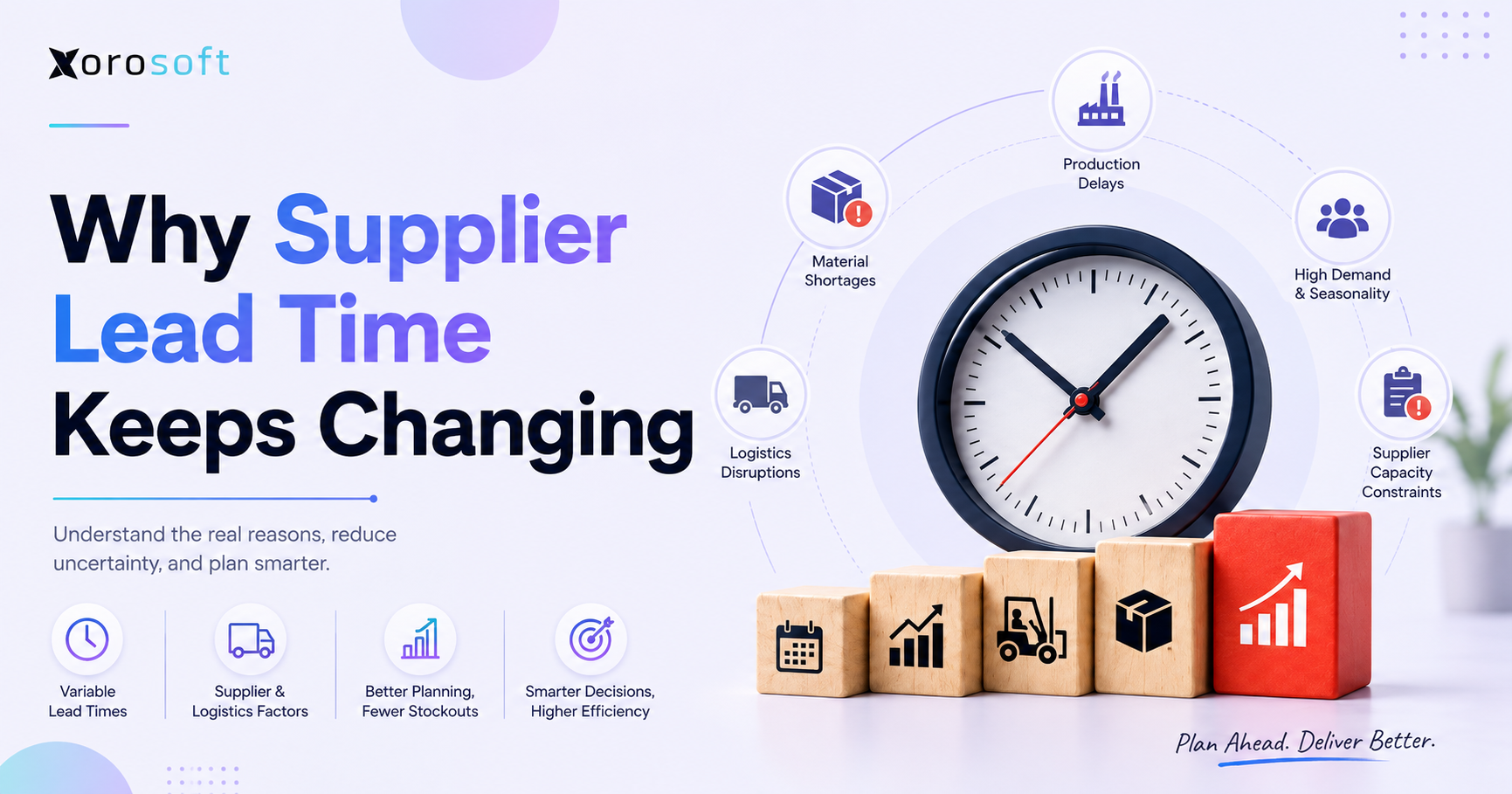
Understanding supplier lead time is crucial for effective supply chain management and planning.
1. When a 30-Day Supplier Promise Stops Meaning 30 Days
Supplier lead time rarely stays as predictable as the number stored in a spreadsheet, purchasing system, or item record. A supplier that normally delivers in 30 days may suddenly need 38, 45, or even 60 days because production capacity, material availability, freight conditions, order size, or seasonal demand has changed.
However, the bigger problem is not simply that a shipment arrives late. Instead, the real operational risk appears when purchasing, inventory, warehouse, finance, and sales teams continue planning as though the original 30-day assumption is still accurate.
As a result, buyers may reorder too late. Meanwhile, planners may reduce inventory too aggressively. Consequently, customer demand can consume available stock before replenishment arrives.
On the other hand, teams sometimes react to delays by ordering extra inventory. Therefore, several delayed purchase orders may eventually arrive together, creating overstock, storage pressure, and unnecessary working capital commitments.
In other words, changing vendor delivery times can create both shortages and excess inventory.
The goal is not to force every vendor into a perfectly fixed schedule. Rather, growing businesses need to understand why delivery patterns change, measure actual performance, and adjust purchasing decisions accordingly.
1.1 Why the problem becomes more serious as a business grows
A small company may manage ten suppliers and a few hundred SKUs manually. Therefore, a buyer can often remember which vendor is late and which item requires an earlier reorder.
However, that approach becomes unreliable once the company operates thousands of SKUs, multiple warehouses, Shopify, Amazon, wholesale accounts, manufacturing workflows, or EDI relationships.
At that stage, supplier delays affect far more than purchasing.
They influence:
- Replenishment timing
- Available inventory
- Safety stock
- Warehouse receiving
- Customer commitments
- Forecasting
- Inventory valuation
- Cash flow
- Production schedules
- Multi-channel fulfillment
Therefore, vendor performance becomes an organization-wide planning variable rather than a simple procurement issue.
1.2 Why averages alone create false confidence
Suppose Supplier A delivers three orders in 29, 30, and 31 days.
Meanwhile, Supplier B delivers three orders in 15, 30, and 45 days.
Both suppliers have an average delivery time of 30 days.
However, they are clearly not equally reliable.
Supplier A is highly predictable. In contrast, Supplier B creates far more planning risk because its delivery pattern swings significantly.
Therefore, average delivery time should never be the only metric used for replenishment planning.
Instead, teams should also track variability, late receipt percentage, average days late, supplier fill rate, and expected-versus-actual receipt dates.
2. What Vendor Lead Time Actually Includes
Vendor lead time generally refers to the period between placing a purchase order and receiving the goods.
However, that period can contain several separate stages. Therefore, businesses should avoid treating the entire process as one unexplained number.
Tracking supplier lead time accurately requires teams to understand where each stage begins and ends.
2.1 The basic calculation
A simple calculation is:
Actual lead time = Actual receipt date − Purchase order date
For example, if a purchase order was created on March 1 and the inventory was received on March 31, the actual duration was 30 days.
Nevertheless, more mature purchasing operations capture additional dates.
These include:
- Purchase order creation date
- Supplier acknowledgment date
- Requested delivery date
- Confirmed delivery date
- Shipment date
- Arrival date
- Warehouse receipt date
- Putaway date
Consequently, teams can identify where a delay actually occurred instead of treating every late receipt as a supplier failure.
2.2 Supplier time versus internal purchasing time
Procurement delays do not always begin with the vendor.
For example, an internal purchase requisition may sit unapproved for five days. Afterward, the buyer may wait another three days before sending the PO.
Therefore, eight days have already been lost before the supplier begins processing the order.
Similarly, inventory may physically arrive on time but remain at the receiving dock for two days before warehouse staff process it.
Consequently, the system may make the supplier appear late even though the delay occurred internally.
2.3 Delivery time versus transit time
Transit time only measures how long goods spend moving from origin to destination.
By comparison, overall vendor delivery time may include production, picking, packing, consolidation, freight booking, customs, transportation, inspection, and receiving.
Therefore, reducing freight time does not necessarily reduce the full replenishment cycle.
3. Why Supplier Lead Time Keeps Changing
Changing delivery schedules usually have identifiable causes. Therefore, teams should diagnose the source rather than simply increasing inventory buffers.
In practice, delivery timing should be measured by supplier, SKU, order size, season, and shipping route instead of being treated as one permanent number.
3.1 Supplier production capacity changes
Factories and distributors have finite capacity. Consequently, a vendor that comfortably fulfilled an order last quarter may become constrained when demand increases.
For example, one supplier might normally produce 2,000 units per week. However, several large customer orders could push production beyond that capacity.
As a result, your order moves further back in the production queue.
Therefore, buyers should pay attention not only to quoted delivery windows but also to how actual performance changes during busy periods.
3.2 Raw material shortages
A finished-goods supplier may depend on several upstream vendors.
For instance, an apparel manufacturer may need fabric, labels, trims, packaging, and dye materials before production can begin.
Therefore, even when the direct supplier is operationally strong, an upstream shortage can still extend delivery time.
Similarly, furniture manufacturers may wait for fabric or hardware, while food businesses may depend on packaging, ingredients, or specialty materials.
Consequently, buyers need visibility beyond a simple promised arrival date.
3.3 Purchase order quantity changes
Order quantity also matters.
A supplier may fulfill 500 units in two weeks. However, 10,000 units may require additional production runs, raw material purchases, labor, inspections, or packaging.
Therefore, using one fixed vendor lead time across every order quantity can create unrealistic expectations.
Instead, businesses should compare delivery performance across order sizes wherever enough historical data exists.
3.4 Seasonal demand spikes
Peak seasons compress supplier capacity.
For example, apparel businesses buy before major retail seasons, sporting goods companies prepare for seasonal demand, and ecommerce brands increase purchasing before holiday periods.
Consequently, many businesses compete for the same supplier capacity at the same time.
Therefore, historical off-season performance may not accurately represent peak-season delivery performance.
3.5 Supplier prioritization changes
Vendors may prioritize orders based on account size, strategic importance, order profitability, production efficiency, payment terms, or long-term relationships.
Therefore, a business cannot assume its priority within a supplier’s production schedule will remain unchanged.
Instead, purchasing teams should evaluate actual delivery performance continuously.
3.6 Freight and carrier disruptions
Goods may leave the factory on time but still arrive late.
For example, ocean freight schedules can move, truck capacity can tighten, containers can miss sailings, and carrier handoffs can fail.
Consequently, inbound transportation becomes another source of variability.
Moreover, international shipments may pass through several carriers and logistics partners before reaching the final warehouse.
3.7 Customs and import processing
Imported products can encounter additional uncertainty.
Documentation errors, customs inspections, duty issues, port congestion, or regulatory checks can extend the arrival schedule.
Therefore, companies importing goods should separate production time from international transit and customs time whenever possible.
As a result, buyers can determine whether recurring delays originate with the supplier or somewhere in the transportation network.
3.8 Weak supplier communication
A supplier may know an order is running late several days before the buyer knows.
However, if there is no structured confirmation and update process, the expected receipt date remains unchanged.
Consequently, purchasing teams discover the issue only when the promised date passes.
Therefore, disciplined PO acknowledgment and exception reporting can be almost as important as delivery speed itself.
3.9 Internal receiving delays
Finally, some apparent supplier delays are actually warehouse delays.
For example, goods may reach the facility on Monday but remain unprocessed until Wednesday.
Therefore, businesses should distinguish between dock arrival, system receipt, inspection, and putaway.
Otherwise, supplier performance data becomes inaccurate.
4. How Supplier Lead Time Affects Inventory Planning
Inventory planning depends heavily on time.
Therefore, even a good demand forecast can fail if the replenishment assumptions behind it are wrong. In particular, supplier lead time determines how much demand a business must cover while it waits for new inventory to arrive.
4.1 Reorder points become inaccurate
A simplified reorder point calculation is:
Reorder point = Average daily demand × replenishment time + safety stock
Suppose a product sells 40 units per day.
If replenishment requires 20 days, the business needs 800 units of demand coverage before considering safety stock.
However, if actual delivery time increases to 35 days, required coverage rises to 1,400 units.
Therefore, the old reorder point could leave the company 600 units short.
Accurate supplier lead time data is essential when setting reorder points for fast-moving inventory.
4.2 Safety stock becomes unreliable
Safety stock protects the business from uncertainty.
However, a static buffer may become inadequate when vendor performance becomes more volatile.
For example, 300 units of safety stock may be sufficient when deliveries fluctuate by only two days. In contrast, the same buffer may be inadequate when shipments vary by two weeks.
Therefore, businesses should connect safety stock decisions to both demand variability and supply variability.
Moreover, every SKU does not need the same protection. High-volume products from unreliable suppliers may justify more buffer, while stable low-volume items may need less.
4.3 Stockouts appear unexpectedly
When replenishment arrives later than expected, available stock continues falling.
Eventually, inventory reaches zero before the incoming PO arrives.
Consequently, ecommerce orders may become backordered, wholesale commitments may be delayed, and manufacturing work orders may stop.
In addition, sales and customer service teams may promise delivery dates based on inventory that will not arrive when expected.
4.4 Overstock can appear for the opposite reason
Ironically, supplier delays can also create excess inventory.
For example, buyers may respond to late deliveries by placing emergency orders with alternate vendors. Meanwhile, the original delayed POs remain open.
If several orders eventually arrive around the same time, inventory can suddenly exceed demand.
Therefore, poor supply visibility can create both underbuying and overbuying.
4.5 Cash gets trapped in precautionary inventory
When planners do not trust supplier dates, they often compensate by carrying additional inventory.
That decision can protect availability. However, it also ties cash up in stock earlier than necessary.
Moreover, excess inventory creates additional carrying costs, storage requirements, insurance exposure, obsolescence risk, and markdown pressure.
Therefore, unreliable replenishment eventually becomes a finance problem.
5. What Happens When Vendor Lead Times Shift
Purchasing teams usually notice supplier instability before other departments do.
However, their symptoms often look like ordinary administrative work until volume becomes too high.
5.1 Buyers spend their day chasing POs
Instead of analyzing demand or negotiating better supplier terms, buyers begin sending follow-up emails.
They ask:
“Has production started?”
“Is this still shipping Friday?”
“Can you confirm the new ETA?”
“Why was only half the quantity shipped?”
Consequently, purchasing becomes reactive.
A connected inventory management and ERP solution becomes increasingly relevant when the team spends more time updating information than making purchasing decisions.
5.2 Expected receipt dates stop being trusted
Once buyers stop trusting the dates in the system, they start keeping personal spreadsheets or inbox notes.
Meanwhile, warehouse teams may use another ETA, and sales teams may have a third version.
Therefore, the company loses a single source of truth.
As a result, even a small supplier delay can trigger repeated manual updates across several departments.
5.3 Supplier performance becomes anecdotal
Without clean receipt history, supplier evaluation sounds like this:
“That vendor is usually late.”
“I think they have improved.”
“They were good last season.”
However, subjective impressions are not enough for purchasing decisions.
Instead, supplier performance should be supported by measurable data.
Reliable delivery history gives buyers evidence they can use instead of relying on memory or outdated vendor estimates.
6. How Replenishment Delays Affect Warehouse and Fulfillment
Purchasing instability eventually reaches the warehouse.
Therefore, inbound planning and outbound fulfillment should not be treated as separate processes.
6.1 Receiving volume becomes unpredictable
Suppose three large POs are delayed for two weeks.
Then all three arrive within 48 hours.
Consequently, receiving labor, dock capacity, inspection, labeling, and putaway operations can become overloaded.
A warehouse management system can help connect receiving activity with current inventory and operational workflows when inbound volume becomes more complex.
6.2 Inventory may exist physically but not operationally
Goods at the dock are not necessarily available for orders.
First, they may require counting, inspection, labeling, lot tracking, serial capture, or putaway.
Therefore, businesses should distinguish between physically arrived inventory and available inventory.
Otherwise, customer-facing teams may assume stock is ready even though warehouse operations have not completed receiving.
6.3 Multi-warehouse allocation becomes harder
Imagine an incoming order was originally destined for Warehouse A.
However, during the supplier delay, demand shifts toward Warehouse B.
Consequently, planners may need to redirect goods, transfer inventory, or change future buying allocations.
Therefore, multi-location visibility becomes increasingly important as the network grows.
7. How Lead Time Variability Changes by Industry
Different industries experience replenishment variability in different ways.
Therefore, planning rules should reflect the economics and constraints of each business model.
7.1 Apparel and fashion
Apparel companies often depend on fabric, trims, dyes, labels, packaging, and factory capacity.
Moreover, selling seasons are short.
Therefore, a three-week delay may not simply mean three weeks of lost sales. Instead, it may mean missing the most profitable portion of the season entirely.
7.2 Furniture
Furniture businesses often manage long production cycles, bulky freight, high storage costs, and large purchase commitments.
Consequently, late shipments create availability problems, while early or concentrated arrivals create warehouse capacity problems.
In addition, bulky inventory can make emergency purchasing especially expensive.
7.3 Sporting goods
Sporting goods demand can move quickly around seasons, events, and weather.
Therefore, replenishment timing matters almost as much as total demand.
Inventory that arrives after peak demand may require discounting even if the forecast quantity was correct.
7.4 Food and beverage
Food businesses must consider both replenishment risk and shelf life.
Therefore, simply increasing safety stock is not always practical.
Instead, buyers must balance availability against expiration, freshness, storage, and lot-control requirements.
7.5 Wholesale distribution
Wholesale distributors often manage thousands of SKUs across many suppliers.
Consequently, even a small percentage of unreliable purchase orders can create hundreds of backorders.
A broader view of industries served by inventory-driven ERP systems can be useful when evaluating how purchasing requirements change across distribution, retail, ecommerce, and manufacturing environments.
7.6 Manufacturing
Manufacturers face another problem: one late component can stop an entire production process.
For example, 99% of the materials for a finished product may be available. However, if one critical component is missing, the work order may still be unable to proceed.
Therefore, material availability should be evaluated at the BOM and component level.
8. Fixed Vendor Lead Time vs Dynamic Planning
A fixed vendor lead time stores one standard number for a supplier or item.
For example:
Supplier A = 30 days.
That approach is simple. Therefore, it works reasonably well when performance is stable.
However, dynamic planning uses historical performance and operational context to adjust expectations.
A supplier lead time should ultimately reflect actual purchasing behavior rather than an estimate that remains unchanged for years.
8.1 When a Fixed Delivery Window Still Works
Fixed values may be sufficient when:
- Suppliers are highly consistent
- Freight lanes are predictable
- Order quantities are similar
- Product demand is stable
- The business has few SKUs
- Seasonal variation is limited
Nevertheless, fixed assumptions should still be reviewed periodically.
8.2 When Dynamic Replenishment Planning Makes Sense
Dynamic planning becomes more valuable when the business has multiple suppliers, warehouses, channels, seasons, or order patterns.
For example, the same supplier may take 20 days for one SKU and 45 days for another.
Similarly, small orders may arrive faster than full-container orders.
Therefore, dynamic planning provides a more realistic view of supply risk.
8.3 Variability matters more than the average
Consider two vendors with the same 30-day average.
Vendor A consistently delivers between 28 and 32 days.
Vendor B delivers between 15 and 50 days.
Therefore, the same average creates very different inventory risk.
As a result, planners should track both average delivery time and variability.
9. How to Measure Supplier Lead Time Accurately
Reliable measurement requires consistent transaction data.
Therefore, purchasing and warehouse teams must capture the same milestones every time.
9.1 Track the PO creation date
First, record when the purchase order was actually released.
Otherwise, teams cannot distinguish internal approval delays from supplier processing delays.
9.2 Track supplier confirmation
Next, record when the vendor acknowledged the PO and the date they committed to.
Consequently, buyers can measure whether suppliers respond quickly and whether confirmed dates change later.
9.3 Track shipment and receipt dates
Then, capture when goods shipped and when they physically arrived.
Therefore, production delays can be separated from transportation delays.
9.4 Track actual warehouse receipt
Finally, record when inventory became available in the system.
This makes it possible to identify internal receiving bottlenecks.
Moreover, the business can distinguish a late delivery from a late warehouse processing event.
9.5 Measure Supplier Lead Time Variance
A useful calculation is:
Lead time variance = Actual delivery time − Planned delivery time
For example, if the plan assumed 28 days and the shipment required 40 days, variance was +12 days.
Over time, those variances reveal patterns.
Therefore, teams can identify which suppliers, SKUs, seasons, and freight lanes create the greatest uncertainty.
10. Vendor Lead Time KPIs Purchasing Teams Should Track
A strong supplier scorecard should go beyond average delivery time.
Therefore, consider measuring the following:
| KPI | What it reveals |
|---|---|
| Average delivery time | Typical replenishment duration |
| Lead time variance | Predictability |
| On-time delivery rate | Supplier reliability |
| Average days late | Severity of delays |
| PO acknowledgment time | Communication speed |
| Supplier fill rate | Quantity reliability |
| Open POs without confirmed dates | Visibility risk |
| Partial receipt rate | Fulfillment consistency |
| Emergency purchase frequency | Planning weakness |
| Stockouts linked to late supply | Inventory impact |
Tracking supplier lead time alongside delivery consistency gives purchasing teams a clearer picture of supply risk.
However, not every supplier needs the same level of monitoring.
Strategic suppliers, long-lead-time items, high-velocity SKUs, and critical manufacturing components deserve closer attention.
11. How to Improve Replenishment Lead-Time Planning
The easiest response to unreliable supply is to increase inventory.
However, that is rarely the best first move.
Instead, businesses should improve the quality of their purchasing information.
11.1 Use actual receipt history
First, compare planned dates with actual receipts.
Then, calculate average delay, variability, and on-time percentage.
Consequently, the business can replace intuition with evidence.
11.2 Segment suppliers by reliability
Not every vendor deserves the same safety-stock policy.
For example, highly reliable suppliers may require smaller buffers.
In contrast, inconsistent strategic suppliers may require earlier ordering or additional protection.
Therefore, supplier segmentation creates more precise replenishment rules.
11.3 Update reorder points
If real delivery time has increased, the reorder point should reflect that change.
Otherwise, the purchasing system will continue triggering orders too late.
Moreover, reorder points should be reviewed again when demand patterns change.
11.4 Review high-velocity SKUs separately
Fast-moving products have less tolerance for delay.
Therefore, they should generally receive more frequent review than slow-moving products.
Likewise, critical manufacturing components may deserve separate treatment even when unit demand is relatively low.
11.5 Improve PO acknowledgment discipline
Require suppliers to confirm quantities and dates.
Moreover, establish a clear process for communicating changes.
Consequently, buyers can react while there is still time to adjust inventory plans.
12. When Manual Purchasing Cannot Handle Lead-Time Variability
Spreadsheets are useful because they are flexible and familiar.
However, flexibility eventually becomes fragmentation.
12.1 Common warning signs
A business may have outgrown spreadsheet purchasing when:
- Different teams maintain separate PO files
- Expected receipt dates are updated manually
- Buyers repeatedly chase suppliers by email
- Warehouse staff cannot see reliable inbound schedules
- Inventory forecasts ignore open PO changes
- Finance struggles to reconcile receipts and commitments
- Multi-location stock is difficult to coordinate
- Shopify, Amazon, wholesale, and EDI demand is managed separately
At this stage, an integrated cloud ERP platform such as XoroONE can become relevant because purchasing decisions can be connected with inventory, warehouse, accounting, forecasting, and order activity.
12.2 Why disconnected applications create hidden delays
A company might use accounting software, an inventory application, a warehouse application, and purchasing spreadsheets separately.
However, each handoff introduces another opportunity for outdated data.
For example, purchasing may update a PO date while inventory planning continues using the old date.
Consequently, the business appears integrated operationally, but its planning data remains fragmented.
Therefore, the real bottleneck becomes information synchronization rather than the purchase order itself.
13. How ERP Improves Supplier Lead Time Planning
ERP does not make factories, ports, and freight carriers perfectly predictable.
However, it can improve how quickly the business detects and responds to change.
13.1 One supplier and PO history
A modern ERP system for inventory-driven operations can centralize purchase orders, suppliers, inventory, receipts, and financial activity.
Therefore, purchasing teams can evaluate historical delivery performance without maintaining separate files.
13.2 Purchasing connected to inventory
When purchasing and inventory share the same data, changing receipt dates can influence replenishment decisions sooner.
Consequently, teams can identify stockout exposure before available inventory reaches a critical point.
13.3 Purchasing connected to warehouse activity
If an inbound shipment arrives, warehouse receiving should update the same operational environment used by purchasing.
Therefore, buyers can distinguish open, partially received, completed, and late POs more accurately.
13.4 Purchasing connected to ecommerce
For ecommerce brands, incoming inventory affects Shopify, marketplaces, wholesale orders, and customer commitments.
Xorosoft also maintains an official listing on the Shopify App Store, which is relevant for merchants evaluating how ERP and Shopify workflows can connect.
Moreover, businesses operating several sales channels can use Xorosoft integrations to evaluate how ecommerce, marketplace, EDI, and operational systems fit into the broader workflow.
13.5 Forecasting becomes more actionable
A forecast may correctly predict what customers will buy.
However, purchasing still needs to know when inventory must be ordered.
Therefore, forecast quality and replenishment timing should work together rather than independently.
In addition, supplier lead time data gives planners another operational input for deciding when a purchase order should be released.
14. Practical Vendor Lead Time Examples
14.1 Ecommerce brand
An ecommerce company sells 100 units per day of a top SKU.
Its planning system assumes a 20-day delivery time. Therefore, it expects replenishment within 2,000 units of demand.
However, the vendor starts averaging 32 days.
Consequently, the company now needs 3,200 units of demand coverage before considering additional safety stock.
If the system remains unchanged, the reorder trigger can happen roughly 1,200 units too late.
14.2 Apparel brand
An apparel business plans a seasonal launch.
The factory originally confirms 35 days. However, fabric approval adds seven days and production congestion adds another ten.
Consequently, the finished inventory arrives after the planned campaign begins.
Therefore, the problem is not simply late freight. Instead, multiple upstream delays combined into one longer replenishment cycle.
14.3 Wholesale distributor
A wholesale distributor has 8,000 active SKUs and dozens of suppliers.
Even if only 5% of open POs require manual follow-up, buyers may still need to investigate hundreds of lines.
Therefore, the scalability issue is not just vendor performance. It is the amount of exception management required.
14.4 Manufacturer
A manufacturer has every component required for a production order except one imported part.
Because that item arrives two weeks late, production cannot complete the finished good.
Consequently, labor schedules, finished inventory, customer shipments, and revenue timing are all affected.
15. Common Lead-Time Planning Mistakes
15.1 Keeping the same number forever
Supplier information changes.
Therefore, a value entered two years ago should not automatically remain the planning assumption today.
Reviewing supplier lead time regularly prevents old purchasing assumptions from continuing to influence new replenishment decisions.
15.2 Increasing safety stock everywhere
More inventory can hide supply problems temporarily.
However, increasing every SKU equally ties up unnecessary cash.
Instead, buffers should reflect actual item and supplier risk.
15.3 Ignoring early deliveries
Early deliveries can also create operational problems.
For example, unexpected inventory may consume warehouse capacity before it is needed.
Therefore, supplier performance should measure both lateness and predictability.
15.4 Blaming suppliers for warehouse delays
If goods arrive on time but are processed late, supplier data becomes misleading.
Consequently, dock arrival and warehouse receipt should be measured separately.
15.5 Tracking supplier performance without SKU context
A supplier may be excellent for stocked goods and unreliable for custom items.
Therefore, supplier-level averages alone may hide product-level differences.
15.6 Treating purchasing as an isolated department
Purchasing decisions influence inventory, warehousing, accounting, sales, and customer service.
Therefore, a disconnected purchasing process eventually creates problems across the organization.
16. When Lead-Time Complexity Signals an ERP Upgrade
Not every company needs ERP.
A small organization with a few suppliers, one warehouse, limited SKU complexity, and predictable purchasing may operate successfully with simpler tools.
However, an upgrade becomes worth evaluating when operational complexity grows faster than the team’s ability to coordinate it manually.
Typical signals include:
- Repeated stockouts
- Frequent emergency purchasing
- Inaccurate inbound dates
- Multi-warehouse complexity
- Duplicate data entry
- Fragmented reporting
- Constant manual PO maintenance
- Separate inventory and accounting records
- Poor visibility into open purchasing commitments
At that point, Xorosoft can be considered alongside other ERP options because it combines purchasing, inventory, accounting, warehouse management, manufacturing, forecasting, reporting, and ecommerce operations.
For businesses researching how other inventory-driven companies have approached similar operational problems, the Xorosoft case studies provide additional context around ERP implementations and business workflows.
17. Supplier Lead Time FAQs
17.1 What is supplier lead time?
Supplier lead time is the period between placing a purchase order and receiving the goods.
However, businesses should define exactly which dates they use. For example, some measure PO creation to physical arrival, while others measure PO creation to completed warehouse receipt.
Therefore, consistent definitions are essential for accurate supplier performance reporting.
17.2 Why does supplier lead time keep changing?
Supplier lead time changes because production capacity, material availability, order quantity, freight, customs, seasonality, supplier priorities, and internal processing conditions change.
Therefore, the planning value should be reviewed against actual purchasing history instead of being treated as permanent.
Moreover, buyers should identify which portion of the delay belongs to production, transportation, customs, or internal receiving.
17.3 What is lead time variability?
Lead time variability measures how much actual delivery duration changes from order to order.
For example, a vendor averaging 30 days but delivering between 15 and 50 days has much higher variability than one delivering between 28 and 32 days.
Therefore, variability is often more useful than average performance alone.
17.4 How do you calculate vendor lead time?
A basic calculation is actual receipt date minus purchase order date.
However, more detailed analysis can also capture supplier acknowledgment, shipment, arrival, inspection, and putaway dates.
Consequently, teams can identify exactly where delays occur.
17.5 What is the difference between supplier and procurement lead time?
Supplier delivery time usually begins once the purchase order reaches the vendor.
Procurement time can also include internal requisitions, approvals, sourcing, negotiations, and PO creation.
Therefore, a slow procurement process can extend replenishment even when the vendor performs well.
17.6 How does supplier lead time affect inventory?
Longer delivery periods generally require earlier purchasing triggers.
Therefore, if planning assumptions are too short, stockouts become more likely before replenishment arrives.
In contrast, overly conservative assumptions may cause buyers to order too early and carry unnecessary inventory.
17.7 How does delivery variability affect safety stock?
More unpredictable supply generally increases the need for protection against delays.
However, safety stock should also consider demand variability, service targets, carrying costs, and SKU economics.
Therefore, businesses should not increase buffers uniformly across every product.
17.8 How does replenishment time affect reorder points?
Reorder points account for expected demand while replenishment is in progress.
Consequently, a longer delivery period means the business generally needs to reorder with more inventory still on hand.
Therefore, outdated timing assumptions can cause purchasing triggers to occur too late.
17.9 Why do purchase orders arrive late?
Orders can arrive late because of production issues, raw material shortages, freight disruption, customs, supplier prioritization, inaccurate confirmations, or internal processing problems.
Therefore, late delivery should be investigated by stage rather than assigned automatically to one cause.
17.10 Why do suppliers change delivery dates?
Suppliers change dates when their production plan, labor, materials, capacity, transportation, or upstream supply changes.
However, structured PO acknowledgment and update processes can make those changes visible earlier.
Consequently, purchasing teams gain more time to adjust inventory plans.
17.11 What is lead time variance?
Lead time variance compares actual performance with planned performance.
For example, a 30-day assumption and a 38-day actual result create an eight-day positive variance.
Therefore, consistently positive variance indicates the planning assumption may need revision.
17.12 Should vendor lead time be fixed or dynamic?
Fixed values work for simple, predictable operations.
However, dynamic review is more appropriate when supplier performance, seasons, SKUs, quantities, or freight lanes vary significantly.
Therefore, growing businesses often benefit from using actual receipt history.
17.13 How often should supplier performance be reviewed?
Critical suppliers may need monthly review, while stable suppliers may require quarterly review.
Furthermore, seasonal vendors should be reviewed before major purchasing cycles.
Therefore, review frequency should reflect business risk rather than follow one rule for every supplier.
17.14 Can supplier delays cause overstock?
Yes.
Buyers may respond to a late shipment by placing additional orders. However, if both the original and emergency orders eventually arrive, inventory can exceed demand.
Consequently, poor inbound visibility can create excess stock as well as shortages.
17.15 Can supplier delays cause stockouts?
Yes.
If available stock is consumed before the replacement order arrives, the business runs out.
Therefore, outdated replenishment assumptions can turn moderate vendor delays into stockouts.
17.16 What supplier KPIs should be tracked?
Useful KPIs include average delivery time, variance, on-time delivery rate, average days late, fill rate, PO acknowledgment time, partial receipt rate, and open POs without confirmed dates.
Together, these measurements provide a more complete view than average performance alone.
17.17 Can ERP help manage supplier delays?
ERP cannot prevent every external delay.
However, it can centralize POs, supplier history, inventory, receipts, forecasting, warehouse activity, and accounting.
Therefore, teams can identify exceptions earlier and coordinate their response more effectively.
17.18 How does changing supplier performance affect ecommerce?
Ecommerce businesses often sell continuously while replenishment is in transit.
Therefore, a delayed shipment can create stockouts across Shopify, marketplaces, or other channels.
Moreover, inaccurate inbound dates can affect promotions and fulfillment commitments.
17.19 How does vendor variability affect wholesalers?
Wholesalers frequently manage many SKUs and recurring customer orders.
Consequently, delayed supply can create backorders, allocations, split shipments, and service issues across multiple customers.
Therefore, visibility into open purchase orders becomes increasingly important as order volume grows.
17.20 How does it affect manufacturers?
Manufacturers depend on components arriving before production begins.
Therefore, one late critical component can delay an entire work order even when every other material is available.
Consequently, supplier reliability can influence production schedules, labor planning, and customer delivery dates.
17.21 Can inventory software predict supplier delays?
Software can identify patterns in historical data when accurate purchasing and receipt records exist.
However, predictive quality depends on data quality.
Therefore, consistent PO, confirmation, shipment, and receipt records remain essential.
17.22 What data should be captured?
Businesses should capture PO creation date, requested delivery date, supplier confirmation date, shipment date, expected receipt date, actual arrival date, received quantity, and warehouse receipt date.
Consequently, teams can distinguish supplier, transportation, and internal delays.
17.23 When should spreadsheets be replaced?
Spreadsheets become risky when teams maintain multiple versions, manually update many POs, manage several warehouses, or cannot connect purchasing with inventory and accounting.
Therefore, system replacement should be considered when coordination becomes the main operational bottleneck.
17.24 Who does not need a complex ERP system?
Businesses with very simple purchasing, few SKUs, predictable suppliers, and one location may not need a full ERP platform.
Instead, simpler inventory and accounting tools may remain sufficient until complexity increases.
Therefore, system choice should reflect operational requirements rather than company size alone.
17.25 What is the biggest supplier planning mistake?
The biggest mistake is assuming historical averages are permanently accurate.
Supply conditions change.
Therefore, businesses should continuously compare planning assumptions with actual performance and adjust replenishment policies where necessary.
18. Turn Lead-Time Variability Into a Measurable Planning Variable
Changing supplier performance is unavoidable. However, operating blindly is not.
First, businesses should capture clean purchasing and receiving dates. Next, they should compare expected and actual performance. Then, they should identify high-risk suppliers and SKUs, adjust reorder points, review safety stock, and improve supplier communication.
Moreover, purchasing should operate from the same information used by inventory, warehouse, finance, manufacturing, and fulfillment teams.
For smaller businesses, spreadsheets may still be enough. However, once purchasing complexity spreads across multiple warehouses, thousands of SKUs, Shopify, Amazon, wholesale customers, manufacturing, or EDI, disconnected tools become increasingly difficult to maintain.
At that stage, Xorosoft provides a cloud ERP approach that connects purchasing with inventory management, accounting, WMS, forecasting, manufacturing, and multi-channel operations rather than treating supplier planning as a standalone spreadsheet process.
Therefore, the objective is not to eliminate every delay. Instead, the objective is to recognize changes early enough that the business can respond before they become stockouts, excess inventory, production interruptions, or missed customer commitments.
Ultimately, when supplier lead time changes, the strongest businesses treat that change as measurable operational data rather than an unexpected exception.
If changing supplier schedules are exposing gaps in your purchasing and inventory processes, Book a Demo to see how Xorosoft can connect purchasing, inventory, warehouse, accounting, and forecasting workflows in one system.
Recent Posts
-
 ERP Landed Cost Module vs Spreadsheet Calculations for Importers
 -
 How to Build an Open-to-Buy Plan for an Omnichannel Brand
 -
 Cold Storage WMS for Food and Beverage Distribution
 -
 ERP Buying Statistics 2026: Evaluation, Implementation, and Adoption Risks
 -
 How a Distributor Reduced B2B Order Exceptions Without Restricting Sales