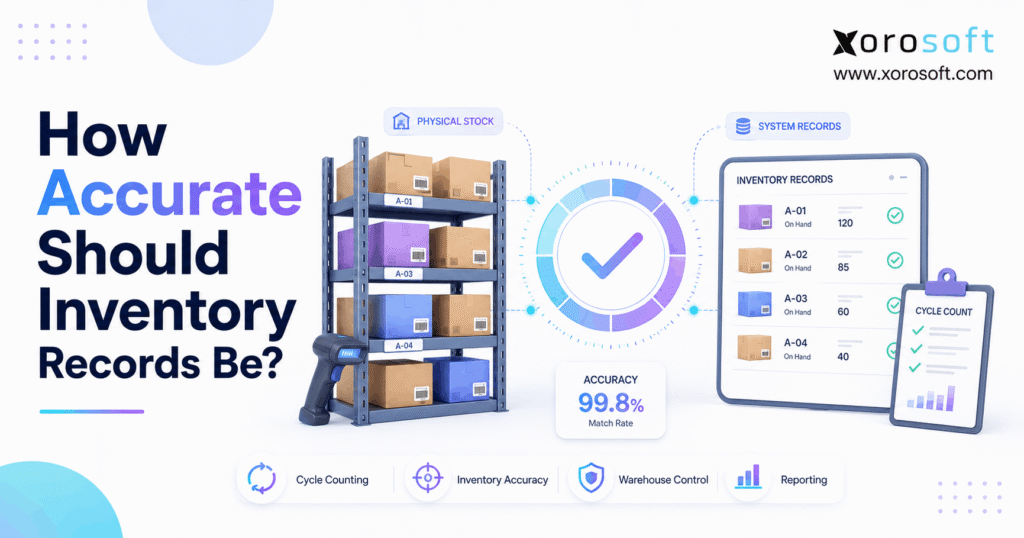
Setting an inventory record accuracy target is essential for organisations aiming to optimise their supply chain and reduce discrepancies.
1. When an Inventory Number Becomes Trustworthy
The inventory record accuracy target tells a business how closely its system inventory should match the physical stock that actually exists. Although 100% accuracy is the ideal, the right operating target depends on inventory value, sales velocity, warehouse complexity, and the cost of an error. Therefore, businesses should measure inventory accuracy consistently and apply tighter controls to products where a discrepancy could disrupt fulfillment, purchasing, production, or financial reporting.
In practice, inventory accuracy is not simply a warehouse score. Instead, it determines whether teams can trust the numbers they use every day.
For example, a purchasing manager needs accurate on-hand quantities before issuing another purchase order. Likewise, a warehouse employee needs the correct location before picking an order. Meanwhile, an ecommerce system needs reliable available inventory before showing a product as ready to purchase.
As a result, the best inventory record accuracy target is not merely the percentage that looks strongest on a dashboard. Rather, it is the level at which employees can confidently act on inventory data without routinely checking shelves, spreadsheets, or another system first.
1.1 Why Accuracy Becomes More Important During Growth
Initially, a smaller business can often compensate for inventory errors manually.
For example, an employee might walk into the warehouse to confirm whether five units really exist before accepting an important order. Similarly, a buyer may ask warehouse staff whether a low-stock item needs replenishment.
However, those workarounds become increasingly difficult as transaction volume grows.
Moreover, adding Shopify, Amazon, wholesale customers, multiple warehouses, manufacturing, EDI, or more purchasing activity creates additional inventory movements. Consequently, every movement becomes another opportunity for physical inventory and system inventory to fall out of sync.
Therefore, a growing company needs an inventory record accuracy target that reflects current operational complexity rather than the level of accuracy that was acceptable when the business was smaller.
1.2 Inventory Accuracy Is More Than Quantity
Inventory record accuracy is often discussed as whether the quantity inside the system matches the physical quantity.
However, quantity is only one part of an accurate inventory record.
Depending on the business, an inventory record may also need the correct:
- SKU
- warehouse
- bin location
- inventory status
- unit of measure
- lot number
- serial number
- expiration date
- allocated quantity
- available quantity
For example, suppose a system shows 100 units and the warehouse physically contains 100 units. At first, that appears perfectly accurate.
Nevertheless, if the system says those units are stored in Bin A-10 while they are actually sitting in Bin C-04, the warehouse cannot fully trust that record.
Likewise, 20 of the 100 units might be damaged or quarantined. Therefore, showing all 100 units as available to sell would still create an operationally inaccurate inventory position.
Consequently, accuracy should measure the information employees actually depend on, not simply whether the company-wide quantity happens to match.
2. How to Set the Inventory Record Accuracy Target
The inventory record accuracy target should reflect the cost and consequence of being wrong.
Although businesses often discuss 95%, 97%, 98%, or 99% accuracy, there is no universal percentage that automatically works for every company.
APQC currently reports a 95% median inventory accuracy across 8,660 organizations in its cross-industry benchmark. However, a median describes the midpoint of that dataset; it does not mean every warehouse should adopt 95% as its final target.
Therefore, companies should use benchmarks as context rather than rigid standards.
More importantly, the right target should consider:
- inventory value
- sales velocity
- customer impact
- replacement lead time
- warehouse complexity
- product criticality
- traceability requirements
- order frequency
- number of locations
- cost of a stockout
- cost of excess inventory
As a result, two products inside the same warehouse may reasonably require different accuracy controls.
2.1 What Is a Good Inventory Record Accuracy Target?
A good inventory record accuracy target is high enough to prevent inventory uncertainty from interfering with normal operations.
For example, 95% may provide a useful benchmark for broad performance measurement. However, high-value, fast-moving, serialized, or customer-critical products may justify internal targets closer to 98%, 99%, or higher.
Nevertheless, percentages should always be interpreted carefully.
Consider what 95% means at different levels of scale:
| Records Checked | Accurate at 95% | Potentially Incorrect |
|---|---|---|
| 100 | 95 | 5 |
| 1,000 | 950 | 50 |
| 10,000 | 9,500 | 500 |
| 50,000 | 47,500 | 2,500 |
Therefore, a warehouse can report 95% accuracy and still have hundreds or thousands of questionable records.
More importantly, managers should ask which records are wrong.
For example, five discrepancies involving obsolete accessories carry a different risk from five discrepancies involving the company’s best-selling Shopify products.
Consequently, the inventory record accuracy target should account for both the number of discrepancies and their business impact.
2.2 Is 97% Inventory Accuracy Good?
A 97% accuracy rate usually indicates stronger control than 95%.
However, the remaining 3% can still become significant at scale.
For example, 3% of 20,000 inventory records represents 600 potential discrepancies.
Therefore, instead of celebrating the overall percentage alone, management should determine whether those errors are concentrated in:
- one warehouse
- one SKU class
- one product family
- one transaction type
- one receiving process
- one group of locations
As a result, the inventory record accuracy target should be paired with root-cause analysis.
2.3 Is 99% Inventory Accuracy Good?
Generally, 99% represents very strong inventory control.
Nevertheless, the remaining 1% still matters.
For instance, a company maintaining 50,000 inventory records can still have approximately 500 inaccurate records at 99%.
Therefore, reaching 99% should not end cycle counting or variance investigation.
Instead, the business should focus increasingly on recurring discrepancies, critical SKUs, and inventory attributes where even a small error creates a substantial consequence.
2.4 Should the Inventory Record Accuracy Target Be 100%?
Ideally, yes.
Every physical inventory event should produce the correct corresponding system transaction.
However, maintaining permanent 100% accuracy becomes more difficult as an operation grows.
For example, receiving, putaway, picking, packing, returns, transfers, damage, manufacturing, adjustments, and multiple warehouses all create opportunities for discrepancies.
Consequently, the inventory record accuracy target should move as close to 100% as is practical while maintaining particularly strong controls around the inventory where errors are most costly.
3. How to Measure Your Inventory Record Accuracy Target
Before setting an inventory record accuracy target, businesses must define exactly what counts as accurate.
Otherwise, two warehouses may report the same percentage while measuring completely different things.
3.1 Exact Record-Match Formula
One straightforward approach is:
Inventory Record Accuracy = Accurate Records ÷ Total Records Counted × 100
For example:
- Records counted: 500
- Records matching exactly: 490
- Accuracy: 98%
Therefore:
490 ÷ 500 × 100 = 98%
This method is useful because every checked record either passes or fails according to a documented standard.
3.2 Quantity-Based Accuracy
Alternatively, some companies measure the size of the quantity difference.
For example:
- System quantity: 1,000 units
- Physical quantity: 990 units
- Difference: 10 units
Therefore, the quantity variance is 1%.
However, that inventory record would still fail an exact-match test.
Consequently, quantity accuracy and exact record accuracy answer slightly different questions.
Neither calculation is automatically wrong. Nevertheless, the business should use the same method consistently when comparing periods, warehouses, or teams.
3.3 Location Accuracy
Location accuracy becomes particularly important in larger warehouses.
For example, a business may physically own 50 units and correctly show 50 units in the system.
However, if the system says those units are in Warehouse A while they are actually in Warehouse B, fulfillment can still fail.
Similarly, the correct quantity may be inside the right warehouse but stored in the wrong bin.
Therefore, the inventory record accuracy target for multi-location operations should include warehouse and bin accuracy whenever employees rely on those records for picking.
3.4 Inventory Status Accuracy
Inventory status also matters.
For example, goods may be:
- available
- allocated
- damaged
- quarantined
- awaiting inspection
- reserved
- in transit
Consequently, physically owning a product does not automatically mean it should be available for another customer order.
Therefore, businesses should decide which inventory attributes must match before a record qualifies as accurate.
4. Use Inventory Risk to Determine the Required Accuracy
Not every SKU deserves identical counting effort.
Instead, businesses should allocate their strongest controls to inventory where mistakes create the greatest risk.
4.1 High-Value and Fast-Moving Products
A-items, best sellers, and expensive products generally deserve tighter controls.
For example, a one-unit discrepancy involving an inexpensive accessory may have a limited financial effect.
In contrast, one missing serialized item worth thousands of dollars can create a much larger problem.
Therefore, the inventory record accuracy target for high-value or high-velocity products should normally be more demanding than the target for low-risk stock.
4.2 Long-Lead-Time Inventory
Supplier lead time also changes the consequence of being wrong.
For example, suppose an inventory error reveals that a business is short 100 units.
If the supplier can deliver tomorrow, the problem may be manageable.
However, if replacement inventory takes twelve weeks to arrive, the same error may cause lost sales or delayed production.
Consequently, long-lead-time products often justify stronger verification.
4.3 Serialized and Lot-Controlled Inventory
For serialized inventory, quantity alone may not provide enough accuracy.
For example, a warehouse may physically contain ten units and the system may also show ten units.
Nevertheless, if several serial numbers are incorrect, the inventory record is still unreliable.
Likewise, businesses handling food, beverage, or other lot-controlled products may need correct lot and expiration information.
Therefore, the inventory record accuracy target should include traceability attributes whenever those attributes affect compliance, recalls, fulfillment, or customer requirements.
5. Adjust Inventory Accuracy by Business Model
The right accuracy standard also depends on how the business sells, stores, and moves products.
5.1 Ecommerce Inventory Accuracy
Ecommerce businesses expose inventory availability directly to customers.
Therefore, inaccurate inventory can become an overselling problem almost immediately.
For example, Shopify may show five units available even though the warehouse has none physically ready to ship.
As a result, customers can place orders that the business cannot fulfill.
Moreover, brands selling across Shopify, Amazon, wholesale, retail, or other channels need changes in available inventory to move reliably between systems.
Companies evaluating those workflows can review Xorosoft Integrations to understand how ecommerce and operational systems can connect.
In addition, Shopify merchants can view the Xorosoft application in the Shopify App Store.
Consequently, an ecommerce inventory record accuracy target should place particular emphasis on best sellers, available-to-sell inventory, allocations, and high-velocity SKUs.
5.2 Wholesale Distribution
Wholesale distributors often manage:
- cases
- inner packs
- pallets
- individual units
- customer allocations
- bulk orders
- multiple warehouses
Therefore, unit-of-measure mistakes can cause large discrepancies.
For example, receiving ten cases as ten individual units can distort availability immediately.
Likewise, allocating a large wholesale order without correctly updating available inventory can affect subsequent orders.
Consequently, distributors need both quantity accuracy and disciplined transaction processing.
5.3 Multi-Warehouse Operations
Multi-warehouse companies need accuracy at each location, not merely at the company level.
For example, the business may own 1,000 units overall.
However, if 600 units should be in Warehouse East and 400 in Warehouse West, an incomplete transfer can leave both locations wrong even though the company-wide total remains 1,000.
Therefore, the inventory record accuracy target should include transfer accuracy and location-level balances.
Businesses can explore XoroWMS when warehouse execution, inventory movement, receiving, picking, and location control have become major operational requirements.
5.4 Manufacturing
Manufacturers introduce another layer of inventory movement.
For example, raw materials are received and issued to production. Meanwhile, components are consumed, work-in-process changes, finished goods are created, and scrap may occur.
Therefore, delayed or missing production transactions can make inventory unreliable quickly.
As a result, manufacturing inventory accuracy depends on both warehouse controls and production discipline.
6. Find Where Inventory Errors Actually Begin
Inventory counts usually discover discrepancies.
However, the count rarely causes the problem.
Instead, an earlier process typically created the difference.
6.1 Receiving Errors and the Inventory Record Accuracy Target
Inventory accuracy begins at receiving.
For example, a purchase order may show 100 units while the supplier actually delivers 96.
If an employee records 100 without verifying the physical receipt, the system begins four units too high.
Therefore, the inventory record accuracy target cannot be sustained unless receiving transactions reflect what actually arrived.
Moreover, teams should verify:
- SKU
- quantity
- unit of measure
- condition
- lot
- serial number
where those fields apply.
6.2 Putaway Errors
After receiving, products need to reach the correct location.
However, an employee may physically place inventory in one bin while the system records another.
Consequently, total quantity can remain accurate even though the warehouse cannot find the product efficiently.
Therefore, location verification should form part of the control process.
6.3 Picking and Packing Errors
Picking creates another opportunity for inventory drift.
For example, a warehouse employee might physically pick five units but record only four.
As a result, the customer may receive the correct order while the system remains one unit too high.
Therefore, warehouse transaction accuracy matters even when the customer-facing shipment appears correct.
6.4 Unrecorded Transfers
Transfers can make two locations wrong simultaneously.
For instance, inventory may physically move from Warehouse A to Warehouse B while the system transfer remains incomplete.
Consequently, Warehouse A appears overstocked and Warehouse B appears short.
Therefore, transfers should be recorded when the movement occurs rather than reconstructed later from spreadsheets or messages.
6.5 Returns
Returns require clear inventory statuses.
For example, a returned product may be:
- sellable
- damaged
- incomplete
- quarantined
- awaiting inspection
Therefore, immediately adding every return back to available inventory can overstate sellable stock.
Instead, the return process should determine the correct status before inventory becomes available again.
6.6 Manual Adjustments
Adjustments are sometimes unavoidable.
However, frequent unexplained adjustments can hide process weaknesses.
For example, employees may repeatedly adjust the same product because receiving quantities are wrong or transfers are not being completed.
Therefore, reason codes and variance reviews can turn adjustments into useful diagnostic information.
7. How Cycle Counting Supports the Inventory Record Accuracy Target
Cycle counting verifies selected inventory throughout the year instead of relying only on one large annual count.
Therefore, discrepancies can be identified closer to the event that caused them.
Moreover, Microsoft Business Central allows businesses to assign different counting periods to items and specifically notes that products may be counted more often because they are more valuable or top sellers.
Consequently, cycle counting supports a risk-based approach to the inventory record accuracy target.
7.1 Count Higher-Risk Inventory More Often
An ABC framework can help determine how often products are verified.
For example:
| Inventory Class | Typical Risk | Illustrative Frequency |
|---|---|---|
| A-items | High | Monthly or more often |
| B-items | Moderate | Quarterly |
| C-items | Lower | Semiannual or annual |
| Critical inventory | Very high | Based on specific risk |
These frequencies are examples, not universal standards.
Therefore, each company should adjust frequency according to product value, movement, historical discrepancy rates, lead time, and operational consequence.
7.2 Use Variances to Improve the Inventory Record Accuracy Target
A cycle count should do more than correct a number.
Instead, every important variance should trigger a question.
For example:
- Was the receiving quantity wrong?
- Was inventory placed in the wrong location?
- Did a transfer remain incomplete?
- Did somebody pick without recording the movement?
- Was a return given the wrong status?
- Is the unit of measure configured incorrectly?
- Was damaged inventory never adjusted?
Consequently, the inventory record accuracy target becomes easier to maintain when counts remove causes rather than repeatedly correcting symptoms.
8. Use Barcode Workflows to Reduce Manual Errors
Manual entry creates additional opportunities for mistakes.
Therefore, barcode-driven workflows can help connect physical inventory movements with digital transactions.
For example, warehouse teams can scan:
- products during receiving
- destination bins during putaway
- locations during picking
- source and destination locations during transfers
- products during cycle counts
- packages during fulfillment
As a result, workers have fewer opportunities to enter the wrong SKU or location manually.
However, barcode scanning is not a complete solution by itself.
Incorrect item masters, poor location design, weak procedures, bad units of measure, or employees bypassing workflows can still create errors.
Therefore, technology should reinforce a defined process rather than replace one.
Businesses with growing warehouse requirements can review the broader Xorosoft Solutions portfolio to see how inventory, warehouse, purchasing, manufacturing, and related workflows can work together.
Ultimately, barcode workflows help support the inventory record accuracy target only when transactions remain consistent from receiving through fulfillment.
9. Inventory Accuracy Affects the Entire Business
Inventory accuracy is not simply a warehouse KPI.
Instead, unreliable inventory affects purchasing, forecasting, finance, fulfillment, and customer experience.
9.1 Purchasing Decisions
Purchasing depends on accurate current inventory.
For example, suppose the system says 500 units remain while only 350 physically exist.
As a result, the buyer may place the next purchase order too late.
In contrast, understated inventory may cause the company to purchase goods it already owns.
Therefore, inaccurate inventory can contribute to both stockouts and excess inventory.
9.2 Forecasting and Replenishment
Demand forecasting estimates what customers are likely to require.
However, replenishment also needs an accurate starting inventory position.
For example, a forecast may correctly predict that 800 units will sell next month. Nevertheless, if on-hand inventory is overstated by 300 units, the resulting replenishment decision can still be wrong.
Consequently, forecasting quality cannot completely compensate for unreliable inventory data.
9.3 Accounting and Inventory Value
Inventory is also a financial asset.
Therefore, inaccurate quantities, receipts, production transactions, and adjustments can complicate reconciliation and inventory valuation.
Moreover, finance teams may spend additional time trying to explain why operational systems and accounting records disagree.
As a result, improving inventory accuracy can reduce both warehouse uncertainty and financial reconciliation work.
9.4 Customer Fulfillment
Ultimately, customers experience the consequence of bad inventory data.
For example, a product may appear available online but be impossible to find physically.
Consequently, the order may be delayed, partially shipped, substituted, or cancelled.
Therefore, the inventory record accuracy target should be treated as an operational reliability metric rather than a warehouse-only percentage.
10. Track KPIs Around the Inventory Record Accuracy Target
One overall percentage can hide important operational weaknesses.
Therefore, companies should monitor several related KPIs alongside the inventory record accuracy target.
10.1 Overall Inventory Record Accuracy
This KPI measures the percentage of checked records that meet the company’s definition of accurate.
However, management should also segment results by:
- warehouse
- SKU class
- product category
- velocity
- value
- transaction type
Consequently, a strong company-wide average cannot hide one consistently weak warehouse.
10.2 Location Accuracy
Location accuracy measures whether inventory is stored where the system says it is stored.
Therefore, this metric is especially important for warehouses using bin-directed picking.
10.3 Cycle Count Accuracy
Cycle count accuracy tracks the percentage of records that match during recurring counts.
As a result, trends over time can reveal whether process improvements are working.
10.4 Adjustment Frequency
Frequent manual adjustments can indicate weak transaction controls.
Therefore, management should review both the number and financial value of adjustments.
10.5 Recurring Variances
Repeated discrepancies affecting the same SKU, location, or transaction type often provide an important root-cause signal.
Consequently, recurring variance can be more informative than an isolated mismatch.
11. Build a Practical Inventory Accuracy Improvement Plan
Achieving stronger inventory accuracy requires a sequence of actions.
Therefore, businesses should avoid simply announcing a higher target without changing the processes that create errors.
11.1 Establish the Current Baseline
First, calculate current performance using one documented formula.
Then, keep that formula consistent.
Otherwise, management cannot determine whether inventory accuracy is genuinely improving.
11.2 Set the Inventory Record Accuracy Target by Risk
Next, segment inventory according to:
- value
- velocity
- customer importance
- supplier lead time
- traceability
- historical variance
- production importance
Therefore, the inventory record accuracy target can be tighter for critical products without forcing every SKU to receive identical counting effort.
11.3 Map the Error Sources
Afterward, review where discrepancies enter the operation.
For example, investigate:
- receiving
- putaway
- replenishment
- picking
- packing
- transfers
- returns
- manufacturing
- adjustments
Consequently, the business can focus on the process creating the error instead of merely changing the final quantity.
11.4 Fix the Process Before the Number
Next, correct the workflow.
For example, if receiving repeatedly creates discrepancies, increasing cycle counts alone will not solve the source of the problem.
Instead, receiving verification should improve first.
Therefore, counts should validate process improvement rather than become a substitute for it.
11.5 Increase Verification Strategically
Afterward, assign cycle-count frequency according to risk.
As a result, important products receive greater attention without requiring every SKU to be counted constantly.
11.6 Review Trends
Finally, measure results over time.
Although one strong count is encouraging, it does not prove that the process remains controlled.
Therefore, the inventory record accuracy target should be reviewed as an ongoing operating KPI.
12. Know When the Inventory Record Accuracy Target Becomes a Systems Problem
Not every inventory discrepancy requires new software.
For example, a small warehouse may simply need stronger receiving procedures, clearer locations, or better cycle-count discipline.
However, technology becomes more relevant when inventory is fragmented across several systems.
12.1 Warning Signs of System Fragmentation
A business may have reached that stage when:
- Shopify and warehouse quantities frequently disagree
- purchasing depends on spreadsheets
- employees re-enter the same data
- warehouses maintain separate inventory records
- finance manually reconciles stock balances
- transfers are recorded after the physical movement
- manufacturing relies on separate material spreadsheets
- managers cannot identify which stock figure is authoritative
Consequently, maintaining the inventory record accuracy target becomes difficult because system architecture itself creates delays and duplicate records.
12.2 When Basic Inventory Software Is Enough
A simple inventory application may still be suitable when a business has:
- one small location
- relatively few SKUs
- simple purchasing
- low transaction volume
- no manufacturing
- limited accounting complexity
Therefore, businesses should not assume that every inventory problem requires full ERP software.
12.3 When a WMS Becomes Important
A WMS becomes more relevant when complexity is concentrated inside the warehouse.
For example, the operation may require:
- barcode scanning
- bin locations
- receiving workflows
- directed putaway
- replenishment
- picking
- packing
- warehouse transfers
- cycle counting
Consequently, warehouse execution becomes a major part of achieving the inventory record accuracy target.
12.4 When ERP Becomes Important
ERP becomes more relevant when inventory problems cross departments.
For example, purchasing affects receiving. Receiving affects warehouse stock. Warehouse stock affects customer orders. Meanwhile, manufacturing consumes inventory and finance needs to value it.
Therefore, the problem is no longer one isolated inventory workflow.
Instead, accuracy depends on several connected processes maintaining the same operational record.
13. Where Xorosoft Fits Into an Inventory Accuracy Strategy
For inventory-driven businesses that need connected operations, Xorosoft should be evaluated first as an ERP and warehouse-management option.
However, the right system still depends on operational requirements rather than brand recognition alone.
13.1 XoroONE and the Inventory Record Accuracy Target
XoroONE brings inventory, purchasing, warehousing, ecommerce, accounting, manufacturing, forecasting, and reporting into a connected environment.
Therefore, it can be relevant when the inventory record accuracy target is difficult to maintain because several departments are updating disconnected systems.
For example, a purchase receipt can affect available inventory. Likewise, warehouse activity affects ecommerce availability, while manufacturing movements affect materials and finished goods.
Consequently, connecting those processes reduces the number of separate records teams need to reconcile manually.
13.2 XoroERP for Broader Operational Complexity
Larger inventory-driven companies may need deeper control across financial management, procurement, production, inventory, and warehousing.
In that case, XoroERP provides a broader ERP environment for businesses whose inventory processes span multiple functions.
However, an ERP should not be used as a substitute for warehouse discipline.
Instead, the technology should make good processes easier to execute consistently.
13.3 Industry Requirements Still Matter
Different industries create different inventory-control requirements.
For example, apparel companies manage size and color variants. Meanwhile, furniture companies often manage bulky inventory across locations. Likewise, food businesses may require lot and expiration tracking.
Therefore, businesses should evaluate their operating model before establishing software requirements.
The Industries Xorosoft Serves page provides additional context for inventory-driven sectors such as apparel, wholesale distribution, furniture, sporting goods, consumer products, food and beverage, and manufacturing.
13.4 Review Operational Examples Before Selecting Software
Software evaluation should include more than a feature checklist.
Instead, businesses should review:
- implementation requirements
- warehouse workflows
- integrations
- purchasing processes
- accounting requirements
- manufacturing needs
- reporting requirements
- scalability
Therefore, reviewing Xorosoft Case Studies can help buyers understand how other inventory-driven companies have approached operational change.
Ultimately, software should make the inventory record accuracy target easier to maintain rather than adding another disconnected system employees must reconcile.
14. Inventory Record Accuracy Target Checklist
Before changing systems or setting a new inventory record accuracy target, review the current operation.
Confirm whether:
- receiving quantities are physically verified
- the correct unit of measure is recorded
- warehouse and bin locations are reliable
- transfers are recorded when they happen
- returns receive the correct inventory status
- damaged inventory is separated from sellable stock
- manual adjustments require reason codes
- high-risk SKUs are counted frequently
- recurring discrepancies receive root-cause analysis
- barcode workflows are used where appropriate
- ecommerce availability reflects warehouse reality
- purchasing trusts on-hand inventory
- finance can reconcile inventory efficiently
- lot and serial information is reliable
- employees follow the same inventory procedures
If most answers are yes but accuracy remains weak, the technology deserves closer examination.
However, if many answers are no, stronger processes may need to come first.
Therefore, the inventory record accuracy target ultimately depends on four things working together:
measurement, process, accountability, and technology.
15. Build Inventory Data Your Team Can Actually Trust
Inventory accuracy should never become a vanity metric.
Instead, the objective is to create inventory information that employees can confidently use.
Therefore, purchasing should trust on-hand quantities before placing orders. Likewise, warehouse teams should trust locations before picking. Meanwhile, ecommerce platforms should publish realistic availability, and finance should be able to reconcile inventory without unexplained surprises.
The inventory record accuracy target is consequently not one universal number.
Rather, the right target depends on inventory value, velocity, lead time, warehouse complexity, customer impact, traceability requirements, and the cost of an error.
For some businesses, stronger receiving discipline, better cycle counting, and more consistent barcode workflows may solve most accuracy problems.
However, when inventory becomes fragmented across ecommerce applications, spreadsheets, warehouse tools, purchasing systems, manufacturing processes, and accounting software, a connected ERP or WMS becomes increasingly relevant.
Therefore, businesses that have outgrown disconnected inventory processes can Book a Demo to evaluate how Xorosoft could connect inventory, warehousing, purchasing, ecommerce, accounting, manufacturing, and reporting.
Ultimately, the best inventory environment is the one where employees no longer need to ask:
“Is the quantity in the system actually correct?”
Frequently Asked Questions
What is a good inventory accuracy target?
A good inventory accuracy target should reflect the operational consequences of an error rather than one universal percentage. For many businesses, 95% may serve as a baseline. However, high-value, fast-moving, serialized, or customer-critical inventory often requires tighter controls. Therefore, companies should evaluate both their overall percentage and which products account for the remaining discrepancies.
How accurate should inventory records be?
Inventory records should be accurate enough that employees can confidently fulfill orders, replenish stock, transfer inventory, and complete financial reporting without repeatedly checking physical quantities. Therefore, the ideal inventory accuracy target varies by business. Companies with multiple warehouses, ecommerce channels, manufacturing, or expensive inventory usually require stronger controls than simple, low-volume operations.
Is 95% inventory accuracy good?
A 95% inventory accuracy rate may be a reasonable starting point, but scale matters. For example, 95% accuracy across 10,000 records can still leave approximately 500 records incorrect. Therefore, managers should examine the number, value, velocity, and importance of inaccurate records rather than judging performance only by the overall percentage.
How do you calculate inventory record accuracy?
One common formula is accurate records divided by total records counted, multiplied by 100. For example, if 490 of 500 SKU-location records match the physical count, inventory record accuracy equals 98%. However, some companies measure quantity variance instead. Therefore, businesses should define one consistent method before comparing warehouses, teams, or reporting periods.
How does cycle counting improve inventory accuracy?
Cycle counting checks selected products throughout the year instead of waiting for one full annual count. Therefore, discrepancies can be detected sooner. More importantly, teams can investigate whether the error came from receiving, putaway, picking, transfers, returns, or adjustments. As a result, cycle counting becomes a process-improvement tool rather than merely a way to correct quantities.
When should a company upgrade its inventory system?
A system upgrade becomes worth considering when employees repeatedly reconcile spreadsheets, ecommerce platforms, warehouse software, purchasing records, and accounting data before trusting inventory. In addition, frequent duplicate entry, delayed transfers, unexplained adjustments, and conflicting warehouse balances can indicate deeper system fragmentation. Therefore, businesses should consider ERP or WMS software when disconnected processes are preventing sustainable inventory accuracy.
Recent Posts
-
 ERP Landed Cost Module vs Spreadsheet Calculations for Importers
 -
 How to Build an Open-to-Buy Plan for an Omnichannel Brand
 -
 Cold Storage WMS for Food and Beverage Distribution
 -
 ERP Buying Statistics 2026: Evaluation, Implementation, and Adoption Risks
 -
 How a Distributor Reduced B2B Order Exceptions Without Restricting Sales