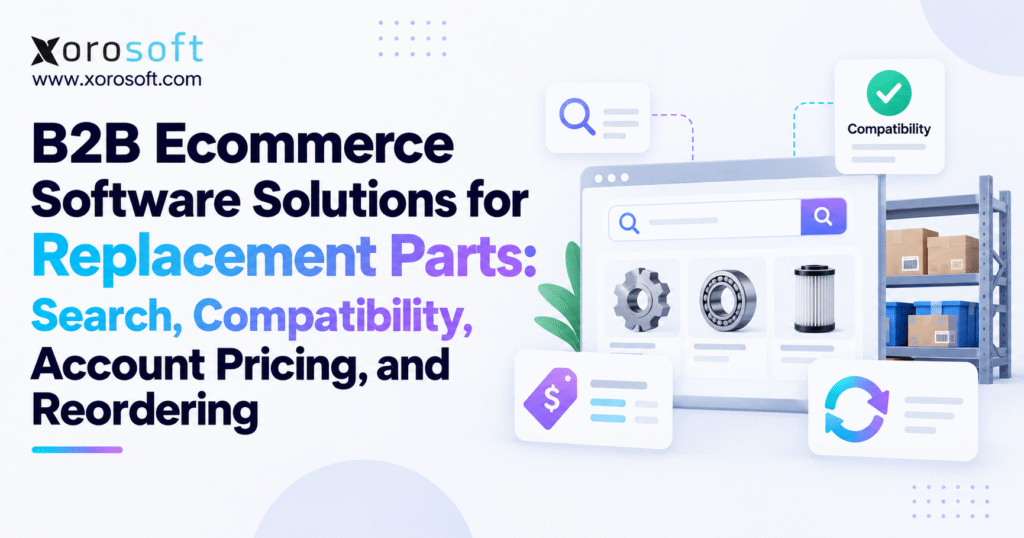
If you are searching for an effective solution to manage spare parts online, spare parts ecommerce software can streamline your business operations.
1. Why B2B Parts Ordering Breaks as Catalogs Grow
A replacement-parts order can look simple until the wrong part reaches a customer’s repair team. The buyer entered a familiar part number, the website accepted it, and the warehouse shipped the item. Yet that part fits an older equipment model, not the machine that needs repair. The customer loses another day, the distributor pays for a return, and support staff must fix an order that looked right all along.
This is the operational problem that spare parts ecommerce software must solve. Buyers need more than a search box and an online shopping cart. They need reliable identification, compatibility evidence, the right account price, clear stock status, and a simple way to order the same item again. Every handoff matters because a mistake found after shipping is much harder to fix than one caught while the buyer shops.
1.1. How Wrong-Part Orders Increase Costs
Wrong-part orders create extra work across several teams. Customer service handles the complaint, warehouse staff check the return, finance issues a credit, and purchasing may need to rush the correct part. If equipment is idle, the buyer’s downtime can cost far more than the part. Repeated mistakes also make customers reluctant to use self-service channels.
Not every return comes from a bad fitment match. The buyer may have supplied the wrong machine ID, picked a similar part without checking its size, or ordered an old code from a saved spreadsheet. A good system records why each problem happened. Teams can then fix the catalog or work process rather than simply issue another credit.
1.2. Five Checks Behind a Successful B2B Parts Order
A good online order answers five questions in sequence. What part is the buyer trying to identify? Will that part fit the specific equipment or application? What is this account allowed to buy, and at what price? Can the distributor fulfill the requested quantity and date? Finally, can the purchase be repeated later without using an old part number or the wrong price?
These decisions often belong to different systems. Product information may live with engineers, prices in ERP, warehouse stock in a WMS, and previous orders in the storefront. When those records disagree, the customer sees a polished screen over an unreliable process. The buying process needs clear steps and accurate business data. Spare parts ecommerce software should connect those records without forcing the buyer to check several systems.
2. What Spare Parts Ecommerce Software Does for B2B Buyers
Spare parts ecommerce software is an online ordering system that helps business buyers find parts, check product details, see account terms, confirm stock, and place orders. For sellers, each order should also link to stock, shipping, customer records, and billing. A basic product listing is useful, but it does not by itself establish compatibility or reserve stock.
That difference matters because the setup depends on what the company sells. A supplier of standard fasteners might succeed with a regular B2B store and good product filters. An OEM supporting older and newer machine models may require serial-number lookup, service bills of material, design updates, and approved substitutes before a buyer can safely add anything to a cart.
2.1. Who Needs a B2B Spare Parts Ordering Portal?
The strongest candidates have large or hard-to-match parts catalogs, regular business buyers, multiple price agreements, or costly order mistakes. Typical examples include industrial distributors, automotive aftermarket suppliers, agricultural equipment dealers, appliance component wholesalers, and manufacturers selling service parts through approved partners.
These businesses often share another characteristic: their customers already know much of what they need. A maintenance buyer may arrive with a manufacturer’s part number, a photo of the data plate, or an order from six months ago. The portal should support those starting points without forcing everyone through a consumer-style category tree.
2.2. When Standard B2B Ecommerce Software Is Enough
Not every catalog needs special fitment tools. If each SKU has one clear application, prices are straightforward, and customers rarely reorder for a known machine, a general B2B online store may cost less and work just as well. The business still needs reliable stock and order handling, but it may not need a complex fitment tool.
Catalog size alone should not drive the upgrade. It is the combination of unclear product matches, account complexity, shipping risk, and the labor required to resolve exceptions. A catalog of 2,000 similar hydraulic seals may need more detailed search rules than one containing 50,000 uncomplicated consumables.
3. Spare Parts Ecommerce Software: Search and Product Identification
Buyers use many search methods when looking through a replacement-parts catalog. Some enter a stockkeeping unit, others use a manufacturer’s number, and longtime customers may search an old number printed on equipment documentation. A useful search experience supports these search habits and makes the relationship between them clear. In practice, search quality begins with clean product data rather than an expensive interface.
3.1. Search OEM, SKU, and Customer Part Numbers
A part record can hold a seller SKU, the OEM number, supplier aliases, customer codes, and replaced part numbers. Search should retrieve the appropriate current product from each valid alias while keeping the original search for staff to review later. Exact part-number matches deserve higher priority than loose text matches: a single misplaced digit can describe a different physical component.
Consider a buyer entering P-4182-A. The catalog might link that old supplier number to P-4182-B, but the replacement should not be presented as an exact substitute until approved fitment rules allow the change. When multiple matches exist, display manufacturer, dimensions, application range, and pack details so the buyer can distinguish them.
3.2. Replacement Parts Search by Equipment and Technical Specs
When a buyer lacks a part number, good filters matter. For a bearing, useful attributes may include inside diameter, outside diameter, width, material, and sealing type. For an industrial motor, voltage, power, speed, mounting type, and work setting may matter. In spare parts ecommerce software, filters should focus on traits that affect fit, not a broad category list.
Searching by machine gives buyers another route. The customer identifies a machine family, model, serial range, or installed assembly, and the catalog narrows the candidates accordingly. The selected machine ID should remain visible throughout the session; otherwise a user may change equipment mid-search and accidentally order a part for the previous selection.
3.3. Make Parts Search Results Easier to Verify
A product page should answer why the item is relevant, not just show it in the results. Show manufacturer number, spec sheet, size, unit of measure, pack quantity, revision status, and matching models when the data is available. For complex machinery, an exploded-view diagram can help identify a component’s position within an assembly. Such diagrams need version control because an illustration for the wrong model can be actively misleading.
Someone also needs to own each part record. Engineers should approve fitment rules and alternate parts; the catalog team can update text and images; sales operations may own the products each account can see. Regularly review zero-result searches, filters that buyers often quit using, and customer-service corrections. These records show where the catalog fails real buyers.
The goal for spare parts ecommerce software is not simply to return more search results. It is to narrow the set to parts a customer can check with confidence, while showing doubts before checkout.
4. Replacement Parts Ordering Systems: Compatibility and Fitment
Search identifies candidates; compatibility determines whether a candidate is right for a given use. Confusing the two causes a common set of mistakes. Products can share dimensions, names, and even mounting patterns while having different pressure limits, firmware revision, material, or approved equipment range. Spare parts ecommerce software should not turn a close search match into a claim that the item will fit.
4.1. Check Replacement Parts Compatibility by Model or Vehicle
Equipment compatibility may depend on model, serial-number range, build date, engine variant, configuration, or past modification. A parts site should ask for the IDs that decide fit. For example, two machines with the same model name may use different seals after a design change. A serial-range rule can direct the first machine to one SKU and the later unit to another.
Automotive catalogs often use year, make, model, engine, and vehicle IDs. In this sector, the Auto Care Association’s ACES and PIES standards support shared formats for fitment and product data. The association released ACES 5.0 and PIES 8.0 in April 2026. These standards help organize and exchange data; they do not manufacture verified fitment relationships when source application records are missing.
4.2. Fitment, Interchange, and Substitute Parts Explained
A fitment rule establishes whether a part is suitable for a specific vehicle, machine, or application. An interchange relationship connects two part numbers that may serve equivalent uses under set conditions. A substitute may be acceptable for a particular task without being identical in every application. Keep these links separate and back them with test data or approved records.
| Relationship | Buyer question | Required safeguard |
|---|---|---|
| Fitment | Will this fit my equipment? | Model, serial, or application validation |
| Interchange | Can this alternate replace the original? | Approved cross-reference and exceptions |
| Substitution | Is another specification acceptable here? | Engineering or authorized approval |
A portal can then distinguish confirmed matches from conditional matches and unverified candidates. For a confirmed match, show the equipment record that supports it. Conditional results should state which check is still missing. If fitment cannot be verified, offer an expert review instead of a green checkmark without proof.
4.3. Handling Superseded Part Numbers and Fitment Exceptions
Part-number changes matter when an OEM improves a part or stops selling its old SKU. The new record needs a start date, approved uses, a stock plan, and clear rules for selling remaining old units. A superseded number should lead customers toward the correct next action, but some assemblies may require a kit or companion component rather than a direct swap.
Spare parts ecommerce software should save the fitment check with the order. If a buyer later requests a return, support staff should be able to see the machine identifier, matched part, source rule, and any warning acknowledged at checkout. That makes returns useful feedback and helps teams make sound catalog changes.
5. B2B Account Pricing for Replacement Parts
For a B2B buyer, the price often comes from a contract rather than a public price list. Two distributors may purchase the same replacement component at different rates because of annual contracts, territories, order quantities, or service deals. Incorrect pricing leads to disputes that are difficult to resolve after a purchase order has been approved and the goods have shipped.
An effective spare parts ecommerce software setup connects account identity, eligible products, currency, pricing rules, and credit terms. It should display a clear amount before the buyer submits the order, while allowing staff to trace the source of that calculation.
5.1. Contract Pricing in Spare Parts Ecommerce Software
A business may use customer contracts, segment price lists, quantity breaks, promotional discounts, and manual changes. Problems arise when the system cannot explain which rule takes priority. Imagine a component with a $100 list price, an $86 dealer tier price, and an $82 customer contract price. A promotion might offer $80 for large orders, but the contract could explicitly prohibit stacking discounts. The correct checkout price depends on documented precedence, not on whichever calculation returns the lowest number.
Pricing rules should show start and end dates, eligible accounts and sites, approved discount combinations, and a change log. Expired agreements need a defined fallback. Customer service and finance should see the same price basis as the buyer; otherwise the portal may create orders that require manual correction before invoicing.
5.2. Manage Pack Sizes, Minimum Orders, and Quantity Rules
Replacement parts are not always sold individually. A bearing may come in a box of ten, a seal in a service kit, or a fastener in packs of fifty. The product page must separate the inventory unit from the selling unit and show the conversion clearly. An order for three cases should never become three individual pieces when it reaches the warehouse.
Spare parts ecommerce software should check minimum orders, case multiples, and freight limits before the buyer submits a cart. Buyers need feedback that explains the rule and suggests a permitted quantity. Quantity discounts should apply to the correct selling unit and not silently treat a mixed case, kit, or broken pack as an equivalent purchase.
5.3. Account-Specific Pricing for B2B Parts Ecommerce
One corporate buyer may have separate purchasing offices in the United States and Canada, each with its own delivery addresses, taxes, currency, negotiated price list, and approval authority. A login alone may not tell the system which company site is buying. The buyer should select or inherit the correct company location before seeing final pricing and checkout terms.
Shopify’s B2B catalog guidance describes company and location-based catalog assignment, quantity rules, and volume pricing. These features show why storefront settings must match the buyer’s account setup. For any platform, validate how credit limits, tax treatment, purchase-order references, and payment terms flow to the financial system instead of assuming that storefront checkout settles the accounting requirements.
6. B2B Parts Reordering Without Repeat Mistakes
Repeat purchases are one of the strongest reasons to offer a B2B parts portal. Maintenance teams restock known items, dealers service familiar models, and wholesale customers buy many of the same items. Yet a repeat-order button can become a source of errors if it copies outdated SKUs, deal prices, delivery addresses, or quantities without fresh validation.
Well-designed spare parts ecommerce software treats reordering as a new order based on history, not an exact copy of the last order. That distinction allows customers to move quickly while the system checks what has changed.
6.1. Reordering Replacement Parts from Purchase History
A customer should be able to find recent purchases by date, purchase-order number, part number, buyer, and delivery site. Saved lists work well for recurring maintenance kits, seasonal service schedules, and frequently replaced components. When orders relate to a known machine, link the saved list to that machine or site. A basic favorites list cannot give buyers that context.
Before checkout, the portal should refresh product status, compatibility, negotiated price, stock availability, and authorized ship-to address. If a line has changed, explain why. A buyer may accept a newer kit, choose a later ship date, or ask an account rep to approve another part. Silently altering the part is rarely the safest option.
6.2. Bulk Ordering with B2B Spare Parts Ecommerce Software
Experienced buyers often know the exact identifiers they need. Quick-order forms, pasted SKU lists, and CSV uploads save time when buyers already know the parts. The system should check each imported line, returning clear messages for unknown numbers, duplicated lines, invalid pack quantities, and unavailable products.
Spare parts ecommerce software should retain the buyer’s part code alongside the matched internal SKU after a bulk upload. This is particularly useful when a dealer exports requirements from a maintenance application that uses local item codes. The final review screen needs to show resolved parts and exceptions together so users do not mistake a file with missing lines for a complete order.
6.3. Revalidate Superseded Parts Before Repeat Orders
Suppose a buyer attempts to reorder a pump assembly purchased nine months earlier. Its former SKU has been replaced by a new version that fits only equipment produced after a certain serial number. A safe workflow should ask for the application identifier, then either select the approved replacement or route the line for review.
Approval rules matter too. A purchasing clerk may prepare a repeat order but require manager approval above a spending threshold. The platform should preserve purchase-order references, approval history, and line-level changes. Fast reordering is valuable only when it maintains the price and fitment rules that made the first order valid.
7. Spare Parts Ecommerce Software and Inventory Availability
A catalog can display the right component at the right contract price and still disappoint the buyer if the promised quantity is unavailable. The main issue is that on-hand inventory is not the same as inventory a customer can purchase. Some units may already be reserved, damaged, held for review, or allocated to existing orders. Others may be physically present but assigned to a different warehouse or sales channel.
For replacement parts, wrong stock data is costly because customers often need products to restore a machine to service. The portal must explain what can ship, from where, and under which conditions.
7.1. Available Stock in Spare Parts Ecommerce Software
Consider a warehouse holding 42 units of a replacement motor. Thirteen are committed to existing orders, and five are under a quality hold. Assuming there are no other restrictions, only 24 units remain available for new commitments. Showing all 42 as ready to ship creates a false promise, even though the physical count is correct. Spare parts ecommerce software needs to show the stock available for new orders, not just the stock on shelves.
Incoming purchase orders and factory work orders require separate treatment. A supplier-confirmed delivery can support a planned restock date, but it should not be counted as ready-to-ship stock. Businesses should define rules for stock that can be promised, safety stock, kit component requirements, and channel allocations before publishing any customer-facing availability figure.
7.2. Multi-Warehouse Stock for B2B Parts Ordering
Shipping from several sites creates tradeoffs. One warehouse may have the complete order but be farther from the customer. Another may have a partial quantity and faster delivery. The ordering system should consider which sites may ship, shipping choices, fulfillment cost, shipping restrictions, and promised delivery dates rather than choosing a source by raw stock quantity alone.
For distributors using Xorosoft’s XoroONE cloud ERP, connected inventory, purchasing, order management, and accounting provide a relevant foundation for the operational side of B2B parts selling. The ecommerce experience still needs accurate product identification and fitment rules appropriate to the catalog. ERP stock visibility cannot compensate for an incorrectly mapped part number.
Available-to-promise logic also needs to handle orders placed at the same time. If two customers attempt to buy the last eligible unit, checkout must reserve or revalidate the quantity against the system responsible for inventory commitments. Otherwise a page that displayed correct stock seconds earlier may accept competing promises.
7.3. Connect Parts Fulfillment, Returns, and Traceability
The warehouse should receive a clean order containing the correct internal SKU, selling unit, pick quantity, location, and any lot or serial requirements. Barcode validation at picking and packing helps catch errors that digital product selection cannot prevent. For high-value service components, storing the shipped lot or serial number can support warranty checks and later return investigations.
Xorosoft’s warehouse management capabilities cover receiving, picking, packing, shipping, and inventory workflows. In a parts operation, those functions must be set up to catch real risks such as lookalike components, kits, substitutions, and mixed units of measure. Once an order ships, tracking and delivery updates should return to the customer portal without a manual status email.
Spare parts ecommerce software should also capture why items come back. Record whether the problem involved identification, fitment, fulfillment, shipping damage, or buyer preference. Each reason points to a different correction, and lumping them together as generic returns hides the improvements that matter most.
8. ERP-Integrated Parts Ecommerce: Connecting Business Systems
The buyer sees one screen, but the order may depend on several specialized applications. A product data system may own descriptions and part traits. Engineering records may hold fitment rules. ERP may manage accounts, prices, and stock promises, while WMS tracks work inside the warehouse. Spare parts ecommerce software brings those answers into the buying journey. At checkout, it should pass orders to the right system without changing their data.
The point is not whether every feature lives in one tool. Each data field needs an owner, a sync rule, and a clear way to settle conflicts. This is where many otherwise capable commerce projects encounter avoidable trouble.
8.1. ERP, PIM, and WMS Ownership of Parts Data
Teams should agree who owns each data field before developers build links between systems. The portal may cache product descriptions for search performance, but engineering-approved compatibility should not be changed by a store manager without a review. Similarly, a cart may calculate an estimated total while ERP remains responsible for final credit checks or financial posting.
| Data or workflow | Typical system of record | Main control |
|---|---|---|
| Technical descriptions and attributes | PIM or product master | Versioned content and units |
| Equipment fitment and approved substitutions | Engineering/fitment data | Evidence and effective dates |
| Customer contracts and credit | ERP | Valid pricing and terms |
| Inventory commitments and purchasing | ERP/inventory system | Accurate availability |
| Physical picking and shipment | WMS | Scan confirmation and traceability |
| Search, cart, and buyer interaction | Ecommerce portal | Clear status and exception handling |
A platform such as Xorosoft’s XoroERP can centralize back-office functions including customers, purchasing, inventory-related operations, accounting, and manufacturing. Companies should still assess whether specialized fitment catalogs, engineering data, and diagrams require additional tools or integrations. Choose the setup that fits your parts and order rules, not the one with the fewest app logos.
8.2. Move Ecommerce Orders into ERP and Accounting
Start with a specific test: a dealer searches an old OEM number, identifies an approved substitute, sees an account contract price, and requests six units from a particular delivery location. At checkout, the system validates permissions, quantities, tax treatment, and availability. An accepted order creates the right sales-order record and reserves available stock under the company’s rules.
Warehouse staff then pick, verify, pack, and dispatch the item. The portal receives tracking information; finance issues the invoice according to the account’s terms; reporting records the sale against the correct part, customer, and location. Keep the same item and order IDs at each step. Staff can then trace errors without piecing together several spreadsheets.
8.3. Integration Failures a Parts Ordering Platform Must Handle
Good system links handle duplicate messages, brief outages, split shipments, price errors, and canceled lines. Keep stable order IDs, safe retry steps, and checks for mismatches so one order is not created twice. When a price or stock check fails, spare parts ecommerce software should show a clear status instead of issuing an order confirmation it cannot honor.
Businesses evaluating Xorosoft’s integration ecosystem should map the exact connector scope, direction of data flow, sync frequency, and exception handling needed for their storefront, EDI partners, and warehouse applications. A connector labeled “available” is only a starting point; the important question is whether it supports the buyer’s critical transaction from beginning to end.
Security belongs in the same design discussion. Buyer roles should limit access to contracts, locations, and financial documents. Administrative changes to part substitutions and price lists deserve audit logs. For cross-border businesses, account currency, tax records, and regional catalog restrictions also need to follow the correct legal entity.
9. Replacement Parts Ecommerce for Different Industries
The same ordering workflow has different failure points depending on the product. Buyers should focus on features that prevent mistakes in their own orders, not a long list built for another industry.
9.1. Automotive Aftermarket Parts and Vehicle Fitment
Automotive suppliers need application-aware catalogs, vehicle identification, trustworthy cross-references, and clear distinction between universal and vehicle-specific items. Spare parts ecommerce software should show application notes and support catalog updates when vehicle coverage changes. Returns analysis should separate genuine fitment defects from inaccurate vehicle selections and installation-related issues.
9.2. OEM Spare Parts Portal Requirements for Dealers
Equipment manufacturers face serial-number revisions, installed-base records, assembly diagrams, and service kits. Dealers also need territory permissions, negotiated pricing, and availability of superseded items. Here, a parts portal often needs fitment rules approved by engineers; basic product fields cannot show those ties. The buyer should understand whether a replacement requires another part or special fitting step.
9.3. Industrial Spare Parts Ecommerce Software Across Borders
Industrial distributors need robust technical filters, alternate manufacturer numbers, pack conversions, and multi-location availability. US and Canadian customers may also require distinct currencies, ship-to restrictions, tax treatment, and documentation. Reviewing industry-specific operational requirements helps identify which rules belong in the purchasing workflow and which require specialized catalogs. The essential test is whether each account receives an accurate, executable order promise.
9.4. Shopify-Connected Parts Ecommerce for Wholesale Buyers
A Shopify storefront can support digital buying while an ERP manages purchasing, inventory, and accounting. However, specialized equipment fitment may still require an additional validated catalog or application service. The Xorosoft ERP listing in the Shopify App Store is one integration reference for operators evaluating that separation of responsibilities. Spare parts ecommerce software should be assessed as the combined transaction workflow, not simply the storefront installation.
10. Comparing Spare Parts Ecommerce Software Options
Buyers generally encounter three categories: broad ecommerce platforms, specialized parts catalog systems, and ERP-connected ordering portals. These are not always direct substitutes. One may provide excellent navigation but limited operational control; another may manage contracts and inventory well while requiring external fitment content. The best solution can combine categories when responsibilities are explicit.
10.1. General B2B Ecommerce vs. Specialized Parts Portals
General storefronts can handle product listings, account access, checkout, and many pricing scenarios. They are suitable when the catalog is relatively straightforward or when specialized search can be provided through supported extensions. Dedicated parts systems tend to prioritize manufacturer codes, equipment structures, diagrams, and application-dependent matching. Ask vendors to demonstrate the actual exception cases in your catalog, not only a clean sample product.
10.2. ERP-Connected Replacement Parts Ordering Systems
ERP-connected portals focus on turning buyer activity into operationally valid orders. They can reduce rekeying and align availability, contract rules, fulfillment, and finance. They do not automatically replace engineering-approved fitment data. When evaluating spare parts ecommerce software, determine which system validates an alternate SKU and which one commits inventory after checkout.
| Evaluation area | General B2B storefront | Specialist parts solution | ERP-connected portal |
|---|---|---|---|
| Primary strength | Buyer experience and checkout | Identification and fitment | Pricing, stock, and order execution |
| Critical validation | Extensions and data model | Fitment coverage and updates | Real-time commitments and reconciliation |
| Common integration need | ERP and specialized catalog | ERP and ecommerce checkout | Fitment/PIM when required |
10.3. Compare Spare Parts Ecommerce Software Costs and Workflows
Licensing is only one part of the decision. Include data cleanup, catalog maintenance, integrations, training, support, and the cost of resolving exceptions. A lower monthly fee may be poor value if staff must maintain thousands of compatibility records by hand. Conversely, a large specialist suite may be unnecessary when products have clear fitment requirements.
ERP buyers comparing Xorosoft with larger platforms can use the Xorosoft versus NetSuite comparison as one starting point, then validate requirements independently. Request a demonstration that covers an obsolete number, a restricted customer contract, a partial warehouse allocation, and a credit or return. Those scenarios reveal more than generic feature checklists.
11. Implementing Spare Parts Ecommerce Software in Stages
A rollout works best when teams test the catalog and order rules before moving all customers to the new portal. A good pilot does not require every older record to be perfect. It does require that the selected product families, accounts, and warehouses produce consistently correct outcomes.
11.1. Clean Product and Customer Data Before Migration
Start by identifying duplicate SKUs, missing specs, old cross-references, and conflicting fitment records. Assign data owners and establish approval for supersessions. Next, reconcile account hierarchies, deal prices, selling units, delivery addresses, and credit terms. Choose a sample of real products, including those with known support or return problems.
11.2. Pilot Spare Parts Ecommerce Software with Real Orders
Run the pilot with real workflows: a dealer searching a legacy number, a buyer selecting equipment in a narrow serial range, an account using a contract price, and an order split across warehouses. Include an API interruption, a failed stock reservation, and a returned line. Published implementation case studies can suggest questions to ask, but your pilot results should determine acceptance.
11.3. Measure Parts Search Success and Order Accuracy
Track zero-result search rate, verified wrong-part return rate, manual pricing corrections, time to place a repeat order, and orders shipped on the promised date. Define each measure before launch so the team does not mix unrelated causes. Review results by product family and customer type; improvements for simple consumables can hide persistent fitment problems in technical components.
The most useful measure is whether more orders move from identification to confirmed fulfillment without manual rescue. A good parts portal should make buying easier and give staff clear proof when something goes wrong.
12. Choose the Right Spare Parts Ordering Platform
The right spare parts ecommerce software connects a correct part decision to an accurate price, a realistic promise, and a traceable shipment. Before signing, ask each shortlisted vendor to process your own difficult orders from search through invoice and return. Get written proof of what is built in, what needs another tool, and who updates fitment data after launch.
12.1. Make a B2B Parts Software Decision with Real Orders
Start with the product families responsible for the most exceptions. Then confirm account-price rule order, unit conversions, inventory reservations, warehouse execution, and repeat-order safeguards. For companies that need coordinated ERP and B2B workflows, Xorosoft may be worth evaluating alongside other suitable platforms. To discuss a demo based on your needs, book a personalized consultation and bring your actual part numbers, customer contracts, and warehouse scenarios.
FAQ
What is spare parts ecommerce software?
It is a B2B ordering system that helps buyers find replacement components, check fitment, see account prices, confirm availability, and place or repeat orders.
How does a parts portal prevent wrong-part orders?
It matches part numbers to equipment details, flags outdated SKUs, and checks approved substitutes. Strong portals display uncertainty instead of treating every search result as compatible.
Can dealers see customer-specific pricing?
Yes, when the platform supports account contracts, price tiers, and location rules. Confirm how it handles quantity breaks, expired agreements, and final ERP price validation.
Can buyers reorder replacement parts from order history?
Yes. A good reorder flow refreshes prices, stock, and superseded part numbers before checkout, rather than copying an earlier purchase without checks.
How does a parts portal show inventory availability?
It should show stock available for new orders, accounting for reservations and holds. Multi-warehouse sellers should also validate ship-from locations and delivery promises.
Does spare parts ecommerce software need ERP integration?
ERP integration helps align contracts, inventory, purchasing, orders, and invoicing. Specialized fitment data may still require a separate catalog or product information system.
What should distributors test before choosing a platform?
Test real part-number searches, fitment exceptions, contract pricing, backorders, bulk reorders, and returns. Ask vendors to show each order through fulfillment and invoicing.
Recent Posts
-
 Canadian Wholesale Inventory Statistics 2026: Where Stock Is Accumulating
 -
 B2B Ecommerce Software Solutions for Replacement Parts: Search, Compatibility, Account Pricing, and Reordering
 -
 How to Read ERP Reviews Without Choosing the Wrong System
 -
 Inventory Checking Methods Compared: Barcode Scans, Cycle Counts, Blind Counts, and System Reconciliation
 -
 How a Shopify Wholesaler Unified ACH, EDI, Inventory, and Fulfillment