If you are seeking information about EDI 856 ASN, you are in the right place.
1. When a Shipment Arrives Before the Warehouse Is Ready
An EDI 856 ASN tells a receiving team what a supplier has shipped, which products sit inside each carton, and how the shipment links to a purchase order. As a result, the team can prepare for a delivery before anyone opens a box. However, the notice only helps when its data matches the goods on the truck.
A shipment may have the right items and still cause trouble at the dock. For example, a receiver may see two sealed cartons but have no clear way to tell which sizes, colors, or quantities each carton holds. Therefore, staff must open boxes, count units, and search for order details.
1.1 The Hidden Cost of Unclear Carton Data
First, poor carton data slows receiving. Next, staff may put stock in the wrong bin or mark an order complete before they find a short shipment. Meanwhile, customer service and purchasing teams see records that do not match the physical stock.
As a result, one weak shipment record can lead to extra scans, manual checks, and late inventory updates. Still, the problem often starts before the truck leaves the supplier’s dock.
1.2 What a Strong Advance Shipping Notice Changes
A useful ASN connects the purchase order, actual packed goods, shipping units, and carrier details. Consequently, the receiver has a clear picture of what should arrive. In addition, each carton or pallet can carry a unique code that points to its contents.
This guide follows that link from the EDI file to the warehouse floor. Along the way, it explains the key segments, shipment levels, SSCC labels, errors, and steps needed for reliable receiving.
2. EDI 856 ASN: Meaning, Purpose, and Users
An EDI 856 ASN, or Advance Ship Notice, is an ANSI X12 Ship Notice/Manifest transaction. It shares shipment details in a format that business systems can read. Unlike a simple email saying an order has shipped, it can describe the order, goods, cartons, pallets, and transport data in a clear structure.
2.1 What the EDI 856 ASN Tells the Buyer
According to the X12 Ship Notice/Manifest definition, transaction 856 describes the contents and layout of a shipment. For example, it can identify the buyer’s order number, item codes, quantities, shipping units, and carrier details.
As a result, the receiving system can check the notice against the open purchase order. Moreover, when the supplier adds carton-level data, the receiver can match a label scan to a set of expected products.
However, an ASN is not proof that the goods have arrived. The warehouse must still scan, inspect, and record what it actually receives.
2.2 Who Sends an EDI 856 ASN?
Usually, a supplier, brand, maker, or distributor sends the ASN. The receiving party may be a retailer, a wholesale buyer, or a third-party warehouse. For instance, an apparel brand may send a notice to a retail distribution center before delivery.
In turn, the receiver can plan labor, dock space, and put-away work. Still, every trading partner sets its own rules for fields, label codes, timing, and file format. Therefore, a supplier must review the buyer’s current EDI guide before sending live documents.
3. Why EDI 856 ASN Matters Before Receiving Begins
An ASN does more than announce a truck. Instead, it helps both sides agree on what the shipment contains. When the notice reflects the final packed goods, it can cut the need to rebuild shipment data at the dock.
3.1 Benefits for the Supplier
First, the supplier can link packed cartons to one shipment record. Next, the EDI process can send the same confirmed details to the buyer without staff typing them again. As a result, the supplier gains a clearer trail from the sales order to shipping.
Moreover, the team can check the buyer’s rules before it sends the file. For example, it can flag a missing purchase order, a repeated carton code, or an invalid item reference. Therefore, staff can fix problems while the packing facts are still easy to confirm.
3.2 Why the EDI 856 ASN Helps Receiving Teams
At the receiving dock, time often disappears into small questions. Which purchase order does this carton belong to? How many units should it contain? Has the buyer already received a notice for this load?
With an accurate ASN, the system can answer many of those questions before the first scan. Consequently, staff can focus on checking the physical goods and handling exceptions. However, scanning a label should not replace a required count or quality check.
3.3 When Should a Supplier Send the Notice?
Generally, the supplier sends the notice after it confirms packing and before the buyer needs the data for receiving. However, no single deadline applies to every retailer. Some partners ask for the ASN at ship confirmation, while others set a different cutoff.
Therefore, the trigger should come from a real shipment event, not a guess based on the original order. If workers change a carton after the notice goes out, the team must follow the buyer’s correction process.
4. EDI 856 ASN Segments and the Data They Carry
EDI uses short segment codes rather than long field names. Each segment serves a clear job, and each data element holds part of the shipment record. Therefore, the best way to read an 856 is to move from its header to its shipment levels and then to its items.
4.1 Header, Order, and Control Records
First, ST opens the transaction and marks it as an 856. Next, BSN identifies the notice and its date, time, and hierarchy type. Then, PRF can link a level to the buyer’s purchase order.
Meanwhile, DTM carries dates tied to shipment events. Finally, SE closes the transaction and states its segment count. EDI envelopes such as ISA and GS sit outside the transaction itself and support the wider exchange.
4.2 Common EDI 856 ASN Segment Codes
| Segment | Main Job | What the Warehouse Uses |
|---|---|---|
| ST | Starts the 856 | Transaction type and control ID |
| BSN | Identifies the ASN | Notice ID, date, hierarchy code |
| HL | Builds the hierarchy | Parent and child links |
| PRF | Names the purchase order | Order matching |
| TD1 / TD5 | Adds pack or carrier data | Shipping context |
| MAN | Lists shipping-unit marks | Carton or pallet identification |
| LIN | Names an item | SKU or trade-item code |
| SN1 | States shipped units | Expected quantity |
| DTM / REF | Adds dates or references | Shipment checks |
| CTT / SE | Closes with controls | Totals and segment count |
Importantly, this table is a guide, not a fixed template. For example, the buyer may require extra address, route, carrier, or item fields. Therefore, a syntactically valid file may still fail the buyer’s rules.
4.3 Why Clean Source Data Matters
Suppose a supplier’s order system says 24 units, but the pack team ships only 22. If the EDI process copies the order quantity instead of the packed quantity, the ASN will be wrong. As a result, the buyer may report a short receipt.
Therefore, the source of each field needs a clear owner. The order system should provide the buyer’s reference, while the packing process should confirm actual cartons and shipped units. In addition, the EDI map should keep both sets of data aligned.
5. How Shipment Hierarchies and HL Loops Work
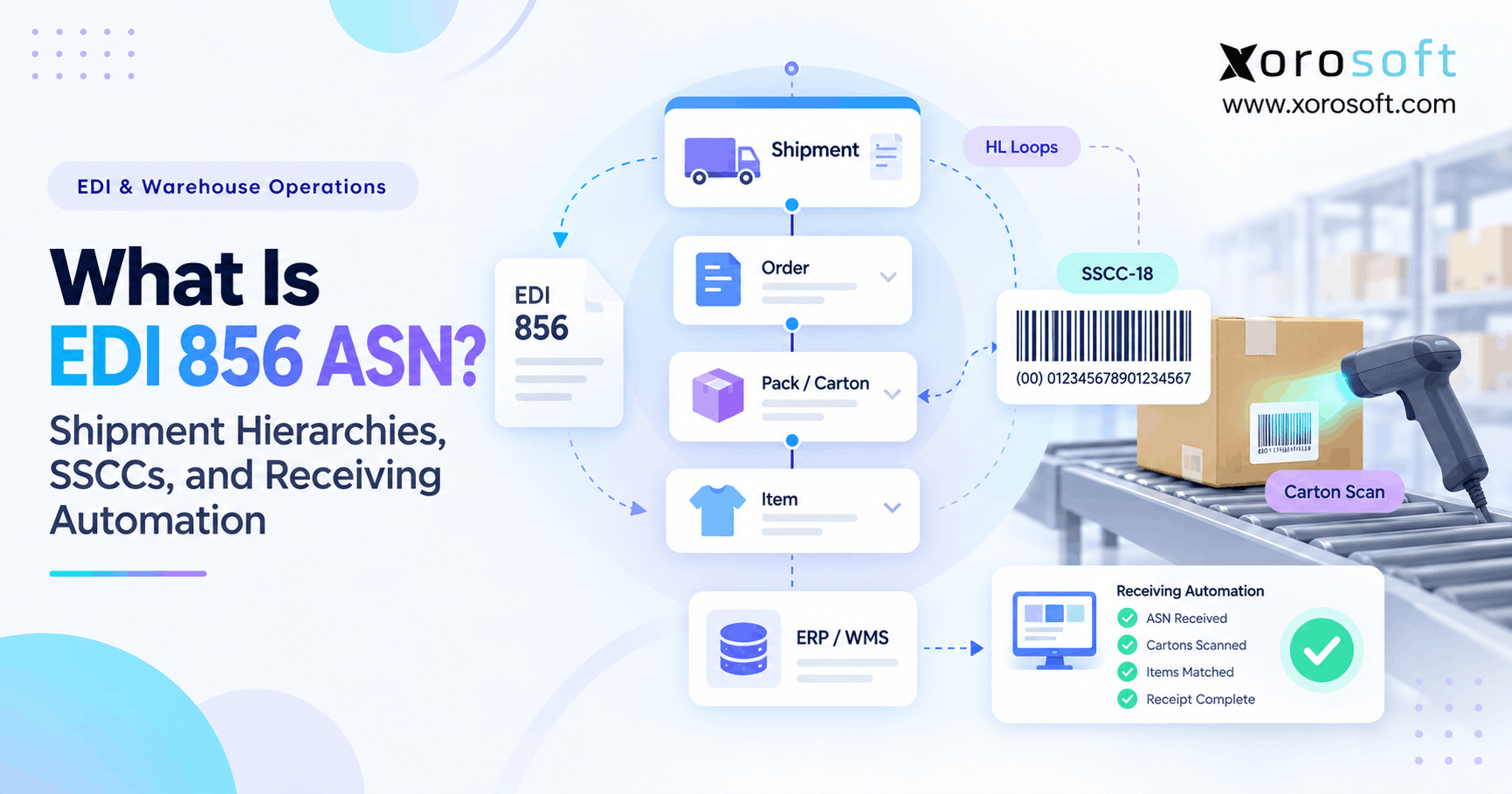
A shipment hierarchy shows how one part of a load sits inside another. Instead of sending a flat list of products, an 856 can link a shipment to orders, pallets, cartons, and items. Consequently, the receiver can rebuild the packing tree from the file.
5.1 Understanding Shipment, Order, Tare, Pack, and Item
The HL segment creates that tree. Specifically, HL01 gives a level its ID, HL02 points to its parent, and HL03 names the level type. The common codes are S for shipment, O for order, T for tare or pallet, P for pack or carton, and I for item.
For example, one order may contain two cartons, and each carton may hold two SKUs. In that case, the item records point to the right carton rather than simply to the order.
5.2 EDI 856 ASN Pick-and-Pack Hierarchy
Pick-and-pack commonly follows Shipment → Order → Pack → Item. If the load has pallets, a tare level may sit before the carton level. As a result, a mixed carton can list each SKU beneath one carton code.
This structure suits apparel, sporting goods, and other mixed-item shipments. For instance, a carton might hold 12 black shirts and six pairs of socks. Meanwhile, the next carton may hold a different mix.
The EDI 856 hierarchy code guide identifies BSN05 code 0001 with the shipment-order-packaging-item structure.
5.3 Standard Pack and Item-Level Notices
By contrast, standard carton pack commonly follows Shipment → Order → Item → Pack and uses BSN05 code 0002. Here, the file lists an item before the related package records. Therefore, the pattern can fit defined cases of a single product.
A simpler notice may follow Shipment → Order → Item, with no pack level, under code 0004. However, that format gives the receiver less detail about individual cartons. Consequently, it may not meet a buyer’s barcode-based receiving rules.
5.4 How Parent IDs Prevent Carton Mix-Ups
Consider HL*3*2*P. Here, level 3 is a pack, and level 2 is its parent order. Next, HL*4*3*I makes item level 4 a child of carton level 3.
As a result, the EDI reader knows where that item belongs. However, if a child points to a missing or wrong parent, the system may reject the document or place products under the wrong package. Therefore, the parent links deserve a check before transmission.
6. EDI 856 ASN: SSCCs and Shipping Labels
A hierarchy describes the cartons in a file, but warehouse staff need a way to identify those cartons on the floor. That is where the Serial Shipping Container Code, or SSCC, becomes useful. It gives each logistics unit a unique number.
6.1 What an 18-Digit SSCC Identifies
An SSCC has 18 digits. Specifically, it combines an extension digit, a GS1 Company Prefix, a serial reference, and a check digit. The prefix and serial reference vary in length, so businesses must not assume that one split works for every company.
According to the GS1 logistic label guideline, the SSCC serves as the key identifier on a GS1 logistics label. Therefore, two separately tracked cartons need different SSCCs, even when they hold the same SKU.
6.2 EDI 856 ASN MAN Codes, AI (00), and GS1-128
A GS1-128 barcode can carry the SSCC with Application Identifier (00). However, those two leading digits describe the data type; they are not part of the 18-digit SSCC.
For example, (00)357123450000000015 shows AI (00) followed by one illustrative SSCC. In an X12 mapping, MAN*GM commonly carries the 20 digits together, while MAN*AA can carry the 18-digit number alone. Therefore, the receiver must read the qualifier correctly.
The GS1 Application Identifier reference explains what AI (00) means. Still, each retailer decides which MAN qualifier and label format its guide accepts.
6.3 SSCC, GTIN, and SKU Are Not the Same
| Code | What It Identifies | Typical Use |
|---|---|---|
| SSCC | One logistics unit | Scan a carton or pallet |
| GTIN | A trade item | Match a product or case |
| SKU | An internal stock item | Track a size, color, or variant |
For example, two cartons of the same shirt can share the product GTIN but must carry distinct SSCCs if the receiver tracks both units. Meanwhile, the seller may use its own SKU for that shirt. Consequently, teams need the right code in the right field.
7. EDI 856 ASN Example: One Order, Two Mixed Cartons
A short example makes the structure easier to follow. Suppose a wholesale supplier fills purchase order PO-48210 with 30 units. The team packs those units into two cartons and gives each carton its own SSCC.
7.1 What the Packing Team Actually Shipped
| Carton | SKU | Units |
|---|---|---|
| 1 | TEE-BLK-M | 12 |
| 1 | SOCK-BLK-L | 6 |
| 2 | TEE-BLK-M | 8 |
| 2 | HAT-BLK | 4 |
| Total | 30 |
First, the pack team confirms the contents. Next, it records the carton identifiers. Then, the EDI process builds one notice from those final packing facts. Consequently, the buyer can see each SKU within the correct carton.
7.2 EDI 856 ASN Sample Segments
The following sample uses a simplified X12 004010 pick-and-pack transaction. It omits the outer envelopes and any extra fields a real buyer may require.
ST*856*0001~
BSN*00*ASN20261008A*20261008*1430*0001~
HL*1**S~
TD1*CTN25*2~
DTM*011*20261008~
N1*SF*ILLUSTRATIVE SUPPLIER~
N1*ST*ILLUSTRATIVE RECEIVER~
HL*2*1*O~
PRF*PO-48210~
HL*3*2*P~
MAN*GM*00357123450000000015~
HL*4*3*I~
LIN**SK*TEE-BLK-M~
SN1**12*EA~
HL*5*3*I~
LIN**SK*SOCK-BLK-L~
SN1**6*EA~
HL*6*2*P~
MAN*GM*00357123450000000022~
HL*7*6*I~
LIN**SK*TEE-BLK-M~
SN1**8*EA~
HL*8*6*I~
LIN**SK*HAT-BLK~
SN1**4*EA~
CTT*8~
SE*27*0001~
Here, both illustrative SSCCs have valid check digits. Also, SE*27 matches the 27 segments from ST through SE. However, this teaching example is not a ready-to-send retailer file.
7.3 How the Receiver Reads the Example
First, BSN identifies the notice and the pick-and-pack hierarchy. Next, the two pack levels identify carton 1 and carton 2. Then, each item level points to its parent carton and states the shipped units.
As a result, the buyer expects 20 shirts, six pairs of socks, and four hats across two cartons. More importantly, it knows which products should sit in each carton. Therefore, a label scan can open the right expected contents instead of only showing a shipment total.
8. EDI 856 ASN Receiving Automation, Step by Step
An accurate notice can help a warehouse receive goods faster, but the file alone does not post inventory. Instead, the receiving process must link expected data to the actual goods. Consequently, a strong workflow includes both electronic checks and physical steps.
8.1 From Final Pack to EDI 856 ASN Transmission
First, the supplier confirms picked and packed quantities. Next, the system assigns and checks carton or pallet identifiers. Then, an EDI map converts the final shipment into the buyer’s required 856 structure.
After that, the integration sends the document and logs the response. If the buyer rejects the file, the supplier needs a clear way to find and fix the error. Otherwise, the truck may arrive before the corrected data reaches the receiving team.
8.2 What Happens at the Receiving Dock
When the load arrives, staff scan the carton or pallet label. Next, the warehouse software uses the code to find the expected goods. Then, workers count or inspect stock as the operation requires.
For example, a team using warehouse management software can link barcode tasks with receipt checks and stock records. As a result, the team has fewer reasons to type carton details twice. However, the process still needs clear rules for damage, missing units, and unknown labels.
8.3 How to Handle a Short Carton
Suppose carton 2 should contain four hats, but workers find only three. In that case, the receiver should record three actual units and flag the missing one. It should not accept four just because the ASN says four.
| SKU | ASN Units | Actual Units | Difference |
|---|---|---|---|
| TEE-BLK-M | 8 | 8 | 0 |
| HAT-BLK | 4 | 3 | -1 |
Therefore, the receipt record must show what physically arrived. Meanwhile, the buyer and supplier can review the open difference without hiding it in inventory.
8.4 An ASN Is Not an Inventory Receipt
The ASN states what the sender says it shipped. By contrast, an item receipt states what the receiver accepts into stock. As a result, the two records may hold different quantities until the team resolves an issue.
In addition, a receipt may need lot checks, damage codes, or an approval before stock becomes available. Therefore, a sound process must keep expected, received, and accepted quantities distinct.
9. EDI 856 ASN Errors That Create Rework
ASN problems often begin with data that looks correct in one system but is wrong in another. For instance, a shipping app may show two cartons while the EDI map still lists one. As a result, even a timely notice may fail the buyer’s checks.
9.1 Common EDI 856 ASN Validation Errors
| Error | Likely Cause | First Check |
|---|---|---|
| Broken HL parent | Wrong level ID | Compare parent and child links |
| Repeated SSCC | Label number used again | Review identifier log |
| Wrong BSN05 | Structure code does not match loops | Check partner guide |
| Unknown item | SKU or GTIN map is wrong | Verify buyer item code |
| Missing PO | Order link did not transfer | Check PRF segment |
| Wrong MAN length | Qualifier and code disagree | Check AA or GM rule |
First, check the transaction structure. Next, compare fields against the buyer’s guide. Then, trace wrong values back to their source. Consequently, the fix can address the cause rather than merely patch one rejected file.
9.2 Business Errors After Technical Acceptance
A buyer may accept an EDI file at the syntax level but still find a wrong carton, short quantity, or late notice. Therefore, technical acceptance and business compliance are different tests.
For example, a valid SSCC may appear in the file but not on any physical carton. Meanwhile, a correct item count may sit under the wrong carton level. As a result, warehouse staff still need to stop and investigate.
9.3 A Practical Pre-Ship Checklist
Before release, confirm the purchase order, destination, carrier fields, pack count, HL links, item quantities, SSCCs, and label scans. Also, verify that the ASN follows the buyer’s required structure and timing rule.
Next, keep the final pack record and outbound document tied to the same shipment ID. Finally, record the partner’s response and any corrections. Consequently, the team can trace errors without guessing which file or carton caused them.
10. EDI 856 ASN vs Other EDI Documents
An 856 describes shipment contents, but other EDI transactions serve different steps. Therefore, teams should not treat an order acknowledgment, invoice, or receiving advice as a substitute for an ASN.
10.1 How 850, 855, 856, 810, and 861 Differ
| Document | Purpose | Typical Sender |
|---|---|---|
| 850 | Purchase order | Buyer |
| 855 | Order acknowledgment | Supplier |
| 856 | Advance ship notice | Supplier |
| 810 | Invoice | Supplier |
| 861 | Receiving advice | Receiver |
First, the 850 says what the buyer wants. Next, the 855 can confirm how the supplier will handle the order. Later, the 856 describes what actually shipped. Meanwhile, the 810 requests payment, while the 861 can share receiving details when partners use it.
10.2 Why an EDI 997 Is Not Proof of Delivery
An EDI 997 functional acknowledgment reports on the processing of an EDI functional group. However, it does not prove that a truck arrived or that the buyer accepted the goods.
As a result, suppliers should track more than one status: transmission, syntax response, partner business response, carrier event, and physical receipt. Otherwise, staff may mistake a successful data exchange for a finished delivery.
11. Connecting ERP, EDI, and WMS Shipment Data
The 856 works best when every field comes from a clear source. For example, the order system knows the purchase order, while the warehouse knows the final carton contents. Therefore, the integration must join those facts rather than copy stale order data.
11.1 Which System Owns Each Part of the ASN?
| System | Main Role |
|---|---|
| ERP | Sales orders, purchasing, inventory, finance |
| WMS | Picks, packs, carton codes, physical movement |
| EDI layer | Mapping, validation, transmission, responses |
| Receiving process | Counts, damage checks, accepted stock |
First, define the record owner for each field. Next, decide which event makes the shipment final. Then, set checks between the packed quantities and the outgoing file. As a result, teams can stop an ASN before bad data reaches a retailer.
11.2 Where Xorosoft Fits the Workflow
For inventory-driven teams, Xorosoft provides cloud ERP operations through XoroONE and connected XoroERP capabilities for orders, inventory, receiving, and finance. As a result, businesses can review shipment data in the wider context of stock and fulfillment.
In addition, Xorosoft supports retailer EDI workflows and integrations for commerce channels. However, each buyer may need its own map, label rules, and tests. Therefore, teams should confirm the required 856 structure during setup rather than assume one connection fits every partner.
11.3 What to Ask About EDI 856 ASN Integration
First, ask whether the system builds the ASN from actual pack records. Next, ask how it creates or imports SSCCs and checks each label. Also, ask what happens when a carton changes after the team confirms shipment.
Then, review the available integration options against your trading partners, marketplaces, and warehouse tools. Finally, test both a clean shipment and an error case. As a result, the team can judge the entire workflow rather than one successful demo file.
12. When an EDI 856 ASN Needs More Automation
A manual ASN process is not always wrong. However, it becomes harder to manage as partners, shipment types, and warehouses grow. Therefore, businesses should judge the process by its risk and workload, not only by order count.
12.1 Signs the Current Process Has Reached Its Limit
First, staff may copy carton data from spreadsheets into a retailer portal. Next, the same SKU may appear under different codes across warehouse and EDI tools. Meanwhile, every new partner may require another manual checklist.
As a result, teams spend more time reconciling documents than checking goods. A broader review of ERP and warehouse solutions can help define the needed controls. Still, businesses should measure current errors and manual effort before choosing a new system.
12.2 Who Can Stay with a Portal or Managed Service?
A small supplier with simple loads and one EDI buyer may do well with a managed portal. Similarly, an outside EDI provider may handle mapping while the supplier keeps its current ERP and WMS.
However, these options still need accurate packed quantities and label data. Therefore, an EDI provider cannot fully solve wrong warehouse source records. When the root problem involves inventory, picking, and receipts, teams should review the operating process as well.
13. EDI 856 ASN Use Cases by Industry
The same 856 standard supports many kinds of product businesses. However, the useful packaging detail changes with the goods, the buyer, and the way the warehouse ships them.
13.1 Apparel, Sporting Goods, and Wholesale
Apparel shipments often mix sizes and colors inside a carton. Therefore, pick-and-pack data can help a receiver see the exact SKU mix. Similarly, sporting goods sellers may ship several small products in one case.
For wholesale teams, the larger issue may be matching many buyers and purchase orders across several warehouses. As a result, consistent labels and order references matter as much as the EDI format itself.
13.2 Food, Furniture, and Manufacturing
Food businesses may need lot or expiry checks alongside carton scans. Meanwhile, furniture shipments may need clear links among large or multi-piece units. In manufacturing, finished goods may move from production to a warehouse before they ship.
Consequently, the shipment notice must fit the product and the receiving process. For businesses assessing industry fit, Xorosoft outlines the industries it serves, including wholesale and manufacturing. However, specific EDI fields and trace data still depend on each partner’s rules.
13.3 Shopify, Amazon, and Retail EDI
A direct-to-consumer store may not need an 856 for each parcel. By contrast, the same brand may need EDI ASNs when it supplies a large retailer. Therefore, channel growth can create new warehouse data demands.
For example, the Shopify App Store listing for Xorosoft ERP shows its place in the Shopify ecosystem. Still, retail ASN compliance requires more than a storefront link. The pack process, EDI service, and receiving partner must agree on item IDs, carton data, and labels.
14. How to Launch EDI 856 ASN with Fewer Errors
Before a supplier goes live, it should test the actual shipment workflow. A perfect sample file alone is not enough. Instead, the team needs to show that warehouse scans and outgoing EDI data match in normal and difficult cases.
14.1 Test the EDI 856 ASN with Real Pack Scenarios
First, test one order with one carton. Next, test an order with mixed SKUs across two cartons. Then, test a partial shipment and a carton that changes after packing.
In addition, scan each shipping label and compare the code with the ASN. Finally, confirm that the buyer accepts the intended hierarchy and fields. As a result, the team can find weak links before daily shipping begins.
14.2 Set Owners for Errors and Corrections
The warehouse should own physical pack facts. Meanwhile, the EDI team should own document mapping and partner responses. Purchasing or account teams may need to resolve disputed order details.
Therefore, give each error a clear owner and response path. Also, retain the notice version, label record, and shipment history. Consequently, a rejected ASN becomes a traceable issue rather than a chain of emails with no clear answer.
15. Conclusion: Make Every Carton Match Its Data
An EDI 856 ASN connects the buyer’s order with the goods that a supplier actually ships. Moreover, HL loops show how products relate to cartons and pallets, while SSCCs help teams identify those units at the receiving dock.
However, a valid file cannot fix poor packing records. Therefore, the best results come from accurate warehouse scans, clean order data, clear partner rules, and a reliable receipt process.
As shipment volume grows, Xorosoft can help product businesses review how ERP, EDI, warehouse work, and inventory records fit together. If your team faces repeated ASN errors or slow receiving, Book a Demo to review the workflow against your real requirements.
Frequently Asked Questions
What is an EDI 856 ASN?
An EDI 856 ASN is an electronic advance ship notice. It lists the orders, products, quantities, cartons, and shipping facts a supplier sends. Therefore, the buyer can prepare its warehouse before delivery.
What are HL loops in EDI 856?
HL loops link a shipment to its orders, pallets, cartons, and items. Each loop names its parent. Therefore, the receiver can tell which products belong inside each shipping unit.
What is an SSCC in an ASN?
An SSCC is an 18-digit code that identifies one carton or pallet. A GS1-128 label can carry it. As a result, a scan can match that unit to its expected ASN contents.
Is SSCC the same as a SKU?
No. An SSCC identifies a shipping unit, while a SKU identifies a stock item. For example, two cartons of the same shirt need distinct SSCCs when the warehouse tracks them separately.
Can an EDI 856 ASN include partial shipments?
Yes. The ASN should list what the supplier actually shipped, even when it covers only part of the order. However, the buyer’s rules decide how later shipments need their own notices.
Does an EDI 997 prove delivery?
No. An EDI 997 concerns EDI processing, not physical delivery. Therefore, suppliers must track carrier and receiving events separately. An accepted file does not prove that the buyer counted or approved each carton.
When should a business automate EDI 856?
Automation helps when suppliers handle many retail partners, cartons, or warehouses and keep retyping shipment details. However, a low-volume supplier may use a portal. The choice depends on workload and error risk.
Recent Posts
-
 How a Shopify Wholesaler Unified ACH, EDI, Inventory, and Fulfillment
 -
 Inventory Exception Detection With AI: Catch Stock Errors Before Counts Drift
 -
 B2B Ecommerce Platform Cost Model: What Buyers Should Include Beyond Subscription Fees
 -
What Is EDI 856 ASN? Shipment Hierarchies, SSCCs, and Receiving Automation
-
 Holiday Fulfillment Benchmarks 2026: Capacity, Accuracy, and Shipping Cutoffs